Nicola Tacchinardi never intended his daughter, Fanny Tacchinardi-Persiani (1812–1867), to be a prima donna. The only child of the celebrated tenor and pedagogue, she received from him both impeccable vocal training and discouragement.Footnote 1 Tacchinardi proudly displayed his daughter's vocal talent in salons and private academies; yet the moral prejudices attached to a career in the opera house were still all too common for a woman. Tacchinardi-Persiani's career nevertheless took off in 1832, and with such momentum that within six years she established herself as one of the leading prima donnas of the Paris Théâtre-Italien, appearing there uninterruptedly until 1850.Footnote 2 Tacchinardi-Persiani's professional path developed under circumstances that contributed to changing attitudes towards female opera singers. Fanny's husband, the opera composer Giuseppe Persiani, was almost constantly by her side, and his presence prevented rumours from affecting her public persona. Tropes such as those found in Giovanni Tebaldini's hagiographic homage to Persiani, which describe Fanny as the composer's ‘compagna amorosa’ and ‘sposa fedele e ideale’, may now sound clichéd, but they are nonetheless symptomatic of the patterns of reception that endured long after the conclusion of her career.Footnote 3 Moreover, these tropes participated in broader discursive trends that allowed nineteenth-century prima donnas to acquire an aura of respectability, whether real or assumed.Footnote 4
While these tropes fostered Tacchinardi-Persiani's pristine reputation, they also cast a shadow on the ways in which biographers have described her professional activity. Rarely, if at all, has she been granted any self-determination in artistic, business or personal matters. It speaks volumes that the two main sources of information about the soprano's life are dedicated to both Fanny and Giuseppe, with his name always preceding hers.Footnote 5 One of them goes as far as claiming that ‘[Fanny Tacchinardi-Persiani's] rise to fame must be credited to the instant recognition of two great names – Tacchinardi and Persiani.’Footnote 6
A similar male-orientated outlook lurks behind assumptions about Fanny's dependence on her husband. After a lukewarm debut, Giuseppe Persiani rose to some prominence with the success of his Danao, re d'Argo (1827, rev. 1833) and Ines de Castro (1835).Footnote 7 By this time, however, Fanny had already emerged as one of the leading prima donnas of the time. The same year Ines de Castro received its premiere, indeed, she created the title role of the opera for which she is still best remembered today: Donizetti's Lucia di Lammermoor. Given how much more lucrative the career of a prima donna was in comparison to that of a composer, Persiani gradually relinquished his creative career to follow his wife around Europe, as his income would not have allowed him to provide for their family as much as hers did. Paola Ciarlantini, the biographer of the Persianis, describes Giuseppe's decision as a sacrifice, only partially compensated by his taking control of his wife's career as ‘her impresario’, thus reinforcing the perception of the prima donna's lack of agency over her professional activity and of her submissiveness to the imperatives of nineteenth-century gender norms.Footnote 8 To be sure, this approach may have resulted in part from the documentary evidence that Ciarlantini had at her disposal. Although her biography includes extensive quotations from Persiani's correspondence, she mentions just one letter by the prima donna – the only one that, according to her, has survived.Footnote 9 On these grounds, Ciarlantini is led to believe that ‘unlike her husband and her father, [Fanny] did not enjoy writing’.Footnote 10 Her biography of the prima donna is thus mediated by what others have written about her: her father, her husband and critics of the time.
Several hitherto overlooked letters by the prima donna, now housed in the City Library of Vienna (Wienbibliothek im Rathaus), provide a different picture. These letters belong to the cache of over 360 surviving documents from the business archive of Italian opera impresario Carlo Balocchino (1770–1851), who managed the Kärntnertortheater in Vienna in partnership with Bartolomeo Merelli between 1836 and 1848.Footnote 11 The correspondence between Tacchinardi-Persiani and Balocchino spans the period 1837 to 1845, and most of it falls chronologically during the soprano's long-term tenure at the Paris Théâtre-Italien and at Her Majesty's Theatre in London. Although scholars have long been aware of these documents, only John Rosselli has acknowledged their importance for opera studies.Footnote 12 In fact, Balocchino's archive as a whole has been disregarded in scholarship of both Italian opera and Viennese music history. This surprising neglect may be due, in part, to the fact that this collection comprises only a small number of letters to and from well-known opera composers, and therefore was of little use for traditional composer-centred narratives.Footnote 13 This attitude, however, also manifests a persistent influence of reading the music history of Vienna through the lens of national ideologies. Even though for the greater part of the century the city had maintained strong cultural, economic and political connections with the Italian operatic market, scholars gradually marginalised Vienna from narratives of nineteenth-century Italian opera in favour of its rise to prominence in the realm of German music.Footnote 14 In this respect, by ignoring crucial documents from a major Viennese collection, Ciarlantini simply followed the beaten path.Footnote 15
Although only a handful of Tacchinardi-Persiani's letters are autograph (most of them are fair copies in the hand of different scribes with her original signature), there is little doubt that she was their author. Indeed, Giuseppe Persiani corresponded with Balocchino too, and his letters are also preserved in the impresario's archive (see Appendix, section A). Persiani's letters all pertain to his wife performances in Vienna, and mostly discuss very ordinary matters: the renting of musical materials for the Viennese premiere of Lucia di Lammermoor, her health and the couple's journey back to Italy after Tacchinardi-Persiani's first season at the Kärntnertortheater.Footnote 16 If Giuseppe was in control of Fanny's career, why did he not write other letters as well, since they mostly pertained to business affairs? Instead, it was the prima donna who reached out to Balocchino, whom she had probably known for several years as one of the business partners of a close friend of her family, the impresario Alessandro Lanari.Footnote 17 This is not to suggest that she conducted her business affairs with Vienna all alone: it is fair to assume that she consulted with her husband and father. Nevertheless, her family seems to have played little role (if any at all) in dealing directly with the matter. In fact, as we shall see, the singer's gender and social status became an important factor in her negotiations with Balocchino.
In the context of this special issue, these letters offer an important window onto the Parisian opera world for at least two important reasons: they allow us to bring one of the most prominent singers of the Théâtre-Italien into sharper focus, and they provide enlightening insights into the economic and artistic landscapes of the different contexts in which Tacchinardi-Persiani worked. Given the nature and the content of this correspondence, however, this article will inevitably concentrate on the French stage less than other contributions to this issue. In what follows, my objective is to shed light on some of the economic, social, and cultural dynamics of the international operatic network connecting the Italian States, Vienna, Paris and London. What arises in these letters is a fundamental tension between different systems of opera production, one that Tacchinardi-Persiani exploited in her negotiation with Balocchino but that also affected her later reception in Vienna. To put it differently, this article is less about what Tacchinardi-Persiani meant for the Parisians than about what Paris (and its connection to London) meant for Tacchinardi-Persiani, for Balocchino, and for the Viennese. The following pages open with a sketch of the soprano's early career in Italy, leading to a discussion of the premiere of Donizetti's Lucia di Lammermoor in Naples and its revival in Venice. The second section addresses the negotiations between Tacchinardi-Persiani and Balocchino, the repertory choices for the prima donna's first season in Vienna, and their different perspectives on Lucia. I will then discuss transnational aspects of the correspondence, looking comparatively at the ideologies underpinning the business of opera in Vienna, Paris and London. Finally, I will close with some remarks about Tacchinardi-Persiani's second visit to the Kärntnertortheater in 1845, and the ways in which the prima donna's prolonged affiliation with the Théâtre-Italien marked her return to the city and brought her correspondence with Balocchino to a conclusion.
Prima Donna against all odds
Little is known of Tacchinardi-Persiani's early years, except that she was educated by her father.Footnote 18 That Fanny may have not always been a submissive daughter emerges from a highly fictionalised anecdote about her romance with Giuseppe Persiani:
Fanny fell in love with a handsome young man … Giuseppe Persiani, the author of twelve operas, which had all blown away like autumn leaves … Her father was accustomed to rubbing shoulders with the notables of the Tuscan court and was dreaming of an aristocratic husband for his beloved daughter. He opposed her wishes, but could not bend her. She crumpled to the floor and locked herself in silence, refusing food and water; ‘she wanted to die’. As in old comedies, the doctors explained the predicament to her frightened father: ‘either let the girl marry, or we won't be held responsible for the consequences’.Footnote 19
Despite its hyperbolic tone, this passage captures one of the traits that later emerged from the prima donna's correspondence with Balocchino – her determination. Indeed, despite her father's social ambitions, she eventually married Giuseppe Persiani in 1828. Francesco Regli describes their first years of marriage by portraying Fanny as the embodiment of the mid-nineteenth-century feminine ideal: ‘Once she became Madame Persiani, totally devoted to her love, which grew even more after the birth of a much-desired son, Fanny Tacchinardi lived in complete isolation until 1832.’Footnote 20 This date is crucial, since on 21 July 1832 she made her professional debut as an opera singer.
The circumstances of Tacchinardi-Persiani's debut contributed to the perception that her father and husband were in control of her career. While she was in Livorno, her father's birthplace, the prima donna of the company at the local Teatro degli Avvalorati withdrew from the production of an opera by Giuseppe Fournier, Francesca da Rimini. Since no other soprano was available, the impresario of the theatre, Alessandro Lanari, thought of Tacchinardi-Persiani as a replacement. Lanari was close to her family and well acquainted with her vocal skills. He and Nicola Tacchinardi had jointly managed the Teatro La Pergola in Florence between 1823 and 1828, and Giuseppe Persiani owed to the impresario his career as an opera composer.Footnote 21 Despite their initial antipathy, both Tacchinardi and Persiani ultimately acquiesced to Lanari's request. The production met with considerable success and Lanari seized the opportunity to showcase his new discovery, promoting her in the opera houses under his control for the following five years.Footnote 22 Tacchinardi-Persiani became a prima donna despite her father's strong wishes.
This period was by and large the most experimental phase of her career, closely monitored by her father.Footnote 23 Tacchinardi-Persiani tried out a variety of roles, many of which she abandoned once she left Italy. A few of them, however, became her warhorses: three of Bellini's heroines (Amina in La sonnambula, Elvira in I puritani and the title role from Beatrice di Tenda), Donizetti's Adina (L'elisir d'amore), Mozart's Zerlina (Don Giovanni) and Cimarosa's Carolina (Il matrimonio segreto). She also featured frequently in two operas by her husband: Danao (which she never revived outside Italy) and Ines de Castro, neither of which was originally written for her.Footnote 24 The operas that Tacchinardi-Persiani premiered are concentrated in this initial phase. Only one of them, however, became a mainstay of the operatic repertory: Donizetti's Lucia di Lammermoor.
First performed at the Teatro San Carlo on 26 September 1835, Lucia shares with La sonnambula pride of place in the list of Tacchinardi-Persiani's most frequently performed operas. Lucia was the second of three works that Donizetti wrote for the prima donna, coming in between Rosmonda d'Inghilterra (Florence, 1834) and Pia de’ Tolomei (Venice, 1836).Footnote 25 At first the composer himself was unenthusiastic about Tacchinardi-Persiani. Even though he acknowledged her impeccable precision and intonation, he condensed his first impression of her into a rather scathing verdict – ‘freddina, freddina’ – and accepted her in the title role of Rosmonda only as a second choice.Footnote 26 He nonetheless gave the prima donna plenty of opportunities for displaying her technical prowess, which the critic of Il giornale di commercio e d'industria eulogised in a review published in the aftermath of the opera's premiere:
The voice of this prima donna is not very strong, but so clear, in tune, and pure that one can hear everything she sings, without losing anything of what she performs with endless precision and good taste … Once her acting is perfected with the passing of the years, she will combine all the qualities of a great artist. What pleasure she provides when she reinforces those sustained phrases as if they were produced by a bell of the finest metal, and which sometimes end with the purest and most precise diminuendo, and other times with exquisitely tasteful ornaments, executed with perfect ease and gracefulness.Footnote 27
While the prima donna won over spectators and critics with her technical skills, flawless intonation and tasteful ornamentation, she was found wanting in terms of vocal power and acting. These opinions became common currency wherever Tacchinardi-Persiani was to sing. An article published in The Musical World thirteen years later, for instance, reveals the remarkable consistency of her artistic reception from the beginning of her professional path.Footnote 28 Although her intonation had lost some of its initial precision, her voice, ‘miraculously flexible’, could still reach a high F and astonish the listener with her virtuosity and ‘most consummate taste’.Footnote 29 Yet hers was still an instrument ‘deficient in power’ and ‘too soft and gentle to portray violence and extreme feelings’. Her acting was instead found very much in line with mid-nineteenth-century Victorian ideals, ‘truly feminine, passive, and characterised by no efforts of passion’. Comments like this reinforced the perception that her artistry was a perfect embodiment of widely disseminated conceptions of femininity – something to which her social standing also contributed.Footnote 30 Moreover, the contributor to The Musical World found that these features were perfectly encapsulated in her portrayal of the heroine in Donizetti's Lucia di Lammermoor, ‘perhaps Persiani's most admirable part’.
The reviews issued at the time of the opera's premiere also point out that Tacchinardi-Persiani was successful in the role, but once more her singing proved more convincing than her acting.Footnote 31 The prima donna did not seem fully at ease with the role either, and it was more than a year before she revived it. When she finally did (in Venice during the 1836–7 Carnival season), she substituted Lucia's opening aria ‘Regnava nel silenzio’ with the cavatina from Rosmonda d'Inghilterra, ‘Perché non ho del vento’, which she apparently found better suited to her voice.Footnote 32 It was in this new form that Lucia di Lammermoor featured regularly in her repertory, marking both her debut at the Kärntnertortheater in Vienna and her first undisputed success at the Théâtre-Italien in Paris.Footnote 33
This season in Venice also coincided with the end of what I previously called the ‘experimental phase’ of Tacchinardi-Persiani's career. From this moment on she performed almost exclusively abroad, where she relied increasingly on the most successful operas she had already performed in Italy. Vienna was the first step in this new course. Significantly, a large portion of her early negotiations with Balocchino consisted in strategising her debut at the Kärntnertortheater, with Lucia di Lammermoor forming a major bone of contention.
Vienna, 1837
We learn from Balocchino's business correspondence that he and Tacchinardi-Persiani came into contact through the mediation of the agent Agostino Marchesi of Bologna.Footnote 34 In 1836 Balocchino and his business partner, Merelli, had agreed to hire the prima donna for the 1837 spring season at the Kärntnertortheater. Merelli was in charge of gathering the Italian company for Vienna. On 1 June of the previous year, his secretary had asked Marchesi to enter into negotiation with the soprano while she was performing at the Teatro Comunale in Bologna. Tacchinardi-Persiani demanded a fee of 20,000 francs, a benefit performance and free accommodation. Marchesi also reports that she was singing in Bologna for 18,000 francs and that, while there, the impresarios of the Théâtre-Italien had offered her a six-month contract for 80,000 francs. Meanwhile, Lanari had secured her for Venice for 30,000 francs.Footnote 35 Given her skyrocketing fees, her decision to head to Vienna for a lower amount before moving to Paris seems surprising, all the more so because Merelli's dealings with the singer were so negligent that he almost risked losing her.Footnote 36 Ultimately, she decided to maintain her commitment with the Kärntnertortheater, but from that moment forward, she discussed all business matters directly with Balocchino.
The tone of Tacchinardi-Persiani's first letter to the impresario reveals her firm and straightforward character, at odds with the apathetic personality that emerges from most of the other sources.Footnote 37 Their first exchange revolved around preparing the prima donna's debut. Balocchino had planned to open the season with Lucia, which had not yet been performed in Vienna. Tacchinardi-Persiani, however, did not consider it suitable for her debut, and proposed instead La sonnambula or Beatrice di Tenda.Footnote 38 A few days later, she brought up the issue again, revealing that the poor success of the Venice production of Lucia was behind her resistance: ‘Although Lucia is an opera written for me, it is not advisable for my debut. After many repeated requests from Lanari and the President [of La Fenice], I agreed to perform it first, but its reception now compels me to avoid exposing myself to an uncertain outcome.’Footnote 39 At first, Balocchino yielded to Tacchinardi-Persiani's wishes and agreed to schedule La sonnambula for her debut, but in the end Donizetti's opera was scheduled first.Footnote 40 The reasons for this change are unclear; at any rate, Balocchino's original strategy proved far-sighted.Footnote 41 With Lucia, Tacchinardi-Persiani brought about a triumphal start to both the season of the Kärntnertortheater and her international career.Footnote 42 Once again, the prima donna played it safe and modified Donizetti's original score. According to two newspapers, she changed the cabaletta of Donizetti's original mad scene. Furthermore, several Viennese music sources suggest that, as in Venice, Fanny also changed her Act I cavatina – a substitution that the local press did not mention.Footnote 43 Within a year of the production two Viennese music publishers, Anton Diabelli and Pietro Mechetti, issued a vocal score of the aria from Rosmonda d'Inghilterra, ‘Perché non ho del vento’, along with the cabaletta ‘Torna, o torna, caro oggetto’. The titles of both prints inform us that Tacchinardi-Persiani had sung the aria in Lucia di Lammermoor.Footnote 44 These two prints also offer us a glimpse into other aspects of her performance of the piece and its dissemination.
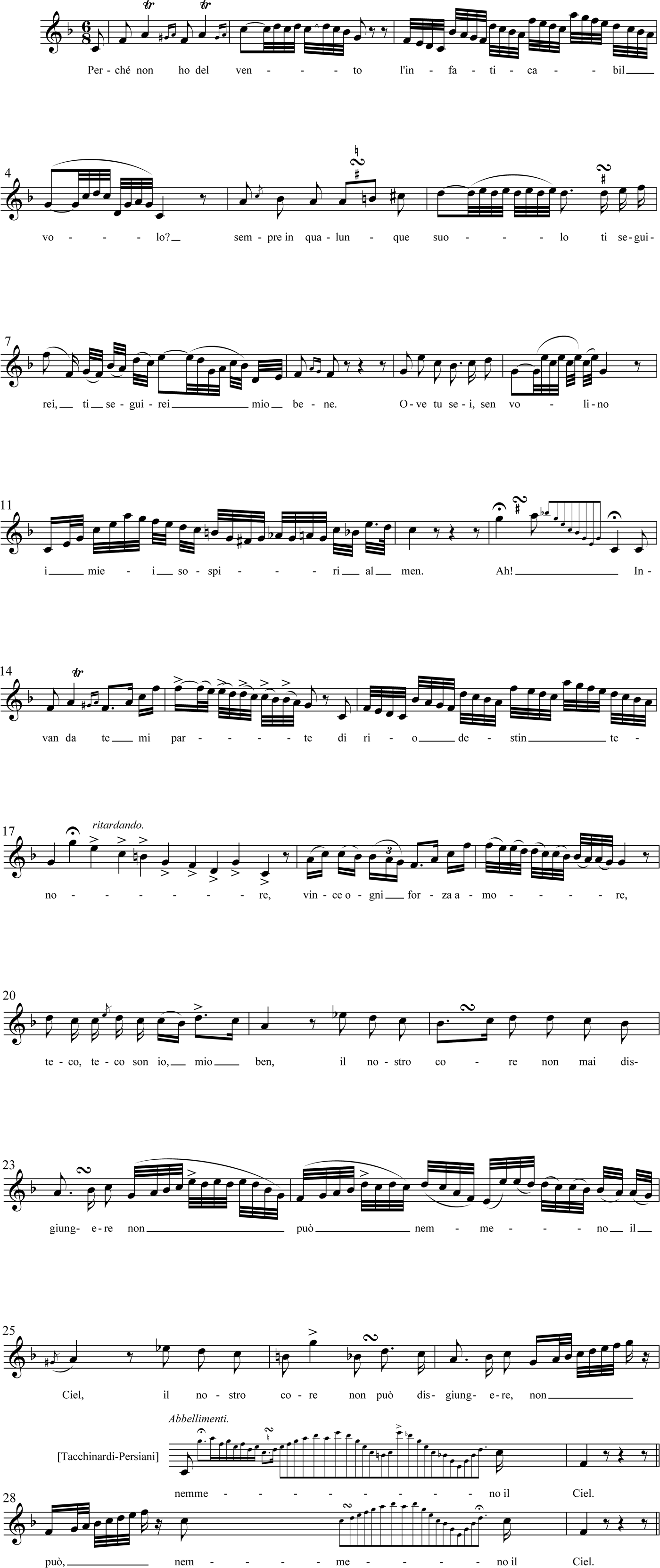
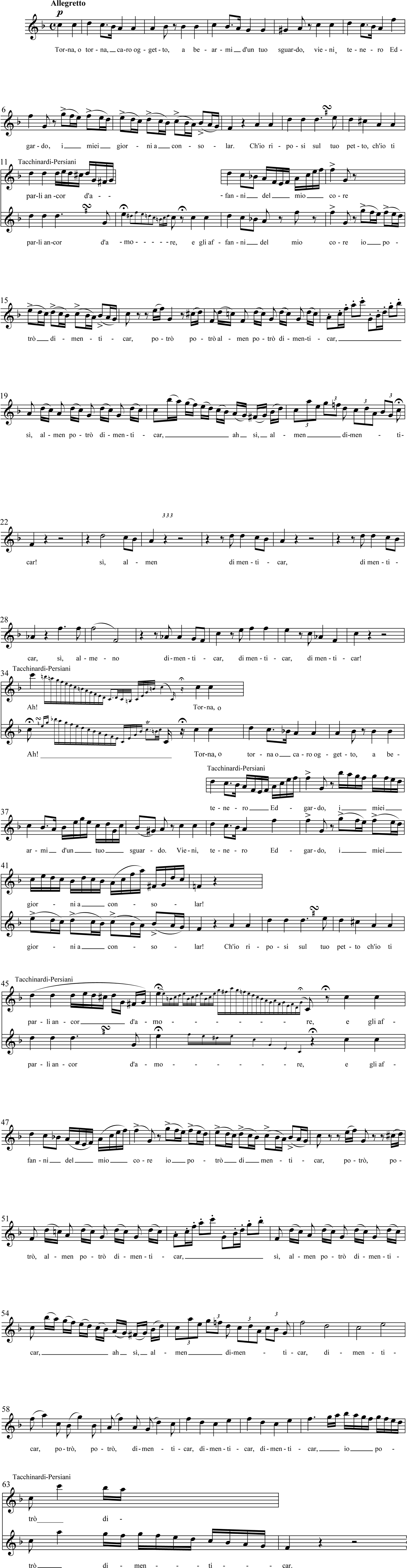
Diabelli published the aria in G major, requiring the singer repeatedly to reach a high D – a note that Tacchinardi-Persiani could show off with apparent ease. Mechetti, on the other hand, opted to transpose the aria down to a slightly less challenging F major, thus making his publication more palatable to those who did not possess Fanny's stratospheric upper register. Mechetti offered the choice between Donizetti's original melodic line of the aria and what he advertised as the prima donna's own ornamentation, both transposed a whole step down. Diabelli only published the embellished version, omitting Donizetti's original. In the cantabile of the cavatina only the final fermata is expanded – a most obvious spot for a singer's display of improvisatory skills (see Ex. 1). The alterations in the cabaletta, though more extensive, are still judiciously placed and worked out (see Ex. 2). The exposition of the melody (structured in a prototypical a a′ b a′′ pattern) features only a small flourish at the end of the b section (b. 11) and at the reprise of the opening material (bb. 13–14). Later on, the lead-in to the repetition of the melody is expanded (b. 34), the dactylic figurations of a′ are developed into a run of semiquavers (bb. 40–1), a new elaborate cadenza substitutes the one placed before a′′ (b. 46), and finally, three notes of the coda are modified to allow the singer to reach a high C (a high D in Diabelli's version).
Gaetano Donizetti. Cavatina ‘Perché non ho del vento’ with Fanny Tacchinardi-Persiani's ornaments. Print Pietro Mechetti, Plate Number 2888.

Gaetano Donizetti. Cabaletta ‘Torna, o torna, caro oggetto’ with Fanny Tacchinardi-Persiani's ornaments. Print Pietro Mechetti, Plate Number 2888.

Several of these embellishments are in line with the principle of variatio upon which the aesthetics of the time was grounded. Furthermore, the position of the ornamentation, usually at the end of a bar or melodic segment and organised according to the logic of gradual expansion, follows the precepts found in contemporary treatises.Footnote 45 Surprisingly, however, the added ornamentation is rather discreet compared to other contemporary examples of embellished arias.Footnote 46 This moderation jars with the fact that critics of the time – in Italy and elsewhere – consistently pointed out the richness of Tacchinardi-Persiani's ornamentation.Footnote 47 Mechetti might have trimmed the prima donna's original embellishments to facilitate the circulation of his print among less gifted singers than Tacchinardi-Persiani. (Mechetti's transposition of the aria, after all, similarly aimed at making the piece more accessible and expanding the potential target audience of the print.) It is also possible that, since the aria was custom-made for Tacchinardi-Persiani, she may have found Donizetti's original line elaborate enough to showcase her agility, thus confining her interventions only to the sections that spectators expected her to modify.
Whatever the reason, the two publications testify to Tacchinardi-Persiani's striking success as Lucia. The frontispieces of both scores suggest that the reason why Donizetti's piece was published was that the prima donna sang it. In both prints, her name is placed at the centre of the heading and appears in the largest font. Her ornamentation, furthermore, provided an added value meant not only to increase the sales of the publications, but also to cement the bond between the role of Lucia and its first interpreter.
Balocchino may have had another reason to insist that Tacchinardi-Persiani make her debut with Lucia rather than with La sonnambula. He must have known that, although Amina was one of her warhorses, she had to stand comparison with a darling of the Viennese, Eugenia Tadolini, who had sung the opera with much success during the previous two seasons.Footnote 48 Later on, indeed, Viennese critics regularly measured Tacchinardi-Persiani's rendition of Amina against Tadolini's. One pointed out, for instance, that Tacchinardi-Persiani surpassed Tadolini in purely technical matters, but not in the construction of a compelling character.Footnote 49 Tacchinardi-Persiani made even less of an impression in Beatrice di Tenda – which the prima donna had originally proposed as an alternative to La sonnambula for her debut in Vienna – and in I puritani. Beatrice di Tenda, in particular, was given only four times and the memories of Tacchinardi-Persiani's performances faded as soon as more charismatic singers revived the opera during the following seasons.Footnote 50
In sum, these first negotiations between the soprano and the impresario show the dynamics that helped the prima donna to strategise her repertory choices. Tacchinardi-Persiani was a rising star, courted by the major opera houses, and fully aware of her contractual rights, skills and limitations. At the same time, she was ready to yield to Balocchino, opening the season with Lucia di Lammermoor instead of La sonnambula or Beatrice di Tenda. Her appearance in a new work for Vienna gave no space for comparisons and allowed her some freedom to tailor the part to her needs. The 1837 Italian opera season at the Kärntnertortheater also serves as an indicator of the future development of Tacchinardi-Persiani's repertory. From now on Lucia and Sonnambula constituted the two pillars of her repertory while Beatrice di Tenda and I puritani seldom appeared again in her performance schedule. In the case of the latter opera, however, part of the reason she set aside the role of Elvira had to do with the circumstances in which she worked in Paris and London, which we will now consider more closely.
‘An invincible stronghold’
After the 1837 season, Balocchino regularly tried to re-engage Tacchinardi-Persiani, but his wishes went unfulfilled for several years. After her stay in Vienna, she moved to Paris to start a multi-year engagement at the Théâtre-Italien, which also led to remunerative duties at Her Majesty's Theatre in London. Following Émile Laurent's appointment as manager of the Théâtre-Italien (1827), it became customary for its company to perform in Paris from October to March, in London during the spring, and then on tour for part of the summer.Footnote 51 Tacchinardi-Persiani took full advantage of these opportunities: this system offered her professional and financial security, the possibility of consolidating her repertory, and a considerable reduction of the number of new operas she had to learn. After her debut in Paris (November 1837), her first new role did not occur until June 1838, when Tacchinardi-Persiani performed the Countess from Mozart's Le nozze di Figaro for the first time. Thereafter, she maintained an average pace of one new opera per year.Footnote 52 At the core of her repertory, however, remained La sonnambula and above all Lucia di Lammermoor, both of which she revived every season until the late 1840s. The dissemination of Lucia in France owed as much to Tacchinardi-Persiani's own imprint on the opera as to Donizetti's revisions and translation for the Théâtre de la Renaissance in 1838 – an adaptation moulded upon the version that the prima donna had brought to Paris from Venice and Vienna.Footnote 53
The bulk of the correspondence between Tacchinardi-Persiani and Balocchino belongs to this period. The impresario repeatedly invited the prima donna back to Vienna. Her rejections shed light on several aspects of the opera marketplace in Paris, London and Vienna, and on the ways in which she constructed her public persona. Between December 1837 and June 1838 Balocchino made several attempts to offer Tacchinardi-Persiani an engagement at the Kärntnertortheater during the 1839 spring season. His rhetoric reveals the power relations underpinning the management of the Viennese opera house. He appealed not only to the prima donna's ego, showering her with praise for her talent and international successes, but also to the moral obligations she had contracted with Viennese political authorities by promising to return to sing in the city.Footnote 54 As the Habsburgs owned the Kärntnertortheater, politics intruded regularly on the daily running of the opera house.Footnote 55 At times Balocchino played this card by adopting a rather ominous tone: he suggested, for instance, that Tacchinardi-Persiani's appointment as Hofkammersängerin in 1837 was a political decision bearing implications for her return to the Habsburg capital.Footnote 56 In so doing, the impresario betrayed a conception of power relations still indebted to the logic of the ancien régime, whereby honours and distinctions were a form of obligation to the sovereign, a means through which the person honoured should feel bound to his or her lord. Honours and devotion to authority, in other words, went hand in hand.
Tacchinardi-Persiani's letters instead show the extent to which her professional career depended on rather different conditions – those of a capitalist free market. To be sure, the prima donna tried to sugarcoat her negative response by showing some sensitivity to the impresario's political arguments, regretting for instance, ‘not having been able to obtain a three-month leave in order to show my zeal to the Illustrious Ministers, my affection to your generous audience, and my good will for your solicitude’.Footnote 57 But she was also adamant that she had no reason to break her current contract.Footnote 58 Two letters, written on 14 April and 28 May 1839 and transcribed in full in the Appendix, are particularly telling in this respect, providing an overblown account of her establishment in Paris and London along with her rejection of Balocchino's offers. A closer look at these two letters reveals not only several tactics of self-representation that the prima donna adopted in her business dealings, but also the fact that her reputation in Paris and new professional status put her in a different negotiating position from before.
Tacchinardi-Persiani was aware of rumours, gossip and misconceptions circulating about her, and strove to turn them to her advantage. A case in point is her alleged rivalry with the other Italian prima donna at the Théâtre-Italien, Giulia Grisi. One year Tacchinardi-Persiani's senior, Grisi had joined the company of the Théâtre-Italien in 1832 and soon became one of its pillars. Grisi was a singer with a vigorous voice, remarkable acting skills, and a predilection for roles of considerable intensity, such as Norma and Lucrezia Borgia.Footnote 59 By the time Tacchinardi-Persiani moved to Paris, Grisi was already well established, and comparisons between the two were inevitable. Yet neither prima donna seems to have acted maliciously towards the other. In fact, their relationship was characterised by respectful collegiality.Footnote 60 Their different vocal and dramatic talents, however, divided spectators into factions. This is likely what Tacchinardi-Persiani was implying when she wrote to Balocchino that ‘the colossal name of another prima donna casts confusion about my debut and affected the response of the prejudiced Parisians’.Footnote 61 She also used military imagery to depict – and perhaps overstate – the circumstances of her debut: Paris appeared to her as an ‘invincible stronghold’ with ‘cannons and an immense crowd of enemies’, whom she faced with no weapons other than her faith and her ‘modest talent’, deprived as she was of any army of supporters.Footnote 62
Tacchinardi-Persiani's rise to the highest spheres of success in Paris and London by the sole virtue of her strengths became a leitmotif in her letters to Balocchino during this period.Footnote 63 According to her, Carlo Severini's death on 14 January 1838 in the fire that destroyed the Salle Favart, the theatre that hosted the company, deprived her of her major supporter. Thanks to her determination, she achieved a complete triumph in Lucia di Lammermoor at the Salle Ventadour. Another followed in London with La sonnambula, despite the second-rate colleagues with whom she had to make her debut – a move ‘which would have ensured my defeat in that capital’. Eventually, her sensational London debut allowed her to consolidate her position in Paris: ‘the stronghold called invincible is conquered; I am in the castle with the flag in my hand’.Footnote 64 And in yet another letter, the prima donna reminded Balocchino that her success in Paris and London was the result of a battle (combattimento) that she fought ‘with no other resource but my weak talent’.Footnote 65
By depicting her conquest of the French operatic market with only ‘modest’ artistic capital at her disposal, the prima donna was in fact appropriating the most typical of bourgeois myths – that of the self-made man (or here, the self-made woman).Footnote 66 As historian David Kuchta has argued, this was not only one of the most powerful tools with which conceptions of masculinity were constructed at the time, but also a particularly important site of tension between capitalist and feudal/aristocratic ideologies – between aggressive entrepreneurship and resentful disdain for the ethics of accumulation, which was eroding established privileges and power relations.Footnote 67 Tacchinardi-Persiani's appropriation of the self-made woman trope at once inhabited this liminal space and complicated it even further. On the one hand, this trope was instrumental to the monetary considerations with which she declined Balocchino's calls back to Vienna, since it helped her maintain her listing on the operatic market congruent with her reputation. On the other, it exposed her to accusations of greed. In this respect, her correspondence provides a different twist on those nineteenth-century narratives that sought to enhance the image of operatic prima donnas by challenging assumptions about their greed and mercantilism.Footnote 68
To avoid such risk, Tacchinardi-Persiani used economic arguments as a means to reassess her role as mater familias – the head of a family sustained by her income alone. By that time, indeed, her husband had given up his career as an opera composer to follow his wife, along with their son, resuming it only occasionally in later years when Fanny's voice had started declining. ‘I am a mother’, she wrote to Balocchino, ‘and this title compels me not to decline a fortune offered to me by divine Providence’. And in another letter, she described ‘success and profit’ as something that ‘as a mother, I should not disdain’.Footnote 69 Once again, in this role she held responsibilities normally associated with men. But here is where her family history proved useful: it allowed her self-awareness as a successful professional in a competitive market to be reconciled with what was commonly perceived as her ‘legitimate’ social role as a respectable and loving mother. Of course, this is not to say that she may not have been using her familial credentials to improve her professional status – the two, in the end, were inseparable. But it is this very inseparability that constituted Tacchinardi-Persiani's trump card in her negotiations with Balocchino.
Tacchinardi-Persiani's skill in manipulating her image provides the greatest evidence for a reconsideration of her self-determination, as well as an important perspective for a comparative understanding of opera's cosmopolitan business networks. Clearly aware of the fact that the dynamics of the free market were playing in her favour, Tacchinardi-Persiani showed no hesitation in entering the impresario's professional territory and discussing business matters with him. To the rhetoric of friendship and duty with which Balocchino tried to convince her to request a three-month leave to appear in Vienna, the prima donna opposed him through sheer force of numbers. Balocchino's request would have jeopardised the closing of a very remunerative three-year contract ‘which, combining Paris, London, concerts, and festivals, would exceed the amount of two hundred thousand francs a year’.Footnote 70 That was ten times what Balocchino had paid her in 1837 for three months, and almost two and a half times the honorarium established in her first contract with Severini at the Théâtre-Italien. The main reason adduced to explain this compensation was not, as one might think, her virtuosity, but her repertory – twelve ‘opere classiche’ that she could sing without need of rehearsals.Footnote 71 The importance of mastering a broad repertory resurfaced in 1842, when Tacchinardi-Persiani informed Balocchino that the new impresario of Her Majesty's Theatre, Benjamin Lumley, had rejected the prima donna's request for a three-month leave. As she wrote to Balocchino, Lumley needed her because she was both ‘too popular with this audience’ and had ‘a repertory of ten operas, whose roles cannot be assigned to other singers without putting the season at risk’.Footnote 72 In sum, from Tacchinardi-Persiani's perspective, her high fees were a fair outcome of the law of supply and demand.
While the prima donna had much to offer the impresarios in Paris and London, she also profited greatly from them. A contributing factor to her rejection of Balocchino's offers was the system of festivals and smaller opera houses revolving around the Paris–London axis, which usually transformed the company into a touring troupe during the summer.Footnote 73 The advantages of this system were manifold. For impresarios these tours were a source of easy money, since performances of first-rate singers were occasional events in provincial towns and thus sure box-office successes. Provincial institutions were able to showcase world-class artists without the costs of a full season. For singers, a multi-year contract in a system that occupied them all year long meant not only financial security, but also the possibility of additional income through benefit concerts.
Comparatively speaking, therefore, Vienna could not compete with Paris or London, not so much because of the different institutional structure of their opera houses, but because of the different strategies underpinning their managerial policies. Both the Kärntnertortheater and the Théâtre-Italien, for instance, enjoyed public subsidies and both of them partnered with other institutions to control costs. But the circuit between the Kärntnertortheater and La Scala (facilitated by Merelli's joint management of the two opera houses) was a decision imposed top-down to enact the cultural policies of the Habsburg Court: it helped maintain an Italian contingent in Vienna that contributed to the city's multinational cultural environment and thus participated in the construction of its image as the capital of a multinational Empire.Footnote 74 Politics, of course, affected the Théâtre-Italien as well, just as any other state-funded opera house in Paris.Footnote 75 But in this case, the partnership with London was an answer to the plummeting of government subsidies.Footnote 76 In other words, the Théâtre-Italien filled the financial void left by the French government by selling its ‘house brand’, reaching beyond national borders through the channels provided by an incipient form of a globalised market.
Vienna, 1845
Eventually Tacchinardi-Persiani did return to Vienna. On her own initiative and without pressure from the impresario, she resumed her correspondence with Balocchino in 1844 following two years of silence. She was now empowered to fulfil her ‘promise’ in her own terms as a celebrated prima donna. Tacchinardi-Persiani informed Balocchino that she was granted a leave during the 1845 season on the condition that her engagements with Her Majesty's Theatre would be postponed to a later season. If the impresario wanted, she was ready to show her ‘good will’ to him and to the Viennese.Footnote 77 Within six weeks, they settled the terms of her engagement.Footnote 78 Tacchinardi-Persiani also sent a list of operas in which she was willing to appear, providing us a glimpse into what she considered her standard repertory: Lucia, Sonnambula, Il barbiere di Siviglia, Linda di Chamounix, Elisir d'amore, Fioravanti's Cantatrici villane, Don Giovanni, as well as Giuseppe Persiani's Il fantasma (the only work he had written to date after leaving Italy), I puritani and Rossini's Otello, two operas that she had rarely sung in Paris and London, as they belonged to Grisi's repertory.Footnote 79 Balocchino fulfilled her wishes: in 1845 she appeared in her two warhorses, Lucia and La sonnambula, in I puritani, as Rosina in Il barbiere di Siviglia, and in Il fantasma.Footnote 80
One may wonder whether the prima donna sacrificed a lucrative season in London for one in Vienna only out of her sense of duty. In fact, Lumley recalls in his memoirs that during the 1844 season Tacchinardi-Persiani, although remaining a darling of London opera-goers, had appeared ‘on the wane’; Fétis dated her incipient decline to the previous year.Footnote 81 In addition to measuring herself against her own previous performances while resorting to an instrument that had begun to fail her, the prima donna also had to confront another issue affecting her in London. She belonged to what was then known as the vieille garde of the company – the tight-knit group of established singers, Grisi and Mario en tête, who resisted changes to the company as a potential threat to their acquired positions. According to Lumley, Tacchinardi-Persiani's departure for Vienna (or, as he called it, her ‘removal’) was an ‘experiment’ through which the impresario intended ‘to offer room for novelty’ and introduce ‘younger talent[s]’ while undermining the hold of the vieille garde over managerial policies.Footnote 82 Vienna must have appeared a welcome escape from a rather tense working environment, all the more so since spectators there were not as accustomed to her interpretations as those in Paris and London.
Viennese critics, however, noticed that something had changed in Tacchinardi-Persiani's voice. Just as in 1837, the prima donna made her first appearance at the Kärntnertortheater with Lucia di Lammermoor – a choice that led to comparisons with past performances. Commenting on the opening night, Ferdinand von Seyfried, the editor of Der Wanderer, claimed that her technical flexibility had improved over the years, but that the passing of time had also affected her shortcomings: ‘[Her] voice has undergone the natural process of time: previously it was not brilliant and is even less so now. La Tacchinardi will always shine the most in arias, since her organ is lacking in strength for the ensembles, giving way to a strident strain.’Footnote 83 A couple of weeks later he noticed similar problems with her rendition of La sonnambula.Footnote 84 Similarly, the critic of the Wiener Zeitschrift für Kunst, Literatur, Theater und Mode observed that, despite a still-exceptional virtuosic arsenal, the prima donna's voice had lost its freshness as Lucia, and that she even met with some opposition at her first reappearance in Vienna.Footnote 85
Tacchinardi-Persiani possibly underestimated not only the memory of Viennese opera-goers, but also, and above all, their pride. The initially lukewarm reception with which her return in Vienna was met may be an indicator of some resentment for her prolonged absence from the city – an absence that coincided with the zenith of the singer's possibilities and that came to an end only when her voice started to display signs of deterioration. Writing at the beginning of the Italian opera season, the reviewer of Der Wanderer offered a description of Vienna as a laboratory of talents, and commented on the incipient Italian opera season with a tinge of sourness: ‘Celebrities are not born; they are made.’Footnote 86 In 1837 Vienna had contributed to the making of the up-and-coming Tacchinardi-Persiani, but now she was returning as an internationally acclaimed star, without providing anything new to justify her acquired status. Rather, she conformed to a much-dreaded trend whereby celebrated singers routinely presented a well-established repertory of old operas, which was exactly what, in her own words, made her ‘indispensable’ in Paris and London. What this critic was railing against was the risk-free commodification of stardom that he saw taking place at the Kärntnertortheater.Footnote 87 Tacchinardi-Persiani's name surely guaranteed a full house no matter what she was singing, but in the process, Vienna was turned from a centre of production of celebrities to one of consumption. It did not help that the celebrity in question did not measure up to the standard that she herself had set during her first season at the Kärntnertortheater. From this perspective, then, the Paris engagement had spoiled Tacchinardi-Persiani. In this context, we should perhaps not be surprised that as the curtain fell on the 1845 Italian season, the correspondence between her and Balocchino also came to an end.
Conclusions
The years separating Balocchino's first negotiations with Tacchinardi-Persiani and her last bow in Vienna coincided with the full blossoming of the prima donna's career and the beginning of her decline. Their epistolary exchange allows us to chart this trajectory, prompting a reconsideration of a number of issues – biographical, social, economic and political. These letters also challenge the traditional portrayal of a soprano whose voice may have well resonated in opera houses across Europe, but who offstage supposedly spoke only through those of her father and husband. They reveal instead the personality of an artist equipped with enough confidence and self-awareness to face as seasoned an impresario as Balocchino, and with a clear knowledge of both the workings of the professional market and the potentially detrimental repercussions of her career on her social status. Although it is very possible that she discussed career strategies and professional matters with her father and her husband, the Viennese letters reveal the extent to which Tacchinardi-Persiani managed her career first-hand.
The fact that this correspondence has lain overlooked brings up one further issue: historiography. This neglect is just one persistent manifestation of Vienna's position at the periphery of narratives of nineteenth-century Italian melodramma – a position that still endures despite the loosening grip of both composer-centred and national approaches over opera scholarship. The letters between Tacchinardi-Persiani and Balocchino, however, remind us of the importance both of Vienna for the economy of early nineteenth-century Italian opera, and of Italian opera for the cultural landscape of early nineteenth-century Vienna. Vienna remained a vital centre at the crossroads of a transnational operatic network that stretched from Madrid to St Petersburg – two capitals that Tacchinardi-Persiani indeed reached in the last phase of her career – and was gradually expanding outside Europe.Footnote 88 This is not to say that this position was always a favourable one. Reading the correspondence between Tacchinardi-Persiani and Balocchino in parallel with Viennese reviews reveals local anxieties towards the shifting geographies of such operatic landscapes. In this respect, the impresario's insistence on the return of the prima donna, and critics’ discomfort with the ever-changing processes of celebrity-making are two sides of the same coin. They were different manifestations of a palpable tension between the aspirations of the political and cultural élites of the Austrian capital and their frustration with the exposure to a growing and competitive marketplace – one that stretched beyond the control of Austrian political authorities and questioned the city's supremacy over other European capitals.Footnote 89 These tensions, to be sure, were not unique to Vienna, but were symptomatic of a far-flung ambivalence towards ruthless capitalism and its alleged responsibilities for the erosion of established power relations.Footnote 90 Paris was an obvious source of apprehension. As Mark Everist has pointed out, the wealth of its operatic market was sustained not only by generous state subsidies, but also by what he calls ‘the clandestine power resided in the so-called loups-cerviers, the financiers and bankers that supported the Opéra in the first instance, and other theaters subsequently’.Footnote 91 It was the private capital of these individuals as well as the interest of some of them in establishing an international business network that allowed Paris to rise to prominence among other European cities.Footnote 92
In this respect, we may regard Tacchinardi-Persiani's life, career, self-perception and critical reception as a case study reflecting on and responding to major cultural, social, ideological and political transformations. Her rise to celebrity resulted from an uphill battle against evolving social conventions and political circumstances, as well as against the changing expectations of different audiences. Tacchinardi-Persiani prevailed through her ability to recognise (and profit from) the diverse contexts in which she worked, her social standing and the specificities of her vocal abilities. At the same time, the transformations that developed in parallel to her career provided a counterpoint to her correspondence with Balocchino. They came to affect not only the description of her achievements in Paris and London but also the manufacturing of her persona as the result of a mutual but precarious relationship between her professional status and her social role as a wife and mother. While thereby providing us with fascinating insight on the prima donna's life and career, these letters also offer us a point of entry into the multiple perspectives from which the different operatic landscapes of Paris, London and Vienna were observed from the outside. Acknowledging this multiplicity contributes to a broader understanding of both local and transnational histories of opera in the nineteenth century. Tacchinardi-Persiani's road to celebrity was certainly not a straight one; yet the obstacles she encountered along the way helped her to build an acute sense of her position within the operatic market of her time as well as in society. To paraphrase the reviewer of Der Wanderer, Tacchinardi-Persiani's international reputation was indeed the result of a gradual ‘making’; as the correspondence between the prima donna and Balocchino reveals, such making was above all an act of self-making.
Appendix: The Tacchinardi-Persiani–Balocchino Correspondence
The correspondence between opera impresario Carlo Balocchino and soprano Fanny Tacchinardi-Persiani comprises several documents currently housed at the Wienbibliothek am Rathaus. Balocchino's business archive has been an integral part of the library's manuscript collection since its purchase in 1888.Footnote 93 To date no other letters between Balocchino and Tacchinardi-Persiani appear to have survived.
This Appendix consists of two parts. The first part lists all the letters in Vienna as they appear in the library catalogue as well as Balocchino's letters to other correspondents pertaining to his negotiations with the prima donna. The second part provides a transcription and translation of a portion of the correspondence. Letters included in this section of the Appendix are marked with an asterisk in the list below.
My transcriptions do not seek to produce a critical edition of these documents. In most cases, for instance, I refrained from reproducing passages that were erased but are still legible. Because several of these documents are drafts, doing so would have required packing this section with a heavy apparatus of footnotes and graphic interventions. In two cases (nos. 3 and 4), however, I did reproduce two such passages since they provide intriguing insights on the rhetorical strategies that Balocchino adopted in addressing the prima donna. I have expanded the standard abbreviations using square brackets, and I modernised the punctuation while maintaining the original spellings. One letter by Tacchinardi-Persiani to Balocchino (no. 9) has several tears in the paper, which prevent reading certain words or portions of a word. I filled these lacunae and placed my hypothetical readings in square brackets.
Because at times Balocchino had his secretaries draft his answers to Tacchinardi-Persiani on the back of her letters, these drafts do not appear in the catalogue of the Wienbibliothek am Rathaus. In the list below I specify which letter contains such a draft. The selection of letters in the second part contains only one instance of this practice (no. 1). I decided to publish this document as a single item, clearly distinguishing the portion that pertains to Tacchinardi-Persiani's original letter from that concerning Balocchino's reply. Most of Balocchino's letter drafts to Tacchinardi-Persiani, however, are written on separate pieces of paper and are listed as separate items both in the library catalogue and in the following list. By and large these documents are in the hands of Balocchino's secretaries. Sometimes he revised the drafts by inserting corrections himself. In my transcriptions I specify which drafts were written entirely by Balocchino's secretaries and which present his autograph interventions. For the sake of clarity, however, I decided not to distinguish graphically between the autograph and non-autograph portions of these documents.
A. Complete list of letters held at the Wienbibliothek am Rathaus
Items marked with an asterisk are transcribed in section B.
Undated letter from Tacchinardi-Persiani to Balocchino: A-Wst, H.I.N. 10273
*Letter from Tacchinardi-Persiani to Balocchino, 22 February 1837: A-Wst, H.I.N. 10274, with draft of Balocchino's reply
*Letter from Tacchinardi-Persiani to Balocchino, 3 March 1837: A-Wst, H.I.N. 10275
*Letter draft from Balocchino to Tacchinardi-Persiani, 8 March 1837: A-Wst, H.I.N. 10421
Two letter drafts from Balocchino to Tacchinardi-Persiani, 18 December 1837 and 1 February 1838: A-Wst, H.I.N. 10429
*Letter draft from Balocchino to Tacchinardi-Persiani, 20 June 1838: A-Wst, H.I.N. 10433
Letter from Tacchinardi-Persiani to Balocchino, 12 July 1838: A-Wst, H.I.N. 10276
Letter draft from Balocchino to Tacchinardi-Persiani, 6 March 1839: A-Wst, H.I.N. 10441
Letter draft from Balocchino to Tacchinardi-Persiani, 7 March 1839: A-Wst, H.I.N. 10442
*Letter from Tacchinardi-Persiani to Balocchino, 14 April 1839: A-Wst, H.I.N. 10277
*Letter draft from Balocchino to Tacchinardi-Persiani, 27 April 1839: A-Wst, H.I.N. 10443
*Letter from Tacchinardi-Persiani to Balocchino, 28 April 1839: A-Wst, H.I.N. 10278
Two letter drafts from Balocchino to Tacchinardi-Persiani, 24 December 1839 and 3 February 1840: A-Wst, H.I.N. 10456
Letter draft from Balocchino to Tacchinardi-Persiani, 2 March 1840: A-Wst, H.I.N. 10459
Letter draft from Balocchino to Tacchinardi-Persiani, 16 May 1840: A-Wst, H.I.N. 10460
Letter draft from Balocchino to Tacchinardi-Persiani, 7 April 1842: A-Wst, H.I.N. 10474
*Letter from Tacchinardi-Persiani to Balocchino, 26 April 1842: A-Wst, H.I.N. 10279
Letter draft from Balocchino to Tacchinardi-Persiani, 5 June 1842: A-Wst, H.I.N. 10476
Letter from Tacchinardi-Persiani to Balocchino, 12 June 1842: A-Wst, H.I.N. 10280
Letter draft from Balocchino to Tacchinardi-Persiani, 26 April 1842: A-Wst, H.I.N. 10477
Letter from Tacchinardi-Persiani to Balocchino, 16 April 1844: A-Wst, H.I.N. 10281
Letter draft from Balocchino to Tacchinardi-Persiani, 24 April 1844: A-Wst, H.I.N. 10497
Letter from Tacchinardi-Persiani to Balocchino, 8 May 1844: A-Wst, H.I.N. 10282
Two letter drafts from Balocchino to Tacchinardi-Persiani, 17 and 20 May 1844: A-Wst, H.I.N. 10500 with a draft of Tacchinardi-Persiani's contract for the 1845 opera season
*Letter from Tacchinardi-Persiani to Balocchino, 29 May 1844: A-Wst, H.I.N. 10283
Letter draft from Balocchino to Tacchinardi-Persiani, 6 June 1844: A-Wst, H.I.N. 10504
Letter draft from Balocchino to Tacchinardi-Persiani, 12 February 1845: A-Wst, H.I.N. 10512
Letter draft from Balocchino to Tacchinardi-Persiani, 1 March 1845: A-Wst, H.I.N. 10513
Letter from Tacchinardi-Persiani to Balocchino, 8 March 1845: A-Wst, H.I.N. 10284
Letter draft from Balocchino and Bartolomeo Merelli to Tacchinardi-Persiani, 27 April 1845: A-Wst, H.I.N. 10514
***
Letter from Agostino Marchesi to Balocchino, 17 June 1836: A-Wst, H.I.N. 10259
Letter from Balocchino to Agostino Marchesi, 20 June 1836: A-Wst, H.I.N. 10405
Letter from Balocchino to Antonio Coppini, 20 December 1836: A-Wst, H.I.N. 10415
Letter from Balocchino to Giuseppe Persiani, 30 March 1837: A-Wst, H.I.N. 10423
Letter from Giuseppe Persiani to Balocchino, 24 June 1837: A-Wst, H.I.N. 10285
Letter from Giuseppe Persiani to Balocchino, 3 July 1837: A-Wst, H.I.N. 10286
Letter from Giuseppe Persiani to Balocchino, 10 July 1837: A-Wst, H.I.N. 10287, with draft of Balocchino's reply
Letter from Giuseppe Persiani to Balocchino, 26 April 1845: A-Wst, H.I.N. 10288
Letter from Balocchino to Giuseppe Persiani, 13 June 1845: A-Wst, H.I.N. 10516
B. A selection of the letters
1a. Letter from Tacchinardi-Persiani to Balocchino, 22 February 1837, A-Wst, H.I.N. 10274
Al Pregiatmo: Sig:r
Carlo Balochino
Vienna
Preme assai
Pregiatissimo Sig:r Balocchino
Venezia 22. Febbrajo 1837
Il Ballerino signor Montani mi comunicò un suo articolo, a me riguardante, il quale diceva che mi avrebbe scritto in proposito tanto per combinare l'Opera per il mio debbutto [sic] in Vienna, come per l'alloggio etc.. Attesi inutilmente i suoi caratteri, e credetti causa di tal silenzio il non aver ancora completata la compagnia per la malattia ostinata del bravo Salvatori. Appena intesi che lo spartito della Lucia era stato spedito a Vienna, e destinato per prima Opera, scrissi subito in proposito al sig: Merelli il quale per doppia gentilezza non si è degnato in 15 giorni rispondermi, cosicché sono costretta ad incomodar lei ripetendo ciò che scrissi al detto Merelli. La Lucia non è Opera che conviene al mio debutto, e lungi di proporre spartiti di mio marito, mi adatterò alla Vecchia Opera la Sonambola [sic] tanto più che i tenori già scritturati, l’[h]anno eseguita in Vienna altra volta con successo, se poi invariabile fosse tale scielta [sic] potranno fare eseguire la parte di Lucia ad altra prima Donna, ed io garantita dal mio contratto aspetterò il momento opportuno per presentarmi al pubblico Viennese.
Mi dispiace assai che per la prima volta che le scrivo, debba esser con lei poco cortese ma l'agire non troppo conveniente dell'Impresa mi sforza a sostenere in qualunque maniera i miei diritti. Attendo pronto riscontro, e mi dico di lei,
Umiliss[im]a Serva
Fanny Persiani.
Dear Signor Balocchino,
Venice 22 February 1837
Signor Montani, the dancer, told me about your letter concerning me, which supposedly said that you were writing to me both about the opera for my debut in Vienna and about lodging, etc. I have been waiting for it in vain, believing that the reason for your silence was that you had not yet finalised the company, due to the continuing illness of the good Salvatori. As soon as I heard that the score of Lucia had been sent to Vienna and was intended to be the first opera [of the season], I immediately wrote to Signor Merelli, who has been equally kind in not deigning to respond for the past fifteen days. I am therefore forced to disturb you, repeating what I told Merelli. Lucia is not a suitable opera for my debut and, instead of proposing an opera by my husband, I will consent to perform the old opera la Sonambola [sic], especially since the tenors already contracted have successfully sung it in Vienna in the past. If your choice is immutable, then you can assign the part of Lucia to another prima donna, and I, protected by my contract, will await the appropriate moment to introduce myself to the Viennese audience.
I regret that in this first letter to you I must be less than courteous, but because of the inconsiderate behaviour of your administration, I am forced to claim my rights in whatever way I can. I look forward to your prompt answer, and I profess myself,
Your most humble servant,
Fanny Persiani.
1b. Non-autograph letter draft from Balocchino to Tacchinardi-Persiani, 26 February 1837
Preg[iatissi]ma Sigra
li 26 feb[brai]o 837.
Riscontro a vista la cortese sua del 22 feb[brai]o. È vero che mi era prefisso di scriverle, ma vedendo che Ella era sempre in corrispondenza col mio socio Sig.r Merelli ho giudicato inutile. Ella intende scegliere per Debut[t]o la Sonnambula invece della Lucia di Lammermoor. Io mi permetto di osservarle che quest'opera è stata sentita e risentita in Vienna, e che il Pubblico Viennese ama la varietà e la novità. Qualora però ella non trovasse ammissibili queste mie ragioni, sono disposto ad allestire la Sonnambula, lasciando la Lucia per altro di lei Debut[t]o. Atterò un cenno in proposito, come pure l'emergente per il di lei alloggio. La prego di miei rispettiFootnote 94 al degnissimo di lei consorte. Mi è grato l'incontro per protestarmi
S[u]o Balochino
Most esteemed Signora,
26 February 1837
I am promptly replying to your kind letter from February 22. In fact, I had intended to write you, but knowing that you were corresponding with my business partner, Signor Merelli, I thought it useless. You wish to choose La Sonnambula instead of Lucia for your debut. Permit me to remark that this opera has been heard repeatedly in Vienna, and that the Viennese audience prefers variety and novelty. In case you find my reasons inadmissible, however, I am ready to mount La Sonnambula and leave Lucia for another debut of yours. I will await your reply about this, as well as about the question of your lodging. Please send my regards to your most worthy husband. I gladly take this opportunity to declare myself
Yours,
Balocchino
2. Letter from Tacchinardi-Persiani to Balocchino, 3 March 1837, A-Wst, H.I.N. 10275
Al Pregiatissimo
Signore Carlo Balochino
Vienna
Preme assai
Pregiatis[si]mo Sig.r Balochino.
Ricevo la sua gentile risposta con data 26 scaduto, e rilevo dalla medesima le sue osservazioni le quali in parte mi sembrano giuste, ma non sono però meno da calcolarsi le mie che l'esposi, e che ripeto. La Lucia benché sia un'Opera scritta per me non conviene ch'io ci azzardi un debutto; Alle tante replicate istanze di questa Presidenza e di Lanari, condiscesi a rap[p]resentarla in questo teatro per prima, e l'esito della medesima mi obbliga a non espormi nuovamente ad avere un esito incerto; Se la Sonnambula è per Vienna Opera Vecchissima vi è la Beatrice di Tenda di Bellini nuova per quella Città.
Non tanto per l'articolo del mio Contratto che mi garantisce, quanto per le riflessioni che espongo alla di lei saggezza, certa sono che la Lucia si darà in seguito, e che o Sonnambula, o Beatrice sarà assolutamente l'opera del mio debutto.
L'alloggio lo gradirei in situazzione [sic] ariosa, e composto di una sala da ricevere, una camera da letto da due persone, un salotto per pranzare, due camerine per Cameriera e Domestico, e cucina libera del tutto. Le porgo i complimenti di mio marito, nell'atto che piena di stima mi dico
Umilis[sim]a Serva
Fanny Persiani
Venezia 3. Marzo 1837
Most esteemed Signor Balocchino,
I received your kind reply of the 26th of last month, and I acknowledge your remarks that in part seem fair. Nevertheless, the reasons that I provided, and that I now repeat, are no less worthy of being taken into account. Although Lucia was written for me, it is not advisable for my debut. After many repeated requests from Lanari and the President [of La Fenice], I agreed to perform it first, but its reception now compels me to avoid exposing myself to an uncertain outcome. If La Sonnambula is too old hat for Vienna, Bellini's Beatrice di Tenda is new for that city.
I am certain that, because of my remarks and not because I am protected by my contract, Lucia will be given later [in the season], and that either La Sonnambula or Beatrice will most certainly be the opera for my debut.
I would like to have my lodging in an airy location. It should include a drawing room, a bedroom for two, dining room, two smaller bedrooms for a maid and a servant, and a kitchen. I send along my husband's regards, while full of esteem I profess myself
Your humble servant,
Fanny Persiani
Venice 3 March 1837
3. Non-autograph letter draft from Balocchino to Tacchinardi-Persiani, 8 March 1837, A-Wst, H.I.N. 10421
Preg[iatissi]ma Sig.ra
Per la stima che professo alla di lei persona mi sono creduto in dovere di farle alcune osservazioni sulla scelta da lei fatta della Sonnambola [sic] per prima Opera di debut[t]o. Queste osservazioni però non fu mia intenzione che dovessero avere un carattere positivo, mentre nella mia precedente lettera, come ella avrà rilevato, io mi sono dichiarato pronto ad accondiscendere a questo di lei desiderio. Ed infatti io ne informai tosto questa Autorità, da cui non ho incontrato alcun ostacolo in proposito. La Sonnambola resta quindi fissata per di Lei debut[t]o nella prossima stagione, ed ancorché ella non fosse assicurata dal di lei contratto, il desiderio che ho di uniformarmi per quanto mi è possibile ai di lei voleri, gliene farebbe sicura garanzia. La Beatrice di Tenda poi, datasi qui alcuni mesi [or] sono in lingua Tedesca, non ebbe alcun successo.
Riguardo all'alloggio, procurerò di trovarlo corrispondente alla descrizione da Lei fattami.
Gratissimi mi furono i saluti del degnissimo di lei consorte, e glieli concambi cordialmente.
Aggradisca, egregia Sig.ra i sentimenti della mia perfetta stima, con cui mi pregio di dichiararmi
[senza firma]
Vienna li 8 Marzo 1837.
Dear Signora,
Given my esteem for you, I believed it was my duty to share my observations about your choice of Sonnambola [sic] as your debut opera. It was not my intention, however, that these observations be taken as imperative; in fact, as you may have noticed in my previous letter, I have declared myself ready to yield to your wish. Indeed, I promptly informed the authorities here and met with no obstacle. La Sonnambola, therefore, is scheduled for your debut this coming season. Even if you had not been protected by your contract, my wish to satisfy your requests to the best of my abilities would be your guarantee. As for Beatrice di Tenda, it was given here a few months ago in German, but had no success.
With respect to your lodging, I will arrange for a place that matches your description.
I received with great pleasure the greetings of your most worthy husband, which I return cordially.
Accept, dear Signora, the expression of my deepest esteem, with which I have the pleasure to declare myself
[no signature]
Vienna 8 March 1837.
4. Non-autograph letter draft from Balocchino to Tacchinardi-Persiani, 20 June 1838, A-Wst, H.I.N. 10433
Pregiatissima Sig.ra Tacchinardi-Persiani
a Londra
Vienna li 20 Giugno 1838.
Conoscendo le molte e interessanti di lei occupazioni, mi sono per molto tempo astenuto dal molestarla con mie lettere; ho però sempre tenuto dietro ai luminosi trionfi da lei riportati su coteste [sic] grandi scene, i quali mi cagionarono un vivo piacere, e di cui le faccio le mie sincere congratulazioni.
Nella cortese sua lettera del 12 Febbraio scorso ella fece dipendere il bene di averla di nuovo in questa Capitale, dall'effetto, che avrebbe prodotto sulla di lei salute il clima di Londra. Persuaso che ora sarà in istato di dirmi in proposito qualche cosa di più positivo, non manco di domandarle se possa sperare di rivederla per la prossima stagione della primavera 1839. Dopo le non dubbie prove di affezione, che la Corte Imperiale, gli Ill[ustrissi]mi Ministri, ed il Pubblico di questa Capitale le tributarono unanimemente nella primavera 1837, è inevitabile, che io le ripeta, che tutti desiderano di rivederla. In quanto a me se fossi egoista sarei tentato a bramare, che il clima di Londra fosse cattivo. Mi asterrò però da un simile desiderio, nella dolce speranza, che quando anche impegni già contratti ed indissolubili mi togliessero il bene di ammirarla nella primavera 1839, almeno per quella del 1840, che è l'ultima del nostro contratto d'appalto non vorrà privarmi dell'onore di avere lei per principale ornamento della Compagnia.
Avendo poi il deg[nissi]mo di lei Consorte scritto al mio amico e socio S.r Merelli, che era sua intenzione, finito il contratto con la Direzione di Parigi, di fare un carnevale alla Scala, e la successiva primavera a Vienna, le faccio sapere anche a nome del detto mio amico e socio, che non aspettiamo che un cortese di lei cenno per spedirle ambedue i contratti. Per quello poi che riguarda Vienna, è questo di lei cenno ancora più necessario, onde possa giustificarmi presso questo ottimi Ministri, che io nulla tralascio per avere i più distinti artisti, e principalmente lei per cui conservano tanto buona memoria, e tanta speranza di ammirarne di nuovo i perogrini [sic] talenti.
Si compiaccia dunque, egregia Signora, di farmi pervenire al più presto questa di lei risposta, ed aggradisca i miei distinti rispetti, che vorrà compartire anche al degnissimo Sig.r Consorte.
[senza firma]
Most esteemed Signora Tacchinardi-Persiani
In London
Vienna 20 June 1838
In consideration of your many and interesting affairs, I have refrained from troubling you with my letters for a long time; nonetheless, I have always followed your brilliant triumphs in those celebrated theatres; they gave me real pleasure, and I sincerely congratulate you for them.
In your kind letter of 12 February you maintained that our pleasure in welcoming you back to this capital would depend upon the effect of the London weather on your health. Since I am persuaded that you are now ready to tell me something more positive about this matter, I won't hesitate to ask you whether we can hope to see you during the next opera season of spring 1839. After the unquestionable proof of affection that the imperial court, the most illustrious ministers, and the audience of this capital unanimously demonstrated during the spring of 1837, it is not surprising that I should repeat that everybody wishes to see you again. As for me, if I were selfish, I would be tempted to wish for bad weather in London. I will refrain from this wish in the sweet hope that, even if binding commitments prevent me from admiring you in the spring of 1839, you won't deprive me of the honour of having you as the chief ornament in our company in the spring of 1840 – the last season of our lease.
Because your most worthy husband has written to my friend and partner Signor Merelli that, at the end of your contract with Paris, it would be your intention to spend one Carnival [season] at La Scala and the following spring in Vienna, I am letting you know – also on behalf of my aforementioned friend and partner – that we only await your reply to send you both contracts. Regarding Vienna, your reply is even more necessary so that I can show these excellent Ministers that I leave nothing undone in order to have the most distinguished artists, and first and foremost you, for whom they have held so many fond memories and very much hope to admire your many talents.
Do not hesitate, dear Signora, to send me your reply as soon as you can, and accept my most distinguished regards, which you will pass on to your most honorable husband as well.
[no signature]
5. Letter from Tacchinardi-Persiani to Balocchino, 14 April 1839, A-Wst, H.I.N. 10277
Pregiatis[simo] Sig.r Balochino
Londra 14. Aprile 1839.
La mia partenza intempestiva per Londra per ordine dell'Impresa di Parigi è stata la sola causa del ritardo della presente risposta. Io scrivo non all'Impresario del Teatro italiano di Vienna, ma all'amico Balochino, tale si è mostrato sempre a noi, ed io persuasa che l'amico convincerà l'impresario, mi accingo ad esporle la mia situazione.
Il mio venire in Francia e in Inghilterra a molti sembrò cosa pericolosa e ad onta che nessuno poteva negarmi un poco di talento, eppure il nome colossale d'un[’] altra prima donna facevano essere tutti perplessi intorno al mio debutto e al giudizio che avrebbero dato di me i prevenuti Parigini. Io obbligata da un contratto mi recai a Parigi, e (confesso il vero) con gran timore. Appena giunta in quella Capitale vidi la fortezza inespugnabile, vidi i cannoni e la turba immensa de’ miei nemici. Io sola priva di coraggio, e di partito, mi slanciai contro la fortezza e non avevo in mio favore che la fiducia in Dio, e il poco mio talento.
Il primo assalto fu buono, ma non buonissimo … ritentai con doppia forza e mi riuscì salire dei gradini, e abbattere una parte de’ miei nemici. Molti ostacoli si fecero insorgere doppo [sic] la morte di Severini onde oscurare i miei successi, ma il coraggio in me cresceva a misura che gli altri intrigavano, e nel riprodurre la Lucia doppo l'incendio in altro teatro assai più vasto, fu per me un nuovo trionfo.
Si congiurò per farmi partire per Londra avanti a tutti gli altri artisti per farmi debuttare con due seconde parti nella Sonnambula, onde assicurare la mia caduta per sempre in questa Capitale. Furono innutili [sic] tutti i compensi che io offrivo onde sottrarmi da un macello … il progetto era da molto tempo combinato, e non rimaneva che sospirare sulla perdita del nostro amico Severini; rilessi l'articolo di cessione che esisteva nel mio contratto, e piangendo pel mio amor proprio traversai il mare.
Quella Divinità che vigila ed innalza i prostrati volle compensare le pene da me sofferte, facendomi ottenere nel mio debutto un successo tanto felice, del quale non se ne conta l'uguale … così mi trovai senza accorgermi in cima alla fortezza. Consolidata con altre produzioni la mia opinione in Inghilterra, ciò accrebbe la persuasione in Francia nel giudizio pronunciato già in mio favore. Dopo un giro che feci in Irlanda e Scozia, ritornai a Parigi, e non so se realmente avessi progredito nell'arte, o se fosse stata illusione francese il fatto si è che il Pubblico non solo trovò la mia voce rinforzata, ma perfezionata in tutto ciò che poteva costituirmi tale, da non avere Emule.
Eccomi alla conclusione di questo noioso panegirico. Tutti i contratti terminano ai 20. Agosto 1840. Una nuova impresa mi offre un contratto per Parigi e Londra per anni tre, io ho fatto una forte domanda che spero dovranno accordarmi, giacché io credo partirà chi ha per 8. anni regnato in quel teatro.
Caro amico la fortezza chiamata inespugnabile è vinta, sono nel Castello, la bandiera è in mia mano … e dovrei vo[lo]ntariamente battere in ritirata cedendo il mio posto ad altre? Vanto un alloro di queste due prime Capitali del Mondo, è vero, ma è bagnato ancora di sudori, e pianto.
Sono madre e questo nome mi obbliga a non ricusare un patrimonio che la provvidenza mi offre in tal circostanza. La Concessione che il Governo farà al nuovo Impresario sulla privativa del Teatro, non avrà luogo prima della metà del Novembre venturo, e così le scritture degli Artisti si faranno dentro il Dicembre, se la cosa non è combinabile io tornerò in Italia dove sono già stata prevenuta con molti [sic] richieste. Se però mi accordano a Parigi ciò che ho domandato, la mia coscienza non mi permette di lasciare questi luoghi.
Riflettete Sig. Balochino a quanto vi ho esposto e dedurrete che non è cattiva volontà, non è ingratitudine se io non posso per ora accettare la vostra carissima offerta, ma una circostanza a me vantaggiosa, che ricusandola senza una qualche ragione, mi prenderei la critica di tutti non esclusa la vostra.
In Decembre tutto sarà deciso, ed io per ora non posso che ringraziarlo della sua bontà. Non mancai parlare ai campioni del Canto Italiano Rubini, e Tamburini, e l'uno e l'altro mi risposero che cesserà la loro carriera col termine del Contratto presente.
Nel chiederle scusa del ritardo della risposta, le porgo i complimenti di Persiani uniti ai miei pregandolo a compartirli alla degna di Lei consorte mentre con stima passo a dirmi sua
Sott[oscrit]ta Fanny Persiani
Most esteemed Signor Balochino [sic]
London, 14 April 1839
My unexpected departure for London on the order of the Paris management is the sole reason for my delayed reply. I write not to the impresario of the Vienna Italian Theatre, but to my friend Balocchino, who has always proved himself such. As I believe that the friend will convince the impresario, I will explain my situation to you.
To many, my coming to France and England seemed a dangerous move, despite the fact that no one could deny that I had talent. Yet the colossal name of another prima donna cast confusion on my debut and affected the response of the prejudiced Parisians. I went to Paris as required by my contract – and (to tell the truth) with great trepidation. As soon as I arrived in the capital, I saw an invincible stronghold; I saw the cannons and an immense crowd of enemies. Alone, deprived of courage or allies, I threw myself against the stronghold, trusting only my faith in God and my modest talent.
My first assault was good, but not excellent… I intensified my efforts, managed to climb a few steps and destroy some of my enemies. After [Carlo] Severini's death,Footnote 95 many obstacles were thrown up to prevent my success, but my courage grew in proportion to the intrigues against me. After the fire, the revival of Lucia in a much larger opera house produced a new triumph.
There was a conspiracy to make me leave for London before anybody else in the company, so that I had to debut in La sonnambula with second-rate singers, which would have ensured my defeat in that capital. I tried in vain to avoid this turmoil… but the project had been planned for a long time, and I could not but sigh at the loss of our friend Severini; I read and reread the article in my contract that provided for my assignment and crossed the sea weeping for my self-esteem.
I was compensated for my sufferings by the God who looks after and protects those who are humiliated; He allowed me to achieve such a success as never seen before… Thus before I knew it, I found myself in command of the stronghold. Other productions fortified my reputation in England, while also reinforcing the favourable opinion about me in France. After a tour of Ireland and Scotland I returned to Paris. I can't tell whether I had really made progress in my art, or if it was an illusion of the French, but the fact remains that the audience found my voice not only stronger, but also improved in every way, so that I no longer had any rivals.
Here is the conclusion of this tedious panegyric. All my contracts expire on 20 August 1840. The new management has offered me a three-year contract for Paris and London; I have made a very high demand that I hope will be accepted, since I believe that those who have reigned over this theatre for the past eight years will leave.
Dear friend, the stronghold deemed invincible is conquered; I am in the castle with the flag in my hand… Should I now retreat and cede my place to others? True, I lay claim to the laurels in these two main capitals of the world, but they are still soaked with sweat and tears.
I am a mother, and this title compels me not to decline a fortune offered me by divine Providence. The government will not grant the license to the new impresario before next November, and therefore the artists’ contracts will be finalized by December. If the deal hasn't been settled, I will return to Italy, whence I have already received many requests. If, however, my demands are accepted in Paris, my conscience will not allow me to leave.
Reflect on what I have told you, Signor Balocchino, and you will realise that neither ill will nor ingratitude currently prevent me from accepting your very generous offer, but rather a very advantageous circumstance. Were I to turn it down, I would be blamed by everyone, including you.
All will be settled by December; for the moment I can only thank you for your kindness. I did not forget to talk with the champions of Italian singing, Rubini and Tamburini, and both replied that their careers will come to an end once their current contracts have expired.
In apologising for the delay of my response, I send you Persiani's regards along with my own, and I kindly ask you to pass them along to your worthy wife. I profess myself with much respect,
Your undersigned,
Fanny Persiani
6. Letter draft with autograph interventions from Balocchino to Tacchinardi-Persiani, 27 April 1839, A-Wst, H.I.N. 10443
Sig.ra Tacchinardi-Persiani
a Londra
Vienna li 27. ap[ri]le 1839
Non le esporrò il dolore che mi cagionò la di lei risposta negativa alla preghiera, che le feci di voler un'altra volta beare della sua presenza questo Pubblico, che l'adora, che già da se stessa potrà im[m]aginarlo, ma volendo anch'io farla da coraggioso guerriero m'accingo a dare alla fortezza un altro assalto, e tanti ne replicherò, finché essa non sarà caduta nelle mie mani, e imitando con piacere la di lei per me tanto lusinghiera maniera di scrivere non risponderò alla celeberrima Prima Donna, all'idolo di Parigi, di Londra, e di Vienna, ma risponderò all'ottima Sig.ra Fanny, per la quale conservo e conserverò sempre una stima che non può essere maggiore. E parlando apertamente le dirò, che tutte le ragioni da lei addotte sono belle, buone, e plausibili in faccia ad un Impresario qualunque, ma perdono il loro valore verso l'amico, col qual prezioso nome ella ha la bontà di chiamarmi.
Nel farle l'ultima proposta non fu già mia intenzione, che Ella rinunciasse ad un contratto che le venisse offerto, ma bensì di farle presente, che nella conclusione di esso ella volesse distribuire il suo tempo in modo da aver di libertà i tre mesi della primavera 1841 per recarsi a questo I. R. Teatro; per il qual tempo procurerò di soddisfare quella domanda, che la sua conosciuta equità crederà di farmi.
Non tralascerò di ricordarle l'impegno assunto verso questa Augusta Corte, che ha degnato presceglierla al luminoso posto di sua Cantante di Camera, verso questi graziosissimi Ministri, che a ciò tanto s'interessarono, e in somma verso tutto il Pubblico che è impaziente di rivederla. Ella mi assicurò allora di esser pronta a tornare nel caso, che il di lei contratto di tre anni per Parigi e Londra non avesse il suo pieno effetto per tutto il tempo indicato, dietro il diritto di scioglimento, che si era riservato; ma fortunatamente l'ostacolo, che allora si presentava non esiste più, essendo già svanito il tempo del contratto stesso. Ora che ella sta per assumere altri impegni, devo amichevolmente ricordare alla somma sua delicatezza l'obbligo, che ella deve aver presente per la detta sua promessa. E qui non si tratta di un lungo contratto, ma di tre soli mesi; anzi in caso di assoluta di lei impossibilità per tutti e tre mi adatterei a ridurlo ai soli mesi di Aprile e Maggio. Un tempo così limitato renderà son certo il buon effetto che io desidero, potendosi facilmente ac[c]ondiscendere la dimenzione [sic] nel contratto di detti due mesi da chi tenta di possederla per più anni, in favore di chi ha una speranza così modesta, com’è la mia. Per lo che io ritengo, che tutto dipenda dalla di lei volontà.
Prenda, ottima Sig.ra Fanny, in considerazione quanto le ho qui addotto, e faccia questo sacrificio all'amico che la prega, sacrificio che mi procurerà il bene di rivederla, e l'onore il diritto alla riconoscenza di questo colto Pubblico per la mia premura di procurargli il godimento dei di lei sommi talenti.
Interessando la di lei compiacenza a non farmi sospirare la risposta, la prego di aggradire e far aggradire al de[gnissi]mo Sig.r consorte i miei più affettuosi rispetti, e quelli di mia moglie.
[senza firma]
Signora Tacchinardi-Persiani
in London
Vienna 27 April 1839
I will not describe my sorrow upon reading the negative reply to my request to allow this audience, which adores you, to delight once more in your presence – you can imagine. Yet I also want to act as a brave warrior and lead another assault upon the stronghold; and thus will I do until it has fallen at my hands. Following with pleasure your flattering example in address, I reply not to the celebrated prima donna, nor to the idol of Paris, London, and Vienna, but to the excellent Signora Fanny, whom I hold in the highest esteem, and always will. Speaking openly, I will tell you that your arguments are all fine, good, and plausible in the face of an impresario, but worthless with a friend, as you were so kind as to call me by such a cherished name.
In making my last proposal it was not my intention that you would decline the offer for a contract, but that, in signing it, you could plan your schedule in such a way to free yourself to come to this Imperial and Royal theatre for three months in the spring of 1841; by that time I will have endeavoured to meet the demands that you will have made with your well-known sense of fairness.
I won't hesitate to remind you of your commitment to this imperial court, which has deigned to choose you for the prestigious position of Kammersängerin, and to these most gracious ministers, who took a keen interest in this, and ultimately to the entire audience, which is impatient to see you again. You then assured me that you were ready to come here if your three-year contract with Paris and London could not be continued for its full duration, as you had not waived your right to resign from it. Fortunately this obstacle no longer exists, since the period of the contract has expired. Now that you are about to accept other engagements, I must cordially remind you of the obligation of such a promise and appeal to your consideration. We are not talking in terms of a long contract, but a mere three months; in fact, if you were unavailable for all three, I would content myself to reduce [the period of engagement] to the months of April and May. I am certain that such short time will certainly be beneficial, since whoever will try to engage you for several years will comply with these two months in his contract, thus assisting someone with as modest ambition as mine. For this reason, I believe that all this depends on your will.
Take into consideration, excellent Signora Fanny, what I have proposed to you, and make a sacrifice for your friend who begs you – a sacrifice that will give me the pleasure of seeing you again, and the gratitude of this cultivated audience for my zeal in providing them with the enjoyment of your supreme talent.
Calling on your consideration to not make me yearn for a reply, I beg you to accept, and to pass on to your most worthy husband, my warmest regards and those of my wife.
[No signature]
7. Letter from Tacchinardi-Persiani to Balocchino, 28 May 1839, A-Wst, H.I.N. 10278
Gentilis[sim]o Sig.r Balochino
Londra 28 Maggio 1839
Voi mi chiedete una pronta risposta alla vostra carissima lettera, credendo che tutto dipendesse dalla mia volontà ed io volendo darvi una risposta definitiva, volli scrivere a Parigi alla persona incaricata ad accomodare gli affari teatrali del 41. per domandare un parere volendo io disporre di due mesi almeno nella Primavera del 41. senza compromettere il resto. Il Riscontro a tale mia non mi è pervenuto che tardi a causa delle contrarie circostanze che turbavano quella popolazione; con la speranza che il ritardo non avrà pregiudicato i vostri affari, mi accingo a parlarvi con la solita sincerità affidando le mie riflessioni alla vostra amicizia.
Sono tante le amichevoli espressioni sparse nella vostra lettera che io sarei già più che vinta e rinuncerei (credetelo giacché lo giuro sulla vita del mio figlio) a tutti i grandissimi vantaggi che offre una stagione di Londra, per venire a Vienna con una paga conveniente, se ciò non compromettesse la conciliazione d'un veniente contratto di tre anni, il quale unito Parigi, Londra, Concerti, Festival, sorpasserebbe la somma di Duecentomila franchi all'anno. Permettetemi dunque che vi faccia le osservazioni che mi sono state fatte a me in tal rapporto, e son certa che le troverete giuste. Figuratevi che come prima donna preferita mi si accordi da quell'Impresa al debito tempo la somma che io chiesi, e con due altre donne di spalla io dovessi sostenere il repertorio annuale con la stessa impresa Parigi, e Londra, e che doppo il servizio di cinque mesi io dovessi partire … Voi mi direte ne prenderanno un[’] altra … Ma quale sarà quella donna che possa l'impresa presentarla al difficile pubblico Inglese in compenso della Grisi, e della Persiana [sic]? e quale sarebbe quell'artista che senza veruna prova potrebbe sostenere un repertorio di 12. e più Opere Classiche? Mi risponderete la Grisi… benissimo ma tale artista non s'ingaggiarebbe mai per soli tre mesi tanto più dovendo venire da Italia.
Conoscerete bene mio caro amico che il chiedere congedo anche per soli due mesi ad una nuova impresa che comincia i suoi impegni con due pubblici tanto difficili, e che basa l'edificio su di voi è lo stesso che rinunciare a tutto l'affare, e che tanto più che io dissi per lettera, che se non mi si accordasse la somma che avevo chiesto, io sarei partita decisamente per l'Italia. È tale la mia agitazione fra la volontà di andare a Vienna, e il timore di fare un gran pregiudizio alla mia famiglia, che avrei desiderato con tutta l'anima di non esser stata da questa Impresa preferita. Caro Balochino ceda l'interesse (se pure io sono soggetto di farlo) e vinca l'amicizia; aspettate se non vi è di pregiudizio alla già descritta epoca, e se io sarò libera da questi impegni avrete la soddisfazione di vedermi pronta a servirvi d'artista, ed amica. Se sarò ingaggiata non avrete il dispiacre di avermi pregiudicato con le preghiere, e anzi godrete de’ miei onori, e de’ miei vantaggi, i quali come madre non li devo calpestare. Conoscendovi a fondo sono più che certa che questa mia risposta non atter[r]erà la vostra amicizia a mio riguardo, che anzi aspetterete la decisione del mio affare, e qualunque ne sarà il risultato, non cesserete di stimarmi, e di credermi vostra
Af. Umilis. Serva ed Amica
Fanny Persiani
Dearest Signor Balocchino
London 28 May 1839
You asked me for a prompt reply to your dear letter, believing that all depended on my will, but I wanted to give you a definitive reply; I therefore wrote to a person in Paris in charge of theatre affairs for 1841, asking his opinion about whether I could get at least two months off in the Spring of 1841 without compromising the rest [of the engagement]. The answer to my letter didn't arrive until recently due to the adverse events troubling the country. In the hope that such a delay hasn't compromised your affairs, I will speak to you with my usual sincerity, entrusting my thoughts to your friendship.
Your letter contains so many demonstrations of your friendship that I would be more than won over and – please, believe it, since I swear it on my son's life – willing to turn down all the benefits that a season in London can offer in order to come to Vienna for an appropriate remuneration. All of this, however, would put in danger the negotiation of a forthcoming three-year contract which, combining Paris, London, concerts, and festivals, would exceed the amount of two hundred thousand francs a year. Allow me, therefore, to go over the observations made to me in this respect, and I am sure you will find them fair. Consider what would happen if, as a leading prima donna, the impresa accepts my demand to sustain the repertory for the whole year in Paris and London with two other supporting singers, and then I were to leave after five months… You will reply that they will find another prima donna. But which other prima donna could the impresa present to the demanding English audience in place of Grisi and of Persiani? And which artist could sustain a repertory of twelve or more classic operas? You will answer with Grisi… Very true, but she would never commit herself for only three months, especially since she would have to come from Italy.
You know all too well, my dear friend, that asking for as short a leave as two months to an impresa that is about to start its commitments with two such demanding audiences, and whose business depends upon you, is the same as giving up the whole affair – even more so because I stated in writing that if they did not accept the sum I demanded, I would by all means go back to Italy. Such is my agitation that, between my desire to come to Vienna and the fear of hurting my family, I wish the impresa here had never chosen me. Dear Balocchino, let interest (to which I may contribute) yield to friendship, and if you can, wait until the above-mentioned date. If I am free of my obligations here, I will be ready to serve you as an artist and a friend. If I am engaged, you will not regret having hurt me with your pleas, and will instead rejoice at my success and profit, which as a mother, I should not disdain. Knowing you so well, I am more than certain that this letter of mine will not diminish our friendship, that you will wait until the conclusion of my negotiations, and that, no matter what their outcome may be, you will always consider me your
Most humble servant and friend
Fanny Persiani
8. Letter from Tacchinardi-Persiani to Balocchino, 26. April 1842, A-Wst, H.I.N. 10279
Monsieur
Charle [sic] Balocchino
Directeur du Theâtre Italien
Vienne
Autriche
Gentilis[si]mo Sigr Carlo
Londra 26. Aprile 1842
Di sommo piacere mi è stato rivedere i caratteri d'una persona stimabile come voi siete, e se all'ultima lettera da voi scrittami io non diedi veruna risposta, ne fu causa il non sapere come corrispondere alle vostre tante gentilezze. Sarebbe troppo grande la mancanza se io tacessi ancora, ed è per ciò che mi accingo a rispondere alla vostra gratis[si]ma del 7. corrente, con il timore però di non potere abbastanza spiegarmi in scritto, su ciò che brevemente è necessario che io vi dettagli.
Non mi sembra inutile il ripetere che io fino dal 1838 sono ingaggiata con la direzione del teatro italiano di Parigi, e che quella mi ha ceduto per le consuete primavere all'Impresa di Londra, come pure richiamarvi alla memoria i sospiri che mi ha costato il possesso di queste due fortezze, e quanto combattimento ho dovuto sostenere non avendo altra risorsa che il mio debole talento, per conservare la mia riputazione al grado che Iddio volle farla giungere. Fu di opposizione alle altrui cabale i miei continui successi, ed il favore cresciente [sic] del pubblico Francese e Inglese, che nel corso di cinque anni mi ha posto nella situazione di essere (mi sia permesso il dirlo) più che necessaria in questi due teatri; i contratti megliorati [sic] con aumento di paga che io condiscesi firmare, mentre le prime artiste d'Italia si offrivano per la metà, mi dà certezza di aver sempre fatto l'interesse dell'impresa.
Vi prego di credere caris[si]mo Signor Balocchino che ho avuto ed ho sempre il vivo desiderio di ritornare al vostro teatro, fra i buoni Viennesi, che ho tentato di ottenere più volte il permesso di tre mesi, assumendomi tutto il sacrifizio che può esservi fra la paga che dà il teatro di Londra, a quella che può dare il teatro di Vienna, rinunziando al gran vantaggio dei concerti, Festival etc. per poter dimostrare a quell'Augusta Corte, all'Eccellentis[si]mi Ministri, non che al pubblico, ed alla vostra amicizia il mio vero disinteresse. Mi si dirà: Perché firmare dei contratti quando avevi sì buona disposizione? Chi poteva consigliarmi che per un ingaggiamento di soli tre mesi, io ne compromettessi uno di dieci anni? Che per aderire ad un mio desiderio io rinunciassi ad un patrimonio che sarà il sostegno di qua[l]che famiglia? Posso assicurarvi che a tutte le offerte lusinghiere dell'Impresari d'Italia, io ho sempre risposto con un bel Grazie, ma al vostro ripetuto invito rispondo con un sospiro, il quale è figlio della speranza ch'io sempre nutro di recarmi a Vienna.
Concludo che alla metà di Maggio arriveranno in Londra i direttori di Parigi, provenienti dall'Italia, ai quali farò ulteriori preghiere, rinunciando sempre all'interesse, onde ottenere un congedo per tre mesi; e alla fine di Maggio riceverete senza fallo una mia lettera dove o vi saranno le mie ristrette pretese, o i miei dolenti ringraziamenti. Vi prego di gradire la mia buona volontà e di conservarmi la vostra apprezzabile amicizia, e nel ritornarvi i complimenti di mio marito ho il vantaggio di dirmi di voi
Devot[issi]ma Serva ed Amica
Fanny Persiani
Most esteemed Signor Carlo
London 26 April 1842
It was an immense pleasure to see a letter from such an esteemed person as you; if I did not reply to your last letter, it was because I did not know how to return your kindness. It would be disrespectful if I kept silent any longer. I am therefore replying to your very gracious letter of the 7th of this month, but with the fear that I will not be able to explain myself briefly in writing about what needs to be said in detail.
It seems worth repeating that I have been engaged with the management of the Théâtre Italien in Paris since 1838, and that, as is customary, they passed me on to the impresa in London for the usual spring seasons; I shall also remind you that conquering these two strongholds cost me many a sigh and much strife, since I had no other resource than my weak talent to maintain my reputation to the level that God intended it to reach. The cabals of others were frustrated by my steady success and the growing favour of the French and English spectators, who over the course of five years put me in the position of being (if I may say so) more than necessary for these two theatres. An improved contract renewal with a raise of salary, which I signed while the best artists in Italy had to accept half of what I was offered, proves that I have always acted in the best interest of the impresa.
Dearest Signor Balocchino, please believe that such is my desire to return to your theatre among the good Viennese that I have tried several times to obtain a three-month leave. I was ready to accept the difference between the fees in London and those in Vienna, and to desist from taking advantage of the concerts and festivals in order to show my selflessness to the imperial court, those most excellent ministers, as well as to the entire audience and to your friendship. You will ask: Why did you sign your contract when you had such good intentions? Who would have advised me to compromise a ten-year commitment in favor of one of only three months? Or for the sake of my desire, to give up a fortune that would support my family? I can assure you that I replied with a firm “Thank you” to all the offers I received from Italy, but to your many invitations I reply with a sigh born of my hope to return to Vienna one day.
Finally, in mid-May the Parisian management will arrive in London directly from Italy. I will renew my request for a three-month leave, once again setting aside my interest. By the end of May you will certainly receive a letter from me containing either my modest demands, or my regretful thanks. Please, believe in my good will and preserve your valuable friendship for me, and in returning my husband's greetings to you, I have the pleasure to profess [or, of professing] myself
Your most devoted servant and friend
Fanny Persiani
9. Letter from Tacchinardi-Persiani to Balocchino, 29 May 1844, A-Wst, H.I.N. 10283
Autriche
A Monsieur
M.r Charles Balochino
Directeur du Théâtre Italien
à Vienne
Gentilissimo Sig:r Balochino
Londra 29. Maggio 1844
Accuso la grata sua lettera del 20 corrente con l'accluse scritture. Alla modificazione da lei fatta sulla Serata di benefizio, risponderò senza esagerazione ed ampollosità, che quell'Artista che rinuncia ad un forte interesse per un doveroso desiderio di recarsi a Vienna, e che si sottopone a compensare o con denaro o con fatiche l'ottenuto permesso di tre mesi per aderire alle tante graziosissime dimande dell'Ottimo Sigr Balochino, non [de]ve respingere un contratto a Vienna, per la differenza di mezza [serat]a di Benefizio. Dunque a ciò vi rinunzio di buon grado, [sta]nte le circostanze del suo Teatro, ma quello che non posso aderire si è, il terminare il contratto ai primi di Luglio, perché sapendo che la stagione di Vienna ha sempre terminato con l'ultimo Giugno, per detta epoca ne ottenni il congedo, per cui spirato il terzo mese io appartengo ad altri, e non volendo farle credere pretesto rispingendole [sic] il Contratto per modificarlo, l'ho firmato con la condizione che vedrà. Tutto il resto lo credo in regola tanto più che ho da fare con un Impresario onesto ed Amico, il quale son certa che non vorrà espormi al Pubblico che con Opere adatte al mio Genere, al mio grado onde io possa essere utile alla Direzione, e fare onore a me stessa. Le Opere che in questi paesi mi hanno procurato infiniti successi sono Lucia Sonnambula Barbiere Linda Puritani Otello Fantasma Elixir Cantatrici villane Don Giovanni etc. etc. tanto per sua regola. Le accludo la contro copia della Scrittura da me firmata, e pregandolo a ricevere e far gradire alla pregiatissima sua famiglia i nostri più distinti ossequi, in fretto [sic] ho l'onore dirmi di lei
Sua serva ed Amica
Fanny Persiani
Most esteemed Signor Balochino
London 29 May 1844
I gratefully received your letter of the 20th of this month with the included contract. Concerning your modification in relation to the benefit concert, I will reply without exaggeration or affectation that the artist who renounces major gains in favour of a loyal desire to return to Vienna, and who agrees to recompense a three-month leave with money and industry in order to fulfil the request of the most excellent Signor Balocchino, should not reject a contract from Vienna because of a half benefit concert. So I gladly give it up, in consideration of the situation of your theatre. But what I cannot concede is to end my contract on 1 July. Knowing that the season in Vienna is over on 30 June, I obtained my leave only up to that date. Therefore, once the third month is over I belong to someone else. Since I did not want you to think that I am making an excuse to reject your contract, I signed it with the provision that you will see. I believe that everything else is in order, especially considering that I am dealing with an honest and loyal impresario, who certainly will not want to present me to the audience except in operas suitable to my genre [of singing] and my rank, so that I can be useful to the administration and bring honour upon myself. For your information, the operas that have brought me endless success in these countries are Lucia, Sonnambula, Barbiere, Linda, Puritani, Otello, Fantasma, Elixir, Cantatrici villane, Don Giovanni etc. etc. I enclose a signed copy of the contract, along with our most respectful regards for you and your most esteemed family, I have the honor of calling myself
Your servant and friend
Fanny Persiani