Introduction
Making remakes making: every creative project re-creates the wider cultures of creativity to which it belongs. ‘Remaking’ can mean the reproduction of norms or refusal and revolution. Or it may entail a subtler reshaping that leaves things just slightly different. Narrating these understated projects can help us to understand creative work in terms of local commitments to distinctive ways of making, embroiled in, yet irreducible to, dominant and resistant practices. Pleasure Garden is one such project. Created by Australian recorder player Genevieve Lacey and a team of collaborators, it began as a project to ‘plant’ the music of Dutch composer Jacob van Eyck (c. 1590–1657) in a garden as a site-specific sound installation. It later took several other forms, including concerts and an album, as it was repeatedly and subtly transformed through its encounter with the classical music industry.
This article uses Pleasure Garden to explore what I call the ‘cultures of creativity’ associated with Western art music, the music industries, late capitalism, and neoliberalism. Musicians can and do work within these overlapping cultures, yet their relationship is far from straightforward. To take just one example: the musical work – understood as an autonomous entity distinct from text and performance – is central to Western art music culture, but does not map easily onto the commodity form.Footnote 1 Where these cultures come together most powerfully, despite the tensions between them, is in the artistic milieu and brand known as ‘classical music’.Footnote 2 I employ this term in part to reflect the everyday usage of the Pleasure Garden team and the music industry at large, and also as a shorthand for the articulations, amplifications, and antagonisms at stake in the relationship between Western art music, capitalism, and neoliberalism today.Footnote 3 Complicating matters further, the cultures of creativity underlying Pleasure Garden also involved articulations between early music and sound art, and practices variously associated with nineteenth-century concert culture and twentieth-century experimentalism (although, as I elaborate, Pleasure Garden’s modest project of ‘remaking’ allies it more with the former than the latter). This article provides an ethnographic perspective on this complex territory, tracing the creative process behind Pleasure Garden in order to shed light on these overlapping cultures of creativity.
Wary of treating artistic work as either simply conditioned by or resistant to wider cultures of creativity – that is, the dominant or normative ideas and practices associated with making in a particular setting – I argue that Pleasure Garden’s creators attempted to carve out alternative spaces inside, yet sometimes out of alignment with, ‘classical music’. I use Pleasure Garden’s complex genesis and multiple outputs to show how it sometimes diverged from the creative norms of classical music, while at other times it was pulled back towards them. This article explores, in turn, the institutional and conceptual origins of Pleasure Garden, the creative and collaborative practices underlying its production, the aesthetic and ontological features of the resulting installations into specific sites, and its reworking into concert and album formats. Taken together, these sections reveal the play of power and values at stake as an artistic project moves through various creative phases and into different settings and media. Following the whole trajectory of the creative process necessarily engages a wide range of issues. Sensitivity towards the multiple intersecting factors in this creative process is crucial if we are to fully grasp the complexity of the cultures in question. This means attending to the intersections between, for example, collaboration and gender; technology and history; class, race, and creative agency; colonialism and site-specificity; or the ‘work’ ontology and the commodity form. These are all familiar topics within music studies, but – informed by the turn towards intersectionality in studies of gender and identity – I contend that these topics operate in constellations, not isolation, and that better recognition of this fact can be built into our analyses from the beginning.Footnote 4 Singling out individual issues would fail to capture the relationships between different cultures of creativity – and between these cultures and specific creative projects – that I want to investigate.
My theorization of these relationships is propelled by two, productively disparate, meanings underlying the term ‘project’. This word was used by Pleasure Garden’s creatorsFootnote 5 and it appears frequently in the entrepreneurial discourse of neoliberalism to describe the ‘musician-driven’, relatively self-contained enterprises that have become a common feature of musicians’ increasingly portfolio-based (and so precarious) careers.Footnote 6 Recent work by Andrea Moore, Marianna Ritchey, and Christina Scharff has provided a powerful critique of this ‘project’ model and of neoliberalism's wider impacts on musical life. Yet, by figuring musicians as either resisting or reproducing dominant ideologies,Footnote 7 such studies risk overlooking other distinctive commitments alive inside and alongside neoliberalism. And while Pleasure Garden shares some features of the neoliberal ‘project’ model, it does not fit comfortably with others. This prompts my turn to an alternative treatment of ‘projects’, drawn from Sherry Ortner's work on practice theory. She explains:
the point of making the distinction between agency-in-the-sense-of power and an agency-in-the-sense-of-(the pursuit of) projects is that the first is organized around the axis of domination and resistance, and thus defined to a great extent by the terms of the dominant party, while the second is defined by local logics of the good and the desirable and how to pursue them.Footnote 8
I use the term ‘project’ throughout this article to signal this double meaning, encompassing entrepreneurialism and the pursuit of distinctive local commitments. Pleasure Garden did not directly challenge or critique the hegemony of the cultures of creativity within classical music – the dominant power structures in Ortner's terms – but nor was it business as usual. Indeed, reading the project in terms of domination-resistance binaries fails to capture its complex, often ambivalent negotiations. I argue, instead, that as well as reinscribing and resisting wider cultures of creativity (sometimes simultaneously), the creative team's commitments also mattered in their own right. The double meaning of ‘remaking’ – as both reproducing and changing – reminds us that the friction between local project and wider culture can reshape both.Footnote 9
Between academia and industry: institutional beginnings
Pleasure Garden was commissioned by the Australian Research Council Centre of Excellence for the History of Emotions (CHE), an academic institution spanning several Australian universities. CHE commissioned or co-commissioned a range of artistic projects as part of its outreach programme and many, including Pleasure Garden, also functioned as practice-based research projects, aimed at exploring the contemporary legacies of past European cultures surrounding the emotions through creative outputs such as concerts, operas, CDs, plays, festivals, and exhibitions.Footnote 10 Lacey was approached by Jane W. Davidson, director of CHE's ‘Performance’ research strand, because of her reputation as a leading Australian performer of early music and her prior involvement in projects that, in various ways, departed from classical music conventions. The ‘brief’ for this project was for a creative output, based on music from the historical period covered by CHE, namely 1100–1800, that in some way explored the relationship between music and the emotions – beyond this, Lacey was free to devise the project as she wished. Lacey joined CHE as an Associate Artist and, as described below, devised a project based on concerns that pre-dated the commission. I joined CHE as a postdoctoral researcher after creative work on Pleasure Garden had begun and, because it chimed with my wider research interests, began to follow the project as an ethnographer (in short, like much ethnographic work, my involvement was, frankly, opportunistic). As this article hopefully attests, despite the close institutional connection, my research did not aim to validate or valorize the artistic project, and there was no institutional pressure to write about it in a particular way. Throughout this process, the broader institutional goal was to strike a balance: enabling an ambitious artistic project that might not otherwise have been possible, yet without setting a strong agenda, so as to keep the artistic project and the research independent and allow both to be emergent. With this context in mind, the Pleasure Garden team, and Lacey in particular, can usefully be understood through what George Marcus calls the figure of the ‘counterpart’ (as distinct from anthropology's focus on the ‘other’): people ‘who … share some of the same privileges and modest empowerments as those of us who interview and write about them, and [thus] … do not easily fit into the category of marginality ready-made for given critical arguments’.Footnote 11 Working with such figures, Marcus argues, involves an ‘interest in how ambiguously alternative perspectives emerge amid … people involved explicitly with major institutional powers’.Footnote 12 The ‘ambiguously alternative’ creativity underlying Pleasure Garden is the central topic of this article.
The model described above – the commissioning of an artistic project for research purposes using academic funding – is relatively unusual, but not unique. For example, Eric Clarke, Mark Doffman, and Renee Timmers present a study of issues of creativity and collaboration in the piece ‘Ouija’, written by composer and academic Jeremy Thurlow for violinist Peter Sheppard Skærved – a piece commissioned using the AHRC funding that also supported their research.Footnote 13 A comparable funding model is central to much practice-based research, often conducted by composer-academics, and, on a more modest scale, ethnographic research often involves some form of compensation or payment to musicians, for example, for music lessons or session fees. These models involve different kinds of power dynamics and fieldwork relationships, but nonetheless the economic basis for empirical research into artistic projects is a widespread methodological issue, not one confined to Pleasure Garden. At the same time, the specific relationship between classical music and academic music departments is particularly relevant here: universities (at least in Europe, the United States and Australia) provide a significant part of the economic basis for the classical music industry, not only through the education of musicians, but also through concerts, masterclasses, ensemble in residence programmes, commissions, and so on.
Because academia is implicated in the cultures of creativity surrounding classical music, Pleasure Garden’s institutional backstory is extremely pertinent to my interests here. At first sight, Pleasure Garden’s reliance on CHE – a large institution with state funding – seems anathema to the central tenets of neoliberalism, including promoting free markets and reducing the role of the state. CHE did not, however, provide outright funding for the whole project, necessitating that Lacey seek other sources of support, both financial and in-kind – an entrepreneurial process entirely in keeping with neoliberal principles. As a result, Pleasure Garden drew support from multiple other institutions, primarily the Australia Council for the Arts, but also Lambley garden, Four Winds Festival, ABC Classics, Music Norway, Vaucluse House, Sydney Living Museums, the Sydney Festival and the Melbourne Recital Centre (some of which are discussed below). As Moore notes, ‘[t]he promise of efficiency and adaptability makes the neoliberal project especially appealing for foundering institutions or industries, of which contemporary concert culture is one’.Footnote 14 Viewed in this light, Pleasure Garden can be seen as part of the wider neoliberalization of classical music, which aims to ‘revitalize’ concert culture through ‘innovative’, musician-driven projects that are taken up by an effective marketplace of cultural institutions. At the same time, as I hope to show, Pleasure Garden itself complicates these characterizations, in part because its self-consciously modest agenda aimed neither at substantial innovation nor straightforward perpetuation of concert culture, but at subtler, more ambivalent accommodation. Indeed, the outreach programmes of academic institutions, such as that out of which Pleasure Garden emerged, are similarly ambivalent: they promote, on the one hand, initiatives that bring academia and the cultural industries into closer embrace, while on the other hand offering spaces and resources for artistic projects that may not be viable within external commercial systems (or not yet viable, in which case they offer a kind of prototyping service for industry).
Roles and relationships: slow collaboration in a fast industry
The creative practices and distinctive commitments underlying Pleasure Garden grow out of Lacey’s biography. After an early career performing and recording a standard repertoire for recorder, her work has shifted increasingly towards leading or joining collaborative projects, encompassing varied musical genres. This move responds to her substantial yet carefully voiced concerns over the creative limitations and cultural politics of classical music. In one radio interview, Lacey describes the ‘potentially precarious and vexed’ results of the ‘quite separate and … rarefied’ culture of classical music, based on firm divisions between both performer and composer, and artists and audiences.Footnote 15 Talking to me, she characterized the classical music profession as ‘short and sharp’, with artistic labour ‘predicated on speed’ and ‘incredibly scripted’ professional roles.Footnote 16 In contrast, she sees collaborative projects as allowing space for slower, more emergent creative processes, in which roles are more flexible, interactions more sociable, investments more personal: ‘you're all actually trying to create a world together that … brings together parts of each of your lives’.
Lacey's comments provide an opportunity to clarify my critical agenda. My aim is not to assess whether Pleasure Garden was actually any more or less collaborative (or ‘slow’ or personal) than any other classical music project – indeed, the idea of an objective measure of collaboration is perhaps unhelpful. Rather, these qualities – collaboration, slowness, personal investment – represent local ‘goods’ (in Ortner's terms); they were valued and sought after, and understood through their contrast with perceived cultural norms (classical music as hierarchical, fast, impersonal). Accordingly, here and throughout the article, I see Lacey and other team members’ comments not as transparent recollections of ‘what really happened’, but rather as reflexive narrations. These narrations served, I suggest, two main purposes. First, they helped the team to navigate, consolidate, and enrich their sense of the emerging project – stories were themselves a resource for ongoing creative work.Footnote 17 Second, their narrations responded to the dialogism of the interview situation: in answering my questions, they drew distinctions between the project and classical music in general – distinctions that were not necessarily intrinsic to their conception of the project, but that allowed them to describe it to me in terms that were culturally salient.
Collaboration was one of the local ‘goods’ central to Pleasure Garden. Although Lacey conceived Pleasure Garden and functions as its figurehead, she is also keen to credit the collaborative nature of the project. Jim Atkins, a long-term collaborator, worked as the sound designer and recording engineer. Jan Bang, a Norwegian musician and record producer, collaborated with Lacey for the first time on Pleasure Garden as co-composer and producer, bringing his experiences with pop, jazz, and electronic music. Robin Fox, an Australian audio-visual artist, created the installation's interactive system.Footnote 18 Pleasure Garden was designed with an appreciation for these team members’ diverse skills and the social pleasures of professional collaboration.Footnote 19 This, in turn, made Lacey's own role more complex: she managed the project and played the vast majority of the music, much of which is semi-improvised, yet, in interview, she was hesitant to adopt the freighted label of ‘composer’, partly because of the term's hierarchical implications, partly to credit Pleasure Garden’s complex authorship, which involved at least Bang and van Eyck, if not the whole team. This did not preclude, as I describe below, her occasionally taking the label on; for example, in the credits for the Pleasure Garden CD. But on this point Lacey was characteristically cautious: she neither definitively adopted the identity of ‘composer’ nor rejected it; but rather moved in and out of the role in different contexts. Despite such complexities regarding roles, and although it proved far from straightforward or stress-free, as I spent time with the team it became clear that Pleasure Garden did afford a different way of working amid their busy ‘portfolio careers’.Footnote 20 As I show below, they described experiences of the creative process distant from the quick, ‘scripted’ and hierarchically driven model, highlighting instead the importance of slow creative gestation, looser roles, and productively ambiguous creative practices.
The roles and relationships that shaped Pleasure Garden were refracted through the gendered power structures of classical music. In one respect, Lacey’s leadership of a large collaborative project remains somewhat unusual (although far from exceptional) in an industry still characterized by strongly gendered roles and shaped by sexism.Footnote 21 In other respects, the project fell relatively neatly within gender differences that characterize the wider music industry: Lacey's main collaborators were all men and occupied the often male-dominated roles of technician and producer. But issues of gender become complex where they intersect with the project's emphasis on collaboration. Lacey reflected that she has an extremely consultative, careful approach to collaboration – one often gendered as feminine – and contrasted this with her experience of the charismatic leadership role that some male artists adopt in collaborative contexts. The latter image draws on long-standing tropes: McCormick identifies male virtuosi and heroes as central figures in nineteenth-century European musical culture and suggests that romantic ideology was especially resistant to the idea of the ‘heroic female performer’, except where re-feminized as a siren or seductress.Footnote 22 The ongoing legacy of such ideas makes the gender dynamics of collaboration hard to navigate for contemporary artists, especially in the light of feminist critiques of ‘genius’ as entrenching male hegemony.Footnote 23 Tracing these complexities, Lacey expressed some frustration at the difficulty of adopting these traditionally male – and potentially empowering – modes of creative leadership, yet was wary of naturalizing them or stereotyping particular ways of working along neat gender lines, not least because of what she experienced as the sensitivity and care of her male collaborators on Pleasure Garden. She also saw care as an important ethical commitment in her work (one often overtly theorized as feministFootnote 24) and at least as valid as heroic leadership. But this compounds the ambivalence of her position, because, as she noted, a highly consultative approach places a large burden of, often invisible, labour onto her. This was certainly the case in Pleasure Garden, where she worked as both artistic leader and producer – a common elision of roles in entrepreneurial, musician-driven projects.Footnote 25 Collaboration represents an ambivalent practice then: valued by the team as a local ‘good’, partially freeing them from Western art music conventions around separate and hierarchically organized creative roles, yet constrained by normative gender and labour structures.
Origins, surprises, sociality: creative ambiguities
Visiting Lacey’s home for an interview, I asked her to talk through the creation of Pleasure Garden, starting at the beginning. Her response – ‘So which beginning do you want?’ – signalled her sense of the project's ambiguous origins. First, as we looked out at her carefully maintained garden, she described a ‘genealogy of gardens’ whereby her own garden is home to plants that began life in her mother's garden and in Lambley, a garden near Lacey's family home in Victoria that became crucial to the project. She recalled visiting Lambley and noticing that by ‘translating or recreating an essentially English garden in Australia, but using plants that were appropriate to this climate’ it chimed with her long-standing interest in how to ‘transplant’ European art music, especially early music, to Australia (discussed further below). But she also identified another ‘beginning’ for the project: her interest, since childhood, in Jacob van Eyck's Der Fluyten Lust-Hof (The Flute's Pleasure Garden; first published in 1646), a large collection of variations on well-known tunes for solo soprano recorder, which carries with it the historical association of van Eyck playing the recorder to entertain the public in the Janskerkhof garden in Utrecht. Thus the Pleasure Garden installation – a piece of sound art installed in a garden – intended to recreate, albeit substantially transformed, this historical experience. This recreation proceeded, however, via an unusual combination of genre conventions associated with sound art and early music, justified in terms of imagined affinities (e.g., between van Eyck's outdoor performances and the site-specificity of an installation) and so quite distinct from the reconstructionist impulse that guides some early music performance.
Importantly, then, Pleasure Garden was not inspired by van Eyck's Lust-Hof alone, but emerged through the convergence between long-standing preoccupations with gardens, van Eyck's music, and playing early music in Australia (all, as I discuss below, bringing colonial associations), such that Der Fluyten Lust-Hof functioned as much to consolidate as initiate the conception of the project. Of course, there is nothing remarkable in itself about Lacey’s uncertainty regarding the origins of the project; rather, her recollections serve to frame its origins as deeply personal and humanized – a tangled knot of influences lost in her early biography – and so implicitly to contrast the project with a view of classical music as impersonal and professionalized. As I discuss below, a similar emphasis on the non-linearity and ambiguity of the creative process recurred in accounts of other parts of Pleasure Garden, thus juxtaposing other ‘local logics of the good’ with the norms of classical music.
As they tell it, Lacey and Atkins’s arrival at Bang's house and studio in Kristiansand, Norway, in early June 2015 is another key episode in the Pleasure Garden story, and brought another moment of creative uncertainty. Introduced by a mutual friend, Bang and Lacey had met briefly and corresponded by email, but for Bang – partly because of the ambiguity of the English word ‘recorder’ (quite unlike the Norwegian blokkfløyte) – the project was initially ‘lost in translation’ because he ‘believed she [Lacey] was a sound recordist’. When he realized Lacey was a recorder player, Bang was very surprised, but this soon turned into excitement:
In general, your life is so planned that … surprises when they come … I think it's so welcome, because then you really have to use all your knowledge and … creative powers to find ways to make things in the moment.Footnote 26
In valuing this departure from fixed processes, Bang's comment implicitly critiques the regulation of creative labour under late capitalism, while advocating a creative response aligned with rhetorics of flexibility. Wilf describes the emphasis on flexibility in neoliberal creativity discourse as one of several ‘built-in mechanisms that can guide neoliberal subjects in making decisions under conditions of increased uncertainty’.Footnote 27 Thus, Pleasure Garden’s modestly oppositional loosening of long-standing roles and scripts associated with the classical music industry aligned it with this newer, flexible figuration drawn from neoliberalism. Even brief moments – a misunderstanding, a surprise, a creative reorientation – can move a creative process at once into and out of alignment with different facets of the cultures of creativity in which it participates.
In Kristiansand, the team began composing the new compositions for Pleasure Garden. Talking to the team revealed a set of parallel origin stories about one of these compositions, ‘Bermagui Dawn’, which offers a third example of their narration of the non-linearity of the creative process. As Atkins describes it, the piece has its origin in a three-hour field recording of the dawn chorus in Bermagui, NSW, which he, Lacey, and Bang edited into a ‘time-compressed’ version. They then recorded Lacey as she ‘played along’ with the edited version on recorder, before removing the time-compressed recording to leave a final track that was an ‘echo’ of the original dawn chorus. Bang explained that the piece was an attempt to recreate the track ‘Women gathering mushrooms’ from the album Bayaka: The Extraordinary Music of the Babenzélé Pygmies.Footnote 28 He wanted to try ‘replacing the instrumentation, [and so] make something completely different, but thinking of the same physical space’. His interest was fuelled by his liking for another track, titled ‘Ba-Benzélé’ on Brian Eno and Jon Hassell's album Fourth World, Vol. 1: Possible Musics,Footnote 29 itself indebted to Bayaka music. Unsurprisingly, given that she was caught up in an intense improvisatory process, Lacey's memory is less elaborate: she simply recalls Bang asking her to imagine van Eyck melodies and then play fragments of them ‘at different speeds and on the wrong instruments’. These three accounts are in no way mutually exclusive, but as contrasting recollections they suggest that a ‘single’ creative process – composing ‘Bermagui Dawn’ – can follow multiple trajectories and mean different things to those involved. Together, they illustrate a range of ‘local logics of the good’ associated with collaboration and sociality – framing improvization, the performer's embodied memories and social interactions as creative resources – all of which contrast with more solitary and cerebral figurations that have historically gendered composition as a male activity.Footnote 30 In addition, they help to explain Lacey's ambivalence around adopting the identity of ‘composer’ of Pleasure Garden, since the team experienced the compositional process as highly collaborative (albeit in very different ways), and drew heavily on the work of a historical composer, van Eyck, for their raw materials.
The team's repeated narration of the productive ambiguities of the creative process – illustrated here in terms of Pleasure Garden’s origins, the confusion around the term ‘recorder’, and the three accounts of ‘Bermagui Dawn’ – served to frame the project's relationships with Western art music. But they also situate it in relation to a much broader romantic model of creativity, ubiquitous in many areas of contemporary life, which treats creativity as ex nihilo, autonomous, individualist, mystical, and associated with genius.Footnote 31 The project's insistence on collaboration, sociality, and emergence is a clear departure from these norms. Subtler is the narration of ambiguity, especially around the project's origins, which reproduces some of the mystery typical of romantic accounts of creation, yet reframes it as biographical and social. Rather than treating the project as created ‘out of nothing’, Lacey situates Pleasure Garden within a ‘genealogy of gardens’, both material and musical, and frames herself not as a creative genius, but as a participant in long-standing creative traditions. This relational model of creativity distances the project from the emphasis on autonomy in several areas of musical and cultural thought. First, it chimes with feminist critiques, mentioned above, of the autonomous creative ‘genius’ as a patriarchal concept.Footnote 32 Second, unlike sound art that privileges ‘the sound in itself’ – critiqued by Thompson as silencing the social and cultural from a dominant, unmarked position of white identityFootnote 33 – Pleasure Garden was framed as thoroughly enmeshed in a world of relationships. Third, it clearly departed from the much-critiqued idea of Western art music as autonomous from society and culture.
The project’s relational approach to creativity also stems from Lacey's concerns over the ‘short and sharp’ ethos of the classical music industry. As scholars such as Wilf describe, the romantic model of creativity has been intensified and re-inflected by late capitalism and neoliberalism, such that creativity is now also powerfully allied with ideas and rhetorics of economic value, productivity, efficiency, and entrepreneurship.Footnote 34 The slow, emergent model of creativity narrated by the Pleasure Garden team largely eschewed these economics-derived rhetorics; instead, it provided respite from the entrepreneurial rush of neoliberal subjectivity experienced especially intensely by cultural workers such as musicians (and women in particular).Footnote 35 Yet, symptomatic of the contradictions of neoliberalism, Lacey's ability to pursue such unconventional projects has been ‘earned’ through her long-term success with more conventional (individualist, virtuosic, entrepreneurial) forms of participation in classical music.Footnote 36
Alongside all this, the conceptual origins of Pleasure Garden and parts of its creation also raise questions about colonialities – ongoing power relations, structured by colonial logics – that shape the production of classical music in Australia (and elsewhere).Footnote 37 The centrality of Jacob van Eyck to Pleasure Garden connects it with the Dutch ‘golden age’ (roughly spanning the seventeenth century), a time of major colonial expansion. The idea that the project involved ‘transplanting’ early music to Australia situates it specifically within a history of settler colonialism. The inclusion of bird sounds in the installation and its siting in the colonial-era pleasure garden of Vaucluse House (both discussed below) also link it with colonial logics of incorporation and occupation. Finally, the project adds to the long history of appropriations of Bayaka music (in which ethnomusicology is also implicated), extensively critiqued by Steven Feld and Michelle Kisliuk among others. The mimesis of Bayaka singing in ‘Bermagui Dawn’ is possible because, as Feld argues, ‘commodity circulation reproduces the place of givers and takers, sources and users’ and, indeed, involves what he calls schismogenesis, ‘a mutualism of splitting and escalation’, whereby control over and ownership of sounds is increasingly polarized and asymmetrical.Footnote 38
In various ways, these features of Pleasure Garden demonstrate colonialities that pervade both Australian cultural life and the global music industry, but they also draw attention to the ways in which colonialism, class, and race all structure the cultures of creativity surrounding classical music.Footnote 39 That is, the project carved out, as its creators were well aware, a space of considerable privilege, specifically a white and broadly middle-class form of privilege, in which the opportunity to ‘remake’ classical music and the ability to navigate the culture of creativity itself are held by some people and not others. Indeed, this privilege is evident in the very subtlety of Pleasure Garden foregrounded in this article: the project is enacted from a position of creative agency that has sufficient security to explore modest, gentle reworkings of the status quo – a position that might be impossible for other artists to occupy or that would be untenable in contexts where more urgent or radical forms of intervention are felt necessary.
Emergent aesthetics: de/humanizing the studio
This slow, somewhat unconventional creative process had implications for the emergent aesthetics of the project. During the composition of the new parts of Pleasure Garden, studio-based practices afforded valued opportunities for collaboration and offered an alternative to the stereotype of single-authored, score-based composition associated with Western art music. Yet the studio's association with technological mediation – potentially at odds with the ‘natural’ soundworld of Pleasure Garden – made it an ambivalent alternative. Negotiating this tension, Lacey's recollections frame their work as an ‘organic’ creative process that occupies a kind of third space – distinct both from standard Western art music conventions and the highly interventionist character of some studio practices. She recalls:
I loved the way that we quickly agreed, without really talking about it, that the sounds we might make together would be organic, not pristine, and that while we would use studio techniques and technology to create music that I couldn't play live as a single person, phrases would be as they fell out of my hands and breath … [T]he fragments [of van Eyck] I found myself improvising around, or that suddenly came out of my fingers often surprised me. I didn't look at scores or listen to recordings – anything that happened in Jan [Bang]’s studio emerged from imperfect memory, unpractised phrases, dredged up from my imagination.Footnote 40
Here we see several key characteristics of what Lacey calls this ‘organic’ process. It was improvisatory, intuitive and centred on the human performer's embodied memory and imagination, not on scores, technologies or pre-determined structures. The team sought textures with rough edges, fluidity, and internal pulsations, avoiding the ‘pristine’ onsets, metres, and timbres of classical music, while stopping short of the extremes of splicing and distortion afforded by digital technology. The process was also mimetic, propelled by discovering relationships between sounds: the track ‘Granite’ emerged because Bang, inspired by several pieces by the Estonian composer Helena Tulve, wanted to use the sounds of stones struck together, which led them to create textures based on the percussive sounds of key clicks on Lacey's recorders; a field recording of an Australian whipbird fascinated Bang, so he suggested Lacey try to do something in the same frequency range on one of her recorders, leading to the piece ‘Whipbird’. In various ways, then, such conceptualizations of both the compositional process and the project’s emergent aesthetics allowed the team to navigate and articulate an intermediate position that selected and synthesized elements of creative practices associated with Western art music and studio production, while disavowing others.
Bringing the ‘natural’ recorder (a wooden instrument animated by the player's breath), field recordings of natural sounds, and natural materials (such as stones) into Bang's studio set up a productive tension between the natural and artificial that carried into accounts of the design of the installation's infrastructure. Alongside his surprise surrounding the term ‘recorder’, discussed above, Bang describes a similarly generative surprise when Atkins showed him an example of the speakers for the installation, a transducer fitted inside an up-turned black plant pot (see Figure 1). After trying several fittings for transducers, Atkins had settled on plant pot speakers – which the team called ‘buckets’ – because they projected sound in a hemisphere (helping to fill the garden space with sound evenly) and were inexpensive, discrete, and naturalistic, providing ‘camouflage’ for the technical system in the garden. Also, Atkins explained, they ‘produce … the perfect frequencies for the recorder as it happens, because recorders don't have very many harmonics and [they're] certainly not very pronounced’.Footnote 41 When Bang heard the ‘bucket sound’ it happened to chime with his long-standing preoccupation with production techniques that remove high frequencies, especially working with dictaphones. This accidental aesthetic convergence added momentum to the collaboration and fed into subsequent work, with Bang often using a dictaphone to record Lacey's recorder playing in his studio. Where, for Bang, classical recording aesthetics are typically about naturalness and accuracy, the dictaphone sound was ‘otherworldly’ and brought a powerful ‘inaccuracy’. His approach to recording also incorporated a preference for close-miking and minimal reverb, an aesthetic that Lacey initially found challenging. She explained that in Bang's studio ‘everything was recorded with absolutely no air and you could literally hear the inside of my mouth, as well as every finger movement … it was so closely miked and so dry and so utterly unforgiving’. This was in sharp contrast to the other material for the installation, the original van Eyck pieces, which were recorded in the warm, airy acoustics of a small concert hall. But, she explained, Bang's belief that ‘proximity is about intimacy’ convinced her of the expressive power of the close-miked recordings.
Bucket speaker, bird box speaker, and bird box video camera. Photographs by the author.

These aesthetic negotiations are instructive. First, they demonstrate how the collaborative process encouraged team members to explore new territory, which, although initially uncomfortable, sometimes proved highly effective. Second, they reveal how individuals may work in two, seemingly opposed, aesthetic directions simultaneously: where Bang valued dry, close-miking for its intimacy and vulnerability, he liked the ‘dehumanizing’ effect of the buckets because they removed breath sounds from the recordings. Third, they highlight how collaborators can bring different artistic sensibilities to bear even on the same object: where Atkins saw the buckets as naturalistic in appearance, Bang heard them as unnatural. Such contradictions were no obstacle to collaboration, however. Rather, these emergent effects are perhaps best understood in terms of Tsing's rethinking of collaboration as based on misunderstandings and ‘partial agreement’, rather than consensus and compromise.Footnote 42 Discussing this with me, Bang commented that generative creative processes are often ‘full of contradictions’; so, for example, ‘the bucket … represents something that is dehumanising … because it … takes away something that you would hear … while I wanted to take away the reverb in order to be more human’. Importantly, what these pulls towards the intimate and the dehumanized share is a broadening of conventional classical music aesthetics in keeping with Pleasure Garden’s wider reconfigurative impulse. The involvement of Bang, with his background in other genres, was crucial to this process. Indeed, Pleasure Garden’s creators were both careful and creative with its genre alliances, such that the project formed connections with Western art music, early music, sound art, electronic music, and more, without belonging definitively to any one category.
Refashioning the work: provisional, interactive, distributed
If the team’s creative processes and the project's emergent aesthetics were partially out of alignment with the norms of classical music, so too were the finished art-objects they created. Where Western art music's culture of creativity centres on the ‘work’ – mediated via a score and typically authored by a single individual – Pleasure Garden explored other musical ontologies. This stemmed partly from its source material, since the pieces in van Eyck's Der Fluyten Lust-Hof were ‘based on tunes of the time’ and their status as originally composed or improvised is debated.Footnote 43 As co-composers, Lacey and Bang developed new compositions inspired by van Eyck's collection, using a spectrum of approaches ranging from creating new textures around melodies from Der Fluyten Lust-Hof, through using melodic fragments, to creating substantially new pieces (perhaps connected to Der Fluyten Lust-Hof only through echoes of idiomatic ornamentation or modes). In the full cycle of Pleasure Garden, these new compositions were interspersed with several unchanged pieces from van Eyck's collection. This served both to recontextualize van Eyck's originals and to rework the collection-of-variations format associated with Der Fluyten Lust-Hof. Thus Pleasure Garden and Der Fluyten Lust-Hof both represent something akin to what Born calls a ‘provisional work’ in that they manifest a complex relationship between original, transformed, and finished musical materials and ‘both retain … and blur … the traces and boundaries of individual and collective authorship’.Footnote 44 Through the team's reliance on studio-based practices, the project also departed from the pervasive textuality of Western art music – there is no Pleasure Garden score. Instead, arguably its primary manifestation was as a collection of sound recordings that formed the basis of the installations, project album and concerts (where it was combined with live performance). As I discuss below, each of what Atkin's called the project's ‘iterations’ raises new questions about ontology and categorization. The installation, for example, was variously described by its creators as a ‘listening garden’, an ‘interactive sound sculpture’, and ‘a gently interactive instrument’.Footnote 45 Such descriptions – suggestive, unconventional, plural – helped keep Pleasure Garden open, avoiding familiar ontological categories, yet with a gentleness that characterized the project at large. Through its interactive elements (described further below), the installation also compounded the project's already complex authorship by distributing limited creative agency to audience members. In these ways, Pleasure Garden unsettled the qualities of fixity, abstraction, and sole authorship inherent in the ‘work concept’ through its turn to the alternative ontologies of early music and sound art.
The project's subsequent branching into multiple ‘iterations’ – not only an installation, but also concerts and album – further complicated Pleasure Garden’s ontological status. It became a ‘distributed object’, dispersed in time and space across different media and performance acts.Footnote 46 Taken individually, these later iterations suggest a return to the norms of classical music. The album, for example, seems to fix Pleasure Garden as a work ready for circulation as a commodity. Yet, as we shall see, each iteration in fact involved a new set of negotiations between wider conventions and the priorities of the Pleasure Garden team. Furthermore, the ‘iterative’ nature of the project is itself ambivalent: branching into multiple versions suggests a flexible, entrepreneurial impulse that helped to diversify a commercially uncertain installation into other, potentially more economically viable outputs, yet also sustained and pluralized the team's distinctive commitments across various media.
Early music in Australia: place and history in Pleasure Garden
The creation of Pleasure Garden also entailed distinctive attitudes towards place and history, many tied to Lacey’s long-standing preoccupation with questions about Australia's European musical heritage. She describes how, after growing up learning the ‘handful of amazing birds’ in the canonical recorder repertoire, she came to wonder: ‘Why don't we have any Australian birds? … I've got nightingales and larks and cuckoos, why don't I have a magpie?’ This has led to several new commissions and collaborations, including John Rodgers's Five Short Pieces on Australian Bird Song (2006), and Hollis Taylor's Butcherbird Suite (2016) and Absolute Bird (2017). Pleasure Garden joins this flock of bird pieces in adding to a growing, self-consciously Australian repertoire of new music for the recorder. Track titles such as ‘Her Nest’, ‘Whipbird’, and ‘Featherstorm’ highlight this preoccupation and field recordings made throughout the creative process brought the voices of Australian and European birds into the project. These sonic elements, combined with the site-specificity of the installations, meant that the project responded to particular locations, while also tracing a cosmopolitan loop between Australia and Europe – a departure from the apparently universal or unmarked European identity to which classical music sometimes aspires.Footnote 47
Despite this concern with place, engagement with Australian indigenous culture was conspicuously absent from Pleasure Garden. This was not a straightforward omission, however: Lacey explained that she had thought carefully about whether to try to incorporate reference to Australian indigenous culture in the installation, but decided against this, partly due to concerns over cultural appropriation, partly because of the difficulty of reconciling it with the project's singular focus on van Eyck.Footnote 48 The omission is made more stark because colonial associations and a concern for nativity do shape other elements of the project – not only the ‘transplanting’ of European music to Australia discussed above, but also the incorporation of field recordings of native Australian birds into the installation. Alejandra Bronfman argues that field recordings of birds and other animals were, alongside photography and taxidermy, crucial to imperial ideologies that sought to control nature through collection, classification, and preservation.Footnote 49 The recordings in Pleasure Garden were not understood in this way by their creators, but as indexing the project's connections with particular locations and communities. For example, the field recording underlying ‘Bermagui Dawn’ stems from Lacey's close connection with Bermagui, where she directed the town's Four Winds Festival for several years. Nonetheless, the incorporative logic, using native sounds to build a national musical repertoire, and the lack of engagement with issues of indigeneity mean that the version of Australian (classical) music ‘remade’ by Pleasure Garden reproduced structures of coloniality and privilege that pervade the country's wider classical music scene. Collaboration between Indigenous Australian and White Australian artists is, however, an important concern in Lacey's wider work, and questions that were left unresolved in Pleasure Garden appear to have motivated subsequent projects. For example, Lacey curated a chamber music series titled A Brief History of Time for the Adelaide Festival 2019, which set European ‘early music’ within the much longer history of Australian indigenous music-making.Footnote 50 Another ambivalence then: while Lacey's wider career is concerned with reconciliation amid the ongoing colonialities of contemporary Australia, Pleasure Garden on its own does little to unsettle classical music's association with White Australian identity.Footnote 51
Pleasure Garden’s place-making impulses combined with a distinctive attitude towards historicity, transposing van Eyck from the concert hall (back) into the new (old) setting of the pleasure garden. Turns towards or breaks with the musical past are, of course, characteristic of various twentieth- and twenty-first-century musical movements; as Born puts it: ‘cultural-historical time … forms part of the calculative agency of musicians and artists’.Footnote 52 But Pleasure Garden’s particular relationship with history was unusual in some respects. It was less anxious in its inheritance, reproducing neither the reconstructionist agendas of early music, centred on concerns for authenticity, nor the desire to continue a ‘great’ tradition that orients the ongoing construction of a classical canon, nor the impulse to disavow tradition that animates iconoclastic forms of experimentalism and modernism. At the same time, it was more limited in its aims, reproducing neither the discourse of innovation central to both musical entrepreneurialism and much ‘new music’, nor, as already discussed, the romantic figuring of creativity as ex nihilo. Where all these approaches are, despite their differences, valorized within classical music, Pleasure Garden instead positioned itself as an inheritor of an ongoing practice, previously extended by van Eyck, involving the improvisatory bricolage and remediation of pre-existing material. Again, this approach grew out of Lacey's concern with Australia's European musical heritage. She commented that ‘in some ways … [Pleasure Garden] could only have been done by someone from the new world rather than the old world’, because ‘history is present in a really different way’ for her, compared to many European musicians. Although only ever vaguely articulated – ‘my ears are different, my whole internal landscape is different, I just place him [van Eyck] differently’Footnote 53 – such comments allude to Lacey's sense of her own subjective relationship with Western art music history, wherein the obligation or responsibility towards tradition is lessened, both by physical distance (from Australia to Europe) and by a host of cultural and contextual differences (e.g., growing up in a place populated by birds other than those typically referenced in European art music). Somewhat paradoxically, this feeling of history weighing a little less strongly is tied – perhaps through a compensatory impulse – to Lacey's narration of an unusually intimate relationship with a particular historical figure, as signalled by her tendency to refer to van Eyck, both in conversation and in the texts surrounding Pleasure Garden, simply as ‘Jacob’, or sometimes as a ‘companion’.Footnote 54 While she recognizes the strangeness of this sense of connection with a long-dead composer, it matches the project's wider commitment to sociability, and sets up a slight dissonance with the conventional figurations – great composer, historical figure, unknowable genius – of classical music.
This ‘companionship’ with van Eyck is a tiny detail in Pleasure Garden, but it usefully encapsulates my wider argument here. Lacey’s deliberately informal framing intervenes in normative discourse around Western art music history by self-consciously familiarizing or humanizing that historical relationship, but it does so with a modesty that makes ‘intervention’ and similar terms seem unwarranted. My concern here with ‘remaking’ – the double meaning usefully implying both continuity and change – attempts to capture this modest positioning of Pleasure Garden. While some readers may find this position overly conciliatory or see Lacey's companionship with van Eyck as romanticizing, my point is that such gentle reworkings are often missing from scholarly accounts, and that our understanding of the cultures surrounding classical music would be richer for their inclusion. Moreover, such reworkings are not simply reducible to acts of domination and resistance, but also motivated by local values and desires – here Lacey's idiosyncratic attitude towards the kind of relationship it is possible to cultivate with a musician who lived several centuries earlier.
These ideas about history guided several phases in the creation of Pleasure Garden and remain audible in its various iterations. For example, the preponderance of bell sounds in Pleasure Garden comes via van Eyck, well known as a carillonneur and an expert in the casting and tuning of bells. On a trip to van Eyck's home city of Utrecht in late May 2015, Atkins and Lacey made recordings of the city's bells and carillon performances by Malgosia Fiebig, who, as the current Utrecht City carillonneur, holds the position van Eyck occupied several centuries earlier. Lacey explained how exploring the city and working with Fiebig heightened her sense of the living musical traditions underlying Pleasure Garden. In Utrecht, Lacey and Atkins also visited Museum Speelklok, a museum of mechanical musical instruments, and sounds recorded there were incorporated into Pleasure Garden. Lacey describes how the museum made her realize that the pre-set music played by automatic carillons can perhaps be thought of as ‘the earliest computer music’, revealing a connection that ‘lines up across the centuries’ between van Eyck's carillon and the Pleasure Garden installation. The historical veracity of that claim is beside the point here; rather, various features of Pleasure Garden – its cycling of musical material roughly every 55 minutes; the combination of pre-programmed automation and interactivity (allowing the audience to ‘play’ the installation) – afforded inventive parallels with clocks, music boxes, and both automatic and manual carillons, which helped Lacey make sense of the emerging project and narrate it to others. These ideas again demonstrate Pleasure Garden’s unusual attitude towards historicity, one based on felt social affinities and imaginative continuities, rather than the canonical work-and-composer histories of Western art music or notions of historically informed performance practice typically associated with early music.
In the garden: remaking reception practices
As Pleasure Garden developed, the issues of process, aesthetics, and ontology discussed so far came increasingly to intersect with questions of reception, performance, and commodification. In order to trace how the project’s outputs relate to the cultures of creativity surrounding classical music, I turn now to the ways in which the team's activities shaped future practices of reception and consumption.Footnote 55 Each output signals a process of negotiation – at once constrained by and reworking the conventions of classical music – as Pleasure Garden responded to different settings and media, and imagined future listeners.
Of these outputs, it is the Pleasure Garden installation, arguably the project's central ‘iteration’, that most substantially reworked conventional reception practices – although the project's unusual genre-status complicates the question of which conventions were reworked. As a piece of sound art, Pleasure Garden was in fact highly conventional. But as a remediation of van Eyck's Der Fluyten Lust-Hof, it must also be understood with reference to early music and Western art music more broadly, where reception remains profoundly linked to contemporary concert culture. Thus Pleasure Garden effectively disarticulated this repertoire from the ‘still and silent listening’ associated with Western art music,Footnote 56 and recontextualized it within a scene of reception typical of much sound art. Audience members could engage in a range of activities that concert hall listening precludes – walking, lying down, talking, taking photos, and more. They were encouraged to draw on modalities of sensory experience such as smell and touch that are normally sublimated in concert hall listening, and the spatialized diffusion system further pluralized their relationships with the sounds of the installation. These reception practices are, of course, far from unprecedented. They bear a resemblance to those associated with experimental music, especially Cageian ‘happenings’. But again the centrality of van Eyck, as well as other factors such as the cyclic repetition of the installation and the sedate garden setting, with its air of respectability (all in contrast to the unrepeatable, often chaotic or subversive, ethos of ‘happenings’), suggest that Pleasure Garden is better understood as part of a current trend for informal and ‘immersive’ concerts of classical music. While research into this phenomenon is nascent at best, it is likely amenable to divergent critical readings as, on the one hand, an attempt to develop new economic markets for classical music and, on the other, a move to make it more accessible, less exclusive, and its audiences more diverse.
The installation’s interactivity also shaped reception practices. Explaining how interactivity became part of Pleasure Garden, Lacey again turned to birds, describing an installation by video artist Lynette Wallworth titled Still/Waiting 2 (2006). The installation showed a video of a tree full of birds, which would fly away as audience members approached. Most people would notice this then leave, but, as Lacey remarked to me, ‘If you stood there long enough and you were still, the birds came back.’ Pleasure Garden aspired to a similar spirit of ‘time and care and slowness and attentiveness’, its interactivity allowing audience participation in ways that Lacey variously described in terms of ‘permission’, ‘agency’, and ‘ownership’. Thus the interactivity deepened the project's alliances with sound art, where, as Born argues, an assumption of perspectival and relational listening practices is widespread.Footnote 57
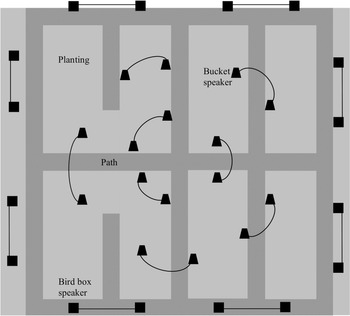
Pleasure Garden’s interactivity was realized, primarily, by Robin Fox, who adapted a multi-person video tracking system he had developed for his own projects. Parallel to this, Atkins and Fox designed an audio system with which they could spatialize the music, placing and moving different musical elements within a thirty-two speaker array (comprising sixteen discrete channels, each assigned to a pair of speakers), arranged in three concentric rings. The installation was first tested in Lambley garden (which, as discussed above, helped to inspire the project). Over several days in October 2015, the team worked to populate the garden with the music made during the earlier stages. From a workstation in the middle of the garden, they experimented with spatialization, volume, and other parameters: a spreadsheet made at the time labels particular sounds with phrases such as ‘pulse concentric ripples’, ‘place carefully’ or ‘low level all buckets’. Lacey recalls, ‘Listening intently, and thinking always about the experience we wanted visitors to have, we decided to balance all levels to the birdsong in the garden.’Footnote 58 Thus the team arrived at a first (but not final) accommodation between the installation's pre-existing aesthetic and the features of the garden setting. They also augmented the installation's infrastructure after finding that the relatively inefficient bucket speakers alone could not effectively fill the garden with sound. Atkins added small, high-quality speakers housed inside wooden bird boxes to form the inwards-facing outer ring of the diffusion system (see Figures 1 and 2; bird boxes also housed the video cameras for the interactive system). Powerful and directional, these ‘bird boxes’ represented a re-importation of hi-fi sound reproduction into the already multifarious mix of hi- and lo-fi aesthetics in Pleasure Garden.
Plan of Lambley Garden showing speaker pairs.

Lambley also highlighted issues surrounding the interactivity after the team invited members of the local community to come and ‘test’ the installation (adding another layer of sociality to the project). As Atkins explained, their original conception involved ‘very localized’ interactivity, so that ‘you could walk down a path and a melody would come with you’, but they abandoned this idea after discovering that ‘People … don't walk linearly … which means that the melody would disappear, because they'd get lost by the cameras.’ On top of this, Bang had reservations that the interactivity might undermine textures that had been carefully composed in the studio – interestingly, a reassertion of the ‘work’ ontology from a team member relatively unconnected to Western art music, perhaps signalling its dispersal into other genres. Nonetheless, the interactivity remained important to Lacey and was expected by the organizers of the Sydney Festival, in which the project would be launched.
The launch saw Pleasure Garden installed in the actual pleasure garden of Vaucluse House, a historic, colonial-era estate in Sydney's affluent eastern suburbs. As mentioned above, this location intensified the project’s association with colonial history: the Vaucluse pleasure garden is home to numerous exotic plant specimens, witness to its participation in nineteenth-century systems of botanical knowledge, trade, and display, which played a key role in the expansion and consolidation of colonial powers.Footnote 59 The pleasure garden setting also entrenched the project's links with colonial-era, bourgeois reception cultures in which such gardens were places of respectable middle- and upper-class leisure and recreation (although also, sometimes, extravagance and spectacle), often directed towards taking pleasure in human control of nature.Footnote 60 Thus the class and colonial associations of the Vaucluse site powerfully shaped the project, yet these were re-inflected by features of the discursive framing of Pleasure Garden, especially the emphasis on sensual, embodied, and attentive orientations towards the music and the garden itself, which are aligned neither with bourgeois principles of restraint nor colonial mastery over nature.Footnote 61 The project's links to gardens in Lacey's family similarly nuance the picture by drawing on traditions of Australian domestic gardening that have a more intimate and ambivalent cultural politics than the gardens of colonial-era estates such as Vaucluse (not least in the gendered association of domestic gardening with women and professional gardening with men).Footnote 62
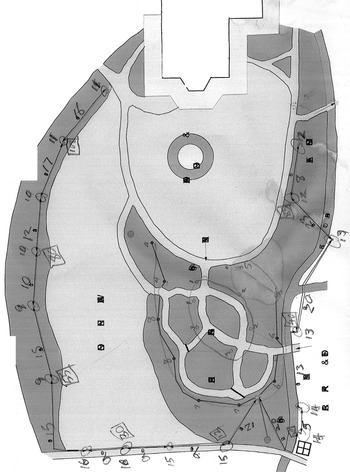
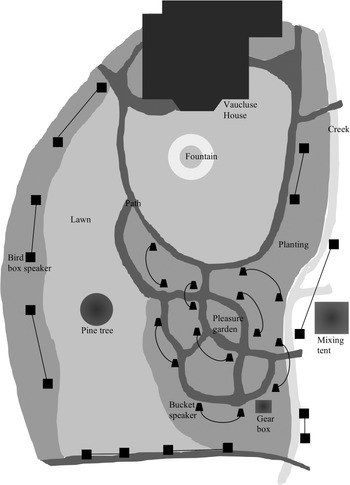
Beyond these dimensions, work installing Pleasure Garden in Vaucluse in early January 2016 also helped to mediate between previously divergent agendas, resolve practical issues, and crystallize the team’s conception of the installation. The spatialization system was replanned for the new site (see Figure 3) and, when they arrived in Vaucluse, several team members remarked on the need for an unexpectedly far-reaching reworking of the piece. When first designing the system, Atkins had imagined that they would simply tweak the mix for different gardens, but ‘subsequently we've come to the realisation that it … has to be remixed for every garden. It's never going to be one mix fits all.’ And where, in Lambley, the focus was on subtlety and balance, the team's sense of the relationship between the project's aesthetic and its site-specificity shifted in Vaucluse. Lacey reflected that she and Bang quickly agreed to make it ‘much less delicate than it had been at Lambley so that it … felt like it suited the drama of that landscape’. The interactivity, problematized in Lambley, finally came to fruition: the team focused on calibrating only the simplest form of interaction – presence in a location triggering a nearby sound – so that it would work effectively. The interactive sounds would supplement, but not fundamentally alter, the underlying composition – effecting a compromise between the fixed work and more flexible ontologies. We repeatedly walked the garden paths – from the mixing tent, positioned just outside the garden, into the pathways of the central garden and up onto the lawn (see Figures 4 and 5) – listening, remixing, and reprogramming.Footnote 63 Together, these highly mobile and site-specific listening practices anticipated those of the installation's future audiences.
Map of Vaucluse garden (excerpt), prepared by Mick Jessop, with hand annotations for Pleasure Garden by Jim Atkins. Reproduced with the permission of Mick Jessop and Jim Atkins.

Plan of Vaucluse garden showing speaker pairs and mixing tent. After Figure 3 and from the author's own notes.

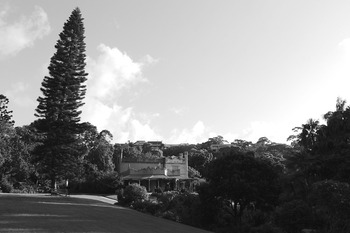
Lawn (left), pleasure garden (right) and Vaucluse House (rear). Photograph by the author.

The Pleasure Garden concerts: negotiating conventions
The Pleasure Garden concerts brought a different set of accommodations with the conventions of classical music. Most notably, where the installations removed live performance, the concerts reinstated it – returning to the convention normally associated with contemporary performances of van Eyck's music. As Atkins reflected, ‘[W]e're not having too many people lining up to take it as an installation, but people line up to get Genevieve [Lacey] to perform and even in what was supposed to be a straightforward installation in Sydney, she still ended up having to perform.’Footnote 64 This situation demonstrates the project's relatively unconventional status, distant from the classical music industry's emphasis on stars and live performance, while also illustrating the team's willingness to adapt to outside expectations and reintroduce conventional practices in order to make the project as a whole viable.
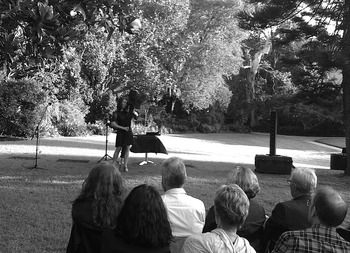
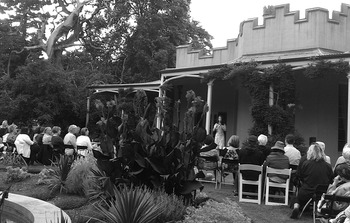
This ambivalence can be seen in the two concerts that marked the launch of Pleasure Garden in Vaucluse in January 2016 (Figures 6 and 7). These took place on the lawn above the pleasure garden and saw Lacey perform several unaccompanied van Eyck pieces and adaptations of Pleasure Garden pieces (with Atkins playing the remaining pre-recorded tracks from his laptop). Both concerts reinstalled certain typical features of Western art music concerts – quiet, stationary audiences watching a live, stationary performer – while retaining the unusual (although far from unprecedented) outdoor setting. Lacey played with modest amplification and added reverb – an effect that was especially noticeable in the unaccompanied van Eyck pieces. The result was somewhat paradoxical: such technological mediation is uncommon in performances of early music, but here it seemed to simulate the reverb of a typical concert hall or the resonant acoustic expected for classical recordings, effecting a slightly uncanny compromise between the unconventional outdoor space and conventional genre-based aesthetic expectations.
The Vaucluse evening concert. Photograph by the author.

The Vaucluse dawn concert. Photograph by the author.

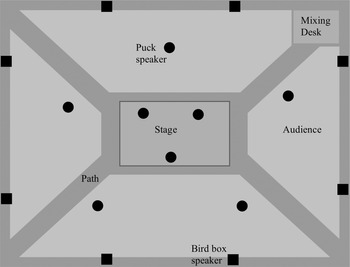
In August 2016, I joined Atkins and Lacey to prepare for the concert version of Pleasure Garden in the Melbourne Recital Centre (MRC). Compared to the Vaucluse concerts, this was a much more substantial attempt to adapt Pleasure Garden to the concert format. The sound design was reworked so that Lacey could play some melodic lines live and Atkins re-planned the speaker array, keeping the three concentric rings, but reducing the number from thirty-two to sixteen. The audience would face a central platform from four sides, leaving four aisles along which Lacey could walk while performing (see Figure 8). The perimeter bird box speakers were retained, now mounted on top of mike stands, but the bucket speakers were replaced with black, disc-like ‘puck’ speakers, which were safer and judged more in keeping with the concert environment.
Plan of Pleasure Garden set-up for MRC Salon concert.

Such accommodations also shaped the remixing phase. While remixing ‘Her Nest’, Lacey suggested moving certain bird sounds out of the perimeter speakers and placing them amongst the audience, in order to ‘try to give everyone their own bird’, rather than creating an ambient wash of birdsong. Thus the intimacy that oriented earlier creative activity was an ongoing concern. Yet the concert setting prompted a concern with high-fidelity sound that had been relatively subdued in the installation. Experience of the acoustic of the MRC Salon – a timber-lined hall seating around 130 people – prompted Atkins to reduce reverb, anticipating that the room would provide its own, and to work on removing noise that would be more audible in the quiet concert space than in the gardens. Cultivating the right atmosphere also extended into the visual domain. Visiting the Salon to discuss logistics and the lighting design with MRC staff, Lacey suggested they needed something that was ‘organic’ and ‘theatrical’ and that retained the ‘immersive’ feeling of an installation.
Finally, the performance itself illustrates multiple accommodations between the project and the conventions of the concert hall. As with other iterations, publically available descriptions of the concert carefully avoided familiar categories: the programme explained, ‘More a state of mind than composition or performance, Pleasure Garden invites an hour of gentle contemplation.’Footnote 65 Atkins prepared a pre-show audio track of birdsong, designed to prepare the mood in advance. The room lights were set low, a spotlight occasionally illuminating the central platform while coloured, slowly shifting textures dappled the walls and floor. The concert was conceived as continuous, lasting around one hour, so several musical transitions were adjusted in order to hold the atmosphere between pieces and across instrument changes. Observing other listeners during the actual performance, I noticed that Lacey's practice of remaining still until the next piece began or, if swapping instruments, moving with visible concentration and without relaxation was key to holding the audience's attention during moments when applause would have been typical. When she played while walking along the aisles, this broke the static, platform-focused format and gave a close-up, intimate experience of the live recorder sound to a few audience members. This walking also had a processional, subtly theatrical function, slightly divergent from standard concert conventions, and, as the programme mentioned, recalled van Eyck playing the recorder while wandering through the Janskerkhof garden in Utrecht. During numbers such as ‘Granite’ and ‘Bermagui Dawn’, for which they had decided to have little live sound, Lacey sat listening at the end of one aisle, occasionally playing short interjections from her seat.
In multiple ways then, the Pleasure Garden concert involved varied negotiations between the project and the wider culture of classical concert performance. Some conventions were necessarily reinstalled (having been absent from the installation) – the live performer, still and silent listening, applause at the end – but these were counterbalanced by other more-or-less subtle reworkings, including the avoidance of labels such as ‘performance’ or ‘composition’, the unbroken nature of the concert, the ‘in the round’ seating, the movement of the performer (substituting for the mobility of the audience in the installation), and the theatrical lighting and immersive soundscape. Throughout, these accommodations were mediated by a performative calibration, absent from the other iterations: the careful curation of audience attention through the presence and actions of a live musician. And some features served, paradoxically, to both rework and intensify concert norms: the extended sections without any live sound, where Lacey sat within the audience, at once blurred the boundaries between concert and installation, and between performer and audience, while also figuring Lacey as an exemplary still and silent listener.
The Pleasure Garden album: between project and industry
Examining the Pleasure Garden album sheds further light on the project's accommodations with classical music. Various aesthetic concerns that guided the composition and installation stages persisted into the mixing of the album. Lacey and Atkins worked initially with the fully spatialized Lambley mix, often making references to decisions and discoveries made ‘in the garden’ and hoping to carry the installation's strong ‘sense of place’ into the album. As this was gradually converted into a stereo mix, they adjusted reverb, volume, and spatialization to make sounds feel close, distant, or mobile. Bang, sending feedback from Norway via email, often encouraged them to reduce reverb levels and several times asked for birdsong to be removed. Both suggestions were in keeping with ideas about (de)humanization and naturalness that oriented earlier stages in the creative process and, at the time, Lacey commented that she found Bang's ‘unsentimental’ approach a helpful counterbalance to her usual, more romantic, tendencies, in which warm reverb and ambient birdsong were comparably welcome.
Nonetheless, her instincts – and wider classical music conventions – did sometimes reassert themselves. While mixing ‘Bermagui Dawn’, Lacey commented that she was ‘sitting on her hands’ to stop herself fixing technical details of her recorder playing. She knew that the track was meant to be a ‘collage’ rather than a pristine performance, but at the time half-jokingly remarked that it might get her ‘into trouble in the recorder world’. Improvisatory playing done on the fly in Bang's studio was cast in a new light by the prospect of commercial release, with its different aesthetic ideals and the potential for more critical listening publics. Eventually they cut or softened a few fragments where Lacey felt unhappy with her playing, but left much of the track intact. Meanwhile, much of Atkins's attention was directed towards technical concerns aimed at maximizing sound quality. He too had to compromise on some details, especially where Bang's improvisatory studio practices had introduced leakage between recordings that proved difficult to remove. In these ways, prior creative decisions and various imagined future listeners haunted the mixing process. During the final stages, we sat in silence listening repeatedly to the full recording, seeking out tiny flaws in sound quality and checking the balance between tracks. Such listening reinstalled – and in its concentration and technical expertise intensified – conventional listening practices that were largely absent from the installation (although partially resurgent in the concerts), namely the ‘silent, self-disciplined, contemplative and interiorised spectatorship’ so central to Western art music.Footnote 66
Despite such accommodations, the team were well aware that the album version did not fit neatly into conventional expectations about classical music recordings. While mixing ‘Whipbird’, with its shrill whistles and strange bird calls, Atkins and Lacey joked about the track ‘going to number 1’ or getting airtime on a well-known classical music radio show. Such comments humorously acknowledged the uncertain commercial prospects of the Pleasure Garden CD, with its unusual and occasionally uncompromising aesthetic – and they complicate any straightforward reading of Pleasure Garden exclusively in terms of the calculating model of musical entrepreneurship discussed above. Lacey and Atkins were, nonetheless, under pressure to finish both the album and a short promotional video in time for the launch of the installation in Vaucluse. Together, these iterations worked to cross-promote each other: the mediated versions of the project were able to circulate widely, while the Sydney Festival launch provided a prestigious and tangible event. In short, while some activities were clearly oriented towards entrepreneurial ends (e.g., promotion), this was not the only logic guiding their work – at times, aesthetic goals seemed to take precedent, even where following an aesthetic choice to its logical conclusion provoked slight anxieties around commercial viability.
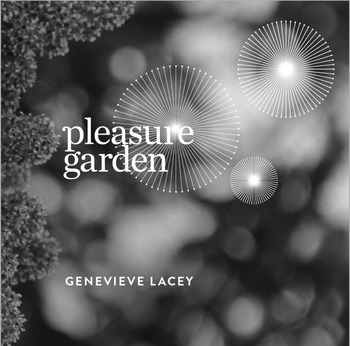
The issuing of the Pleasure Garden CD on the ‘ABC Classics’ label sets the negotiation between project and industry in still starker relief. This fixing of the album’s genre (soon after its release I chanced upon a copy in a well-known music and bookshop in Melbourne, shelved under ‘Classical New Releases’) clearly departs from the more plural and unconventional genre-affiliations cultivated elsewhere in the project. In addition, only Lacey's name appears on the front of the album (Figure 9), thus partially reinstalling classical music's individualism and conventional creative hierarchies through an emphasis on the star performer.Footnote 67 Paradoxically, the Pleasure Garden CD, which the team consider the project's least definitive iteration, is also its most durable and accessible (through commoditization) and the most closely identified (via copyright) with its authors. The concerts and installations had looser economic-legal ties to their makers, but much stronger personal and artistic ties.
The Pleasure Garden album, front cover. Reproduced with the permission of Genevieve Lacey.

The album is not, however, a straightforward concession to the norms of classical music marketing, but something more ambivalent. The focus on Lacey’s name on the album cover was, at least initially, made at Bang's instigation: he was happy to foreground his role as producer for that iteration. Nonetheless, the CD reverse provides composition credits for individual tracks (to various combinations of Bang, Lacey, Atkins, and van Eyck). Thus Bang's presence as ‘co-composer, producer’ and Lacey's as ‘recorder [player], co-composer’ (as credited in the liner notes) are felt differentially across the album.Footnote 68 Similarly two-sided is the mention in the liner notes of Lacey's ‘companionship’ with van Eyck and the explanation that her love of gardens was forged in her mother's garden.Footnote 69 On the one hand, this emphasis on Lacey's biography could be seen to fold a sense of non-capitalist social relations back into the impersonal market commodity, framing it in terms of both personal and historical relationships and inheritances.Footnote 70 Likewise, description of the recording process acknowledges the personal investments at stake in the team's creative labour and their links to communities in Bermagui and Lambley, perhaps downplaying the alienated and privatized nature of a mass-produced, copyrighted recording.Footnote 71 The liner notes also clearly avoid typical ‘singularising’ tropes such as highlighting Lacey's virtuosity or van Eyck's status as a ‘great’ composer.Footnote 72 On the other hand, such moves could represent an alternative means of imbuing the commodity with value by ‘insert[ing] representations of unalienated labor and social relations to make the commodity seem like a gift again’,Footnote 73 as well as signalling the ‘increasingly blurred boundary between private and professional life’ in musical entrepreneurialism.Footnote 74 Such ambiguities will remain undecidable, not only because they result from a complex authorial process involving record labels and promoters as well as the Pleasure Garden team, but also because artists’ self-representations are rendered unstable by the ongoing discursive appropriations and adaptations of capitalism and neoliberalism.Footnote 75
Remaking classical music
Following Pleasure Garden from its multiple inspirations to its multiple iterations is a lesson in the complexity of artistic creation. During its diffuse transition from of-the-world to in-the-world, Pleasure Garden was repeatedly recalibrated. In Ortner’s terms, the project, oriented by ‘local logics of the good … and how to pursue them’,Footnote 76 rubbed up against wider power structures, namely the dominant conventions of classical music at large. These conventions were, in part, anticipated by the creative team themselves rather than imposed by others – Pleasure Garden involved negotiations between local project and wider culture, not a collision between artistic integrity and the demands of an outside world. My aim has been to explore the play of power and values at stake in that creative trajectory.
Pleasure Garden’s reworkings of classical music conventions are diverse and interconnected. It participates in a broad tradition, primarily associated with sound art, experimental, and electronic music, aimed at ‘reconfiguring the musical division of labour through experiments in composer-performer-audience relations’.Footnote 77 Its thoroughly (socially and historically) decentred approach to authorship and creative agency also eschewed ‘modern possessive individualism’ more broadly.Footnote 78 Notions of fixity, reproducibility, and textuality associated with the ‘work concept’ were also unsettled: no definitive version of the project exists and the installation has to be remade for each new site. Pleasure Garden contains many ‘retentions’ of earlier worksFootnote 79 – Der Fluyten Lust-Hof, Wallworth's Still/Waiting 2, several versions of Bayaka songs, Helena Tulve's compositions – and so has genre-crossing ties to, amongst others, early music, video art, world music, new music, and sound art. Its hybrid sound design also reworks conventions: warm, resonant, hi-fi sounds typical of ‘classical’ music combine with other aesthetics – dry, close-miked, lo-fi – that emphasize bodily intimacy and technological mediation. Pleasure Garden’s reworkings are, of course, far from unprecedented, but their unusual relationship with dominant practices is notable. Georgina Born's discussion of Lydia Goehr's ideas about experimentalism and the work concept provide a useful counterpoint here. She notes that:
experimental music in its various manifestations – Cageian chance operations, Fluxus-like performance art and happenings, and Max Neuhaus-type sound installations – is … charged by Goehr with productively undermining the work ideal. Yet, astutely, she [Goehr] notes how these post-modern experiments, in their antagonistic protest, were caught up in a paradoxical intimacy with the very terms of the romantic and modernist work ideal.Footnote 80
Pleasure Garden, I suggest, effects a different, although equally ambivalent, intimacy, conciliatory rather than antagonistic, valuing that which it seeks to remake. It is for this reason, perhaps even more than the centrality of van Eyck to the project and Lacey's strong affiliation with Western art music, that I treat Pleasure Garden as reworking ‘classical music’, as it were from the inside, rather than as an inheritor of an experimentalist tradition positioned outside the mainstream (even though it revisits many of that tradition's ontological and performative concerns). Accordingly, the team's narrations of the project's creative genealogy drew inspiration not from experimentalist iconoclasm, but from a more eclectic lineage, reaching beyond music and back to earlier historical periods, which instead emphasized historical continuities, creative bricolage, recontextualization and remediation.
Importantly, then, even during its most unconventional stages, Pleasure Garden’s reworkings were gentle rather than inherently oppositional. Indeed, many of the features discussed here – multi-sited creative processes, reliant on collaboration, improvisation, and reworking older musical material, and aimed at producing immersive, multi-sensory experiences – are exemplary of the creative processes underlying much commercial popular music.Footnote 81 They are, nonetheless, unconventional within the wider cultures of creativity underlying classical music, where single-authored composition of original works, authoritative performance of a canon, and disciplined concert listening are the norm. Thus practices that are normative in one context or genre may be non-normative (oppositional, subversive, but also just subtly different) in another. In addition, the contradictions of musical capitalism lend even apparently conventional creative practices a certain autonomy. Jason Toynbee suggests, for instance, that pop musicians retain a surprising degree of creative independence, because ‘institutional autonomy’ is built into the structure of the pop music industry, due to factors including the ‘cult of authorship’ and the difficulty of predicting success amid ‘the massive oversupply and indiscipline of musical labour’.Footnote 82 Thus the creative reworkings that shaped Pleasure Garden were undergirded by two, seemingly contradictory, factors: first, the presence of this culture of ‘institutional autonomy’ throughout the music industry; second, because support from public institutions freed the project from stringent market logics. Indeed, the project's iterations were as diverse as the wider economic logics of classical music, involving institutional patronage and entrepreneurial diversification, as well as commodification, private consumption, and concert revenue: it was part-supported by large institutions, but remained largely musician-driven; the installations were (like much sound art) free to attend and situated in public space; two of the concerts were ticketed, one was free; the album was a commodity, yet one with uncertain commercial prospects. The fact that creative experimentation can be afforded, paradoxically, by both commercial and public institutional support highlights my argument that cultures of creativity are never monolithic or homogeneous, but full of internal tensions, and that individual projects cannot be reduced to these wider cultures. Pleasure Garden is not, then, simply an example of the neoliberalization of Western art music nor its increasing alignment with late capitalism. Parts of the project – especially its entrepreneurial trajectory and diversification across media – were, indeed, symptomatic of neoliberalism. Others – the ‘slow’, emergent, and often uncertain, creative process, and the attempt to cultivate similarly ‘slow’ and careful reception practices – self-consciously distanced the project from neoliberal and capitalist agendas, which prioritize speed, efficiency, and rationalization.Footnote 83
When pulled back towards classical music's centre ground, the team reinstalled certain conventions and played with others, oscillating between the cultural logics of classical music and their own, sometimes conflicting, creative commitments. By examining various stages and dimensions of the project, I have argued that it neither simply opposed nor reproduced the culture of creativity associated with classical music, but rather had a more elusive, ambivalent relationship. As Ortner puts it, ‘social actors, through their living, on-the-ground, variable practices, reproduce or transform – and usually some of each – the cultures that made them’.Footnote 84 Tracing the many issues at play in the creation of Pleasure Garden suggests that it represented both a gentle challenge to and a participation in the cultural norms of the classical music industry. Indeed, this position arguably mirrors the wider ambivalence – sometimes discussed in terms of a ‘crisis’Footnote 85 – in classical music as it responds, in varied and sometimes contradictory ways, to the economic pressures and cultural ideologies of neoliberalism.
A story-telling impulse helped the team to negotiate this ambivalent position. Clarke, Doffman, and Timmers identify a related impulse in much collaborative work, which both ‘makes and feeds upon its own micro-historical context’ as well as participating in and using longer traditions to fuel creative work.Footnote 86 Noticing and narrating historical continuities and surprising aesthetic convergences helped team members to navigate the emerging project, and the surrounding documentation served to publicly narrate many of its commitments to biography, sociality, place, and history. The incorporation of field recordings from Bermagui, Utrecht, Kristiansand, and Vaucluse has the strange effect of making the creative process (for listeners primed by the documentation) an unusually audible presence in the finished iterations. Track titles became, as Lacey put it, ‘signposts to things or people or experiences … that somehow shaped’ the project. In ways overt and implicit, sonic and discursive, Pleasure Garden re-presented its own creative process. This importation of a reflexive concern with process into Western art music is yet another reconfigurative move, mirroring what Waters identifies as a wider resurgent concern with narrativity in sound art since the 1980s, including with ‘documentation of [the] compositional process’.Footnote 87
In describing Pleasure Garden’s relationship with classical music, my analysis makes explicit a set of commitments that were largely implicit and enacted. Lacey made no claims to ‘revolutionize’ classical music; the team did not self-consciously attempt to challenge normative creative practices, subvert neoliberalism, or somehow evade capitalist structures; they were there to make something and, as professional musicians, they set out to create a commercially viable project. And yet, Pleasure Garden clearly attempted to do something subtly different. This subtlety matters here, because otherwise our theorization of creativity is caught, metaphorically, between a rock and a hard place, where all continuity of practice is understood as inherently conservative, and so complicit with cultural hegemony, and all changes in practice are understood as ‘innovative’, and so complicit with capitalist imperatives. My aim here has been for a more nuanced theorization.
Pleasure Garden is one of many projects to have emerged during the historical intersection of Western art music, capitalism and neoliberalism in the late twentieth and early twenty-first centuries.Footnote 88 Where other studies discuss the alignment of classical music with, on the one hand, neoliberal and, on the other, socio-political or activist agendas,Footnote 89 Pleasure Garden offers a more intermediate position: it is neither critique nor apologia, protest nor entrenchment, but a gentle reworking of widespread economic and cultural forms. Pleasure Garden’s complex accommodations help us understand classical music not as a singular, coherent system, but as a heterogeneous and sometimes internally contradictory culture.Footnote 90 Individual artistic projects may bring only small cultural shifts,Footnote 91 but they nonetheless participate in a contingent historical formation – one that is not only shaped by the complex articulation of Western art music, neoliberalism and late capitalism, but also animated on the ground by diverse projects of world-making. This is not to downplay classical music's institutional stability and hegemony, but to argue for making it, to borrow Tsing's phrase, ‘something more than an object of contemplation or refusal’.Footnote 92 At the same time, this means recognizing individual artistic projects as irreducibly distinctive, perhaps especially those more modest or subtle interventions, which neither simply ‘reproduce’ nor ‘resist’ cultural norms, but repeatedly remind us of the double meaning, the combination of conservatism and inventiveness, inherent in the word ‘remaking’. Projects such as Pleasure Garden re-create the cultures of creativity in which we work, revealing both their power and the possibility of making things otherwise.