Introduction
Over the last decade, attention for measuring and describing the needs of people with dementia and their caregivers has increased. Despite the availability of many care and welfare services, the needs of people with dementia and their caregivers are not always met (Miranda-Castillo et al., Reference Miranda-Castillo, Woods and Orrell2013). One of the most frequently reported unmet needs among people with dementia and their carers (Van der Roest et al., Reference Van der Roest2009; Black et al., Reference Black, Johnston, Rabins, Morrison, Lyketsos and Samus2013) is the need for information about available care and welfare services matching individual needs, and about dementia symptoms. Informal carers also want more coordination of care and emotional support (Zwaanswijk et al., Reference Zwaanswijk, Peeters, van Beek, Meerveld and Francke2013).
Variation, fragmentation and continuous changes in regional care services, makes it difficult for clients and referrers to find appropriate care for their needs. They tend to utilize only familiar and established services, instead of the broader spectrum of available services (Van der Roest et al., Reference Van der Roest2009). As a consequence, more specific individual needs often remain unmet. Another cause for unmet needs is that people are not willing to use services, because they consider them not attuned to their wishes (Van der Roest et al., Reference Van der Roest2009). Poor control over and difficulty getting information on services and unmet needs in general are predictors of dissatisfaction and lower mortality among carers (Raivio et al., Reference Raivio2007).
As the number of people with dementia will double in the coming decades (Prince et al., Reference Prince, Prina and Guerget2013), and as the professional care resources will not increase proportionally, the number of unmet needs is also expected to further rise in the future. In the Dutch FrUX project, a possible solution for this problem was developed named DEM-DISC (Dröes et al., Reference Dröes2005). DEM-DISC is a DEMentia-specific Digital Social Chart that provides information on health and care services, tailored to the needs of people with dementia and carers, and is easy accessible, anywhere and anytime (Dröes et al., Reference Dröes2005). DEM-DISC aims to offer better self-management opportunities for informal carers, and better disease management opportunities for professional caregivers. The system helps people manage their own care and support by guiding them in clarifying their needs and providing them with customized answers about potentially relevant care services in their region that may fulfill these needs.
A small controlled pilot trial with the first prototype of DEM-DISC showed positive results (van der Roest et al., Reference van der Roest, Meiland, Jonker and Dröes2010). At post-test people with dementia and informal carers in the DEM-DISC group reported less unmet needs and more met needs as compared to the controls. Informal caregivers in the DEM-DISC group also reported higher levels of competence afterwards than the control group. However, they felt the prototype could be more customized.
The present study focused on further developing and evaluating DEM-DISC with the aim to improve self-management and disease management in dementia by attuning care advices to individual needs. The main aim was to evaluate the effectiveness of DEM-DISC on informal carers and people with dementia. Our second aim was to investigate its user-friendliness and usefulness among informal caregivers of people with dementia and case managers who provide care coordination and continuity of care in community-dwelling people with dementia. Last, we investigated which facilitating and impeding factors are expected to influence the further nationwide implementation of DEM-DISC.
Method
Design
This study consisted of two phases: in the first, the DEM-DISC was adapted and made more customer directed based on a recent literature review on personalized dementia care and the abovementioned pilot study. In phase 2, we evaluated DEM-DISC by (a) studying the effects on informal caregivers and people with dementia in a cluster randomized trial; (b) by testing the user-friendliness and the usefulness of DEM-DISC among participants in the intervention group and (c) by investigating the conditions for its successful implementation. In other words, we used a mixed methods design to evaluate DEM-DISC.
Design phase 1
DEM-DISC provides several services for informal caregivers and case managers. First, it helps users to formulate their needs for care and support. This is done by showing several standard starting questions that enable users to select the most appropriate need. After this first choice, users are guided via a tree structure of questions to a specific demand for care and support. Second, it gives advice on (combinations of) care and support that may meet the identified needs of individual people with dementia and informal caregivers (such as an advice to go to a day care center which also requires an indication from the Care Assessment Centre (CIZ). Information on how this indication can be obtained is also provided in DEM-DISC). DEM-DISC provides answers attuned to the users’ personal characteristics that are also context relevant, based on information that users can fill in on their personal page. Last, DEM-DISC provides links to relevant (regional and national) dementia care related organizations for people with dementia and carers. The prototype of DEM-DISC, which focused on only a few problem areas in the early phases of dementia, was adapted and improved. First, the starting questions in DEM-DISC were expanded to include questions and/or problem areas that are relevant in all phases of the disease. The starting questions were attuned to the fourteen problem areas identified in the Dutch the National Dementia Program (Meerveld et al., Reference Meerveld, Schumacher, Krijger, Bal and Nies2004). Second, the information on the available care and welfare offer in DEM-DISC (Amsterdam Zuid) was complemented with information regarding the offer in the regions that were included in the present study (i.e. Amsterdam Zuidoost, Amsterdam Nieuw-West, regions of Lelystad and Amstelveen). Third, the personal page was elaborated and more questions were added regarding personal characteristics or context information, with the aim to improve customization of recommendations on relevant health, care and welfare services for people with dementia and their carers. In the first prototype, the users were asked to provide the following information: zip code, availability of own transportation, age, possibility to receive care during the day or in the evening. A literature review was performed (Van Mierlo et al., Reference Van Mierlo, Van der Roest, Meiland and Dröes2010; Reference Van Mierlo, Meiland, Van der Roest and Dröes2012) to study which other characteristics might be relevant to add in DEM-DISC, by assessing which characteristics of people with dementia and/or carers are significantly related to positive outcomes of care and support interventions. Based on this review, we added the following questions on the personal page: severity of dementia, living situation (caregiver and person with dementia living together or not), preferred maximum travel distance to care and support services. Last, the software was adapted to better attune the recommended services to the personal situation and context of the user, for instance gender and age of the informal caregiver or person with dementia.
Design phase 2
In phase 2, the DEM-DISC was evaluated as part of the COMPAS study (Macneil-Vroomen et al., Reference MacNeil-Vroomen2012). A cluster RCT design was used with measurements at baseline, after 6 and 12 months to test DEM-DISC among informal carers and professional carers. Computerized randomization was performed on case manager level (cluster-randomization) and stratified by region (four regions) and caseload (low or high). Allocation concealment was performed (by the primary researcher) on cluster level by assigning each participating case manager with an allocation number, after which computer software randomly determined which number was allocated to the experimental group and which number to the control group.
To investigate the user-friendliness and usefulness of DEM-DISC and to trace facilitating and impeding factors of implementation of DEM-DISC, a process evaluation was conducted in the intervention group during the intervention study. The process evaluation had a qualitative design with semi-structured interviews with informal carers, case managers, and other relevant stakeholders respectively.
Setting and participants
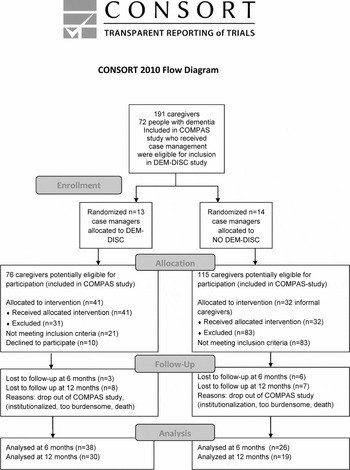
This study, which was conducted within the framework of the COMPAS study (a study into the effectiveness of different models of case management; MacNeil-Vroomen et al., 2013) was carried out among informal caregivers of people with dementia and case managers in several regions in the Netherlands (Amsterdam Zuidoost, Amsterdam Nieuw-West, regions of Lelystad and Amstelveen). Informal caregivers and people with dementia were recruited through the case managers in these regions who participated in the COMPAS study (see Figure 1). Inclusion criteria were: informal caregivers of people with dementia living at home who (i.e. the caregiver) have a computer with internet possibility and knows how to use it. Exclusion criteria were: the caregiver is not able to understand or read Dutch, and anticipated nursing home admission of the person with dementia within six months.
Flow chart of inclusion.

A power analysis was conducted to assess the required sample size. The analysis was based on the CANE. The planned sample size was set at 2×64 caregivers. To take into account clustering of caregivers within case managers, we assumed an intra-class correlation (ICC) of 0.05 and an average cluster size of 5 (meaning that 26 case managers had to be randomized). The planned sample size yields a power of 70% to detect a medium standardized effect size, i.e. a Cohen's D of 0.5, for the primary outcome, and 85% power to detect a standardized effect of Cohen's D of 0.6. To account for drop-out rate of 8%, a total number of 138 were needed.
Ten stakeholders were purposively selected from nine organizations in the region of Amsterdam for the process evaluation into facilitating and impeding factors of implementation of DEM-DISC. Stakeholders interviewed for the process evaluation who had used DEM-DISC were an informal caregiver and a case manager, as well as the director of the ICT Company who developed DEM-DISC. To obtain a wider perspective from potential future partners and care professionals in the dementia care network about the feasibility of (regional and national) DEM-DISC implementation, we also interviewed the following stakeholders: a director of another ICT research and development organization, a project leader of a dementia care network, a project coordinator of a meeting center for people with dementia and one representative of the municipality, the Alzheimer Center, the Municipal Health Service and a welfare organization.
Intervention
Case managers from the experimental group had access to DEM-DISC and they could use it to assist them advise their clients on care and welfare services that were relevant for them. Their clients (informal caregivers of people with dementia) had unrestricted access to DEM-DISC at home for a period of one year. Participants in the control group did not have access to DEM-DISC. They had access to the regular information channels (e.g. via the GP, brochures etc.) and were advised by case managers who did not have access to DEM-DISC.
Measuring instruments
Background characteristics
To describe the characteristics of the people with dementia (e.g. age, gender, education, living situation, multi-morbidity, IADL), we used the Minimum Dataset (MDS-care receiver) developed by the Dutch National Care for the Elderly Programme to promote the gathering of uniform information on a large sample of older persons and caregivers (Lutomski et al., Reference Lutomski2013). The severity of the cognitive problems was assessed with the mini-mental state exam (MMSE; Folstein et al., Reference Folstein, Folstein and McHugh1975). Background characteristics of the informal carer (e.g. age, gender, relationship with person with dementia, living together with person with dementia or not and perceived health) were assessed by means of the MDS-caregiver.
Primary outcome measure
The primary outcome measure of this study was needs of people with dementia as reported by informal caregivers, measured by the Dutch version of the Camberwell Assessment of Needs for the Elderly (CANE, Dröes et al., Reference Dröes, van Hout and van der Ploeg2004α = 0.99, test–retest reliability: between 0.66 and 0.84; Reynolds et al., Reference Reynolds2000), The CANE consists of 24 domains of daily living and assesses if respondents have needs and, if so, whether these needs are met or unmet. Three scores can be derived from the CANE, one for total needs, met needs and unmet needs.
Secondary outcome measures
For people with dementia, secondary outcome measures were: quality of life (Qol-AD; Thorgrimsen et al., Reference Thorgrimsen2003; EQ5D+c, Wolfs et al., Reference Wolfs, Dirksen, Kessels, Willems, Verhey and Severens2007) and neuropsychiatric symptoms as measured by the Neuropsychiatric Inventory (NPI, α = 0.88; Cummings et al., Reference Cummings, Mega, Gray, Rosenberg-Thompson, Carusi and Gornbein1994). For informal caregivers, secondary outcome measures were feelings of competence as measured by the Short Sense of Competence Questionnaire (SSCQ; α = 0.76; Vernooij-Dassen et al., Reference Vernooij-Dassen, Felling, Brummelkamp, Dauzenberg, van den Bos and Grol1999), quality of life (EQ5D+c, Wolfs et al., Reference Wolfs, Dirksen, Kessels, Willems, Verhey and Severens2007) and the stress caused by neuropsychiatric symptoms in people with dementia (NPI, Cummings et al., Reference Cummings, Mega, Gray, Rosenberg-Thompson, Carusi and Gornbein1994). Furthermore, the user-friendliness, usability and satisfaction with DEM-DISC were assessed with the USE Questionnaire (Lund, Reference Lund2001) in both the informal carers and case managers, and some additional questions were emailed to informal caregivers only. The USE questionnaire contains four components: “usefulness,” “ease of use,” “ease of learning,” and “satisfaction.” Questions are scored on a five-point scale (range 1–5, lower scores indicate a more positive outcome).
Procedure
The recruitment and informed consent procedure took place within the framework of the COMPAS study. Case managers were approached and asked to participate via the project leaders of the dementia care networks. The names of case managers willing to participate, together with data about the caseload were given to the researcher who then assigned the case managers within each participating region randomly to the group with access to DEM-DISC (experimental group) or to the group that did not have access to DEM-DISC (control group). All these case managers offered regular collaborative dementia care management. During an introduction meeting, case managers received information about DEM-DISC and instructions on how to introduce the DEM-DISC study to their clients (informal caregivers). When informal caregivers agreed to participate (and had signed an informed consent form), they were given a username and password, with which they could log in to DEM-DISC at home. Both informal caregivers and case managers received an instruction manual on DEM-DISC and a telephone number of a helpdesk that they could call during the intervention period with any questions or problems regarding the use of DEM-DISC. Instruction on how to use DEM-DISC at home was available to informal caregivers if they wanted it.
During the whole intervention period, the usage of the DEM-DISC was logged. The participants were interviewed at home by researchers of the COMPAS study. The data collected through the interviews and questionnaires at pre-test, after 6 and 12 months follow-up were used for the DEM-DISC study. Furthermore, informal caregivers filled in a questionnaire they received via email to evaluate the DEM-DISC. This questionnaire incidentally was conducted by telephone.
The case managers were interviewed by telephone after six months. Stakeholders were interviewed on the implementation of the DEM-DISC using semi-structured interviews. The interview schemes were based on a theoretical model for adaptive implementation that was developed in the previous research (Dröes et al., Reference Dröes2003; Meiland et al., Reference Meiland, Dröes, Lange and Vernooij-Dassen2004).
Analysis
SPSS 20.0 (2011) was used to analyze the data. Characteristics of informal caregivers and people with dementia were summarized by descriptive statistics. To test for differences between the experimental and the control group, χ 2 tests, Mann–Whitney U-tests and t-tests were conducted. A two-sided significance level of 0.05 was used in all statistical analyses. The effect of DEM-DISC use on outcomes was estimated using generalized estimating equations (GEE). GEE are an extension of standard regression techniques that can take into account the correlation between observed outcomes due to clustering of observations. In our study, people with dementia and informal caregivers were clustered within case managers that supported them. To take into account the cluster effect in the analyses, we used the exchangeable correlation structure, assuming equal correlations between outcome measures for all caregivers supported by the same case manager.
In case of continuous outcomes, the regression coefficients (β) are reported together with their 95% confidence intervals (95% CI). For dichotomous outcomes, the exponentiated regression coefficients, or odds ratios, are reported together with their confidence interval. Analyses were performed in three steps. In the first step, the primary and secondary outcome measures were regressed on the variable DEM-DISC use only (unadjusted analyses). In the second step, potential confounders were separately added to the models to check if this addition caused the regression coefficient of DEM-DISC to change by more than 10%. In that case, the factor was considered a confounder. In the third step, a corrected estimate for the regression coefficient for DEM-DISC use was estimated by performing a GEE analyses that included all confounders identified for that particular outcome.
Descriptive statistics were used to analyze data on the use, usefulness and user-friendliness of DEM-DISC. Qualitative data about the evaluation of DEM-DISC based on the emails and telephone interviews were summarized and described.
The semi-structured interviews with stakeholders to trace facilitators of and barriers to implementation of DEM-DISC were transcribed verbatim and entered into the qualitative computer program Atlas-ti. Member checks were conducted by the interviewer at the end of each interview by checking and re-confirming the accuracy of important statements made by stakeholders. The data were analyzed using the directed content analysis method (Hsieh and Shannon, 2005). A predefined coding scheme was used with potential barriers and facilitators in different phases of the implementation process and on different levels (micro, meso, macro) that could be elaborated when considered relevant. Codes were assigned to text sections by two assessors, following a pre-established coding scheme based on the study of Meiland et al. (2005) (deductive method). When considered necessary, new codes were added to this scheme (inductive method). All codes were discussed by the independent coders until consensus was reached. All thematic extracts were inventoried, analyzed, and summarized. Finally, the results were discussed in the project group.
Results
Sample characteristics and potential confounders
Figure 1 presents the flow chart. Case managers from participating DEM-DISC regions were randomized. Thirteen case managers were allocated to the experimental group and had access to DEM-DISC. From the caseload of 11 of these case managers, a total of 41 informal caregivers and 23 people with dementia were recruited, who all completed the baseline interview. Two case managers in the experimental group were not able to recruit participants, because all eligible carers in their caseload refused to participate in the study.
Fourteen case managers were allocated to the control group and continued their work as usual. From the caseload of eight case managers, a total of 32 informal caregivers and 15 people with dementia were recruited. No participants were recruited for the control group from six case managers, because none of the informal caregivers they supported were eligible for the study.
Reasons why informal caregivers dropped out after completing the baseline interview were: high burden, and nursing home admission or death of the person with dementia.
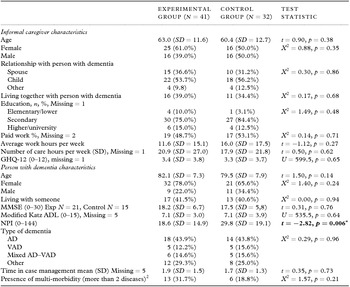
The socio-demographic characteristics of the respondents at baseline are described in Table 1. We found a significant difference between the experimental and control group on the number of neuropsychiatric symptoms as measured with the NPI, with more neuropsychiatric symptoms in the control group (t = −2.82, p = 0.006). As the presence of these symptoms can potentially influence the outcomes measures (potential confounder), the total NPI baseline score was included in the GEE analyses as a covariate.
Baseline characteristics of respondents

Note: Significant differences are given in bold (p < 0.05).
1The underlined score of the range indicates a positive outcome on that measure.
2These scores were dichotomized.
GHQ-12; general health questionnaire, NPI = neuropsychiatric inventory.
Primary and secondary outcomes at six months
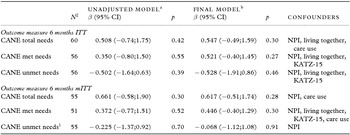
Table 2 presents the beta coefficients for the unadjusted model and the corrected model, including covariates for the primary outcome measures at six months. The table shows outcomes based on the intention to treat and the modified intention to treat analysis (mITT; Abraha and Montedori, Reference Abraha and Montedori2010). The modified intention to treat analysis comprised all informal caregivers who logged in and used DEM-DISC at least once. These were 36 informal carers of the total group of 41 caregivers in the experimental group who completed the baseline interview. This means that 5 informal caregivers from the experimental group were excluded in the mITT. Because the total number of unmet needs was skewed with a high frequency of zero counts, this variable was dichotomized into categories “no unmet needs” and “at least one unmet need.” The intention to treat analyses showed no differences between the experimental and control group on the primary outcome measure at six months: care needs of informal caregivers. Also, no significant differences were found between the experimental and control group on the secondary outcome measures as reported by informal caregivers, i.e.: sense of competence, quality of life, emotional distress due to neuropsychiatric problems and quality of life of people with dementia. However, at six months, there was a significant effect for the number of neuropsychiatric symptoms (p = < 0.001) including the number of neuropsychiatric symptoms at baseline, and relationship between the person with dementia and informal caregiver as confounders. Compared to the control group, the mean score on the neuropsychiatric inventory questionnaire in the experimental group was estimated to be 8.56 (95% CI: 5.46; 11.66) points higher after six months.
Generalized estimating equations of primary outcome measures at 6 months

aUsing generalized estimated equations (GEE) adjusted for clustering of caregivers within case managers. A positive beta coefficient indicates a higher mean score in the intervention group.
bIncluding covariates.
1Scores for total unmet needs were dichotomized. Odds ratio effect for ITT and final model = 0.590 (95% CI: (0.15; 2.36)); Odds ratio effect for mITT and final model = 0.935 (95% CI: (0.30; 2.94)).
2Number of included participants in the final model.
The modified intention to treat analyses showed no significant effects at six months for primary and secondary outcome measures. The sample of people with dementia in both groups was too small (n = 19 in experimental group, and n = 9 in control group) to perform statistical analyses on any of the outcome measures of people with dementia.
Primary and secondary outcomes at 12 months
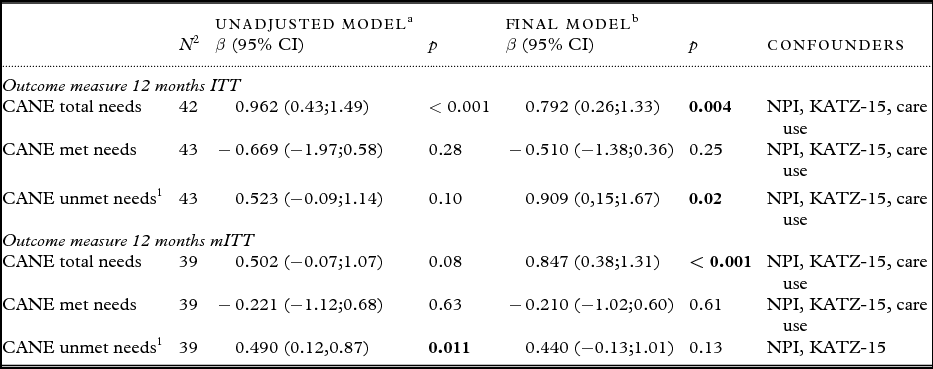
Table 3 presents the beta coefficients for the unadjusted model and the corrected model including covariates for the primary outcome measures at 12 months. This table shows outcomes based on the intention to treat and the modified intention to treat analysis.
Generalized estimating equations of primary outcome measures at 12 months
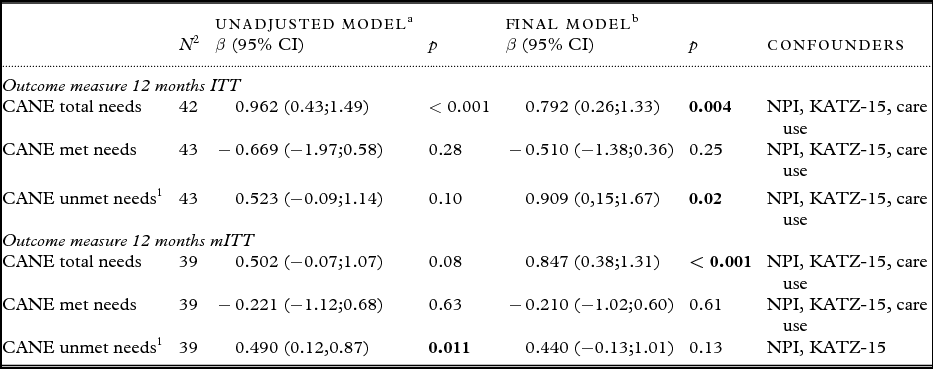
aUsing generalized estimated equations (GEE) adjusted for clustering of caregivers who received care from 19 case managers.
A positive beta coefficient indicates a higher mean score in the intervention group.
bIncluding covariates.
1Scores for total unmet needs were dichotomized. Odds ratio effect for ITT and final model = 2.48 (95% CI:(1.17; 5.29)), Odds ratio effect for mITT and final model = 1.55 (95% CI: (0.88;2.74)).
2Number of included participants in the final model.
Intention to treat analyses showed a significant difference between the experimental and control groups on total care needs (p = 0.004) and total unmet needs (p = 0.02). Mean number of total needs reported after 12 months was estimated to be 0.792 (95% CI: 0.26; 1.33), points higher in the experimental than in the control group after 12 months. The proportion of caregivers reporting at least one unmet need at 12 months was larger in the experimental group compared to the control group (69.0% vs. 47.4%; OR = 2.48, 95% CI: 1.17; 5.29).
On the secondary outcome measures, an effect was found on the sense of competence of caregivers (p = 0.03). In the experimental group, the mean competence score after 12 months was 1.034 (95% CI: 0.12–1.71) points higher than in the control group. This indicates a higher sense of competence in the experimental group after 12 months compared to the control group.
The modified intention to treat analysis showed stronger effects for total needs after 12 months (p < 0.001), and feelings of competence (p = 0.01). It did not show an effect for total unmet needs.
Both the intention to treat and modified intention to treat showed no significant differences between the experimental and control groups on the other secondary outcome measures as reported by informal caregivers at 12 months: quality of life, neuropsychiatric problems, emotional distress due to neuropsychiatric problems and quality of life of people with dementia.
Post-hoc analysis of subgroups based on frequency of DEM-DISC use
Five informal caregivers were excluded from the effect analysis because they never logged in to DEM-DISC after being formally included in the study. During the telephone interview to conduct the USE Questionnaire, all excluded caregivers confirmed that they did not have the time to use DEM-DISC. In addition, one caregiver said she did not need help because she already knew everything about (the care for) her mother with dementia. One caregiver said she was too busy and felt overburdened. Finally, one caregiver was incorrectly included, as she found it difficult to read Dutch and could not properly understand the DEM-DISC website.
An explorative post-hoc subgroup analysis between a subgroup of frequent DEM-DISC users and the control group was performed on the number of needs reported by informal caregivers. As the number of times, caregivers in the experimental group logged into the DEM-DISC ranged from 0 to 26, we divided this group into low frequent DEM-DISC users (logged in six times at most, N = 16), and high frequent users (logged in at least seven times, N = 20). The cut-off score of seven was based on the median score for the DEM-DISC users. There was no difference between the high frequent user group and the control group on the presence of neuropsychiatric symptoms. A significant difference was found between high frequent DEM-DISC users, and the control group on the number of met needs reported at six months (p = 0.03): the mean score of reported met needs after six months in high frequent users was 1.142 (95% CI: 0.13–2.15) points higher than the mean score in the control group. The largest differences in met needs were related to the domains of daytime activities, physical ability, self-care, medication and financial benefits. High frequent users reported more met needs in these domains compared to the control group.
In addition, we found that high frequent users had significantly more mental health problems at baseline (as measured by the GHQ-12) than low frequent users (t = −2.352, p = 0.03) (excluding the five informal caregivers who never logged in). We also found that most high frequent users did not have a paid job compared to low frequent users who often had paid work (X 2 = 7.438, p = 0.01), and were significantly older than low frequent users (t = −2.155, p = 0.04).
User experience of DEM-DISC
On the USE Questionnaire (Lund, Reference Lund2001), informal caregivers (N = 24, 14 missing) judged DEM-DISC as easy to learn (m = 1.94, SD = 0.71), and user-friendly (m = 1.99, SD = 0.78). Informal caregivers were moderately satisfied with DEM-DISC (m = 2.55, SD = 0.92). They rated the usefulness of DEM-DISC as moderate to neutral (m = 2.72, SD = 1.03). Fourteen informal caregivers did not complete the USE Questionnaire because they either felt they had not used DEM-DISC frequently enough to evaluate the system (N = 8), had dropped out of the study (N = 5), or refused to fill in the questionnaire because they felt too burdened (N = 1). Informal caregivers who used DEM-DISC relatively frequently appreciated the links to other relevant websites and indicated that they regularly found an (at least partial) answer to their questions.
Low frequent users of DEM-DISC often expressed they did not see the added value of using DEM-DISC because they already had a case manager whom they could consult for advice or information. They reported not having used DEM-DISC much or at all. This was also due to time constraints they experienced. Some informal caregivers felt that it was too early in the disease process of dementia to search for care information and had no questions yet. Comments were also made about the wording of the care demands on the website: informal caregivers felt they did not always reflect the problems or questions they experienced or wanted to be solved. One informal caregiver who had been searching for potential care services said DEM-DISC did provide an overview of services, but when she made additional telephone calls she was still overwhelmed by the different information provided by those services, which made it difficult for her to choose the appropriate service.
Case managers (N = 10, 3 missing) judged DEM-DISC to be easy to learn (m = 1.47, SD = 0.56), and user-friendly (m = 1.46, SD = 0.83). Overall, the case managers’ opinion on the usefulness of DEM-DISC was neutral to slightly negative (m = 3.77, SD = 0.91). Finally, case managers were moderately satisfied to neutral with DEM-DISC (m = 2.43, SD = 0.87).
During the telephone interviews, case managers further expressed their opinion about the user-friendliness and usefulness of DEM-DISC: In general, they agreed that DEM-DISC can have added value, especially for case managers who are new on the job, but also for supporting clients that live outside the work region of the case manager, and when the work area of the case manager is expanded. They positively valued the links to other relevant websites and the majority of case managers used them in their daily practice or referred caregivers to them. The main functionality, however, in their opinion is most useful for informal caregivers themselves. All case managers indicated they would recommend DEM-DISC to them. Only one case manager said she would not refer caregivers to DEM-DISC if they already had a case manager.
Almost all case managers felt that DEM-DISC offered no new information about care and welfare services to them and that the information provided was often too general and contained insufficient details about the care provider or care service. This made it difficult to select the right care service for a specific client. Comments were also made about how search results would sometimes include care services from outside the specified postal code, and that it was impractical that the search results were not provided in an overview but as separate results they needed to browse through. Two case managers said they missed current information about upcoming meetings for case managers or caregivers and a news section. Individual comments of case managers about navigating through DEM-DISC were that the standard questions asked by the system were too general and did not always fit the perception of the caregivers; that the care demands in reality were often more complex than the structure of the questions in DEM-DISC; and that questions were formulated too broadly which made it difficult to find your way when you first start working with the system.
Barriers to using DEM-DISC, listed by case managers, were the requirement of a username and password to login to use the system and that the system was often slow. These were reasons why case managers would rather consult a colleague with a question about care services or consult a paper version of the social chart. One case manager pointed out that creating a new username for caregivers in DEM-DISC took a lot of time, and that it was much quicker to show caregivers information on paper. However, if caregivers had free access to DEM-DISC, this case manager could imagine looking at the website together with the caregiver.
Two case managers highly valued DEM-DISC. One of them felt DEM-DISC helped to work more effectively and in a more structured way. They both felt that the questions in DEM-DISC cover all the important topics and are useful to give more specific answers to questions of caregivers. The information in DEM-DISC helps case managers to expand their knowledge of the social chart. The other case manager said the system works well and is logical. In particular, she appreciated the search structure and the fact that multiple questions direct to the same care service. She said that a service can often address multiple problems and caregivers are not always aware of this.
Facilitators of and barriers to implementation
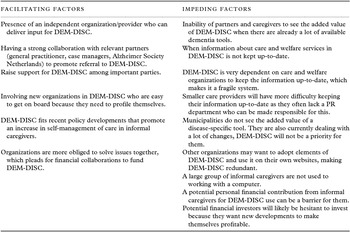
Table 4 shows the inventoried expected facilitators of and barriers to the future implementation of DEM-DISC based on the qualitative interviews with ten stakeholders.
Facilitators and barriers to future implementation of DEM-DISC

Discussion
In this study, DEM-DISC has been improved to promote self-management by informal caregivers of people with dementia and disease management opportunities for professional carers. The randomized controlled evaluation study showed mixed results. Informal caregivers who had access to DEM-DISC felt more competent in their carer role after 12 months than those who did not have access to DEM-DISC, but they also reported more needs in general, including more unmet needs. A potential explanation for this increase is that DEM-DISC provides users with information about a broad range of topics, which may cause users to realize they have needs in areas they were not previously aware of. We also found a decrease in neuropsychiatric symptoms after six months in informal caregivers who did not have access DEM-DISC compared to caregivers with access. The higher incidence of neuropsychiatric symptoms in the control group at baseline may have caused the case manager or informal caregiver to focus more on how to target these symptoms, causing a decrease in symptoms over time.
Although, informal caregivers generally found DEM-DISC easy to learn and user-friendly, some of them used the system more frequently than others. Informal caregivers who used DEM-DISC frequently reported more met needs after six months than informal caregivers who received usual care. High frequent users reported more met needs related to daytime activities, physical ability, self-care, medication and financial benefits. Reasons why some informal caregivers did not use DEM-DISC much in daily life were that they already had a case manager they were satisfied with who could answer their questions, they did not have time to use DEM-DISC, simply forgot it or did not have any care needs. Case managers who were able to use DEM-DISC to assist them in their work judged the system as easy to learn and user-friendly, but most of them felt DEM-DISC did not offer them any new information. However, they were convinced that DEM-DISC could be of added value for informal caregivers as well as case managers who are new on the job.
The results of the current effect evaluation are in line with the results of the pilot study on DEM-DISC by Van der Roest et al. (Reference van der Roest, Meiland, Jonker and Dröes2010) that also showed an increase in met needs and an increase in the sense of competence in informal caregivers who used DEM-DISC for several months.
Chiu et al. (Reference Chiu2009) evaluated an internet-based caregiver support system (providing information about dementia and community resources) combined with professional support. They also found that informal caregivers differed in their user behavior and that a reduction in expressed caregiver burden was found among frequent users of the system only. Younger caregivers and caregivers with a lower sense of competence were more likely to be frequent users.
In our study, frequent users reported more mental health problems at baseline compared to low frequent users, most of them did not have paid work and were older. This suggests that frequent users may have been more inclined to look for services to help them cope with their problems, and had more time to do so as most of these caregivers had reached retirement age.
Other ICT-mediated interventions also showed positive effects in certain subgroups such as an improvement in depression for caregivers who were more depressed at baseline (Finkel et al., Reference Finkel, Czaja, Schulz, Martinovich, Harris and Pezzuto2007) and a decline in depression, anxiety and “bother” in informal caregivers with low mastery scores at baseline (Mahoney et al., Reference Mahoney, Tarlow and Jones2003).
A recent study by Chiu and Eysenbach (Reference Chiu and Eysenbach2011) investigated user behavior of internet-based interventions for family caregivers of people with dementia. They constructed a concept map, which states that the usage of internet-based interventions is dependent on multiple factors. They found that caregiver needs influence the desire and effort to search for information on the internet. New caregivers expressed a desperate need for information after receiving the diagnosis and were much more prone to seek for information than experienced caregivers. Another influencing factor was the presence of support from family members, and the informal caregivers’ own capacity to deal with their situation. Children caregivers deal with competing roles and responsibilities as they try to balance work, their children and running a household in combination with their caregiver jobs. This may leave no time to seek for information on the internet. Spouses of people with dementia, on the other hand, may encounter difficulties to work with computers or do not have access to the internet.
These results, as well as the results of our study, suggest that not all informal caregivers may benefit from internet-based support systems or would be inclined to use them regularly. Identifying the right subgroup(s) that will likely benefit from using DEM-DISC or other ICT solutions is important and will help target these interventions better.
Furthermore, the use of web-based support systems is very dependent on referrals by and support of professional caregivers, such as general practitioners or case managers (Lauriks et al., Reference Lauriks2007). Many previously studied ICT-mediated interventions, therefore incorporated professional support with regular contact moments into the intervention (Finkel et al., Reference Finkel, Czaja, Schulz, Martinovich, Harris and Pezzuto2007; Chiu et al., Reference Chiu2009; Lundberg, Reference Lundberg2013). In our study, informal caregivers received support from case managers who could support them in their use of DEM-DISC. However, many caregivers felt that the regular support of their case manager was sufficient, making DEM-DISC redundant, which contradicts the effects found on carer competence. The fact that the carers’ competence improved after using DEM-DISC, however, indicates that professional caregivers should be made more aware of the potential of web-based interventions and should stimulate its use among their clients to increase the efficiency of care and promote more self-management.
Whether DEM-DISC can be successfully implemented depends on several facilitating and impeding factors. A key element of success is keeping the information up-to-date. This also poses the greatest challenge, as continuously changing care and welfare organizations make it difficult to keep their information current. Another important precondition is to raise support for DEM-DISC among professional caregivers who can promote referral of informal caregivers to DEM-DISC.
The results of this study indicate the importance of developing ICT solutions to assist informal caregivers of people with dementia in finding appropriate care services tailored to their specific situation and needs. This is in line with current policies that promote more independence and self-management in informal caregivers of people with dementia. However, municipalities are currently dealing with a lot of changes in laws and legislation and do not necessarily see the added value of a disease-specific ICT tool. This poses another challenge for implementation. Also, a sustainable business case is needed to enable implementation of DEM-DISC in daily practice.
Limitations
A few limitations should be taken into account when interpreting the results. We were not able to recruit the planned sample size of 128 caregivers, as fewer people than expected had access to a computer. Due to this, the power of the tests were small and potential effects of DEM-DISC may have been unnoticed. In addition, the limited power of the tests indicate that the results of this study should be considered with caution.
Future studies should include a larger sample size to confirm our findings and to be able to make more grounded conclusions. Results of the modified ITT analyses and post-hoc analyses should be considered with care, as restricting the experimental group to actual and frequent users may have resulted in the experimental and control group differing on characteristics (motivation, employment, age) which are possibly related to outcomes. This may have led to a biased comparison. Another limitation of this study is that the DEM-DISC interface did not always function properly technically. Sometimes, care services outside the specified postal code were shown among the search results, or it would take too long before care services appeared after a search. This may also have caused users to stop looking on DEM-DISC. In general, informal caregivers who had access to DEM-DISC reported more needs than non-users, but this was not apparent when we looked at met and unmet needs separately, probably due to the smaller sample size. A possible explanation for the increased needs in DEM-DISC users is that as they become more aware of the available offer on DEM-DISC, they also become more aware of their needs and therefore also report needs of which they were previously unaware.
Despite these limitations, the results of this study are promising. Although many different e-solutions aiming to assist informal caregivers and people with dementia in daily life and to help them find relevant information, have been studied in the past (Lauriks et al., Reference Lauriks2007), most of these services were not able to provide personalized support attuned to characteristics and needs of the users. DEM-DISC offers this by a unique interface that provides users with the option to search for specific care and welfare services that are attuned to their personal characteristics and needs. The system thus also promotes self-management of the disease in informal caregivers, which will be a skill of increasing importance in coming decades, when considerably fewer professionals will be able to support informal carers in finding the information they need to organize care for their family member with dementia. When offering care interventions like DEM-DISC to informal caregivers, professional caregivers like general practitioners, geriatricians and case managers, are adviced not to refer all informal caregivers to this intervention, but to look specifically at who is most likely to benefit from DEM-DISC, and who should probably be referred to a different type of support. They should take into consideration specific needs of caregivers (need for more information about different available care services), presence of mental health problems, enough time to use DEM-DISC, and the family situation, such as not having a lot of other concurrent care tasks in the family. In these cases, DEM-DISC will be adopted best.
Conflict of interest
None.
Description of authors’ roles
LVM, FM, HVH and RMD contributed to the development, conceptualization, and the design of the study. LVM was responsible for data collection (recruitment of participants and conducting semi-structured interviews), analysis and preparation of the manuscript. FM, PVDV, HVH and RMD supervised the research process data and provided assistance with data analysis and editing the final manuscript. All authors contributed to the interpretation of the results, and all authors reviewed and approved the final manuscript.
Acknowledgments
This study was funded by the National Programme Elderly Care (ZonMw). Additional funding was received from Vita Valley. ZonMw nor Vita Valley contributed to the study design or manuscript preparation.