Introduction
Traumatic brain injury (TBI) is the leading cause of death and disability in children and adolescents (Faul, Xu, Wald, & Coronado, Reference Faul, Xu, Wald and Coronado2010). The sequelae for children differ from those of adults for a variety of mechanistic and developmental reasons (Giza, Mink, & Madikians, Reference Giza, Mink and Madikians2007). A critical consideration for children is injury to the substrate of later developing cognitive skills, such as executive functions and working memory, which continue to develop throughout the adolescent years. As a result of this protracted developmental time course, the full morbidity of childhood brain injury may not be evident until years after the injury (Gamino, Chapman, & Cook, Reference Gamino, Chapman and Cook2009). Developing cognitive abilities, in turn, underpin the maturation of sophisticated communication skills.
Pragmatic Language Abilities After Pediatric TBI
While reports of persistent aphasia are relatively uncommon following brain injury (Heilman, Safran, & Geschwind, Reference Heilman, Safran and Geschwind1971), even in children with focal left hemisphere lesions (Vicari et al., Reference Vicari, Albertoni, Chilosi, Cipriani, Cioni and Bates2000), deficits in communication skills are widely reported, both in the ability to produce effective language such as maintaining and organizing topic sequences in narratives and turn taking (Brookshire, Chapman, Song, & Levin, Reference Brookshire, Chapman, Song and Levin2000; Morse et al., Reference Morse, Haritou, Ong, Anderson, Catroppa and Rosenfeld1999) and the ability to understand language in context (Dennis & Barnes, Reference Dennis and Barnes1990). In particular, the ability to appreciate pragmatic inference is impaired. This includes problems differentiating truth from deception (Dennis, Purvis, Barnes, Wilkinson, & Winner, Reference Dennis, Purvis, Barnes, Wilkinson and Winner2001), understanding sarcasm (Turkstra, McDonald, & DePompei, Reference Turkstra, McDonald and DePompei2001; Turkstra, McDonald, & Kaufmann, Reference Turkstra, McDonald and Kaufmann1996), and comprehending figurative language such as metaphors and idioms (Towne & Entwisle, Reference Towne and Entwisle1993). Such pragmatic communication impairments adversely affect social outcomes in children and adolescents with TBI (Yeates et al., Reference Yeates, Swift, Taylor, Wade, Drotar, Stancin and Minich2004) as it does adults (Struchen et al., Reference Struchen, Clark, Sander, Mills, Evans and Kurtz2008). Poor pragmatic communication skills in childhood will influence later development, as children and adolescents learn social and intimacy skills by interacting with others and those who are socially isolated may miss this opportunity. Developmental pragmatic communication difficulties are linked to negative outcomes such as rejection by peers (Place & Becker, Reference Place and Becker1991), a reduction in the frequency of dating and making new friends (Asher & Hymel, Reference Asher and Hymel1986), and limitations related to employment (DeGroot & Motowidlo, Reference DeGroot and Motowidlo1999).
Contribution of Social Cognition to Pragmatic Language Skills
Although cognitive skills such as language, working memory, and reasoning are known to influence pragmatic ability, social cognition, the ability to make judgments about the emotional and mental state of others, is especially critical. For example, the statement “You look great!” when the facts speak otherwise may be a comforting white lie or a contemptuous sarcastic joke. This can only be understood by using contextual cues to determine what the speaker believes and intends by the remark (Channon, Pellijeff, & Rule, Reference Channon, Pellijeff and Rule2005; Dennis & Barnes, Reference Dennis and Barnes2001; Happe, Reference Happe1994). Such judgments require Theory of Mind (ToM). Emotion perception is also important as many indirect speech acts, such as sarcasm, are associated with a particular emotional state or attitude (McDonald & Flanagan, Reference McDonald and Flanagan2004; Shamay-Tsoory, Tomer, & Aharon-Peretz, Reference Shamay-Tsoory, Tomer and Aharon-Peretz2005).
It is increasingly recognized that children and adolescents with TBI have difficulties with social cognition. Deficits in understanding ToM are common (Dennis et al., Reference Dennis, Purvis, Barnes, Wilkinson and Winner2001; Turkstra, Dixon, & Baker, Reference Turkstra, Dixon and Baker2004; Turkstra, Williams, Tonks, & Frampton, Reference Turkstra, Williams, Tonks and Frampton2008). Adolescents and children with TBI have difficulty understanding feigned emotions (Dennis, Barnes, Wilkinson, & Humphreys, Reference Dennis, Barnes, Wilkinson and Humphreys1998) and also thoughts (first order ToM) and intentions (second order ToM) when a conversation involves deceit, irony, and faux pas (Dennis et al., Reference Dennis, Purvis, Barnes, Wilkinson and Winner2001; Turkstra et al., Reference Turkstra, Williams, Tonks and Frampton2008). They have also had difficulty interpreting emotions and thoughts from the eye region in photographs (Tonks et al., Reference Tonks, Williams, Frampton, Yates and Slater2007a; Turkstra, Reference Turkstra2008). Although the research is scant, emotion perception deficits have also been reported (Tonks, Williams, Frampton, Yates, & Slater, Reference Tonks, Williams, Frampton, Yates and Slater2007b; Turkstra et al., Reference Turkstra, McDonald and DePompei2001) and are not simply accounted for by general cognitive deficits (Tonks et al., Reference Tonks, Williams, Frampton, Yates and Slater2007b).
Developmental and Pathological Issues in Social Cognition Abilities After Childhood TBI
Social cognition appears to be mediated by a specialized system of interconnected networks involving the orbital and ventromedial frontal cortex (Adolphs, Reference Adolphs2009). These structures are especially vulnerable to TBI as ventral surfaces of the brain scrape across the bony floor of the anterior and middle fossa during impact (Bigler, Reference Bigler2007). Disruption to social cognitive abilities following childhood injury, however, is complex. Development of the capacity to recognize emotions and the ability to understand ToM occur along somewhat different trajectories. Emotion perception develops in stages with evidence for significant maturation around 10 years of age (Kolb, Wilson, & Taylor, Reference Kolb, Wilson and Taylor1992; Tonks et al., Reference Tonks, Williams, Frampton, Yates and Slater2007a) and again at 14, consistent with spurts in brain development (Kolb et al., Reference Kolb, Wilson and Taylor1992). ToM abilities develop incrementally from around 2 years of age, with children able to master complex ToM judgments in reference to sarcasm at around the age of 6 to 9 years (Perner & Wimmer, Reference Perner and Wimmer1985) and faux pas by the ages of 9 to 11 years (Baron-Cohen, O'Riordan, Stone, Jones, & Plaisted, Reference Baron-Cohen, O'Riordan, Stone, Jones and Plaisted1999). While regarded as different facets of social cognition, there is also overlap between ToM and emotion. For example, experimental ToM measures such as the Faux Pas test (Baron-Cohen et al., Reference Baron-Cohen, O'Riordan, Stone, Jones and Plaisted1999) and the Mind in the Eyes test (Baron-Cohen, Wheelright, Hill, Raste, & Plumb, Reference Baron-Cohen, Wheelright, Hill, Raste and Plumb2001) require an appreciation of not simply what people are thinking but what they feel. Disruption in the development of either ability may well influence the other and, in turn, impact upon the capacity to understand pragmatic inference. This complex interplay will be dependent upon the nature of the injury and its timing in the developmental trajectory of these abilities. In sum, the potentially independent but inter-related nature of the development of emotion perception, ToM and pragmatic understanding suggests that each is an important focus of assessment in children and adolescents with brain damage.
Assessment of Pragmatics and Social Cognition in Adolescents with TBI
Despite the clear functional importance of disorders in social cognition and pragmatic inference, there are few standardized assessment instruments available to assess these in the pediatric population (McCauley et al., Reference McCauley, Wilde, Anderson, Bedell, Beers, Campbell and Yeates2012). To be ecologically valid, such assessment instruments must tap into the kinds of cues that are available in everyday social environments. Audiovisual vignettes are ideal, as these provide multimodal, dynamic cues similar to those encountered in social settings along with real time demands of social information processing. The Video Social Inference Test (Turkstra, Reference Turkstra2008), for example, was designed specifically to measure social cognition in adolescents with TBI, but awaits further research as to normative data and standardization.
The Awareness of Social Inference Test (TASIT) is one of the few instruments in the field of social cognition and communication with established validity, although to date this is only for adults. TASIT uses audiovisual vignettes to assess emotion perception, ToM judgments and comprehension of direct and indirect speech such as sarcasm. It is sensitive to a range of clinical conditions affecting adults including TBI (McDonald & Flanagan, Reference McDonald and Flanagan2004; McDonald, Flanagan, Rollins, & Kinch, Reference McDonald, Flanagan, Rollins and Kinch2003), right hemisphere lesions (Blake, Reference Blake2009; Fournier, Calverley, Wagner, Poock, & Crossley, Reference Fournier, Calverley, Wagner, Poock and Crossley2008), frontotemporal dementia (Kipps, Nestor, Acosta-Cabronero, Arnold, & Hodges, Reference Kipps, Nestor, Acosta-Cabronero, Arnold and Hodges2009; Rankin et al., Reference Rankin, Salazara, Gorno-Tempinia, Sollbergera, Wilson, Pavlica and Miller2009), and schizophrenia (Kern et al., Reference Kern, Green, Fiske, Kee, Lee, Sergi and Nuechterlein2009; Kosmidis, Aretouli, Bozikas, Giannakou, & Ioannidis, Reference Kosmidis, Aretouli, Bozikas, Giannakou and Ioannidis2008; Sparks, McDonald, Lino, O'Donnell, & Green, Reference Sparks, McDonald, Lino, O'Donnell and Green2010). There is a consistent pattern across these groups wherein clinical participants show relative impairment in the recognition of emotion (especially negative emotions) and indirect speech acts with preserved performance on direct exchanges. TASIT is also sensitive to everyday deficits in social skills as assessed in vivo (McDonald, Flanagan, Martin, & Saunders, Reference McDonald, Flanagan, Martin and Saunders2004).
Purpose of This Study
While designed for adults, TASIT has normative data for adolescents aged 13 to 15 (McDonald, Flanagan, & Rollins, Reference McDonald, Flanagan and Rollins2011). However, for it to be of use in clinical settings, its validity as a measure for social cognition and communication deficits in adolescents with TBI needs to be established and that is the purpose of this study. Validity was assessed in two ways. First, TASIT performance for adolescents with TBI was compared to that of a group of demographically matched, typically developing (TD) adolescents. Second, the correlations between TASIT performance and questionnaires tapping everyday communicative performance as reported by the adolescents themselves and their relatives were examined to establish predictive validity. In addition, correlations between TASIT performance and basic demographic and clinical variables were examined to determine the influence of these factors.
On the assumption that TASIT is a valid test of social perception for adolescents with TBI it was hypothesized that this group would perform more poorly than TD adolescents on TASIT measures of emotion perception, ToM, and comprehension of indirect speech acts (sarcasm). It was hypothesized that TASIT scores in the adolescents would be predictive of difficulties in everyday social language comprehension as reported by both the participants themselves and their relatives.
Methods
Participants
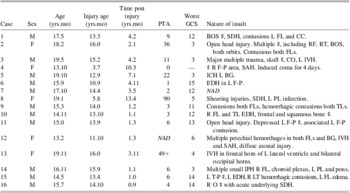
This study recruited 16 adolescents (11 males) aged 13 to 19 years from the brain injury services of the Sydney Children's Hospital, Sydney, and the Newcastle Children's Hospital, Newcastle, New South Wales, Australia. All participants had sustained a TBI at least 9 months before testing. Of these, nine were classified as severe according to the following criteria: initial Glasgow Coma Scale (GCS) score of 8 or less; post-traumatic amnesia (PTA) of 7 days or more; loss of consciousness greater than 24 hours (Williamson, Scott, & Adams, Reference Williamson, Scott and Adams1996). The remaining seven participants had sustained moderate injuries, that is, GCS between 9 and 12 and/or PTA between 1 and 7 days. Clinical details for the TBI group are provided in Table 1.
Clinical details of the adolescents with traumatic brain injuries

PTA = post traumatic amnesia; GCS = Glasgow Coma Scale; ♯ = fracture; SDH = subdural hematoma; EDH = extradural hematoma; ICH = intracerebral hemorrhage; IVH = intraventricular hemorrhage; SAH = subarachnoid hemorrhage; IPH = intraparenchymal hemorrhage; CO = cerebral edema; BG = Basal Ganglia; CC = Corpus Callosum; BOS = base of skull; F = frontal, T = temporal, P = parietal, O = occipital; L = left; R = right; NAD = no available data.
In addition, 16 typically developing (TD) adolescents (11 males) aged 13 to19 years without brain injuries, recruited from the general community and matched on the basis of age, education, and gender, were tested.
Participants in both groups were excluded on the basis of psychosis, sensory deficits, and a history of pre-injury learning or intellectual difficulties. All participants spoke fluent or native English. Demographic and basic clinical details (where relevant) for the two groups are detailed in Table 2.
Demographic and basic clinical details for the adolescents with TBI and the typically developing (TD) adolescents

Notes. IQ based on Wechsler Abbreviated Scale of Intelligence (two subtests). IQ estimate is missing for one adolescent with TBI. High mean and large SD for DASS-D in the TBI group is due to the inclusion of one participant with significant depression. All scores reflect means (and standard deviations) except occupation for which values represent number of participants.
BFRT = Benton Facial Recognition Test; PTA = Post Traumatic Amnesia; RCMAS = Revised Children's Manifest Anxiety Scale; Child CDI = Child Depression Inventory; DASS-D = Depression subscale of the Depression, Anxiety and Stress Scale.
Measures
The Awareness of Social Inference Test (TASIT)
TASIT (McDonald et al., Reference McDonald, Flanagan and Rollins2011) uses short audiovisual vignettes of emotional displays and everyday interactions, and comprises three parts.
TASIT 1: The Emotion Evaluation Test (EET).
TASIT 1 measures recognition of emotions presented in audiovisual displays. It contains 28 professionally acted vignettes, depicting four instances of each of the six primary emotions (happiness, sadness, anger, fear, surprise, disgust) and neutral. As the scripts are ambiguous, judgments about emotion must be made based on nonverbal cues (i.e., facial expression, vocal tone and body language). Participants were required to state the emotion displayed from a list of the seven possibilities. The maximum possible score for TASIT 1 is 28.
TASIT 2: Social Inference – Minimal (SI-M) & TASIT 3: Social Inference – Enriched (SI-E).
Both TASIT 2 and 3 measure the ability to interpret literally true versus counterfactual statements by using information that is suggested through nonverbal cues, rather than directly stated. TASIT 2 (15 items) assesses the ability to identify sincere and sarcastic comments, while TASIT 3 (16 items) measures the ability to identify sarcasm and lies. In TASIT 2, interpretation of the true meaning of the conversational exchange is based on nonverbal cues alone. There are three types of vignette (1) sincere exchanges; (2) simple sarcasm in which the conversation is ambiguous but given a sarcastic meaning by the demeanor of the speakers; (3) paradoxical sarcasm where the exchange does not make sense literally and can only make sense as sarcasm.
In TASIT 3, there is additional information, either a prolog or visual edit that “sets the scene” at the beginning or end of each vignette (e.g., a prolog of Ruth confiding to a friend that her partner Gary has put on weight before she enters the fitting room to talk to Gary and reassure him about his figure). In both parts, comprehension of each vignette is assessed by asking four questions which probe for interpretations of what the speaker was (1) feeling (e.g., “does Garry seem happy with Ruth”), (2) thinking (first order ToM: e.g., “Does Ruth think Gary has put on weight?”), (3) intending (second order ToM: e.g., “Is Ruth trying to make Gary believe he hasn't put on weight?”), and (4) meaning to say (e.g., “Is she trying to say he has put on weight?”). Consequently each item is scored out of four, yielding a maximum score of 60 in TASIT 2, and 64 in TASIT 3.
Neuropsychological and psychological measures
Estimates of IQ, face recognition and current mood were obtained using the following scales:
1. IQ was estimated using the Wechsler Abbreviated Scale of Intelligence, 3rd Edition (WASI). The WASI (Wechsler, Reference Wechsler1999) has been standardized for use in participants aged 6 to 89. Participants completed the two subtest form, which uses the scaled T scores from the Vocabulary and Matrix Reasoning subtests to yield a Full Scale IQ (FSIQ) estimate.
2. Face recognition was assessed using the Benton Facial Recognition Task Short Form (BFRT). The BFRT (Levin, Hamsher, & Benton, Reference Levin, Hamsher and Benton1975) is a measure of facial recognition, where participants are presented with photographs of faces and have to discriminate between them using only facial features. In all 13 items of the short form, participants are presented with a single front view photograph of a face, and asked to select the person's face from a choice of six photographs. Seven of the items require the participant to find three instances of an individual's face, leading to a maximum score of 27. This is then converted to a long form equivalent, out of 50, where higher scores indicate greater ability at discriminating between similar faces.
3. Anxiety was assessed using the Revised Children's Manifest Anxiety Scale (RCMAS). The RCMAS (Reynolds & Richmond, Reference Reynolds and Richmond1978) is a 37-item self-rated measure of the nature and level of anxiety in children and adolescents from 6 to 19 years of age. Children are presented with a range of statements, and must indicate whether each applies to them by selecting a “yes” or “no” response (e.g., “I worry a lot of the time”, “I am afraid of a lot of things”). The total score was converted to scaled scores based on age and gender norms (mean = 50; SD = 10) where higher scores indicate greater levels of anxiety and above 70 is of clinical concern.
Adolescents who were younger than 18 were assessed using the Children's Depression Inventory (CDI). The CDI (Kovacs, Reference Kovacs1992) is a 27-item self-rated depression scale designed for school aged children and adolescents aged between 7 and 17 years. The scale contains items specifically related to children (e.g., items about school), and has a low reading level compared to similar measures (Berndt, Schwartz, & Kaiser, Reference Berndt, Schwartz and Kaiser1983). Each item consists of three statements, one indicating absence of the symptom (e.g., “I like myself”), one indicating a mild symptom (e.g., “I do not like myself”), and one indicating presence of the symptom (e.g., “I hate myself”). Children are asked to choose the statement from each grouping that best describes how they have felt over the past 2 weeks. The total score was used (M = 50; SD = 10) with higher scores indicating higher symptom severity and a score of 70 indicative of clinical problems.
Depression for adolescents who were 18 and older was assessed using the Depression subscale of the Depression Anxiety Stress Scales (DASS) shortened 21 item form. The DASS (Lovibond & Lovibond, Reference Lovibond and Lovibond1995) contains three self-report scales measuring depression, anxiety and stress. Participants rated how often they have experienced core symptoms of depression, anxiety, and stress over the past week (e.g., “I couldn't seem to experience any positive feeling at all”) on a 4-point scale. Scores are summed for each subscale separately, and then converted to long form equivalent scores (maximum = 42). Higher scores indicate greater symptom severity and a score of 20 on the depression subscale is indicative of clinical depression.
Self and relative communication questionnaires
Everyday communicative ability was assessed using a self-rated and relative rated questionnaire designed specifically for this study. The Self Communication Questionnaire (SCQ) asks how well participants feel they have understood different types of communication in the past week. Specifically they were asked: “At home in the past week, how well have you understood the following on a scale of 1 to 5” (ranging from 1 = not at all, to 5 = perfectly). Ten items were then presented: instructions, teasing, road directions, playful talk, when someone says one thing but means another, the details of conversation, when someone is not serious, news items, jokes, when someone is serious. Items were either literal (e.g., news items) (SCQ-L) or non-literal (e.g., playful talk) (SCG-NL) forms of communication, and scores are generated by summing the items in each category. The Relative Communication Questionnaire (RCQ) has an identical format; however it is completed by a relative of the participant. The relative was asked to rate how well they believe the participant understands the different types of communication listed in the questionnaire. Both forms of the questionnaire as used in this study demonstrated acceptable reliability based on internal consistency across all participants (SCQ-L; α = .83; SCQ-NL: α = .81; RCQ-L: α = .75; RCQ-NL: α = .82). Within groups, reliability was higher for the TBI group (ranging from .85 to .91) than the TD group (ranging from .51 to .74).
Procedure
Procedures for recruitment and testing complied with the University's ethical guidelines and informed consent was obtained in every case. Participants were tested individually, completing TASIT, the WASI, the BFRT, the RCMAS, the CDI or DASS, and the communication questionnaires in that order. During TASIT, participants were instructed that they would view video clips of people interacting, and be asked questions about each scenario. A practice item preceded each section to familiarize participants with task requirements. Vignettes were played only once. Duration of testing was 90 min, extending to 2 hr for slower participants.
Analysis
T tests were used to examine between group differences on basic demographic and clinical variables. Differences between groups and within TASIT subtests were examined via repeated measures analysis of variance (ANOVA). Associations between TASIT performance and demographic, clinical variables, and communication questionnaires were examined using Pearson correlations.
Results
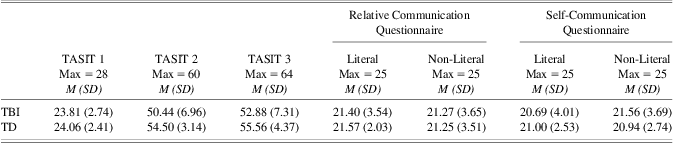
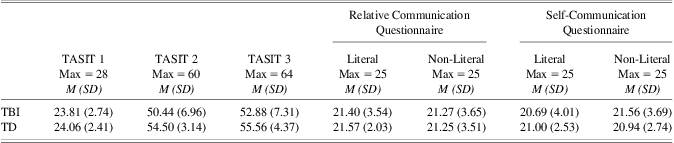
The two groups did not differ in terms of age, education, IQ, face recognition, anxiety, or depression. For face recognition, one participant with TBI had scores in the severely impaired range while two adolescents with TBI and one TD adolescent had scores in the moderately impaired range. For IQ, two adolescents with TBI had scores in the borderline range. All other adolescents were low average or above. One participant in the TBI group (Participant 13) reported significant levels of anxiety and depression. Total scores on TASIT and communication questionnaires are detailed in Table 3.
Performance on TASIT and Communication Questionnaires for adolescents with TBI and TD adolescents
TASIT 1: Emotions
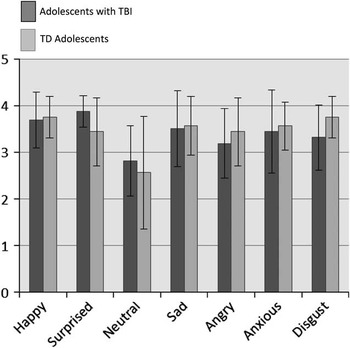
Total performance on TASIT 1 is detailed in Table 3 and performance across the individual emotions in TASIT 1 is depicted in Figure 1.
Mean performance (± one SD) on TASIT 1 across emotions (max score for each emotion = 4) for adolescents with traumatic brain injury (TBI) compared to typically developing (TD) adolescents.

There was a significant difference across emotions (F(6,25) = 9.44; p < .001; ŋp2 = 0.69). As has been found in previous research (McDonald & Flanagan, Reference McDonald and Flanagan2004), scores for neutral were lower than others, presumably due to their ambiguity. There was no overall group difference (F(1,30) = 0.075; ns; ŋp2 = 0.003). There was a significant Group × Emotion interaction (F(6,25) = 2.614; p = .042; ŋp2 = 0.386) arising from the fact that the adolescents with TBI were more accurate judging surprise than happy whereas for the TD adolescents this was the reverse. Otherwise, the pattern across emotions was similar for both groups.
TASIT 2: Sarcasm Versus Sincere Exchanges
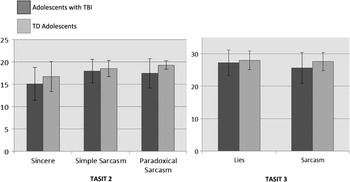
Performance across the sincere items versus the simple sarcasm and paradoxical sarcasm subtests is depicted in the left hand of Figure 2.
Mean scores (and SD) on sarcasm and sincere subtests (TASIT 2: max score for each subtest = 20) and lies and sarcasm (TASIT 3: max score for each subtest = 32) for adolescents with a traumatic brain injury (TBI) and typically developing (TD) adolescents.

There was a significant difference across subtests (F(2,29) = 5.15; p = .012; ŋp2 = 0.262) due to scores on the two sarcasm subtests being higher than the sincere (simple sarcasm, p = .005; paradoxical sarcasm, p = .003). The adolescents with TBI performed more poorly than the TD adolescents on TASIT 2 (F(1,30) = 4.39; p = .045; ŋp2 = 0.128) representing a medium to large effect (Cohen, Reference Cohen1988), but there was no Group × Part interaction (F(2,29) = 1.70; ns; ŋp2 = 0.105).
TASIT 3: Sarcasm Versus Lies
Performance on TASIT 3 is depicted in the right hand panel of Figure 2. There was no difference across subtests (F(1,30) = 1.67; ns, ŋp2 = 0.053) nor Group × Part interaction (F(1,30) = 0.77; ns, ŋp2 = 0.025), nor was there any group difference (F(1,30) = 1.59; ns; ŋp2 = 0.050).
Probes: Feel, Think, Intend, and Say
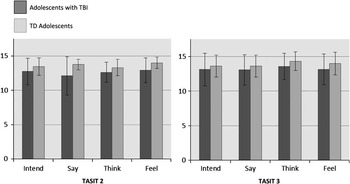
Performance of the two groups on the four probe questions: “think,” “feel,” “intend,” and “say” for TASIT 2 and TASIT 3, are depicted graphically in Figure 3 in the left and right panel, respectively. In both cases, there was no overall difference in accuracy for the different questions and no Group × Probe interaction. Finally, although depression and anxiety were not associated with TASIT performance (see below), one of our adolescents with TBI was significantly depressed and anxious. To ensure that her performance was not a major factor in the between group results, all analyses were re-run excluding her scores. There was no change in the pattern reported.
Mean scores (and SD) for think, feel, intend, and say probes for TASIT 2 (max score for each probe = 15) and TASIT 3 (max score for each probe = 16) for adolescents with a traumatic brain injury (TBI) and typically developing (TD) adolescents.

Predictive Validity of TASIT for Adolescents with TBI
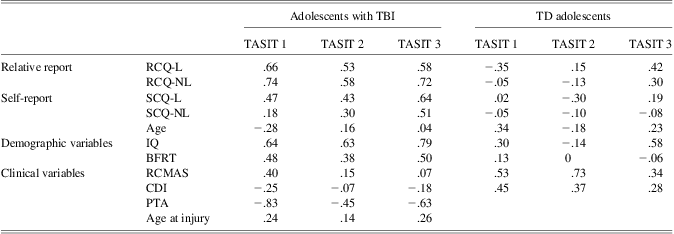
To examine whether TASIT is a valid measure of everyday communication difficulties in adolescents with TBI, correlations between performance on the self and relative communication questionnaires and TASIT were conducted for the TBI and TD groups separately. The results are summarized in Table 4. Correlations between TASIT and demographic variables (age, WASI IQ, and BFRT) and clinical variables [depression: CDI (but not DASS due to insufficient numbers), anxiety: RCMAS, duration of PTA and age at injury] are also provided.
Correlations between TASIT and Communication Questionnaires, demographic and clinical variables for adolescents with TBI and TD adolescents
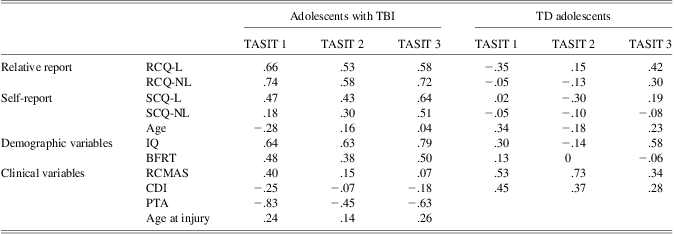
Note. Shaded cells denote significant correlations, p < .05.
RCQ = Relative Communication Questionnaire; SCQ = Self Communication Questionnaire; L = Literal; NL = Non-literal, IQ based on Wechsler Abbreviated Scale of Intelligence (two subtest version); BFRT = Benton Facial Recognition Test. PTA = post-traumatic amnesia.
As can be seen, relative report of difficulties comprehending both literal and non-literal language correlated with all parts of TASIT. Adolescents with TBI who had poorer scores on TASIT 3 also self-reported greater difficulties with both literal and non-literal language. No such associations emerged for either self or relative report for the TD adolescents.
TASIT performance was associated with IQ (TASIT 1, 2, and 3) and face recognition (TASIT 3 only) for the group with TBI. Within the TD group IQ correlated with TASIT 3 only. Age was not associated with TASIT performance in either group, nor was depression or anxiety. Finally, the severity of injury as indicated by duration of PTA was associated with all parts of TASIT but age of injury was not.
Discussion
In this study, we examined performance of adolescents with traumatic brain injuries relative to their typically developing peers on TASIT, an established assessment tool for assessing social cognition and pragmatic understanding. TASIT has validity for assessing adults with a range of neurological disorders including traumatic brain injury, dementia, and schizophrenia. It was assumed that it would also differentiate adolescents with brain injuries from those without.
Surprisingly, there were few overall group differences between the adolescents with brain injuries and their peers. Emotion perception as assessed by TASIT 1 yielded no group differences. This is in contrast with the findings of two previous studies that have examined independent groups of children (Tlustos et al., Reference Tlustos, Chiu, Walz, Taylor, Yeates and Wade2011) and adolescents with TBI (Tonks et al., Reference Tonks, Williams, Frampton, Yates and Slater2007b; Turkstra et al., Reference Turkstra, McDonald and DePompei2001) and reported that their emotion recognition skills were impaired.
Performance on TASIT 2, in which participants were required to observe an exchange between two speakers and determine, on the basis of demeanor and dialog, the feelings, thought, intentions and meanings of their conversations, yielded an overall group difference of medium to large size. TASIT 3, tapping similar abilities but focused upon lies and sarcasm and with some additional context, yielded no differences. In neither case was there clear suggestion of particular problems with counterfactual versus literal exchanges. These variable findings fit with the scant literature in the area that is also variable in its findings. For example, Turkstra and colleagues (2001) found their group of 10 adolescents with TBI failed to understand sarcasm when observing a video of peers enacting different social scenarios. Dennis and Barnes (Reference Dennis and Barnes2001) reported that a group of children and early adolescents were able to understand sarcasm but not deception using pictures and simple text. Yet other studies have failed to find impairment in adolescents (Turkstra et al., Reference Turkstra, Williams, Tonks and Frampton2008) and primary school aged children (Walz, Yeates, Taylor, Stancin, & Wade, Reference Walz, Yeates, Taylor, Stancin and Wade2010) with TBI on comprehension of irony, lies, etc.
Within TASIT 2 and 3, specific probes make it possible to determine whether participants are able to understand the beliefs and intentions of the speakers. There was no indication that the adolescents with TBI had differential difficulty in making these kinds of judgments. This again diverges with some (Tonks et al., Reference Tonks, Williams, Frampton, Yates and Slater2007a; Turkstra et al., Reference Turkstra, Dixon and Baker2004; Walz et al., Reference Walz, Yeates, Taylor, Stancin and Wade2010) but not all (Turkstra et al., Reference Turkstra, Williams, Tonks and Frampton2008) research in the field.
On the other hand, TASIT performance correlated with both relative and self-report of difficulties with language, literal and non-literal. It is interesting that these findings held true for the adolescents with TBI but not their TD counterparts. It is possible this reflects the experience of the individuals with TBI and their families, making them aware that difficulties are present and to be practiced at observing them. The generally lower reliability of the questionnaire scores in the TD group may have also masked any genuine associations. Nonetheless, the finding that deficits in IQ, facial recognition and injury severity were also associated with TASIT performance in the TBI group reinforces the interpretation that poor TASIT performance reflected acquired cognitive impairments. It is also consistent with the notion that pragmatic understanding is complex and reliant upon executive and working memory skills as well as social cognition.
To understand our finding of relatively few differences between the TD and TBI adolescents on TASIT compared to reports of impaired performance in the literature, it is important to consider the nature of tasks used. TASIT uses professional actors in audiovisual vignettes. During development, many vignettes were piloted and only those with higher inter-rater agreement were retained. This may have decreased the difficulty of the task relative to tasks using written vignettes (Dennis et al., Reference Dennis, Purvis, Barnes, Wilkinson and Winner2001; Turkstra et al., Reference Turkstra, Williams, Tonks and Frampton2008; Walz et al., Reference Walz, Yeates, Taylor, Stancin and Wade2010) or amateur, adolescent actors (Turkstra et al., Reference Turkstra, McDonald and DePompei2001). An additional consideration is the inherent variability in the development of social cognition through childhood and adolescence. No association was found between TASIT performance and age at testing in the adolescent groups. This could reflect the fact that social cognition skills tapped by TASIT are fully matured by the age of our youngest participants (13 years) but this seems unlikely. While three participants with TBI had very poor scores (below the 5%) on TASIT 1, 2, or 3, there were also two participants in the TD group with similarly low scores. This suggests that group performances reflected both acquired impairment and individual differences in maturation of these skills.
The relatively small differences in performance found between our two adolescent groups could be taken to suggest that TASIT is not as sensitive to impairments in social cognition in adolescence as would be desirable in a clinical assessment instrument. If we take this stance, it is challenging to consider ways in which a test could be developed that would retain the advantages of TASIT, using realistic audiovisual cues, while tailoring it to be “more difficult” for adolescents and while also retaining acceptable levels of reliability. It would be a relatively simple task to increase the subtlety and complexity of social cognition cues such as arise from facial and body gesture or the context in which communication occurs. However, this increases the ambiguity and decreases inter-rater agreement regarding how such cues are to be interpreted. Social communication is not linear and many factors, cultural and temperamental, influence our interpretation of the social world. Alternatively, it may be that the development of audiovisual vignettes based around adolescent dialogue such as in the Video Social Inference Test (Turkstra, Reference Turkstra2008) will provide an increased level of sensitivity. It could be argued that there are additional levels of cognitive processing involved when adolescents make peer based judgments of emotion, intention and meaning. During adolescence, there are numerous preoccupations including dating, independence, self-image and values (Turkstra, Reference Turkstra2000) that may well influence peer judgments differently to the way in which adults are viewed.
An alternative proposition is that normative data for adolescent social skills is relatively meaningless due to individual variability in the maturation and development of social skills during this period of childhood. What is important is that lab based measures of social cognition are sensitive to deficits in social performance as observed by the adolescents themselves and their family members. In this study there is some evidence that TASIT fulfills these criteria as there were clear associations between poor TASIT performance in the TBI group and difficulties communicating at home.
Conclusion
In conclusion, this study demonstrated that TASIT, a test of social perception designed for adults with clinical impairments, has the potential to be a useful clinical measure of pragmatic comprehension and social cognition for adolescents with TBI. While adolescents with TBI, as a group, produced a generally normal level of performance on two parts of TASIT, they were found to perform significantly more poorly relative to their TD peers on TASIT 2 which required comprehension of pragmatic inference and judgments regarding emotional state and ToM. Furthermore, performance on TASIT was significantly associated with both self and parental report of communication difficulties at home, suggesting that TASIT is sensitive to communication difficulties that arise following pediatric TBI. Our findings raise questions concerning the validity of “normative” performance on social cognition measures during the rapidly changing period of adolescence. However, it is clear that further research is needed to examine a range of different kinds of measures of social competence following childhood TBI.
There are inevitable limitations to this study. As is typical of TBI, the participants were heterogeneous with respect to both nature and severity of pathology. They varied in other factors such as age of injury and socioeconomic background that are also critical to emerging social skills (Beauchamp & Anderson, Reference Beauchamp and Anderson2010). This variability combined with relatively small numbers makes it very difficult to discern real group differences in performance on TASIT. However, the effect sizes were very small for between group differences for TASIT 1 and 3, which suggest that even a much larger sample would have failed to find significant group differences. Nonetheless such variability can be useful in detecting relationships between test performance and the kinds of behavior we are hopefully trying to assess and this certainly emerged with TASIT predictive of real world communication difficulties. These results do add legitimacy to the notion that lab based assessments can be useful for characterizing social cognitive and communicative performance and pave the way for additional research into ecologically valid measures of social cognition in childhood and adolescence.
Acknowledgments
This research was funded by the National Health and Medical Research Council of Australia. We are grateful to the Prince of Wales Children's Hospital, Brain Injury Unit and the John Hunter Pediatric Brain Injury Service for their assistance with recruitment. We are especially indebted to the young people and their families who participated in this research. The Awareness of Social Inference Test (TASIT) is sold commercially by Pearson Assessment and the first author receives royalties for this. Other than this there are no conflicts of interest.