If comparative politics is in one if its periodic states of theoretical collapse (Blyth Reference Blyth2006, 493), no one feels the lack of roof and walls more acutely than instructors in undergraduate comparative politics classes. With professional colleagues and graduate students one preaches to the choir, but with college students, many of whom may be non-majors, we must work in partibus infidelium, among those who have not yet been converted. Without an orthodox doctrine to work from, this can be a challenging task indeed. The approach used here, combining detailed socio-political narratives with strong analytic theory, tends to engage students because it fills in a full range of national life, rich in national eccentricities, cultural exaggerations, and hidden motives, and because it controls the proliferation of detail by emphasizing its logic. In a sense the abstract becomes concrete and the concrete becomes abstract.
The approach described here has been worked out over several recent years to fulfill two major goals: (1) providing student motivation for the study of comparative politics, and (2) providing effective techniques for explanation of political events at home or abroad. As stated in one syllabus, the primary assumption of the course is that human behavior can be explained, and that comparative politics is the field in which it is perhaps easiest to begin such social analysis.Footnote 1 I describe below two courses, one the standard curricular politics of developed nations, the other a more advanced course centering on countries in Asia, Africa, and the Middle East.Footnote 2 Both courses use similar methods:
• Game theory is the major theoretical-methodological tool taught to and used by students.
• Scientific explanation of political events is emphasized rather than regime evaluation.
• Informal institutions are given priority over formal institutions.
• Societies are seen as self-organized, developed over time from within the society.
• Formal political institutions are analyzed in light of the society's particular needs.
• Student readings on included countries emphasize micro-level everyday behavior.
The most debatable aspects of the courses are the use of game theory and the higher than usual attention to informal rather than formal institutions.Footnote 3 On game theory it should be said that my emphasis is methodological rather than mathematical; the readings include minimax but quickly move on to real-world analysis using game theory as a tool rather than a solution. The emphasis on informal institutions is congruent with the game theoretic approach, which works at the level of individual actors, but is also recommended because of the high interest students show in the social infrastructure of the countries studied. Experienced comparativists know that formal institutions have no meaning without understanding the country's underlying circumstances and norms (the Weimar principle) but we do not always pass on to students the sheer interest of the informal level.Footnote 4 The use of well-written, empirically rich studies of different countries, studies that provide answers to questions students had not previously even thought about asking, has proven attractive.
The use of game theory in teaching comparative politics, or political science in general, has been hampered by game theory's polarizing role in political science's ongoing methodological debates (Johnson Reference Johnson1996). Hard core behavioralists, committed to tenets of extreme quantitative positivism, seem to have monopolized game theory, while Perestroikans adamantly reject game theory's mathematical rigidities and, because of that, its applicability to their anthropologically rich worlds. Historical inquiry (see the essays in Weintraub Reference Weintraub1992) shows that this dichotomy is ancient but inaccurate: one of the modern founders of game theory (Morgenstern), and many of his predecessors, saw game theory not as mathematics but as a flexible way of conceptualizing human behavior in all its irregularities (Leonard Reference Leonard and Weintraub1992, 45; Schotter Reference Schotter and Weintraub1992, 97–104). For these classical theorists the game was an exciting way of looking at the social world and exploring its intricacies in an open-ended methodology that would guide but not constrict research. If a game could be “solved,” according to the early theorist Emile Borel, it lost all interest (Leonard Reference Leonard and Weintraub1992, 49).Footnote 5
Game theory in this exploratory, explanatory mode was used in the courses described here. The basic concepts were players, goals, strategies, and the outcome matrices that emphasized the interdependence or interaction of players as defining payoffs. American students may have a culturally biased belief that, when one acts, it turns out as one intended. The idea that the intended outcome may be distorted or destroyed by the action of another player because one failed to anticipate what that player might do, is a major contribution made by game theory to clear empirical analysis. The basic point of such analysis is to encourage students to recognize this role of the often-ignored other, and thus the bottom-up nature of social and political events. Top-down, a group of men create a specific institution for their specific reasons; bottom-up, that institution may be deliberately biased, or may shortly take on a use that is opposite to the creators' purposes.
The bottom-up game perspective moves students away from quick normative judgments of other nations' behavior, and toward a recognition that people in other societies are playing games that are as important and serious as American practices, but are utterly different from games played here. LaPalombara's explanation that it is irrational in Italy to repair or even license one's vehicle (because Italian police find it a waste of time to go to court) makes this point at a level students easily recognize.
When game theory is used in this Morgenstern sense (rather than the von Neumann sense), game theory becomes an interesting combination of the nomothetic and the idiographoc Students work, in effect, with case studies of whole nations or peoples, yet develop logically derived and empirically testable hypotheses about individual behavior under specific circumstances through use of game concepts. Students often start by reporting, in their semester-long study of a given country, that “a policy has been put into effect.” They are then challenged to redefine such opaque reports with game theory's sharp questions: who exactly were the players (who proposed the policy, who opposed it) what were their goals (stated and unstated), why did the interaction result in this particular outcome (how did the players see the payoffs and thus choose their strategies)? This makes an important pedagogical point, that events do not just happen but are part of an ongoing battle between social forces of various types. Game theory provides essential tools to undertake what might otherwise be an unguided journey.
The bottom-up game theory approach is fully consistent with political science's trademark study of institutions, whether of the old or new variety, because institutions often define the games, and games define the institutions.Footnote 6 Institutions, including constitutions but also cultural norms, provide roles in the games societies play, and roles help to define an actor's available strategies: one player is allowed to propose, the other may veto; one player may attack, the other has so few resources he can only defend. Within these constraints the players work out their futures. Of course institutions, both formal and informal, also provide innumerable and unnoticed options, and creative players will be able to transcend the institutions that might otherwise define them (this was the gist of Riker's heresthetics). Game theory from the open perspective need be neither excessively skeptical nor excessively respectful of institutions, because it shows that institutions come about in many ways, both good and bad, and political science students benefit from the push this provides toward objectivity rather than ideology.
Both critics and advocates of rational choice and game theory often overlook Stinchcombe's (Reference Stinchcombe1968, 48–53) important distinction between the various levels at which theory works. We may tend to associate the term theory with lower levels, specific predictions about specific cases, but theory is also important at higher, paradigmatic levels, where it specifies what types of events are considered appropriate for study. While conventional game theory has tended to work at the lower levels, with sharply constrained situations and solutions, game theory also can take a higher role, stipulating attention to actors, strategies, and interactions but leaving the whole lower analysis open to empirical inquiry rather than mathematics. Game theory, as I have used it, shows its full height as theory by defining a research model for the open-ended, ever-changing human behavior faced by the student of comparative politics. This wider definition of game theory's level and role also frees game theory from the ideological functionalism manifested by hardcore rational choice theorists in the assumption that institutions, by their existence, can be assumed to be filling a collective need.Footnote 7 Game theory's analytic role, which jettisons ideological assumptions and just asks who is fighting whom, over what, is a more flexible tool for understanding everyday politics, whether at home or abroad.Footnote 8
Self-organization or complexity theory fits well with game theory by showing how communities and governments may arise from many individual games played for individual stakes, as groups coalesce (or fail to coalesce) into endogenously organized systems. The Guatemalan coup illustrates this in two ways. First, the Guatemalans had been working slowly over preceding decades to decide what the country would become. As some persons attained middleclass status they were less amenable to dictatorship, and found a mild nationalist professor to elect as president. The prospect of a more open politics created competitors, and the Guatemalans were working things out, as among friends, when the disruption occurred. The U.S. coup itself was self-organized, as Schlesinger and Kinzer's book Bitter Fruit shows. Up until the last minute it might have failed or been avoided, but the “autocatalytic set” made up of incompetent local politicians, ambitious diplomats, heedless capitalists, Washington ideologues, and various unemployed soldiers of fortune, tipped the balance.Footnote 9
How do students benefit from this approach? First, the idiographic is interesting and makes learning a pleasure; many of the books tell the students the intimate details of life (sleeping with the pigs, murdering one's neighbors) in the societies covered. Second, game theory emphasizes explanation. Child soldiers in Liberia are not just a dreadful fact, they are easily explained because signing up with a warlord provides even young kids with an AK47 to carry around, and carrying an AK47 into a local shop ensures you will get breakfast (a breakfast not otherwise available). The result is that one understands the world better and cannot take the easy course of hoping things will, in some happier world, naturally make progress towards better states. Third, students develop over the duration of the courses a better (though imperfect) sense that the world runs on its way in its own way, dancing to rules the students have not previously encountered at home. In summary, students learn the basics of scientific analysis, in a comparative context with countries far from home, where they are encouraged by fascinating stories from abroad to look below the surface to the principles that lie beneath behavior.
Recognizing that games create institutions, it is nonetheless excessively optimistic to say these game-created institutions are solutions in any desirable sense to collective action problems. Apartheid is a game outcome, but few would defend it in collective action terms. The course therefore includes game theory as a stage in, or a component of, a larger historical context. Here Barrington Moore's Social Origins of Dictatorship and Democracy (Reference Moore1967) becomes relevant, showing how one game (or stage in the flow of historical events) influences but does not control the next stage in the process.Footnote 10 It matters whether agriculture is based on sheep or grapes, but it modifies options rather than determining them. Complexity theory, with its roots in micro-sociology and micro-economics, gives students ways of seeing how one thing leads to another: how Boston brahmins and southern slave owners might become an autocatalytic set, acting and reacting within its own purposes and strategies to generate, perhaps, a colonial rebellion.Footnote 11
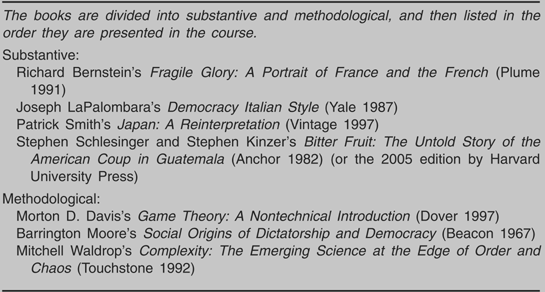
To indicate how these themes fit together in practice, I first describe the two courses individually, then return to some of the analytic and academic issues the approach raises (see Table 1).
The Politics of Developed Nations Course

The Politics of Developed Nations Course
As indicated, the course combines two different types of reading material. First, the reading includes micro-descriptive works on current life and politics in a given country; here the countries include France, Japan, the U.S., and LaPalombara's Italy. Second, the readings include a major theoretical theme, game theory, using Davis's (Reference Davis1997) short classic text on the subject; and Barrington Moore's Social Origins of Dictatorship and Democracy (Reference Moore1967), which I present as game theory within a rich historical context. The game theoretic approach is emphasized in two ways to organize the class discussions. First, the game theory concepts (unlike most theory) are transparent to students and serve to chart the logic inherent in everyday political behavior. They learn to see how one group's claim or action leads to a counterclaim or counteraction, and how the result of the interchange can only be understood by recognizing that the same action may differ in its meaning, depending on how others respond.Footnote 12
The second way of emphasizing game theory is by allowing each student to choose a country for the semester, on which they report every week on interesting news items that they analyze in terms of game concepts. This encourages students to appreciate how the theory works in the world around them, and they use both game theory and Barrington Moore to probe beneath the surface of events reported in the media. Instead of “one damn thing after another” they begin to see that a series of events follows logically, step by step, as different actors compete and negotiate over public decisions and policies. Game theory serves here to focus their attention on human interaction, and on the goals, strategies, and payoffs of the players as they variously win or lose each encounter.Footnote 13 This emphasis on explanation (explanations developed by the students themselves) speaks to the pedagogic purpose of the course. Rather than memorizing textbook descriptions of institutions, descriptions that may be obsolete by the time the book reaches them, students acquire an analytic viewpoint that they can use throughout life to understand socioeconomic and political events as these occur.
Midway in this course I introduce a related theme, complexity theory, which builds on game theory but extends greater attention to processes of social self-organization.Footnote 14 Self-organization theory allows students to see how everyday interpersonal behavior constitutes larger institutions, and to understand that policy debates are not well understood as searches for “good public policy” so much as they are reified conflict between the particular groups that are important in a given society. This is particularly emphasized by the case with which the course concludes, the famous micro-history of the U.S. coup in Guatemala, a lively case study in game theory that emphasizes, in the context of the course, that some events yield their meaning only to game theory, leaving its more conventional and less realistic alternative theories (functionalism, institutionalism, democratization) well behind in the explanatory race.
The Interpersonal Politics Course
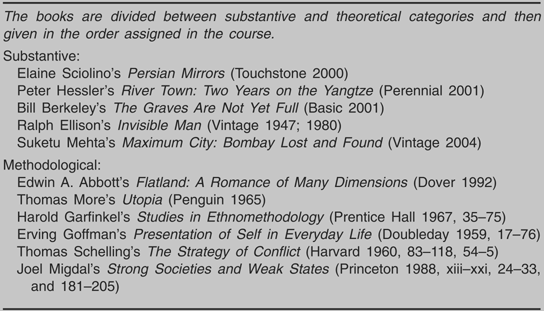
The second course (see Table 2), using the same game-theory-plus-microhistory approach, is less traditional, particularly in widening its analytic scope to include ethnomethodology, microsociology, microeconomics, and Migdal's melange theory. Readings in the course emphasize method from the start, while bribing the students with studies of particularly compelling empirical cases from Iran, back-country China, South Africa and the Sudan, and Mumbai's underworld. The course opens with Abbott's famous Flatland, which is thrown at the students largely without introduction as a way of perplexing everyone.Footnote 15 When the students have coped with a country that looks like the surface of a large table with circles, squares, and triangles fighting to distribute social goods and social status, and have exercised their ingenuity on Lineland and Pointland (where the leader sings happily to himself in total ignorance of the real world), they go away with the lesson that there are other worlds and that understanding anything but one's own requires real energy and ingenuity.
The Interpersonal Politics Course

Note: Abbott and More are difficult to classify here, but leaving aside the ambiguities their purpose in the course is methodological.
This leads directly into the first descriptive book, on Iran, which provides high motivation because of the country's role in current international news, although the book itself is centered on what life is like among ordinary Iranians of all ages, positions, and occupations. Leaving behind the ayatollahs, the students attend stylish if clandestine social gatherings, investigate Persian poetry, and explore the complexities of what it is like to live wrapped in a chador with any stranger in the street liable to complain about a stray lock of hair not adequately covered.
From this point on, I alternate micro-descriptions of unfamiliar societies with seminal works in social theory designed to help students understand social behavior patterns that are usually invisible. We start with Goffman's Presentation of Self in Everyday Life (Reference Goffman1959), which, as one student said, “seems perfectly clear once you think of it, but I never thought of it exactly that way before.” Goffman's perspective is of course a sociological version of game theory, where actors tacitly collude to create presentable daily social dramas; he is therefore a master of the surface of things, of the comfortable and conventional. We used his handy phrase, “life is a wedding” to summarize the various pictures he paints, and we studied both Flatland and Iran to discover examples of how worlds other than the students' own call forth other performances. With some trepidation I also included Harold Garfinkel in the syllabus: he was difficult for them because of the “bottomless boat” quality of his ethnomethodology (anything we can say isn't really it), but the chapter I used has descriptions of the experiments he did with his students, and the class grasped these concrete cases instantly.
The unfamiliar ideas of the two theorists did not stay with the students unless continually reinforced. When we had covered a particular reading thoroughly, I found myself asking “What's the Garfinkel of this?” or “Where's the Goffman in that?” At first this brought looks of perplexity, and I had to be well prepared to answer my own question at the beginning, but the students caught on quickly and developed a talent for coming up with sometimes surprising answers. It used to be said by old-time comparativists that in any nation there are some things that need not be explained to natives, and cannot be explained to foreigners. Between Goffman and Garfinkel my students began to bridge this divide and get to the inside of newly encountered societies.Footnote 16
Two other works completed the theoretical part of this second course—or perhaps three since I included More's Utopia as an example of a transparent society, one that could be seen as a whole with all its intersecting principles openly stated.Footnote 17 The two explicitly theoretical works, beyond Goffman and Garfinkel, were well-known political science works, Schelling's Strategy of Conflict (Reference Schelling1960) and Migdal's Strong Societies and Weak States (Reference Migdal1988). These were less effective than the sociology: Schelling is difficult to excerpt, and Migdal's model is not presented in a way that makes vivid its originality. I have recently added Davis to this course as well as the other, but retained Schelling because he does have a flavor unlike all others, of the way game theory stands at one's very doorstep.
The key to maintaining motivation through these unfamiliar and sometimes taxing readings was the excitement of the substantive readings, which I had collected over several years of experimenting with the course. China was represented by a book written by a Peace Corps volunteer who taught English in back-country Sichuan province. Because he naturally assigned written essays to his students, frequently about their personal and family experiences, the book brought American students about as up close and personal as could be imagined to Chinese people who were the children of peasants and had vivid memories not only of communism but of the world prior to communism. It put China in an entirely new light to see the underside of the society, and the way in which bright students in China joined the party as bright students in the U.S. get jobs on Wall Street.
The book on Africa had the same immediacy as the China and Iran books because it was written by a human rights activist and writer who had interviewed almost every dictator on the continent, and had lived sympathetically among the people who suffered at the bottom of the system. This would not ordinarily be appropriate for a comparative politics course, but the author was neither unrealistic nor utopian about the continent. First of all he took a strong stand against the “ancient tribal hatreds,” which are often said to explain the continent's troubles, arguing instead that Africans are just like the rest of us, but face far more difficult circumstances. Second, the author presented a rational choice approach to various wars and civil conflicts—the idea that such situations persist because there are huge payoffs for people who scramble to the top, gun-runners, drug dealers, ethnic armies, and strategically motivated leaders. That current African history is entirely rational has been explored within political science (e.g., Bates Reference Bates1981), but at the level of formal institutions rather than the more powerful informal ones.
Since the course had an open format I included a book usually considered fiction but that I chose to characterize as sociology. Ellison's Invisible Man, after all the theoretic groundwork we had laid, generated one of the most intense discussions of the semester, and in game theory terms everyone instantly adopted the narrator's grandfather, with his grand pronouncement, “you live with your head in the lion's mouth.” As sheer description of a society of which neither my white nor black students had any direct experience, Ellison's sociology was very effective in comparative terms because it takes the reader directly into the lives of the people, on the street or in the luxurious apartments, who live within and upon racial societies.
The hit of the semester came last, in a book on lower-class life in Mumbai that achieved something no textbook account could attain when it introduced the students directly to people who had murdered other people in communal riots, or because murder was their occupation, and why they chose it. Mehta interviewed gang members and showed the rational logic that led them into gangs and showed students how ordinary people struggled to survive in an informal political milieu of which most of us can have no concept. The personal politics of Mumbai residents was not solely personal, because the gangs in fact ruled many sections of the city, as they and the police and other formal authorities fought for turf; but it was raw in describing events and I put a sex and violence warning on the class web site. No student, however, turned a hair as they worked through and delighted in the desperately vivid descriptions of what literally is meant by strong societies and weak states.
The impact of the course depends on the student's actually doing all the reading, and as a game theorist I did not trust to virtue in this matter but gave a mini-quiz every week before any class discussion. The system seems Prussian, but students adjust to it and find it useful: they always have a running record of their grades in the course, and can rationally calculate their priorities in that light. Although the exams are simple, directed to giving students opportunity to answer factual questions rather than doing deep analysis, grading was sometimes subtle in that the material was so rich students often made very personal responses to it. I learned quickly that what I had thought would be a suitable response was nowhere to be found on their exam sheets, but that (1) students had clearly done the reading, and (2) they answered suitably if unexpectedly. As was perhaps appropriate therefore it turned out to be a bottom-up course about bottom-up political behavior.
Methodologically Interesting Comparative Studies
The success of the courses with students depends wholly on the quality of the substantive readings, which must be sufficiently rich to maintain commitment to the theoretical demands.Footnote 18 Such books are not easy to find because they tend to be sui generis rather than members of an established category.Footnote 19 Not just any compendium of minutiae on a country is suitable. The books I now use are not just high in detail but give a rounded picture of a country's life ways, along with an acute theoretical awareness.Footnote 20 The key to success seems to be the attitude of the author toward the country; colloquially, one student was not far off when he said, in half complaint of the book on France, “he's in love with them.” Sheer affection will not succeed however, unless some kind of logic is present. The book on Africa was popular with students not solely because the author ventured into dangerous places to report events, but because he began with the methodological assumption that there was nothing “dark” about Africa, that Africans were as rational as the rest of us. And he did not just grieve over the violence but explained it. Similarly the book on Japan seemed to originate in the author's strong sense of annoyance that so much had been written on an illusory Japan, a false history slanted to U.S. illusions but incommensurate with Japanese reality. Again, as with the Africa book, the author refused to accept the myth of the inscrutable Asian, but showed exactly the forces and circumstances that led them to act in ways that seem, on the surface, so antithetical to Western norms. LaPalombara's interpretation of Italy takes the same strategy, throwing aside standard theoretical frameworks, and their patronizing dismissal of Italian democracy, and instead celebrating Italy's transcendent originality.
There is no standard label for such works either among political scientists or booksellers, but while we cannot convert the trade market it must be admitted as a loss that books such as these have no accepted status within comparative politics. At present informal political behavior has no standard place in the curriculum, although nothing precludes it.Footnote 21 Explaining why the Fifth French Republic fits the country so much better than did the Third or the Fourth cannot be explained in formal institutional terms, but is self-evident once students have been thoroughly introduced to France's micro-culture and social norms. Italy is similarly incomprehensible until we are shown the appropriately Italian industrial-feudal compact that LaPalombara finds at its base. Or African wars. Or communal riots. None make sense in the abstract, but in the concrete detail of everyday life, along with a flexible game theoretic method, explanation and possibly science has the opportunity to emerge.Footnote 22
Evaluation of the two courses is difficult in any broad comparative terms, because the department allows wide discretion in the construction of courses and all the relevant variables are uncontrolled.Footnote 23 Reading the narrative comments is a rough guide, and two points were clear: universal enthusiasm for the required books (with occasional complaints on the large amount of reading), and concerns about a perceived lack of structure in the presentation of material.Footnote 24 Evaluation from the top down was easier to accomplish, because I had a running guide in the exams into whether students were grasping the material, and an empirical test in the weekly reports as to whether they were applying the empirical methods appropriately to their chosen countries. In both cases the results were positive. Experience also showed that the audience for such courses was wide, ranging from students who claimed “this is my first political science course” to graduating seniors. The two courses registered from 20 to 30 students each; a higher enrollment would make discussion participation less universal, but this could be handled with greater instructor participation. The approach would be expected to work well at many types of educational institutions, from state and even community colleges to more restrictive educational milieux. The highly detailed substantive materials reach out to students who might need this type of motivation to get them started (and such students exist at all types of institutions), and while the theory is challenging it is straightforward and attractive to those with more active intellectual interests.
The Wider Field of Comparative Politics
The teaching of comparative politics courses contains an inherent difficulty, and this difficulty is directly related to the shape of comparative politics as a field within political science. If the discipline seeks to be scientific, then it must emphasize systematic comparison under some effective theoretical framework. But these conceptual frameworks, from structural-functionalism to democratization, have been abstract and unsatisfactory. The alternative case studies are condemned as storytelling, yet those “foreign” stories with which undergraduates were once introduced to comparative politics were often a major component of the educational value students derived from comparative courses. Facts are not enough, of course, but they play an essential role and without them students acquire a very disembodied sense of the world beyond American borders. Complicating this problem is the standard comparative focus on formal political institutions, which may entail high levels of abstraction and a total absence of reference to the larger national context—social, economic, cultural, personal—within which the institutions must function.
The approach used in both the courses described above, designed to respond to these circumstances, has implications for comparative politics research as well as pedagogy. Is the essence of comparative politics “comparison” (and if so, comparison of what), or is the purpose of comparative politics to understand a country in its entirety? Academics have always recognized that institutional comparisons of whole nations were difficult because too often institutions don't compare well; there are the same institutions used for differing purposes, and differing institutions used for similar purposes. Reaction to this problem of course stimulated systems theory and functionalism, but these, to make a long story very short, also failed. Recently, isolated voices have suggested that comparison is a means and not an end, and that comparison should take a second place to understanding whole individual systems (e.g., Zuckerman Reference Zuckerman, Lichbach and Zuckerman1997, 298). The only way this can be done without becoming idiographic, given the tools currently available, is through some analytic path such as that of game theory and/or agent-centered models. As we perhaps should have learned from Moore, a strong analytic method rescues science from stories because the underlying processes can be highlighted and explanatory models can be constructed (Lane Reference Lane1997).
Scholars within comparative politics have tended to resist rational choice approaches (Katznelson Reference Katznelson, Lichbach and Zuckerman1997), which arrived late in the field (Popkin Reference Popkin1979) and, when used, have often been used in a highly formal manner (Bates et al. Reference Bates, Greif, Levi, Rosenthal and Weingast1998). The debates aside however, rational choice or game theory at a meta-theoretic level has proven attractive to those doing empirical research because it allows them to use its framework concepts to bring order to the substantive material without accepting the highly restrictive assumptions of mathematical game theory. The new emphasis on process tracing (George and Bennett Reference George and Bennett2005), on the study of mechanisms (see Elster Reference Elster1978; Stinchcombe Reference Stinchcombe1991), or the reassertion of comparative historical analysis (Mahoney and Rueschemeyer Reference Mahoney and Rueschemeyer2003) suggests that substantive history and sharp theory can be combined, though a descriptive title for the approach is elusive. Overall the approach fits within agent-centered methodology and its emphasis on the way individuals self-organize themselves and their societies, and how this self-organization is reflected in the formal political institutions that top everything off, but that approach has not been used extensively in comparative politics (see Lustick, Miodownik, and Eidelson Reference Lustick, Miodownik and Eidelson2004).
Exclusive concentration on formal institutions alone, within comparative politics, can be misleading in accepting the presupposition that political institutions have effect in themselves, quite apart from the societies over which they appear to reign. This leads to a simplistic reliance on free and fair elections as a short solution to many long problems. In the complex world our students face today and tomorrow, panacea solutions will continue to show their inadequacy. Emphasis on knowing other nations and other peoples in their full idiosyncrasy, with the analytic structure provided by the universal applicability of a tactical interpretation of human behavior through game theory, may serve students better than we currently appreciate, as globalization overtakes us all.