Introduction
Perhaps one of the most striking features of animal morphology is the presence of diverse external colouration, both within and among taxa. The diversity, along with the ease of visibility of this trait throughout development makes it an ideal subject for Evo-devo studies. Studies of mammalian pigmentation have identified hundreds of genes and a common pigment cell, the melanocyte, which can produce either the black or brown eumelanin or the yellow to red pheomelanin (Mills & Patterson, Reference Mills and Patterson2009). In contrast, poikilotherm vertebrates, such as fish and amphibians, have multiple pigment cell types generally known as chromatophores. Teleost fish have the greatest number of chromatophore types: black melanophores, yellow xanthophores, red erythrophores, iridescent iridophores, blue cyanophores, and white leucophores (Jeon et al., Reference Jeon, Friedlander, Jarvik and Fujii1993). It is therefore not surprising that teleost fish exhibit some of the most varied and brilliant colours among animals.
It has long been recognized that the fields of evolution and development are closely entwined, and much can be learned about one by studying the other (reviewed in Raff, Reference Raff2000). As such, detailed analyses of pigmentation development in the model organisms Danio rerio (zebrafish) and Oryzias latipes (medaka) provide a solid foundation for exploring evolutionary changes in fish colour (Kimmel et al., Reference Kimmel, Ballard, Kimmel, Ullmann and Schilling1995; Lamoreux et al., Reference Lamoreux, Kelsh, Wakamatsu and Ozato2005). Mutations in pigmentation genes of zebrafish and medaka, many of which are homologs of those found in mammals, reveal an array of phenotypes (Kelsh et al., Reference Kelsh, Brand, Jiang, Heisenberg, Lin, Haffter, Odenthal, Mullins, van Eeden, Furutani-Seiki, Granato, Hammerschmidt, Kane, Warga, Beuchle, Vogelsang and Nusslein-Volhard1996, Reference Kelsh, Inoue, Momoi, Kondoh, Furutani-Seiki, Ozato and Wakamatsu2004). Developmental analyses of the mutants have not only informed much about the establishment of pigments and their patterns, but several studies performed in Danio spp. suggest possible evolutionary mechanisms that could give rise to diversity of colouration and patterns (reviewed in Parichy, Reference Parichy2006). Research of alternative model organisms could expand upon this work, providing information on possible conserved, converged, and novel pigmentation mechanisms. While the most impressive display of diversity of colour and pattern is found in coral reef fish, a freshwater model system is more tractable for laboratory study.
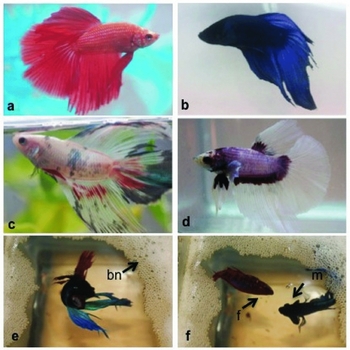
Betta splendens, a freshwater fish endemic to Southeast Asia, has long been a popular pet because of its attractive appearance and hardiness. Originally bred for aggressiveness and durability during fighting, they are now largely bred for aesthetic purposes. Key among these desired traits is that of novel colourations; B. splendens with variations of reds, greens, blues, yellows, and white are commonplace in pet stores (Fig. 1). These colours are likely created by melanophores, xanthophores, iridophores, and erythrophores (Monvises et al., Reference Monvises, Nuangsaeng, Sriwattanarothai and Panijpan2009). It should be mentioned that although blue is a common colour among B. splendens, it is not likely to be due to cyanophores, as only two fish have been shown to contain these cell types (Goda & Fujii, Reference Goda and Fujii1995). Most studies performed on B. splendens have focused on the behavioural aspect of these fish, but two recent studies have described early development of the embryos and larvae (Duarte et al., Reference Duarte, de Faria e Vasconcellos, Vidal, Ferreira, da Cruz Mattoas and Branco2012; Valentin et al., 2014).
Male B. splendens exhibiting: (a) super red, (b) blue, (c) marbled, (d) purple butterfly colourations, and (e) a pair of B. splendens (blue male and red female) in the process of mating, the pair is in full embrace with the male wrapped around the female. The bubble nest can be seen off to the side (f) male (on the right) collecting dropped eggs before placing them in the bubble nest while the female is lies paralyzed on her side. Abbreviations: bn: bubble nest; f: female; m: male. Arrows in (e) indicate bubble nest and in (f) the female and male fish.

In an effort to learn about the evolution of the molecular and cellular basis of colouration we have a begun a research program that employs B. splendens as a model system. Here we report the results of our work to find reliable methods for breeding B. splendens pairs, raising offspring, and documenting and analysing pigmentation patterns in developing larvae and juveniles. Furthermore, we show that variation in pigmentation of offspring of different coloured parents is manifested early during development.
Materials and methods
Breeding B. splendens
Tank size, water temperature, photoperiod, mate introduction methods, and nest supports were optimized for breeding of pairs of B. splendens. The results reported here used the methods as follows: male B. splendens were kept in individual 2.5 gallon tanks; and multiple females were kept in a single 10 gallon tank. Water temperature was maintained at 27–29°C and a light source provided a cycle of 14 h light to 10 h dark. Nest anchors were made from a halved base of a Styrofoam cup and added to male tanks.
Males were deemed ready to mate when a bubble nest was constructed. Females were chosen upon the appearance of a white protrusion from the ovipositor and the roundness of the abdomen. Ready females were introduced to males in clear cups floated in the male's tank. Behaviour was monitored for interactive activity, opercula spreading, fin erection by both individuals, and, depending on colouration of the female, a change in stripe patterns on her flanks (Fig. 1e, f ). If these signs were present the female was released from the cup.
Successful breeding (physical coupling, spawning, and placement of zygotes in bubble nest) was monitored. Both male and female were removed immediately after breeding. If intense aggression occurred prior to breeding, fish were separated.
Raising B. splendens larvae and juveniles
As soon as the parents had been removed, a glass top was placed on the tank. Dead embryos and detritus were carefully removed from the tank bottom. Upon hatching of larvae from the chorion at about 48 h post fertilization (hpf), an air stone was set to disturb the water's surface but not create a strong current. A day after hatching, larvae were fed Hikari First Bites two to three times daily until 1 month old, at which point they were fed frozen baby brine shrimp two to three times daily. At 1 month of age, juveniles were separated into individual jars.
Microscopy and photography
Fry were fixed in 2% paraformaldehyde in phosphate-buffered saline (PBS). Fixed larvae and live larvae and juveniles were imaged with a Leica dissecting microscope, with Video Toolbox Pro software or with an inverted Olympus light microscope and QICAM software.
Results
Breeding
Approximately 25% of paired B. splendens participated in breeding and produced viable offspring. The other pairs did not interact as they either were aggressive enough to cause harm to each other, mated without complete spawning, or ate the offspring before being removed from the tank. Mating consisted of an embrace immediately followed by spawning (Fig. 1e, f ). After 4–10 eggs were released the male released his embrace and swam downwards in order to put the eggs in his mouth. He immediately placed the eggs in his bubble nest and then the pair began another cycle of mating. This process was repeated for approximately 1 h and produced from 10–200 zygotes.
Development of B. splendens larvae and juveniles
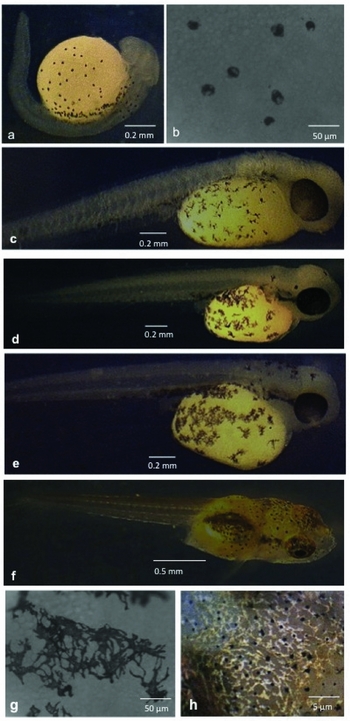
Early development was similar to that described by Valentin et al. (2014) and Duarte et al. (2013). As mating typically occurs for 1 h or more it can be difficult to determine exact times post fertilization. Here we report typical representatives from a given breeding. Figure 2 shows representative offspring of a blue male and red female B. splendens. Melanophores are visible by 24 hpf on the sides of the yolk sac and in a striped pattern on the dorsal surface of the embryo (Fig. 2a, b ). At 54 hpf the eyes are fully pigmented. Melanophores, which have taken on a branching morphology, cover more of the yolk sac and the ventral side of the larvae (Fig. 2c ). Branching morphology and number of melanophores increase during development as shown at 73 hpf (Fig. 2d ) and 100 hpf (Fig. 2e ). By 13 days post fertilization (dpf) the yolk sac had almost disappeared, melanophores had taken on a punctate morphology, and iridophores were present along the dorsal and lateral surfaces of the larvae (Fig. 2f ). Figure 2g shows the branched morphology of melanophores at 100 hpf. Figure 2h shows the punctate morphology of melanophores and branched morphology of iridophores.
B. splendens larvae: (a) 24 hpf, (b) yolk sac of 24 hpf (×20 magnification), (c) 54 hpf, (d) 73 hpf, (e) 100 hpf, (f) 13 dpf, (g) yolk sac of 100 hpf (×20 magnification), (h) dorsal surface of 13 dpf (×20 magnification).

Variation in early pigmentation
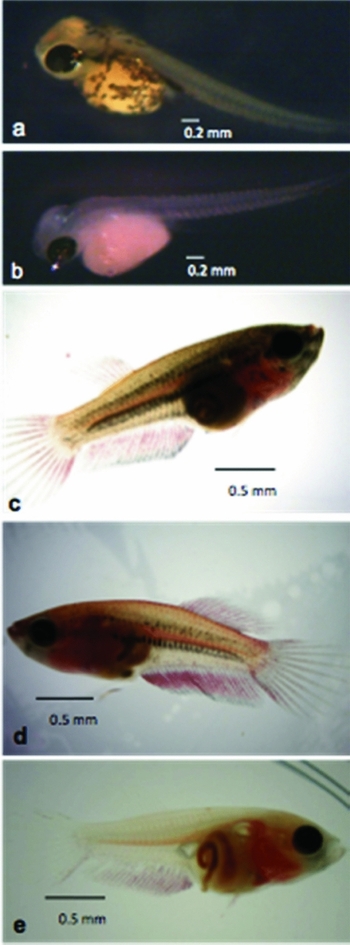
We found variation in both melanophore pigmentation and morphology between offspring of different parents, and, in some cases, between individuals within a brood produced by the same parents. Figure 3a shows a 100 hpf larva from a blue male and red female as compared with Fig. 3b , the 100 hpf larva of a red male and colourless female. Branched melanophores are clearly seen on the yolk sac, a lateral stripe, and limited ventral and dorsal surfaces in the larva of Fig. 3a . In contrast, no melanophores are visible in the larva in Fig. 3b . Both larvae have pigmented eyes.
(a) 100 hpf offspring of blue male and red female. (b) Offspring of red male and a colourless female. (c–e) 29 dpf offspring of a red male and red female.

Figure 3c–e show three different 29 dpf offspring of a red male and red female. The larva in Fig. 3c has horizontal stripes of melanophores surrounding a stripe of erythrophores on the flanks, sporadic melanophores on the dorsal and ventral surfaces, erythrophores on the fins, and some melanophores on the distal end of the ventral fin. The larva in Fig. 3d shows a relatively fainter melanophores stripes surrounding a stripe of erythrophores on the flanks, fewer melanophores on the dorsal and ventral surfaces, more erythrophores on the fins with some melanophores on the melanophores on the distal end of the ventral fin. Lastly, Fig. 3e shows a larva with only a erythrophore stripe on the flank and a fewer number of erythrophores on the ventral and tail fin.
Discussion
The brilliant colours of B. splendens selected by breeders for aquaria use provide ideal phenotypes for pigmentation studies. We have determined that pairs of B. splendens can be reliably bred to produce adequate numbers of large, transparent larvae for pigmentation analysis. Conveniently, developmental stages appear to be similar to the well studied zebrafish, as well as patterns of larval melanophores seen in B. splendens offspring of blue males and red females (Kimmel et al., Reference Kimmel, Ballard, Kimmel, Ullmann and Schilling1995). These similarities will allow for easier morphological characterization of young larvae and their pigmentation.
Our results show that B. splendens has great potential as a model organism for studying the evolution and development of pigmentation. As this initial study aimed to test and optimize the use of B. splendens for this purpose, our data on pigmentation phenotypes are qualitative in nature. However, we have begun systematic matings to obtain quantitative data about inheritance patterns of pigmentation. Of particular interest is the larvae observed with a complete lack of melanophores. Similar mutant phenotypes have been extensively studied in zebrafish, helping to resolve genetic pathways involved in larval pigmentation (Kelsh et al., Reference Kelsh, Schmid and Eisen2000; Braasch et al., Reference Braasch, Schartl and Volff2007). This work will provide an invaluable basis for forming hypotheses about molecular mechanisms in B. splendens.
The identification of melanophores, iridophores, and erythrophores in B. splendens juveniles supports our assertion that this organism is a good model for studying the development of a wide variety of colouration. We find that in some of offspring adult melanophore pattern and morphology in these offspring is also similar to that of zebrafish (Quigley & Parichy, Reference Quigley and Parichy2002). We predict we will find xanthophores upon examination of offspring from parents with orange or yellow colourations. The complex patterns we observe during adult pigmentation development could shed light how such varied colourations are achieved. It has been suggested that Turing-type interactions between chromatophores may be responsible for pigmentation patterns in adult vertebrates (Kondo & Miura, Reference Kondo and Muira2010). Recent work has demonstrated the importance of chromatophore interactions in pattern formation in zebrafish (Patterson & Parichy, Reference Patterson and Parichy2013; Singh et al., Reference Sing, Schach and Nusslein-Volhard2014). It will be of interest to track chromatophore subtype migrations relative to each, especially those of the less-studied erythrophores.
The ability to obtain large numbers of offspring from individual adult pairs will help with an analysis of the inheritance of specific pigmentation types. The knowledge of genetics of pigmentation in B. splendens is limited to a handful of early papers that rely on classical genetic techniques (Goodrich & Mercer, Reference Goodrich and Mercer1934; Wallbrunn, Reference Wallbrunn1958; Lucas, Reference Lucas1972) and breeding patterns reported by aquaria enthusiasts. A lack of consistency in pure-breeding lines and the convergence of phenotypes by multiple incidents of selection complicate the matter further. The variation in pigmentation patterns of the red male by red female cross we have reported here suggests the complexity of the relevant genetics. We suggest that the use of current molecular sequencing techniques could quickly identify genes involved in B. splendens pigmentation. Analyses of colour-specific polymorphisms in these genes could shed light on both developmental and evolutionary mechanisms. Additionally, it would be interesting to examine the impact of environmental conditions on pigmentation, especially during sex determination.
Acknowledgements
The authors would like to thank Kate Rice and Browning Smith for photographs of adults B. splendens, Sydney Katz and Scarlett Blevins for preliminary work photographing larvae, and Mark Johnson for help optimizing tank and feeding conditions. We also thank James Wagner for valuable help with the development of this project. Finally, we thank Transylvania University's Kenan Fund for Faculty and Student Development for funding.