Introduction
Pigeonpea [Cajanus cajan (L.) Millsp.] is a multi-purpose grain legume grown by resource-poor farmers in the semi-arid tropics and subtropics. The crop has narrow genetic diversity and is susceptible to a range of diseases and pests such as pod borer [Helicoverpa armigera (Hub.)], pod fly [Melanagromyza obtusa (Malloch)] and bruchid [Callosobruchus chinensis (F.)]. High levels of resistance to many of these pests and diseases are low to moderate in the cultivated germplasm (Sharma, Reference Sharma2005), but the wild relatives of pigeonpea have shown high levels of resistance to many of the constraints (Green et al., Reference Green, Sharma, Stevenson and Simmonds2006; Sujana et al., Reference Sujana, Sharma and Manohar Rao2008; Sharma et al., Reference Sharma, Sujana and Manohar Rao2009). The utilization of wild species from the secondary gene pool is important as they are closely related, leading to normal chromosome recombination. This helps in the transfer of useful genes/traits to the cultivated pigeonpea (Mallikarjuna et al., 2011a, b, c). Cajanus lanceolatus, a native of northern Australia, is a wild relative from the secondary gene pool. Until now, C. lanceolatus had not been successfully crossed; for instance, a previous study (Sateesh Kumar, 1985) has reported that F1 hybrids died during the vegetative stage. The present paper reports the successful crosses between the cultivated pigeonpea and C. lanceolatus.
Experimental
Cajanus lanceolatus (ICP 15639) and C. cajan (ICPL 85010) plants were grown and maintained in a glasshouse. Crosses were made using C. cajan as the female parent and C. lanceolatus as the pollen donor. Pollinations were carried out soon after emasculations in the morning before 10 a.m. Out of 86 pollinations, 20 pods were obtained. The pods were harvested 40–45 d after pollination. For cytological analysis of meiocytes, immature flower buds from F1 hybrids were fixed in Carnoy's II solution (acetic acid–chloroform–ethanol, 1:3:6) for 24 h at 4°C and transferred to Carnoy's I solution (acetic acid:ethanol, 1:3). Meiocytes were squashed and stained in 4% acetocarmine and well-spread meiotic preparations were taken for analysis and photographed.
Results and discussion
Pod formation was 23% when C. cajan was crossed with C. lanceolatus. More than half of the seeds were normal with the exception of few semi-shrunken seeds (34 %). Of the 35 morphologically normal seeds, 14 germinated to produce hybrid plants under in vivo germination conditions. The plants initially grew slowly, but, later on, normal growth was observed. Morphologically, the hybrid plants had excessive growth compared with both the parents. The F1 hybrids were screened for morphological traits such as plant height, branching pattern, flower size and shape, pod shape and size, and seed colour. Hybrids were tall, measuring 325 cm (P10-F1) to 380 cm (P13-F1) in height, resembling the male parent C. lanceolatus with a height of 285 cm compared with the female parent C. cajan with a height of 185 cm (Fig. 1(a)). All the hybrids flowered at 98 to 160 d from the date of germination. Sateesh Kumar (1985) reported that F1 hybrids died during the vegetative stage. It is possible that the authors of this study failed to notice that hybrids inherited the long-duration trait of the male parent, and did not maintain the hybrid plants until they reached the flowering stage. Alternatively, it is possible that the genotypes of the female cultivars used in their study, in combination with C. lanceolatus, were not genetically successful.
Morphological observations and meiotic analysis of the F1 hybrids derived from the cross Cajanus cajan (ICPL 85010) × Cajanus lanceolatus (ICP 15639). (a) Comparison of the hybrids (middle) with the cultivar (female, left) and wild (male, right) parents. (b) Metaphase I (fertile plant F1-P6) showing two rod and nine ring bivalents. (c) Metaphase I (sterile plant F1-P7) showing four univalents and nine bivalents. (d) Anaphase I (fertile plant F1-P6) showing normal disjunction of chromosomes. (e) Anaphase I (sterile plant F1-P7) showing five laggards. (f) Fertile and sterile pollens. (g) Unseparated and empty pollen grains in the sterile anther.

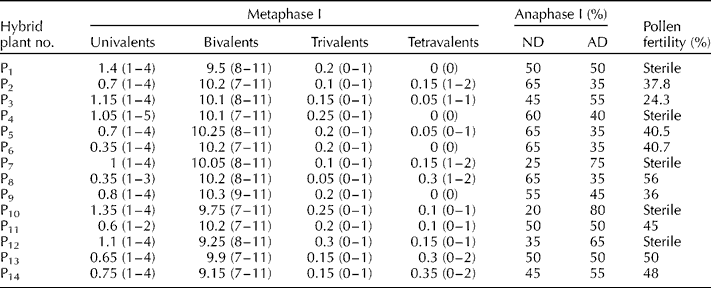
The meiotic analysis of pollen mother cells of the F1 hybrids exhibited a regular formation of 11 bivalents that were predominantly rings. It is clear from Table 1 that the number of bivalents ranged from 11 in the anther from the fertile plant to 7 in the sterile F1 plant (Fig. 1(b) and (c)). Univalents were also found in many cells, and the average number of univalents per cell varied from 1 to 5 in the sterile F1 plant. Meanwhile, trivalents and tetravalents appeared at a lower frequency, ranging from 0 to 2. Normal bivalent formation in the majority of the pollen mother cells is an indication that there is good recombination between the parental genomes. Meiotic anaphase I showed 50–70% of the pollen mother cells with normal disjunction and remaining 30–50% with abnormal disjunction of chromosomes (Fig. 1(e)). At the tetrad stage, 100% normal tetrads were observed in all the hybrids except in P7 in which 6% of the tetrads contained micronuclei. Pollen fertility was found to vary between 35 and 50 % in the fertile hybrids (Fig. 1(f)). In some of the F1 hybrids (P1, P4, P7, P10 and P12), total male sterility was observed in all the anthers having 100% sterile pollen grains, a result of unseparated tetrads (Fig. 1(g)). An important observation made was that male sterility was a post-meiotic process. The development of tetrads was normal, but none of them formed pollen grains. Instead, they grouped together and the tetrads did not separate into individual pollen grains. Such sources may be useful in the development of cytoplasmic male sterile systems in pigeonpea; as such, a phenomenon was observed in the A7 cytoplasmic male sterile (CMS) system derived from Cajanus platycarpus (Mallikarjuna et al., Reference Mallikarjuna, Jadhav, Saxena and Srivastava2012). Pigeonpea crossed with different wild Cajanus species has been reported to have given rise to different cytoplasmic male sterile systems (Saxena et al., Reference Saxena, Sultana, Mallikarjuna, Saxena, Kumar, Sawargaonkar and Varshney2010; Mallikarjuna et al., 2011a, b, c). Hence it is worth exploring if a CMS system can be developed from this cross, as complete male sterility was observed in the F1 hybrids.
Meiotic studies of the hybrids derived from the cross Cajanus cajan (ICPL 85010)×Cajanus lanceolatus (ICP 15639)

ND, normal distribution; AD, abnormal distribution at anaphase I.
The cross between the cultivated pigeonpea and C. lanceolatus generated two categories of progenies. The first category is the fertile progeny with good recombination between the parental genomes, leading to fertile plants, good material for broadening the narrow genetic base of pigeonpea and traits of interest. The second progeny category is the CMS lines, i.e. F1 hybrids with 100 % male sterility which can be used to develop another CMS source, distinct from the currently available A5 CMS system (Mallikarjuna and Saxena, Reference Mallikarjuna and Saxena2005), which was derived from the cross between cv. ICPL 85010 and Cajanus acutifolius, and developed on cultivated pigeonpea cytoplasm. CMS is developed as a result of the interaction between the cytoplasmic genome of the female parent and the nuclear genome of the pollen parent (Saxena et al., Reference Saxena, Sultana, Mallikarjuna, Saxena, Kumar, Sawargaonkar and Varshney2010). It is envisaged that the gametic recombination between cv ICPL 85010 and C. lanceolatus may have given rise to fertile and sterile hybrid plants.