I. INTRODUCTION
Biodiesel is a promising alternative fuel since it can be used in diesel engines without any modification. Furthermore, biodiesel shows interesting properties such as biodegradability, nontoxicity, and renewability. This biofuel is produced by the transesterification reaction of vegetable oils with alcohols, and the most common method to its production is the use of homogeneous catalysts, such as sodium ethoxide or methoxide.Reference Lang, Dalai, Bakhshi, Reaney and Hertz1 However, the removal of these catalysts from the final products is not easy because, in case of water presence, soapy fractions are formed as a competitive reaction, which emulsifies the final products with unreacted fractions. The separation in that cases is a very complex process, increasing the cost of the biodiesel processing.Reference Di Serio, Tesser, Pengmei and Santacesaria2 Then, compared with the commonly applied homogeneous catalysts, heterogeneous catalysts are much more easily separated from the reaction medium, avoid the emulsification, and may be recycled for several runs, implying also lower corrosion in production equipments.Reference Liu, Piao, Wang, Zhu and He3–Reference Almeida, Noda, Gonçalves, Meneghetti and Meneghetti5 However, the activities of the heterogeneous catalysts are generally lower than that of a homogeneous catalyst, such as KOH.Reference Kawashima, Matsubara and Honda6 In this way, a great research effort has been performed to obtain an effective heterogeneous catalyst.Reference Liu, He, Wang, Zhu and Piao7–Reference Lam, Lee and Mohamed9
Currently, several types of heterogeneous nanocatalysts are explored for the formation of biodiesel, such as ceramic oxides,Reference Almeida, Noda, Gonçalves, Meneghetti and Meneghetti5, Reference Kawashima, Matsubara and Honda6, Reference Yoo, Lee, Veriansyah, Kim, Kim and Lee8 alkali carbonates,Reference Kouzu, Kasuno, Tajika, Sugimoto, Yamanaka and Hidaka10 and several other compounds of alkali metals supported on silica or zeolites.Reference Suppes, Dasari, Doskocil, Mankidy and Goff11, Reference Albuquerque, Urbistondo, González, Robles, Tost, Castellón, López, Azevedo, Cavalcante and Torres12 CaO is the most studied heterogeneous catalyst, due to its high basicity, which leads to a more prominent activity for biodiesel transesterification.Reference Liu, He, Wang, Zhu and Piao7, Reference Kouzu, Kasuno, Tajika, Sugimoto, Yamanaka and Hidaka10, Reference Kawashima, Matsubara and Honda13 Acid catalysts may also have adequate characteristics since the reaction may be catalyzed by both basic and acid sites.Reference Di Serio, Tesser, Pengmei and Santacesaria2, Reference Lam, Lee and Mohamed9 However, many researches showed that there is a relationship between the transesterification rate and the intrinsic basicity of the catalyst,Reference Bancquart, Vanhove, Pouilloux and Barrault14 indicating that acid catalysts present low activity in transesterification of vegetable oils to biodiesel if compared with basic catalysts in the same reaction conditions.Reference Di Serio, Tesser, Pengmei and Santacesaria2, Reference Yoo, Lee, Veriansyah, Kim, Kim and Lee8, Reference Bancquart, Vanhove, Pouilloux and Barrault14 According to Di Serio et al.,Reference Di Serio, Tesser, Pengmei and Santacesaria2 to improve the reaction rate using acid catalysts, it is necessary to increase the reaction time and temperature.
Several nanocrystalline metal oxides with potential application, such as TiO2,Reference Almeida, Noda, Gonçalves, Meneghetti and Meneghetti5 ZnO,Reference Yan, Mohan, DiMaggio, Kim, Ng and Salley15 SnO2,Reference Lam, Lee and Mohamed9 and CaTiO3,Reference Kawashima, Matsubara and Honda6 have been studied as catalysts for the biodiesel production. Nevertheless, there are few works comparing the effectiveness of the transesterification reaction, regarding the acidity–basicity of these catalysts.Reference Di Serio, Tesser, Pengmei and Santacesaria2, Reference Kawashima, Matsubara and Honda6, Reference Yoo, Lee, Veriansyah, Kim, Kim and Lee8 In this scenario, the choice of the synthesis method is essential for the quality of heterogeneous catalysts due to influence in multiple properties and especially on the surface of the material. Different methods are used to obtain nanoparticles, such as nonaqueous synthesis,Reference Niederberger16 coprecipitation,Reference Ngamcharussrivichai, Totarat and Bunyakiat17, Reference Rubio, González, Robles, Tost, Alonso, López and Torres18 sol–gel,Reference Lakshmi, Dorhout and Martin19 and the polymeric precursor method.Reference Barros, Barbosa, Santos, Barros and Souza20–Reference Malagutti, Mourão, Garbin and Ribeiro22 The last one offers several advantages to produce different materials, including single metal to multication oxides, such as direct and accurate stoichiometric control, homogeneity, and uniform multicomponent mixing on a molecular scale.Reference de Macedo, Cela, do Nascimento, Martinelli, Melo, Rabelo and Paskocimas23
In this way, the present work was aimed to compare different metal oxide nanoparticles obtained by the polymeric precursor method and correlate their activities against the transesterification of corn oil with methanol.
II. EXPERIMENTS
A. Synthesis of catalytic powders
ZnO, SnO2, CaO, and CaTiO3 nanoparticles were obtained by the polymeric precursor method.Reference Pechini24 The choice of this method was based on its efficacy in the synthesis of multication oxides.Reference Moreira, Paris, do Nascimento, Longo, Sambrano, Mastelaro, Bernardi, Andrés, Varela and Longo25, Reference Paris, Espinosa, de Lazaro, Lima, Joya, Pizani, Leite, Souza, Varela and Longo26 As reactant precursors for the ZnO, SnO2, CaO, CaTiO3, and TiO2 syntheses, zinc chloride ZnCl2 (99.3% purity; Mallinckrodt, Hazelwood, MO), tin chloride SnCl2·2H2O (98% purity; Synth, Brazil), calcium carbonate CaCO3 (99% purity; Synth, Brazil), titanium(IV) isopropoxide [Ti(OC3H7)4, 97% purity; Aldrich, Brazil] were used. The anhydrous citric acid (C6H8O7, 99.5% purity; Nuclear, Brazil) and ethylene glycol (C2H6O2, 99% purity; Synth, Brazil) were used to promote the complexation and polyesterification reactions, respectively. An aqueous solution of each metallic citrate was prepared for each oxide.
In a typical procedure, citric acid is dissolved in distilled water under constant stirring and heated to approximately 90 °C. In this solution, the corresponding cation source for each oxide is added, according to molar relation 3:1 citric acid:metallic cation. After the total cation complexation, ethylene glycol is added to the solution in a mass ratio of 60 citric acid:40 ethylene glycol, to polymerize the final solution. Stirring and temperature are maintained constant during the process. Thus, a precursor solution containing the metallic cations is obtained. After that, the solution is annealed in a conventional furnace at 350 °C for 2 h to favor the polymer prepyrolysis. The resultant materials are deagglomerated and calcined at different temperatures and periods, to promote the oxidation and complete elimination of the residual organic material.
In this way, the respective oxide precursors were heat treated at 800 °C for 2 h to SnO2 and ZnO, 450 °C for 1 h to TiO2, 700 °C for 2 h to CaTiO3, and 1000 °C for 2 h to CaO with the view to obtain a crystalline and single phase for each oxide. The experimental conditions for each were adjusted to guarantee a final crystalline material, with clean surfaces.
B. Characterization
The synthesized oxides, SnO2, ZnO, TiO2, CaTiO3, and CaO, were characterized by x-ray diffraction, using a Shimadzu XRD-6000 diffractometer (Japan) at 30 kV and 30 mA with Cu Kαradiation of 0.154 nm. The samples were scanned from 20° to 70° with a scan velocity of 1°/min. The specific surface areas (SAs) were obtained by nitrogen physisorption method [Micromeritics ASAP 2000, Norcross, GA using the Brauner-Emmett-Teller (BET) isotherm], where the samples were subjected to a pretreatment in vacuum at 90 °C to achieve degassing pressure below 6 μmHg before obtaining the adsorption isotherms. Zeta potential measurements were used to infer the surface basicity/acidity of the synthesized oxides nanoparticles (Zetaplus, Nano-ZS; Malvern Instruments, UK). To ensure the adequate evaluation of surface basicity/acidity, an aliquot of equal mass of each oxide was stirred during 24 h in dark on 1 mL of methanol at room temperature (25 °C), and the final Zeta potential was measured on the solution, without oxide separation.
Inductively coupled plasma optical emission spectrometer (ICP-OES) with radial view (Vista RL; Varian, Mulgrave, Australia) and 1.3 kW was used to determine the oxide solubility in methanol. Microstructural characterization was performed by field emission scanning electron microscopy (FEG-SEM, Zeiss Supra TM 35, Germany) operating in 2 kV.
C. Catalytic activity test
The catalytic activity of the oxides was evaluated using commercial corn oil and methanol (99.8% purity; Aldrich) with a catalyst:oil mass ratio of 5%. In summary, the catalyst was dispersed in methanol followed by the addition of corn oil in a alcohol:oil molar ratio of 30:1. The suspension was then heated at 70 or 150 °C for 2 h, using sealed tubes to avoid methanol evaporation. At the end of each test, the methyl ester phase was separated by centrifugation. The resultant material was analyzed by 1H nuclear magnetic resonance (1H NMR) spectroscopy to quantify the biodiesel produced. The analyses were performed in a Varian Inova 400 NMR spectrometer (Palo Alto, CA), with magnetic field of 9.4 T (400 MHz) for 1H resonance frequency. All spectra were obtained by accumulating 32 spectra with 90° flip angle, 2.5 s of acquisition time, and 15 s of delay time.Reference Mambrini, Ribeiro and Colnago27 An aliquot of 10 μL sample dissolved in 500 μL of deuterated chloroform and tetramethylsilane was used as internal standard.
III. RESULTS AND DISCUSSION
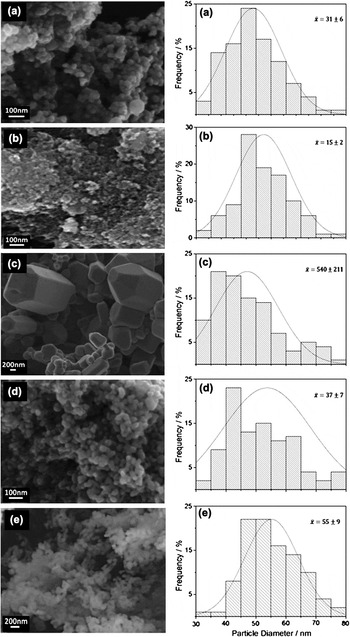
Figure 1 shows FEG-SEM images of the as-synthesized materials annealed at 800 °C/2 h for SnO2 and ZnO, 450 °C/1 h for TiO2, 700 °C/2 h for CaTiO3, and 1000 °C/2 h for CaO. As observed, the polymeric precursor method resulted in very similar morphologies for all the powders, except for ZnO nanoparticles. This sample shows a faceted behavior in Fig. 1(c), typical of wurtzite hexagonal structure, which is observed in several other synthesis procedures, as reported by Umar et al.Reference Umar, Ribeiro, Al-Hajry, Masuda and Hahn28 ZnO phase presented the largest particle size with an average size of 540 nm, while other materials showed values around 15–55 nm, which are confirmed by direct measurement in FEG-SEM images. A comparative analysis of all synthesized oxides indicates that the ZnO nanoparticles present a low control of the particle size and distribution by this synthetic method. This behavior may be related to the low crystallization temperature of the ZnO phase, when compared to the other oxides. Due to this, in this material, a presintering process is possible at this temperature, which will involve the particle growth and formation of larger particles by diffusion. Comparing to SnO2, this oxide also presents low crystallization temperature; however, this oxide does not sinter without dopants, as is the case of the present work. Regarding TiO2, at that annealing temperature, the transition from anatase to rutile phases may retain the grain growth. Finally, for CaO and CaTiO3, it is important to remember that both oxides are formed from the dehydration of Ca(OH)2, which means that this process may also retain the grain growth.
FEG-SEM microscopy and the particle size diameter of oxides synthesized at different temperatures and times: (a) SnO2 at 800 °C for 2 h, (b) TiO2 at 450 °C for 1 h, (c) ZnO at 800 °C for 2 h, (d) CaTiO3at 700 °C for 2 h, and (e) CaO at 1000 °C for 2 h.

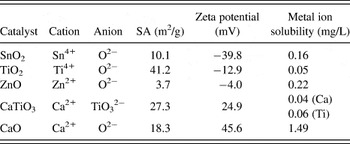
As observed by Table I, the measured SAs showed different values for each sample. TiO2 nanoparticles showed SA around 41 m2/g, a larger value comparable to other papers in literatureReference Yoo, Lee, Veriansyah, Kim, Kim and Lee8, Reference Ronconi, Ribeiro, Bulhoes and Pereira29, Reference Aboelfetoh and Pietschnig30 for this material. Despite the similar particle sizes, SnO2, CaO, and CaTiO3 nanoparticles showed lower values than TiO2, which may be explained by the different agglomeration behaviors during calcinations, distinct density of materials, and dissimilar pore size distribution. The smallest SA value for the ZnO (3.7 m2/g) is directly associated to the largest particle sizes, as previously discussed. It is important to observe the powder agglomeration, which is characteristic of the synthetic method. This is highly undesirable for catalytic purposes since it can suppress SA for the heterogeneous process. However, the equilibrium electrode potential measured at room temperature in methanol medium, for each system analyzed, showed a sequence correlated to the expected basicity of the oxides, from CaO (highest) to SnO2 (lowest), despite the different SAs. The basicity scale is an important reference for the catalytic activity in methanol since it is well consolidated in literatureReference Xuejun, Huayang, Yujun, Shenlin and Xianglan31 the reaction between basic sites and methanol. This reaction generates methoxide groups, which are referred as the real reactant in biodiesel formation.Reference Xuejun, Huayang, Yujun, Shenlin and Xianglan31
Physicochemical properties of the metal oxides and methanol.

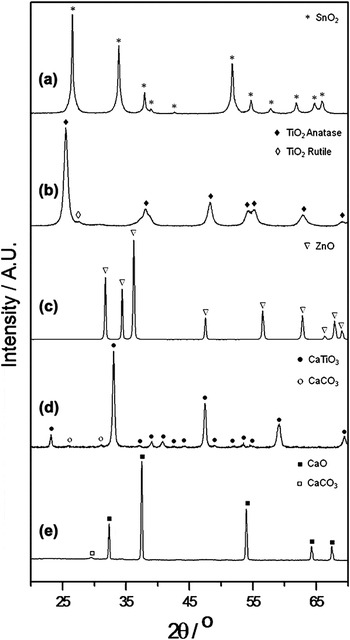
The phase formation of the synthesized powders was evaluated by x-ray diffraction (XRD), as shown in Fig. 2, confirming the desired phases in all the cases. CaO and CaTiO3 nanoparticles showed some small contamination of CaCO3phase, resulted from direct reaction with the environment.Reference Granados, Poves, Alonso, Mariscal, Galisteo, Moreno-Tost, Santamaría and Fierro4, Reference Albuquerque, Urbistondo, González, Robles, Tost, Castellón, López, Azevedo, Cavalcante and Torres12
XRD patterns of oxides synthesized at different temperatures and times: (a) SnO2, (b) TiO2, (c) ZnO, (d) CaTiO3, and (e) CaO.

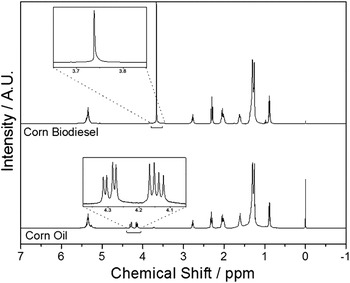
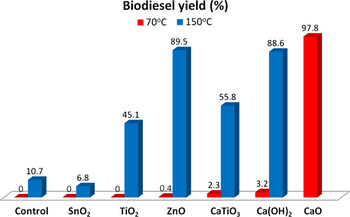
The catalytic performance of the oxides against biodiesel formation was monitored by NMR spectroscopy. Figure 3 shows typical spectra of corn oil (bottom) and its biodiesel (top). The signal between 4.05 and 4.35 ppm in the oil spectra and inset is related to the glycerol moiety of the triacylglycerides and disappears during the biodiesel formation. During the reaction, a singlet at 3.67 ppm related to the methoxy group of the fatty acid methyl ester (biodiesel) is observed and used to monitor the biodiesel yield.Reference Mambrini, Ribeiro and Colnago27, Reference Morgenstern, Cline, Meyer and Cataldo32Figure 4 shows the biodiesel yield after 2 h for each system. Except for CaO, the conversions at 70 °C were negligible, and the materials could not be reported as catalysts for this reaction. The activity observed for CaO is similar to that observed in other papersReference Granados, Poves, Alonso, Mariscal, Galisteo, Moreno-Tost, Santamaría and Fierro4, Reference Liu, He, Wang, Zhu and Piao7 and comparable to the expected activity for other homogeneous catalysts, such as NaOH and KOH.Reference Georgogianni, Kontominas, Pomonis, Avlonitis and Gergis33–Reference Karmee and Chadha35
1H NMR spectra of the corn oil (bottom) and corn biodiesel (top). The insets show the glycerol and methoxy groups used to monitor the transesterification reaction.

Yield to biodiesel using the metal oxides as catalysts at 70 and 150 °C for 2 h. Control refers to the reaction of methanol:oil without catalyst.

However, an adequate comparison at higher reaction temperature may reveal details about the surface activity of each oxide. The essays at 150 °C for 2 h, using the same reactants in a sealed system, showed catalytic activity for all the samples, except for SnO2. Since CaO was verified as very effective at 70 °C, its evaluation at 150 °C was not necessary, but it was opted to compare with commercial calcium hydroxide Ca(OH)2 (P.A.-ACS; Synth, Brazil). It is important to notice that this material was observed as inactive at 70 °C, as shown in Fig. 4.
In fact, the expected surface characteristic, regarding basicity for those materials, is SnO2 < TiO2 < ZnO < CaTiO3 < Ca(OH)2 < CaO. This behavior was the same observed for the catalytic activity at 150 °C. Furthermore, it is important to notice those data in the function of the SA measurements: despite ZnO showed the lowest value, its activity was higher than the other oxides, indicating that the surface basicity is more important than SA, in case of the experimental conditions of this present work. It is worth mentioning the amphoteric feature of ZnO materials.Reference Singh and Fernando36 This observation confirms that the reaction shows the higher activity on basic surfaces, as reported in literature. However, a very important aspect is noticed: TiO2 and CaTiO3 showed significant activities (around 45–50% conversions) after 2 h at 150 °C, which are good results compared to the literature.Reference Kawashima, Matsubara and Honda6, Reference Yoo, Lee, Veriansyah, Kim, Kim and Lee8 In a similar paper, Kawashima et al.Reference Kawashima, Matsubara and Honda6 reported activities around 79% after 10 h at 60 °C, with mass ratio of 10% to catalyst/oil and 6:1 molar ratio of methanol:oil for CaTiO3 (SA—4.9 m2/g). Granados et al.Reference Granados, Poves, Alonso, Mariscal, Galisteo, Moreno-Tost, Santamaría and Fierro4 observed for TiO2 nanoparticles (SA—10.9 m2/g) activities around 10% after 10 min at 200 °C, with mass ratio of 1% to catalyst/oil and 40:1 molar ratio of methanol:oil. Concerning CaTiO3, the authors studied longer periods at lower temperature and higher catalyst concentrations than in this paper, to improve the activity. In TiO2, although the authors applied higher temperatures and longer times, the lower catalyst concentration influenced the final results. In this way, it is possible to verify that all synthesis parameters influence significantly the biodiesel conversion.
It is worth mentioning the difference observed between ZnO and CaTiO3. Despite one may expect better conversion values for this last oxide, due to its presumably higher surface basicity, its lower activity may be related to the larger anion involved in this reaction, TiO32−. In fact, literature claims that the active site for heterogeneous basic catalysis is the anion site,Reference Lee, Park and Lee37, Reference Hoffmann, Martin, Choi and Bahnemann38 which, in this case, would be less active, since the Ti4+into its structure may reduce the electronegativity of the final site. Anyway, this is an aspect still open, which is under investigation yet.
A last point that arises from this comparison is the real heterogeneous feature of analyzed oxides. The solubility concentration values of the residual metal ions in methanol obtained from ICP-OES measurements are depicted in Table I. These results indicate that all the oxides are poorly soluble in the reaction conditions, except CaO. For this oxide, after annealing at 70 °C during 2 h, the analysis revealed it as soluble, compared to the other oxides, despite with very low dissolved values, which suggests that homogenous catalysis is not occurring or is not the main mechanism in the reaction. However, this fact needs to be taken in account since this small portion solubilized can act as an initiator for the reaction, which is clearly improbable for the other portions. On the other hand, it is noticeable the good performance of nanometric CaO at 70 °C and ZnO at 150 °C, which may support future investigations regarding those materials.
IV. CONCLUSION
This paper shows a comparison between different nanostructured oxides, obtained by polymeric precursor method, regarding their activity for biodiesel conversion from oil–methanol mixtures. The temperature dependence for the heterogeneous catalysts was analyzed, where only CaO showed activities at 70 °C (∼98% of conversion), while the other oxides, SnO2, ZnO, TiO2, CaTiO3, were observed active only at 150 °C. Surface basicity against SA measurements revealed that the highest activity observed is not associated to SA only but mainly with the surface basicity. These results suggest that, for oxides synthesized by the polymeric precursor method, the surface basicity surpasses the particle size effects in catalysis in a way to promote the transesterification reaction.