Introduction
Pleomorphic adenoma is the most common benign tumour of the parotid. Its non-malignant nature is reassuring for patients, but surgery is still challenging due to the proximity of the facial nerve, recurrence risksReference Chen, Wang, van Zante and Yom1, Reference Wittekindt, Streubel, Arnold, Stennert and Guntinas-Lichius2 and the possibility of malignant transformation.
Surgical management of pleomorphic adenoma is increasingly codified, based on studies describing its risk of progression as well as knowledge of the lesion's pathology, particularly recurrence originating from a ruptured capsule.Reference Seifert, Brocheriou, Cardesa and Eveson3 The recurrence rate has decreased from 40 per cent to less than 5 per cent since enucleation was abandoned in favour of more or less extensive parotidectomy (depending on the size and location of the tumour).Reference Leonetti, Marzo, Petruzzelli and Herr4
However, pleomorphic adenoma recurrence remains a problem, with management generally considered to be complex, delicate and endangering the functional prognosis of the facial nerve.Reference Redaelli de Zinis, Piccioni, Antonelli and Nicolai5
The goal of this study was to retrospectively assess pleomorphic adenoma recurrence managed at the Nantes University Hospital between 1988 and 2008, and to determine the prognostic factors affecting secondary recurrence risk based on the epidemiological, clinical, histopathological and therapeutic (surgical and radiotherapeutic) data analysed.
Following presentation of the results of this retrospective study and a literature review, an approach to rational management of pleomorphic adenomas is proposed, specifically in recurrent cases, addressing most particularly the type of surgical treatment, any adjuvant irradiation treatment, and secondary monitoring of these tumours.
Materials and methods
This study was conducted in the department of otolaryngology, ENT, and head and neck surgery of Nantes University Hospital, France.
Study concept
The main study objective was to identify predictive factors for secondary pleomorphic adenoma recurrence, in particular as regards the epidemiological, anatomical and pathological data, type of surgical treatment, and adjuvant radiotherapy (if used). The study also aimed to present a literature review, and to propose and evaluate an approach to the management and monitoring of these tumours.
Inclusion criteria were established to obtain the most homogeneous series possible given the retrospective nature of the study. Parapharyngeal pleomorphic and non-intraparotid adenomas were not included, as these were managed differently.
We reviewed 39 files of patients treated for pleomorphic adenoma recurrence between January 1988 and December 2008; of these, 32 were retained. We analysed these 32 patients' data regarding: biometric parameters (i.e. age and sex), type of initial surgical treatment (i.e. enucleation or parotidectomy), type of recurrence treatment, histopathological characteristics (i.e. tumour cellularity, capsule quality, uni- or multifocal recurrence, and quality of resected margins), and whether post-operative radiotherapy was delivered. Facial nerve motor function was analysed no earlier than one year after the most recent surgery, depending on the area concerned and the intensity, using the House–Brackmann classification.
Ethical considerations
The methodology of this retrospective study, including data collection and analysis, was submitted to and approved by the Nantes University Hospital Ethics Committee.
Statistical analysis
Recurrences were estimated using Kaplan–Meier survival curves, utilising SPSS for Mac version 19 software. Survival was compared using the Cox model. The statistical significance of results was calculated using non-parametric tests whenever qualitative or semi-quantitative data were compared. The chi-square test was used to compare these values. Results are shown as means ± standard deviations unless otherwise specified.
Results and analysis
Age and sex
The patients' mean age was 31.5 ± 11.8 years at the time of initial surgery and 41.3 ± 15.5 years at the time of the first recurrence.
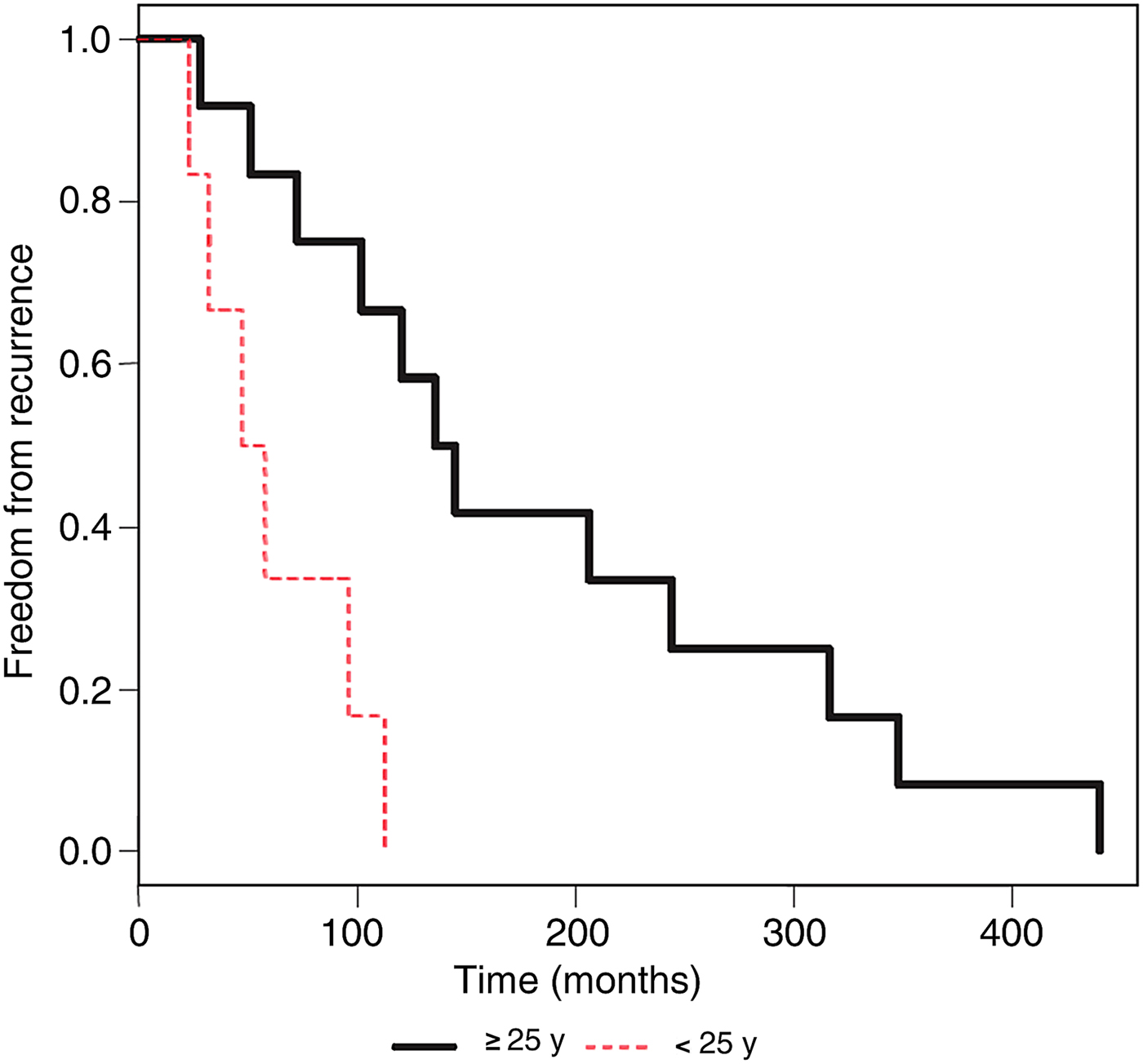
The sex ratio was 1. Following the first intervention, primary recurrence occurred significantly more quickly in patients under 25 years of age: at a mean time of 5.1 ± 2.8 years in the under 25 year age group versus 15.5 ± 10.6 years in the 25 years and older age group (for comparable first parotidectomy surgery) (p = 0.0084) (Figure 1), independent of follow-up time.
Time to pleomorphic adenoma recurrence in younger (<25 years) vs older (≥25 years) patients. p = 0.0084, comparing the two groups.

Initial surgery
Data on patients' primary and secondary surgery are shown in Table I.

Five patients (15 per cent) underwent their initial surgery at the Nantes University Hospital.
The other 27 patients were initially managed in another institution by different specialists: ENT specialists, dental surgeons, plastic surgeons and general surgeons. Of these 27 patients, 17 (53 per cent) had a single surgical intervention, 7 (22 per cent) had 2 interventions, 2 (6 per cent) had 3 interventions and 2 (6 per cent) had 4 interventions.
There was no significant difference in time to first recurrence between patients undergoing parotidectomy or enucleation; these results were not affected by whether patients had been managed at the Nantes University Hospital or another institution. The first recurrence occurred at a mean of 10.4 ± 8.6 years after the first intervention. The mean time to recurrence decreased as the number of recurrences increased, being 10.4 ± 8.6 years for the first recurrence and then 5.6 ± 4.2 and 3.5 ± 2 years for the second and third recurrences, respectively.
Primary recurrence surgery
Once recurrence had occurred, the surgical strategy depended on the type of surgery previously performed and the recurrence location. In 93 per cent of the cases, facial nerve monitoring was used. Table I details the number and type of interventions carried out to treat primary recurrence.
Histopathological analysis
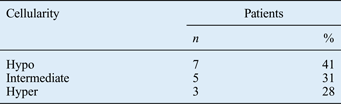
Histopathological reports were not available for all the patients initially managed outside an academic hospital setting. For those patients whose reports were available, the mean size of the initial tumour was 25.4 ± 12.6 mm (n = 15). Six tumours were larger than 30 mm, and five were located in the deep part of the gland (3 of 17). In five specimens, the tumour was fractionated (5 of 17). The capsule was described as absent in two cases, discontinuous in three and present in eight (n = 13). In three cases, satellite nodules were observed distant from the main lesion (n = 17). A predominance of low-cellularity tumours was observed (Table II).
Histopathological cellularity of initial lesion*

* n = 17. Hypo = hypocellular; Hyper = hypercellular
Post-operative radiotherapy
Eleven of the 32 patients (34 per cent) received complementary radiotherapy, which was indicated in the context of at least 3 interventions, multifocal disease, and/or intralesional resection limits during the last intervention. These patients had a mean age of 40.4 years (range, 21–78 years).
Nine per cent of the patients received complementary radiotherapy for malignant transformation. This group's mean age was 65 ± 11.5 years and the mean time to malignancy was 36 ± 8 years after disease onset.
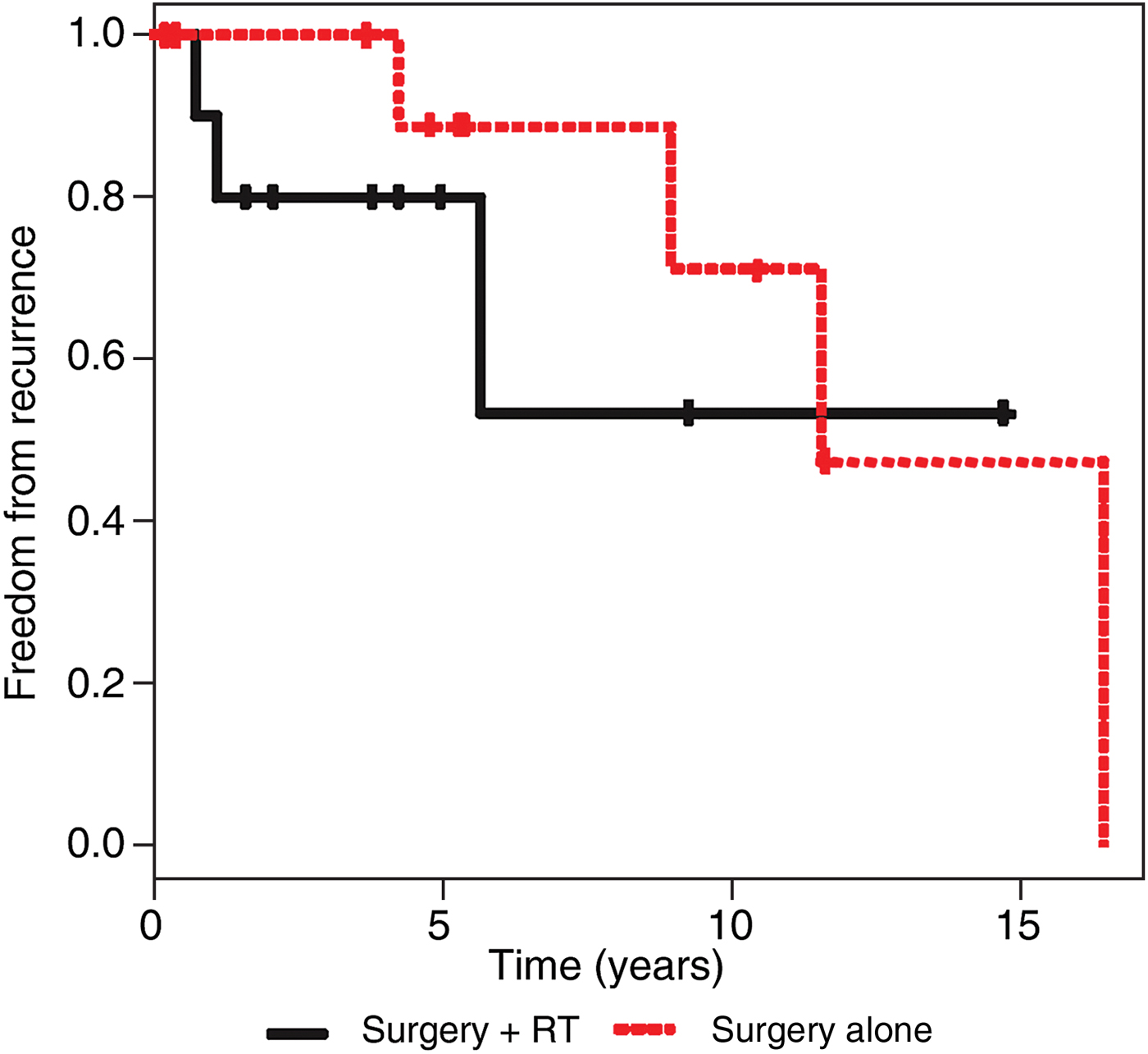
After radiotherapy, the mean follow-up duration with no recurrence was 5.3 ± 4 years. Eight patients were in remission at the time of analysis, 1 had superficial, unifocal recurrence 8 months after radiotherapy, and 2 had presented with deep, non-evolving recurrence (both patients were clinically and radiologically monitored, over 7 and 11 years' follow up, variously). There was no significant difference in recurrence between the groups managed with and without radiotherapy (p = 0.08) (Figure 2).
Time to pleomorphic adenoma recurrence in patients managed with and without adjuvant radiotherapy (RT) (in addition to surgery). p = 0.08, comparing the two groups.

Secondary recurrence
The mean patient follow-up duration was 9.7 ± 6.4 years. The secondary recurrence rate was 28 per cent (9 of 32 patients), over a mean follow-up time of 6.2 years (range, 3 months to 14.5 years). The mean time from first to second surgical intervention was 3.8 ± 6 years. Of the nine patients with secondary recurrence, three presented with a third recurrence a mean 2.3 ± 1.3 years later. No significant additional risk of secondary recurrence was demonstrated as a function of sex, number of previous interventions, age at first surgery, superficial or deep location of the recurrence, lesion cellularity, capsule rupture, nodule size, or post-operative radiotherapy (Table III). There was a significantly lower risk of secondary recurrence when the first surgery had included enucleation (p = 0.02), and a significantly greater risk in cases with multifocal tumour observed at first surgery (p = 0.019).
Potential Risk factors for secondary recurrence

*Six cases identified at initial surgery and two at primary recurrence. Pt no = patient number; Hypo = hypocellular; Hyper = hypercellular; Post-op = post-operative
Facial palsy
Assessment was carried out at least one year after the previous surgery. Facial palsy was the main complication of pleomorphic adenoma recurrence surgery.
In one case, the mental nerve was resected and then anastomosed before tumour invasion (this patient's pleomorphic adenoma had not become malignant).
In another case, the surgeons were forced to section the facial plexus trunk, as the malignant tumour encompassing the facial nerve could not be separated from the nerve.
In the other 30 patients, dissection of the facial nerve was conservative. Post-operative facial paresis was seen in 53 per cent (7 of 13) of patients requiring retrograde dissection, but in only 35 per cent (6 of 17) of patients requiring anterograde dissection. However, this difference was not statistically significant (p = 0.28).
In all, 31 per cent (9 of 29) of study patients, presenting with pleomorphic adenoma recurrence, suffered post-operative facial palsy, predominating in the inferior territory. Facial palsy was severe in 17.2 per cent of patients (5 of 29), as attested by a House–Brackmann score greater than III (Table IV).

Discussion
The objective of this retrospective study was to assess pleomorphic adenoma recurrence management and to identify risk factors for secondary recurrence. The interpretation of our results was complicated by patients' histories (many patients had been managed elsewhere for several years before treatment in our department) and number of surgical procedures, performed by multiple operators, creating a retrospective bias.
Age and sex
The mean age at first surgery was 31.5 years; this was younger than previously reported results (i.e. approximately 40 years).Reference Phillips and Olsen6 Two patients were under 15 years of age at first surgery. This study could not confirm young age as a prognostic factor for recurrence. However, it found a significantly earlier initial recurrence, post-parotidectomy, in patients younger than 25 years (p = 0.0084). Several other studiesReference Renehan, Gleave and McGurk7 have found young age to be an independent predictor of recurrence, with no other cause found. Laskawi et al. Reference Laskawi, Schott and Schroder8 found young age to be associated with more frequent recurrences and initial multinodular disease. ChillaReference Chilla9 hypothesised that younger patients were more likely to show greater tumour aggression, although this theory was not supported by histological or cellular arguments. Norman and McGurkReference McGurk, Norman and McGurk10 proposed that a young patient age encouraged practitioners to perform minimal surgical exploration so as to minimise cosmetic repercussions; the risk of recurrence would therefore be greater.
As for sex ratio, the literature describes a female predominance (60 per cent) for pleomorphic adenoma; the sex ratio of 1 found in the current study may indicate a male predominance for recurrence. Some authors have hypothesised that tumours are hormone-dependent. Glas et al. Reference Glas, Hollema, Nap and Plukker11 studied the effect of sex hormones, insulin-like growth factor receptor 1 and the Ki-67 antigen (a pleomorphic adenoma cell proliferation marker) in pleomorphic adenoma. They observed a higher prevalence of tumours with receptors for progesterone and insulin-like growth factor 1 in patients with multiple recurrences; the potential clinical applications of these results have not been investigated.
Initial surgical technique
Of the referred pleomorphic adenoma recurrence cases included in this study, 17 had initially undergone enucleation; this equates to more than 50 per cent of patients. Enucleation, which is assumed to reduce the risk of facial palsy, is associated with a 45 per cent risk of recurrence.Reference Zbaren, Tschumi, Nuyens and Stauffer12 Recent studies show no difference in the results of total parotidectomy versus partial parotidectomy extended to the adjacent tissue, as regards pleomorphic adenoma recurrence. Subtotal parotidectomy is systematically indicated for lesions found to be multifocal on initial surgery; however, previous authors have found multifocal tumours to occur only rarely (e.g. in 0.5 per cent of patients) or not at all.Reference Lam, Wei, Ho and Ho13
Primary recurrence surgery
Magnetic resonance imaging (MRI) is an essential part of the pre-operative investigation of pleomorphic adenoma recurrence cases. It establishes the quantity and distribution of the gland tissue and demonstrates any multifocal recurrence that has not been clinically detected. In two of our primary recurrence cases, MRI identified tumour multifocality and allowed the surgeon to reassess the therapeutic strategy and to perform revision parotidectomy rather than enucleation. This procedure is advocated by most authors.Reference Redaelli de Zinis, Piccioni, Antonelli and Nicolai5
Histopathological analysis
While multifocal primary pleomorphic adenomas appear to be rare, a more common cause of recurrence is low cellularity. In the present study, 72 per cent of tumours had stromal connective tissue showing hypocellularity or intermediate cellularity. In 1990, Seifert et al. Reference Seifert, Brocheriou, Cardesa and Eveson3 explained the principle of dissemination through the relationship between hypocellularity and the risk of capsular effraction. The existence of satellite nodules and pseudopods around the tumour has also been described.Reference Zbaren, Tschumi, Nuyens and Stauffer12 Hypocellular, stroma-rich forms of the tumour are correlated with tumour capsule thinness and the presence of pseudopods and satellite nodules. However, this hypothesis does not explain the higher risk of recurrence in young subjects: in children, Rodriguez et al. Reference Rodriguez, Vargas, Robson, Perez-Atayde, Shamberger and McGill14 did not observe predominant hypocellularity.
Secondary recurrence
Of this study's 32 patients, nine re-presented with a secondary recurrence after a mean of 6.2 years, a percentage in agreement with the literature. Multifocality and young age are the main reported factors influencing recurrence.Reference Stennert, Wittekindt, Klussmann, Arnold and Guntinas-Lichius15 Wittekindt et al. Reference Wittekindt, Streubel, Arnold, Stennert and Guntinas-Lichius2 have reported secondary recurrence rates of 42 per cent at 5 years and 75 per cent at 15 years; the secondary recurrence rate rose with increasing follow-up time. The time between recurrences decreases as the number of recurrences increases. Three reasons are suggested: superficiality of the recurrence (enabling earlier discovery), increased surveillance and accelerated tumour kinetics.Reference Chilla9 The comparison of primary recurrence rates after initial surgery (2–5 per cent) and secondary recurrence rates (up to 75 per cent at 15 years) show the importance of ensuring that the initial surgery is of the highest quality.
In the present study, initial enucleation was a major source of recurrence. However, when salvage parotidectomy was well conducted, secondary recurrence was significantly less frequent (p = 0.02). Complete parotidectomy provides a ‘second chance' for patients initially undergoing enucleation with no identification of the facial nerve; this has also been observed by Carew et al. Reference Carew, Spiro, Singh and Shah16 who reported that complete parotidectomy led to nearly 100 per cent control of secondary recurrence in patients initially undergoing enucleation, but only 63 per cent control in patients initially undergoing primary parotidectomy (follow up, seven years). The absence of a wide detachment plane after enucleation may limit tumour dissemination to the peritumoural and scar area.
The identification of lesion multifocality after primary recurrence was a major prognostic risk factor for secondary recurrence in our study (p = 0.019), a finding also reported by several other authors.Reference Renehan, Gleave and McGurk7 If enucleation becomes the only possibility after multiple parotidectomy revisions, the risk of further recurrence worsens, and permanent remission becomes highly unlikely.
Radiotherapy
No significant benefit was demonstrated for radiotherapy in this study (p = 0.8). This result may be related to a lack of statistical power due to the small number in this patient group (n = 11). It is comparable to findings for small numbers of patients.Reference Redaelli de Zinis, Piccioni, Antonelli and Nicolai5, Reference Carew, Spiro, Singh and Shah16
Renehan et al. Reference Renehan, Gleave and McGurk7 studied 114 cases of pleomorphic adenoma recurrence, and showed a significant benefit for radiotherapy in cases of multifocality but not in cases of unifocal tumours; the time to recurrence was also longer.Reference Chen, Wang, van Zante and Yom1
However, others have pointed out the iatrogenic risks, with the emergence of radio-induced cancersReference Malard, Toquet, Gayet-Delacroix, Bordure, Beauvillain de Montreuil and Bardet17 or malignant transformation following radiotherapy. These risks may be greater in young subjects.
Some authors have proposed radiotherapy in cases of multiple and multi-operated recurrences with lesion multifocality, invasion of adjacent structures, and positive margins despite maximally extensive surgery.Reference Seifert, Brocheriou, Cardesa and Eveson3, Reference Renehan, Gleave and McGurk7 Our department follows these indications.
Intensity-modulated radiotherapy techniques were not evaluated.
• In this study, secondary parotid pleomorphic adenoma recurrence occurred in 32 per cent of first recurrence patients at 6 years
• Younger patients had quicker, more aggressive recurrence, mandating definitive initial resection
• Recurrence correlated with tumour multifocality
• Radiotherapy may delay, but not prevent, recurrence
• Nine per cent of patients progressed to malignancy
• The main complication of secondary recurrence surgery was facial palsy
Facial palsy
The 31 per cent prevalence of facial palsy found in our study (14 per cent of which was severe) is comparable to the published data.Reference Phillips and Olsen6 Prevalence was higher following retrograde dissections (albeit non-significantly), probably because patients undergoing this procedure had a higher prevalence of previous facial nerve dissections. In patients who had undergone multiple operations, Leonetti et al. Reference Leonetti, Marzo, Petruzzelli and Herr4 proposed cutting the facial branches in contact with the tumour and then repairing them via grafting or suturing. However, this technique is contested; Niparko et al. Reference Niparko, Beauchamp, Krause, Baker and Work18 did not demonstrate a reduction in recurrences despite undertaking this radical procedure. The majority of teams only opt for this procedure when it is impossible to dissect the facial nerve branches from the tumour.Reference Myssiorek19 We prefer this latter, more conservative strategy, in conjunction with facial nerve monitoring, for patients with recurrence, as it significantly reduces surgical time and post-operative neurological sequelae.Reference Lowry, Gal and Brennan20
Malignant transformation
Three patients presented with malignant tumour transformation within pleomorphic adenoma recurrence, identified more than 25 years after the initial parotid surgery. A literature review found prevalences of such malignant transformation ranging from 2 to 25 per cent;Reference Phillips and Olsen6, Reference Niparko, Beauchamp, Krause, Baker and Work18 the prevalence increased by 1 to 7 per cent every 10 to 20 years.
Conclusion
Managing pleomorphic adenoma recurrence is difficult; in the present study, the secondary recurrence rate was 28 per cent over six years. The recurrence rate correlates with the presence of tumour multifocality; for multifocal tumours, it seems that the clinician can only control the disease, not cure it.
Young patients may experience more rapid, more aggressive recurrences, and in no case should treatment be minimalist; surgery limited to adenoma enucleation without parotidectomy is not adequate.
Treatment of pleomorphic adenoma recurrence depends on the type of initial surgery and the pre-operative MRI appearance; the latter is indispensable when assessing the tumour residue and distribution. Enucleation is adequate in cases of very localised recurrence; for multifocal recurrence, extended resection should be performed.
Radiotherapy has not been adequately evaluated and should be reserved for multiply recurrent, multifocal forms (i.e. beyond the third recurrence), especially those in which histopathological examination reveals atypical cellularity.