At least on the face of it, ethical theories operate with two kinds of property: value (or axiological) properties and deontic properties. That is, on the one hand things may be good or bad; on the other they may be right or wrong, obligatory or forbidden. Most moral philosophers also believe that not everything having value properties has deontic properties as well. Indeed, according to some moral philosophers, including consequentialists, any event – indeed, any thing – has some morally relevant value property, if only it has at least some morally significant consequences (or has intrinsic value). But only a certain subclass of events, namely actions, have deontic properties in addition. For instance, a hurricane could be a bad event, by causing much pain or desire frustration or whatnot. But no hurricane could be wrong or forbidden (though an agent's starting a hurricane of course could be). A hurricane just is not the kind of thing, or event, that could have deontic properties. So, most moral philosophers, including consequentialists, believe that only objects of a certain kind – and we will say more about this kind presently – can have deontic properties. If a thing does have some such property, we will say for short that it has deontic status. Yet consequentialists, unlike many other moral philosophers, also assert that what makes actions have this or that particular deontic property – what makes them wrong rather than right, for instance – has nothing whatever to do with their belonging to this special kind, nothing to do with their deontic status, nor with whatever it is about actions that gives them this status. This fact about consequentialism, I believe, leads to a very profound difficulty for that doctrine. Or rather, it does so if consequentialism accepts another doctrine, which I will call the thesis of the autonomy of the deontic. Hence consequentialists can avoid the objection I will be pressing in this article by giving up that thesis – by becoming what I will call deontic reductionists. Whether the price is worth paying is a question I will not attempt to answer. Still, I do not deny that I think the autonomy of the deontic is a necessary part of any plausible ethical theory, and thus that the argument I offer in this article effectively refutes consequentialism. But that battle is better fought another day, and so my thesis in this article is more modest: if the autonomy of the deontic holds, then consequentialism is unacceptable.
There is another way in which the article's ambition is limited. I will be concerned exclusively with what is sometimes called ‘objective’ consequentialism, the view that the deontic properties of an action are determined by its actual consequences, and those of alternative actions. There are other forms of consequentialism. In particular there are ‘subjective’ versions, according to which right and wrong is determined somehow by what the agent believes will be the consequences of his actions; and motive consequentialism, according to which right and wrong is determined somehow by the consequences of the agent's motives. The argument I develop in this article is applicable, albeit with some bells and whistles added, to these alternative forms of consequentialism as well. Or at least so I contend. I will not attempt to make good that contention in the article. I have found that the philosophical payoff from such an extension of the argument does not warrant the space and effort needed for its execution. And in any case, even if I prove to be wrong, and the argument does not affect the alternatives, objective consequentialism is an important enough quarry in its own right to make my result interesting.
I. PRELIMINARIES
The two pivotal notions of the article are (objective) consequentialism and the autonomy of the deontic. Therefore I should first say something about them. As far as consequentialism is concerned, there is no need for any detail. All we require is the concept of optimality. An action is optimal in a particular situation just in case its consequences are at least as good as the consequences of any alternative action available to the agent in the situation. I stipulate that the consequences of a certain action are not constituted solely by its causal consequences; rather, the action itself is included in the consequences; and, generally, the consequences of any event include that event itself. Let us ignore the question of which consequences are good, as it is irrelevant to our concerns. Consequentialism, then, says that an action is right (obligatory) just in case it is optimal, wrong otherwise.Footnote 1
I turn now to the notion of the autonomy of the deontic. It is modelled on the perhaps more familiar concept of the autonomy of ethics. Philosophers who advocate the autonomy of ethics are typically out to deny that it is possible to define moral concepts in terms of non-moral concepts, and possibly also to assert (in a more metaphysical vein) that moral properties are sui generis.Footnote 2 When I speak of the autonomy of the deontic, I am concerned with a certain move within the ethical sphere, rather than any attempt to subordinate that sphere under another. Specifically, to deny the autonomy of the deontic is to assert that all deontic properties are reducible to axiological properties. Some versions of consequentialism espouse this type of (deontic) reductionism. Specifically they hold that the property of rightness is identical with the property of maximizing value. There are two types of reductionist consequentialism. On the one hand we have analytic reductionism. This is the view Moore defended in Principia, but later recanted.Footnote 3 On the other hand there is synthetic reductionism. The difference between the two views is that while analytic reductionism asserts that the reductionist thesis is analytic (and a priori), synthetic reductionism maintains that it is synthetic (and empirical). Both are one, though, in holding that the deontic property of rightness is identical with the axiological property of maximizing value.Footnote 4 In slightly different terms, analytic reductionists believe that the concept of rightness is identical to that of action optimality, while synthetic reductionists hold that these are distinct concepts, but associated with the same property.
Let me now make a few remarks about reductionism. (1) A consequentialist does not have to be a reductionist. Both analytic and synthetic reductionists say that rightness just is the property of being action optimal. They are not saying that a right action is right because it is optimal – on the contrary, they deny that explanatory claim, if they accept the plausible assumption that a fact cannot explain itself. An anti-reductionist consequentialist does maintain precisely what the reductionist denies, that a right action is right because it is optimal. According to the anti-reductionist consequentialist, the deontic property of rightness is distinct from the axiological property of optimality, and the former is explained by the latter. Nabbing a phrase from the title of R. E. Bales's well-known article, anti-reductionists hold that consequentialism is an ‘account of right-making characteristics’, rather than an account of what rightness is.Footnote 5
(2) Anti-reductionist consequentialists may, but need not, believe that the two distinct properties of rightness and action optimality are necessarily coextensive. The individuation of properties is a contentious matter, but it is a common enough view that properties could be necessarily coextensive without being identical.Footnote 6 An example often used to illustrate that thesis is that of the two properties being an equilateral triangle and being an equiangular triangle. I will not defend that view of property individuation here. However, if it is false, and necessary coextension entails identity, then an anti-reductionist consequentialist would of course have to deny necessary coextension. That denial would amount to denying that consequentialism is necessarily true.
(3) One way of understanding reductionism is as a form of eliminativism. On such a view, we eliminate the deontic, in favour of the evaluative or axiological; consequentialism would not be a deontic or normative position at all, but rather simply an axiological one, concerning which actions are best. It is perhaps not clear what distinguishes reductionism from eliminativism. This is so especially for the analytic version of reductionism. In any case, a move to eliminativism seems inadvisable for the reductionist, for much of the interest of consequentialism, and of particular striking consequentialist claims (such as those of Singer and Kagan), stems precisely from the fact that consequentialists making these claims do not take such an eliminativist position.Footnote 7 They agree with the common-sense view – and indeed it is a crucial part of their mission to assert – that in calling an action wrong we are doing something that goes beyond what we do in simply calling it suboptimal. The exact nature of this ‘extra’ is of course contentious but it seems to include the idea that the action is in a special way significant.
(4) Consequentialists who reduce the deontic property of rightness to the axiological property of action optimality could, but need not, take a further reductive step: they could reduce the axiological property to some natural property, such as maximizing happiness. They could become naturalists.Footnote 8 And this other reduction could of course also be both analytic or synthetic. There is no need for me to discuss this further reductive step in the article, and I will not do so. The reader should bear in mind that all references to ‘reduction’ and ‘reductionism’ in what follows concern the first reductive step I have described, not any naturalistic reduction. This reminder is important as these terms, when used in moral philosophical contexts, tend to pertain to naturalism. The position I call ‘deontic reductionism’ may or may not be naturalistic – that does not matter for us.
Finally, to repeat, the most important thing I want to say about reductionism is this. The argument against consequentialism I offer below does not apply to any reductionist form of that doctrine, whether of the analytic or synthetic variety. Instead it is aimed at all forms of anti-reductionist consequentialism.
II. WHY DO ONLY CERTAIN THINGS HAVE DEONTIC STATUS?
As a way of easing into the argument, I want to discuss the question in the heading. That discussion will also allow us to see the significance of the distinction between reductionist and anti-reductionist versions of consequentialism. First, though, a simplifying stipulation: as the question indicates, I will assume that only actions have deontic status. The purpose of this stipulation is indeed merely to simplify; I am certainly not concerned to deny that, e.g., intentions also typically have deontic status. Nothing of importance hinges on this decision.
I have said that only certain categories of things have deontic status; actions do, while hurricanes do not. It is an important challenge, facing any deontic theory, to show what actions have that hurricanes (or whatever) lack, explaining why the former, but not the latter, have deontic status. But that original challenge leads to another, peculiar to consequentialism. For according to that doctrine, the criterion determining the particular deontic property of an action (right or wrong) is the optimality or suboptimality of that action. And so the question arises: why does that criterion not have the same function with respect to other categories, where it also appears – why only with respect to actions?
Setting aside for the moment the issue between consequentialism and its critics, how would we be inclined offhand to answer the initial challenge? Why do actions, typically at least, have deontic status? Ignoring controversial matters of detail, we can easily offer a programmatic explanation of their deontic status. For it would seem inevitable that we appeal to the special relationship between actions and the agent, able to do or not do the action in question. Specifically, the agent is responsible for his actions and (some of) its consequences in a way that no non-agent could possibly be, and in which he is not responsible for other events. Or at least this is so for actions that indisputably have deontic properties: to the extent that there is doubt about the agent's responsibility for a given action, there is also doubt about whether to apply deontic categories to that action, and indeed about whether to call it an ‘action’ at all, rather than simply a piece of behaviour. To have a label, let us say that actions have deontic status because they are, essentially and distinctively, products of agency. (Strictly speaking, we should say something like ‘direct’ products, as an action's consequences fit under the heading ‘products of agency’ as well, but I will dispense with the qualifier.) We could say, then, somewhat vaguely, that actions have deontic status in virtue of their being products of agency in the sense I have described. No doubt we would be in a position to amplify this hypothesis once we are equipped with satisfactory theories of agency and of the deontic, but even the current crude version will serve adequately.
I have just suggested an explanation, admittedly programmatic, of why actions have deontic status but other things do not, namely that actions and actions alone are products of agency. I have also said, in effect, that consequentialists could not simply take over this explanation and make do with that. The reason is that their view leads to a follow-up question that they must also answer: why does the optimality/suboptimality factor give rise to deontic properties when combined with products of agency but not when combined with other significant events (e.g. hurricanes)? But the nature of this second explanandum differs, depending on what type of consequentialism we have in mind. And this difference is crucial.
Let me elaborate. According to anti-reductionist consequentialism, action optimality and rightness are distinct properties, and a thing has the latter because it has the former. The action optimality factor, then, ‘gives rise to’ deontic properties in a metaphysical sense. But action optimality is unique among optimality properties: no other type of optimality stands in a similar metaphysical relation to a distinct deontic property. There is no ‘hurricane rightness’ etc. That uniqueness needs explanation – and I cannot see what that explanation could be. Anti-reductionist consequentialism, then, is at a disadvantage compared with non-consequentialist anti-reductionist views that do not give rise to any such additional explanandum, because they define right and wrong in terms of properties that are characteristic of actions. (I will return to this at the end.)
By contrast, reductionist consequentialism does not imply any such explanandum, for it does not recognize any distinct deontic property. On this view, action optimality just is rightness. To be sure, even on reductionism action optimality does distinguish itself, for it is the only optimality property that is identical with a deontic property, or that is also itself deontic. Indeed, it is only the eliminativist version of the doctrine that avoids that explanandum, allowing that action optimality fails to distinguish itself in any way at all. Then it would be just like any other type of optimality. Now, I have already suggested that there might be no difference at least between analytic reductionism and eliminativism, and so I will set that type of reductionism aside. As I have already suggested, however, synthetic reductionists might assert that though there is just one property, there are two concepts picking out that property, one deontic and one naturalistic. Then the relationship between action optimality and the deontic, singled out (perhaps misleadingly) by talk of ‘giving rise to’, is not metaphysical: the explanandum the synthetic reductionist faces is why this particular optimality property (action optimality) is associated with a deontic concept alongside the ‘regular’ naturalistic one when other such properties are not. But that explanation might be forthcoming – or at least I will not claim otherwise. As I have been saying, reductionist consequentialism is not my target.
I have argued that anti-reductionist consequentialism cannot explain why only actions have deontic status. But the doctrine's predicament is actually worse than that. Not only is it in principle incapable of explaining a fact in manifest need of explanation, but further reflection on that fact shows the doctrine to be deeply problematic, arguably even incoherent.
III. AN ARGUMENT AGAINST ANTI-REDUCTIONIST CONSEQUENTIALISM
If we want, we can talk about a deontic genus, comprising several species, including right and wrong. (Another simplifying stipulation: from now on, let us assume that the only deontic properties, and thus the only species in the deontic genus, are rightness and wrongness. This simplification is in line with consequentialism.) As I will make heavy use in this section of the notions of species and genera I should say something here about how I understand them. This is particularly important in that my use of this terminology is perhaps a bit unorthodox.
I will say that a genus is an ordered pair G = 〈C, M〉. C is a criterion: a defining characteristic or set of such characteristics possession of which makes an object fall under one of the species of G. M is what I will call a species-determining mechanism. I will understand M in turn as an ordered pair, 〈P, T〉. P is a function. Its values are the species of G, while its arguments are the properties (or property sets) distinctive of each of these species. Each such property or property set is such that it makes a member of a certain species in G into a member of just that species, rather than some other one in G.Footnote 9 It is possible, and useful for our purposes, to characterize P in terms of the information it contains (some of which may not be available to us at a given time). P contains, for each species s in G, just that information we can get out of the fact that a given object belongs to s rather than some other species in G. Note that P is explicitly relativized to G (and so to C): P contains the information we can get out of the fact that an object belongs to one of the species in G rather than some other one. So much for the function P. T is what I will call a ‘type’. All the properties in P will have something in common that explains why they are able to do their species-determining job. T is that something.
Let us illustrate with the standard case of animal species (〈CA, MA〉). For the sake of convenience, let us say that CA is simply this: a thing is an animal just in case it is a living being with a DNA-based genetic make-up. But what, then, is MA? Well, it contains the information we can get out of the fact that the thing we have before us is a horse, rather than a hummingbird or a halibut or whatever. And PA will contain analogous information for every animal species. This information will concern the specific genetic make-up of the species in question, whatever makes it into the species it is rather than some other one. This information is not contained in CA, of course. TA is that which all the properties serving as arguments for PA have in common that makes them into species determiners. This is precisely that they are DNA properties: an animal belongs to a particular species rather than some other one because of its DNA structure – or rather, because of part of that make-up (the distinctive part).Footnote 10
What of the deontic genus (〈CD, MD〉)? CD contains all the information we need to tell that an object is subject to deontic appraisal, and whatever follows from that. (I will return to the content of CD shortly.) The nature of MD, the species-determining mechanism of the deontic genus, which determines whether a given action is right or wrong, is of course the subject of much controversy. Different moral theories offer different candidates. For instance, according to consequentialism, what we learn in knowing that an action is right rather than wrong is that it is optimal. I argue below that if consequentialism of either type (reductionist or anti-reductionist) holds, then PD will take precisely two argument properties: optimality and suboptimality. What is TD, then? Again different moral theories will answer differently, but the answer we give will of course depend on our view of the function PD – for in identifying TD we just point to whatever it is the species-determining properties in PD have in common that make them species-determining. Consequentialists, for instance, will point to the fact that the species-determining properties of the deontic genus (i.e. optimality and suboptimality) are properties having to do with the value of the consequences of the objects falling under that genus.
I will now make two general remarks on the notions of genus and species. First, and briefly, species are identified by the properties distinctive of them. If two species have distinct species-determining properties, then they are themselves distinct. Therefore, anti-reductionist consequentialism implies that the species corresponding to the properties being right and being action optimal are distinct. This fact will be important below.
Second, in the sequel I will be speaking frequently of ‘entailment’, ‘essential properties’, etc. These modal notions are controversial, not least in the context of species and genera, and natural kinds. For instance, some would agree that whales are necessarily mammals, but others would not. Also, different philosophers use these terms differently. Even if two philosophers agree verbally that a certain quality is essential to whales, one of them may mean by this that that quality belongs to whales by some form of natural or metaphysical necessity holding quite independently of human beings, while the other might mean that this quality belongs to whales in virtue of our classificatory conventions. Now, my concern is with the deontic genus, and so I do not want to get entangled in these general issues. However, I do want the various claims I make about that genus – including claims using modal terminology – to be acceptable also to consequentialists. Fortunately I believe that the modal claims I do make about that genus are acceptable to just about any consequentialist (even though different defenders of that doctrine might prefer to understand these claims differently). In particular, just about any consequentialist will agree that any right (or wrong) action is necessarily a product of agency. Therefore I believe that my use of these notions is legitimate in the dialectical context, although I will not stop to offer definitions of them. Below I will use these notions in other contexts as well, but then the purpose will be merely illustrative, and so whether a particular consequentialist (or reader generally) is happy with their application in that context is less important. I should only point out that I do not assume that the (supposed) modal facts I speak of in these contexts are a priori – even though it may be plausible to hold that they are in the special case of the deontic genus.
After having described my theoretical framework I now turn to the argument. I wish to argue (i) that if anti-reductionist consequentialism holds, the species-determining mechanism of the deontic genus must entail the fact that the objects to which it applies, actions, are the products of agency and (ii) that is not the case in consequentialism of either type. There should be no doubt that these claims, if true, spell serious trouble for anti-reductionist consequentialism, but I will postpone discussion of precisely what conclusion we should draw from them. I will now defend these two premises, beginning with the second.
To tell whether the species-determining mechanism of the deontic genus entails the essential nature of the objects to which it applies we need to know precisely what information is contained in that mechanism, MD. Again, MD consists of two components, a function PD and a type TD. However, TD does not entail anything that is not also contained in PD, as the type of a genus involves only what is common to its various species-determining properties. Hence we can ignore that component here. As I have indicated, something's being entailed by PD amounts to its being entailed by whatever we get to know from the fact that something is right rather than wrong (or wrong rather than right), but that we do not get to know from the fact that it is either right or wrong – i.e. that it has deontic status.
The question is what information PD contains according to consequentialism. My answer is that the information PD gives us, on that doctrine, consists of just one thing: the thesis that being optimal relative to the relevant set of alternatives is what makes x right, rather than wrong. According to consequentialism, what we learn in learning that x is right (or wrong, as the case may be), but not from the fact that x has deontic status, is precisely that x is optimal (or suboptimal). In particular PD does not tell us how to go about identifying the relevant set of alternatives for a given action. If we are able to figure that out at all, we can do so just as well from knowing that x is either right or wrong, that it has deontic status – or at least that is what a consequentialist will say. Simply by knowing that x has deontic status we know a whole bunch of things about x – here we are talking about information contained in the criterion CD. We will know that x is an action, and that it has alternatives, meaning that there was something else the agent could have done in the situation, in whatever sense of ‘could have done’ matters. And we could also tell how to define the set of alternatives (which includes an account of what sense of ‘could have done’ is important). Here there will naturally be disagreement, even among consequentialists. And we should be able to tell that each alternative has, or at least may have, value, and will be optimal or suboptimal relative to the whole set. These claims about CD are perhaps acceptable to just about any ethical theorist. Slightly more controversial is the idea that simply in virtue of knowing that a thing has deontic status we also know that if we are to consider its value in deontic assessment, the relevant set of comparison consists of its alternative actions, rather than some other set of objects. But consequentialists, at least, would agree.
And so we see why (ii) is true. The information contained in PD does not entail that a given object to which it applies is an action, the product of agency. Of course, a full statement of a particular consequentialist theory will contain more than what is in PD; not least it will specify a method of determining the set of relevant alternatives relative to which action optimality is defined. But that just goes to show that a full statement of a theory of the deontic genus, such as consequentialism, will contain more than a description of the species-determining mechanism of that genus. It will also have to specify the criterion CD. The characterization of that criterion a given consequentialist offers might differ in various ways from the one offered by some other theorist, consequentialist or not, but there is really nothing distinctively consequentialist about any such characterization. The peculiarly consequentialist content is only found in the characterization of PD.Footnote 11
Now for (i). To repeat, it says that if anti-reductionist conse-quentialism holds, the species-determining mechanism of the deontic genus must entail the fact that the objects to which it applies, actions, are the products of agency. The argument I will offer for this claim relies on a general principle. I will state it momentarily, after having introduced a technical term. The deontic genus is of a special kind, which I will call a realm. A realm is simply a highest-order genus, one that is not subordinated under any other genus. I will say that a genus G is subordinated under another G* just in case the corresponding components of G and G* are properly related. What does that amount to? First, every species in G is also a species in G*. Second, TG is identical with TG*. As an example of subordination, we have the case of primates and mammals. First, all primate species are also mammal species – and so the range of the function PP is a subset of the range of PM. Second, TP is identical with TM: what all the properties in PP have in common that makes them species-determiners is the same thing that all the properties in PM have in common that makes them species determiners. That is to say, all mammals have DNA structure.Footnote 12 That will do as illustration of the subordination relation. As an example of a realm, a non-subordinated genus, we have the animal genus encompassing all (DNA-based) animal life forms, as described earlier. It is not subordinated under any other genus. There are other kinds of living being, of course (plants, notably), but these do not have DNA-based genetic structure, and so the type of their species-determining mechanism is different from that of animals.Footnote 13
Now we can state the principle:
(P) If some property E is essential to explaining why a given object belongs to any of the species of a particular realm R, as opposed to not belonging to any of these species at all, then the species-determining mechanism of R must entail E.
This formulation requires some elucidation. To say that the species-determining mechanism entails E is to say that each property serving as an argument for PR entails E. And that in turn means that an object has one of these properties only if it also has E. Note that (P) applies to realms only; nothing similar holds true of other genera. Sticking to biological examples for illustration, consider the genus of placental mammals. All such animals are placental. But that fact has nothing to do with their species-determining mechanism. The fact that an object has whatever properties of dogs that make them different from all other mammals does not entail that that object is a placental mammal.
We may derive (i) from three premises. One is (P); another is the assumption that the deontic genus is a realm; the third is that actions, and actions alone, have (primary) deontic status in virtue of their relation to agency. We reason as follows. The deontic genus is a realm, and only actions can belong to it. Furthermore, necessarily actions have deontic properties on account of their being products of agency, and so that latter property instantiates E. If (P) is true, then, it follows that the species-determining mechanism operating on the deontic genus must entail that property, in whatever way we eventually understand it.
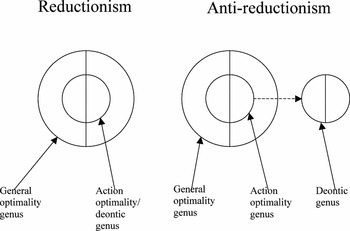
I take the third premise of this argument to be uncontroversial. I will now defend the other two premises, beginning with the proposition that the deontic genus is a realm. The crucial point here is this. The deontic genus is a realm if anti-reductionist consequentialism holds, but not if reductionist consequentialism does. The argument is straightforward. Given reductionist consequentialism, rightness is identical with action optimality and wrongness is identical with action suboptimality. Then the deontic genus satisfies the two conditions for being subordinated under what we could call the general optimality genus, which encompasses all objects that are either optimal or suboptimal (relative to the relevant set of alternatives). The deontic genus satisfies these conditions because the action optimality genus does, and these two genera are identical given reductionist consequentialism. If anti-reductionist consequentialism holds, by contrast, the deontic genus is not identical with the action optimality genus, and so is not subordinated under the general optimality genus. To verify that claim of non-identity, remember that subordination requires that every species of the subordinated genus also be a species of the subordinating genus. And since rightness and wrongness will not belong to the species associated with the general optimality genus, the deontic genus is not subordinated under that genus. In figure 1, the relationship between the different genera is illustrated graphically.Footnote 14 (The dashed arrow represents the explanation or ‘in virtue of’ relation. A divided circle's being included in another represents the genus inclusion relation. The common dividing line represents the separation into optimal and suboptimal, or right and wrong.)
Figure 1.

Now for (P). Let me first illustrate that principle with two examples less controversial than the deontic case. Hopefully, they will make the principle seem intuitive. First, consider again the paradigmatic example of animal species. What makes all such species members of the realm animal life? Simplifying, we may answer that question like this: they are DNA-based. But it is precisely the role of DNA to determine which particular species a given animal belongs to, as I have already mentioned. The set of properties of an animal that make it belong to some particular species, rather than any other one, does entail that that animal has DNA. Second, take the example, reminiscent in some ways of deontic status, of truth value (classically conceived). The ‘truth value genus’ is a realm, whose species are truth and falsehood. What makes something have a truth value is simply its having propositional content. (For the sake of the example, let us ignore the complications.) But, by the same token, the nature of that content is highly relevant in determining which truth value a given truth-value bearer has. In particular, let us say that truth value depends on whether the propositional content of the truth value bearer in question corresponds with reality. This relation, or its absence, can only meaningfully be ascribed to objects with propositional content, which explains why the truth value genus is a realm. (Contrast the property of optimality.) The fact that a truth-value bearer is true rather than false (or vice versa) entails its having propositional content.
I will now offer an argument for (P). First we need a crucial premise: if R (〈CR, MR〉) is a realm, an arbitrary object x has (exactly) one of the properties serving as arguments in the function PR (one of the two components of MR, remember) only if x satisfies CR.Footnote 15 I will defend this premise in a moment. Let us first see how we can use it to derive (P). Suppose, then, that the antecedent of (P) is true of some property E and some realm R. That is to say: E is essential to explaining why a given object belongs to any of the species of R, as opposed to not belonging to any of these species at all. Suppose further that some arbitrary object x belongs to one of the species of R, and so has one of the explanatory properties in MR. Now, what it takes to belong to any of these species is precisely to satisfy the criterion CR. Thus, x's satisfying CR entails its being E. But from that proposition and our premise we conclude that x's having any of the explanatory properties in MR entails its having property E.
Let us then look at how to argue for the premise. For a reductio, suppose that x has one of the properties in PR, yet does not satisfy CR. Now we want to show that R is not a realm. For R not to be a realm there would have to be another genus R* that includes or subordinates it. As I pointed out earlier, for a genus R to be subordinated to another genus R*, two conditions must be met. To repeat: (i) Every species in R is also a species in R*. (ii) The type TR of R is identical with the type TR* of R*. It is easy to show that, given our assumption, there is a genus R* meeting these two conditions. We look first at condition (i). As x does not satisfy CR, it cannot belong to any of the species of R either, for satisfaction of that criterion is a necessary condition of belonging to any of those species. Let us say, then, that there is a species s 1*, not belonging to R, with x as a member. R*, then, encompasses at least the species of the original R plus the new s 1*. (I assume it makes no sense to suppose that x does not belong to any species at all.) And so condition (i) is met.Footnote 16
Let us turn now to condition (ii). Let p 1 . . . p n be the properties serving as arguments in the function PR. Call these properties ‘p-properties’. For each species in R, there is exactly one p-property distinctive of that species, possibly quite complex, distinguishing it from all the others in R. Moreover, as R is a genus, the p-properties have a type, TR, something they all have in common explaining why they are species-determining (in the way the fact that the species-determining properties of the animal genus are DNA properties explains why they are species-determining). It does not matter here what the type TR is; so in order not to complicate matters further, let us make do simply with the idea that what all properties in PR have in common is that they are p-properties, and let that serve also as a characterization of TR. Now x has one of the p-properties – p 1, let us say – but does not satisfy CR. We have also seen that x belongs to a species s 1*, not included in R. At this point we are entitled to conclude that there exists another genus G, such that CG is distinct from CR, and such that PG is a function taking the p-properties as arguments but returning as values species different from those figuring in PR. For p 1 it returns s 1*, for p 2 it returns s 2*, etc. These other species (s 2*, s 3*, etc.) may or may not actually be instantiated. If they are not, presumably they do not actually exist. But G will exist as long as at least one of its species exists – and s 1* does exist, being instantiated by x. The p-properties are species-determining in G just as they are in R. Moreover, if the p-properties are species-determining in R in virtue of being p-properties, there is nothing stopping us from saying that they are species-determining in G as well in virtue of being p-properties. Hence we can say that R and G have the same type, that TR is identical with TG. Similarly we should be able to say that all the species of R as well as all the species of G are also species of R*. And so we find that what all the species-determining properties of R* (the arguments of PR*) have in common, explaining what makes them species-determining, is precisely that they are p-properties – and in particular, TR is identical with TR *. Hence condition (ii) is met.
The upshot of our discussion so far is that we have identified two requirements on those ethical theories that uphold the autonomy of the deontic.
(1) There must be an explanation of why only actions have deontic properties.
(2) The species-determining mechanism distinctive of the deontic genus – or in more familiar terms, the right making feature(s) – must entail the fact that the objects to which it applies are the products of agency.
Anti-reductionist consequentialism fails to meet either. What should we conclude from that fact? I think a good case can be made for holding that we can draw a rather strong conclusion: that anti-reductionist consequentialism is incoherent. I say this because the argument above relies only on premises to which that doctrine is itself inescapably committed, and eventuates in a conclusion incompatible with it. To repeat, there are three premises. One is (P); another is that the deontic genus is a realm; the third is that actions, and actions alone, have deontic status in virtue of their relation to agency. The second of these I take to be constitutive of anti-reductionist consequentialism; it is (in effect) what distinguishes it from its reductionist cousin. The third seems to be inherent in the very notion of the deontic itself, to which any non-eliminativist ethical theory is committed. And (P) seems to me to have something like the status of a principle of logic, or of reason generally. I think it is legitimate to resort to such a principle in an effort to show some doctrine incoherent. But in the end the question of whether anti-reductionist consequentialism is incoherent or just deeply problematic is not that important.
One final, and important, point. I have required that, if an ethical theory is to respect the autonomy of the deontic, the explanation it offers of why an action is right rather than wrong must refer to, or at least entail, the fact that objects with deontic status are the products of agency. This is (2) above. And I have claimed that anti-reductionist consequentialism fails to meet that requirement. I have also claimed, though without argument, that reductionist consequentialism, even if it avoids the difficulty I have described, should be rejected along with all other moral theories that fail to respect the autonomy of the deontic. But if I am right about all this, one might well wonder whether any leading ethical theory that does respect the autonomy of the deontic could pass the requirement; if not (perhaps) it is simply too strong. Fortunately it seems that at least one such theory meets the requirement, namely Kant's. Or at least I think there is a case to be made here. For Kant's theory of deontic classification does entail that objects with deontic properties have these in virtue of other properties essential to actionhood. According to Kant, what makes an action right (permissible) rather than wrong is that its maxim is universalizable: if it is, the action is permissible, otherwise not.Footnote 17 But this explanation does apply only to actions. For to act, on Kant's view, essentially involves acting on a maxim, and in order to understand what a maxim is, we must grasp the role it plays in acting. To that extent, at least, the species-determining mechanism of the deontic genus entails something about the essential nature of actions. Moreover, Kant's view satisfies (1) as well, for only actions could have the kind of relation to a maxim that Kant identifies. And, of course, Kant's theory avoids the problem of explaining why its proposed mechanism does not confer deontic status when applied to non-actions, since it is defined in terms of agency and so cannot be ‘applied’ to non-actions. An important moral to draw here – hardly novel – is that moral theories of the nature of the deontic go hand in hand with theories of the nature of agency: they must fit together on pain of arbitrariness or even incoherence.
Now I confess that the example of Kant's theory suggests that (2) is really uncomfortably weak and, in particular, that if we want to save that theory from the charge of being ad hoc (and perhaps incoherent as well) it is not enough to point out that the notion of a maxim is defined in terms of agency (and that the different deontic categories in turn are defined in terms of the notion of a maxim). For it seems that we also need to show that the notion of the universalizability of a maxim is defined in terms of agency. After all, otherwise any old theory defining right and wrong in terms of the action's relation to a maxim – no matter how arbitrary that relation may be – would fare just as well, or badly, as Kant's theory. I believe that reasonable strengthenings of (2) are available, and also that Kant's theory arguably meets these also. But that is a topic for another day.Footnote 18