Introduction
A defining feature of the US economic downturn of 2008–2010 was the alarming rate of home foreclosure. More than 2.3 million properties went into foreclosure in 2008, representing an 81% increase from the previous year (RealtyTrac, 2009). This trend continued in 2009–2010 with foreclosure filings reported on more than 2.8 million properties in each of these years (RealtyTrac, 2010, 2011). Although a substantial number of US households have experienced foreclosure since 2008, the effects of foreclosure on health remain unknown. Given the associations of other financial stressors with health outcomes, particularly psychiatric morbidity (Kessler et al. Reference Kessler, Turner and House1987; Dew et al. Reference Dew, Bromet and Penkower1992; Catalano et al. Reference Catalano, Dooley, Wilson and Hough1993; Dooley et al. Reference Dooley, Fielding and Levi1996; Gallo et al. Reference Gallo, Bradley, Siegel and Kasl2000; Taylor et al. Reference Taylor, Pevalin and Todd2007), the effects of foreclosure on health are likely to be substantial. If foreclosure is indeed associated with ill health, the magnitude of recent exposure to this event suggests that the foreclosure crisis could have a significant impact on the health of the US population.
A recent study examined the health status of persons seeking aid at a mortgage counseling agency in Philadelphia in relation to a representative community sample of the same area (Pollack & Lynch, Reference Pollack and Lynch2009). Persons who were at least 2 months behind on mortgage payments had elevated odds of hypertension and heart disease, and in a psychiatric diagnosis compared to the community sample, more than one-third met the screening criteria for major depression (Pollack & Lynch, Reference Pollack and Lynch2009). However, this study identified characteristics of individuals at risk of foreclosure rather than the consequences of foreclosure itself. An online survey of consumers found that individuals who were behind in mortgage payments or who had experienced foreclosure in the past year had poorer self-rated health and marked elevations in psychological distress than renters and homeowners not experiencing foreclosure (Alley et al., unpublished observations). Although both of these studies found large associations between foreclosure and psychiatric outcomes, the cross-sectional study designs preclude clear inferences regarding the role of foreclosure in the onset of mental health problems.
We present, to the best of our knowledge, the first prospective study examining the effect of foreclosure on mental health using data from a longitudinal study of adults in Detroit, Michigan, a city that experienced some of the highest rates of unemployment and foreclosure during the financial crisis (Rooney, Reference Rooney2008; Bureau of Labor Statistics, 2011). We evaluate whether individuals who experienced foreclosure exhibit subsequent increases in symptoms of major depression and generalized anxiety disorder (GAD), both of which are sensitive to social and environmental conditions, particularly exposure to stress (Roemer et al. Reference Roemer, Molina, Litz and Borkovec1996; Kendler et al. Reference Kendler, Karkowski and Prescott1999, Reference Kendler, Hettema, Butera, Gardner and Prescott2003; Acierno et al. Reference Acierno, Ruggiero, Kilpatrick, Resnick and Galea2006; Moffit et al. Reference Moffit, Caspi, Harrington, Milne, Melchior, Goldberg and Poulton2007).
Method
Sample
Data were drawn from the Detroit Neighborhood Health Study (DNHS), a longitudinal cohort of predominately African-American adults (aged ⩾18 years) living in Detroit, Michigan. A probability sample of 1547 individuals living within the Detroit city limits participated in a baseline telephone survey in 2008–2009. Respondents were sampled from a dual-frame probability sample design. Telephone numbers were obtained from two sources: (1) the US Postal Service Delivery Sequence File, which consists of the entire Detroit population and includes non-telephone and cellular phone-only households, and (2) a list-assisted sampling random-digit-dial frame, covering Detroit households that are not residential directory-listed numbers (the unlisted number frame). We matched the telephone numbers in these two databases to identify the sample addresses that had at least one listed landline telephone number and then contacted these people by telephone to participate in the telephone survey. We invited the other part of the sample with no listed landline, no telephone, or a cell phone only to participate in the survey through a postal mail effort. The overall response rate was 53.0%. Additional details regarding sampling procedures and sample characteristics are available elsewhere (Uddin et al. Reference Uddin, Koenen, Aiello, Wildman, de los Santos and Galea2011). Weights were applied to adjust for selection probabilities and non-response and to match the sample to the Detroit population distributions on sociodemographic characteristics. A comparison of the DNHS sample with the 2005–2007 American Community Survey (ACS, 2009) showed that the sample is representative of the Detroit population in terms of age, gender, race, income and educational attainment.
A total of 1054 individuals were reinterviewed in a telephone follow-up survey 1 year later. Respondents who did not complete the wave 2 survey were younger, had completed fewer years of education, were more likely to be employed and previously married, and had greater trauma exposure than respondents who participated at both waves 1 and 2. Weights were applied to adjust for differences in the composition of the follow-up sample compared with the baseline sample. All respondents provided informed consent before completing the interviews. The Institutional Review Board of the University of Michigan approved all study procedures.
Measures
Foreclosure and financial stressors
At the follow-up, respondents were asked whether they had experienced a home foreclosure since the baseline interview. Foreclosure was defined as a repossession of the respondent's home by a creditor as a result of non-payment. Individuals who were delinquent on mortgage payments but who had not yet experienced foreclosure were not included in the foreclosure group. Those responding affirmatively were asked about reasons for the foreclosure. Respondents were also queried about stressful life events occurring since the baseline interview. Financial stressors included job loss, being unemployed and seeking employment for at least 3 months, legal problems, problems accessing health care, and divorce.
Psychiatric morbidity
Symptoms of major depression and GAD in the 2 weeks prior to the survey were assessed at baseline and at the follow-up with validated instruments based on DSM-IV criteria (APA, 1994). The Patient Health Questionnaire (PHQ-9; Kroenke et al. Reference Kroenke, Spitzer and Williams2001) was used to assess depression symptoms. The nine items on the PHQ-9 are scored from 0 (not at all) to 3 (nearly every day), with scores ranging from 0 to 27. GAD was assessed with the seven-item generalized anxiety disorder scale (GAD-7; Spitzer et al. Reference Spitzer, Kroenke, Williams and Lowe2006). Items are scored from 0 (not at all) to 3 (nearly every day), with scores ranging from 0 to 21. Because the incidence of major depression and GAD was fairly low over the1-year follow-up period, analyses focused on the continuous symptom counts of major depression and GAD at baseline and at the follow-up.
Lifetime history of major depression, GAD and post-traumatic stress disorder (PTSD) were assessed at the baseline interview. Major depression and GAD were assessed with lifetime versions of the PHQ-9 and GAD-7 respectively. Additional questions were added to these measures to determine the timing, duration and severity of illness and also symptom-related disability. Lifetime PTSD was assessed using the PTSD Checklist (PCL-C; Weathers & Ford, Reference Weathers, Ford and Stamm1996), a 17-item measure of DSM-IV symptoms of PTSD. Participants first completed a measure assessing exposure to 19 traumatic events (Breslau et al. Reference Breslau, Kessler, Chilcoat, Schultz, Davis and Andreski1998), and were queried about PTSD symptoms in response to their worst trauma. Respondents rate the degree to which they are bothered by each of the PTSD symptoms on a scale ranging from 1 (not at all) to 5 (extremely), with scores ranging from 17 to 85.
A clinical reappraisal study was conducted with a probability sample of 51 participants. Respondents who exhibited symptoms of mental disorder during the telephone interview and respondents who did not endorse symptoms were selected using an algorithm based on the prevalence of the three disorders in previous community studies. A counselor blinded to the information obtained during the telephone interview conducted clinical interviews using the Structured Clinical Interview for DSM-IV Disorders (SCID; First et al. Reference First, Spitzer, Gibbon and Williams2002) to assess depression and GAD and the Clinician-Administered PTSD Scale for DSM-IV (CAPS; Blake et al. Reference Blake, Weathers, Nagy, Kaloupek, Gusman, Charney and Keane1995) to assess PTSD. The results showed good concordance between lifetime diagnoses based on the screening scales and the clinical interviews, with an area under the receiver operative curve (AUC) of 0.76 for depression, 0.93 for GAD, and 0.78 for PTSD.
Sociodemographic factors
We examined the associations of a range of baseline sociodemographic factors with foreclosure and adjusted for these characteristics in subsequent models. Sociodemographic factors included sex, age (coded as <52 and ⩾52 years of age based on a median split), marital status (coded as married, divorced/separated/widowed and never married) race (coded as Black or White), educational attainment [coded as less than high school, high school diploma or General Educational Development (GED), and at least some college], household income (coded as <US$35000 and ⩾US$35000 based on a median split), and employment status (coded as unemployed and seeking work versus all others).
Statistical analysis
The prevalence of foreclosure was examined using cross-tabulations. The associations of foreclosure with sociodemographic factors were examined using logistic regression. Inspection of normal probability plots for the PHQ-9 and the GAD-7 suggested that neither variable was normally distributed. Further examination of the distributions for the PHQ-9 and the GAD-7 revealed that both variables had a median value of zero and were positively skewed (skewness=1.90 and 1.92 respectively). The association between foreclosure at baseline and psychiatric symptoms at the follow-up was therefore estimated using Poisson regression, an approach that treated symptoms of major depression and GAD as count variables. Associations between foreclosure and psychopathology were examined in a series of models that sequentially added controls for sociodemographics, lifetime history of psychiatric disorders, and exposure to other financial stressors. Symptom levels at baseline were controlled in all models. Logistic regression coefficients and their standard errors were exponentiated to generate odds ratios (ORs) and 95% confidence intervals (CIs); Poisson regression coefficients and their standard errors were exponentiated to generate incidence density ratios (IDRs) and 95% CIs. Analyses were performed using SUDAAN software (Research Triangle Institute, 2008) to account for the complex survey design. Survey weights were applied to adjust for selection probabilities and non-response. Statistical significance was evaluated using two-sided 0.05 level tests.
Results
Prevalence and reasons for foreclosure
A total of 25 respondents (2.5%) reported a foreclosure between the baseline and follow-up. The most commonly reported reason for foreclosure was that the monthly payments had increased (30.6%). The next most common reasons included increases in expenses for non-medical reasons, including credit card debt, taxes and uncontrolled spending (20.5%), and a drop in household income due to job loss, divorce, or other reasons (14.4%). The least common reasons for foreclosure were medical problems (10.0%) and having monthly payments that were too high from the beginning (4.1%).
Correlates of foreclosure
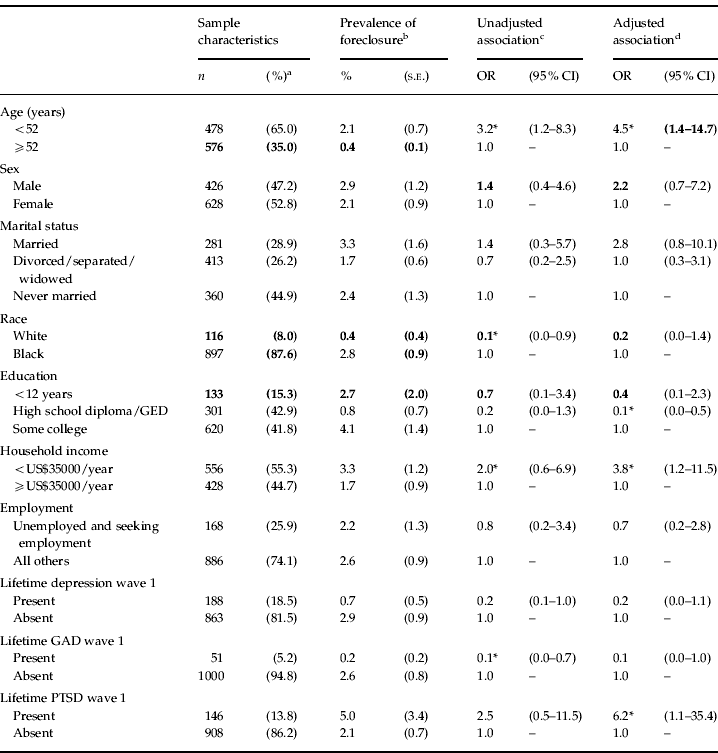
In models that adjusted for all covariates simultaneously, foreclosure was more common among younger than older respondents (OR 4.5) and among respondents whose total household income was <US$35000/year compared to those with higher household income (OR 3.8). Relative to respondents who did not attend college, those with at least some post-secondary education were more likely to experience foreclosure (OR 10.0). Individuals with a lifetime history of PTSD also had greater odds of experiencing foreclosure than those without a history of the disorder (OR 6.2) (Table 1). Although foreclosure was more than five times as common among Black compared to White respondents, this association was not statistically significant.
Sociodemographic and mental health correlates of foreclosure (n=1054) in the Detroit Neighborhoods and Health Study (DHNS), 2008–2011

GED, General Educational Development; GAD, generalized anxiety disorder; PTSD, post-traumatic stress disorder; s.e., standard error; OR, odds ratio; CI, confidence interval.
a Weighted prevalence estimates. See Method section for details.
b Weighted prevalence of foreclosure.
c Association between foreclosure and each sociodemographic and mental health characteristic based on a univariate logistic regression model.
d Association between foreclosure and each sociodemographic and mental health characteristic based on a logistic regression model adjusting for all covariates simultaneously.
* Significant at the 0.05 level, two-sided test.
Associations of foreclosure with psychiatric symptoms
Foreclosure was associated with an increase in symptoms of depression at the follow-up, controlling for baseline levels (IDR 1.7, 95% CI 1.04–2.91) (Table 2). The association between foreclosure and depressive symptoms at the follow-up was larger in models that adjusted for sociodemographic factors (IDR 1.8, 95% CI 1.05–3.23), lifetime history of mood and anxiety disorders (IDR 2.3, 95% CI 1.42–3.82), and exposure to other financial stressors between the baseline and follow-up surveys (IDR 2.4, 95% CI 1.59–3.64). In the fully adjusted model, individuals experiencing home foreclosure experienced a 2.4 times increased rate of depressive symptoms from baseline to the follow-up than individuals not experiencing foreclosure.
Incidence density ratios (IDRs) for the association between foreclosure and psychiatric symptoms (n=1054) in the Detroit Neighborhoods and Health Study (DNHS), 2008–2010Footnote a

GAD, Generalized anxiety disorder; CI, confidence interval.
a All models are weighted to account for the complex survey design and to adjust for selection probabilities and non-response.
b Model includes controls for baseline symptom levels.
c Model includes controls for baseline symptoms and sociodemographics including age, sex, marital status, race, educational attainment, income, and employment status.
d Model includes controls for baseline symptoms, sociodemographics, and lifetime history of depression, GAD, and post-traumatic stress disorder (PTSD).
e Model includes controls for baseline symptoms, sociodemographics, lifetime history of depression, GAD and PTSD, and exposure to financial stressors (job loss, unemployment for >3 months, legal problems, difficulty accessing health care, and divorce).
* Significant at the 0.05 level, two-sided test.
Foreclosure was also associated with an increase in symptoms of GAD at the follow-up, controlling for baseline GAD symptoms (IDR 1.9, 95% CI 1.46–2.58). The association between foreclosure and symptoms of GAD at the follow-up was unchanged in models that adjusted for sociodemographic factors, lifetime history of mood and anxiety disorders, and exposure to other financial stressors between the baseline and follow-up (IDR 1.9 in all models). In the final model adjusting for all covariates, those who experienced foreclosure between the baseline and follow-up surveys experienced a 1.9 times increased rate of symptoms of GAD than those who did experience foreclosure.
Discussion
We provide novel prospective evidence documenting increases in symptoms of major depression and GAD among adults with recent exposure to foreclosure. The association between foreclosure and symptoms of depression and anxiety was observed even after rigorous adjustment for sociodemographics, prior history of psychiatric disorder, and exposure to other financial stressors, including job loss. Our findings extend two cross-sectional surveys reporting high rates of psychiatric problems among individuals experiencing foreclosure (Alley et al., unpublished observations; Pollack & Lynch, Reference Pollack and Lynch2009) and build on an extensive literature linking stressful life events to the onset of mood and anxiety disorders (Brown et al. Reference Brown, Bifulco and Andrews1987, Reference Brown, Harris and Hepworth1995; Shrout et al. Reference Shrout, Link, Dohrenwend, Skodol, Stueve and Mirotznik1989; Brown, Reference Brown1993; Kendler et al. Reference Kendler, Karkowski and Prescott1999, Reference Kendler, Hettema, Butera, Gardner and Prescott2003; Galea et al. Reference Galea, Ahern, Resnick, Kilpatrick, Bucuvalas, Gold and Vlahov2002). Qualitative research suggests that foreclosure is associated with feelings of loss, sadness, fear, helplessness, shame and embarrassment (Nettleton & Burrows, Reference Nettleton and Burrows2000; Fields et al. Reference Fields, Justa, Libman and Saegert2007), all of which have been linked to the onset of anxiety and mood pathology (Abramson & Sackeim, Reference Abramson and Sackeim1977; Abramson et al. Reference Abramson, Seligman and Teasdale1978, Reference Abramson, Metalsky and Alloy1989; Shrout et al. Reference Shrout, Link, Dohrenwend, Skodol, Stueve and Mirotznik1989; Brown, Reference Brown1993; Brown et al. Reference Brown, Harris and Hepworth1995). Foreclosure may be a particularly pernicious stressor because of the prolonged duration of the event (Bennett et al. Reference Bennett, Scharoun-Lee and Tucker-Seeley2009) and the increased likelihood of exposure to additional risk factors for psychopathology including displacement, isolation from social support networks, unstable housing and homelessness (Oxman et al. Reference Oxman, Berkman, Kasl, Freeman and Barrett1992; Berkman & Glass, Reference Berkman, Glass, Berkman and Kawachi2000; Bennett et al. Reference Bennett, Scharoun-Lee and Tucker-Seeley2009; National Coalition for the Homeless, 2009; Martin, Reference Martin2010).
Study findings should be interpreted in light of limitations. Although we provide novel evidence of prospective associations between foreclosure and psychiatric morbidity, a relatively small number of individuals experienced foreclosure over the 1-year follow-up. However, the foreclosure rate in our study is consistent with tracking data from Detroit in 2008–2009, which reported foreclosure filings in one out of every 136 homes. Moreover, the process of foreclosure (e.g. speed, judicial involvement, options for refinancing) may vary markedly across states and municipalities, and these differences in the foreclosure experience may have implications for mental health. Our findings therefore warrant replication in samples drawn from other geographic areas and with longer follow-up periods. Questions regarding home ownership and foreclosure were only queried at the follow-up survey. Both homeowners and renters were therefore included in the comparison group when estimating associations between foreclosure and mental health. Renters have been shown to have worse mental health than homeowners (Alley et al., unpublished observations), suggesting that their inclusion in our comparison group may have attenuated the associations between foreclosure and psychiatric symptoms. The results were unchanged, however, when we restricted our analyses to homeowners at the follow-up survey. Because mental health problems are common among individuals at risk of foreclosure (Pollack & Lynch, Reference Pollack and Lynch2009), it is possible that the observed associations resulted, in part, from pre-existing psychopathology. We addressed this by controlling for lifetime history of psychiatric disorder at wave 1, but residual confounding remains a possibility. A relatively high proportion of baseline respondents did not complete the follow-up survey. It is likely that loss to follow-up was more common among those who experienced a foreclosure, given the difficulties associated with relocating individuals who change residence in a prospective study. If those individuals exposed to foreclosure and who were unable to relocate were also more likely to have mental health problems, any differential loss to follow-up would result in conservative estimates of the relationship between foreclosure and psychiatric outcomes. Finally, we controlled for factors that could be on the causal pathway linking foreclosure to psychopathology. For example, the financial stressors that were included as covariates in our analysis (e.g. job loss, divorce) could represent consequences, rather than causes, of foreclosure. Adjustment for these experiences attenuated the foreclosure–psychopathology association, highlighting the conservative nature of our estimates.
Identifying the specific aspects of the foreclosure process that increase risk for mental health problems represents an important goal for future research. Foreclosure is a prolonged event involving multiple stages, beginning with delinquent mortgage payments and progressing to legal action by the lender and eviction (Bennett et al. Reference Bennett, Scharoun-Lee and Tucker-Seeley2009). Determining which aspects of the foreclosure process are most detrimental for health could usefully inform the targeting of interventions. The delivery of mental health screenings and referral to low-cost mental health services in mortgage counseling agencies and other settings that provide services to individuals experiencing foreclosure represents one strategy for intervening with this at-risk population. Another goal for future research is determining whether foreclosure is associated with the onset of mental health problems other than symptoms of depression and GAD. We did not examine the associations of foreclosure with PTSD symptomatology in this study, because PTSD symptoms were not assessed in relation to foreclosure as a traumatic event. It is likely, however, that foreclosure increases risk for a variety of mental health problems, including not only depression and anxiety but also substance misuse and abuse. This possibility warrants examination in future research.
Adults who have experienced foreclosure are at risk of developing major depression and GAD. Individuals experiencing foreclosure represent important targets for mental health intervention. The high rates of unemployment, financial strain, and lack of health insurance coverage among those experiencing foreclosure may limit their access to mental health services (Alley et al., unpublished observations; Pollack & Lynch, Reference Pollack and Lynch2009), compounding the mental health risks conferred by foreclosure. Moreover, predatory lending practices specifically targeted low-income areas with high concentrations of racial/ethnic minorities (Newman, Reference Newman2009; Ojeda, Reference Ojeda2009), which could exacerbate health problems in already disadvantaged segments of the population. These findings combined with the high rate of home foreclosure since 2008 suggest that the foreclosure crisis could have adverse effects on the mental health of the US population.
Acknowledgments
We thank R. M. Coulborn for overseeing the DNHS specimen collection, J. Slayden for coordinating the overall DNHS project, and A. Weckle and R. Soliven for handling the DNHS specimen processing and for laboratory technical assistance; the many Detroit residents who chose to participate in the DNHS; and J. Delva, L. Gant, B. Marans and T. Raghunathan for contributing to the conceptual development of the DNHS.
This study was supported by National Institutes of Health Grants DA022720, DA022720-S1, MH088283 and MH078152, and also MH082729 (to S.G. and A.A.), MH070627 and MH078928 (to K.K.), and MH092526 (to K.M.). Additional support was provided by the Robert Wood Johnson Health and Society Scholars Small Grant Program and the University of Michigan Office of the Vice President for Research Faculty Grants and Awards Program (M.U.). Funders provided support for data collection and analysis. K. M. Keyes had full access to all of the data in the study and takes responsibility for the integrity of the data and the accuracy of the data analysis.
Declaration of Interest
None.