INTRODUCTION
Many neurodevelopmental disorders are characterized by distinctive behavioral–communicative profiles, and may show atypical pathways in the development of communication skills. With current advances in refining the phenotypic descriptions of many developmental disorders, including those of rare incidence and of known genetic origin, researchers have increasingly adopted an etiology-based approach to the study of communicative development in atypical populations (Abbeduto, Evans & Dolan, Reference Abbeduto, Evans and Dolan2001; Dykens, Hodapp & Finucane, Reference Dykens, Hodapp and Finucane2000). In particular, those that show uneven cognitive profiles promised to provide opportunities to test theoretical assumptions about the core architecture of human cognition and its development. For almost two decades Williams syndrome (WS), a neurodevelopmental disorder with well understood genetic causes, has been at the forefront of theoretical debates about the separability of linguistic and cognitive functions, their possible genetic underpinnings, and the differences between delay and atypical trajectories in the development of cognitive, linguistic, and social abilities (Bellugi, Bihrle, Neville, Jernigan & Doherty, Reference Bellugi, Bihrle, Neville, Jernigan, Doherty, Gunnar and Nelson1992; Bellugi, Marks, Bihrle & Sabo, Reference Bellugi, Marks, Bihrle, Sabo, Bishop and Mogford1988; Karmiloff-Smith, Ansari, Campbell, Scerif & Thomas, Reference Karmiloff-Smith, Ansari, Campbell, Scerif, Thomas, Morris, Lenhoff and Wang2006; Stojanovik, Perkins & Howard, Reference Stojanovik, Perkins and Howard2004).
Williams syndrome is a neurodevelopmental disorder caused by a hemizygous deletion of approximately 1·6 megabases on chromosome 7, which encompasses over twenty-five genes (Osborne, Reference Osborne, Morris, Lenhoff and Wang2006). Although of relatively rare occurrence (1 in 7,500 live births; Strømme, Bjørnstad & Ramstad, Reference Strømme, Bjørnstad and Ramstad2002), this syndrome has captured the interest of cognitive scientists because it is associated with a striking neurocognitive phenotype, characterized by severe visual–spatial impairments, but relatively preserved face recognition skills, verbal auditory memory, expressive language, and high sociability, in the context of mild intellectual or learning disability (Mervis, Robinson, Bertrand, Morris, Klein-Tasman & Armstrong, Reference Mervis, Robinson, Bertrand, Morris, Klein-Tasman and Armstrong2000). Research on the language abilities of individuals with WS in particular has been fueled by persistent theoretical controversies. Over time, interest in WS shifted from debates about the relative independence of language from other aspects of cognition and from focusing on structural and content aspects of language (i.e. syntax, morphology, vocabulary; e.g. Bellugi et al., Reference Bellugi, Marks, Bihrle, Sabo, Bishop and Mogford1988; Mervis & Bertrand, Reference Mervis, Bertrand, Adamson and Romski1997; Zukowski, Reference Zukowski, Rice and Warren2004), to exploring the pragmatic aspects of language in social communication, and its relationships with aspects of social engagement and social cognition that set apart people with WS from other populations with developmental disorders (John, Rowe & Mervis, Reference John, Rowe and Mervis2009; Laing et al., Reference Laing, Butterworth, Ansari, Gsodl, Longhi, Panagiotaki, Paterson and Karmiloff-Smith2002; Laws & Bishop, Reference Laws and Bishop2004; Philofsky, Fidler & Hepburn, Reference Philofsky, Fidler and Hepburn2007). Recent research has produced a complex picture of strengths and deficits in the language and social abilities of individuals with WS, revealing the complicated, often paradoxical nature of the relations between social interest or social engagement and social–communicative competence (Plesa Skwerer & Tager-Flusberg, Reference Tager-Flusberg2006).
Children with WS are extremely interested in social interaction, gregarious, and, by school age, have well-developed vocabularies (Brock, Reference Brock2007; Mervis & John, Reference Mervis and John2008), and often actively try to keep an interlocutor engaged in the interaction verbally (Reilly, Klima & Bellugi, Reference Reilly, Klima and Bellugi1990). However, the view that people with WS have good social communication skills, proposed in the early literature on WS (Bellugi et al., Reference Bellugi, Marks, Bihrle, Sabo, Bishop and Mogford1988; Bellugi et al., Reference Bellugi, Bihrle, Neville, Jernigan, Doherty, Gunnar and Nelson1992) has been challenged in a number of studies that examined particular, well-defined features of the communication profiles of individuals with WS, using conversational and narrative samples (Crawford, Edelson, Plesa Skwerer & Tager-Flusberg, Reference Crawford, Edelson, Plesa Skwerer and Tager-Flusberg2008; Stojanovik et al., Reference Stojanovik, Perkins and Howard2004; Stojanovik, Perkins & Howard, Reference Stojanovik, Perkins and Howard2006; Udwin & Yule, Reference Udwin and Yule1990), parental reports (Laws & Bishop, Reference Laws and Bishop2004), or experimental paradigms (John et al., Reference John, Rowe and Mervis2009; Asada, Tomiwa, Okada & Itakura, Reference Asada, Tomiwa, Okada and Itakura2010).
Only a few studies used an experimental setting to probe particular aspects of pragmatic ability in WS. One study focused on the listener's role in a modified referential communication task (John et al., Reference John, Rowe and Mervis2009), examining the ability of six- to twelve-year-old children with WS to verbalize message inadequacy. Results of this study showed that children with WS had difficulty evaluating whether a message was informative and verbalizing the nature of the referential problems encountered. This study did not include comparison groups of children without WS, as the researchers' focus was on variability and the factors contributing to this within the WS population. Asada and colleagues (2010) focused on the role of the speaker in communication, investigating whether six- to eighteen-year-olds with WS could modify their verbal communication according to an interlocutor's attention in order to share what they did. These authors reported that the children with WS had more difficulties than vocabulary age-matched typically developing (TD) children in communicating according to another's attentional state.
There is a growing consensus in the field that pragmatic abilities represent an area of considerable weakness in people with WS, despite their heightened interest in social interaction and relatively good expressive language (Klein-Tasman, Mervis, Lord & Phillips, Reference Klein-Tasman, Mervis, Lord and Phillips2007; Laws & Bishop, Reference Laws and Bishop2004; Mervis & Becerra, Reference Mervis and Becerra2007; Philofsky et al., Reference Philofsky, Fidler and Hepburn2007; Stojanovik, Reference Stojanovik2006), but the causes and developmental course of pragmatic impairments in WS remain poorly understood. Thus, research in WS appears to be uniquely suited for examining the interplay of social engagement, linguistic proficiency, and the social use of language, in particular pragmatic abilities and deficits. Efficient communication is especially critical when people are engaged in a joint, collaborative activity. Successful communication during a joint activity relies on the ability of the interaction partners to coordinate their individual knowledge and actions (Clark, Reference Clark1992).
The aim of our study was to investigate the possible sources of communicative difficulties in WS, by examining the interactive behavior of five- to thirteen-year-olds during a modified referential communication task, designed as a collaborative game scenario. Our collaborative game was loosely modeled on the task used by Hanna and Tanenhaus (Reference Hanna and Tanenhaus2004) with TD individuals to probe whether a listener would take into account a speaker's goals and pragmatic constraints in reference resolution during a joint activity. The task in the study by Hanna and Tanenhaus (Reference Hanna and Tanenhaus2004) used a cooking simulation, in which a confederate was the ‘cook’, who provided instructions about moving and manipulating objects following a recipe to the subject, who was the ‘helper’. The critical referring expressions matched either one or two objects that were distributed between an area accessible only to the helper and an area accessible to both the cook and the helper. The helper's eye-movements were monitored to examine whether the addressee would take into account task-related pragmatic constraints to determine the intended referent of expressions matching more than one object. This study provided clear evidence of the importance of examining attention monitoring in reference resolution during a natural collaborative interaction. As Sperber and Wilson (Reference Sperber and Wilson2002) point out, in order to decide what a speaker intended to assert, the hearer may have to resolve referential ambivalences and ambiguities and “assign appropriate interpretations to vague expressions or approximations […] Pragmatic interpretation involves the resolution of such linguistic indeterminacies on the basis of contextual information” (p. 19). Making good use of contextual information requires the coordination of several different sets of abilities, from attending to and interpreting verbal messages, to visual search and inferring intentions. While TD children as young as four years old start to demonstrate these pragmatic abilities (Ackerman, Szymanski & Silver, Reference Ackerman, Szymanski and Silver1990; Beal & Belgrad, Reference Beal and Belgrad1990; Beck & Robinson, Reference Beck and Robinson2001), competence in both the roles of listener and of speaker in referential communication tasks continues to develop through middle childhood (Glucksberg, Krauss & Higgins, Reference Glucksberg, Krauss, Higgins and Horowitz1975).
Studies addressing the referential communication performance of individuals with intellectual disabilities have generally found that they often fail to provide relevant and sufficient information to a listener, or to signal non-comprehension of another speaker's verbal messages (Abbeduto & Nuccio, Reference Abbeduto and Nuccio1989; Abbeduto et al., Reference Abbeduto, Murphy, Kover, Giles, Karadottir and Amman2008; Rosenberg & Abbeduto, Reference Rosenberg and Abbeduto1993), but that there is considerable variability in their communicative problems, varying with etiology, as well as within-group. The only other experimental study of pragmatic comprehension in WS (John et al., Reference John, Rowe and Mervis2009) revealed that children with WS have difficulties in verbalizing message inadequacy, but that study did not include control groups or an investigation of attention deployment and of non-verbal indications of non-comprehension during a referential communication task in which the speaker and listener were separated by a barrier.
In an effort to disentangle the possible sources of pragmatic deficits in children with WS, we devised a referential task in the form of an interactive game, in which we could track visual attention monitoring along with verbal and non-verbal communicative exchanges. We monitored children's head, body, and eye movements to examine how they deployed attention to object locations in the process of reference resolution, following the requests of the experimenter, and how they responded to ambiguous verbal requests. Thus, we probed children's ability to consider different types of information to select the experimenter's intended referent from an array of items during the joint construction of a toy-sized ‘Farm’ or ‘Wildlife Park’. The performance of children with WS was compared to that of two control groups of TD children: one matched on chronological age (CA) to the WS children, and the other matched on verbal mental age (VMA) with the WS group.
We hypothesized that the WS group would be less likely to ask for clarification of the experimenter's ambiguous requests than the CA group, but that the children with WS would not differ from the VMA group in their pragmatic abilities, at least as manifested in their verbal behavior. We also hypothesized that children with WS would differ from controls in their attention deployment during the game (e.g. in attending to the physical layout of the items in the game-space in order to evaluate the partner's message against the referential display). Thus, we further examined whether pragmatic difficulties in WS may be related to impairments in attention monitoring, verbal communication, or both, by investigating contingencies between visual attention deployments, requests for clarifications, and object selections.
METHOD
Participants
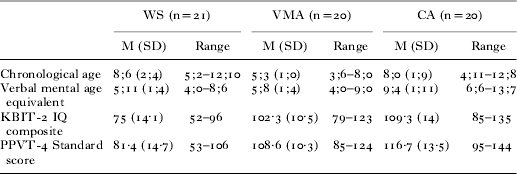
A total of sixty-one native English-speaking children coming from comparable socioeconomic backgrounds participated in the study, playing the game with the same female experimenter. Twenty-one were children with Williams syndrome (13 girls) between five and thirteen years old, all with genetically confirmed classic-length WS deletions. They were matched on verbal mental age to a group of twenty TD children in the age range three to eight years (10 girls; t(39) = −0·377, p = 0·71), and on chronological age with another group of TD peers (11 girls; t(39) = 0·772, p = 0·44). All children were administered the Kaufman Brief Intelligence Test 2nd edition (KBIT-2; Kaufman & Kaufman, Reference Kaufman and Kaufman2004) to assess level of cognitive functioning and to enable matching of the WS and VMA participants on verbal age equivalent scores. Children were also administered the Peabody Picture Vocabulary Test-4 (PPVT-4; Dunn & Dunn, Reference Dunn and Dunn2007) as a measure of receptive vocabulary. Table 1 presents details of the participant characteristics.
Participant characteristics
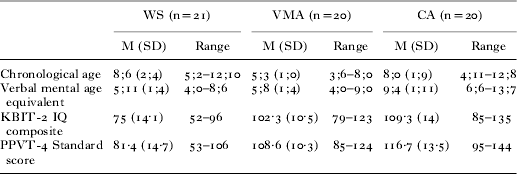
note: Chronological and mental ages are reported as years;months. Verbal mental age equivalent from Kaufman Brief Intelligence Test, 2nd edition. WS = Williams syndrome; CA = chronological age match; VMA = verbal mental age match.
Materials and procedures
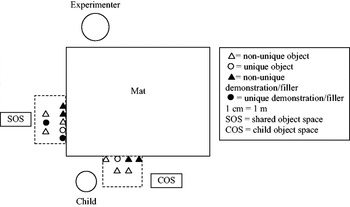
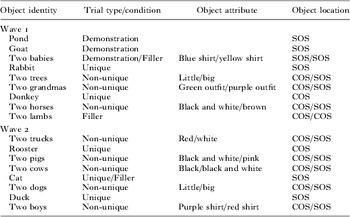
The experimenter and the child were jointly engaged in building a Farm or a Wildlife Park (counterbalanced) by placing toy sized objects on a mat. The child sat on the floor opposite the experimenter with a 103 cm × 78 cm laminated mat between them. The mat was printed with photographs of the objects used in the game, arranged in configurations resembling the layout of a farm or of a wildlife park. Half the children in each group were randomly assigned to the Farm version of the task, and the other half helped build the Wildlife Park with the same experimenter. The two versions were identical in terms of types of trials, but different objects were used in each, as appropriate for the game theme. The objects used in the game were twenty-seven natural-looking toy animals, people, cars, and trees, ranging in size from 3·5 cm × 3 cm × 3 cm (height × width × depth) to 31 cm × 14·5 cm × 14·5 cm. Of these, there were ten pairs of objects of the same identity that differed in either size or color (e.g. white bear and brown bear), while the remaining seven objects were unique referents (see Table 2 for a complete list of objects by type and relevant attribute). The objects were initially set up in two areas defined as the child's object space (COS), representing an approximate 22 cm × 32 cm space/rectangle between the mat and the child's sitting place, out of the experimenter's reach, and as the shared object space (SOS), representing an approximate 22 cm × 36 cm space, but with the objects placed there accessible to both partners (see diagram of the set-up in Figure 1).
Diagram of the game-setting – Wave 1.

List of objects, attributes, locations

note: Object attributes are only listed when relevant for distinguishing non-unique objects (objects in a pair of the same identity). COS = child's object space; SOS = shared object space.
The game was played in two waves to reduce the spatial attention and memory demands placed on the ‘players’, by having no more than eight objects in one area at a time: of the fourteen objects used in the first wave, eight were placed between the child and the mat, in the COS, and six were placed in the SOS. The design of the game in two waves allowed us to analyze learning effects, based on the experimenter's feedback, as the interaction progressed. A set of 8 cm × 13 cm laminated cards each showed an image of an object to be used in the game, and the order in which the experimenter playing the role of ‘builder’ picked up the cards from the pile determined the order in which the objects would be placed on the mat. Therefore, the picture on the card, which the child could not see, always predetermined the object intended by the experimenter and trials were the same across participants. The entire session was videotaped with two cameras mounted on adjacent walls, with rotation and zoom controlled from another room. Both cameras captured the child's face and body at all times and at least one camera captured both the COS and SOS at all times.
At the beginning of the game the child was told that he or she was going to build a farm or wildlife park with the experimenter, by placing objects on their pictures on the mat. The child was told that ‘the builder’ (always the experimenter) would look at the game cards and tell the ‘helper’ (always the child) which object was needed next, and that the ‘helper’ would need to help with all the objects in the COS and with some objects in the SOS. Before the game trials, the child was instructed to ask questions if unsure of which object the builder needed: “If you're not sure which one I'm asking for, you can ask me questions to find out.” Two simple rules constraining the partners' actions were explained and demonstrated to the child before the first task trial: (1) Only the builder was allowed to see the card showing which item should be placed on the mat; therefore, to select the appropriate item, the child had to rely on the partner's verbal information and elicit more information when needed; (2) The helper could reach objects placed in two areas, one in front of the child but out of reach for the builder, the other accessible to both game partners; the builder could only reach objects located in the SOS, but not those in the COS, therefore she had to request the child's help for getting items located out of her reach.
During the game trials, the builder indirectly requested items pictured on the cards without providing the relevant attribute for identifying non-unique items (e.g. “Now we need a bear”, “This card shows a cow”). The first three cards represented the demonstration/practice trials, which were meant to familiarize the child with the game procedures. The first two demonstration trials involved unique objects, one placed by the builder, the other selected and placed by the helper at the direct request of the builder (e.g. “Now, can you put the cactus on its picture?”). In the third demonstration trial, the builder pointed out to the helper that two objects have the same identity and emphasized verbally and non-verbally the attribute that distinguished the two (e.g. “Now we need a baby. Look, there are two of them, we need the blue baby”). Wave 2 followed the same rules, so there were no additional demonstration trials, but children were reminded to ask questions: “Remember, you can ask me questions if you're not sure which one I'm talking about.”
Prior to the demonstration trials the helper was asked to name each of the objects in the COS and SOS. For each pair of objects of the same identity, the builder and helper discussed what attribute to use to distinguish between the two. If, during the naming phase, the helper provided a relevant disambiguating attribute other than color or size, that attribute was used during the game trials, if needed (e.g. “the girl with books” and “the girl with a purse” instead of “blue shirt girl” and “red shirt girl”). During the game children were encouraged to ask questions as needed by the experimenter, who used the same script to address the children: If the child did not respond to the builder's request verbally or non-verbally within a normal conversational timeframe (10–15 seconds), the builder repeated the request, and if the child still did not respond within 10–15 seconds, the builder asked, “Do you have a question for me?” When children ‘guessed’ correctly the intended non-unique referent object without asking for clarification, the builder would confirm verbally, pointing out there are two of the same identity items (e.g. “Yes, there are two bears, but we need the white bear now”).
Coding
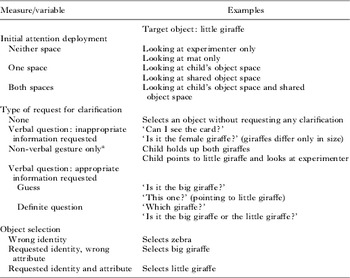
Children's initial attention deployment, verbal and non-verbal communicative exchanges, and object selections were coded from the videotapes. Table 3 presents details of the coding scheme, including examples for each set of child behavior measures (initial attention deployment, requests for clarification, object selection).
List of measures with examples

a Only includes requests for clarification that had no verbal component. Clarification requests that had both verbal and non-verbal components were classified based on the verbal component.
‘Initial attention’ was defined as where the child looked in the period between the end of the builder's request and the child's first verbal or action response. This was coded from the videotapes based on a split-screen display, enabled by the dual-camera set-up, therefore the coders could see the child's face from both profile and frontal views while simultaneously seeing the COS and SOS on the screen. Looking direction was coded based on the child's eye, head, and body movement. However, because the child was seated and instructed to stay in one place, body movement was minimized. The placement of the COS and SOS was designed so that when attention was focused in one space, the other space was out of the child's peripheral vision.
The total target trials coded across the two waves included eight trials with unique referents and eight with non-unique referents, while the remaining objects were used for demonstration or filler trials. Of the eight unique referent trials, four were unique from the start, and the other four became unique referent trials after the other item in the pair had been placed on the mat. Table 2 presents the order and type of trials in the Farm version of the game (the order of types of trials was identical in the Farm and in the Wildlife Park versions).
Two coders watched and coded independently 20% of the tapes and obtained high levels of agreement for two of the three measures: for clarification requests agreement was 94% (kappa = 0·895), for object selection agreement was 99% (kappa = 0·901), and for attention deployment 76% (kappa = 0·522). Although initial attention deployment was somewhat difficult to determine from the videotapes, all disagreements were resolved by consultation and discussion with a third investigator who watched all the tapes with coding disagreements. These disagreements were not systematically related to looking in specific spaces.
RESULTS
There were no differences related to the version of the game on any measures analyzed, and no gender-related differences in any of the groups. Analyses of group differences were first conducted separately on each of the interactive behavior measures targeted – object selections, clarification requests, and attention deployments – prior to any clarification requests or object selections. We then examined contingencies between visual attention, communicative exchanges, and object selections, to determine whether and how differences in the ways children attempt reference resolution, indicative of their pragmatic abilities, might be related to attentional and communicative processes during the collaborative game activity. We report results from non-parametric statistical tests, applied in consideration of the unequal variances in the data and the relatively small group sizes.Footnote 1 Kruskal–Wallis ANOVA was used for comparisons across the three groups on the relevant measures, followed by Mann–Whitney U tests for pairwise comparisons. Group means are presented in figures for ease of data interpretation.
Object selection
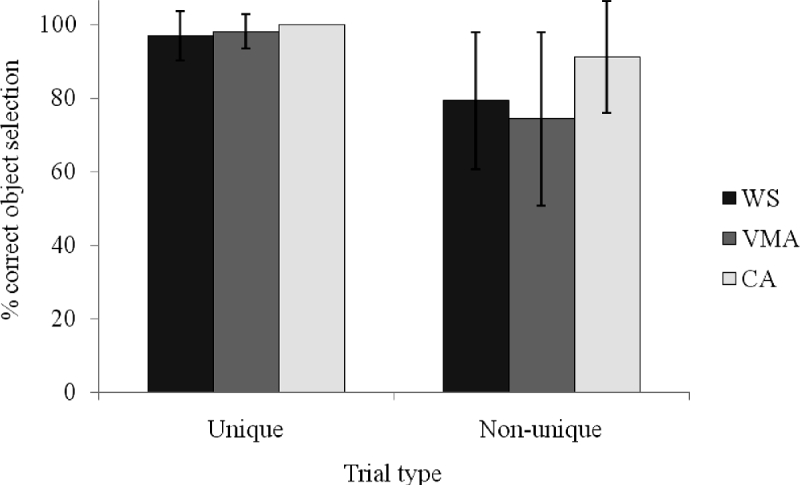
In this collaborative game the ostensible measure of interaction success is the helper's correct choice of objects requested by the builder. As expected, children's success in selecting the object intended by the builder differed as a function of the type of referent and of referring expression used by the speaker (see Figure 2).
Mean object selection accuracy for unique and non-unique trials. Error bars represent standard deviations.
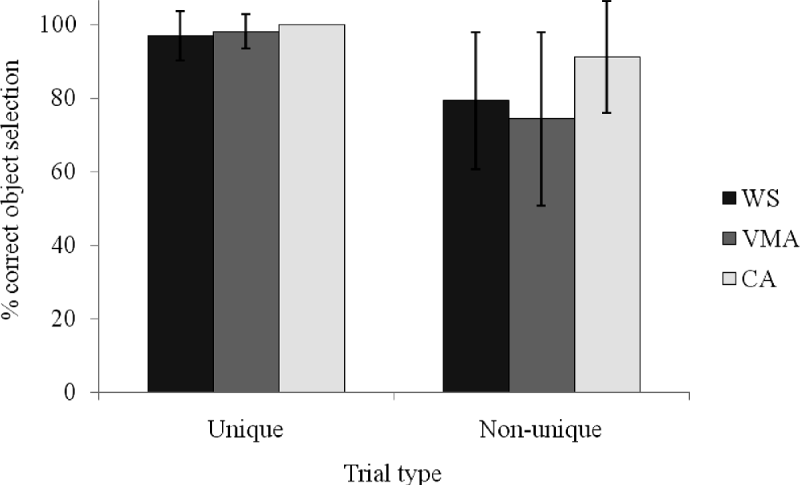
On trials involving unique referents, all three groups had high success rates (almost ceiling performance in selecting the object intended by the builder), confirming that all the children understood the rules of the game and were able to follow unambiguous requests. A Kruskal–Wallis ANOVA test indicated that the groups differed in object selection accuracy on non-unique referent trials (χ2 (2, N = 61) = 8·31, p = 0·016). Follow-up Mann–Whitney pairwise comparisons indicated that, on non-unique referent trials, the CA group made significantly more correct selections than the WS group (U = 116, p = 0·01) and than the VMA group (U = 114, p = 0·02) did, while the WS and the VMA groups did not differ from each other (U = 193, p = 0·65). All incorrect object selections involved choosing the appropriate object identity but with the wrong attribute.
Clarification requests
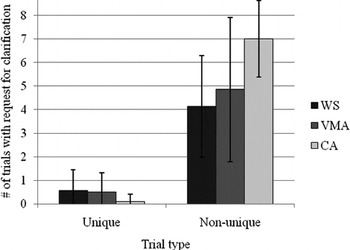
Significant group differences were found in the number of trials with requests for clarification, as indicated by a Kruskal–Wallis test (χ2 (2, N = 61) = 8·83, p = 0·012). Follow up Mann–Whitney U tests revealed that the WS group asked for clarification on average fewer times than the CA group (U = 93, p = 0·002), but did not differ from the VMA group (U = 183·5, p = 0·49), while the CA and VMA groups did not differ significantly from each other in overall number of trials with clarification requests (U = 134, p = 0·08). However, when comparing separately the number of clarification requests on trials with non-unique referents, the CA group outperformed both the WS and VMA groups, (U = 55, p < 0·001 and U = 121·5, p = 0·03, respectively). On unique referent trials, when there was no need to request clarifications, the children with WS asked for clarifications more than the CA group (U = 148, p = 0·03; see Figure 3).
Mean number of trials with requests for clarification according to referent type (out of eight trials of each type). Error bars represent standard deviations.

The pattern of use of clarification requests on non-unique referent trials differed between the groups both quantitatively and qualitatively: while only one child in the WS group (4·8%) requested clarification on all eight ambiguous-referent trials, 55% of the CA group (11 children) and 35% of the VMA group (7 children) appropriately requested clarifications on all relevant trials. Conversely, whereas there were no participants in the CA group who failed to request clarification on at least one non-unique referent trial, there were three children in the VMA group and one in the WS group who never questioned the adequacy of the builder's ambiguous requests.
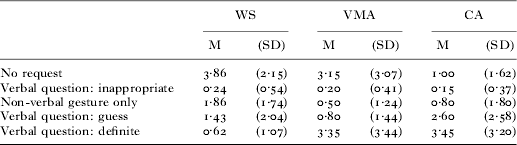
To examine further whether the groups differed in the ways they requested more information or clarifications, we conducted analyses on the types of clarification requests identified from the videotapes (see Table 4). Because verbal requests for inappropriate information (e.g. “Show me the card”) occurred very infrequently, only non-verbal requests and appropriate questions (including verbal guesses and definite questions) were included in the analyses. These types of requests were entered into analyses as percentages of the child's total number of clarification requests (therefore, one WS and three VMA participants were not included in these analyses because they never requested clarification). If, on the same trial, children requested clarification both verbally and non-verbally, the request was classified as ‘appropriate question’, so that only one type of clarification request was counted per trial.
Mean (SD) number of non-unique referent trials with each type of request for clarification
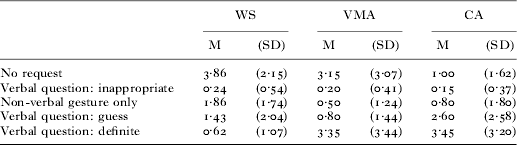
note: Means (SD) are out of eight trials.
Kruskal–Wallis ANOVAs revealed that the groups differed significantly in their use of both types of clarification requests: non-verbal requests without a verbal component (χ2 (2, N = 57) = 11·05, p = 0·004); appropriate questions (χ2 (2, N = 57) = 10·6, p = 0·005). Follow-up Mann–Whitney U tests indicated that children with WS used non-verbal requests on proportionally more of their trials with clarification requests than the CA (U = 96·5, p = 0·004) or the VMA group (U = 99, p = 0·03) did, and they used fewer verbally appropriate requests than the CA (U = 91, p = 0·003) or the VMA group (U = 100·5, p = 0·033) did. The CA and VMA groups did not differ in the proportional use of the two different types of clarification requests.
Within-group comparisons of types of clarification requests (by Wilcoxon signed-rank tests) showed a prevalent use of verbal appropriate compared to non-verbal clarification requests in both the CA (z = −3·37, p = 0·001) and the VMA groups (z = −2·024, p = 0·043), whereas the WS children relied on non-verbal clarification requests without a verbal component as often as they used verbally appropriate requests (p = 0·91).
Initial attention deployment analyses
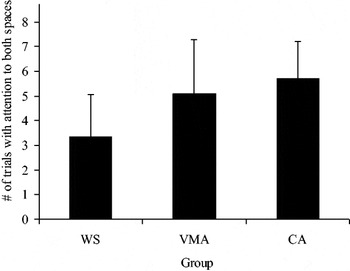
Analyses of children's initial attention deployment after hearing the experimenter's request revealed significant group differences (χ2 (2, N = 61) = 8·9, p = 0·012). Follow-up Mann–Whitney U tests indicated that the WS children looked to both object spaces significantly less than the CA (U = 109·5, p = 0·008) or than the VMA group (U = 116·5, p = 0·014) did, while the CA and VMA groups did not differ from each other in their initial attention deployment behavior (see Figure 4).
Mean number of clarification requests for non-unique referents by initial attention deployment.

Contingencies analyses: relations between attention deployment and communicative behavior
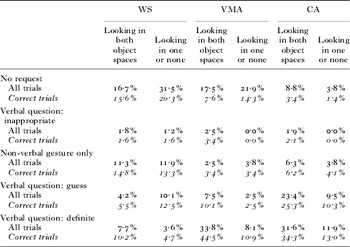
We further examined whether the three groups differed in their prevalent use of different behavioral sequences of attention deployment and clarification requests prior to their object selections. Across all trials children used various behavioral responses to the builder's ambiguous requests, from failing to visually check both object spaces and to ask for clarification on non-unique referent trials before selecting an object, to looking in both object spaces and making a direct verbal request for clarification. Table 5 presents the mean percentage of use of different behavioral sequences of initial attention deployment and clarification requests in the three groups, as well as the proportion of successful reference resolution associated with each respective behavioral sequence, out of total correct object selections.
Proportion of non-unique referent trials with and without requests for clarification as a function of the child's initial attention deployment (looking behavior) and object selection accuracy

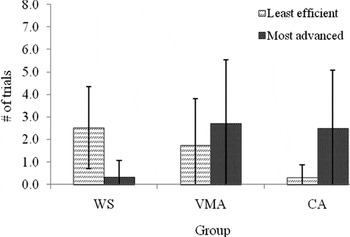
The most advanced behavioral sequence of the helper's initial attention and verbal communication for determining the intended referent of the builder's ambiguous referential expressions on non-unique object trials involved looking in both object spaces (SOS and COS), and requesting clarification with a definite direct question; the least advanced and least efficient behavioral sequence was looking in neither or in just one object space and not requesting any clarification of the ambiguous referent. Kruskal–Wallis ANOVAs indicated that the groups differed in the use of both the least efficient (χ2 (2, N = 61) =17·34, p < 0·001), and the most advanced behavioral sequence of attention deployment, communication, and action (χ2 (2, N = 61) = 15·49, p = 0·012) (see Figure 5). The WS group used the least efficient behavioral sequence more often than the CA group (U = 60, p < 0·001), and used the most advanced behavioral sequence for referent resolution significantly less than the CA group (U = 100·5, p = 0·002). The WS and VMA groups did not differ significantly in the use of the least efficient behavioral sequence, but the VMA group used the most advanced behavioral sequence more often than did the WS children (U = 109·5, p = 0·003). The CA and VMA groups did not differ significantly in the use of the most advanced behavioral sequence for referent resolution, but the CA group used the least efficient behavioral sequence significantly less often than the VMA group did (U = 111, p = 0·015).
Mean number of non-unique referent trials where either the least efficient or the most advanced behavioral sequence (‘strategy’) was used. The least efficient strategy is defined as looking in neither or one space and not requesting clarification; the most advanced strategy is defined as looking in both spaces and requesting clarification with a definite question. Error bars represent standard deviations.

Analyses of communicative behavior differences from Wave 1 to Wave 2 of the game
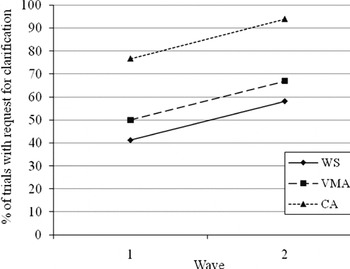
To examine whether during the course of the game children learn to request more information when the speaker's referential expressions are insufficiently informative for reference resolution, we compared the percentage of non-unique referent trials in which the child requested clarification in Waves 1 and 2 of the game activity (see Figure 6). In all groups, there was a significant increase in the proportion of non-unique referent trials with clarification requests from Wave 1 to Wave 2 of the game, as suggested by Wilcoxon signed ranks tests: (z = −2·20, p = 0·028) for proportional use of appropriate questions in the WS group; (z = −2·32, p = 0·02) in the CA group; and (z = −2·29, p = 0·022) in the VMA group for overall use of clarification requests. Across the two waves, the CA group requested clarification more often (M = 85·33%) than the WS group (M = 49·68%, p = 0·001) and the VMA group (M = 58·50%, p = 0·018) did, but the increase in the percentage of clarification requests from Wave 1 to Wave 2 was similar in all three groups (about 17% more clarification requests in the second wave of the game).
Percentage of non-unique referent trials in which child requested clarification in Waves 1 and 2 of the game activity.

The same pattern of results emerged when the children performing at ceiling (i.e. who asked for clarification requests on all non-unique referent trials) were excluded from analyses (11 CA, 7 VMA, and 1 WS). Similar increases in the proportion of clarification requests from Wave 1 to Wave 2 were found in each group.
DISCUSSION
High sociability, affiliative drive, and a willingness to talk to people, including strangers, coupled with relatively good vocabulary knowledge have often been described as distinctive features of the social phenotype of WS (Doyle, Bellugi, Korenberg & Graham, Reference Doyle, Bellugi, Korenberg and Graham2004; Jones et al., Reference Jones, Bellugi, Lai, Chiles, Reilly and Lincoln2000; Mervis & John, Reference Mervis and John2008). While these characteristics might suggest that children with WS are good communicators and conversationally engaging, they nevertheless have significant difficulties in forming reciprocal relationships, and many experience social isolation by adulthood (Einfeld, Tonge & Rees, Reference Einfeld, Tonge and Rees2001; Howlin & Udwin, Reference Howlin and Udwin2006; Plesa Skwerer & Tager-Flusberg, Reference Tager-Flusberg2006). The paradox of high sociability and interest in interacting with people, but difficulties in establishing and maintaining social relationships, despite apparent facility in language use, has recently prompted a surge of interest in investigating the pragmatic aspects of communication in WS. However, only one previous experimental study focused on the role of the listener or pragmatic comprehension in children with WS.
The present investigation was aimed at examining whether and how children with WS use the information available in the context of a collaborative activity to understand the verbal messages of a social partner, and how they respond to referentially ambiguous requests. Real-life communicative exchanges are fraught with complexities and imprecision, requiring inferences about people's knowledge states and intentions, as well as the use of various sources of available contextual information. An important role of a ‘listener’ is being able to evaluate the information provided in a verbal message in the context of a particular social interaction, and to determine whether the message is clear or ambiguous, given the particular context. Our study adds several new dimensions to the exploration of the pragmatic abilities of WS children as ‘listeners’ and may provide insights into sources or correlates of variability in pragmatic development.
First, we explored how children with WS responded to referentially ambiguous messages, by examining if and what types of requests for clarification they produced when the builder gave insufficient information about an intended referent. These analyses revealed that, contrary to expectations, when becoming aware of the ambiguity in the referential expression used by the experimenter, the children with WS were more likely to use pointing or picking up and showing one of the objects of the pair than to verbalize their request for clarification. By contrast, the typically developing children, with increasing age, showed a clear tendency to use increasingly precise or definite verbal questions to obtain the needed information.
Second, we examined the contingencies between attention deployment and evaluating the informativeness of a partner's verbal message. We found that children with WS were less likely than both comparison groups to take into account the available visual information about the game objects before interpreting the intended referent of the partner's request.
Finally, we compared the various behavioral sequences or ‘strategies’ for reference resolution consisting of the possible combinations of looking behavior, asking for clarification as needed, and object selection: we found that the children with WS were more likely to use inefficient reference resolution ‘strategies’ than the comparison groups. By focusing on micro-analyses of interactive behavior during the game and by analyzing contingencies between looking behavior and verbal or gestural communicative exchanges, we were able to reveal that some of the pragmatic understanding deficits showed by the WS group involved difficulties in the coordination of attention to the context of a joint activity and the interpretation of a partner's message.
Not surprisingly, the CA group outperformed the WS group on all the measures of interactive behavior explored. However, the WS group was at the level of the VMA group on some measures (such as number of clarification requests and object selection accuracy), but differed from the VMA group in aspects of attention deployment, and in the use of different behavioral sequences of attention deployment and communicative exchanges for reference resolution. Although the WS group did not differ from the VMA group in the quantitative aspects of pragmatic understanding (i.e. proportion of clarification requests on trials with non-unique referents), differences emerged in the types of clarification requests used, including their balance of verbal and non-verbal clarification requests: children with WS used pointing gestures and looking puzzled toward the experimenter while showing an object more often than the other groups, who relied on verbalizations to express their confusion on the non-unique referent trials. Thus, in a somewhat challenging communicative context, it appears that the verbal proficiency of the children with WS was not supporting their pragmatic understanding performance.
Analyses of attention deployment patterns coded from children's head and eye movements and analyses of contingencies between initial attention deployment and requests for clarification when the verbal message of the builder was ambiguous, indicated further group differences in the sequences of behaviors prevalent in the WS group compared to both control groups. Specifically, children with WS had more difficulties even than their VMA-matched controls in linking visual search processes to interpreting the partner's verbal message when having to select a particular object from an array of items containing more than one object of the same identity: they used the most advanced ‘strategy’ of visually searching both object locations and asking a definite question on significantly fewer trials compared to both control groups, suggesting impairments in coordinating the use of different types of contextual information – both visual and verbal – in their attempts to resolve referential problems. It is possible that these pragmatic difficulties have roots in the delays showed by young children with WS in establishing joint attention during social interaction (Mervis et al., Reference Mervis, Morris, Klein-Tasman, Bertrand, Kwitny and Appelbaum2003; Laing et al., Reference Laing, Butterworth, Ansari, Gsodl, Longhi, Panagiotaki, Paterson and Karmiloff-Smith2002). As their interest very early on appears to be focused primarily on the people they are interacting with, children with WS may miss opportunities to learn about the surrounding world, and may have difficulties monitoring attention in situations where taking into account the physical context becomes important for communication efficacy.
An important finding emerged from the analyses of differences between the first and second waves of the game, which showed that children with WS were able to learn from the unfolding game activity almost as much as the CA and VMA groups: we found that the proportion of non-unique referent trials with clarification requests increased from the first to the second wave of the game in all groups. This finding highlights the importance of considering how children respond and adapt their communicative behavior in real time, making good use of the social partner's feedback, which, in our study, was provided throughout the game. Despite their cognitive limitations, the WS children showed an ability to process the feedback from the experimenter and to adjust their communicative behavior during the interaction. Compared to children of the same verbal mental age, they had more difficulties only in monitoring their attention and in conducting a visual search to determine the intended referent of an insufficiently informative expression. Our findings suggest that attentional processes are among the possible correlates of pragmatic difficulties in WS, but that processing the verbal information exchanged in a joint activity may not be very problematic for these children. If replicated, such findings may have implications for developing intervention strategies to improve pragmatic functioning in WS. Children's prior interaction history, especially the types of behaviors ‘reinforced’ by caregivers, may have also contributed to the differences found in pragmatic comprehension between the WS and the control groups, as interaction partners are more likely to provide more detailed or precise information to children with cognitive limitations. Thus, the WS children may have had less exposure to ambiguous communication than the CA and even the VMA children, and, despite their social engagement propensity, they may have encountered fewer challenges in interpreting the messages of others than their peers.
A syndrome with a distinctive social–behavioral phenotype such as WS can provide insights into the complex dynamics of the interplay between linguistic and social development. Williams syndrome highlights the distinction between pragmatic aspects of communication and verbal proficiency. While children with WS are motivated to engage in a collaborative activity and have the vocabulary knowledge needed to understand the referents of the social partner's expressions, they show difficulties in taking into account the contextual information available to them even when the ‘rules’ of the game are clearly understood. Similarly, pragmatic abilities are also impaired relative to structural language in individuals with ASD, but the roots of pragmatic difficulties in ASD have been related to impairments in social engagement (Philofsky et al., Reference Philofsky, Fidler and Hepburn2007; Tager-Flusberg, Reference Tager-Flusberg2006), whereas the WS children are highly motivated to engage socially. However, as our and other studies have demonstrated, social motivation is not sufficient for the development of social–communicative skills, and studies of related processes of attention monitoring, social perception, and social learning are needed to better understand the typical developmental trajectory of pragmatic competence and social understanding.
One limitation of this study is that it did not include any measures of mentalizing ability (theory of mind). The extent to which reliance on mentalizing abilities differentiates pragmatic aspects of communication from other forms of linguistic processes is still actively debated. In previous studies using experimental measures of theory of mind, the performance of children and adolescents with WS was no better than that of other participants with intellectual disability on false belief tasks and other measures of first and second order belief reasoning (see Tager-Flusberg & Sullivan, Reference Tager-Flusberg and Sullivan2000, for a review), in contrast to initial claims of domain-specific sparing in social cognition in WS (Karmiloff-Smith, Klima, Bellugi, Grant & Baron-Cohen, Reference Karmiloff-Smith, Klima, Bellugi, Grant and Baron-Cohen1995). Because pragmatic skills are related to social cognitive and theory of mind abilities both in typical development and in individuals with developmental disorders, future studies are needed to further examine if and how impairments in social cognition may contribute to the difficulties shown by individuals with WS in social communication.
Our investigation has provided a first step in understanding how a possible lack of coordination between attentional processes, use of contextual information, and verbal messages might contribute to pragmatic difficulties in a collaborative interaction in children with WS. However, the sources and correlates of pragmatic development atypicalities are still poorly understood in the case of WS and in other neurodevelopmental disorders. Longitudinal studies, almost completely absent in current research investigating neurodevelopmental disorders, are necessary to clarify whether pragmatic aspects of language develop in atypical ways in populations with distinctive cognitive and social phenotypes, and what factors contribute to these patterns of development.