[T]he Bankrupt Law is a mass of folly and absurdity from beginning to end; that it violates every principle of common sense; that it is the occasion of the grossest injustice, and the most appalling fraud and perjuries; that as, a whole, it is a disgrace to a civilized community.
———Fane Reference Fane1838a: 26Footnote 1INTRODUCTION
Hobbes famously believed that government existed in order to deliver us from our supposed original “barbarism.” And yet the birth pangs of the Industrial Revolution, watched over by governments, were deemed “barbarous” by many who witnessed them, including important authors and theorists such as Karl Marx and John Stuart Mill. In particular, I will argue here, many nineteenth-century reformers believed that the very core of nascent capitalism—the legal relationship between creditor and debtor—had yet to rise beyond its supposed barbaric underpinnings.
Specifically, the explicit right of the creditor to seize and sequester the body of the debtor, and the corresponding implicit right of the debtor to flee his debts and thereby “swindle” the creditor out of his assets, allegedly created the same dark Hobbesian world that reasoned capitalist trade should eradicate. For example, one eyewitness to the indignities of the debtors' prisons explained, “Among the hideous effects produced on society, by arming the creditor with the power of locking up the debtor, is that of occasionally generating in their breasts, undying hostility one to another; of fostering the hateful passion of revenge…. Both [the creditor and the debtor], under the influence of the basest propensities of our nature, breathe destruction to one another…” (H. [anonymous] 1859: 54, my emphasis).Footnote 2 Or, as William Wordsworth put it more succinctly, “and thus [due to imprisonment for debt] does many a link which might have formed the chain of virtue [via capitalist exchange], become corroded with the rust of wickedness and vice” (Reference Wordsworth1831: 25).Footnote 3
The laws governing credit and debt were clearly not conducive to fostering a fully “civilized” society; thus, a massive campaign ensued, wherein both proponents and opponents of seizure for debt agreed that the system needed to be either substantially amended or abolished altogether. As these attitudes gradually spread and intensified, a vast, international reform effort managed to shutter all the debtors' prisons of Europe.Footnote 4 Indeed, seen in the broad scope of historical time, they were shuttered quite quickly.Footnote 5
Deep harmonies within this debate resonate across many decades and many countries, wherein one can readily discern that the central issues that I will outline here were virtually the same everywhere. Nevertheless, for the sake of simplicity, I will draw primarily, though not exclusively, from the abolition discussion in England, in order to show how pamphleteers on both sides of the debate viewed the reigning practice of imprisonment for debt as a “barbarous indulgence” (Fane Reference Fane1838c: 16). Pamphleteering opponents and proponents alike claimed that the laws were twisted inversions of the admirable aims and goals of the rest of the legal edifice of their civilized countries.Footnote 6
Working through a sampling from many primary documents, I will argue that the debtors' prison and its legal infrastructure were seen as a form of internal barbarism inside the bounds of the nation-state.Footnote 7 And just like barbarism in the colonies, it needed to be rooted out by a proselytizing mission, initially spurred by Christian “missionaries” who were agitating the state for change.Footnote 8 With sensible reforms, many believed that diligent debtors would be able to step out of the jails and back into productive working life, without the creditor needing to seize them out of a fear that they could easily flee.
In this sense, eradicating the ancient practice can be best understood as a colonization of internal space—the alleged remnants of barbarism—by similar modernization tendencies that we have come to know so well in the colonies (Dirks Reference Dirks2001; Merry Reference Merry2000; Stoler Reference Stoler2002; and for this story inside nation-states, see Elias Reference Elias and Jephcott2000; Frykman and Löfgren Reference Frykman and Löfgren1996; and Herzfeld Reference Herzfeld1987; Reference Herzfeld2002). In other words, if nascent capitalism were to succeed, its advocates believed that it needed to be tamed into civility. The story of the shuttering of the debtors' prison, therefore, underscores the well-established claim that liberal, capitalist ideology relied upon the commensurate and simultaneous construction of a supposedly barbaric Other.Footnote 9 But further, this Other was marked by his failure to responsibly grasp the meaning of his financial obligations, whether as creditor (by cruelly seizing bodies) or as debtor (by disdaining debts in various nefarious ways).Footnote 10
Given this rhetorical divide between barbarism and civilization, it should be no surprise that opponents and proponents of the debtors' prison both described it in the idiom of ritual. If modernist reformers convinced themselves that they could gradually reduce ritual life in favor of rational life, in the debtors' prison they discovered a special ritual sanctuary that oddly sealed people off from the humming and calculating capitalism growing outside of the penal walls. Time and again, we find that the debtors' prison was referred to as a shrine or sanctuary where people could take “momentary shelter from the storms of life, within its peaceful haven” (Dixon Reference Dixon1850: 102). Intuitively, if someone had clearly failed at market relations, it made sense to banish him from them; as such, this was a ritual space specifically designed to be set apart from the standard bustle and regulation of daily economic life. Far less intuitively, opponents and proponents both noted that this temple had the dangerous capacity to forgive the sin of unpaid debt, so long as the initiate was willing to undergo a period of punishment and repentance. Given this, critics and proponents alike believed that the debtors' prison actually took neophytes and transformed them into listless non-capitalists, uninterested and incapable of working and planning for their own future.
Like many other rituals studied by the budding armchair anthropologists of the day, these rituals were deemed a “survival of barbarism” (anonymous 1829: 32). Or, as Mill averred, the debtors' prison and its grounding logic (along with debt peonage) stood as “the barbarous expedients of a rude age, repugnant to justice as well as to humanity” (Mill Reference Mill2004b: 828–29). The distinct ritual life housed and honed inside the debtors' prison—sometimes mind-numbingly legalistic, sometimes extravagantly festive—threateningly stood as an outright inversion of the rigors of capitalist life outside.Footnote 11 As will be shown, inside what Finn calls the “unreformed” debtors' prison, one could find eternal and legally enforced leisure, debauchery, and even a sort of plenty.
Such ritual spaces that trained people in non-bourgeois values and inverted the reality of everyday legal and market life needed to be eradicated. And so, within a mere two generations or so, the debtors' prison went from being an integral and essential regulatory mechanism in credit and debt relations to being seen as a barbarous relic of a different era, unfit for civilized countries. In what follows, I will trace three central discourses that were consistently relied upon to root out this supposed barbarism at the very heart of capitalist states.
Firstly, the application of scientific techniques to governmental practice was becoming standard across many fields, and the laws of credit and debt were no different. Reformers of all stripes insisted that causes needed to be discovered. For too long, policies had merely attempted to circumscribe the surface-level effects of social life; now policies had to get to the “root” of a problem, to see what was producing it. With regard to the debtors' prison, this was seen as a potentially simple new insistence that lawyers, prison officials, judges, sheriffs, and creditors should all begin to distinguish between malfeasance and misfortune. Some debtors deserved their just due in prison, while others suffered there irrationally at the hands of a barbaric system of injustice. Only a new dedication to scientific jurisprudence could carefully segregate these two inappropriately conjoined populations (see Stoler Reference Stoler1995).
Secondly, a fascinating dialectic between credit and debt emerges in this historical battle. Consistently, indebtedness is seen as a form of weakness and credit as a form of power.Footnote 12 If noted by reformers, then this weakness was something to be pitied; if noticed by proponents of imprisonment, then it required reform via disciplinary practice. But there is more. The dialectic appears to be one that pits credit as the vehicle of an expanding capitalism whereas debt is the standard-bearer of a gradually disappearing “economic traditionalism” (see Weber Reference Weber1958). Thus, both sides of the debate saw debtors as trapped by a decadent present, while creditors had their eyes keenly on a profitable future. Carefully planning for the future and denying oneself present pleasures was deemed the height of civilized behavior, and economic traditionalism supposedly brushed off such worries of tomorrow. Thus, society had to put in place new systems—either based on carrots or sticks—that would transform debtors from present-oriented spenders into future-oriented savers.
Finally, a supposedly Christian drive toward elevating the soul of the individual to the status of pricelessness took center stage. If the soul was priceless, then it became abhorrent to treat its vessel, the body, as a mere thing that could be seized as collateral like a piece of cheap property. Such conflations of money and the body, as I will show, came to be associated with “barbarism,” whereas a civilized society insisted upon a stark bifurcation of money-value and body-value. Simmel summed up this trend long ago by claiming that because the soul was proclaimed “to be the vehicle of God's grace, it became incommensurable with all worldly measures and has remained so” (Simmel Reference Simmel1978: 362).Footnote 13 It therefore became abhorrent to treat man as a commodity (which Simmel argues had previously been the practice), and “a later stage [in history] further severs the value of man from the value of money” (ibid.: 367). That “later stage,” so far as this paper is concerned, commences with the widespread and rapid abolition of imprisonment for debt.
Though Foucault oddly neglected the rapid demise of the debtors' prison in Discipline and Punish (Reference Foucault and Sheridan1977), the story of its pan-national institutional collapse nonetheless fits nicely with his famous model.Footnote 14 The rhetoric and action that led to the demise of the debtors' prison turns upon the three emergent trends discussed here: A categorizing spirit, a disciplining of the body, and an expanded surveillance over the circulation of people and things. Parties on all sides of the debate converged in their belief that citizens within national spaces had to be transformed into a new cadre of disciplined economic actors who could turn to a newly rationalized and more efficient governmental apparatus for adjudicating credit and debt relations. Proponents and opponents of the debtors' prison both asked governments to step into this void of failed adjudication in order to better aid its citizens in meeting their obligations to their fellow citizens and in responsibly planning for their own futures. Within the ambit of its power, reformers expected the state—in Hobbesian fashion—to banish the supposed barbarity that remained at the core of exchange relations.
MALFEASANCE VERSUS MISFORTUNE
As mentioned above, all parties in this debate hoped that a new scientific and categorizing spirit could rationally categorize economic behavior in new ways. The state and its reformers sought to find the “true” reasons for debt delinquency and then treat the cause, rather than rely on an unscientific catchall law from a previous era. As Field put it, “The duty of society is not only to resent and punish the crimes committed, but also to carefully to seek out their causes, and, so far as it is in human power, to remove them…” (1848: 91). In the past, all debtors were treated de facto the same—as quasi criminals, locked up in a custodial prison even if they were not seen as guilty of anything other than bad luck. As one resident of Whitecross debtors' prison expounded, “Some of the greatest scoundrels have been discharged, and others whose misfortunes have proceeded from the most venial errors, have got a remand” (H. [anonymous] 1859: 45).Footnote 15
But a reformist spirit began to insist that there was a grand and necessary divide between honest and dishonest debtors, and that it was the state's task to objectively delineate the two, rather than allowing private creditors to keep subjectively treating them in an identical fashion. As the governor of the Whitecross put it, “I divide debtors into only two classes, honest and fraudulent…. it is monstrous that the same sentence should await the guilty and the guiltless” (Hicks Reference Hicks1858: 19–20). One anonymous pamphleteer spoke of the ignorant way in which multiple categories of human action bled into each other under the unscientific approach of the reigning legal system: “Should the same punishment await the industrious and the unfortunate—the young and innocent, the defenceless widow, the blind, the ingenious, as the gamester, and swindler?… He who would maintain it must be either ignorant or heartless. Yet the law of Arrest subjects all to the same insulting useless and cruel degradation” (anonymous 1837: 15). Reformers such as these now demanded that malfeasance and misfortune be treated as the potential proximate cause of bankruptcy, and that judges seek out the true reason for insolvency rather than criminalize the lack of money per se.Footnote 16
Before these reforms, the law turned on no other data point than the lack of payment, regardless of the reason for it. Even Fane, one of the more vociferous proponents of imprisonment, complained, “By the law, as it at present stands, insolvency is assumed to be a crime!” (1838a: 27). And the lobbyists for the creditor class of this era were quick to point out why; in practice, they explained, it was virtually impossible to empirically study the etiology of debt. One partisan of the debtors' prison, J. H. Elliott, explained, “A man's moral conduct is not easily ascertained; his pecuniary embarrassments can only be learned by a scrutinizing and inquisitorial investigation, which is too severe for many to submit to, or to be enforced” (1838: 22). Mill complicated matters further by stating that the line between negligence and fraudulence was highly fraught: “If a man has been a spendthrift, or a gambler, with property on which his creditors had prior claim, shall he pass scot-free because the mischief is consummated and the money gone? Is there any very material difference in point of morality between this conduct, and those other kinds of dishonesty which go by the names of fraud and embezzlement?” (2004b: 830). And anyway, empirically speaking, debtors had made off with resources originally owned by someone else, and therefore, they asserted, it was no giant leap to assume that “by far the greater part of all insolvencies arise from notorious misconduct” (Elliott, cited by Mill Reference Mill2004b: 830). Elliott concludes that the loss of someone else's money should be seen “as prima facie evidence of something wrong” (ibid.: 831).Footnote 17
Fane and others suggested that misguided laws that treated all inabilities to pay as prima facie evidence of criminality resulted in countless people becoming fraudulent only because of those laws. One lawyer from Spain, when queried by a committee of London merchants about bankruptcy law in his country, stated, “I am of the opinion, that punishment being very severe, as in Spain, opens the door to fraud, the original report of the failure being framed to avoid criminal results” (Committee of Merchants 1851: 31). Both he (an opponent) and Fane (a proponent) agreed that hefty punishments for non-fraudulent bankruptcies created the conditions to legally transform honest people into dishonest people (Fane Reference Fane1838b: 40–42). They both asserted that, in this manner, the existence of the debtors' prison effectively worked as a ritualistic space of personal transformation, virtually cajoling people to turn themselves into criminals.
Hoping to eliminate such perverse outcomes, people such as Beccaria and Bentham, and countless reformers in their wake, believed that the nefarious intent or hapless misfortune of a debtor could be rooted out with some simple efforts on the part of judges and juries: “It should be possible to distinguish fraud from grievous culpability, the grievous from the mitigated culpability, and this last from perfect innocence” (Beccaria Reference Beccaria and Bellamy1995: 90). With such fine-grained assessments of how people became insolvent, punishment could then finally be meted out that scientifically matched the offense. To be clear, reformers were stating that all cases of insolvency should go through this process, not just those of people deemed prima facie innocent.
In other words, people began to make the radical demand that debtors should not be locked up for ages prior to their culpability being proven. As Bentham pointed out, under the existing system, “The door is shut against evidence, and presumptions made without grounds are substituted to it” (Reference Bentham1843: 176). Further, debtors often did not know for which debts they were being incarcerated, since creditors were not obliged to come forth immediately. Any creditor in England, even a fraudulent one, could easily obtain a writ stating that a sheriff must apprehend a debtor who “lurks, wanders, and runs about in your county” (Farley Reference Farley1788: 63). One author tells the story that there is “A gentleman in Newgate [prison], who was arrested by the wicked contrivance of a villain that he might live in infamy with the gentleman's wife” (ibid.: 22). Evidence, such as it was, was heard ex parte, a sort of evidence ordinarily enjoined in British courts.Footnote 18 Sham witnesses and sham creditors named “John Doe” and “Richard Roe” appeared in the record all too commonly (e.g., ibid.: 52). In a word, the debtors' prison apparatus stood as the inverse of the standard legal infrastructure. As one famous leader begged to know, “Can a more wretched state of man be conceived? Nay, more, does even the fraudulent debtor merit this perpetual, undefined punishment, in all the wantonness of its tyranny?” (Neild Reference Neild1808: 24). All this, reformers asserted, needed to change, by bringing the hallmarks of science into the picture—objectivity, transparency, and etiology. The personal power of imprisonment based on these sorts of slim claims needed to be taken over by an impartial judge, who could weigh the evidence, presume innocence, and better sanction the proceedings with the prestige of the state.
Without such reforms, the system was ripe for abuse. Not least, people on all sides of the debate noted that authentically fraudulent debtors seemed to be far less likely to do time in jail than did honest ones. Because fraudulent debtors could easily set themselves up as traders and enjoy certain protections of the bankruptcy statutes, Neild explained, “The honest debtor may be starved before he can have the benefit of its [of one of the latest bankruptcy bills] provisions; while the fraudulent debtor finds in it the very probable, if not certain prospect of his liberation” (1808: 31). As a consequence, honest debtors “constitute by far the greater number of those who fill our prisons—with a considerable proportion of poets, authors, mathematicians, and men of science, who are the instructors, the amusers, and the pioneers of civilized society…. The gamesters, spendthrifts and profligates, constitute only a small proportion, and from all that is known are not much improved by this method of annoying them” (anonymous 1837: 14, my emphasis). In the prison, the honest debtors would become ritually contaminated by the spendthrifts and gamesters, and reenter society worse than they had gone in: “The great flux and reflux of men continually going in and out of prison, is like a stinking water, that poisons the wholesome rivers of the kingdom” (Farley Reference Farley1788: 133–34).
If, by turning to these new scientific means, fraudulence were proved, then all universally agreed that the body of the debtor should be punished in any number of ways. Beccaria recommended that they “be punished with the same penalties which attach to the counterfeiter, because counterfeiting a metal coin, which is a token of the obligations citizens owe to each other, is no greater crime than counterfeiting the obligations themselves” (1995: 89). A lawyer in Berlin announced his preference for the death penalty, while the Finns remained committed to pillory in the market square with an iron collar. The Antwerpians had abolished branding, but were still quick to lock up the fraudulent debtor.Footnote 19 Negligence was not as egregious as fraudulence, but one could still land in jail in countless countries if such behavior were proven. For example, in Sweden one could get a sentence of two years and hard labor for “carelessness” with other people's money (Committee of Merchants 1851). All of these beliefs turned on the idea that fraudulent debtors were criminals; as such, they should not be tried in civil courts, but in criminal ones, and their punishments should be the same as for any other form of criminality.
Lacking this dividing line between malfeasance and misfortune, the system that undergirded the debtors' prison was deemed a vile and aberrant space within the heart of the state, achieving goals that were precisely the opposite of its stated intention. One author likened it to a cultural system that takes in multifarious categories of people, churns them through its system, and then christens them with an untrue, but no less real, legal status: “It involves the honest and dishonest, the truthful and the habitually false, the accidentally unfortunate and the pre-determined cheat, in the meshes of the same net, returning all ‘tarred with the same brush’—rogues all in fact” (H. [anonymous] 1859: 4). Approaching credit and debt relations with a new scientific epistemology would allow for these categories to stop blending into unjust hybrids; people would be assessed for their “true” status as either knave, or victim. Reformers agitated against the mystified and barbarous understanding of money as itself an index of moral standing and upright behavior, and hoped to build a homogenous national space dedicated to empirical evidence and fair treatment to all, regardless of monetary wealth. The temple would be razed in favor of the laboratory.
ECONOMIC TRADITIONALISM VERSUS CAPITALISM
This new drive to discover empirical evidence that could scientifically distinguish malfeasance from misfortune rested on a moral distinction: Had a debtor behaved in an “upstanding” manner with the money, or not? Via this question, a sustained rhetoric connecting loose money with loose morals came to the fore in the debate over the demise of the debtors' prison. Getting to the heart of a debtor's behavior hinged on the emergent distinction—newly vital within political economic debates—between a supposedly “spendthrift and decadent” economic traditionalism and a “parsimonious and hard-working” capitalism.Footnote 20
Honest debtors, it was claimed, thought about tomorrow. They had simply suffered through unforeseeable events, such as a nationwide financial panic. Dishonest debtors—often called “swindlers,” “rogues,” or “knaves”—were seen to appropriate economic value unto themselves merely for “luxuries” or daily enjoyments at the tavern. Attempting to get one debtor thrown in jail, a lawyer argued before an insolvency judge, “Mr. Yearlar, an officer of the court, proved that the defendant was in the habit of getting drunk nearly every night” (H. [anonymous] 1859: 71). If suspected of leisure, the house of confinement beckoned. In short, a dominant strain of discourse saw a direct and harmonious linkage between a lack of control over one's body and a lack of control over one's wallet.
Mill's favorite pamphleteer on the topic of credit law reform, Mr. J. H. Elliott, provides the most transparent announcement of this attitude: “If we place creditors in one lot, and debtors in another, justice and mercy will characterize the former, as often as fraud and improvidence will characterise the alter…. Creditors, as a body, are a superior class of men; those who are able to give credit are usually better men, possessing a higher morale, more intelligence, habits of far distant calculation, than the debtor who cannot pay; he is the converse of all this…” (Elliott Reference Elliott1838: 23).
Given this alleged ethical distinction between creditors and debtors, what was Elliott's formula for reform? To turn debtors into capitalists: “Severe as it may seem, they must learn to live in the daily and hourly habit of enduring labour, and of abstaining from the instant enjoyment of its fruits. The master virtues for them, and for all mankind are industry, providence, and self-dependence” (ibid.: 24). Mill approvingly quotes Elliott when he compares bankrupts to children at school who have no care for the morrow and are surprised when they discover that they have no more money left. The body and mind of the debtor needed to be cajoled into thinking—like the noble creditor—about tomorrow. According to the proponents of retaining imprisonment for debt, the fear of the prison was the technology most ideally suited to enforcing this moralistic regime. If one could just dread tomorrow's prison sentence, then one would easily deny oneself the pleasures of today.
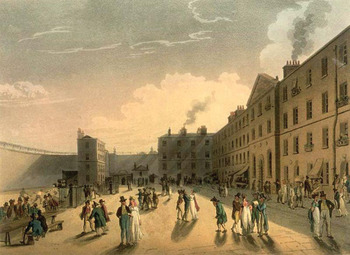
The problem, however, was that the debtors' prison itself gradually came to be seen as a ritualistic space that cultivated precisely this “indolence” and pleasure-seeking: “Who has not heard of Queen's Bench prison? … Is there a lounger in Pall-mall, a saunterer in Regent-street, who has not had a friend there at one time of his life or another? Has not everyone known men prefer it to Rome, Baden-Baden, or Vienna?” (Dixon Reference Dixon1850: 102).Footnote 21 Perhaps even more astonishingly, one author cited Defoe, who pointed out as far back as 1722 that the King's BenchFootnote 22 had better outdoor facilities, while the Fleet had better indoor ones (see Image 1, depicting the outdoor space of the King's Bench in use). For this reason, “Some of those gentlemen that are in for vast sums, and probably for life, choose the one for their summer, the other for their winter habitation; and indeed both are but the show and name of prisons” (ibid.: 114–15).Footnote 23 Many writers of the day who shared this perspective saw the debtors' prison as a space outside of quotidian time, and for them the terms “shrine” or “sanctuary” stood as far more apt monikers than “prison” or “jail.”
Enforced leisure at the King's Bench, with people playing squash and strolling in their Sunday finest, all while behind the barbed wired wall to the left.

To keep the dangers of inveterate debtors at bay, the debtors' prison was designed to be segregated from commercial life, and inside, leisure reigned by decree; some prisoners who tried to maintain their good work habits failed nonetheless, given the tempting surroundings and poor moral fiber of their compatriots (Dixon Reference Dixon1850: 283). More than one author referred to it as a strict regime of “enforced leisure” (e.g., H. [anonymous] 1859). Another writer called it a “sanctuary of the unfortunate” (anonymous 1823: 4), while yet another describes the all-night parties in the prison bar (Hicks Reference Hicks1858: 12–13).Footnote 24 In the bar, prisoners revealed themselves to be “apparently insensible to the effects of that high and gloomy wall which surrounds and shuts them from the world: this is their world, and their ideas seem scarcely ever to soar beyond it. It is not here you see the pensive brow, the lengthened countenance, and the dejected gait” (anonymous 1823: 12). By day, prisoners played squash and gambled, prior to singing and carousing at night. In short, “You will almost forget that you are suffering imprisonment, but find yourself involved in a bustling and active life, and may regale at pleasure” (ibid.: 10).
By the nineteenth century, English commentators remarked that there were even “wealthy beggars” inside the debtors' prisons (Dixon Reference Dixon1850: 121). Another report insisted, “Indeed the most extensive tavern can hardly ever shew a better assortment of the good things of this life … and the absolute gourmand be excited to regale. There is nothing of insolvency in the appearance of this department of the establishment, indeed so much the reverse, that the epicure stranger would consider it the paradise of feasting” (anonymous 1823: 9). This luxury extended beyond drink and food, and we find that, at least at the King's Bench, “Many of the cells of these detenues are beautifully fitted up; carpets, books, pictures, and luxuries of every kind may be seen in them according to the taste and opulence of the inmate. There are men here who make up their minds to consider themselves at home” (Dixon Reference Dixon1850: 118). Thus, in many instances, a life of mandated ease was complemented by a life of relative plenty—two conditions that were far from operative for the vast majority of citizens outside the prison.Footnote 25
And all this decadence was couched in the terms of ritual. One dispatch from inside Whitecross prison reads as if it were taken straight from the anthropological record, complete with ritual elders, initial debasement of the neophyte, and subsequent social rebirth:
At his entrance among the infected herd of confined debtors, the neophyte is naturally cast down and dispirited. With his liberty he has lost his self-respect. The sudden change from locomotion at will to narrow limits, terminating in bolts and bars unnerves him. He looks about with a vacant stare, and fancies he reads a reproach in every eye. He is thoroughly abased. But these effects are of very short duration. He is suddenly startled by the sound of boisterous merriment…. All sense of shame, all dignity of manhood is crushed out of him…. All are prompt to lend their zealous aid in forwarding, in shaping, and in accomplishing the education of our neophyte (H. [anonymous] 1859: 5–6).
This is an education in living for the present—in lifting the veil from the ideology of work (see Day, Papataxiarchis, and Stewart Reference Day, Papataxiarchis and Stewart1999). Prisoners, once tempted by this life of ease and plenty, will rarely manage to rediscover the supposed pleasures of commercial life again. Instead, “After a short term of imprisonment on the indolent system, men, who by nature are full of energy, become listless, taking interest in trifles, and restoring to modes of killing time to which they would not descend when at liberty” (Hicks Reference Hicks1858: 15).
But it is worse, for this ritualistic life of ease and plenty not only teaches them to walk away from the future and instead indulge in today's trifles, it actually debases them and turns them into mere shadows of civilized humanity. To wit, “He becomes careless in his language, in his attire, in his gestures, and his every day voluntary actions…. and as the heart is abundantly wicked, its native wickedness, freed from the reins of caution and decorum, has ample room to expand in all its rank luxuriance” (H. [anonymous] 1859: 13). Innocent people subjected to this training and luxury supposedly lost their ability to plan for the future. One prisoner, for example, was sent a guinea once a week by his charitable friends, only to spend it that very first evening on an extravagant meal, without a care for how he might procure the next six nights of food (Dixon Reference Dixon1850: 110–11). Loose money, loose morals.
Fascinatingly, the prison did have an active commercial life of buying and selling, but only with hard cash. Since anyone confined there had already proven themselves incapable of paying back their debts, credit was (somewhat obviously) not relied upon as a medium of exchange. But credit was further dead on arrival because profligacy was apparently one of the paramount social values of the prison, according to the reform literature surveyed here. Prisoners shared freely with one another (anonymous 1823: 12), failed to respect property (H. [anonymous] 1859: 35), and when they did manage to get their hands on money, they often squandered it on beer and food before the day was up (anonymous 1837: 15). These are all the classic hallmarks of the supposed barbaric economic traditionalist and his lackadaisical approach to his own economy. Without credit lashing anyone to the future, the debtors' prison was, by definition, a space that enforced a timeless orientation toward the present.
But reformers sought to eradicate this educational facility, which was perversely dedicated to living in the present. The governor of Whitecross, in one of his reform tracts put it bluntly: “I desire also to prevent a prison from being used as a sanctuary where fraudulent debtors can defy upright creditors and live in luxurious indolence” (Hicks Reference Hicks1858: 30–31). Like countless other reformers, he proposed that prisoners' work be allowed and even remunerated inside the prison. Work provides the only “honest road to freedom” out of the “condemned idleness” of the jail (ibid.: 21, 24). The transformation to degeneracy facilitated by the debtors' prison must be broken by a new commitment to bring previously banished future-planning into the confines of the prison.
In demanding this radical reform, the governor implies, perhaps unconsciously, that life inside the debtors' prison resembles nothing so much as the Garden of Eden, for he wrote, “Scripture says, ‘In the sweat of man's face shall he eat bread;’ why should imprisoned debtors be compelled to form the exceptions to the rule of the Omnipotent? Why should man issue a counter mandate, ‘Thou shalt not work,’ and thus clash with the Divine command?” (ibid.: 29).Footnote 26 This verse comes from Genesis 3:19—the author was citing the new stricture pronounced by God that humankind must forever and anon suffer a life of toil, directly after discovering that Eve had eaten the forbidden fruit. The governor of Whitecross has acknowledged here that the debtors' prison stood as a space apart, an inversion of the life of toil and trouble that characterized the burgeoning industrial city outside its confines. Lest this sound like a stretch, Bentham also criticized the debtors' prison for providing a “paradise” to the swindler (1843: 177). Civilizing Man could never allow this antediluvian “survival of barbarism” to remain (anonymous 1829: 32). The ideology of work and future-orientation had to penetrate the prison too—into its “peaceful haven.”
MONEY AND FREEDOM
Bolstering their arguments that an internal barbarism had to be eradicated from within the nation-state, reformers also homed in on the manner in which the debtors' prison implied that human life and its “God-given” soul could have a price tag. Following a well-known trope, that anything given by God cannot, by definition, have a price, they reasoned, “It is most iniquitous to authorize the creditor to make the debtor expiate his default of goods or money, by taking his flesh and blood, his body and bones. The maxim: ‘If you cannot pay in purse, you shall in person,’ is unworthy of the enlightening age in which we live…. You take an invaluable jewel, for a worthless pebble. You take the precious immortal soul, and carry it to your place of torment, in satisfaction of perishable goods; things called into existence by the hand of art, but yesterday, and which may cease to be, to-morrow” (H. [anonymous] 1859: 62–63). According to this logic, only barbarians are unenlightened enough to place a money value on human life, whereas civilized people raised it to the level of the sacred.Footnote 27 But reformers voices were beginning to be heard, and, “Happily the influence of our holy religion is felt by those who administer the law. Its truths control both opinion and practice. The magistrates of our land are increasingly sensible of the inestimable value of the human soul” (Field Reference Field1848: 86–88).
The practical solution, according to both sides of the debate, was to carefully acknowledge the segregation of monetary-value and human-value, goods from man. A monetary dispute involved things that were worth money—goods and chattel and land—and not human bodies. Thus, legislation needed to establish that the “laws should be directed against the property and not the person, excepting in the case of fraud, or intended departure from England” (anonymous 1837: 18). “Let property be balanced against property; let not bodily pain and mental suffering be inflicted, as the penalty of misfortune…. Take his property in satisfaction of the property he has acquired from you and dissipated; but bring not his crown to the dust—riot not in his life-blood” (H. [anonymous] 1859: 38–39). Turning to more ritualistic imagery, this same pamphleteer poetically inveighed, “The Juggernauth [sic] of the law, alike insensible to pity or remorse, drives his blood-stained car over your prostrate and butchered liberty. Another victim has been passed through the fire to Moloch, to whom as with the ensanguined idol of old, innocence is only an additional cause for prey” (ibid.: 9).
Quotes such as these reveal that the debtors' prison was viewed as a monstrous assemblage that allowed the body to be contaminated with money-value. Indeed, it actually provided a peculiar and socially sanctioned space for continuing to evaluate bodies on a monetary scale. All too often, apparently, people happily traded money and bodies back and forth, agreeing to lose their freedom rather than acknowledge a monetary debt. Because imprisoned debtors were protected from any further seizures, even if they carried “the very means of payment in the current coin of the realm on his person,” debtors quickly discovered that they could stay in the prison rather than meet payment (Fane Reference Fane1838a: 28).Footnote 28 Suddenly safe from additional losses and banished from normal commercial life, “The prisons afford harbour to many men … who would rather spend their small remains of property there, than give it the creditor who has been his ruin” (Farley Reference Farley1788: 149–50). Footnote 29 One reforming governor found, “A great many [prisoners] … lying there without an object in life, except to indulge in a lazy inanity.” He managed to get rid of many, but “some, however, successfully resisted the pressure put upon them, and still present the strange anomaly of men who prefer captivity to liberty, boasting, as they do, of being ‘their own gaolers’” (H. [anonymous] 1859: 32–33).
The problem that these authors are addressing is a fascinating one. Citizens were supposed to relish their priceless liberty as a foundational and inalienable right. But the history of the debtors' prison reveals that many preferred an entirely different form of liberty—liberty from monetary relations. For example, Hardouin complains that the reforms must create measures to cope with people who have “apathy or indifference for liberty” and therefore opt to stay in prison indefinitely (Reference Hardouin1874: 484). Contrary to the aims of the institution, debtors “have found the King's bench, and its rules, a happy and welcome asylum, where persecution ends. To such men a calm and quiet retirement is a blessing—they seek it—they seek a noiseless privacy, where they may commune with their own thoughts, and be in themselves the world which they have left” (anonymous 1823: 1). Another author explained, “Some of the detenues are smoking long pipes with the resigned and settled air of Orientals; they have apparently ceased to struggle with their fate.… Several of these persons have been locked up here five, six, or seven years.… Some of them have now no other homes, and wish for none. Others of the motley group are lounging jauntily about with a reckless and devil-may-care manner (Dixon Reference Dixon1850: 277).Footnote 30
Finding that prisoners had taken on supposedly foreign traits, not least by descending into opium use, reformers discovered a legally demarcated zone of reprieve from standard capitalist life. They were clearly befuddled and flummoxed by such brazen refusals to submit to the rigors of future-oriented capitalism, and its promises of bodily freedom. They failed to grasp how some people might prefer freedom from the market over freedom in the market.
But the prison's enshrined and protected borders from market life frustrated reformers for yet another reason. As has been shown, the prison had a capacity to protect debtors from paying their debts while locked up. But it also provided a series of dense legal rituals that allowed debtors to “wash” themselves of their debts. In many instances, one could go into a prison for a specific period and perform specific legal rituals instead of paying off the debt. As one inside report from Whitecross put it,
The fact is, that just then the furnace at the Insolvent Court was in full blast, turning out, monthly, again on the community, its scores of spick-and-span new characters that had been purified by the fire, and thus renovated were rendered again fit to re-enter the world of trade and commerce, from which they had for a time been banished…. I had yet to learn that Whitecross Street was the vestibule to Portugal Street [the location of the Insolvent Debtors' Court], and that its principal mission was to afford the needy debtor the means of escape from the grasp of his hostile creditor (H. [anonymous] 1859: 19).Footnote 31
The debtors' prison banished people from commercial life. Once inside, should they decide that living a life outside of capitalism was appealing, they could stay forever inside the bounds of the prison and become its ritual elders; should they decide that they would like to return to it, the system allowed them to be cleansed of their debts and reenter commercial life as a new soul, afresh.Footnote 32
This ritual complex, with its high priests (lawyers), elders (inveterate debtors), neophytes (newly imprisoned debtors) and temples (the prisons), was seen to threaten capitalism itself. Credit, as Elliott and Mill both insisted, was “the life of commerce.” But the debtors' prison created and sustained a world where people could brazenly abuse credit by manipulating the status of their bodies, either by way of cleansing or confinement. This foundational bleeding between two categories that supposedly should be kept separate then succeeded in inverting societal values and goals, by “turning it [the law] from its mission of protecting the rights of person and property, into that of invading, harassing, and destroying them!” (H. [anonymous] 1859: 4).
CONCLUSION
With capitalism growing at an ever-faster clip during the Industrial Revolution, more and more people became enmeshed in debt relations. With debt seemingly everywhere, the prison's ritualistic capacity to nullify the power of monetary obligations and endorse the present-orientation of economic traditionalism was far more dangerous than it had been in the past. One author suggested that the number of debtors had grown so large “that a wall should be built round the borough of Southwark, [the southern half of London, where the King's Bench Prison could be found] because it might be then possible to find a room for every single debtor” (Farley Reference Farley1788: 39). For their earlier history, the debtors' prisons had primarily housed only the poorest and the wealthiest members of society, excluding the broad middle classes.Footnote 33 But once its function as a space free from the rigors of bourgeois capitalism had been democratized beyond these two groups, the debtors' prison's power became more of a threat to the system, and it had to be removed.
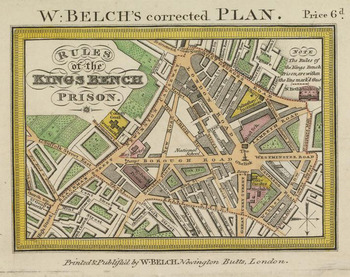
If reformers believed that there was a distinct correlation between loose money and loose morals, then they needed to eradicate any special zones that enshrined such non-bourgeois behavior. They needed to recommend new ways to instill a capitalist ethos that could combat the pernicious power of economic traditionalism. The intriguing concept of “The Rules” that surrounded debtors' prisons in many countries lays the groundwork for this. Physically outside the prison, The Rules stood as an extension of the prison itself, but without the extreme constraints of bars and bolts. For example, Image 2 shows “The Rules of the Kings Bench prison in London,” with the prison itself slightly left of center. Prisoners with special privileges to inhabit The Rules were free to reenter civic life inside The Rules, in the hopes that they might better pay off their debts, at less cost to the state to boot.Footnote 34 But economic traditionalism was still clearly policed inside The Rules, for public houses inside them remained forbidden ground.Footnote 35
The “Rules” of the King's Bench in 1830, with the prison in the middle-left section of the map, and the Rules marked by the dotted line.

One American reformer, in critiquing the debtors' prison, hinted that The Rules could serve as an adequate replacement for the prison itself. He explained that many American states have “denounced the practice [of imprisonment for debt] as sanguinary, and as a foul blot upon our national character. In many parts of New England, the prison bounds are extended to the limits of the township or county in which the prison is located. The Legislative Council of Michigan have [sic] extended the gaol limits to the bounds of the county” (Johnson Reference Johnson1823: 15). With The Rules, we see prison surveillance spilling out beyond its traditional walls, without the need of imprisonment itself. Once this form of surveillance had proven its capacities, it was perhaps but a small step to imagine that the walls themselves were unnecessary. The only remaining way to escape such surveillance was to disappear into exile abroad—to become, in a word, “socially dead” to the community, only to be reborn with a clean slate in a new community.Footnote 36
Thus, much in line with Foucault's arguments in Discipline and Punish, the evolution from debtors' prison to The Rules to state borders suggests that the nation-state replaced the immuring function of the debtors' prison.Footnote 37 That is to say, the nation-state served to replace the debtors' prison by itself becoming a zone of custodial surveillance—both by eradicating ritualistic zones that cleansed or harbored the indebted, and by improving border management to ensure that citizens could no longer easily flee their debts by decamping abroad. In so doing, it held adequately at bay the menacing threat of internal barbarism that supposedly trained people to hold disdain for their debts or taught them to seize bodies as collateral. In his testimony before the U.S. Senate, Colonel Johnson provides an ironic and unintentional synopsis of much of this battle between internal barbarism and national civilization. As he closed his fiery speech against the barbarity of the debtors' prison, he reached deep into the mythical construction of America itself, in order to conclude, “For this love of liberty, a principle inherent in man, the savage still adheres to his wandering life, and spurns the proposition for civilization, because, in his view, prisons mark its bounds” (1823: 20). Foucault could not have agreed more.