In November 2001, Home Secretary David Blunkett implied that judges who objected to plans to indefinitely detain foreign nationals suspected of terrorism lived in an ‘airy fairy libertarian’ world.Footnote 1 Those measures had been struck down by the Appellate Committee of the House of Lords (the ‘Law Lords’) by a majority of eight to one.Footnote 2 One interpretation of that decision is that it split eight airy-fairy libertarians from one hard-nosed realist – that is, it separated judges located in a dimension running from libertarianism to conservatism.
Analysing non-unanimous decisions in order to estimate the locations of judges in the political space is commonplace in political science. Scholars have shown that US Supreme Court Justice Ginsburg is more liberal than Justice Scalia,Footnote 3 that Australian High Court Justice Kirby is to the left of Justice CallinanFootnote 4 and that Canadian Supreme Court Justice L'Heureux-Dubé is to the left of Justice Sopinski.Footnote 5 Despite David Robertson's work on judicial discretion in the Lords,Footnote 6 it is not clear whether we have comparable grounds for believing, say, that Lord Scarman is to the left of Baron Ackner.
This article argues that we cannot locate Law Lords in the political space on the basis of their individual votes. Whilst we can recover ideal points for judges, an ideal point model is a very poor model of judges’ decision making, and should be rejected. Even if the model were accepted, the ideal points do not represent positions in the political space, but rather judges’ attitudes towards dissent. Consequently, it is mistaken to call judges ‘airy fairy libertarians’, ministerial comments notwithstanding.
Why Might Judges Judge Politically?
There is an extensive literature on the politics of the judiciary. We know that, definitionally, courts are political institutions,Footnote 7 that they have important consequences for the rest of the political systemFootnote 8 and that judges can play important non-judicial roles in public life.Footnote 9 My focus is narrower. When I describe judges as being political, or talk of judges judging politically, I mean that they make decisions on the basis of ‘political’ beliefs: specifically, that when judges decide how to dispose of a case – typically whether to allow or dismiss an appeal – their decisions are a function of the location of that case and that judge in some political space, such that judges who are far apart in that political space will be less likely to agree on the disposition of a case. This definition encompasses both ‘attitudinal’Footnote 10 and ‘strategic’Footnote 11 accounts of political judging, but excludes analyses that try to explain the decisions of panels of judges or infer judges’ positions from the decisions of panels they have sat on.Footnote 12
There are both general and particular reasons for believing that judges are political in this sense. Generally, judges in comparable courts have been shown to be political. Of the seven common law courts of last resort in large, consolidated democracies, analysis of judges’ ideal points has been undertaken in four courts: the US and Canadian Supreme Courts, the Australian High Court, and, for a limited period, the Appellate Committee itself.Footnote 13 Scholars who have analysed these courts have always provided estimates of judges’ political positions – even if, in certain cases, the solutions provided were ‘not technically very good’.Footnote 14 Consequently, if the Law Lords do not judge politically, they would be an exception to a general pattern amongst similarly located bodies.
The particular reason for believing that we can locate judges in the political space is that British politicians and commentators have often described judges as holding certain political values, and implied or stated that these values influence their decisions. Judges have been variously – and contradictorily – described as pursuing ‘the protection of property rights, and… political views normally associated with the Conservative party’Footnote 15; having ‘the ideology of old-middle class men… [and] the ethos of those who run an administrative state’Footnote 16, and as being ‘airy fairy libertarians’. Often, these values have been ascribed to the judiciary as a whole. This characterization might mean that judges who share the same values always reach the same decision, and that analysing dissenting opinions is useless. However, this view has always been rather difficult to square with the brute fact of dissent. As Lee asks:Footnote 17
How can it be so simple when there is a 3-2 split in the House of Lords, overturning a 0-3 decision in the Court of Appeal, which was itself overturning the High Court?
Consequently, the attribution to judges en masse of certain political values gives us reason to believe that individual judges judge politically in the sense described above.
Existing quantitative studies of Appellate Committee decision making also suggest that judges judge politically. Early work by David RobertsonFootnote 18 used multidimensional scaling (MDS) to analyse non-unanimous Appellate Committee decisions between 1965 and 1978. He found that three dimensions characterized judicial behaviour. The first dimension concerned criminal law, with high scores associated with finding for the prosecution. The second dimension concerned public law, with high scores associated with finding for the state. The third dimension was left uninterpreted. Even with three dimensions, the fit of the MDS solution was poor, with high stress values.
Later work by Robertson abandoned MDS, and with it the analysis of (dis)agreement between judges. Judicial Discretion in the House of Lords exploited the fact that cases are heard by panels of the Appellate Committee, and that consequently judges may hear some cases but not others. Robertson conducted multiple discriminant analysis on cases heard between 1986 and 1995, asking, for a number of particular outcomes of interest – findings for the Revenue in tax cases, for the state in public law cases, for plaintiffs in constitutional law and civil liberties cases, and for the defendant in criminal cases – whether the (assumed random) presence of judge X on the panel made such an outcome more or less likely. In order to combine insights from different types of cases, factor analysis was performed on judges’ scores on the linear discriminant analysis.
Although a number of factor analytic solutions were possible, Robertson's preferred solution involved dropping criminal cases and presenting two dimensions: egalitarianism (associated with finding for the state in public law and for the plaintiff in civil liberties cases) and constitutionalism (finding for the plaintiff in constitutional cases). Because this method of analysis can use unanimous decisions, Robertson was able to make inferences on the basis of far more cases than would have been possible including only cases with dissent – though at the cost of specifying, ex ante, the components of judicial ideology.
At the same time, there are considerable grounds for doubting that British judges judge politically. The first is that levels of dissent are limited in comparative perspective, and whilst unanimity may point to the homogeneity of judicial preferences or the absence of Dworkinesque ‘tough cases’, it may also indicate that judges do not decide on the basis of their political positions, but rather on the basis of shared views of what the law requires. That is, agreement may indicate that judges are not political. Figure 1 shows that agreement in the House of Lords is higher than agreement in all those common law courts of last resort in which analysis of dissenting opinions has been successfully applied.Footnote 19 Only judges on the Indian Supreme Court agree more, and they face a much higher caseload.
Agreement rates across five courts

Second, the British constitution offers few opportunities for policy-seeking judges. Attitudinal models of judicial decision making, in which judges’ political attitudes are the exclusive determinants of judicial behaviour, have been assumed to apply best where courts are at the top of their respective judicial hierarchy, and are not subject to overrule. Yet for most of the period discussed here, British courts have been at risk of legislative overrule by simple majorities. Whilst strategic decision making – that is, decision making in anticipation of legislative overrule – has not been thought severe enough to entirely preclude the estimation of judges’ political locations, the constraint implied by legislative overrule by simple majority is so extensive, and the policy ‘core’ so reduced, that a strategic desire to avoid overrule may cause British judges to become political mutes, reducing them to redundant veto points. Consequently, ‘political’ judges in the British system would have to act with casual disregard for the possibility of overrule – and, one might reason, be unlikely to reach the higher rungs of the judiciary in the first place.
Data and Model
I use data from the High Courts Judicial Database,Footnote 20 which includes data on all decisions that were heard between 1969 and 2003 by the Appellate Committee of the House of Lords (or by the Privy Council acting in its judicial capacity) and reported in the All England Law Reports. I have supplemented this data with my own data on all non-unanimous cases decided by the Appellate Committee between 2004 and 2009.
I consider only non-unanimous cases – those in which there was at least one dissenting opinion – in this article.Footnote 21 By a dissenting opinion, I mean an opinion that disagreed with the majority of the court over how to dispose of the case: typically, though not exclusively, whether to allow or to dismiss the appeal. I do not, therefore, consider opinions that disagree with the majority of the court over the ratio decidendi of the case.Footnote 22
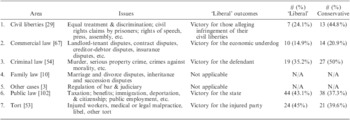
The data matrix is therefore made up of 1,592 individual decisions taken by fifty-nine judges in 318 cases. Decisions by a small number of judges who heard very few casesFootnote 23 were excluded. My data also contain information on the outcome of each case. These outcomes have, in certain areas of the law, been coded as ‘liberal’ or ‘conservative’, following established usage.Footnote 24Table 1 shows this information, and the number of cases in seven broad areas of the law. Information about case outcomes is used in the model that I now describe.
Areas of the Law and Outcomes

Note: Percentages in ‘liberal’ and ‘conservative’ columns do not sum to 100% because not all cases had a clear direction.
To explain judicial decisions I use a hierarchical item response model estimated using Bayesian methods. Item response models have become increasingly popular in political science, and can be considered to directly operationalize the attitudinal model of judicial decision making. They improve on previous methods of analysing judicial behaviour, in particular multidimensional scaling of agreement between judges, by relaxing the assumption that every instance of (dis)agreement between judges is related to the latent trait under investigation. Bayesian methods – in particular the Markov Chain Monte Carlo (MCMC) method – allow otherwise intractable or computationally expensive models to be estimated.Footnote 25
The response I wish to model is the ‘vote’ y of each judge j in a given case i. By convention, yij = 1 if the judge voted with the majority, and yij = 0 if the judge dissented. The probability of voting with the majority can be modelled as a function of three variables: the judge's location and the location and discrimination of the case. The judge's location ( $$\[-->$<>\theta<$>
<!--$$
j) is his/her location in an n-dimensional political space. In this note, the policy space is one-dimensional, and the presumption is that the dimension will run from left to right, or from liberal to conservative.
The case discrimination parameter (βi) represents the degree to which the case discriminates with respect to the recovered dimension: cases with higher absolute values of βi are very good at separating judges along the recovered dimension. This parameter also tells us which end of the policy space is more likely to vote with the majority. If the space is indeed a left-right policy space, a case with a positive discrimination parameter requires ‘more’ of the latent trait (positions further along the real number line to the right) to vote with the majority – and therefore has a right-leaning outcome. Conversely, a case with a negative discrimination parameter implies a left-leaning outcome. The case location parameter (αi) represents how much of the latent trait is needed to vote with the majority – that is, how far along the recovered dimension the case discriminates.
I link these variables to each judge's vote as follows:Footnote 26
 $$Pr({{Y}_{ij}}\, = \,1)\, = \,\phi ({{\beta }_i}{{\theta }_j}\:{\rm{ - }}\:{{\alpha }_i}),$$
where φ(·) is the cumulative normal distribution.
I innovate in my treatment of the case discrimination parameter. There are three broad approaches to dealing with discrimination parameters.Footnote 27 One approach is to set the value of the discrimination parameter to one for all cases. This is the simplest operationalization of the spatial voting model. Models with fixed discrimination parameters are common in the educational testing literature, where they are referred to as Rasch models.Footnote 28 Constraining the discrimination parameter in this way makes sense in educational testing, since investigators may reasonably presume that standardized test items tap an underlying dimension to the same degree and in a similar way. The same is not true of legislative roll calls or court cases, which may discriminate with respect to the recovered dimension to various degrees, with some strongly discriminating, others weakly discriminating and others not discriminating at all.
A second approach is to sample the discrimination parameters from an uninformative prior distribution. Where investigators have reason to believe that items differ in discriminating between positions on the recovered dimension, and where no auxiliary information concerning the contents of the items is available, this is the best approach. The downside of this approach is that it does not employ auxiliary information concerning the substantive content of the items, therefore model parameters may be highly uncertain.
A third approach is to sample some or all of the discrimination parameters from an informative prior distribution. In most instances, this method has involved constraining some discrimination parameters to take on theoretically informed values. Bafumi et al. consider, but ultimately reject, constraining the discrimination parameters for a model of US Supreme Court voting in which ‘1’ indicates ‘liberal’ outcomes: such an approach ‘relies too strongly on the precoding, which, even if it is generally reasonable, is not perfect’.Footnote 29 Jackman sets two roll calls that are mirror images of each other to discriminate, with equal and opposite strength, with respect to the second recovered dimension in a multidimensional item response model.Footnote 30
Both of these strategies use auxiliary information to estimate item response models with genuinely informative parameter estimates. They rely, however, on the choice of the discrimination parameters to constrain.
A more forgiving strategy is to model the discrimination parameters as a function of other variables. Here, I model the discrimination parameters as a function of the broad area of law and of the direction of the outcome, considered either as a ‘liberal’ or ‘conservative’ outcome. The discrimination parameters are drawn from normal distributions, the means of which are modelled as a linear function of these area-specific intercepts and the direction of the case outcome. Thus, if xi =1 denotes a ‘liberal’ outcome in case i, and k indexes the seven areas of law shown in Table 1, the discrimination parameters can be modelled as follows:
 $${{\beta }_i}\, \sim \,N(({{\gamma }_{0k}}\, + \,{{\gamma }_{1k}}{{x}_i}),\sigma ),$$
where γ 0k and γ 1k are area-specific intercepts and coefficients, respectively.Footnote 31 Cases without directionality are drawn from an uninformative prior distribution.
This strategy allows us to plausibly exploit information about the area and the outcome. Suppose, as Robertson claimed, that tax cases discriminate between judges very well, with some judges favouring the Inland Revenue and others favouring taxpayers. In that case, the area-specific intercept will be close to zero and the parameter attached to the case outcome will not only be very large, but if the recovered dimension runs from ‘left’ to ‘right’, will also be strongly negative. If, by contrast, family law cases do not on average discriminate with respect to the recovered dimension, the parameter attached to the case outcome will not be different from zero.
I estimated this model using the JAGS MCMC sampler. The model was identified by post-processing the MCMC output so that (1) ideal points had mean zero and unit standard deviation and (2) Bridge of Harwich was to the right of Griffiths.Footnote 32 The code used is shown in the online appendix. The model was run for two million iterations, discarding the first 750,000 iterations as burn-in and thinning the remaining samples by a factor of 250. A standard convergence diagnostic (Geweke's diagnostic) and inspection of the trace plots showed no problems with convergence.Footnote 33
Results
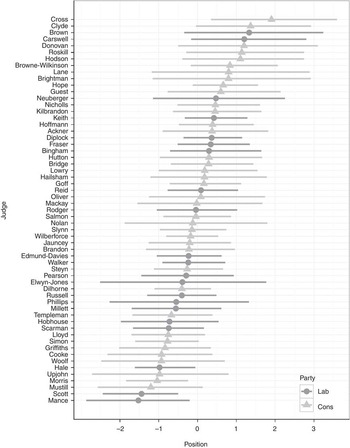
Whilst the model does produce estimates of judges’ locations, which show differences between judges (see Figure 2), this article argues that the model that produces these estimates should not be accepted – and that these estimates do not, in any case, represent a substantive dimension of politics. I base this argument on three points: first, the fit of the model is extremely poor, and does not represent an improvement over a null model; secondly, the parameters relating to case discrimination do not make sense; and thirdly, whilst the locations might seem at first glance to indicate strong partisan differences between judges, these locations do not reflect judges’ political attitudes, but rather their attitudes to dissent.
Judge locations

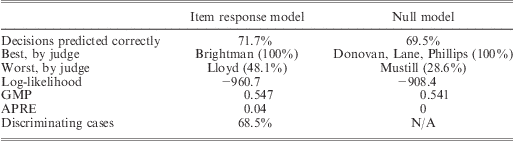
First, I discuss model fit. I take as my comparison a null model in which every judge votes with the majority with p = 0.695, equal to the percentage of concurring opinions in the dataset. Table 2 presents a number of indicators of fit for both the null model and the item response model.
Model Fit Statistics
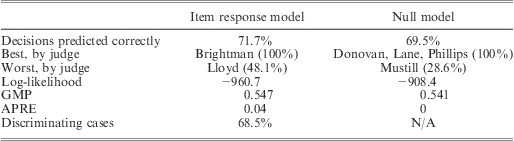
Note: ‘Discriminating cases’ are those cases that had a discrimination parameter whose 95 per cent credible interval did not encompass zero.
It is clear from the table that the item response model scarcely improves on the null model. Considering the four different measures of model fit – the percentage of decisions predicted correctly, the log-likelihood, the average percentage reduction in error (APRE)Footnote 34 and the geometric mean probability (GMP)Footnote 35 – the item response model outperforms the null model only by very small amounts. This extremely limited improvement, when coupled with the considerable cost in terms of the number of model parameters compared to the null model, ought to discourage us from adopting the model.
Secondly, the discrimination parameters, and the coefficients that predict them, do not make sense if the recovered dimension is to run from left to right. We should expect cases with a liberal outcome to have negative discrimination parameters, and cases with a conservative outcome to have positive ones. Yet all ‘liberal’ cases had a positive discrimination parameter – as did all ‘conservative’ cases. Only a handful of cases (fifteen) had a negative discrimination parameter, and they were all cases that lacked a clear direction. Whether our recovered dimension runs from left to right or right to left, this finding implies that one side of the court was permanently in the majority, whilst the other side was permanently condemned to fruitless dissent. Such an interpretation is difficult to sustain, given the rough parity between ‘liberal’ and ‘conservative’ outcomes shown in Table 1.
The coefficients predicting these discrimination parameters also performed poorly. Although four out of five coefficients had the right sign, the coefficient was significantly different from zero at the 95 per cent level in only one case (public law). In one issue area – criminal law – the coefficient had the wrong sign, though again it was not readily distinguishable from zero.Footnote 36
Thirdly, the judges’ positions, whilst superficially related to their politics, are not related to their positions in judging, but rather to their propensity to dissent. From Figure 2 it might seem that there is a powerful partisan division between the judges, with justices such as Lords Bingham and Scarman to the left of the median justice (Lord Hutton), and justices like Lords Ackner and Roskill to the right. There is a large cluster of Conservative appointees at the right end of the scale, and we can be confident that the median Labour appointee lies to the left of the median Conservative appointee ( $ P[{{\tilde{\theta }}_{Lab}}\, \lt \,{{\tilde{\theta }}_{Cons}}]\, = \,0.82 $).Footnote 37
This interpretation is strengthened by considering the known politics of these judges. Suppose we describe a judge as ‘conservative’ if he has contested a seat for the Conservative party, held a government post under a Conservative administration or been described by reliable commentators as a ‘conservative’ judge. Of the fourteen judges who qualify as ‘conservative’ based on these criteria (Ackner, Brightman, Diplock, Hobhouse, Millett and Roskill as conservative judges,Footnote 38 and Clyde, Dilhorne, Fraser, Guest, Hailsham, Reid, Simon and Wilberforce as former Conservative or Unionist office holders or candidatesFootnote 39, nine lie to the right of the median justice, Rodger of Earlsferry. Of the five remaining judges, one (Wilberforce) was an unsuccessful Conservative candidate before starting on the bench, two (Dilhorne and Simon of Glaisdale) were legal officers in Conservative governments and two (Lords Hobhouse and Millet) were perhaps only described as conservative in contrast to expectations about the Blair government's likely judicial appointments.
Conversely, suppose we describe as ‘progressive’ all those judges who have contested a seat for the Labour party or the Liberal party prior to World War II, held government posts under a Labour administration or been described by reliable commentators as ‘progressive’ or ‘liberal’. Of the five judges who can be described as progressive (Donovan, Salmon, Elwyn-Jones, Scarman and Morris of Borth-y-Gest),Footnote 40 all but one – Lord Donovan – lie to the left of the median justice.
However, this interpretation of the recovered dimension as a conservative-liberal dimension is not borne out by more basic statistics on case outcomes. For each issue area, we can calculate a judge's raw ‘liberalism score’ – the percentage of times s/he voted in a notionally liberal direction, as described in Table 1. Although the correlation between a judge's location and his/her raw liberalism score is negative, as expected, the correlation is very weak (r = −0.29) (see Figure 3a).
Ideal points and judges’ voting. (a) Ideal points by liberalism; (b) Ideal points by dissent

Only one judge characteristic is reliably associated with their location. The correlation between judges’ rate of dissent and his/her location is highly significant (p < 0.001) and strong (r = −0.83) (see Figure 3b). This relationship suggests that the recovered dimension is not measuring differences between judges’ political attitudes, but rather their views about the usefulness of dissent, with justices to the left of the recovered dimension – Hale, Mustill, Morris and Hobhouse – more inclined to dissent than justices such as Hope of Craighead, Browne-Wilkinson or Roskill. This is the only explanation for why almost all of the discrimination parameters were positive – because judges who are favourably inclined to dissent are, tautologically, often in the minority.
If the recovered dimension does indicate judges’ propensity to dissent, how can we explain the moderate-to-strong relationship between their locations and the party that appointed them? Previous US research has shown that female judgesFootnote 41 and judges from non-traditional backgroundsFootnote 42 are more likely to author dissenting opinions. Labour nominated the only female Law Lord (Baroness Hale), as well as six of the eleven judges who were not educated at fee-paying schools, despite nominating far fewer judges (twenty-five to the Conservative party's thirty-nine). Whilst attending a state school may only be considered a ‘non-traditional’ background in the rarified atmosphere of the Lords, Labour appointees do differ in their background characteristics.
Conversely, the Conservative party nominated bare majorities of the Scottish (five to four) and Northern Irish (two to one) judges shown in Figure 2; they are clustered towards the right end of the recovered dimension. Of the nine judges who have practised at the Scottish bar or heard Scottish cases, only one – Jauncey of Tullichettle – is to the left of the median justice (Lord Rodger of Earlsferry, also Scottish). Indeed, we can be far more confident about differences between Scottish/non-Scottish judges than we can be about party differences:  $ P[{{\tilde{\theta }}_{Scot}}\, \gt \,{{\tilde{\theta }}_{\neg Scot}}]\, = \,0.96 $.
This finding suggests that propensity to dissent is based on particular personal characteristics, rather than the idiosyncrasies of individual judges, and that appointees of different parties differ in those personal characteristics. Judges who specialize in English law (rather than Scots law or the law of Northern Ireland) and who come from non-traditional backgrounds, such as state schools or countries other than England (thus including both Welsh judges and judges such as Cooke, Pearson, Hoffmann and Steyn), are less likely to act deferentially towards English law in general and precedent in particular. Judges who specialize in Scots or Northern Irish law, whether from non-traditional backgrounds or not, act with greater deference in all cases, the majority of which involve English law. These personal characteristics may translate into differences in jurisprudence – ‘Scots judges have tended towards a… black-letter interpretative approach to the law’Footnote 43 – but there is insufficient evidence of this. Only if we had a coding of the style of judicial opinions in terms of narrow, conservative holdings or broad, liberal holdings – in a fashion analogous to that given in Table 1 for case outcomes – could we demonstrate this.
Discussion
Thus far, I have shown that a particular model of decision making on the House of Lords Appellate Committee, where judges’ votes are expressions of their location along a single dimension, is a poorer model of voting than a simple null model, which predicts that each judge has the same probability of voting with the majority. Therefore, the judge locations plotted in Figure 2 should not be interpreted as positions in the political space.
This conclusion does not mean that judges’ decisions do not ‘reflect’ their attitudes in some other way. First, it is possible that a majority decision of a panel of judges is affected by the attitudes of the judges who comprise it, even if the individual decisions of panel members are not.Footnote 44 This might be the case if judges seek consensus. Judges decide in part based on the draft opinions of their colleagues,Footnote 45 and will ‘acquiesce or give a dubitante opinion’ in order to preserve unanimity.Footnote 46 Judges are also less likely to reverse colleagues with whom they will have to work in the near future.Footnote 47 Such behaviour violates the assumption of conditional independence that is found both in attitudinal models of judging and in the item response framework. Methods that treat the majority outcome as the explanandum, such as linear discriminant analysisFootnote 48 or ecological item response theory,Footnote 49 may therefore yield intelligible judge and case locations.
Secondly, the fact that the attitudinal model has been shown not to work in the Appellate Committee of the House of Lords does not necessarily mean that it will also fail for the new UK Supreme Court. Institutional features of the new court make it more conducive to dissent; more cases are heard by nine-judge panels, which were a rarity in the Lords; more cases result in a single majority opinion; and more cases deal with human rights claims.Footnote 50 These innovations, respectively, increase the likelihood that a judge will disagree with the majority, and decrease the likelihood that a judge who disagrees will be able to finesse his or her disagreement by giving a doubtful concurrence. Consequently, whilst we ought not describe the ‘Law Lords’ as political, we may wish to reserve judgement on future members of the Supreme Court. We may find that the UK Supreme Court is at the same historical juncture as the US Supreme Court in the 1940s – on the brink of a collapse in the norm of consensus.Footnote 51