Introduction
The Philippines has achieved significant economic growth and progress towards achieving the Millennium Development Goals, yet persistent challenges remain in addressing the sexual and reproductive health needs of its citizens. Although the total fertility rate has declined substantially from 6.0 in 1973 to 3.0 in 2013, the wanted fertility rate is 27% lower than actual fertility, with women desiring, on average, only 2.2 children (Philippines Statistics Authority (PSA) & ICF International, 2014). Moreover, over a quarter of women report that their most recent birth was unintended: 11% reported the birth as ‘unwanted’ and 17% reported it as ‘mistimed’, i.e. desired at least two years later (PSA & ICF International, 2014). A large proportion of these unintended pregnancies are attributable to high reliance on traditional, less effective methods or no use of any contraceptive method at all (Darroch, 2009).
These threats to the sexual and reproductive well-being of Filipino citizens are particularly acute for adolescents and young adults (Hussain & Finer, Reference Hussain and Finer2013). The proportion of adolescents engaging in premarital sex has nearly doubled in the past 20 years – from 17.8% in 1994 to 32.2% in 2013 – and only 22% of youth report using a method of contraception at their first sex encounter (DRDF & UPPI, 2014). Younger women are more likely to have an unmet need for contraception (15–19 years 28.7% and 20–24 22.2% versus 17.5% among all reproductive-age women) and to report that a birth was unintended (33% and 27% of births occurring to women aged <20 and 20--24 years, respectively), as compared with older women (PSA & ICF International, 2014). Similarly, the proportion of young women who are mothers by age 19 has doubled in the past decade, from 6.9% in 2002 to 13.9% in 2013 (DRDF & UPPI, 2014).
These statistics reflect broader social shifts and ongoing tensions for young Filipinos as they attempt to navigate their sexual and reproductive lives. In previous generations in the Philippines, sexual behaviour was primarily tied to marriage, yet these events have become increasingly delinked, with a widening gap between sexual initiation and marriage (Medina, Reference Medina2001; Upadhyay & Hindin, Reference Upadhyay and Hindin2007; DRDF & UPPI, 2014). Young Filipinos are more likely to delay marriage, to choose cohabitation over formal marriage and to engage in premarital sex as compared with previous generations (Xenos & Kabamalan, Reference Xenos and Kabamalan2007; DRDF & UPPI, 2014). Strong pronatalist norms persist, as well as more traditional views of marriage and family. Divorce remains illegal in the Philippines and both divorce and childbearing outside of marriage are stigmatized, despite the prevalence of these practices (Kabamalan, Reference Kabamalan2004). Although there have been recent and more progressive shifts in reproductive health policy with the passage of the 2012 Responsible Parenthood and Reproductive Health Law, the enactment of this law has stalled due to ongoing controversy. Much of the controversy is fuelled by the Catholic Church, an institution that plays an active and vocal role in propagating traditional, pronatalist norms and in supporting more restrictive sexual and reproductive health policy in the Philippines (Mello et al., Reference Mello, Powlowski, Nanagas and Bossert2006; Lee et al., Reference Lee, Nacionales and Pedroso2009; Genilo, 2014).
Given persistent challenges in reducing levels of unwanted fertility, particularly among adolescents and young adults, as well as recent sociodemographic shifts in sexual initiation and marriage, this study examines how adolescents’ social contexts shape their subsequent childbearing. Using unique longitudinal and inter-generational data from young women and their mothers, this study has two aims: (1) to examine the effects of peer and familial influences on young women’s fertility, and (2) to assess the degree to which sexual initiation and partnership patterns influence completed fertility by early adulthood (age 25), independent of other fertility determinants.
Based on previous examinations of young adult sexual and reproductive behaviour from the Philippines (Upadhyay et al., Reference Upadhyay, Hindin and Gultiano2006; Upadhyay & Hindin, Reference Upadhyay and Hindin2006, Reference Upadhyay and Hindin2007; Gipson et al., Reference Gipson, Hicks and Gultiano2014), it is hypothesized that in addition to adolescents’ individual and household sociodemographic characteristics, peer and family influences would independently predict young adult fertility. Further, to test the notion that sex and marriage are, in fact, delinked in this population, it is hypothesized that age at first sex and partnership patterns (number and duration of partnerships) would independently predict fertility among these young adults, after adjusting for all other contextual factors (i.e. household, peer and family variables).
Methods
Data and measures
The Cebu Longitudinal Health and Nutrition Survey (CLHNS) is an ongoing longitudinal study of a cohort of Filipino mothers and their children born between 1st May 1983 and 30th April 1984 in Metro Cebu, the second largest metropolitan area in the Philippines (Feranil et al., Reference Feranil, Gultiano and Adair2008; Adair et al., Reference Adair, Popkin, Akin, Guilkey, Gultiano and Borja2011). Thirty-three communities (barangays) were selected from the Metro Cebu area using a single-stage cluster sampling procedure. All women who gave birth in the selected barangays during the survey period were included in the sample. More than 3000 women and their newborns (referred to as index children; ICs) were included in the baseline study. Follow-up surveys were conducted, with more recent surveys conducted in 2009 (on ICs) and 2012–13 (on sample mothers) (Adair et al., Reference Adair, Popkin, Akin, Guilkey, Gultiano and Borja2011).
Data were used from the mothers and the female ICs from the 1998 CLHNS survey, when the ICs were approximately 15 years old. Follow-up data were provided by the ICs in 2002, 2005 and 2009. The dependent variable in this analysis was number of living children, as reported by participating female ICs who had sex by the 2009 survey, representing 70% of the total female sample. (Analyses of the female IC sample confirmed that number of living children closely approximated number of live births, confirming low levels of infant and child mortality in this setting and appropriate use of number of living children as marker of fertility.) Because this study sought to explore maternal influences on daughter’s fertility, households in which the mother and IC did not live together during the 1998 survey (approximately age 15 for the IC) were excluded. Last, a small percentage of girls were excluded (2%) because they had sex prior to the 1998 survey.
Independent variables
Adolescent characteristics
These included sociodemographic characteristics and sexual attitudes and behaviours from the 1998 survey. Findings from previous studies in this and other settings in the Philippines underscore the important influences of education (Upadhyay et al., Reference Upadhyay, Hindin and Gultiano2006; Upadhyay & Hindin, Reference Upadhyay and Hindin2006; Gipson et al., Reference Gipson, Gultiano, Avila and Hindin2012, Reference Gipson, Hicks and Gultiano2014), educational aspirations (Gipson & Hindin, Reference Gipson and Hindin2014), religion and religiosity (Upadhyay et al., Reference Upadhyay, Hindin and Gultiano2006; Gipson et al., Reference Gipson, Hicks and Gultiano2014) and media exposure (Gipson et al., Reference Gipson, Hicks and Gultiano2014; DRDF & UPPI, 2014) on young adult sexual and reproductive health behaviours. Educational aspiration was a binary measure indicating whether the IC wished to graduate from college versus a lower level of education. Religion was measured as whether or not the IC was Catholic, and the IC was considered to be religious if she attends church at least weekly. Media exposure was determined based on how often the IC watches TV, listens to the radio and reads magazines. The IC’s sexual attitudes and behaviours included an index of the IC’s attitudes regarding dating, sex and marriage, whether or not the IC had heard of family planning, the IC’s perception of their mother’s attitudes about sex and whether or not the IC reported engaging in any precoital behaviours by 1998. The index was created by using a factor analysis on questions regarding the appropriate ages for young people to have crushes, court, date and become married. Higher index scores correspond to more conservative attitudes.
The IC’s perception of her mother’s attitudes about sex was determined based on three questions from the 1998 survey. Each adolescent was asked: (1) ‘Do you think your mother agrees that boys your age should not have sex yet?’ (2) ‘Do you think your mother agrees that girls your age should not have sex yet?’ and (3) ‘Do you think your mother agrees that only married couples should have sex?’ If the IC indicates that the mother agrees with all three statements, the IC is coded as perceiving the mother ‘strongly disapproves’. Finally, the IC is coded as having engaged in precoital behaviour if the IC indicated that they have engaged in kissing, holding hands, more than kissing or petting.
Household characteristics
Household wealth and geographic residence have demonstrated strong influences on young adult sexual and reproductive behaviour in this setting (Upadhyay et al., Reference Upadhyay, Hindin and Gultiano2006; Gipson et al., Reference Gipson, Gultiano, Avila and Hindin2012, Reference Gipson, Hicks and Gultiano2014). Household characteristics of the IC included: number of persons in the household; nuclear, multi-nuclear or extended household; household wealth; and an urbanicity score of the household’s community. The household wealth index was derived based on Vyas and Kumaranayake’s index (Reference Vyas and Kumaranayake2006). To create this wealth index, principal component analysis was performed using asset variables from the 1998 survey. Following recommendations from McKenzie (Reference McKenzie2003), the first principal component accounted for the greatest proportion of the variance and was used to approximate household wealth. The urbanicity scale was constructed following a modified version from Dahly and Adair (Reference Dahly and Adair2007). Principal component analysis was performed on five categories of variables relating to urbanization: population size, population density, communication infrastructure, availability of transportation and presence of markets. Parallel analysis was used to determine the number of components to retain from the principal component analysis and indicated that the first component was sufficient.
Peer and family influences
Previous studies from the Philippines and other settings demonstrate effects of peer and family influences on adolescent and young adult sexual behaviour, such as family members’ sexual behaviours and attitudes (e.g. Axinn et al., Reference Axinn, Clarkberg and Thornton1994; Gipson et al., Reference Gipson, Hicks and Gultiano2014) and perceptions of peer engagement in sexual activity (Upadhyay & Hindin, Reference Upadhyay and Hindin2006, Gipson et al., Reference Gipson, Hicks and Gultiano2014). Peer and family variables included the IC’s perception of their friends’ sexual behaviour, whether the IC had a sibling less than 20 years old that had a boy/girlfriend, whether the IC had a family member working abroad and a scale of the mother’s reported adolescent behaviours. To gauge perception of friends’ sexual behaviour, each IC was asked to report if any of their close friends had engaged in specific sexual behaviours. If the IC reported that they thought their friends had at least engaged in kissing, the IC’s perception of their friends’ sexual behaviour was rated as high. Mother’s adolescent behaviours were determined from questions on whether she had a boyfriend when she was 14–16 years old, if she had sex before she turned 18 years old and if she had engaged in premarital sex (range: 0–3). Last, a family member working abroad was noted if the respondent reported that the household received any remittances from a family member working outside of the Philippines.
Mother–child relationship
These variables included the mother’s educational aspirations for the IC, and reported communication and closeness between the mother and IC. Mothers were coded as having high educational aspirations for the IC if they wanted the IC to graduate from college. For the communication variable, both mothers and ICs were asked if they discussed a series of seven topics with each other. The topics ranged from discussion of the IC’s friends to more sensitive issues, such as sex and family planning. If both mother and child separately reported they had discussed at least two of the topics, regardless of which topics, then the pair was rated as having a higher degree of communication. Similarly, if both mother and IC separately reported being close to each other, the mother–child pair was rated as being close.
Mother’s sociodemographic and marital characteristics
These included marital status (currently married, or not), education, age, religiosity (attends church at least weekly, or not), number of children alive in 1998, child’s father present in the household, whether the husband turned over income to the mother and the mother’s status. The status of the mother was assessed by an interviewer-assessed measure of the degree to which mothers, children and their households appeared to be ‘well-kept’. This measure was derived from a previous qualitative study to develop contextually relevant measures of women’s status for the Cebu setting (Adair et al., Reference Adair, Gultiano and Avila1998) and has demonstrated influences on social and health outcomes in this population (Upadhyay & Hindin, Reference Upadhyay and Hindin2005; Gipson & Hindin, Reference Gipson and Hindin2014). For this measure, interviewers were asked to discreetly observe the woman and her immediate household environment to determine if they thought the woman, her household and her children were ‘well-kept’. Based on the distribution of responses, mothers were considered high status if the interviewer rated any of these three as well-kept at the time of the interview.
First sex and union status
To test the hypothesis that age at first sex and partnership patterns (number and duration of partnerships) would independently predict fertility among these young adults, three variables were included from the 2009 survey: the young woman’s age at first sex as reported in the 2009 survey, the number of years married or cohabiting by 2009 and the number of times married or cohabiting by 2009.
Analyses
The analysis was conducted in three steps. First, the characteristics of female participants who participated in the 1998–2000 and 2009 CLHNS surveys who had reported having sex by the 2009 survey (n=532) were assessed (see Gipson et al., Reference Gipson, Hicks and Gultiano2014) for characteristics and further description of young women who had sex by the 2009 survey). Bivariate Poisson regressions were then conducted to predict the number of living children by 2009, followed by multivariate analyses comprised of all predictor variables for which there were significant bivariate findings (p≤0.05). Variance inflation factors (VIFs) were calculated to assess collinearity, yet all variables were below the cutpoint (VIF<10). Last, to test the hypothesis that sexual debut, marital duration and number of partnerships would each independently predict fertility, these variables were sequentially added to test their independent effects in the full model.
Results
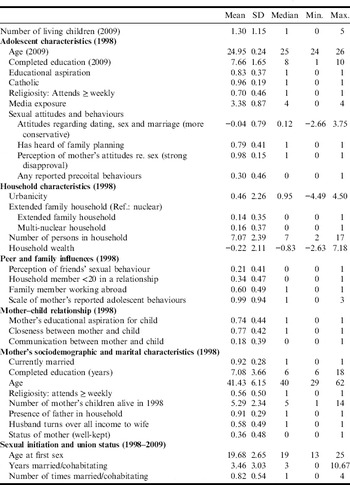
Table 1 displays the characteristics of the sample. By 2009, the young women in the study had an average of 1.3 living children (median: 1; range: 0–5). At the time of the 1998 survey (approximately age 15), these young women had completed just under eight years of education and were predominantly Catholic (96%). Nearly one-third of ICs reported any precoital behaviour (30%) and, on average, espoused more permissive attitudes regarding dating, sex and marriage (mean: −0.04; −2.66–3.75) than they perceived their mothers to have (mean: 0.98; 0–1). Nearly four in five young women (79%) had heard of family planning by the 1998 survey.
Descriptive statistics for model of number of living children (female, age ~25), by household, parental and individual characteristics, Cebu, Philippines (n=532)

When comparing characteristics between mothers and their daughters, completed years of education are similar (7.08 and 7.66 for mothers and daughters, respectively), and daughters report higher levels of religiosity and educational aspirations as compared with the mothers (70% of daughters versus 56% of mothers attend church at least weekly; 83% of daughters and 74% of mothers report wanting the daughter to attend at least college). Twenty-one per cent of adolescents thought that their friends had engaged in ‘at least kissing’ by the 1998 survey, 60% of households had a family member working abroad and daughters reported knowledge of their mothers’ engagement in at least one adolescent sexual behaviour. With respect to parent’s marital relationship, over one-third of mothers were considered to be ‘well-kept’ (36%), and in the majority of households the husband turns over all income to his wife (58%).
In total, 70% of the female ICs had sex by the 2009 survey (ages 25–26) (data not shown). Among those that had sex by 2009, the mean age at first sex was 19.68 (median=19), though the range was from 13 to 25 years. There was substantial variation among this relatively young sample in the number and duration of marriages or cohabitations. Women reported a range of 0–4 marriages or cohabitations, though most women reported only one union. Duration of marriage and/or cohabitation spanned 0–11 years, with a mean of 3.46 years.
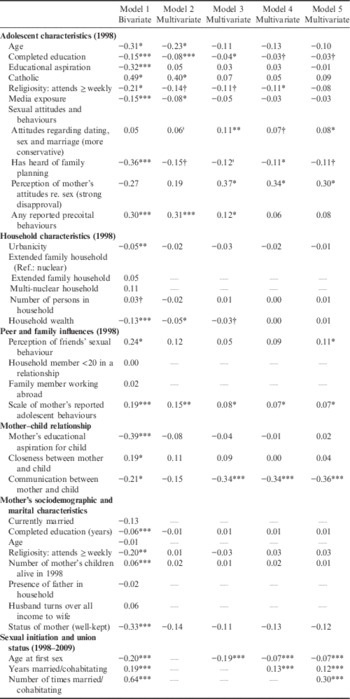
Table 2 displays the Poisson regression coefficients from the bivariate and multivariate models predicting number of living children reported by women in the sample. Model 1 displays the bivariate models unadjusted for the effects of the other variables, whereas Model 2 depicts the multivariate model with all of the background variables. Models 3–5 depict the stepwise addition of age at first sex, and duration and number of partnerships after adjustment for the background variables.
Unadjusted and adjusted Poisson regression models of number of living children (female, age ~25), by household, parental and individual characteristics, Cebu, Philippines (n=532)
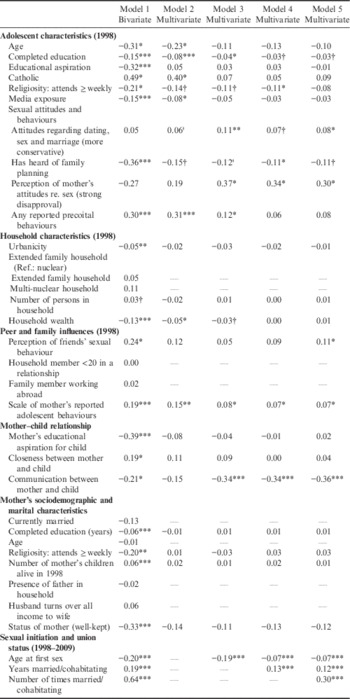
As indicated in Model 3, the inclusion of age at first sex attenuates many, though not all, of the effects of the background variables on fertility. As shown in Models 3–5, though there are slight changes in the effects of background variables across the three models, age at first sex, duration and number of cohabiting unions or marriages are each independently and significantly associated with subsequent fertility. Looking at the final, full model (Model 5), age at first sex is negatively related to fertility (−0.07), whereas duration and number of partnerships are positively associated with fertility. For each year that women report being married or cohabiting, and for each additional union, there is an associated increase in fertility (0.12 and 0.30, respectively).
Although effects of many of the household and peer/family characteristics diminish in the multivariate models, the effects of mother–child communication, peer and family influences and adolescent characteristics are significant, even after adjusting for the other influences. There are marginal effects of the daughter’s education and religiosity across the models.
Reported communication in 1994 between mother and child independently and strongly predicted subsequent fertility. In the full model, reported mother–child communication about sex was associated with lower fertility (−0.36) than similar mother–daughter pairs in which they did not both report communicating about sex and marriage.
With respect to peer and family influences, perception of friends’ sexual behaviour and mother’s reported adolescent behaviours are both significantly and positively related to the daughter’s fertility. Every behaviour that girls perceived their friends were doing, or that their mothers’ had reported doing as an adolescent, was associated with higher fertility (0.11 and 0.07, respectively).
Although no household characteristics remained significant in the final model, several adolescent characteristics persisted. Education and awareness of family planning methods were negatively related to number of living children by 2009, though these results were marginally significant. More conservative and disapproving attitudes regarding dating, sex and marriage that young women espoused themselves and that they perceived that mothers’ espoused, were associated with positive effects on fertility (0.08 and 0.30, respectively).
Discussion
A key finding from this analysis is that among this sample of young adult females, sexual debut, as well as partnership duration and frequency, each exert strong and independent influences on young women’s fertility. This finding provides evidence of the delinking of sex and marriage within this younger generation of Filipinos and corroborates evidence from this setting indicating a shift in sexual behaviour from previous generations (Medina, Reference Medina2001; Upadhyay & Hindin, Reference Upadhyay and Hindin2007; Gipson et al., Reference Gipson, Hicks and Gultiano2014; DRDF & UPPI, 2014). These findings are particularly remarkable among this female sample, given traditional gender norms valuing virginity and abstinence before marriage, especially among young women (Medina, Reference Medina2001). Shifts in such attitudes and behaviours, as documented by rising levels of premarital sex and teenage childbearing, underscore the importance of sexual and reproductive health education and services for young Filipinos, regardless of gender, age or marital status, to ensure that young men and women are becoming parents if and when they desire (DRDF & UPPI, 2014; PSA & ICF International, 2014). Recently approved policies, such as the 2012 Responsible Parenthood and Reproductive Health Law and the Philippines’ National Policy and Strategic Framework on Adolescent Health and Development, mark a shift towards a more progressive approach towards addressing young adults’ sexual and reproductive health needs (Philippines Department of Health, 2013); however, further efforts are needed to minimize continued barriers to young adults’ access to, and use of, these services (Gipson et al., Reference Gipson, Gultiano, Avila and Hindin2012; Guttmacher Institute & IPPF, 2014).
These findings are also interesting when compared with previous analyses examining the predictors of sexual initiation among this young adult cohort in Cebu (Gipson et al., Reference Gipson, Hicks and Gultiano2014). There were consistent and positive associations of mother’s adolescent sexual behaviours and perception of friends’ behaviour on young women’s sexual initiation and fertility. Other variables, such as mother’s education and parity, predicted young women’s sexual initiation, yet did not independently predict young women’s fertility. These findings are important to consider when examining the respective influences on, and pathways associated with, young adult fertility within and across sociocultural settings, and in settings undergoing rapid attitudinal and demographic shifts with respect to sexuality and reproduction.
Differences between the models predicting sexual debut and fertility also underscore the importance of understanding and disentangling the potentially disparate influences on sex and partnership behaviours on fertility, and the psychological motivations that underlie these processes with respect to sexual behaviour and fertility desires (Miller, Reference Miller1986). Qualitative fieldwork conducted with members of this cohort (2007–08) revealed that young adults are curious and interested in having sex, even when they are not yet ready to become pregnant nor to marry, yet are not using contraception or are using less effective methods (withdrawal) (Gipson et al., Reference Gipson, Gultiano, Avila and Hindin2012). At the same time, there are strong incentives to ‘prove fertility’ and to solidify a relationship through childbearing (Gipson, Reference Gipson2013). Thus, in a short, demographically dense period of time, young adults are transitioning from wanting to prevent childbearing (contraceptive needs) to actively wanting to have children (proceptive needs) (Miller, Reference Miller1986). Thus, it is incumbent upon reproductive health programmes and providers to work with young adults to identify their current fertility goals and to help facilitate these goals through accessible and accurate reproductive health education and services.
Also, in contrast to the prior analysis predicting sexual initiation, mother–daughter communication had a strong, dampening effect on fertility, even though this same measure was associated with higher hazards of sexual debut by age 25 among the daughters (Gipson et al., Reference Gipson, Hicks and Gultiano2014). Further examination of the data revealed a significant bivariate association between mother–daughter communication and the daughter’s report sexual behaviours by 1998 (p<0.001), suggesting that mother–daughter communication regarding issues related to sexuality may be prompted by the daughter’s actual behaviours. Indeed, evidence from the United States supports a similar mechanism, in that this communication may be triggered by a parent’s perception or concern about their child’s sexual activity (Jaccard et al., Reference Jaccard, Dittus and Gordon1998; Miller et al., Reference Miller, Kotchick, Dorsey, Forehand and Ham1998; Miller & Whitaker, Reference Miller and Whitaker2001).
Further exploration of the dataset also indicated that the effect of mother–daughter communication was not driven by communication regarding family planning – 79% of the daughters reported having heard of family planning, yet only 18% of mother–daughter pairs separately reported in 1998 that they had discussed at least two of seven topics, including family planning. Recent findings from the 2013 Young Adult Fertility and Sexuality Study indicate that even among this younger sample (15–24 years old), less than 10% of adolescents say that sex was ever discussed in their home while they were growing up, yet more than one-third (34%) report that if given the choice, they would like to learn about sex from their own mother (DRDF & UPPI, 2014). Findings from this study indicating independent and negative effects of mother–daughter communication on daughter’s subsequent fertility suggest that additional information on the quality, content and timing of these communications could provide valuable further insight into potential protective effects on daughters’ subsequent sexual behaviours, as has been shown in other settings (Hutchinson et al., Reference Hutchinson, Jemmott, Jemmott, Braverman and Fong2003).
Last, given the illegality of divorce and the rise in cohabitation rates versus formal marriage in the Philippines (Kabamalan, Reference Kabamalan2004; Xenos & Kabamalan, Reference Xenos and Kabamalan2007), it is notable that 5% of the young women in this sample (n=26) had more than one marriage or cohabitation by age 26. More partnerships were reported among young women with lower household wealth and education, as well among those whose mothers had lower educational aspirations and higher number of reported adolescent sexual behaviours. These characteristics, at least in part, mirror those found in past studies from the Philippines (Williams & Guest, Reference Williams and Guest2005; Xenos & Kabamalan, Reference Xenos and Kabamalan2007). With a doubling of live-in relationships reported among adolescents participating in the most recent YAFS survey (13.8% in 2013), as compared with the previous YAFS survey (5.9% in 2002), it is possible that these socioeconomic gradients in partnership patterns may diminish over time if cohabitation becomes more common among the general population (DRDF & UPPI, 2014). Further investigation is also needed to determine the extent to which these broader shifts in cohabitation patterns may affect fertility.
A few limitations should be noted for this analysis. First, given these class differences in partnership patterns, it would be informative to ascertain the specific exposure to cohabitation versus marriage on fertility in this analysis. Participants were asked to report on the duration of their partnerships – whether cohabiting, in civil union or formal (legal) marriage; thus, it was not possible to determine when the young women may have transitioned from a cohabitation to marriage, nor was it possible to assess potential differences in fertility based on these varied union statuses. Second, age at first sex was determined from the 2009 survey; thus, there may have been inconsistencies in the reporting of age at sexual initiation over time and across survey points. It was found, however, that less than 7% of reports varied by more than one year across the surveys; thus, the impact on the findings is probably minimal. Third, it is important to note that the Poisson models used in this analysis assume constant age-specific fertility of the daughters up to age 25 years. However, as the index children (daughters) are all approximately the same age (see Table 1), minimal effects on the final models would be expected. Last, although this analysis builds on previous evidence demonstrating important influences of inter-generational and adolescent predictors on young adult fertility, subsequent studies are needed that examine the intervening circumstances – other than number and duration of partnerships – that affect young adult fertility. With increased educational and career opportunities for women in the Philippines, as well as the rollout of the 2012 Responsible Parenthood and Reproductive Health Law and publicly subsidized contraceptive services, there is a continued need to examine contemporary influences on fertility given these changing circumstances.
In conclusion, the evidence from this study on the independent influences of sexual initiation and partnership patterns, as well as the role of peer and family influences on young adult fertility, serves to contextualize recent increases in rates of adolescent pregnancy and unwanted fertility among Filipino young adults. These findings and recent fertility trends underscore the importance of comprehensive and, ideally, innovative approaches that acknowledge the current realities of young Filipinos’ lives and that support them in achieving their desired fertility goals.
Acknowledgments
The authors are appreciative of the hard work and dedication of the CLHNS study staff, as well as the co-operation and patience of CLHNS participants, without whom it would not have been possible to conduct this analysis. Research reported in this publication was supported by the Eunice Kennedy Shriver National Institute of Child Health & Human Development (NICHD) of the National Institutes of Health under Award Number R24HD041022. Jessica Gipson would like to acknowledge funding from NICHD grant K01HD067677. The content of this paper is solely the responsibility of the authors and does not necessarily represent the official views of the National Institutes of Health.