INTRODUCTION
Africanist scholarship has focused heavily on the contributions of the newspapers to nationalism and decolonization (Coker Reference Coker1968; Duyile Reference Duyile1987; Omu Reference Omu1978; Mordi Reference Mordi1994). However, the story of the print media transcends its role as an instrument of the anti-colonial movement – it also shaped new social values and identity, the idea of personhood, and everyday literacy within the colonial state (Barber Reference Barber and Barber2006: 1–23; Newell Reference Newell2013; Reference Newell2002). Indeed, the print media, like the school system, helped create and extol new standards of modern life, which were mostly esoteric. Not even romantic love, the main theme of this article, escaped the purview of the print media's representation of modernity. Judging by the depth and intensity of reportage, the representation of love in the print media marked a social revolution. Among other things, it demonstrated that modernization was not entirely a project of the colonialists or of the African political elite; in fact, modernity's champions were often Nigerians who remained largely anonymous and isolated from the main structure of political power. Nigerians at various times and in multi-layered situations played a significant role in defining what constituted modernity, how it should be framed, and which aspects of life it should manifest. For the first time, Nigerians literate in English could share their private emotions about romantic passion with the reading public and seek advice from anonymous readers. It is a truism that newspapers did not pioneer the use of letter writing to express emotions and interiority; the missionaries, through their attempts to inculcate Western education, started the practice. But by publicizing romantic emotions, which otherwise would have been kept private and secret, print culture broadened the geography of affective expression and its audience. Hence, what was modern about love and loving in colonial Nigeria was not just the adoption of European ideals of romance, but also the reduction of emotions to written text using avenues such as newspapers.
This article engages with modernity and modernization ‘from below’: that is, among the literate, aspiring sub-elites rather than the elite politicians and leaders of thought. New ideas about modern love were given a specific form of expression through the print media's advice column, which provided a forum where many views and opinions could be represented, with readers all joining in to discuss the same case. Hence, there was a real sense of a network or collective process of opinion-forming rather than just a columnist calling the tune. Modern love contravened most of the established norms of gender relations and African-style patriarchy. The modern girl would be educated and employed, and would exert strong independent control over her emotions and body.Footnote 1 The modern boy would be a gentleman, ‘clean’, disciplined, polite, and committed to a relationship that sees a girl as a socio-economic equal in courtship. One of the elements on which modern love was built was therefore the idea or assumption of gender equality in an urban space with amenities such as movie houses and dance halls, underpinned by respected jobs for clerks, bookkeepers and teachers in government and the private sector – patterned after the emergent consumerist culture obtainable in Europe and North America. Clearly, the idea of modern romance cannot be understood in isolation from the broader social and structural changes that colonialism unleashed during the first half of the twentieth century. Advocates of modern love thought systematically; they believed that the way in which people establish and maintain courtship has a strong impact on marriage, an institution extolled for its ability to help Nigerians and Africans generally in their drive towards modernization. Modernity, some urbanites thought, would not only solve some of the core problems of backwardness confronting the black race, but would also put the country and the continent at large on the much desired track of global prominence.
Historians of colonial Nigeria, especially those working on marriage, women and gender, have overlooked the study of intimacy and love (Achebe Reference Achebe2011; Aderinto Reference Aderinto, Aderinto and Osifodunrin2012c; Byfield Reference Byfield2002; Chuku Reference Chuku2005; Denzer Reference Denzer1994; George Reference George2014; Korieh Reference Korieh2010; Mann Reference Mann1985). Even newer scholarship on sexuality has focused almost entirely on the politics of the regulation and prohibition of ‘illicit’ sexuality such as prostitution, while paying lip service to the aspect of romantic love (Aderinto Reference Aderinto2012a; Reference Aderinto2012b; Reference Aderinto2015a; Reference Aderinto2015b). Recent attention paid to emotional love by scholars working in other parts of Africa has showed its significance to our understanding of social change under colonial rule (Kallmann Reference Kallmann1999; Mutongi Reference Mutongi, Cole and Thomas2009: 83–108; Thomas and Cole Reference Thometz, Cole, Cole and Thomas2009: 1–30; Vaughan Reference Vaughan and Johnston2011). This present work complements the scant literature on the history of love in colonial Africa by engaging with it as a significant element of African modernization. Although the few existing works, especially Mutongi's (Reference Mutongi, Cole and Thomas2009: 83–108) study on representations of love in Drum magazine between 1960 and 1980, reveal the importance of print media in moulding public perceptions with regard to a new definition of romantic passion, they do not address the relationship between love and modernity in a manner that emphasizes and complicates African agency in a colonial society. Moreover, while Mutongi's work deals with the postcolonial period in several African countries and draws evidence from pan-African sources, this article focuses on the colonial era and southern Nigerian print media.
Anthropological research dating from the 1950s has noted a transformation in the culture of courtship under colonial rule (Jahoda Reference Jahoda1959; Little Reference Little1973: 102–44; Plotnicov Reference Plotnicov and Jankowiak1995: 128–40; Riesman Reference Riesman1973; Sather Reference Sather1961: 197–8; Smith Reference Smith2001). Scholars have successfully challenged the assumption that ‘non-Western cultures, are, by their very nature, incapable of romantic passion or are too closed off to feelings and desires independent of the social context or customary expectation’ (Jankowiak Reference Jankowiak and Jankowiak1995: 2). As Jankowiak and Fischer (Reference Jankowiak and Fischer1992) argued, the fact that Africans showed the lowest incidence of reports on romantic love in ‘traditional’ settings should not be taken to mean that it did not exist. There is a deep biocultural angle to their discussion of romantic love, whose ‘manifestation may deepen, in part, on the socio-ecological, political, or economic contingencies’.
What appears to be missing in the current ethnographic works on love is a close examination of how colonial subjects constructed modern love as a new element of their everyday life and literacy. Also missing in ethnographic research on romantic passion is how the print media established a dichotomy between new (modern) and old-fashioned (traditional) love. In historicizing love, the newspapers gave new colour to a perennial generational conflict between junior and senior men and women, by affirming that modern love represented a departure from the traditional variety, which they considered not only ‘boring’ but also the bane of the advancement of the African race. Modern love also contained elements of individualism. The newspapers were insistent that love was a personal affair that must be directed only by an individual's will and passion for independence and happiness.Footnote 2 The idea of love as something personal was revolutionary for it negated precolonial practices that empowered parents and the community to moderate virtually every stage of a relationship – from betrothal and courtship to resolution of marital conflict. While colonial courtship in the city went largely unregulated, the precolonial type came under strong communal supervision. Among the Yoruba, for instance, parents and the community ensured that prospective brides and grooms had limited contact before the completion of full marriage rites, partly to avoid premarital sexual intercourse, which the people frowned upon. Courtship was so highly regulated that a betrothed girl, according to Samuel Johnson, ‘is not to meet her fiancé or any member of his family without veiling or hiding her face’ (Reference Johnson1966: 114).
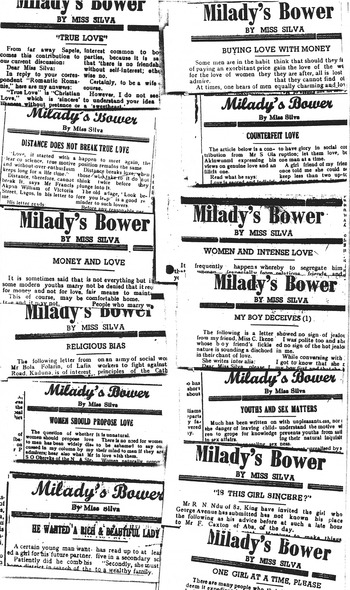
To provide a better understanding of the representation of love in colonial Nigerian newspapers, this study focuses on the women's column entitled ‘Milady's bower’ in Nnamdi Azikiwe's West African Pilot from 1937 to the 1950s. ‘Miss Silva’, the pseudonymous editor of the column, authored several articles on various aspects of relationships and offered advice to lovers (see Figure 1). She also published unedited letters from typically anonymous and pseudonymous readers, the majority of whom respected her opinion on topics of debate. As Stephanie Newell has emphasized in The Power to Name, West African newspaper editors ‘repeatedly defined the press as a vehicle to host public debates rather than simply as an organ for the communication of news or editorial ideology’ (Reference Newell2013: 2). Leaning towards Barber's description of text as ‘social facts’, being ‘used to do things’ and as ‘forms of action’ (Reference Barber2007: 3), this study focuses on the texts in ‘Milady's bower’ to unveil the world of young Nigerian lovers as they attempted to convey emotions and interiority via written text and to create a two-way exchange of information about romance in a rapidly modernizing colonial society. Yet ‘Milady's bower’ was just one of the numerous prescriptive newspaper columns about sex and love marketed to lower- and middle-class literate publics across the world during the twentieth century (Brinkgreve and Korzec Reference Brinkgreve and Korzec1979; Kallmann Reference Kallmann1999; Kent Reference Kent1987; Ryan Reference Ryan2010). Within a comparative context, advice columns negotiate shifting norms of love and sex of one kind or another at one time or another. Indeed, the identity of an ‘agony aunt’, a largely faceless personality who advises the reading public, demonstrates that issues about love, romance and sexuality cut across cultures, race and place. However, the central element in ‘Milady's bower’ – and one that is absent or poorly developed in similar columns – is the consistent framing of the idea of love and romance around the bigger issue of modernity; or the positioning of the notion of modern love and loving as a prerequisite for the social advancement of young Nigerians who appropriated ‘positive’ elements of Western culture in an often contradictory manner.
Selected headlines from ‘Milady's bower’, 1940–46.

A ROMANTIC PRESS
The advent of the print media in the region that would later become Nigeria dates to the 1850s. The country's first newspaper, Iwe Irohin fun awon ara Egba ati Yoruba (Newspaper for the Egba and Yoruba), was established in 1859 and published in Abeokuta by the Church Missionary Society for the purpose of evangelism. From the 1860s, Lagos took the lead as the print industry's main hub, largely because it was the first part of Nigeria to be placed under colonial rule and was subsequently at the forefront of modernity. Moreover, as the print media's character transformed from being a tool of Christian evangelism to an instrument of anti-colonial mobilization, newspapers (with notable exceptions such as Nigerian Pioneer and Nigerian Daily Times) dedicated a sizable amount of coverage to news that highlighted the impact of colonialism and the progress of Westernization as well as to editorials critiquing these developments. To remain economically viable, they allocated advertisement space to mostly European merchandise such as clothing, automobiles, drugs and household goods.
With a few exceptions, such as a series of letters purporting to be by a popular Lagos prostitute (Segilola Eleyinju Ege) that was published in thirty instalments in Akede Eko (Lagos Herald) between 1929 and 1930, the print media paid little attention to the representation of love and intimacy (Barber Reference Barber2012). Women's voices also had very limited exposure. The reasons for this are not hard to discern. Until 1925 there was no daily newspaper in Nigeria. The emergence of the Lagos Daily News (established in 1925) and the Nigerian Daily Times (1926) changed the nature of newspaper reportage as non-political issues increasingly found their way onto the printed page (Coker Reference Coker1968: 17). The first major attempt to place gender and romance in written text was made by E. Ronke Ajayi, Nigeria's first female newspaper editor (Zedomi Reference Zedomi1987: 6–13; Denzer Reference Denzer, Byfield, Denzer and Morrison2010: 259). Between 1931 and 1932, Ajayi wrote critical articles about marriage and women's empowerment through education in the Nigerian Daily Herald. Unlike Ajayi, writers for the Comet, Gertrude La Page and ‘Madame Celeste’, penned articles on religion and spirituality, women's fashion, beauty, food and domesticity (Zedomi Reference Zedomi1987: 15–18). Thus, when the West African Pilot first appeared in November 1937, it joined a print culture that already featured articles about women and gender relations, but it would soon achieve what its predecessors could not. After following the established literary trends of focusing on foreign fashion and British royal culture, in around early 1939 it changed its approach by delving into social issues that were of everyday importance to Nigerians.Footnote 3 By Africanizing its women's column and turning it into a site in which to reflect on romance, ‘Milady's bower’ and similar columns in other newspapers started a transformation that would contribute to the consolidation of the famous Onitsha market literature that took the subject of love from newsprint into the fast-selling pamphlet industry (Dodson Reference Dodson1973; Hogg and Sternberg Reference Hogg and Sternberg1990; McCarthy Reference McCarthy1984; Obiechina Reference Obiechina1973; Thometz Reference Thometz2001).
The print media's modernization of African romantic passion could not have been successful without the transformation of Lagos, Ibadan, Onitsha, Port Harcourt and other southern Nigerian cities into first-class colonial urban centres and the accompanying expansion in literacy. The culture of elitist colonial education of the nineteenth and early twentieth centuries gave way to a ‘populist’ one, starting in the 1920s, as the colonialists' new interest in Western education increased school enrolment (Fafunwa Reference Fafunwa1974: 128–65). The number of southern Nigerians who had completed post-secondary school education jumped astronomically from 200 in the early 1920s to 31,000 in the early 1950s. The primary school enrolment of 1.1 million in the 1950s was in stark contrast to the 140,000 thirty years earlier (Coleman Reference Coleman1958: 141). By independence, 20 per cent of schools in Nigeria were in Lagos (ibid.: 144). Expansion of literacy in English produced two complementary outcomes: on the one hand, it increased newspapers' readership and sales; while on the other, it provided opportunities for Nigerians to express their own ideas about living in a colonial society.
The content and readership of newspapers varied. Issues around constitutional reforms were targeted at leading elites and nationalists, while columns on children and women as well as the advertisements were targeted at a diverse audience drawn from across the confines of age and gender. Most of Miss Silva's writers and audience were the single young men and women in southern Nigeria's major cities. The urban youth demographic popularized her column – in 1950, 67.3 per cent of the total population of Lagos was under the age of thirty (Mabogunje Reference Mabogunje1968: 266). Most educated young people had moved to the big cities in southern Nigeria to acquire education and salaried jobs. Very few would return home to become farmers, not only because agricultural work paid less than the government and private sector jobs in the cities, but because the urban centres had the modern amenities that supported their adopted way of life.Footnote 4 But how ‘young’ were Miss Silva's audience? As used in the newspapers, the terms ‘young’ men and women/ladies and ‘boys’ and ‘girls’ are vague. One could infer that readers of ‘Milady's bower’ were at least fifteen years of age and were secondary school pupils who were experimenting with love affairs or single working-class young adults over twenty. With few exceptions, such as Miss Ayodele (age twenty-one) of Calabar who sought advice about her secret affair with a married man, most of Miss Silva's correspondents did not reveal their true age.Footnote 5
Apart from the West African Pilot, other newspapers, such as the Nigerian Daily Times, Daily Service, Southern Nigeria Defender and Eastern Nigeria Guardian, had columns that published articles and letters on love and marriage in the 1940s and 1950s.Footnote 6 However, ‘Milady's bower’ was the most popular – not just because the West African Pilot, with a daily circulation of 20,000 in the 1940s, was the highest-selling newspaper in colonial Nigeria, but also thanks to the quality of its articles and letters.Footnote 7 The timeliness of the subject matter and how the content was aimed at the public also placed ‘Milady's bower’ above other similar columns. Indeed, the column contributed immensely to the propagation of Dr Azikiwe's project of a ‘populist’ and sensational media, by presenting stories that were closer to the living realities of lower-class young literates. Every article Miss Silva authored appeared to be like a thesis – well structured from beginning to end. Whether writing about such elusive issues as good conduct or controversial ones like whom to blame for a heartbreak, she was able to convey highly complex and interesting ideas in a comprehensible manner. Both Miss Silva and her correspondents borrowed vocabularies from popular foreign novels such as H. G. Wells' Kipps: the story of a simple soul, magazines, movies and plays. Yet by the 1950s, so important was the subject of urban love that Cyprian Ekwensi devoted a portion of his People of the City (Reference Ekwensi1954) to urban courtship and sexual relations.
Scholars have come to doubt the true gender of some editors of romance columns, such as Drum magazine's ‘Dear Dolly’ (Mutongi Reference Mutongi, Cole and Thomas2009: 83–108). Although the West African Pilot did not reveal the identity of Miss Silva to the public, she consistently self-identified as an African and a woman. From the 1930s to the 1950s, she used explicit phrases such as ‘as a woman’ that established her feminine gender, which she believed qualified her to make authoritative contributions to various issues about women and romance.Footnote 8 When one J. O. Smith expressed doubts about Miss Silva's gender and criticized her for misleading lovers, the editor of the West African Pilot wrote a rebuttal professing that she was female and had the requisite experience to educate the public on such matters.Footnote 9 Yet there is a possibility that several Miss Silvas existed from the 1930s to 1960, the year of Nigeria's independence. Be that as it may, anonymity was an important part of colonial literary culture. People not only consumed materials by unknown authors, they also enjoyed anonymity because it allowed them to express their feelings and thoughts about often controversial matters while escaping the societal sanctions that such expressions might engender.
‘I could not love this man … and I still dread the idea of marrying him’: forced betrothal and parental involvement in courtship
One of the most important aspects of colonial urban courtship culture was the freedom to choose a lover. Some young men and women would defy the ‘traditional’ culture of betrothal by picking a prospective bride or groom without the consent or approval of their parents. Some would break established ethnic, class or geographic rules by courting outside their immediate towns and ethnicity. Boys and girls could court without the approval of their parents, but they could not consummate marriage without it.Footnote 10 A sizable number of letters to Miss Silva centred on the refusal of parents to recognize a courtship.Footnote 11 Some correspondents lamented their parents’ refusal to allow them to choose their own spouses. In one instance, a writer claimed that, while he was out of town ‘struggling with his life’, his aged mother had married him to a girl he had never met because she (the mother) was ‘unable to do any domestic work in the house’. The bachelor wrote: ‘Marriage as you see, is not a simple affair as some people seem to think. The happiness of lovers depends upon the love and sympathy between them and this is why a man should be left to choose for himself.’ He believed that his mother was selfish to have married him to a girl simply because of her own domestic need.Footnote 12 In a similar case, the parents of a young man betrothed him to a girl he did not love. He approached Miss Silva for counselling. She advised him to ‘stick to the girl you love best … Never mind what their wish is … Love is such a delicate thing and should not therefore be dictated to intending contracting parties by their parents.’Footnote 13 Such phrases as ‘stick to the girl you love best’, ‘go ahead and get your girl’ and ‘never leave the girl you love’ were intelligible to most young people of the era.Footnote 14 They literally meant disobeying parental instruction by eloping or secretly marrying without performing traditional marriage rites.Footnote 15
Although Miss Silva and her female correspondents consistently attempted to empower readers to be brave in making decisions about love, they also recognized the social, cultural and economic consequences of disobeying one's parents.Footnote 16 She and some of her correspondents advised lovers to pretend to obey their parents, while working to appease them. In other words, they should explore all possible means of peacefully resolving conflict. In one case, a man was prevented from marrying a lady of his choice (even after the parents had received a positive confirmation from the oracles) because they were not from the same town – their places of birth were just 25 miles apart. Miss Silva labelled the boy's problem as ‘old time conservatism’. She advised him to seek the help of elderly men in begging the girl's parents to allow the marriage.Footnote 17 One correspondent, a Miss Ethel Abimbola Macaulay who wrote from Lagos, advised another man with a similar case to tell his girlfriend to ‘Obey [her parents] first and then complain.’ Miss Macaulay ended her letter: ‘If after she had obeyed her parents, and they still refuse, leave her and find another girl.’Footnote 18
But neither abiding by nor disobeying parents' instructions to marry within one's ethnic group, social class or town guaranteed a marriage or romantic happiness. Lovers found themselves in complicated situations with people they loved. A bachelor who had just finished his teacher training was compelled by his parents to stop a relationship with a girl from another town, which he did. He then chose a girl of his own ethnic group who was ‘poor and only half educated’. Out of ‘sympathy and real love’ the bachelor paid for her to be trained as a seamstress. But after years of investment and preparation for the wedding, his wife-to-be refused to consummate the marriage if he did not buy her a gold chain.Footnote 19 This case is similar to that of a twenty-year-old woman who, in her letter to Miss Silva, narrated how her parents had put her in a boarding school to ensure that she could not have any relationships. But after finishing high school at the age of eighteen, her parents betrothed her to the son of their friend. ‘I could not love this man … and I still dread the idea of marrying him,’ the girl wrote in frustration. Like most young women of her generation, this writer had her own boyfriend, a ‘handsome’ man who had a ‘good’ job. However, her boyfriend's parents wanted him to be a polygamist, something that she did not like. Miss Silva used this example to further highlight her conviction that an individual's happiness is paramount in all relationship matters:
My Dear girl, you are still young and I will not advise you to risk life at this age. You may depend on my word that you have not met the right companion, and when you do your present outlook will change. You have a right to your own happiness and nobody should dictate to you. As to the second man you love, you should try to forget him as the future will be risky for you. Be patient and hopeful; you'll soon have the right one.Footnote 20
The problem of divided affections presented a big challenge to those facing parental disapproval of their courtship. Some lovers whose parents refused to recognize their courtship found themselves still in love with their exes. Another man wrote that he loved a girl dearly, but after three years of dating, her family refused to recognize him as their future son-in-law. He then started a relationship with another girl, but confessed he was still in love with his previous girlfriend. He asked Miss Silva: ‘Do you think I can do away with this first girl entirely and cling to my new lover?’ In her response, Miss Silva advised him to return to the first girlfriend even though her parents did not approve of their relationship: ‘Courting another girl when you still love the first one is queer, unless you can grow to love her as the first one … One thing you must know and that is, the course of true love does not run smoothly.’Footnote 21
‘Dear Miss Silva, will you help me ease my present situation?’: heartbreak, courtship and sex
Heartbreak and romantic disappointment were as problematic as parental intervention in love affairs and courtship.Footnote 22 Being a modern lover meant avoiding or managing heartbreak with maturity.Footnote 23 The letters and articles about heartbreak provide a deep insight into core aspects of courtship such as emotional attraction, physical appearance, socialization, ethnicity, social and educational status, and other factors that brought people together for romantic purposes.Footnote 24 Correspondents to Miss Silva trusted her to help moderate debate about why love fades and who in a relationship should be held responsible.Footnote 25 Urban space not only provided people with opportunities to show affection, it also presented reasons to discontinue a relationship without explanation. Men, because they outnumbered women in literacy, were more likely to write about heartbreak, and tended to accuse women of showing ‘counterfeit love’.Footnote 26 They expressed the agony of being abandoned after receiving ‘a promissory note of marriage’, to use the words of one B. Iye Obadodu of Lagos, whose girlfriend left him for a man who worked in the government secretariat.Footnote 27 Men generally regretted the time and money they had spent on girls. At least one contributor, Mr I. A. Onuoha, wanted to recover the money he spent teaching his estranged girlfriend how to read and write.Footnote 28 The few letters written by women about disappointment blamed men for ‘double-dating’ and ‘social corruption’. One such letter by Miss Judy Inyang points out that ‘confidence begets confidence’ and that some women are unfaithful because men had treated them badly. ‘Do our young men know what faithfulness is?’ Inyang queried. After narrating a story of a girl who found out that her lover was cheating on her, she asked: ‘What do you think she will do? Has she not the right to take care of herself then?’Footnote 29
Besides unfaithfulness, disappointments were also attributed to the lack of communication in long-distance relationships. This challenge, which was quite common in a highly mobile colonial society, led to the end of some romances.Footnote 30 Generally, lovers maintained long-distance relationships through correspondence. While lack of response to a letter usually meant that one of the parties was no longer interested in the relationship, in some cases the chain of interaction that held lovers together was broken by a change of address or poor postal service, as occurred during the unstable period of World War II.Footnote 31 Some long-distance lovers ended their relationship by making their intention known through a letter. Others, like Mr. P. C. Njoteh of Yaba, Lagos, found out that a long-distance relationship had ended upon reading the marriage announcement of the ex-girlfriend in the newspaper.Footnote 32 Regardless of the circumstances of heartbreak, Miss Silva and her co-advisers believed that disappointment in romance should not stop an individual from seeking a new lover. ‘On my part,’ Miss Silva opined, ‘I am inclined to fancy that when men and women love several times without any success, it is because they have not found the right partner, and they have to continue the search.’Footnote 33
One frequently discussed matter in ‘Milady's bower’ was the proper age for marrying or how long a courtship should last. This debate was certainly inevitable. The generation of modern boys and girls tended to marry later than their precursors in part because of the unprecedented increase in bride price (Aderinto Reference Aderinto, Dominguez and Wendt2016). In fact, marriage financing seemed to be the most important factor in the postponement of marriage. Time spent acquiring a Western education was another important factor. While male contributors claimed that they delayed marriage because of their lack of jobs and money to satisfy their women, the females thought that men were avoiding marital responsibilities because they preferred to stay single in order to engage in promiscuity. For men, marriage was more expensive now than in the ‘old days’ because modern wives demanded comforts and conveniences such as the latest appliances and furniture and accommodation in decent neighbourhoods.Footnote 34 Miss Silva acknowledged that money was a significant factor in the decision to marry, but she added two other elements: ‘circumstances of birth’ and ‘responsibilities’. She contended that men whose ‘birth is good’ or whose ‘birth is a high one’ – that is, those born into rich families – could afford to marry early. By ‘responsibilities’ she meant the number of dependants a man has – she advised men with many dependants to delay marriage.
Miss Silva gave a similar prescription to women: do not marry a jobless man. This recommendation contravened some of her previous advice that women should be gainfully employed and not depend wholly on men, and that, in modern society, women should not be scared about being the family breadwinner. It also went against her position that love, not money, was the most important element in relationships and marriage. Aside from money matters, she added another condition for marriage: ‘temperament’ – which she defined as anger, which often was to blame for relationship problems. She advised women who had lost a relationship due to ‘high temperament’ to get married as soon as they found a man willing to marry them.Footnote 35 Despite the sometimes contradictory recommendations given by Miss Silva and her contributors, the colonial marriage culture clearly placed more responsibility on men as breadwinners.
On the question of the length of engagement or courtship, there was much disagreement.Footnote 36 The whole idea of courtship was to enable potential husbands and wives to get to know one another and assess the prospects of a successful marriage.Footnote 37 While some believed that courtship could last for months, others thought it could last years, ‘provided the intending couples are still within the marriage age’. One writer, Mr Ebenezer Aro, who worked in the accounting section of the Nigerian Railway, extended the importance of courtship from the usual lifestyle compatibility and behavioural factor to the realm of medicine. He advised men to rid their prospective wives of ‘physical disabilities’ by visiting the doctor to correct physiological or structural defects of ‘endocrine organs or general lack of vitality’.Footnote 38
Courtship, heartbreak and romance received far more attention in the press than sex and sexuality. Editors probably decided to remain silent on such issues in order not to offend those in the community who might find explicit references to sex repulsive. Yet not all aspects of sex and sexuality were repressed by the press – prostitution as a social problem that must be eradicated was a frequent topic of newspaper articles (Aderinto Reference Aderinto2015b). In other words, the sinful and morally degenerate lives of prostitutes could be depicted, with the intent to instil a moral lesson against sexual ‘deviancy’ or to stimulate the government to police prostitution.Footnote 39 What were not published were letters describing the private sexual lives of ‘law-abiding’ citizens or advice on how to enhance one's sex life. Nevertheless, on a few occasions, Miss Silva did try to express her views on sexuality. She started one column entitled ‘Sex, secrecy and chiding’ with a warning to readers about the unpopularity of the subject she was about to address, then went on to present the negative impact of the traditional silencing of sex:
No doubt, the notion that all affairs pertaining to sex should be kept in the dark has done much havoc in the past and is still continuing to work with the same measure and full speed. Some people would make a fuss over sex discussion as if it were some ugly thing which should be erased from human thoughts as much as possible.Footnote 40
There is no way to access the reading public's reaction to her advice on premarital sex, about which she said: ‘If done at all, it should not be too much indulged in.’ However, it would appear that she was not successful in galvanizing her correspondents to write about sex.Footnote 41 Generally, the few articles on sex – including a very powerful one by Dr Azikiwe entitled ‘Sexology’ – attempted to connect sex education with nation building.Footnote 42 Lovers who were well informed about sexual life during courtship would, in Dr Azikiwe's and Miss Silva's estimation, enjoy a good sex life as married couples and produce strong families – the backbone of a virile nation. Both Dr Azikiwe and Miss Silva thought that the ‘high’ rate of divorce could be partly attributed to limited knowledge about human sexuality, and therefore they advocated for sex education to be introduced into the school curriculum.
Is kissing African? Where should people kiss, in private or in public? Can people show affection in public without kissing?Footnote 43 The kissing debate touches on core components of intimacy and skirts the thin line between public and private expressions of love or between what is ‘decent’ and what is ‘scandalous’. Some contributors claimed that kissing was un-African, a cultural practice copied from European cinema. One Mr J. N. Mordi quoted a ‘white foreigner’ who, after viewing Nigerian lovers kiss, remarked: ‘This country is young indeed to understand the theatrical gesture,’ judging it to be like something out of a European movie. Mordi, in another article, claimed that kissing like ‘any other enjoyment had its one vice’. One contributor, a soldier named D. N. O. Ukaru who opposed kissing, attempted to make a medical case – he claimed that syphilis is transmitted through kissing – and pointed out that if even a highly revered European novelist such as H. G. Wells could assert in his famed book Kipps: the story of a simple soul that ‘it is a nasty thing to kiss’, then there was no reason why Africans should follow suit.Footnote 44 A pro-kissing contributor believed that there were marked differences between ‘passionate and erotic kissing’, ‘kissing as a display of softer emotions’, and kissing ‘rascally or with temperance’.Footnote 45 Miss Silva thought that kissing helped to manifest love and could reduce conflict in a relationship. Yet she advised that it required ‘decency’ and should not be ‘performed recklessly’.Footnote 46 As interesting as the debate on kissing was, it remains unclear what the difference was between ‘decent’ and ‘scandalous’ kissing – although it would appear that, in general, there was more of the latter.
‘Love is but a part of a man's nature, while a woman's whole existence breathes on it': gendering modern love
Although Miss Silva and her love advisers laid out generally acceptable rules to govern modern relationships, for both sexes, they effectively established that men and women did not love in the same way.Footnote 47 Hence, in their writing love was not totally genderless. The gendered character of love, as the newspapers depict it, was attributable both to the supposed universal biological differences between males and females and to learned gender expectations in a changing socio-cultural and geographical context.Footnote 48 In advising men and women how to behave in relationships or respond to romantic disappointment, Miss Silva and her correspondents borrowed extensively not only from African but also from Western culture in devising often contradictory recommendations regarding gender roles. Such poetic expositions as ‘A woman's love is unquenchable. It lasts while she lives. I am not sure whether she ceases to love after death’ and ‘Man's love is of man's life a thing apart. / ‘Tis woman's whole existence’, culled from the work of Lord Byron (1788–1824), a leading figure in the romantic movement, spoke to the generally accepted notion that women were more passionate than men.Footnote 49 Another phrase – men are like ‘the fashion journals, always changing with time’ – depicts males as unreliable and inconsistent in the affairs of love.Footnote 50 Two facets of gendered advice on love are clearly discernible. The first deals with an individual's conduct, appearance and composure, all of which are expected to positively enhance the second: how to successfully develop and maintain a healthy relationship. Let us examine how these typologies are reflected in the separate advice for men and women.
‘Milady's bower’ contributed to the moulding of new forms of urban masculinity that emerged as a result of and in response to the realities of city life. A core ethos of the new urban masculinity was ‘gentlemanliness’. Unlike such prescriptions as ‘decent’ kissing, which was ill defined, gentlemanliness (in its full physical and behavioural connotations) was not vague. Looking dandy or wearing ‘tie, collar, shirt, shoes, trousers, coat and hat did not make one a gentleman’, Miss Silva wrote, bucking convention with regard to the physical appearance of a gentleman. She praised more innate and attitudinal qualities: a ‘gentleman should not be bad tempered’, ‘should try to admire others and envy none’, ‘should be respectful and self-contained’, ‘should keep good company and avoid uttering evil words and bad language’, ‘should be honest, truthful and generous’, and ‘should love others as himself’. Overall, a gentleman should place great importance on manners and not on looks.Footnote 51 Miss Silva and her correspondents might disagree on whom to blame for a heartbreak, but they concurred that to be a true modern lover, a man must be a ‘gentleman’ and should not live a ‘pretentious’ life. Indeed, she prized ‘gentlemanliness’ above all other qualities that women adored in men:
The most important thing that most women expect from men is that they should be gentlemen. There is only one kind of gentleman; and he is a man whose innate good breeding helps him to avoid giving pain to anyone; be that person man or woman, high or low, black or white. He never overrates his own personality, to the detriment of others; rather than commit this offence, he is always inclined to encourage others in their self-expression.Footnote 52
But men needed more than gentlemanliness to attract a girl and maintain a relationship. Indeed, living in the city and looking like a dandy did not necessarily guarantee having a girlfriend. Men must socialize in the right places, go to movies, and attend dance shows. Several ‘qualified’ young men experienced frustration and disappointment over their dream of navigating the urban social and sexual network. One such young man was Onuigbo, who still had no girlfriend five months after moving to Lagos.Footnote 53 Although Onuigbo did not state explicitly what he was doing wrong, Miss Silva believed that the way in which men behaved when they met a girl ultimately determined their chances of falling in love.Footnote 54 In ‘When you meet a lady’ she laid out the dos and don'ts of meeting a girl:
Do not stare at her or cause her any embarrassment by walking into her way. By all means, avoid this showing that you are a gentleman, not nominally, but in practice.
Do not try to create an impression by stating how great you and your achievements are. Men who show off may create a temporary amusement, but nothing more.
Do not force yourself on her by proceeding to mention where you work and so on. She herself can ask for this if she is interested.
Do not ask her impertinent questions, such as, Where are you going? Where do you work? Whom do you stay with? Such questions portray a shallow mind, coupled with lack of good behaviour.
Do not give her your hands, even after introduction has taken place. She is the one to take the first step in this matter and not you.
When you meet a lady, do not, out of prejudice, start to talk meanly of other women you know or exhibit their weaknesses. Vulgarity does not pay, rather it lowers one's worth before others.Footnote 55
Although Miss Silva believed that men bore the blame for most failed relationships and that they were less emotional than women, she did give men the opportunity to express their feelings about their maltreatment by women. In one case, a news vendor, Solomon Babalola, wrote to complain that his girlfriend ended their one-and-a-half-year relationship and asked Miss Silva if ‘members of your sex marry for wealth or for love’. This situation was more about social class than ethnicity, religion, location, or other factors associated with relationships. Babalola claimed that his girlfriend left him because he was poor, for an ex-soldier who was promised huge allowances by the government for his military service in Burma during World War II.Footnote 56 Two months after sharing his agony with the public, Babalola wrote again to say that his ex-girlfriend had come back to apologize for leaving him, and asked the ‘community of lovers’ to advise him whether to take her back or stick with his new girlfriend.Footnote 57 Babalola's case divided readers. One government worker advised him not to take his ex-lover back because a ‘fair weather girl’ like her was ‘not worthy to be put as a wife in the house’.Footnote 58 He was even admonished to marry both women.Footnote 59 If his male advisers were divided over whether he should take his ex-girlfriend back, female contributors spoke in unison. Both Miss Hamilton and Miss M. C. Nelson asked him to take her back.Footnote 60 ‘Don't deceive yourself,’ Miss Nelson wrote, ‘You are still in love with your first girl.’Footnote 61 Miss Hamilton wondered if Babalola ‘understand[s] the real meaning of love’. She believed that his ex-girlfriend really loved him, and that that was why she had come back pleading. She even tried to read Babalola's mind by suggesting that he took a new girl in order to ‘show the first damsel that he did not care much for her’.Footnote 62 After weeks of contradictory advice, Babalola wrote to divulge his decision to remain with his new girlfriend. He thought the former girlfriend would disappoint him again.Footnote 63
As previously mentioned, the print media also played a significant role in modelling what constituted a normative modern girlhood by attempting, among other things, to establish a dichotomy between a ‘good’ and ‘bad’ modern girl.Footnote 64 A good modern girl would take the route of social respectability. She would be educated, gainfully employed and financially independent, and she would fall in love with a responsible man. Miss Silva's conviction that education and salaried employment increased girls' chances of courting respectable men was not wrong. One of her correspondents, Miss J, who worked as a receptionist for a ‘well known department’ in Lagos, wrote that several men asked her out because of her education and social status.Footnote 65 The modern girl was expected to get married and later to extol the virtues of modern African womanhood by taking an active role in church and community activities.Footnote 66 She must be confident and reserved, and avoid bad habits such as using alcohol, smoking and wearing ‘charred hair’.Footnote 67 She must obey rules of socialization, including ballroom etiquette, and never indulge in ‘scandalous’, ‘nefarious’ or ‘demoralizing [dance] … a sight of which can make a spectator shudder’.Footnote 68 The modern girl must be neither too British nor too African in her lifestyle and behaviour. ‘We must try to emulate them,’ Miss Silva wrote, referring to Europeans: ‘[T]hat is not a bad thing in itself, but we must do so only in things that are good and beneficial to us.’Footnote 69 To be a good modern girl was to maintain a difficult equilibrium between carefully adopting those European and African cultural practices that prepared young ladies for good African womanhood and rejecting those that compromised it.Footnote 70
In several ways, Miss Silva and her writers attempted to achieve two complementary and often contradictory objectives. First, they wanted the modern girl to challenge the entrenched gender hierarchy, especially women's position on the bottom rungs of the socio-economic and political ladders; second, they admonished her to maintain those ‘charms’ and attributes that enhanced her ‘femininity’.Footnote 71 The writings in ‘Milady's bower’ prescribed that a modern girl must not trade her femininity for attitudes and behaviours that made her appear masculine. While Miss Silva did not see anything wrong with women assuming roles in politics, a field generally considered to be the preserve of males, she did not want women to lose their femininity in their quest to challenge dominant practices of gender. This counsel is more explicit in two concrete articles where she warned girls to:
try to be modest and not play the rough masculine part which spoils a great deal of feminine charm … She will realize how charming it is to be feminine instead of trying to be masculine, because a girl trying to play the latter part will not merely hurt her pride but humble her very existence into the bargain.Footnote 72
In another entry entitled ‘Masculine girls’, she used smoking as an example to buttress her argument: ‘Only masculine girls will smoke,’ according to Miss Silva. She considered smoking a bad habit peculiar to men and Western societies, something that modern girls must not copy. So deep was her antipathy for smoking that she recommended that girl smokers be ‘eliminated from the circles of good societies by all means’.Footnote 73
Not only must the modern girl acquire education like men and avoid some of their bad behaviour such as smoking, she must also be willing to disturb some established practices such as the ways in which relationships were established. Miss Silva and some of her writers believed that a modern girl should be brave enough to ask a man out. Gone were the days when a lady waited for a man to propose love affairs.Footnote 74 Although such action could lead to the girl being tagged as a ‘whore’, Miss Silva was of the opinion that the will to express one's feelings and escape the ‘captivity of love’ overwrote the social implications of divulging one's emotional intent towards a prospective lover. ‘The conspiracy of silence has worked an untold harm, and ought not to exist in these days of modern civilization,’ she opines.Footnote 75 Other aspects of the relationship manual in ‘Milady's bower’ included how a girl should behave when approached by men: she must courteously listen to ‘whatever one had to say to her and to decline the same courteously without being offensive’ and must not engage in ‘false pride’ or dig a ‘trench round herself’. In one entry, ‘How to win it’, Miss Silva offered advice on how a lady could win the heart of men or make herself loved by men.Footnote 76 She claimed that ‘simplicity’ was more important than beauty and that ‘girls with their full share of pleasing looks may be neglected for the reserved and more simpler [sic] ones’. She went on to advise beautiful girls ‘not to make the mistake of thinking that it is enough to be beautiful … Her loveliness may turn her into a selfish, cold hearted being and so she has to remain unapproachable and unloved.’Footnote 77
Two categories of girls existed in the ‘Milady's bower’ articles about sex. One is the ‘young damsel’, the ‘inexperienced girl’ going through the most difficult era of her life – adolescence – which Miss Silva described as a time when a girl was ‘no longer a child but not yet a women’.Footnote 78 Such girls, Miss Silva contended, must be careful not to make the mistake of succumbing to the pressure of sexual advances. The other category of girls was the mature ones, who had passed adolescence but remained single. While Miss Silva did not explicitly condemn premarital sex for this category of girls, she advised them not to ‘cheapen’ themselves or be ‘jolly sport’ by sleeping with different men: ‘A reckless girl flirts, the infamous character will find out sooner or later, that she had created for herself an undesirable reputation.’ But the negative implications of flirting and having multiple sexual contacts went beyond low esteem. They encompassed deterioration in beauty and abandonment by men. She depicted women metaphorically as the orange and sex as the juice: ‘She finds herself stunned, for people after sucking the juice out of an orange will throw the remaining part away.’ In addition, the modern girl must not practise prostitution, not only because of the risk of contracting disease, but because it dented true African womanhood.Footnote 79
CONCLUSION
One of the main premises of this article is that, during the first half of the twentieth century, the idea of modern love emerged as one of the numerous discourses of social advancement in Nigeria. The print media which promoted it believed that the ways in which people established relationships had a strong impact on how the family – one of the cardinal institutions in society – was formed. Hence, the notion of modern love connected strongly with broader issues of nation building. Modern love involved a selective deployment of both precolonial courtship culture and practices that emerged under colonial rule. This form of selective modernity created significant tension and contradiction, which urban youth attempted to reconcile through debates on the pages of the West African Pilot. Both Miss Silva and her correspondents turned the newspaper into a site through which modernity was performed, produced and reproduced on a daily basis. They also helped in shaping new normative forms of boyhood and girlhood in a way that showed that Africans played a significant role in dictating elements of modernity in some spheres of the colonial society.
As this article has shown, the expression of romantic love in the newspaper did not take place in isolation but was part of broader social processes and structural transformation in the key areas of the colonial state. The rise of urban centres, the expansion of Western literacy and changing gender roles all contributed in varying ways to modelling what people wrote about and how they expressed their ideas. By 1960, when Nigeria received its independence from Britain, ‘Milady's bower’ had become a dense cultural trove and a major repository of youth writing about love and gender. The legacy of the column outlived the colonial era; indeed, it contributed greatly to the emergence of the popular Onitsha market literature.
From the 1980s, or earlier, the expansion in radio technology transformed the manner in which people shared their emotional concerns with the public. Building on the success of the print media, several radio programmes, anchored by both men and women, provided their audiences with the opportunity to call in during live broadcasts to express their concerns about their relationships. As in the colonial period, correspondence poured in, providing listeners' often contradictory perspectives on controversial matters.Footnote 80 By the 1990s, new television shows attempted to put a human face to the identities of urban lovers by not only allowing them to appear on live television programmes but also arranging blind dates. If the newspaper editors and radio and television anchors determined which issues were presented to the public, the advent of the internet would give more power to the individual to break editorial barriers and overcome censorship. Nairaland Forum, one of the first opinion sites and the seventh most visited Nigerian website, which was established in 2005 by Seun Osewa, revolutionized the expression of romance by allowing people to post items about relationships and receive unedited advice from its over 1 million registered users.Footnote 81 As in the colonial era, such esoteric qualities as ‘gentlemanliness’ and being an independent girl remain the key attributes for a successful courtship. Although much of what constitutes modern love has changed in response to the drastic transformation of the postcolonial state, a modern lover in 2015, like his or her predecessor in the 1940s, is expected to be educated and to have a ‘decent’ job, and be committed to gender equality. The continuity and change in the manner in which people present their private existence for public consumption affirm the creativity of Nigerians in maximizing the advantages of new forms of technology in a rapidly globalizing world.