

Introduction
International organizations such as the International Monetary Fund and the World Bank raise concerns about the financial sustainability issues of pension systems. These issues have attracted increasing attention because of the challenges presented by lower growth and financial market volatility, making it harder for governments to fulfil their promises on pension policies (Ebbinghaus, Reference Ebbinghaus2011). In order to tackle these challenges, it is not uncommon that governments reform pension schemes with an emphasis on individual responsibility (Yeh et al., Reference Yeh, Cheng and Shi2018). They particularly stress the earnings-related pension measures as an important means to assist people to accumulate pension income (Foster, Reference Foster2014). Employees are the target group for measures relating to earnings-related pension measures. The amount of pension income accumulated through these measures is highly related to employees’ earnings.
There is a growing number of studies that highlight the adverse implications of the earnings-related pension measures on many women (Foster, Reference Foster2010; Gin, Reference Gin2003; Gin & Macintyre, Reference Gin and Macintyre2013; Grady, Reference Grady2015). These studies show that women are more likely to undertake caring responsibilities that lead to interrupted work histories and employment on a part-time basis in low-paid jobs. As a result, it is difficult for women to save sufficient pension income for retirement through earnings-related pension measures (Blackburn et al., Reference Blackburn, Jarman and Racko2016). This article is intended to join in the discussion of how the introduction of earnings-related pension measures can have negative implications for the welfare of women. There is incompatibility in the design of pension schemes for women and the choices open to them in the extent to which they can take part in providing care services in the family. This kind of incompatibility is termed “incompatibility challenge” in this article.
This article has two objectives. The first is to discuss the potential of the government in assisting women to reduce the incompatibility challenge. To meet this objective, two types of strategies that can be used by the government to reduce the incompatibility challenge are discussed. They are “defamilization/familization strategies” and “pension strategies.” The defamilization/familization strategies stress the importance of enhancing women’s freedom to choose whether and how to participate in the family through the provision of defamilization/familization measures. Based on defamilization and familization studies (Kroger, Reference Kroger2011; Lohmann & Zagel, Reference Lohmann and Zagel2016), the defamilization measure in this article is defined as the government measure that reduces financial responsibilities and dependencies between family members, and the familization measure is defined as the government measure which fosters dependencies among family members by actively reducing their negative social and economic consequences. An example of a defamilization measure is the provision of public child care service. By using this service, women may be able to reduce their caring responsibilities in the family and thus gain more time to develop their career. An example of a familization measure is the provision of a carers’ allowance. A generous carers’ allowance financially supports women so that they can choose to be full-time family care providers. If the government is willing to devote sufficient resources to the provision of both defamilization measures and familization measures, this could allow women to choose between playing the role of full-time family carer and taking part in the work economy as a worker. The pension strategies are intended to ensure that women (and men) have the chance of having sufficient financial resources to achieve a secure retirement no matter whether they take part in the work economy as a worker or perform the role of family care provider. To implement these strategies, the government may need to provide both earnings-related pension measures and retirement protection measures for non-workers.
The second objective is to show that the government may not necessarily be willing to assist women to tackle the incompatibility challenge. To meet this objective, this article discusses the case examples of Hong Kong and Taiwan. There are reasons for focusing on Hong Kong and Taiwan. Firstly, both Hong Kong and Taiwan governments see the earnings-related pension measures as an important means for individuals to save pension incomes for retirement (Commission on Poverty, 2015; Shi & Mok, Reference Shi and Mok2012), despite the fact that the over-emphasis on this means for assisting the public to accumulate pension incomes may run the risk of creating incompatibility challenges to women (and men) especially those who act as full-time family care providers. Secondly, as shown in the later part of this article, evidence suggests that the keenness of the Taiwan and Hong Kong governments in assisting women to tackle the incompatibility challenge through the provision of pension and defamilization/familization strategies should not be over-estimated.
This article is organized into three parts. Based on the discussion of the defamilization and familization literature, the first part identifies different types of incompatibility challenges faced by women, and discusses the importance of the pension and defamilization/familization strategies in reducing these challenges. The second part is concerned with the case examples of Hong Kong and Taiwan. The third part discusses the implications of these two case examples for the study of the incompatibility challenges.
Defamilization and familization
Esping-Andersen (Reference Esping-Andersen1990) categorized 18 OECD countries into “three worlds of welfare capitalism” based mainly on the concept of labour decommodification. His work has raised concerns that individuals’ well-being will be put at risk if they have no choice but to sell their labour power in the paid labour market regardless of the work conditions (Kroger, Reference Kroger2011). However, Esping-Andersen’s “three worlds of capitalism” thesis does not pay sufficient attention to gender and family issues (Daly, Reference Daly and Sainsbury1994; Kroger, Reference Kroger2011; O’Connor, Reference O’Connor1993). In response to this problem, a growing number of defamilization and familization studies have been conducted (Israel & Spannagel, Reference Israel and Spannagel2019; Kurowska, Reference Kurowska2018; Lister, Reference Lister, Baldwin and Falkingham1994; Lohmann & Zagel, Reference Lohmann and Zagel2016; Saxonberg, Reference Saxonberg2013). These studies stress that patriarchal family structures make many women financially dependent on their male family members (Bambra, Reference Bambra2007). As a result, they have no choice but to bear the major caring responsibilities in the family. Hence, it is reasonable to point out that women’s well-being can be jeopardized not only by a lack of sufficient opportunities to choose whether or not to take part in the labour market as a worker but also by a lack of sufficient opportunities to choose whether or not to take on the role of the main care provider in the family. Following this logic, it is necessary to pay attention to three kinds of difficulties faced by women in organizing welfare, which are caused by a lack of sufficient freedom to choose to perform (or not to perform) one or both of these two roles: worker in the work economy and care provider in the family:
a. Worker in the work economy but not care provider in the family difficulty
This difficulty refers to a lack of sufficient opportunities for women to choose to take part in the work economy as a worker, and choose not to play an important role in the family (such as the family care provider). It can be manifested in a catch-22 situation. Some women want to earn a living through taking part in the work economy. By doing so, they can achieve a higher degree of financial autonomy and gain more bargaining power to reduce their caring responsibilities in the family. However, they find it difficult to take part in the work economy because they need to spend most of their time providing care in the family. This difficulty in participating in the work economy can generate difficulty in accumulating pension incomes through earnings-related employment pension schemes.
b. Worker in the work economy and care provider in the family difficulty
This difficulty refers to a lack of sufficient opportunities for women to take part in the paid labour market as a worker, and to play an important role in providing care in the family at least for a certain period of time. For example, some women want both to look after their very young child and develop their career. However, it is not easy for them to do so unless they receive sufficient government supports such as generous maternity leave and parental leave benefits. Having the difficulty in playing both the roles of worker and family care provider can mean having the difficulty in accumulating pension income through earnings-related employment pension schemes.
c. Care provider in the family but not worker in the economy difficulty
This difficulty refers to a lack of sufficient opportunities for women to choose to play an important role in the family (such as the care provider) and choose not to take part in the paid labour market. Some women want to play the role of full-time care provider in the family and do not want to take part in the work economy as a worker. However, it is not easy for them to do so if they lack sufficient financial resources to maintain a reasonable standard of living. The government has the potential to reduce this difficulty by providing women with non-contributory state benefits and non-contributory pension schemes.
The discussion of these difficulties provides insights into the examination of the incompatibility challenge faced by women. As highlighted in the introduction, this challenge can be caused by the fact that the design of pension measures that women can access is not compatible with their way of participating in the family. It is possible that women have a family life pattern free from the incompatibility challenge. For example, those who have the opportunity to take part in the work economy as a worker can access affordable earnings-related pension schemes. However, it is important not to overlook the possibility that the ways women prefer to participate in the work economy and family are incompatible with the design of the pension measures they can access. Firstly, some women prefer to participate in the work economy and use earnings-related employment pension schemes to accumulate pension income. However, due to the caring responsibilities in the family, they cannot develop their career or take part in the earnings-related employment pension schemes. Secondly, some women want to play the role of full-time family carer. However, the government only stresses the earnings-related pension schemes as the main means for accumulating pension incomes and is unwilling to provide retirement protection measures for non-workers. As a result, there is no guarantee that these women can have sufficient financial resources to maintain a reasonable standard of living in their later stage of life.
In order to deal with these incompatibility challenges, it may be necessary for the government to implement both the defamilization/familization strategies and pension strategies. The following are examples of how the defamilization/familization strategies and pension strategies can function to assist women to keep their ways of participating (or not participating) in the family compatible with the pension measures they use to accumulate pension income for retirement:
a. Through the provision of defamilization measures (such as affordable public child care services), the government can reduce women’s caring responsibilities, and thus create more favourable conditions for women to take part in the work economy as a worker and join the earnings-related pension scheme to save pension income.
b. Through the provision of such familization/defamilization measures as paid maternity leave benefits,Footnote 1 the government can assist those women with a young child to continue to develop their career and accumulate pension incomes through the earning-related pension scheme.
c. Through the provision of the non-contributory pension schemes for non-workers, the government can enable those women who choose to act as full-time family care providers to save pension incomes for their later stage of life.
d. Through the provision of subsidized earning-related pension measures, the government can assist those women who choose to take part in the work economy as a worker to accumulate pension incomes.
There is no guarantee that the government is willing to carry out the pension strategies or the defamilization/familization strategies to reduce the incompatibility challenge to women. This point is discussed in the next section with the case examples of Hong Kong and Taiwan.
The case examples of Hong Kong and Taiwan
This section discusses the pension systems in Hong Kong and Taiwan. Instead of providing a comprehensive review of these systems and defamilization/familization measures, it focuses on two analytical tasks. The first task is to discuss the earnings-related pension measures in Hong Kong and Taiwan. As mentioned in the introduction, the governments in these two locations regard these measures as an important means for assisting people to accumulate pension income for retirement (Commission on Poverty, 2015; Shi & Mok, Reference Shi and Mok2012). However, those women who spend most of their time providing care in the family are likely to face the incompatibility challenge as they have difficulties in using these measures in saving pension income. The second task is to provide evidence to support an argument that the willingness of the Taiwan and Hong Kong governments to help women tackle the incompatibility challenge through the use of defamilization/familization and pension strategies should not be over-estimated. This evidence includes the gap between what working parents need and what is provided by child care facilities, and the underdevelopment of the retirement protection measures for people who have not worked in Hong Kong or Taiwan or who have worked only for a limited period.
Earnings-related pension schemes
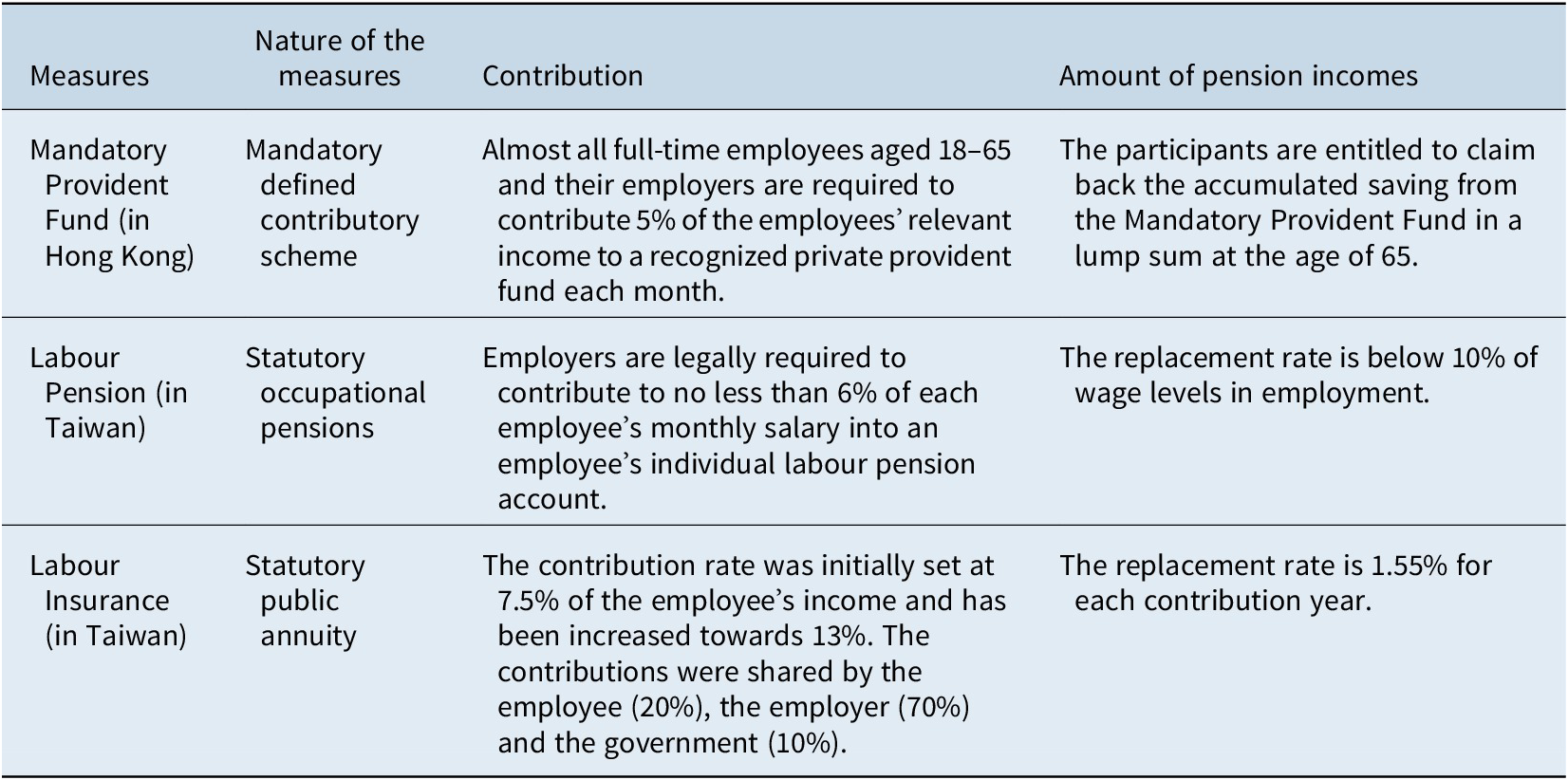
In Hong Kong, the most important earnings-related pension scheme is the Mandatory Provident Fund, which is an employment based, privately managed mandatory defined contributory scheme (Commission on Poverty, 2015). The majority of full-time employees aged 18–65 and their employers are required to contribute 5 per cent of the employees’ relevant income to a recognized private provident fund each month (Shi & Mok, Reference Shi and Mok2012)Footnote 2, Footnote 3 (see Table 1). Workers earning less than HK$7,100 are not legally obliged to make contribution to the Mandatory Provident Fund but their employers are still required to contribute 5 per cent of their employees’ wage to the Fund. The accumulated saving receives tax exemptions. The participants are entitled to claim back the accumulated saving from the Mandatory Provident Fund in a lump sum at the age of 65. In 2018, 73 per cent of the working population in Hong Kong was covered by the Mandatory Provident Fund and only 2 per cent of the working population should have joined but have not yet joined the Fund (Mandatory Provident Fund Schemes Authority, 2019). According to the Commission on Poverty (2015), the Mandatory Provident Fund could provide a person with sufficient money to meet their daily living expenses on three conditions. Firstly, the Mandatory Provident Fund participants have earned the median income of employed persons (in 2014) for a long period of time. Secondly, they have made contributions to the Mandatory Provident Fund for 40 years. Thirdly, at the age of 65, they are entitled to receive the Old Age Allowance, as a supplement to the Mandatory Provident Fund saving.Footnote 4 However, there is no guarantee that everybody has the opportunity to work continuously for 40 years and receive a wage no less than the median income. Due to their commitment to domestic roles, women have more difficulties than men in taking part in the work economy. In 2019, the labour force participation rate of local women is only 50.8 per cent, far below that of 68.5 per cent for local men (Legislative Council Secretariat, 2019). There is also a gender earning gap. For example, the average monthly salaries of male and female service workers HK$14,911 and HK$12,227 in 2019.
Earnings-related pension measures in Hong Kong and Taiwan.

Sources: Mandatory Provident Fund Schemes Authority (2019), Pension Funds Online (2020), Zhao (Reference Zhao2018).
Labour Pension and Labour Insurance are important earnings-related pension measures in Taiwan (Shi & Mok, Reference Shi and Mok2012). The new Labour Pension system was introduced in 2005. The Labour Pension Act requires employers to contribute no less than 6 per cent of each employee’s monthly salary into an employee’s individual account (Yeh & Shi, Reference Yeh, Shi, Mok and Lau2014). The employees have the right to choose to start collecting their payments upon reaching the age of 60. In addition, workers receive protection from the old-age benefit of the Labour Insurance, which was changed to annuity from lump-sum payment in 2008. The replacement rate is 1.55 per cent for each contribution year (Bureau of Labor Insurance, 2018a). If participants make contribution for 40 years, their pension income is expected to be more than 60 per cent of the average monthly insurance salary. Hence, if a person takes part in formal employment for a long period, she/he is likely to gain sufficient retirement income to achieve a secure retirement. However, there is no guarantee that everybody can participate in formal employment for a long period of time. It is particularly difficult for women to save pension income through the earnings-related pension measures due to a lower labour participation and the gender wage gapFootnote 5.
Child care support
Studies found that women’s responsibilities for taking care of their child affect their chance of developing their career and saving pension incomes through earnings-related pension measures (Foster, Reference Foster2010; Price, Reference Price2007). This argument is supported by the evidence that those countries which provide more child care policy measures have a narrower pension gap (Bettiet al., Reference Betti, Bettio, Georgiadis and Tinios2015). Women may provide care not only to their child but also to other dependents such as senior members in the family (Keck & Saraceno, Reference Keck and Saraceno2012; Kroger, Reference Kroger2011). Nonetheless, if the child care policy measures are far from developed to reduce significantly women’s caring responsibilities in Hong Kong and Taiwan, it is reasonable to have doubts about the willingness of the governments in these two locations to assist women to take part in the work economy as a worker and to save pension income through earnings-related pension measures.
In Hong Kong, new fathers are entitled to have five days of statutory paid paternity leave. However, there is no statutory parental leave. The government has recently extended the statutory paid maternity leave compensation from ten weeks to 14 weeks. While it is not mandatory for children to attend kindergartens, almost 100 per cent of children aged 3 to 6 are kindergarten students (The University of Hong Kong, 2018). Obviously, there is a wide gap between the end of the paid maternity leave and the age of children attending the kindergartens.
It is difficult for parents (especially mothers) to take part in formal employment unless they can receive sufficient support from the child care services. However, evidence throws doubts on the government’s keenness to reduce their difficulties through the provision of public child care services. The aided and unaided standalone child care centres and aided and unaided child care centres attached to kindergartens are widely seen as important providers of child care services (Legislative Council Secretariat, 2019; The University of Hong Kong, 2018). All the 12 aided standalone childcare centres provide long full-day child care services for children under 2 with only two which also provide services for children 2–3. Most of the unaided standalone child care centres focus on serving children aged 2 to under 3 (The University of Hong Kong, 2018). The majority of the child care centres attached to kindergartens serve children 2 under 3 with nine aided and 19 non-aided also provide places for children under 2 (The University of Hong Kong, 2018). The services provided by child care centres are seriously inadequate (Xia & Ma, Reference Xia and Ma2019). For example, with every 61 children aged under 2, only one place is available (The University of Hong Kong, 2018). Worse still, there is an uneven distribution of childcare services by district (Legislative Council Secretariat, 2019). For example, there are no aided places for children under 2 in highly populated districts such as Kwun Tong and Wong Tai Sin (The University of Hong Kong, 2018). It is important to note that the childcare services are too expensive for grassroots families, as the government subsidizes only one-fifth of the operating cost of centred based services (Labour and Welfare Bureau, 2019). In 2018, the median monthly employment earnings for working mothers in the bottom half of the income distribution were below HK$ 10,500. However, the median monthly fees for the centre-based services were HK$5,537 for children aged below 2 (Labour and Welfare Bureau, 2019; Legislative Council Secretariat, 2019).
Taiwan provides both paid maternity and paid paternity leave. New fathers are entitled to have five days of paid paternity leave. Paid maternity leave entitlement is up to eight weeks. Employees with a child aged 3 or younger can apply for two years’ unpaid leave. In 2009, the Employment Insurance Parental Leave Allowance scheme was introduced. This scheme provides allowances (six months in maximum) to employees for part of the loss that occurs during unpaid parental leave. The allowance is calculated on the basis of 60 per cent of the insured person’s average monthly insurance salary. Not all eligible employees choose to fully make use of unpaid parental leave. It is because the benefits associated with this kind of leave they receive are much less than the wage they lose (Ministry of Labor, 2016). Hence, in order to develop their career, many working parents need the support of child care services. However, there is a gap between what the child care services offer and what working parents need. Because of the inadequate provision of public infant centres, working parents need to rely on the services provided by babysitters and private child care centres (Ministry of Education, 2018). However, these services are expensive. It is estimated that spending on these services accounts for nearly one-fifth of the total family income (Ministry of Education, 2018). This to a certain extent explains why many women quit their jobs after having their first child (Ministry of Education, 2018). The government has recently become more aware of the insufficient provision of the supports to the parents of young child. In order to make childcare services more affordable to the public, it is expanding the public care centres, activating quasi-public childcare services and providing more parental subsidies (Social and Family Affairs Administration, 2018). However, since these reforms are in their early period, their effectiveness in creating a better condition for women to participate in formal employment remains to be seen.
Retirement protection measures for non-workers
In Hong Kong, the Comprehensive Social Security Assistance scheme can be seen as the most important retirement protection measure for non-workers in Hong Kong. This scheme provides means-tested financial protection to all those who are in poverty (Social Welfare Department, 2019a). Nearly half of Comprehensive Social Security Assistance scheme users are aged 60 or above (Commission on Poverty, 2015). This implies that this scheme has the potential to assist those people who have short or no work history to secure a reasonable standard of living in the later stage of life. If the benefits of this scheme are at a generous level, women (and men) can choose to play the role of full-time care provider and do not need to spend time earning money from the paid labour market. However, the benefits provided by the Comprehensive Social Security Assistance scheme are inadequate. The basic allowance (HK$3,715 per month) provided by the scheme for a single able-bodied adult at 65 or above only accounts for around 20 per cent of the average wage (Census and Statistics Department, 2019). In order to support those households whose income is higher than allowed by the Comprehensive Social Security Assistance to receive financial assistance, the government provides the Normal Old Age Living Allowance and Higher Old Age Living Allowance (Social Welfare Department, 2019b). The benefits provided by these two non-contributory state benefits however are lower than the poverty line (HK$ 4,000) for a one-person household.Footnote 6
In Taiwan, the National Pension Insurance scheme can be seen as an important retirement protection measure for people with no or short work history (particularly for those housewives/househusbands). The National Pension Insurance insures those citizens (aged 25–65) who are not covered by important pension measures such as the Labour Insurance and government employee’s insurance scheme. Housewives, students and unemployed are the main targets for the National Pension Insurance. When the National Pension Insurance was carried out in 2008, the premium rate was 6.5 per cent (Chen et al., Reference Chen, Hsu and Weiss2015). An actuarial evaluation of the rate is made every two years, each covering a period of 40 years (Bureau of Labor Insurance, 2018b). The premium rate will be kept unchanged on condition that the insurance fund is sufficient to pay the insurance benefits for the following 20 years. If this condition cannot be met, the premium rate will be increased up to 12 per cent. Insured people are expected to contribute 60 per cent of the payable contributions and the government subsidizes the rest. However, as many participants do not have sufficient financial resources to pay their share, the government contributes a significant proportion of the premium (Bureau of Labor Insurance, 2018b). In order to be entitled to apply for old-age pension payment from the National Pension Insurance Scheme, it is necessary to make contributions continuously for a long period of time. However, many people make contributions for much less than 40 years. As a result, they received less than NT$4,000 per month (Bureau of Labor Insurance, 2018b). This implies that the National Pension Insurance Scheme in practice cannot guarantee users a reasonable standard of living in their later stage of life.
Implications
This section discusses the lessons learnt from the examination of the case examples of Hong Kong and Taiwan. The government can play an important role in tackling the incompatibility challenge faced by those women who are unwilling or unable to use the earnings-related pension measures to save pension income. It can do so through the provision of public child care support and retirement protection measures for non-workers. As discussed in the previous parts, the public child care support has the potential of creating favourable conditions for women to take part in the work economy and to use the earnings-related pension measures to accumulate pension income. The retirement protection measures for non-workers potentially can ensure that those full-time family care providers gain sufficient financial resources to maintain a reasonable standard of living in their later stage of life. However, as shown in the case examples of Hong Kong and Taiwan, there is no guarantee that the government is willing to commit itself to a comprehensive provision of either child care supports or retirement protection measures for non-workers. Hence, in order to increase women’s freedom to choose the ways of participating (or not participating) in the family and enhance their chance of having a secure retirement, it is necessary to pressurize the government to fully develop the defamilization/familization and pension strategies and investigate why the government’s commitment to the provision of the defamilization/familization measures and pension measures is less than what people need. By doing so, we can convey two significant welfare messages.
The first message is that the double functions of defamilization/familization measures, and pension instruments should be recognized. As a kind of defamilization measure, public child care supports can assist women to choose whether or not to take part in the family as a care provider. In addition to this function, public child care supports can serve to create favourable conditions for women to sell their labour power in the work economy, and as a result, have the opportunity to take part in the earnings-related pension schemes. In view of this function, it is reasonable to regard public child care supports as a part of pension strategies. As shown above, the retirement protection measure for non-workers serves to assist full time family care providers to secure financial resources to maintain a reasonable standard of living in their later stage of life. This implies that this measure can function not only as a pension tool but also as a familization tool. In this sense, it is reasonable to suggest that the retirement protection measure for non-workers should be seen as a part of the defamilization/familization strategies.
The second message is that concerns about the causes of the difficulties in tackling the incompatibility challenges should be raised. The studies of welfare ideologies and welfare regimes in East Asia provide insight into the discussion of this issue (Hudson, Kuhner, & Yang, Reference Hudson, Kuhner and Yang2014; Ku & Jones Finer, Reference Ku and Jones Finer2007; Yu, Reference Yu2012). These studies draw attention to the view that a number of East Asian countries including Hong Kong and Taiwan organize welfare with the emphasis on the ideas of productivist welfare capitalism. These ideas are that the government should regard social policies as an instrument of economic policies and should see the value of social policies mainly in terms of their contributions to economic growth (Holliday, Reference Holliday2000, Reference Holliday2005). This implies that the government is expected to provide welfare mainly for increasing the competitiveness of the economy in the global market and attracting investments rather than for meeting the welfare needs of people. The government is also expected to put the interest of investors and the business sector before the needs of the disadvantaged groups. This explains why many East Asian governments only selectively carry out some welfare measures and expect that adult female members of the family (under the influence of heteropatriarchy) provide care to other members especially those excluded from the labour market (Aspalter, Reference Aspalter2006).Footnote 7
Some studies throw doubt on the importance of the productivist welfare capitalism ideas in guiding the development of social welfare in East Asian countries (Chau & Yu, Reference Chau and Yu2013; Fleckenstein & Lee, Reference Fleckenstein and Lee2017; Lin & Chan, Reference Lin and Chan2015). There is a view that the introduction of competitive politics in East Asian countries makes their welfare policies more sensitive to the needs of citizens (Fleckenstein & Lee, Reference Fleckenstein and Lee2017; Lin & Chan, Reference Lin and Chan2015). Moreover, the family changes such as the decline in the size of the family and increasing female labour participation undermine the capacity of the family in playing the role as a welfare provider (Chau & Yu, Reference Chau and Yu2013). As a result, East Asian governments are required to take more actions to outsource the care responsibilities of the families to other sectors.
However, the existence of the incompatibility challenge caused by the emphasis on the earnings-related pension schemes at the expense of non-contributory schemes and the under-development of familization and defamilization measures in Hong Kong and Taiwan suggests that we should not under-estimate the influence of the ideas of productivist welfare capitalism. This also suggests that those people protected by the capitalist labour market such as the business sector and high-income groups have more influence in the development of the pension policies than those who are in the marginal position in the labour market.
Conclusion
This article is concerned with the incompatibility challenge faced by women. Its focus is on the government’s role in dealing with this challenge. It has shown that the government has the potential to assist women to tackle this challenge by implementing the defamilization/familization and pension strategies. However, there is no guarantee that the government is willing to do so. Hence, in order to enhance women’s freedom to choose whether and how to participate in the family relationship and women’s chance for achieving a secure retirement, it is necessary to pressurize the government to commit itself to the implementation of defamilization/familization and pension strategies.
As the last part of this article, agendas for further work are suggested. So far, this article focuses on child care supports and pension measures for non-workers. It is worth discussing the effectiveness of other elements of the defamilization/familization and pension strategies in assisting women to deal with the incompatibility challenge. Examples of these elements are allowances for carers, and public care services for older people. It is equally worth exploring examples of governments which are willing and able to implement the defamilization/familization and pension strategies.
Disclosure
This research was funded by General Research Fund at the Research Grants Council of Hong Kong (grant number 12604517).
Notes on contributors
Dr Sam W. K. Yu is an Associate Professor in the Department of Social Work at the Hong Kong Baptist University. He teaches social work and social policy. His research interests are social exclusion and welfare mix. His recent publications include “The Contributions of the Studies of Health Care Systems to the Examination of the Productivist Welfare Capitalism Thesis,” Journal of Policy Practice and “Studying the Health Care Systems in Seven East Asian Countries by the Cluster Analysis,” Development and Society. Address: Department of Social Work, Hong Kong Baptist University, Hong Kong; Email: samyu@hkbu.edu.hk.
Dr. Chui Man (Ruby) Chau is an Associate Professor in Public and Social policy, School of Sociology and Social policy, University of Nottingham. Her main research interests are comparative social policy, East Asian welfare regimes, defamilization and women. Latest publications include: “Defamilisation and familisation risks, adult worker models, and pro-employment/decommodification measures for women: The case of Hong Kong” (with Yu, W. K., & Kuhner, S.) in Journal of International and Comparative Social Policy, and “Hong Kong: Ruling principles of the government and responses of social work education and practice” (Yu, W. K.), In I. Shaw, & R. Ow (Eds.), Asian social work: Professional work in national contexts. UK: Routledge. Email Address: ruby.chau@nottingham.ac.uk
Miss Sze-Man Li is a social worker and project supervisor. Her research interests are liquid life and risk and social security measures. Address: Department of Social Work, Hong Kong Baptist University, Hong Kong: Email: szeman_rosetta@hotmail.com
Miss Mei-Yin (Anna) Lee is a researcher and practice teacher. Her research interests are the adult worker models, family carers of adults with intellectual disability. Address: Department of Social Work, Hong Kong Baptist University, Hong Kong: Email: leemeiyinbbb@gmail.com