Introduction
It is perhaps surprising that indigenous Māori in New Zealand have had significant opportunities to influence mainstream politics and policy, given a context of ‘fast policy’ transfer where ‘social investment’ and greater marketisation are globally proclaimed as solutions to ‘wicked’ policy problems (Powell and Miller, Reference Powell and Miller2014; Head and O'Flynn, Reference Head, O'Flynn, Massey and Johnston2015; Peck and Theodore, Reference Peck and Theodore2015). Yet, since 2008, the Māori Party has negotiated supply and confidence agreements with the conservative National Party in return for progress on Māori Party initiatives. The Māori Party combines ‘a drive towards rangatiratanga [self-determination], and an attempt to address the socio-economic needs of Māori’ (Smith, Reference Smith, Mulholland and Tawhai2010: 215, emphasis added). Social policy has been central to the Māori Party's political platform given the relatively poor levels of health, education, housing and income/wealth amongst Māori compared to non-Māori New Zealanders (Marriott and Sim, Reference Marriott and Sim2014). Criticism from both within and beyond its own ranks suggests the Māori Party favours tribal elites at the expense of the poor (Sykes, Reference Sykes2010; Harawira, Reference Harawira2011). Māori voters may support this view, since the number of Māori electorates held by the Māori Party fell from five to one between 2008 and 2014, leaving only two Members of Parliament (MPs) in Parliament (Bargh, Reference Bargh and Hayward2015). Both facts imply that having an indigenous political party in government has made little difference to New Zealand social policy.
This article challenges this view by examining in detail three of the key social policy initiatives promoted by the Māori Party. Each is assessed against three criteria for innovation: a) did the initiative embed Māori cultural values and governance into mainstream policy? b) was the initiative likely to have been implemented without Māori Party lobbying? and c) does the initiative have potential to improve the lives of Māori New Zealanders? Having established a political context, the article argues that the Whānau Ora strategy's holistic, whole-family approach to social well-being and Māori language revitalisation initiatives are significant social policy innovations. A Ministerial Committee on Poverty resulting from Māori Party negotiations with National also allowed Māori representatives to advocate for important poverty-focused initiatives but these did not embed Māori cultural values/governance, cannot be specifically associated with Māori Party advocacy and barely begin to address the structural causes of material disadvantage amongst Māori. Political constraints thus continue to inhibit this new opportunity for an indigenous party to make a significant and lasting difference in the social policy arena.
Political context
The achievements of the Māori Party are a test-case internationally for two reasons. First, as part of a ruling government since 2008, it has gained unprecedented leverage facilitated by specific indigenous representation in mainstream parliamentary politics. Since 1867, Māori have been able to run for Māori electorate seats which provide unique opportunities for Māori to influence New Zealand politics (Bargh, Reference Bargh and Hayward2015). When this is contrasted with indigenous representation in the three Scandinavian countries where Sami live, it can be seen that Sami representatives have only been elected to the mainstream parliament in Norway, although indigenous peoples in each country have indirect political influence through separate Sami parliaments (Josefsen, Reference Josefsen2010). There are also no special electorate seats for indigenous peoples in Australia or Canada; while Australia nonetheless elected three indigenous senators and one member of the House of Representatives in 2016 and Canada elected 10 indigenous MPs in 2015 (Lum, Reference Lum2015; Gobbett, Reference Gobbett2016), New Zealand had 14 Māori MPs in 2016 with half elected into Māori electorate seats (New Zealand Parliament, 2016). Second, Māori Party MPs are elected into the mainstream parliament as members of an indigenous-specific party. Again, if this is compared with Sami representation, it can be seen that only in Norway have Sami issues been a focus for mainstream politics – and this has been less frequent since the Sami parliament was established in 1989 (Josefsen, Reference Josefsen2010).
Although not the first dedicated Māori political party, the Māori Party's formation has had a huge impact on New Zealand mainstream politics. The party was established in 2004 when Labour MP, Tariana Turia, refused to vote for legislation proposed by her own government because it placed the foreshore and seabed into public ownership, thus denying Māori tribes an opportunity to seek judicial recognition that they owned this important resource. Backed by widespread Māori rejection of the legislation, Turia won the by-election as co-leader of the new Māori Party, which went on to gain five of seven Māori electorate seats in the 2008 general election. The National Party won sufficient party vote support under the Mixed Member Proportional (MMP) Representation System to govern alone but, keen to broaden its political base long-term, negotiated supply and confidence agreements with smaller parties including the Māori Party in 2008, 2011 and 2014. This challenged an alliance, which had been apparent since the 1930s, between Māori electorates and the Labour Party. However, this alliance has been less secure since Labour adopted neoliberal policies in the 1980s and since the first MMP election in 1996. National has never won a Māori electorate seat and usually does not even run a candidate, although it actively recruits a small number of Māori MPs into general seats (Bargh, Reference Bargh and Hayward2015).
Supply and confidence agreements require the Māori Party to support the National Party's position in all matters subject to confidence and supply votes in the House of Representatives, as well as on any budgetary or procedural votes needed to pass Bills in Parliament. In return, the Māori Party gained consultation rights on major legislative, budget and policy issues.
Its formal relationship with National also saw the Māori Party gain key ministerial or associate ministerial positions outside of Cabinet for co-leaders Pita Sharples (Māori Affairs, Education, Corrections) and Turia (Community and Voluntary Sector, Health and Social Development and Employment, then later Whānau Ora, Disability, Housing and Social Development and Employment). In 2014, new co-leader, Te Ururoa Flavell, became Minister for Māori Development and Whānau Ora, Associate Minister for Economic Development and a member of the Cabinet Committee on Treaty of Waitangi Negotiations (Bedwell, Reference Bedwell2014). Māori Party members in ministerial positions are bound by collective responsibility in relation to their portfolios and thus speak for the government, not their party. This, and Māori Party votes for procedural motions to ensure Bills are sent through different Parliamentary stages, has made it difficult for the Māori Party to convince voters that it has not ‘sold out’ to National's neoliberal economic agenda. Nonetheless, the Māori Party was denied any political influence in 2005, when the Labour Party described it as the last option for a potential coalition partner. As former Māori Party MP, Hone Harawira (cited by Leahy, Reference Leahy2015: 426) stated: ‘In three days, National offered us more than Labour did in three years’.
Last, but not least, the relationship accords have seen National implement a number of Māori Party policies. In addition to the social policy initiatives discussed later, policy gains include: replacing the Foreshore and Seabed Act 2004 (the catalyst for the Māori Party being established); maintaining the status quo regarding the Māori electorate seats (National had formerly promoted their abolition); a constitutional review; and the unexpected signing of the United Nations Declaration on the Rights of Indigenous Peoples, which the previous Labour-led government refused to endorse (National Party and Māori Party – NP and MP, 2008, 2011, 2014).
Although the Māori Party claims that it has voted against National more than it has voted with it, there are overlaps between National's neoliberal agenda and the economic interests of tribal/Māori businesses with significant assets (MacDonald and Muldoon, Reference MacDonald and Muldoon2006; Sykes, Reference Sykes2010; Godfrey, Reference Godfrey, Johansson and Levine2015), as well as articulated beliefs that the welfare system is part of the ‘problem’ for Māori, that individuals and families should take greater responsibility and that decentralised models of funding are the ‘solution’ (Turia, Reference Turia2006). In 2008, Turia (cited by Leahy, Reference Leahy2015: 392–93) stressed that differences between National and Labour had not only significantly narrowed but that significant developments in Māori services had emerged under a National, not a Labour, government: ‘The difference is National never talks about what it does for us because basically they've got a red-neck voting population’.
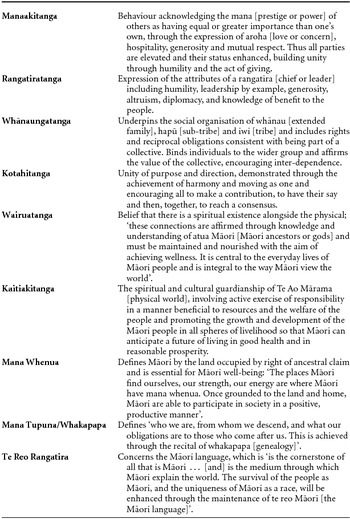
Indeed, National's core constituency has traditionally resisted ‘separate rights’ for Māori based on their indigeneity and their status as signatories of the 1840 Treaty of Waitangi, New Zealand's ‘founding document’. National-led governments have made significant progress on Treaty claim settlements (even prior to the National-Māori Party relationship), to some extent acknowledging that Māori-language versions of the Treaty granted the British Crown the right to ‘kāwanatanga’ (governance, not sovereignty as declared in the English-language Article One) and that Article Two acknowledges the continuing exercise of ‘tino rangatiratanga’ (Māori self-determination and control) rather than simply the ownership of property rights. The National Party has, however, been reluctant to discuss tino rangatiratanga in regards to social policy, instead focusing on the equal citizenship rights granted in Article Three to justify attention to Māori socio-economic needs (Humpage, Reference Humpage2006; Mulholland, Reference Mulholland and Hayward2015). Given that former National Party leader, Don Brash, created a group lobbying against any recognition of indigenous rights in 2016 (Hobson's Pledge, 2016), some National voters probably feel uncomfortable about their party's formal relationship with the Māori Party, which is driven by the nine key principles emerging from a Māori world view summarised in Table 1. This is the case even though the Māori Party's (2013) articulated definition of rangatiratanga cautiously prioritises local, rather than national, level politics.
Principles guiding the Māori Party

Note: All quotes and information from the Māori Party (2013: 2–6) constitution.
Referring to these principles, Turia (cited by Leahy, Reference Leahy2015: 357) has stated that: ‘The Māori Party does not intend to operate like any other political party. The tikanga Māori [Māori custom] nature of the party is an essential part of the justification for its existence’. This, in itself, is internationally significant; however, the following three sections show how Māori Party lobbying has seen the same principles implemented through social policy initiatives. Despite forming part of the government as New Zealand entered a global recession, Flavell (Reference Flavell2014) contends that Māori Party negotiations resulted in substantial investment across subsequent budgets and that his former co-leaders ‘Tariana [Turia] and Pita [Sharples] have transformed the priorities of policy agencies, the agenda of Government, and the attitude of New Zealanders by their unstinting belief in the potential of whānau to do for themselves’. These claims may be exaggerated, but the next section certainly illustrates how the whānau or extended family unit is being reframed as a site for Māori self-determination.
Whānau Ora
Whānau Ora means ‘family well-being’ and this major policy strategy promotes the inclusive provision of services and opportunities to families in need that empowers them as a whole, rather than focusing separately on individual family members and problems. Jointly implemented by Te Puni Kōkiri (TPK or Ministry of Māori Development) and the Ministries of Social Development and Health, it requires multiple government agencies to work together to assist families (TPK, 2015).
Whānau Ora shares strong similarities with ‘joined-up government’ initiatives implemented during the 2000s (Clark, Reference Clark2002; Humpage, Reference Humpage2006) and the Organisation for Economic Cooperation and Development's (2015) recent focus on integrated, holistic services. The strategy's outcomes-focused funding mechanisms also parallel social impact bonds and other schemes to ‘privatise’ social services (Powell and Miller, Reference Powell and Miller2014; Gustafsson-Wright et al., Reference Gustafsson-Wright, Gardiner and Putcha2015). However, Whānau Ora distinctively recognises the collective entity of whānau, defined as a multi-generational family group made up of many households, supported and strengthened by a wider network of relatives. The strategy thus embodies the principle of whānaungatanga, acknowledging that whānau as a collective hold both rights and obligations through broad, interdependent relationships with tribal and other Māori organisations (Māori Party, 2013). Whānau Ora further ‘endorses a group capacity for self-determination’ (Taskforce on Whānau-Centred Initiatives, 2010: 30) that moves beyond individualised notions of ‘empowerment’ and, defining wellbeing holistically, recognises the spiritual and inter-relationships between mental and physical health (Māori Party, 2013).
The whānau ora concept has been utilised in the New Zealand's health sector since the 1990s, while capacity building initiatives in the 2000s strengthened the already significant role that contracted Māori organisations play in service delivery (Humpage, Reference Humpage2006; Leahy, Reference Leahy2015). But Turia remained concerned that health/social services intervene only after things go wrong for an individual, rather than restoring full whānau functioning or potential (Auditor-General, 2015). Significant inequities in the allocation of funding of Māori versus non-Māori providers also supported her view that: ‘We have a right to be self-determining and we need a budget that will assist us to do that’ (cited by Leahy, Reference Leahy2015: 233). By 2008, her ideas for Whānau Ora, as both a policy strategy and an overarching goal, incorporated ‘eliminating poverty, advocating for social justice and advancing Māori social, cultural, economic and community development in the best interests of the nation’ (NP and MP, 2008: 3).
Whānau Ora was central to the 2008 relationship accord, culminating in the formation of a Taskforce on Whānau-Centred Initiatives in 2009 which put the principle of rangatiraranga into practice by consulting with Māori at many levels across the country. The Taskforce (2010: 71) recommended the development of whānau-centred initiatives enabling families to be: ‘self-managing; living healthy lifestyles; participating fully in society; confidently participating in te ao Māori [the Māori world]; economically secure and successfully involved in wealth creation; and cohesive, resilient, and nurturing’. Deputy Prime Minister and Minister of Finance, Bill English, said National understood: ‘the Māori Party was about people taking control of their own lives, which was fundamentally a philosophy, a view of the world, we could connect with’ given National promotes minimal state intervention and individual responsibility (English cited by Leahy, Reference Leahy2015: 423). Turia was appointed the first Minister for Whānau Ora in 2010 and $134 million was allocated over four years, with smaller allocations bringing the total to around $210 million by 2016 (Māori Party, 2014; English, Reference English2016).
The Auditor-General's (2015: 4) report on the first four years of the strategy described it as ‘an example of innovation and new thinking in service delivery. Whānau Ora was an opportunity for providers of health and social services in the community to operate differently and to support families in deciding their best way forward’. Three initiatives constituted the first phase. First, until June 2014 whānau could apply to TPK (Ministry of Māori Development) for small sums of money to prepare and implement a whānau plan through a legal entity responsible for any resulting contract. Vulnerable families in areas of high deprivation and/or geographic isolation, Māori and PasifikaFootnote 1 families were prioritised. Although a formal evaluation remains outstanding, TPK's (2015) analysis of provider reports and whānau surveys found that almost two-thirds of whānau who engaged with Whānau Ora developed plans, with the Auditor-General (2015) reporting that most meet their goals. Planning also produced other benefits, such as: reconnecting whānau and iwi (tribal) members; identifying skills/expertise already within whanau; preserving whānau histories, cultural traditions and/or traditional lands; and encouraging the notion of cultural guardianship (Māori Party, 2013). The whānau plans thus support self-determination at the whānau and individual level.
A second key initiative focused on building the combined ability of provider collectives to deliver coordinated services addressing the needs of both individuals and whānau. By 2014, 34 collectives represented more than 180 independent Māori and Pasifika health and social services providers as well as other Māori organisations. Provider funding can been used to employ ‘navigators’ who work intensively with 15 or more whānau each year, assisting families to access the varied services offered by government and providing ‘wrap-around’ service delivery (Auditor-General, 2015). There are some similarities with the United Kingdom's ‘Troubled Families’ programme, which targets family units identified as having ‘multiple problems’ requiring intervention (Hayden and Jenkins, Reference Hayden and Jenkins2014), and with the Council of Australian Government's indigenous-specific trials for ‘whole of government’ coordination aiming to improve access to government services (Head and O'Flynn, Reference Head, O'Flynn, Massey and Johnston2015). However, families voluntarily opt into Whānau Ora services and the neoconservative ‘deficit thinking’ associated with both international examples is absent from Whānau Ora (although not from other National government policies). Most importantly, Māori values are central to the way in which the provider collectives work; for instance, analysis of their reports indicates that 79 per cent of the 34 collectives believed that whānaungatanga was critical for building connections and trust with families (TPK, 2015).
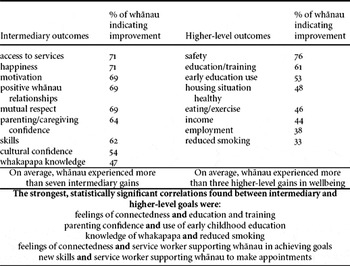
Funding for navigators was intended to be phased out quickly but TPK's (2015: 43) analysis found that navigators had worked with 58 per cent of families engaged with Whānau Ora and ‘[t]hose whānau who were engaged with more services and programmes experienced more improvements’. Navigators have since become a fixed feature of service delivery with increasing funding in 2014 and 2016 (Auditor-General, 2015; English, Reference English2016). Table 2 suggests that the combination of the culturally-specific whānau plans and integrated service knowledge of navigators is already having a positive impact on families.
Whānau Ora outcomes

Note: Findings drawn from TPK's (2015) analysis of provider reporting and 895 whānau surveys.
The third initiative aimed to integrate contracting and government agency support to improve the efficiency of contract management and provider capability to deliver whānau-centred services. While the Auditor-General (2015: 5) observed that health/social providers have been supported to form collectives that ease access to services and to encourage a focus on whānau, ‘the providers are mainly required by their contracts with government agencies to deliver services to individuals . . .. The signals currently sent by different parts of government are, at best, mixed’. TPK's analysis (2015) further reported that only 34 per cent of provider collectives described government agencies as becoming more responsive to whānau-centred approaches.
The Taskforce (2010) proposed a stand-alone commissioning agency as the second and final phase of Whānau Ora, enabling Māori to play a greater decision-making and governance role in the social service sector. Following efforts to expand the whānau-centred approach to Pasifika families from late 2012 (Turia, Reference Turia2014), Cabinet decided three such agencies were required: one for the North Island, one for the South Island and one for Pasifika peoples across the country. The commissioning agencies seek applications and enter into contracts for funding from any community-based organisation in any sector (Auditor-General, 2015). In 2016, the government will also transfer up to $11.38 million of funding for programmes aligned with the Whānau Ora approach from the Ministry of Social Development (out of around $26 billion in appropriations for 2016/17) (Tolley and Flavell, Reference Tolley and Flavell2016; Treasury, 2016). Commissioning agencies will further trial payment-by-results mechanisms, with financial rewards for agencies achieving results in priority or hard-to-reach areas above and beyond the outcomes agreed (Turia, Reference Turia2014). The commissioning agencies now look more like one of the ‘privatisation’ approaches identified by Powell and Miller (Reference Powell and Miller2014) in their international review than the Māori-specific funding model proposed by the Taskforce (2010).
New institutions take time and money to establish (Turia, Reference Turia2014). However, the Auditor-General (2015: 4) was critical of the fact that nearly a third of total spending was on administration and that ‘[d]elays in spending meant that some of the funds originally intended for whānau and providers did not reach them’. More generally, a lack of clear aims and outcomes makes it difficult to measure whether the strategy has made a significant difference to Māori lives (Auditor-General, 2015). For instance, although TPK (2015) identified that 64 per cent of the 9,408 whānau, comprising 49,625 individuals, who had benefitted from Whānau Ora by June 2014 were Māori, the Auditor-General (2015) criticised its decision not to publish collected data on the ethnicity of whānau receiving funding because it is unclear whether Māori and Pasifika were given priority as proposed. A new engagement strategy with whānau, tribal and Māori organisations should improve understanding of how policies impact local communities (Bedwell, Reference Bedwell2014), while commissioning agencies will monitor the performance of commissioned entities against agreed results (Turia, Reference Turia2014). Whānau Ora's similarities with social impact bonds and Troubled Families, which have both had very mixed results (Thoburn, Reference Thoburn2013; Gustafsson-Wright et al., Reference Gustafsson-Wright, Gardiner and Putcha2015), make this lack of a clear evaluation plan troubling – even if early signs suggest the cultural specificity of integrated services may result in improved outcomes for Māori.
Certainty about Māori outcomes is particularly important since Prime Minister John Key overruled the Taskforce's (2010) intention for Whānau Ora to focus only on Māori families by asserting that it could be used by all New Zealanders. While this means non-Māori families are accessing services shaped by indigenous cultural values – a unique policy innovation – it diminishes the Māori Party's focus on radically improving Māori outcomes. Not only did TPK's (2015: 90) analysis conclude that ‘[a] strengths-based approach without an emphasis on rangatiratanga does not generate whānau independence and leadership’ but also the initial Whānau Ora funding was reallocated from elsewhere, meaning Māori may find other services less accessible, weakening outcomes overall.
Whānau Ora remains an innovative and major achievement for the Māori Party. Not only does it seek to incorporate Māori cultural values into mainstream social policy and holds the potential to improve opportunities for Māori governance over services for Māori but it is unlikely the strategy would have been implemented without Māori Party advocacy, given considerable political criticism and opposition (Flavell, Reference Flavell2014). The whānau ora concept is now being incorporated into a number of state agency strategy documents as part of a strengths-based approach to Māori policy (Moore, Reference Moore2014). The Māori Party further plans to extend Whānau Ora commissioning into education, justice, housing and other government portfolios (Māori Party, 2014; Fox, Reference Fox2015).
The significant achievement of extending Māori governance over Māori services and outcomes can only be politically sustained, however, if National understands Whānau Ora as an example of recognition of rangatiratanga and the status of Māori as Treaty partners, instead of just one of many privatisation experiments. Moore (Reference Moore2014) argues that a focus on whānau deflects attention from the Treaty-based relationship between the Crown and iwi (tribal members), side-lining more challenging forms of political self-determination which National is reluctant to endorse. Although noting their relationship will continue ‘based on good faith and no surprises’ (NP and MP, 2014: 1), the 2014 relationship accord did not include the same, specific commitment to the Treaty of Waitangi found in the 2008 and 2011 documents. Whānau Ora may have more direct impact on Māori wellbeing than attempts to insert Treaty references into social policy legislation (Humpage, Reference Humpage2006), but this shift away from a Treaty-based approach nonetheless raises questions about the longevity of Whānau Ora and its capacity to radically transform Māori outcomes.
Māori language education
While Whānau Ora is the Māori Party's highest-profile social policy initiative, significant moves have also been made to protect and teach the Māori language, which is unique to New Zealand. The country is widely regarded as having made ‘the most successful attempt thus far at indigenous language revitalization’ because of the consistent adoption of a total immersion approach through kōhanga reo [Māori-immersion preschools], initially established by parents without government funding in the 1980s and then incorporated into the national education system and expanded to all levels of education (May, Reference May2013: 52). Many countries formally recognise and support indigenous languages but few have given them the status of an official language at the national level as New Zealand has done since 1987 (Central Intelligence Agency, 2016). Yet most New Zealanders still only speak English and recent reviews of the state of the Māori language highlight its ongoing fragility (TPK, 2014).
Te reo rangatira – the revitalisation of the Māori language as the first and official language of New Zealand and as the appropriate language to carry Māori knowledge and customs – has been central to all three relationship accords. But in 2011 the National Party agreed to consider recognising the unique status of Māori-language immersion educational institutions (early childhood through to tertiary) and Māori-medium initiatives found in mainstream schools through their own statutory legislation (NP and MP, 2011). A revised Māori Language Strategy (TPK, 2014) outlined new result areas, indicators and targets, while the historic Te Pire mō Te Reo Māori (Māori Language) Act 2016 acknowledged that the Crown's past policies and practices detrimentally impacted Māori language and culture. An explicit Crown commitment to work in partnership with iwi and Māori to actively protect and promote their language/culture will be activated through Te Mātāwai, a new independent statutory organisation that will lead the Māori and iwi language revitalisation strategy and ‘affirms the role of iwi and Māori as kaitiaki [guardians] of the language’ (Flavell, Reference Flavell2016).
As with Whānau Ora, Te Mātāwai emerges from the Māori Party's belief that improved outcomes for Māori require greater self-determination and control. Only two members of Te Mātāwai will be government appointments with another 10 appointed by iwi and Māori language stakeholder organisations (Māori Party, 2014). In addition to providing leadership within Māori communities, Te Mātāwai will oversee the government's Māori Language Commission, Māori Television Service and the Crown Entity responsible for promotion of Māori language and culture by providing funding for Māori language programming on radio, television and music (TPK, 2014). $12 million was allocated to establish and operate Te Mātāwai matched by similar funding for enabling whānau and tribal groupings to develop Māori language strategies within their communities. Other allocations focus on: researching better ways of regenerating the language; archiving precious Māori language broadcasting content; and supporting Māori economic development through Māori language and culture (Māori Party, 2014; English, Reference English2016).
In addition to this general focus on language revitalisation, the Māori Party negotiated several Māori language learning and teaching initiatives. This included extending the ‘20 hours free’ early childhood education policy introduced by the previous Labour government to all kōhanga reo in 2010 (Māori Party, 2014). This change reduced some of the significant financial costs associated with early childhood education in New Zealand and removed the discrimination apparent when Māori-immersion preschools were excluded from the initial policy, contributing to an existing decline in kōhanga reo enrolments (TPK, 2014). The Māori Party further negotiated new funding to support and strengthen the teaching of Māori history in Years 1–13 in mainstream and Māori-immersion schools, as well as a new designated character school in Christchurch offering a place-based curriculum for the 21st century founded on Māori customs and language. Other initiatives aim to encourage Māori speakers into teaching: 265 Teach NZ scholarships for trainees in Māori-medium education; 30 new scholarships to attract highly talented Māori and Pasifika candidates into teacher education from 2014; and operational funding for a programme supporting new teachers in Māori-immersion education (Māori Party, 2014). These initiatives clearly support the maintenance of Māori language and culture (Māori Party, 2013: 6), which has been linked with improved overall educational (and other) outcomes for students (May, Reference May2013).
The real innovation, however, lies in their recognition that whānau, iwi and Māori should control language development. National's election manifestos have not placed any particular focus on Māori language and, although an improvement on the estimated 5 per cent who spoke Māori in 1975, the proportion of Māori speakers declined from 25 per cent to 21 per cent between 1996 and 2013, most rapidly since National came to power (May, Reference May2013; Statistics New Zealand, 2016). It thus seems unlikely that a significant emphasis on Māori governance over language development would have emerged if National had not had a formal relationship with Māori Party.
It is too early to assess the direct impact of the new Māori Language Strategy and legislation but a focus on Māori language research and development since 2013 will improve measurements of the health of the language, making the absence of a similar evaluation plan for Whānau Ora even more striking (Māori Party, 2014). Moreover, although indigenous input into and control over Māori language development does not necessarily guarantee successful language revitalisation, the attention paid to developing the Māori language workforce and television/radio mediums for language-learning make improvements more likely (May, Reference May2013). The Māori Party has been less successful in implementing other Māori Party proposals: guaranteed mana whenua [local tribal] representation on the boards of all state schools; reference to the Treaty of Waitangi in legislation guiding the operation of the Tertiary Education Commission; and compulsory Māori language learning in schools (Māori Party, 2011; 2014). These are important failures since the new legislation recognises that the survival of the Māori language requires it being learned and used by all New Zealanders, not just Māori. But the Māori Party's achievements are clearly innovative on two of the three criteria established: they embed Māori culture/governance and would likely not have been implemented without skilful negotiation by Māori Party politicians.
Ministerial Committee on Poverty
Cultural identity and language – and greater Māori self-determination – are critical to Māori well-being yet it is unlikely that many negative social outcomes can be reversed without significantly improving the disproportionately poor material circumstances of Māori as a group (Marriott and Sim, Reference Marriott and Sim2014). Disproportionate disadvantage amongst indigenous peoples is not unique to New Zealand with colonisation, institutional discrimination and marked social gradients in health as contributing factors (Mitrou et al., Reference Mitrou, Cooke, Lawrence, Povah, Mobilia, Guimond and Zubrick2014). But the Māori Party was uniquely able to use the 2011 relationship accord to negotiate a new Ministerial Committee on Poverty that, while not targeting Māori specifically, aimed to ‘bring a greater focus to, and improve co-ordination of, government activity aimed at alleviating the effects of poverty in Aotearoa/New Zealand’ (NP and MP, 2011: 2).
Meeting quarterly, the Committee's remit is to look ‘into the circumstances that trap people in poverty’ and provide ‘real opportunities to make changes and choices’ (Department of Prime Minister and Cabinet – DPMC, 2016). Alongside reviewing ‘the effectiveness of current approaches and responses against a backdrop of Better Public Services and getting value for money for taxpayers’, it places a focus on ‘raising education achievement, providing employment opportunities and safe, secure homes for families/whānau’ (DPMC, 2016). Led by the Deputy Prime Minister and Minister of Finance, the Committee is an example of ‘joined-up government’ bringing together the Ministers of Health, Education, Tertiary Education, Skills and Employment, Social Development, Social Housing, Māori Affairs and Whānau Ora (NP and MP, 2011). With Turia as Deputy Chair until her departure from Parliament, the Committee enabled the Māori Party to raise issues directly ‘rather than being from behind the megaphone or, in question time, from the cross benches’ (Flavell, Reference Flavell2014). However, the Committee achievements for which the Māori Party claims credit are rather ad hoc.
These include a cross-party agreement on a new home insulation programme targeting low-income households containing children, the elderly and people with pre-existing health conditions. Building on a subsidy programme initiated by the previous Labour-led government, this provides free insulation to around 46,000 houses by matching government investment with funding from landlords, trusts and other third parties. There has been no action on the Māori Party's proposals for an annual power rebate for low-income whānau and a warrant of fitness for all rental property but the 2011 relationship accord did agree that ‘every State house [social housing owned by the government] built before 1978 which can be practically insulated, will be insulated’ and this will assist the many Māori who live in such housing (NP and MP, 2011: 3, emphasis added). Although not directly associated with the Committee, a new Māori Housing Strategy and Māori Housing Network also facilitate a greater role for iwi and other Māori organisations in building and managing social housing to better meet Māori needs (Māori Party, 2014).
The Māori Party negotiated a further $21.6 million over four years to expand rheumatic fever prevention beyond school-based programmes (Leahy, Reference Leahy2015). This was not the doubling of funding promised in the 2011 relationship accord but will again make a difference to Māori families, who are disproportionately affected by this disease due to overcrowding (Marriott and Sim, Reference Marriott and Sim2014). Other poverty-related health initiatives for which the Māori Party takes credit include: the extension of free General Practitioner visits and prescriptions to under 13-year-olds; increased funding for alcohol/drug rehabilitation services and weight reduction surgeries; programmes ensuring children are enrolled with their free local dental service; and Māori and Pacific Health Innovation Funds, which aim to support communities to find their own health solutions (Flavell, Reference Flavell2014; Māori Party, 2014).
When it comes to income and employment policies that could directly alleviate poverty, however, the Māori Party has met fewer of its own goals, which include: eliminating tax on first $25,000 of income; lowering the retirement age for Māori to 60 because of their lower life expectancy; reintroducing a universal living allowance for tertiary students and abolishing tertiary tuition fees; establishing a working party to calculate tax credits for regular volunteers; and investing in a model of reciprocal and collective development based on food security (Māori Party, 2008, 2011, 2014). Although the Māori Party (2008: 7) has argued that the principles of manaakitanga, rangatiratanga and kotahitanga (see Table 1) ‘prescribe a rise in the minimum wage to help to reduce the gap between low-income taxpayers and the average income for the Nation’, minimum wage increases have been modest and a lower youth wage was reintroduced under National. The expansion of paid parental leave and eligibility for the parental tax credit it claims to have influenced also failed to tackle poverty head-on (Māori Party, 2014).
To deflect growing public concern about child poverty, a $790 million hardship fund was announced in 2015 to increase the incomes of benefit recipients with children by $25 per week, the first time core benefits have been increased by any government since 1972. Fox (Reference Fox2015) estimates that 310,000 families and 570,000 children – including 100,000 Māori families with 89,000 children – will benefit from this and smaller increases for working families, providing evidence that ‘[Māori Party] advocacy has produced a historic and much needed result for our country's most vulnerable families – Māori and non-Māori’. Nonetheless, sole parent benefit recipients will now face work obligations when their child reaches the age of three (down from age five), thus extending the neoconservative focus of National's existing welfare reforms. Focusing only on benefit recipients with children will also not be as effective in reducing poverty as increasing core benefit levels across the board or a universal child benefit, both policies advocated by the Māori Party (2008, 2011, 2014). This suggests the hardship fund was a compromise position; certainly there has been no traction on other Māori Party proposals for children: an ‘Every Child Matters’ Fund providing targeted and time-limited grants to ensure, amongst other things, that no child starts school without a raincoat or shoes; inequality impact statements written into all new legislation to consider the likely impact on children; and an official poverty line and target for eliminating child poverty by 2020 (Māori Party, 2008, 2011, 2014).
Improvements in education and work opportunities have also been limited, despite 29 per cent of 34 Whānau Ora provider collectives highlighting that their outcomes have been limited by ongoing lack of employment or education opportunities (TPK, 2015). However, following the 2011 relationship accord, the government introduced: six-month employment opportunities for rural unemployed youth on local projects paying minimum wage; 3000 zero-fee Māori and Pasifika trade training placements each year for four years; and 350 cadetships for unemployed Māori involving at least six months’ paid employment and mentoring from employers (Leahy, Reference Leahy2015). The 2016 budget also provided funding for a new microfinance programme to improve financial independence for whānau, including whānau-led small and medium enterprises (English, Reference English2016).
Given these limited gains, it is not surprising that Turia (cited by Radio New Zealand – RNZ, 2014) criticised government ministers for failing to fully support the Ministerial Committee on Poverty: ‘It's supposed to report on its progress every six months but the last report was published over a year ago’. The Committee website has not been updated since 2014 and few significant decisions have been made since 2013. Turia stressed that she did not have the ministerial budget to address inequality by herself and needed ministers on the Committee who control larger budgets ‘to consider what contribution they've made to alleviating poverty’ (RNZ, 2014). The number of households receiving 50 per cent of the median income after housing costs rose from 13 per cent in 2007 to 15 per cent in 2014, while child poverty rose from 16 per cent to 21 per cent over the same period. Māori poverty rates are unreliable because of small sample sizes but child poverty rates among Māori are approximately double, given a higher proportion of Māori children living in sole-parent families in receipt of a benefit (Perry, Reference Perry2015). When the provisos made earlier are taken into consideration, it seems unlikely the policies implemented will reverse these trends for Māori.
The Māori Party negotiated the continuity of the Committee and a role on it for non-ministerial Māori Party MP Marama Fox in 2014, alongside an agreement that TPK should urgently refocus on strategic policy advice regarding improving Māori employment/training, as well as housing and education outcomes alongside continued work on a Māori Economic Strategy (NP and MP, 2014). But a lack of progress on poverty was a major reason that Harawira (Reference Harawira2011) left the Māori Party in 2011 to form the Mana Party, which specifically addresses poverty amongst Māori and non-Māori. This public disharmony not only threatened the principle of kotahitanga – the idea that the Māori Party works for unity among Māori people – but highlights the limitations of the Māori Party's influence on National (Māori Party, 2013). Not only did the Māori Party make major policy compromises but public concern about child poverty in 2011 suggests National may have been motivated to do something to address poverty even without Māori Party intervention. The cross-party, joined-up government nature of Committee initiatives is significant but it also poses difficulties in terms of clearly determining which policies resulted from Māori Party influence, meaning the Committee fails on all three measures of ‘innovation’.
Conclusion: innovation and constraints
The Māori Party negotiated some significant and innovative social policy initiatives between 2008 and 2016, supporting Smith's (2010: 215) argument that: ‘In terms of representation and power, the Māori Party have achieved more than any other Māori electoral group’. As with any party, it was not able to implement all of its policy goals. But analysis of three key policies suggests that two of them go some way to meeting the criteria for innovation established earlier.
First, the Whānau Ora and the Māori language initiatives explicitly aim to embed Māori cultural values and governance into mainstream policy, with early findings suggesting this goal is beginning to be achieved through Whānau Ora. Few initiatives emerging from the Ministerial Committee on Poverty supported a ‘by Māori for Māori’ approach and, although the Committee did involve Māori representatives sitting at a mainstream decision-making table, Turia's (RNZ, 2014) criticisms suggest this goal was not fully achieved.
Second, when comparing National's policies prior to its relationship with the Māori Party with those negotiated through relationship accords, it seems unlikely Whānau Ora and the Māori language initiatives would have come into being without the Māori Party's supply and confidence agreements. The evidence is less clear when it comes to the Ministerial Committee on Poverty; the Māori Party drove the establishment of the Committee itself but other parties also claimed credit for specific initiatives.
Finally, it is too early to fully assess whether the three initiatives will improve Māori lives but initial Whānau Ora findings (Auditor-General, 2015; TPK, 2015) provide hope that this new family-focused approach will make a significant difference, while international evidence suggests the approach taken with Māori language is of the right order to improve outcomes (May, Reference May2013). Individually, the Ministerial Committee on Poverty initiatives are important but past experience advises that an incremental approach will not radically improve Māori socio-economic well-being (Marriot and Sim, Reference Marriott and Sim2014; Perry, Reference Perry2015).
The difficulty of assessing policy impact and of attributing innovation to the Māori Party may be one factor explaining declines in support for this party. Although the dismal polling of the Mana Party (which merged with the Internet Party) in 2014 suggests Māori voters are not entirely convinced by pro-working-class policies, such electoral shifts may be aligned with claims that the Māori party is beholden to National and its neoliberal agenda and/or is driven by tribal elites exploiting opportunities for Māori gained by supporting commodification, privatisation and marketisation policies that impact poorer Māori (MacDonald and Muldoon, Reference MacDonald and Muldoon2006; Sykes, Reference Sykes2010). Certainly most voters returned to Labour, even though recent policies do not fully fit with its historical role as advocate of the poor (Godfrey, Reference Godfrey, Johansson and Levine2015). National might not yet have broadened its political base sufficiently to result in a ‘rebalancing of Māori electors’ political attachments’ (Levine and Roberts, Reference Levine, Roberts and Bargh2010: 145), but Bargh's (Reference Bargh and Hayward2015) analysis does show National's party vote increasing in the Māori electorates, even if Māori voters still overwhelmingly favour the Labour and Māori parties.
Ultimately, the Māori Party test-case suggests that the greater policy focus – on recognition of indigenous/Treaty rights and the material disadvantage of Māori – that is needed to radically improve poor social statistics and to more securely embed Māori cultural values within mainstream policy is unlikely to occur until an indigenous party can win a greater proportion of the Māori electorate vote and thus greater political leverage. Nonetheless, existing Māori Party social policy initiatives do hold enormous potential. Whānau Ora commissioning agencies may reflect a broader international shift towards privatisation of social services yet they and Te Mātāwai enable a greater level of Māori self-determination at the whānau and iwi level than was previously available. It is true the constitutional review initiated by the Māori Party achieved little and its relationship with National stalled attempts to constitutionally entrench the Māori electorate seats, but the local level gains are a critical platform for building capacity for greater political decision-making nationally. Similarly, the Māori Party did not solve Māori poverty but it raised the profile of this issue within government and situated representatives of Māori communities at the centre of this discussion. These are social policy gains no previous dedicated indigenous party has achieved.