



The increasing prevalence of depression places a significant burden on global public health.1 Depression was estimated to affect over 300 million individuals worldwide, making it the leading contributor to global disability as reported by the World Health Organization (WHO).2 The course of individual depression exhibits significant variability, and the prognosis frequently tends to unfavourable outcomes.Reference Malhi and Mann3 The major challenges in the treatment of depression primarily stem from exorbitant costs associated with psychotherapyReference Cuijpers, Oud, Karyotaki, Noma, Quero and Cipriani4 and the potential side-effects of antidepressant medications.Reference Jakobsen, Katakam, Schou, Hellmuth, Stallknecht and Leth-Møller5 Consequently, there is an urgent requirement for alternative intervention options that are both harmless and easily accessible.
The efficacy of lifestyle-based approaches in the management of depression has been increasingly recognised. In particular, several reviews have indicated that physical activity serves as an accessible and cost-effective alternative or adjunct intervention that effectively improves the prognosis for individuals with depression.Reference Kandola, Ashdown-Franks, Hendrikse, Sabiston and Stubbs6,Reference Ross, VanDerwerker, Saladin and Gregory7 For example, it has been demonstrated that physical activity plays a contributory role alongside dietary factors in reducing systemic inflammation levels, thereby mitigating the pathological impacts associated with depression.Reference Frodermann, Rohde, Courties, Severe, Schloss and Amatullah8,Reference Salari-Moghaddam, Saneei, Larijani and Esmaillzadeh9 Limited epidemiological studies have indicated a lack of statistically significant interaction between diet and physical activity in the general population, thus supporting the notion that combining a high-quality diet with high levels of physical activity was independently associated with a lower risk of mortality.Reference Ding, Van Buskirk, Nguyen, Stamatakis, Elbarbary and Veronese10,Reference Williamson, Polak, Simpson, Giles, English and Hodge11 Meta-analyses have concluded the positive impact of physical activity on sleep quality.Reference Kelley and Kelley12 Individuals who combine recommended levels of physical activity with normal sleep duration have exhibited a reduced mortality risk compared with those with inadequate sleep duration.Reference Liang, Feng, Chen, Jin, Xue and Zhou13 Moreover, recent reviews have pointed out that all modes of physical activity are beneficial for depression, including aerobic exercise, resistance training, mixed-mode exercise and yoga. The optimal modality appears to be moderated by age and gender.Reference Singh, Olds, Curtis, Dumuid, Virgara and Watson14 For example, the effects seemed to be more significant in females than males when it comes to strength training and cycling, and they also appear to be more pronounced in younger participants compared with older participants.Reference Noetel, Sanders, Gallardo-Gómez, Taylor, Del Pozo Cruz and van den Hoek15
However, the prevalence of depression was more likely to change an individual's movement behaviours. A large cross-sectional study conducted across 36 low- and middle-income countries revealed that individuals with depression exhibited lower levels of physical activity.Reference Stubbs, Koyanagi, Schuch, Firth, Rosenbaum and Veronese16 Another study reported that they were more likely to spend over 8 h/day of sedentary behaviour than their non-depressed counterparts.Reference Stubbs, Vancampfort, Firth, Schuch, Hallgren and Smith17 Limited evidence also indicated that individuals with depression encountered impairments in sleep and energy, characterised by poorer sleep continuity and diminished sleep duration.Reference Baglioni, Nanovska, Regen, Spiegelhalder, Feige and Nissen18 Several previous studies have demonstrated the detrimental influence of physical inactivity on mortality in individuals with poor mental health.Reference Higueras-Fresnillo, Cabanas-Sánchez, García-Esquinas, Rodríguez-Artalejo and Martinez-Gomez19,Reference Perez-Lasierra, Moreno-Franco, González-Agüero, Lobo and Casajus20 Similarly, abnormal sleep patterns might also exert unfavourable effects.Reference Li, Chen, Ruan, Peng, Lu and Wang21,Reference Cheng, Ouyang, Ma, He, Gong and Yin22 However, the aforementioned studies focused solely on a specific type of behaviours among individuals with depression. Currently, there is a lack of evaluation regarding the integration of movement behaviours with mortality in individuals with pre-existing depression. Moreover, existing behavioural profiles were mainly derived from self-reported questionnaires, which were susceptible to recall bias and failed to accurately capture fragmented movement behaviours in individuals with pre-existing depression. An accelerometer is an emerging wearable device that can objectively record movement behaviours during 24 h.Reference Doherty, Jackson, Hammerla, Plötz, Olivier and Granat23 It may help delineate a more actual association between movement behaviours and mortality, and facilitate personalised depression management.
Leveraging data from the UK Biobank, the largest prospective cohort with physical activity measured by wrist-worn accelerometers to date, we aimed to examine the associations between objectively measured movement behaviours (sleep, sedentary behaviour, moderate-to-vigorous physical activity [MVPA] and light physical activity [LPA]) and the risk of mortality in individuals with pre-existing depression. Furthermore, we subsequently investigated the substitutive effect of physical activity as a replacement for unfavourable movement behaviours (sedentary time, abnormal sleep duration) to provide valuable insights for assessing and developing non-pharmacological interventions targeting individuals with pre-existing depression (Supplementary Figure 1 available at https://doi.org/10.1192/bjp.2024.227).
Method
Study population
The UK Biobank is a large-scale, population-based cohort study that recruited over 500 000 participants from 22 assessment centres across the UK between 2006 and 2010.Reference Sudlow, Gallacher, Allen, Beral, Burton and Danesh24 From February 2013 to December 2015, a total of 236 519 participants were invited to wear a physical activity monitor for one week. Among them, 106 053 individuals agreed to participate, and data from 103 712 participants were received. The present study included only those participants with valid accelerometer data that successfully passed quality control (n = 103 660).
Participants with pre-existing depression between 2013 and 2015 were identified through the integration of multiple data sources, including self-reported symptoms of depression obtained through questionnaires, documented usage of prescribed antidepressant medication and diagnostic codes F32–F33 in the electronic health records (England and Wales: Health Episode Statistics; Scotland: Scottish Morbidity Records) based on the 10th revision of the International Classification of Diseases (ICD-10) (Supplementary Table 1). Finally, 10 914 participants with pre-existing depression and valid accelerometry data were included in the main analysis. A detailed flowchart of inclusion and exclusion of participants in the current study is provided in Supplementary Figure 2.
The studies involving human participants were reviewed and approved by National Health Service (NHS) National Research Ethics Service (NW/0382). Participants provided their written informed consent to participate in this study.
Accelerometer-derived movement behaviours
The measures of four types of movement behaviours (sleep, sedentary behaviour, MVPA, LPA) were obtained from actigraphy using an Axivity AX3 wrist-worn triaxial accelerometer, with data covering at least three complete 24 h cycles. Accelerometers were posted to participants with a set of instructions. Participants were instructed to wear the monitor on their dominant wrist for 7 days and return the monitor after completing the protocol. Actigraphy data were recorded at 100 Hz with a dynamic range of ±8 gravity during the 7-day period. Details on accelerometry data processing and analyses have been described previously.Reference Doherty, Jackson, Hammerla, Plötz, Olivier and Granat23 In brief, a validated, customised machine learning model using balanced random forests with Hidden Markov models was then used to identify distinct movement behaviours within 30-second time windows, including sleep, sedentary behaviour (awake activities at ≤1.5 metabolic equivalent of task [METs], such as TV viewing or computer using), MVPA (awake activities at ≥3 METs, such as walking the dog or jogging) and LPA (awake activities at <3 METs that do not meet the definition of sedentary behaviour, such as cooking or doing household chores). In the present study, sleep duration was divided into four groups: <7 h/day, 7–8 h/day (reference group), 8–9 h/day, >9 h/day. For sedentary time, MVPA and LPA were divided into quartiles based on the duration of accelerometer-measured activity.
Ascertainment of mortality
The primary outcome of the present study was mortality. Information on the date of death was obtained from death certificates held by the NHS Information Centre (England and Wales) and the NHS Central Register, Scotland (Scotland). Death registry data were available until 12 November 2021. The follow-up for each participant was calculated from the final date of accelerometer wear until the date of death, loss to follow-up or the end of follow-up (12 November 2021), whichever occurred first.
Ascertainment of covariates
We considered the following covariates for inclusion in the analysis as potential confounders, which have been used in previously related studies:Reference Liang, Feng, Chen, Jin, Xue and Zhou13,Reference Liang, Ai, Xue, Chen, Zhou and Shu25 self-reported age, gender (female/male), ethnicity (white/other), recruitment centres, season of accelerometer wearing (spring/summer/autumn/winter: spring for March to May, summer for June to August, autumn for September to November and winter for December to February, as per UK Meteorological Office definitions). Socioeconomic covariates included educational attainment (college or university degree/others), employment status (currently employed/others), Townsend Deprivation Index (TDI; continuous, calculated based on the preceding national census output areas, with each participant assigned a score corresponding to the output area where their postcode is located, reflecting the degree of deprivationReference Townsend, Phillimore and Beattie26). Included indicators of healthy lifestyles were smoking status (never/former/current), drinking status (never/former/current), diet scores (continuous, constructed to reflect the dietary pattern based on the frequency of consumption of fruits, vegetables, fish, processed meat, unprocessed red meat, whole grains and refined grains, with higher scores indicating a healthier dietary patternReference Mozaffarian27) and body mass index (BMI, kg/m2). Frequency of family/friend visits (no friends/family outside the household or never or almost never/once a week/once a month/2–4 times a week/almost daily), number of types of leisure/social activity engagement (continuous), frequency of confiding in someone (never or almost never/once every few months/once a week/once a month/2–4 times a week/almost daily) were used to measure participants’ social support status. The prevalence of major non-communicable diseases, including diabetes (E10-E14), cardiovascular diseases (CVD I00-I99) and cancer (C00-C97) identified by ICD-10 codes, were also considered as covariates in the models.
Statistical analyses
The baseline characteristics of individuals with pre-existing depression, categorised by four types of movement behaviours, were presented as means and s.d. for continuous variables, or as numbers and percentages for categorical variables.
Multivariable Cox proportional hazards regression models were utilised to investigate the associations between sleep, sedentary behaviour, LPA and MVPA with risk of mortality among individuals with pre-existing depression. To account for potential confounders, four multivariable-adjusted models were constructed by adjusting for different dimensions of covariates. Model 1 was adjusted for demographic information (age, gender, recruitment centres, ethnicity, employment status, educational attainment, TDI and season of accelerometer wearing). Model 2 was additionally adjusted for lifestyle factors (smoking status, drinking status, diet and BMI). Model 3 was additionally adjusted for social support status. Model 4 was additionally adjusted for major health conditions (including diabetes, CVD and cancer). The proportional hazard assumption was assessed by tests based on the Schoenfeld residuals methods. The dose-response associations between the movement behaviours and mortality were examined using restricted cubic splines fitted in fully adjusted Cox proportional hazards models.
We also conducted subgroup analyses of the movement behaviours and mortality by age group (<60 and ≥60 years). Interactions were tested by a likelihood-ratio test comparing models with and without product terms between physical and mortality. Furthermore, considering the potential synergistic effects among the movement behaviours, we further conducted additive and multiplicative interactions analyses. The adjusted Cox proportional hazards model was used to examine the joint effect of sleep duration and physical activity (MVPA and LPA), as well as sedentary time and physical activity (LPA and MVPA) on mortality. The relative excess risk due to interaction (RERI) was calculated to evaluate the interaction between physical activity and sedentary time on an additive scale, where an RERI equal 0 means no additive interaction and >0 means a positive interaction. Interactions on a multiplicative scale were also tested by adding a cross-product term.
An isotemporal substitution model (ISM) was used to estimate the effects of replacing sedentary time and sleep duration with varying intensities of physical activity on the risk of mortality among individuals with pre-existing depression. Compared with conventional regression modelling, ISM can provide a more accurate estimation of the potential effects of different activities.Reference Dumuid, Pedišić, Stanford, Martín-Fernández, Hron and Maher28 We fitted Cox models to assess the risk of mortality among individuals associated with replacing sedentary behaviour and sleep duration with LPA and MVPA of equal duration. For example, when considering the effect of sedentary behaviour being replaced, the model excluded sedentary time but included sleep, MVPA, LPA, total wear time and other covariates. The resulting coefficients represented the impact of reallocating sedentary time to alternative movement behaviours. Sleep duration was treated as a piecewise variable with a breakpoint at 8 h/day (≤8 and >8 h/day) in accordance with the ISM requirement for an approximately linear association between exposure and the outcome, where each of the two sleep duration variables had an approximately linear association with mortality.Reference Stamatakis, Rogers, Ding, Berrigan, Chau and Hamer29
We further conducted a series of sensitivity analyses to examine the robustness of these results. First, we added models that adjusted MVPA, LPA, sedentary time or sleep mutually for additional analysis. Second, to minimise the potential contribution of reverse causality to these findings, we did a landmark analysis excluding death cases occurring within the two years after recruitment. Third, we repeated the analyses in the sample with complete data of all covariates. The missing data were estimated by multiple imputation models by chained equations. Fourth, we replicated the analysis after excluding participants with major non-communicable diseases including diabetes, CVD or cancer.
All statistical analyses were performed using the R software for Windows (version 4.2.3). All P values were 2-sided, with statistical significance defined as P < 0.05.
Results
Baseline characteristics
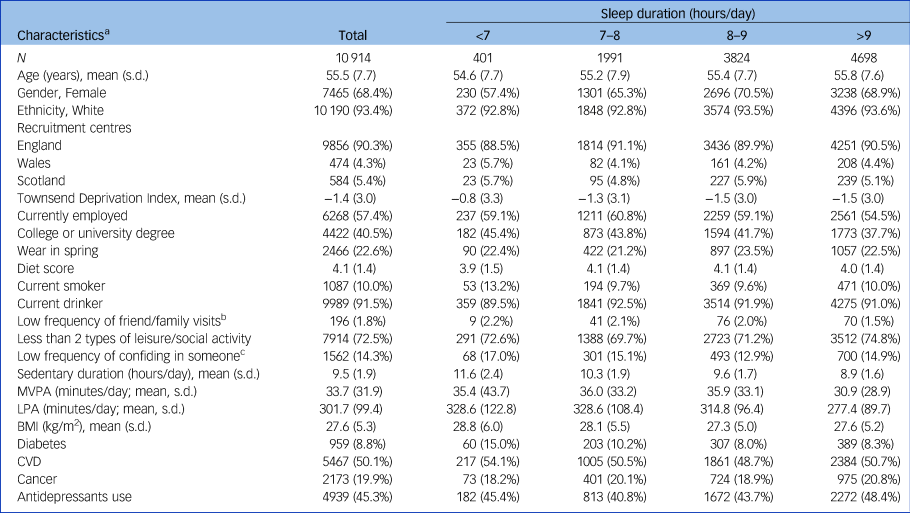
During a median follow-up of 6.9 years (interquartile range 6.4–7.4), a total of 434 deaths were documented among 10 914 individuals with pre-existing depression (68.4% female; mean age: 55.5 ± 7.7 years). The baseline characteristics of participants, categorised by sleep duration measured by accelerometers, are presented in Table 1. Among individuals with pre-existing depression, the mean times spent in sedentary behaviour, MVPA and LPA were 9.5 (s.d., 1.9) hours/day, 33.7 (s.d., 31.9) and 301.7 (s.d., 99.4) minutes/day, respectively. Participants with less than 7 h/day of sleep duration tended to present poorer health conditions, with a longer average sedentary time and a higher proportion of current smoking as well as higher prevalence of chronic diseases such as obesity, diabetes, cardiovascular problems and hypertension.
Baseline characteristics of participants categorised by accelerometer-derived sleep duration

MVPA, moderate-to-vigorous physical activity; LPA, light physical activity; BMI, body mass index; CVD, cardiovascular disease.
a. All characteristics were presented as means (s.d.) or n (%).
b. Low frequency of friend/family visits was defined as participants who reported having no friends or family members outside their household, or reported that they never or almost never visit friends or family.
c. Low frequency of confiding in someone was defined as participants who reported that they never or almost never confide in someone.
The distribution of movement behaviours exhibited by the study participants is illustrated in Supplementary Figure 3.
Participants with the highest level of sedentary time exhibited the shortest sleep duration and were significantly below average in both MVPA and LPA, the lowest diet scores and high prevalence of multiple chronic diseases (Supplementary Table 2). Likewise, we found that participants with the lowest levels of MVPA or LPA both exhibited the longest sleep and sedentary times (Supplementary Tables 3 and 4).
Associations of accelerometer-derived movement behaviours with mortality
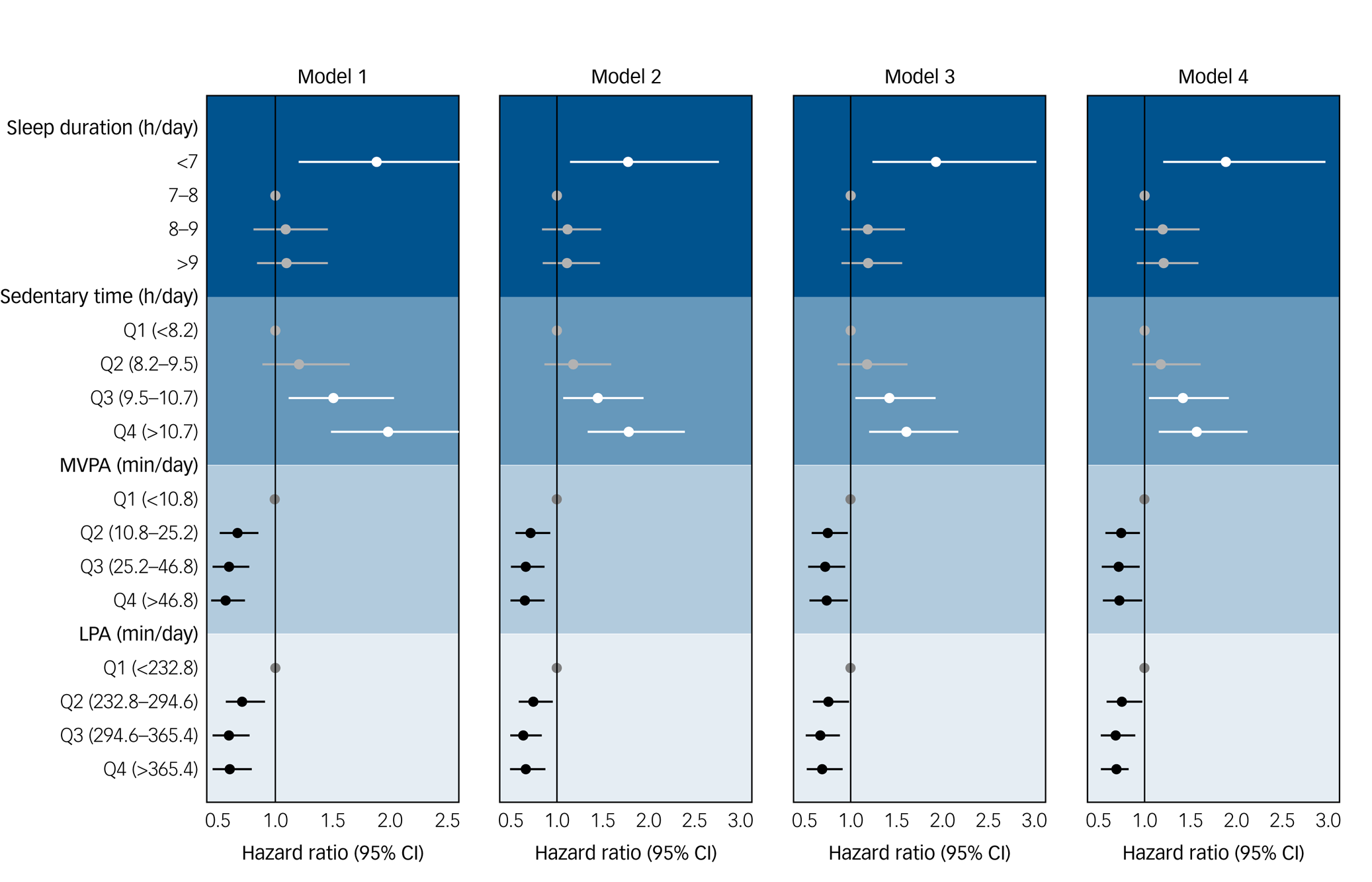
We found <7 h/day of sleep duration was associated with an increased risk of mortality (hazard ratio: 1.89; 95% CI: 1.21–2.97) compared with 7–8 h/day. In terms of sedentary time, participants in the third quartile (hazard ratio: 1.42; 95% CI: 1.05–1.92) and fourth quartile (≥10.7 h/day; hazard ratio: 1.57; 95% CI: 1.16–2.12) had a significantly higher risk of mortality when compared with those in the first quartile. In contrast, the hazard ratios for mortality gradually decreased as the duration of MVPA increased to higher levels. Specifically, individuals engaging in MVPA within the second quartile (10.8–25.2 min/day; hazard ratio: 0.75; 95% CI: 0.58–0.98), third quartile (25.2–46.8 min/day; hazard ratio: 0.72; 95% CI: 0.54–0.95) and fourth quartile (>46.8 min/day; 0.73; 95% CI: 0.55–0.98) demonstrated a significantly reduced risk of mortality compared with those who engaged in lower levels of MVPA intensity or were sedentary throughout the day. The same pattern of associations was also observed for LPA (Fig. 1, Supplementary Table 5).
Associations of accelerometer-derived movement behaviours with mortality among individuals with pre-existing depression. MVPA, moderate-to-vigorous physical activity; LPA, light physical activity. Model 1 was adjusted for demographic information (age, gender, recruitment centres, ethnicity, employment status, educational attainment, Townsend Deprivation Index and season of accelerometer wearing). Model 2 was additionally adjusted for lifestyle factors (smoking status, drinking status, diet, body mass index (BMI)). Model 3 was additionally adjusted for social support status (frequency of family/friend visit, leisure/social activity engagement, frequency of confiding in someone). Model 4 was additionally adjusted for major health conditions (diabetes, cardiovascular disease (CVD), cancer).

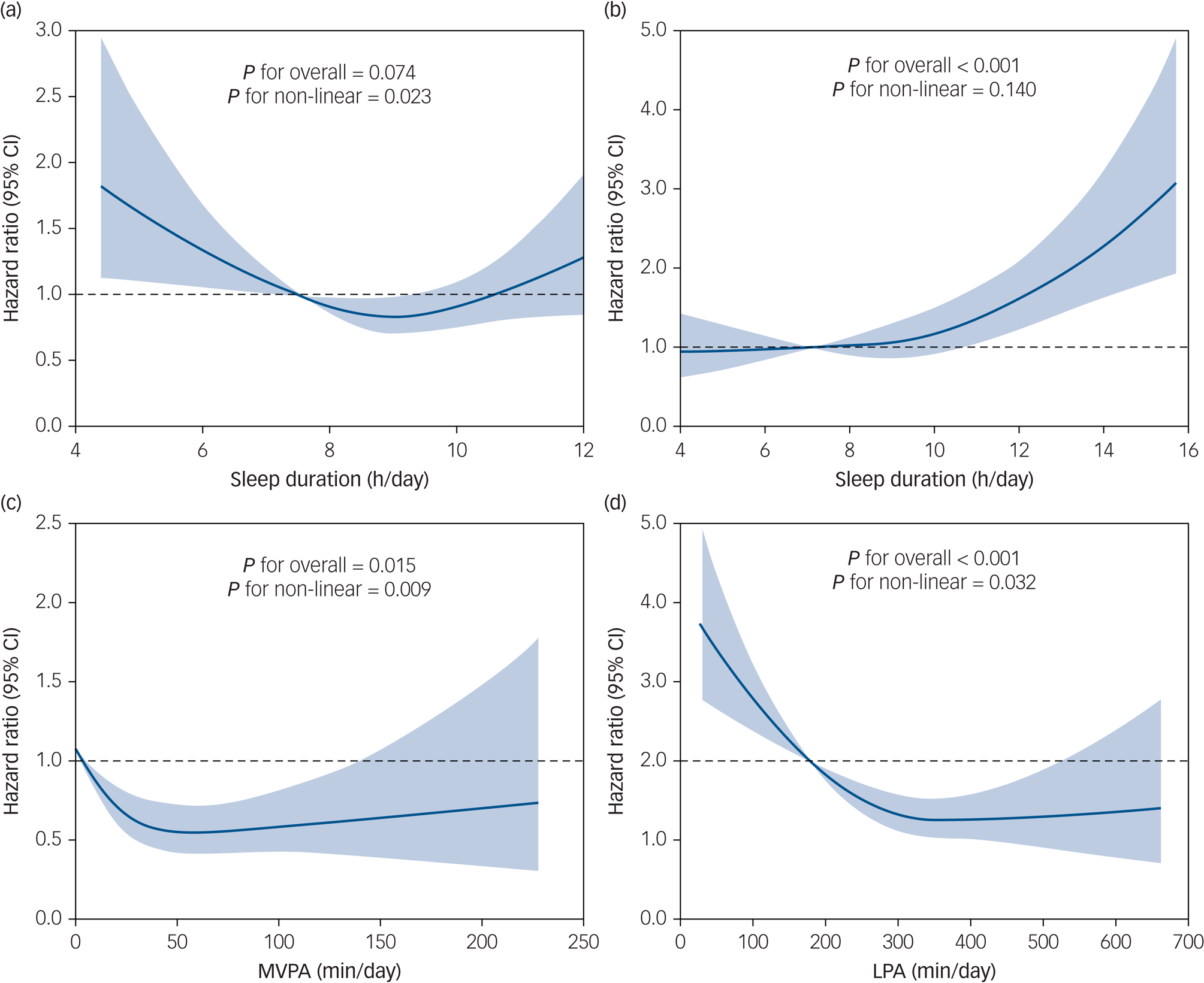
We revealed a U-shaped pattern for sleep duration and mortality (P non-linear = 0.023; Fig. 2), with the risk of mortality tending to increase on either side of approximately 9 h/day of sleep duration. Sedentary time was positively associated with mortality (P non-linear = 0.140; Fig. 2), with a significant upward turn in the risk of mortality observed after approximately 8 h/day. Conversely, sufficient physical activity was associated with a decreased risk of mortality. Both MVPA (P non-linear = 0.009) and LPA (P non-linear = 0.032) exhibited an L-shaped relationship with mortality (Fig. 2). Notably, the risk of mortality was observed to be at its lowest when individuals engaged in approximately 50 min/day of MVPA, with diminishing potential benefits beyond this threshold, and the potential health benefits derived from MPA would result in no further accumulation after reaching the inflection points.
The dose-response association of accelerometer-derived movement behaviours with the risk of mortality among individuals with pre-existing depression. MVPA, moderate-to-vigorous physical activity; LPA, light physical activity. Dose-response associations between accelerometer-measured sleep duration (a), sedentary time (b), MVPA (c) and LPA (d). Restricted cubic splines were constructed with three knots located at the 10th, 50th and 90th percentiles of each exposure. The models were adjusted for age, gender, recruitment centres, ethnicity, employment status, educational attainment, Townsend Deprivation Index, season of accelerometer wearing, smoking status, alcohol intake status, diet, body mass index (BMI), frequency of family/friend visit, leisure/social activity engagement, frequency of confiding in someone, prevalence of diabetes, cardiovascular disease (CVD) or cancer.

Furthermore, there were no interaction effects observed between the four types of movement behaviours and age group, indicating that age did not modify the associations (Supplementary Table 6). In joint analyses, there were no significant interactions between MVPA and sleep duration on either additive (all P values for RERI >0.05) or multiplicative scales (all P values for interaction >0.05; Supplementary Table 7). However, we did find significant associations on both additive and multiplicative scales between sedentary time and MVPA with mortality (P values for RERI were <0.05; P values for interaction <0.05; Supplementary Table 8). Compared with individuals with high MVPA and low sedentary time, those with low MVPA and high sedentary time had a significantly higher risk of mortality (hazard ratio: 1.38; 95% CI: 1.07–1.79).
Isotemporal substitution analyses
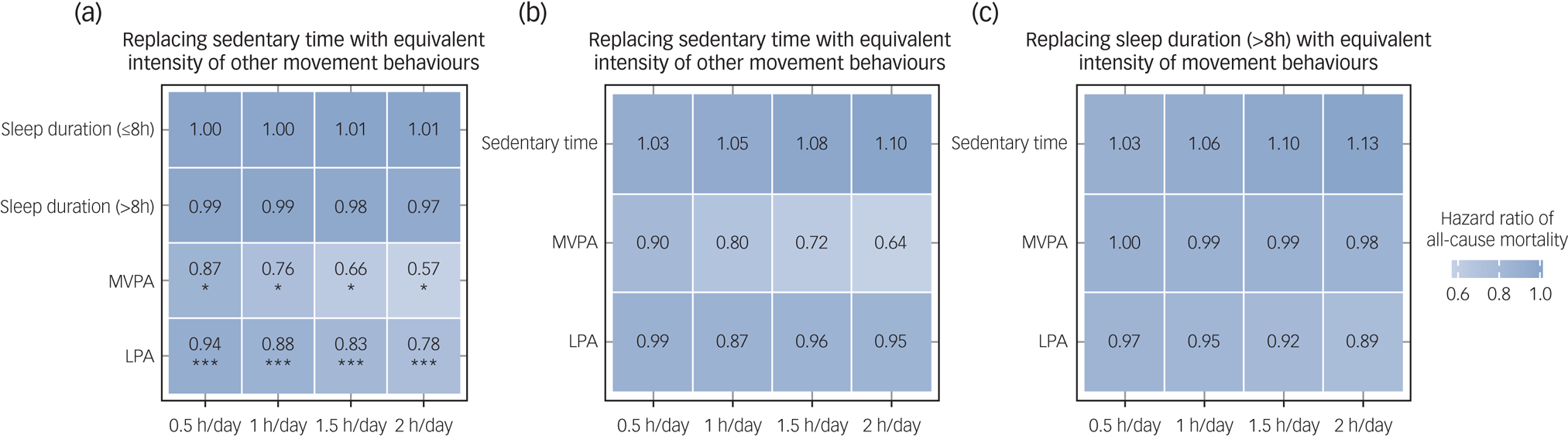
We observed a beneficial association between replacing sedentary time with physical activity and mortality (Fig. 3, Supplementary Table 9). For instance, in individuals with pre-existing depression, substituting one hour of sedentary time with an equivalent duration of MVPA per day was significantly associated with a 24% reduction in the risk of mortality (hazard ratio: 0.76; 95% CI: 0.61–0.94). Additionally, LPA demonstrated similar protective effects, substituting one hour of sedentary time with an equivalent duration per day significantly associated with a 12% reduction in the risk of mortality (hazard ratio: 0.88; 95% CI: 0.83–0.94). We also examined the effects of substituting different daily sleep time (≤8 h/day or >8 h/day) with the equivalent duration of physical activity on risk of mortality (Fig. 3, Supplementary Table 10).
The hazard ratios for mortality when substituting different duration of sedentary behaviours and sleep with equivalent duration of other movement behaviours using isotemporal substitution model. MVPA, moderate-to-vigorous physical activity; LPA, light physical activity. The hazard ratios for mortality when substituting different duration of sedentary time with equivalent duration of sleep duration, MVPA and LPA using isotemporal substitution model (a). The hazard ratios for mortality when substituting different duration of sleep duration (≤8 h/day) with equivalent duration of sedentary time, MVPA and LPA using isotemporal substitution model (b). The hazard ratios for mortality when substituting different duration of sleep duration (>8 h/day) with equivalent duration of sedentary time, MVPA and LPA using isotemporal substitution model (c). The models were adjusted for age, gender, recruitment centres, ethnicity, employment status, educational attainment, Townsend Deprivation Index, season of accelerometer wearing, smoking status, drinking status, diet, body mass index (BMI), frequency of family/friend visit, leisure/social activity engagement, frequency of confiding in someone, prevalence of diabetes, cardiovascular disease (CVD) or cancer and mutually adjusted for all other movement behaviours classes and total time in all movement behaviours classes. *P < 0.05; **P < 0.01; ***P < 0.001.

Sensitivity analyses
The robustness of the main analyses was further strengthened in the sensitivity analyses, including mutual adjustments for movement behaviours (Supplementary Table 11), landmark analyses excluding death cases occurring within two years (Supplementary Tables 12–14) and repeated analyses using multiple imputation datasets (Supplementary Tables 15–17). After excluding participants with major non-communicable diseases, most accelerometer-derived movement behaviours showed consistent but non-statistically significant associations as observed in the main analysis because of limited case numbers (Supplementary Tables 18–20).
Discussion
To the best of our knowledge, this study represents the first investigation specifically designed to assess accelerometer-derived movement behaviours over a 24-hour period among individuals with pre-existing depression. We found that inadequate sleep duration, sedentary behaviour and low levels of MVPA and LPA were associated with higher risk of mortality in individuals with pre-existing depression. More importantly, our findings provided individuals with pre-existing depression a daily movement behaviour recommendation to minimise the risk of subsequent mortality: sleep duration of 9 h/day, no more than 8 h/day of sedentary behaviour, over 5 h/day of LPA and 50 min/day of MVPA. Furthermore, there was a greater health benefit of replacing sedentary time with equivalent MPA or LPA, so engaging in more physical activity is strongly encouraged in individuals with pre-existing depression.
The utilisation of accelerometer-measured data in our study provided unique contributions, thereby offering compelling evidence to compensate for previous studies that traditionally relied on self-reported data. In our study, we found that inadequate sleep duration in individuals with pre-existing depression was associated with an increased risk of mortality. Meanwhile, accelerometer measurements can overcome reporting biases caused by self-reporting measurements, to achieve more accurate estimates of the effects. Interestingly, we found that maintaining sleep duration of at least 9 h/day was associated with the lowest mortality risk among individuals with pre-existing depression, as compared with maintaining the standard sleep duration of 7–8 h/day observed in the general population.Reference Liu, Xu, Rota, Cai, Zhang and Shi30 A potential speculation is that individuals with pre-existing depression commonly experience severe sleep disturbances, such as difficulty falling asleep, poor sleep quality and early morning awakening.Reference Baglioni, Nanovska, Regen, Spiegelhalder, Feige and Nissen18 Consequently, individuals pre-existing with depression often require more sleep than average to compensate for the potential detrimental effects associated with insufficient duration and quality of sleep.
Numerous epidemiological studies have consistently demonstrated a strong association between higher levels of physical activity or reduced sedentary behaviour and poor health outcomes.Reference Patterson, McNamara, Tainio, de Sá, Smith and Sharp31,Reference Ekelund, Tarp, Steene-Johannessen, Hansen, Jefferis and Fagerland32 However, evidence regarding the potential health consequences of movement behaviour is scarce among individuals with pre-existing depression who are at higher risk of mortality. To the best of our knowledge, this is the first study to explore the integrated effect of accelerometer-derived sedentary behaviour and physical activity with mortality in individuals with pre-existing depression. Our study confirmed the detrimental association between sedentary behaviour and increased mortality in individuals with pre-existing depression, highlighting the cumulative impact of prolonged sedentary time and low levels of physical activity on mortality. Notably, we found that the L-shaped association between accelerometer-derived MVPA and risk of mortality among individuals with pre-existing depression showed the lowest risk at the inflection point of 50 min/day. Compared with the self-report-based recommendations by the World Health Organization, which suggest 150–300 min/week of MVPA or 75–150 min/week of VPA,Reference Bull, Al-Ansari, Biddle, Borodulin, Buman and Cardon33 individuals pre-existing with depression should target a minimum of 350 min/week of MVPA to maximise their health benefits.
Compared with previous epidemiological studies using non-substitution models, our study leveraging the ISM offered richer and more specific information. For example, prior substitution analyses focused on the general population demonstrated that substituting one hour of sitting with equivalent MVPA was associated with a 12% lower risk of mortality.Reference Stamatakis, Rogers, Ding, Berrigan, Chau and Hamer29 In our study, individuals with pre-existing depression may lower the 24% risk of mortality by replacing sedentary time with one hour of MVPA, suggesting the greater health benefits of MVPA among individuals with pre-existing depression than the general population. Therefore, recommending a high level of MVPA is a substantial intervention to improve the treatment and prognosis for individuals with pre-existing depression.
It is hypothesised that physical activity mitigates the mortality risk associated with undesirable sleep behaviour and prolonged sedentary time through distinct mechanisms. First, physical activity enhanced cardiorespiratory fitness,Reference Nayor, Chernofsky, Spartano, Tanguay, Blodgett and Murthy34 suppressed inflammatory responsesReference Frodermann, Rohde, Courties, Severe, Schloss and Amatullah8 and improved glucose metabolism.Reference Loh, Stamatakis, Folkerts, Allgrove and Moir35 Therefore, appropriate physical activity could mitigate the risks of overweight, obesity and sleep problems, all of which were linked to depression-related mortality. The benefits conferred by appropriate physical activity may counterbalance some of the detrimental effects of depression on mortality. Additionally, physical activity can reduce cortisol levels,Reference De Nys, Anderson, Ofosu, Ryde, Connelly and Whittaker36 which have been reported to be negatively correlated with depression.Reference Ju, Wang, Lu, Sun, Dong and Zhang37 Thus, our findings emphasised that a comprehensive approach targeting all three movement behaviours within a 24 h period – sleep duration, physical activity and sedentary time – may be more effective in preventing or delaying premature mortality in individuals with pre-existing depression, rather than focusing on any single behaviour alone. Long-term engagement in recommended physical exercise and reducing sedentary time, along with healthy sleep habits, may yield greater benefits for individual with depression. It is worth noting that if avoiding prolonged sedentary time is not feasible, engaging in moderate physical activity can be considered a practical strategy to partially counteract the detrimental effects of prolonged sedentary time. Our findings have important implications for the treatment and prognosis of individuals with pre-existing depression, providing population-based evidence for the development of clinical guidelines.
The primary strengths of this study lie in its large sample size and the objective quantification of movement behaviours in daily life. However, our study had also several potential limitations. First, the lack of participants’ clinical recovery from depression makes it uncertain how many participants achieved symptom control or progressed towards recovery during the follow-up period. Second, the relatively short follow-up period may limit a comprehensive assessment of the association between movement behaviours and mortality risk. Nonetheless, previous studies based on accelerometer data from the UK Biobank supported the robustness of study conducted within such a follow-up period.Reference Liang, Feng, Chen, Jin, Xue and Zhou13,Reference Liang, Ai, Xue, Chen, Zhou and Shu25 Third, the single time-point of accelerometer measurements limited any potential inferences related to within-person changes or variability in these movement behaviours over time. Yet, previous analyses of the data from the UK Biobank suggested that patterns such as sleep and physical activity remained relatively stable over time.Reference Fatima, Bucks, Mamun, Skinner, Rosenzweig and Leschziner38 Fourth, although the wrist-worn accelerometers utilised in our study accurately capture activity duration and differentiate intensity levels, their ability to distinguish between various types of activities (e.g. leisure-time versus occupational) is still limited. Fifth, despite careful consideration of confounding factors, the observational nature of the study made it impossible to completely rule out residual confounding and reverse causation. However, we still obtained consistent results in a repeated analysis after further excluding deaths that occurred during the first two years of follow-up. Sixth, most covariates were assessed during the physical visits to the assessment centres, nearly six years before the present study baseline (date of accelerometer posting). Still, these covariates have been demonstrated to exhibit stability over time,Reference Strain, Wijndaele, Dempsey, Sharp, Pearce and Jeon39 suggesting that such a temporal gap is unlikely to impact the reliability of the current findings. Last, the sample from the UK Biobank is not representative of the population of the UK, which may limit the generalisation of the current findings.
These findings emphasise the importance of behaviourally prognostic management for individuals with pre-existing depression and inform the development of intervention guidelines for the treatment of depression. It is recommended that individuals with pre-existing depression ensure approximately 9 h/day of sleep, minimum sedentary time, as well as maintaining 50 min/day of MVPA to produce great health benefits.
Supplementary material
Supplementary material is available online at https://doi.org/10.1192/bjp.2024.227
Data availability
The data that support the findings of this study are available from the UK Biobank project site, subject to registration and application process: https://www.ukbiobank.ac.uk.
Acknowledgements
This study was conducted using the UK Biobank resource (application no. 79095). We want to express our sincere thanks to the participants of the UK Biobank, and the members of the survey, development and management teams of this project.
Author contributions
T.D.: conceptualisation, methodology, software, formal analysis, investigation, visualisation, writing – original draft. Z.C.: conceptualisation, methodology, software, formal analysis, investigation, validation, visualisation, writing – original draft. X.W.: conceptualisation, methodology, software, writing – review and editing. J.M.: methodology, software, writing – review and editing. T.S.: resources, writing – review and editing. H.L.: resources, writing – review and editing. C.X.: project administration, supervision, conceptualisation, data curation, funding acquisition, investigation, methodology, resources, software, validation, visualisation, writing – review and editing.
Funding
National Natural Science Foundation of China (NO.72204071); Zhejiang Provincial Natural Science Foundation of China (NO.LY23G030005); and Scientific Research Foundation for Scholars of Hangzhou Normal University (NO.4265C50221204119). None of the funders had any role in the design and conduct of the study; the collection, management, analysis and interpretation of the data; and the preparation, review and approval of the manuscript.
Declaration of interest
The authors declare that they have no known competing financial interests or personal relationships that could have appeared to influence the work reported in this paper.




eLetters
No eLetters have been published for this article.