Civil wars, revolutions, litigation, strikes, economic sanctions, international conflict, and the use of power in general pose an inefficiency puzzle. Suppose that a group of actors is bargaining about how to resolve an issue or, more abstractly, about how to divide a “pie.” One or more of them can affect the outcome and possibly even impose a division through the use of some form of power—be it military, economic, legal, or more broadly political. The exercise of power, however, consumes resources, and, consequently, the pie to be divided among the bargainers before anyone tries to impose a settlement is larger than it will be afterward. As a result, there usually are divisions of the larger pie that would have given each bargainer more than it will obtain from an imposed settlement. The use of power, in other words, leads to Pareto inefficient outcomes. Why, then, do the bargainers sometimes fail to reach a Pareto superior agreement prior to the explicit use of power?
A standard explanation of inefficiency appeals to asymmetric information.1
See Ausubel, Cramton, and Deneckere 2002 for a recent review.
Indeed, recent formal work in international relations theory on the causes of war frames the problem in terms of efficiency and focuses almost entirely on informational asymmetries.
2 Fearon (1995) discusses this approach and Powell (2002) surveys it.
But a growing body of work across a wide range of issues in political economy as well as in American, comparative, and international politics explains inefficiency in terms of commitment problems that can arise even if the bargainers have complete information. The issue here is that bargainers are sometimes unable to commit themselves to following through on an agreement and have incentives to renege on it. These incentives may undermine the efficient outcomes. When they do, complete-information bargaining breaks down in the inefficient use of power.
For example, Acemoglu and Robinson (2000, 2001) link democratic transitions, costly coups, and revolutions to the inability of the faction in power to commit to future redistribution policies. Fearon (1998, 2003) shows that the inability of a central government to commit to honoring a power-sharing agreement can lead to prolonged civil wars. In Alesina and Tabellini 1990 and Persson and Svensson 1989, political parties create inefficient levels of public debt because the parties cannot commit to future spending levels. Democratic decision-making in Besley and Coate 1998 may lead to inefficient outcomes if the current decisions of those in power affect the identity or preferences of future decision makers. Political parties in de Figueiredo 2002 may impose inefficient administrative procedures to protect their programs from their political opponents because competing parties cannot commit to refraining from overturning each other's policies when they take office. And Fearon (1995, 404–8) and Powell (1999, 128–32) demonstrate that a rapidly shifting distribution of military power combined with the states' inability to commit to an agreement can lead to war.
Despite the importance of commitment problems, we lack many general results about the basic mechanisms through which actors' inability to commit leads to inefficient outcomes. The results we do have typically focus on specific models, as in the examples above, or the analysis demonstrates the existence of inefficient equilibria in settings where there are Pareto superior, efficient equilibria.3
For example, the inefficient equilibria in infinitely repeated games are Pareto dominated by efficient ones if the players are sufficiently patient. Similarly, the inefficient equilibria are Pareto dominated by efficient ones in models of strikes (e.g., Fernandez and Glazer 1991) or, more generally, in bargaining models in which the bargainers can impose costs on each other between offers (e.g., Busch and Wen 1995 and Muthoo 1999). Analogous results obtain in bargaining games in which the players can renege on or retract an accepted offer (Muthoo 1990, 1999, 194–200). By contrast, Anderlini and Felli (2001) and Merlo and Wilson (1995) do obtain inefficient, Pareto undominated equilibria.
Absent a compelling theory of equilibrium selection, inefficient equilibria that are dominated by efficient ones provide at best a weak explanation of inefficiency.
This paper shows that a common mechanism is at work in a number of the diverse studies cited above. This common mechanism affords a more general formulation of a type of commitment problem that can arise in many different substantive settings. The present analysis then formalizes this mechanism as an “inefficiency condition” that ensures that all of the equilibria of a complete-information stochastic game are inefficient. This condition has a natural substantive interpretation: Large, rapid changes in the bargainers' relative power cause inefficiency. More precisely, the equilibria must be inefficient even with complete information if at some time (along any efficient path) the expected per-period shift in at least one of the actors' minmax payoffs is larger than the bargaining surplus.
The next section briefly reviews Acemoglu and Robinson 2000, 2001, de Figueiredo 2002, Fearon 2003, and Powell 1999. This review shows that, broadly speaking, the central problem confronting the actors in these models is deciding how to divide a flow of pies in a substantive setting in which (i) the actors cannot commit to how they will divide the pies in future periods, and (ii) the payoffs the actors can lock in through the inefficient use of power varies over time.4
This formulation contrasts with Merlo and Wilson (1995). In their game, the bargainers negotiate about dividing a pie the size of which varies stochastically. If, as they suggest, each period's pie represents the present value of the expected flow of benefits, then their model can be interpreted as one in which the bargainers are dividing a flow of pies and can commit to agreements about how they will divide the future flow. But the unique subgame perfect equilibrium of their game is always efficient if there are two players and transferable utility. The mechanism highlighted below can produce inefficiency even in these circumstances.
The review also characterizes the common commitment problem that can arise in this situation. The subsequent section formalizes this commitment problem as an inefficiency condition for stochastic games.
A COMMON COMMITMENT PROBLEM
Complete-information bargaining breaks down in costly coups in Acemoglu and Robinson 2000, 2001, in secessionist civil wars in Fearon 2003, in inefficient policy insulation in de Figueiredo 2002, and in war in Fearon 1995 and Powell 1999 for the same basic reason. Resource constraints, the inability to commit to future transfers, and a rapidly shifting strategic environment create a situation in which every efficient path is dynamically inconsistent.
In Acemoglu and Robinson's (2000, 2001) analysis of political transitions, a rich elite and a poor majority vie for political control of the state and the benefits that such control brings. One of these factions is in power at the start of any period, and times are either “normal” or “bad” (e.g., there is a severe economic downturn), with probabilities 1−s and s. Whether times are normal or bad is revealed at the start of each period and is common knowledge.
When the poor are in power, they move first by setting the tax rate for that period. The rich can then accept this policy or initiate a coup. Accepting ends the period with the agreed tax policy. Launching a coup (in bad times) brings the elite to power but is also inefficient, as it destroys a fraction of the economic income from that period.5
By assumption, launching a coup in good times is too costly (i.e., is dominated by accepting the poor's ideal policy).
The elite then sets the economic policy for that period and begins the next period in power.
When the rich are in power at the start of a period, they decide the tax rate and whether or not they want to extend the franchise to the poor. (Since the median voter is assumed to be poor, this is equivalent to turning power over to the poor.) If the rich relinquish power, the poor take over, set policy for that period, and start the next period in power. If the rich retain power, the poor can accept the tax rate or launch a costly revolution, which, again, destroys a fraction of that period's income. Accepting ends the period with the agreed policy in place and the elite in power at the start of the next period. Launching a revolution effectively ends the game, with the poor assuming power, the rich losing everything, and the threat of any future coup eliminated.
When one group is in power it can set a tax policy favorable to the other group as a way of trying to buy that group off and thereby avoid a coup or revolution. However, Acemolgu and Robinson identify conditions under which the poor cannot offer the rich enough to buy them off. In these circumstances, the rich always launch a coup when out of power and times are bad and relinquish political control when in power and times are bad. Thus, the county oscillates between democratic and authoritarian regimes.
A dynamic commitment problem drives this oscillation. When times are bad and the poor are in power, the poor would like to buy the rich off and thereby avert a coup. To do this, the poor must promise to give the rich their certainty equivalent of launching a coup, i.e., how much the rich would expect to get were they to mount a coup. However, the amount that can be transferred in any one period is constrained by that period's total output and the fact that the poor cannot set a tax rate below zero. As a result, buying the rich off requires that the poor keep taxes low for more than one period. But the poor cannot commit to future tax rates, and, with probability 1−s, normal times will return in the next period. If they do, the threat of a coup will evaporate, and the poor will have an incentive to renege on a promise of lower taxes.6
Recall that the payoffs are restricted in such a way that mounting a coup in normal times is strictly dominated.
Foreseeing this, the rich initiate a costly and therefore inefficient coup.
Fearon (2003) sees a commitment problem at the heart of some secessionist civil wars. His analysis grows out of an effort to explain the empirical patterns of civil wars. (Fearon and Laitin [2003] also describe some of these patterns.) Fearon (2003) begins by rejecting asymmetric information as a plausible account of some types of prolonged civil wars.
[I]t strains credulity to imagine that the parties to a war that has been going on for many years, and that looks very much the same from year to year, can hold any significant private information about their capabilities or resolve. Rather, after a few years of war, fighters on both sides of an insurgency typically develop accurate understandings of the other side's capabilities, tactics, and resolve. Certainly both sides in Sri Lanka (for instance) fight on in the hope that by luck and effort they will prevail militarily. But it is hard to imagine that they do so because they have some private information that makes it reasonable for them to be more optimistic about the odds than the other side is. In the absence of significant private information, why can't they cut a deal on the basis of a more-or-less common understanding of the terms of the military stalemate? (19)
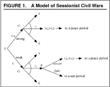
The answer Fearon (2003) develops is a commitment problem arising from “a temporary shock to government capabilities or legitimacy [that] gives coup plotters or rebels a window of opportunity” (22). In his model, a government, G, and a rebel group, R, negotiate about regional control. At the start of a round (see Figure 1, which is based on Fearon's Figure 2), the government is strong or weak with probabilities 1−ε and ε, respectively, and whether the government is strong or weak is common knowledge. The government then makes a take-it-or-leave-it offer ct∈[0, 1] that represents the regional control that the government intends to keep for itself during that period. In effect, the government proposes a division of the social pie. If the government is strong, the rebels' only alternative is to accept the offer and the period ends with the government's receiving ct and the rebels' obtaining 1−ct.
If the government is weak, the rebels can accept the government's offer or fight. Accepting ends the period and brings the government and rebels payoffs of ct and 1−ct, respectively. A new period then begins with the government strong or weak with probabilities 1−ε and ε and the government deciding what to offer.
If the rebels fight, then the government and rebels receive payoffs kG and kR during that period. By assumption, kG+kR<1 so that fighting is inefficient. Fighting ends in one of three ways: With probability α, the government wins and a new period begins, with the government strong or weak with probabilities 1−ε and ε and the government making a new offer. With probability β, the rebels prevail and the game ends with secession. Finally, the fighting results in a stalemate with probability γ=1−α−β, in which case the government and rebels have to decide whether or not to keep fighting. If either of them chooses to fight, they receive the payoffs to fighting, kG and kR, and the war continues for another period. As before, the government wins with probability α, the rebels win with probability β, and a stalemate occurs with probability γ. The war continues in this way until one side of the other wins or both decide to stop fighting.
Fearon shows that in some circumstances there must be fighting in any subgame perfect equilibrium even though it is inefficient. To see the basic intuition, consider a period in which the government is weak. To induce the rebels not to fight, the government must concede enough to them so that they prefer these concessions to fighting. However, the rebels' continuation payoff to fighting typically exceeds one. (This payoff includes the payoff to fighting in the current period, kR, plus the expected payoffs in subsequent periods.) This and the fact that the government can transfer no more than one to the rebels in any single period (by setting ct=0) means that buying the rebels off entails a promise to transfer resources to the rebels for more than one period.
The government strictly prefers this transfer to fighting because the latter is costly. The government therefore would like to be able to commit itself to following through on this promise. But it cannot. With probability 1−ε, the government will be strong in the next period, the threat of rebellion will disappear, and the government's payoff to reneging on its promised transfer will exceed its payoff to following through on it. Anticipating this, the rebel group fights while it has the chance.
A similar complete-information commitment problem arises in a very different substantive context. de Figueiredo (2002) asks why elected officials might deliberately pursue inefficient policies. He postulates a policy environment in which changing circumstances mean that a political party, if it were sure that it would remain in power, would prefer not to lock in a rigid policy so that it could adjust its policy to changing circumstances. In other words, locking in a policy is inefficient. Nevertheless, de Figueiredo shows that a party prefers to lock its policy in when it is unlikely to remain in power.
de Figueiredo's analysis begins with a “reciprocity” game between two political parties, A and B. In this infinite game, A is in power with probability γ in any period and B is in power with probability 1−γ. During any round in which a party is in power, it implements its own policy and decides whether or not to overturn the other party's policy (assuming that the other's policy is still in place). A party receives one during any period in which its policy is in place and the other party's is not, β∈(0, 1) during any period in which both parties' policies are in place, and zero during any period in which its policy is not in place and the other party's is.
If β is larger than γ and 1−γ (and the discount factor is sufficiently high), then both parties prefer cooperating by not overturning the other party's policy.7
Suppose that each party always overturns the other party's policy. If A is in power it obtains one in that period and its expected payoff in all future periods is γ·1+(1−γ)0=γ. Hence, A's average payoff (in the limit as the discount factor δ goes to one) is (1−δ)[1+γ/(1−δ)]→γ, and B's average payoff is 1−γ. Now suppose that the parties cooperate by never overturning the other's policy. Then each party's average payoff is arbitrarily close to β. (Because the second party to assume power obtains zero until it comes to power, its average payoff is slighly less than β and the other party's average payoff is slightly more than β. But these differences go to zero as the discount factor goes to one.) Both parties therefore prefer cooperation if β>max{γ, 1−γ}.
Moreover, this cooperative outcome can be sustained in a subgame perfect equilibrium by the threat that should one party ever deviate by overturning the other party's policy, then neither party will ever cooperate again.
To introduce the inefficiency puzzle, suppose that a party has an additional option when it assumes office for the first time. It can insulate its policy by creating bureaucratic or political obstacles that make it difficult to change. For example, the party in control might create an administrative agency whose procedures are subject to judicial review. (See de Figueiredo 2003, 2002 and de Figueiredo and Vanden Bergh 2001 for additional examples and discussion.) Formally, once a party insulates its policy, the other party cannot overturn it. Insulation, however, is costly.
If political uncertainty is low (i.e., γ is far away from
), then at least one party engages in inefficient insulation.8
Political uncertainty is low if γ is far from
because one party is likely to hold power most of the time.
Suppose that
A is politically weak and unlikely to hold power in general (i.e., γ is small) but that
A happens to be in power in the current period.
A can lock its policy in place so that it obtains α<1 during any period in which only its policy is in place and αβ during any period in which both parties' policies are in place. (The fact that α<1 ensures that insulation is costly.) To forgo the opportunity to lock this payoff in,
A must believe that
B will refrain from overturning
A's policy in future periods sufficiently often that
A's payoff to not insulating its policy is higher than its payoff to doing so.
But the only reason B would refrain from overturning A's policy is that A would subsequently impose a costly punishment on B that outweighs B's gain from overturning A's policy. However, the only way that A can punish B is by overturning B's policy when A is in power. Consequently, a politically weak A will be unable to impose much punishment on B because it is unlikely to be in power very often. Indeed, if A is sufficiently weak, it cannot impose enough punishment on B to deter B from overturning A's policies whenever B is in office. In these circumstances, A prefers to lock its policy in because B is very likely to be in power in the next period and, if so, to overturn A's policy if it has not been insulated. Once again, inefficiency results when one actor must make concessions across multiple periods to buy another actor off (i.e., B must refrain from overturning A's policy to induce A not to insulate). But a shifting strategic environment undermines the credibility of these promised concessions.
de Figueiredo's conclusion that insulation is most likely to occur when political uncertainty is low contrasts with the conclusion derived from nongame theoretic work that argues that inefficient insulation is most likely to occur when political uncertainty is high (e.g., Moe 1990). Moreover, he finds empirical support for this claim in his analysis of when states adopt the line-item veto (de Figueiredo 2003) or an administrative procedures act (de Figueiredo and Vanden Bergh 2003). Both of these are ways for those in control of a state's legislature to lock in or at least insulate their policies.9
More precisely, de Figueiredo shows that fiscal conservatives who are politically weak are significantly more likely to propose a line-item veto than are fiscal conservatives who are in a strong political position, i.e., likely to remain in control of the state legislature.
The strategic environment shifts stochastically in the previous examples. Times are good or bad with probabilities 1−s and s, the government is strong or weak with probabilities 1−ε and ε, and A or B is in power with probabilities γ and 1−γ. The strategic environment shifts deterministically in Powell's (1999) study of preventive war, where, nevertheless, a similar complete-information commitment problem can arise.
In Powell's model of states' efforts to cope with shifts in the distribution of military power, a declining state and a rising state are negotiating about revising the territorial status quo q∈[0, 1]. The declining state, D, begins the game by either proposing a revision x0∈[0, 1] to the status quo or attacking. Attacking ends the game in a costly lottery. In this lottery, the rising state, R, wins all of the territory and the future benefits from that territory with probability p0 and D wins everything with probability 1−p0. R's payoff to fighting is therefore p0[sum ]∞j=0δj(1−r)+(1−p0)[sum ]∞j=0δj(0−r)=(p0−r)/(1−δ), where δ is the states' common discount factor and r is R's cost of fighting. D's payoff to fighting is defined analogously.10
The states are assumed to be risk neutral here for expositional ease. Powell (1999) allows the states to be risk neutral or averse.
If D does not attack and makes an offer instead, then R can accept, reject, or fight. Accepting ends the round. R and D and receive payoffs x0 and 1−x0, x0 becomes the new territorial status quo, and D begins the next round by either attacking or making a new offer. If R rejects D's initial offer, the status quo remains in place, R and D receive payoffs q and 1−q, and D begins the next round by either attacking or making a new offer. Finally, R's attacking in response to D's offer ends the game in a costly lottery with the payoffs described above.
To formalize the shifting distribution of power between D and R, Powell assumes that the rising state's probability of prevailing starts out at some p0. It then increases by Δ in each of the next T periods (i.e., pt=p0+tΔ for 0[les ]t[les ]T), after which it remains at pT=p0+TΔ. All of this is common knowledge.
Powell's primary focus is on bargaining when D is uncertain of R's cost of fighting. But he does show that complete-information bargaining breaks down in war if there are large and rapid shifts in the distribution of power. To highlight the basic idea, observe that the declining state can lock in a payoff of (1−pt−d)/(1−δ) if it fights at time t. In contrast, D's payoff to not fighting is bounded above by 1+δ[1/(1−δ)−(pt+Δ−r)/(1−δ)] for t<T. The first term is the best that D can do in the current period. The second term is an upper bound on D's future payoffs. That is, this term is the discounted difference between the total flow of benefits, which is all there is to be divided between the bargainers, and how much of that total R can lock in for itself by fighting in the next period. Clearly, R has to get at least this much along any efficient path if it is to be induced not to fight. Therefore, the difference between all that there is to be divided and what R can lock in constitutes an upper bound on what D can get in the future. Consequently, D strictly prefers fighting if what it can lock in by doing so is strictly greater than this upper bound on what it can get if it does not fight. In symbols, D prefers to fight if (1−pt−d)/(1−δ)>1+δ[1/(1−δ)−(pt+Δ−r)/(1−δ)] or, equivalently, if δΔ>(1−δ)pt+d+δr. Hence, complete-information bargaining is sure to break down in inefficient fighting if the per-period shift in the distribution of power Δ is larger than the average amount consumed by fighting r+d and if the discount factor is close enough to one.11
Fearon (1995, 402–6) discusses the same kind of commitment problem.
Less formally, the rising state would like to induce the declining state not to fight by committing itself to abiding by a territorial division that D prefers to fighting. To do this, R must forebear from fighting. But R's increasing military strength increases its payoff to fighting and thereby undermines it promise not to attack.
In sum, the actors in the preceding examples face the same broad strategic problem. The bargainers are trying to divide a flow of benefits in a setting in which they cannot commit to future divisions. Each actor also has the option of using some form of power to lock in a share of the flow. But the use of power is inefficient and destroys some of the flow. Finally, a shifting environment changes the amounts the bargainers can lock in.
Complete-information bargaining breaks down in each case for the same basic reason. To avoid the inefficient use of power, one bargainer must buy off a temporarily stong adversary (i.e., a bargainer who can lock in a high payoff). Resource constraints mean that the transfers needed to do this must stretch across a “concession phase” lasting multiple periods. But during this phase, the once-weak bargainer is very likely to become strong enough to want to renege on the promised transfer. This prospect undermines that bargainer's ability to credibly commit to the transfer, and the bargaining breaks down.
AN INEFFICIENCY CONDITION
This section formalizes the common mechanism at work in the previous examples in terms of an inefficiency condition. When this condition holds, all of the equilibria of a two-actor stochastic game are inefficient. The section also shows that the inefficiency condition has three natural substantive interpretations.
The inefficiency condition applies to stochastic games which are a generalization of repeated games. In the latter, the strategic environment remains constant. The actors play the same game over and over. In a stochastic game, the strategic environment changes. The game the actors play in any period may depend on the game they played in the previous period, what they did in that period, and additional random factors. For example, the game that the rich and poor play in Acemoglu and Robinson 2001 depends on which of them was in power in the previous period, on whether or not the out-of-power actor tried to depose the other actor, and on random fluctuations in the economy, e.g., whether times are normal or bad.
To specify some elements of a stochastic game Γ somewhat more formally, let {Ak}Nk=1 denote the set of states or stage games and q be a transition function.12
Abusing the definitions but greatly easing the exposition, I use “stage game” and “state” synonymously. See Friedman (1986, 124–25) for a complete description of a stochastic game.
The states define the various games the actors might play in any round. The transition function
q(
n|
k,
s) is the probability that the next state will be
An given that the current state is
Ak and that the players took actions
s in
Ak. Play begins in Γ in a given state, and each actor's payoff is the present value of the sum of its stage-game payoffs where δ is the players' common discount factor. When deciding what to do, the actors know the current state as well as the entire history of previous states and what the actors did in those states.
To specify the inefficiency condition, let Mj(k) be j's minmax payoff for the two-player stochastic game starting in state Ak.13
Generalizing the inefficiency condition to more than two players is straightforward.
That is,
j can assure itself of an expected payoff of
Mj(
k) starting from state
k. It is important to emphasize that this payoff is not the minmax payoff of the stage game
Ak.
Mj(
k) is the minmax payoff of the continuation game starting in state
k. Consequently,
j's payoff in any subgame perfect equilibrium starting from state
Ak must be at least as large as
Mj(
k).
Now consider an efficient profile e and the path p(e) that it traces out. That is, e is a pair of strategies e=(e1, e2) for players 1 and 2 such that the expected payoffs to following these strategies are Pareto optimal in the stochastic game, and p(e) are the states that are reached with positive probability if the actors play according to e.14
More precisely, let π(h|e) be the probability of history h given e. Then h is along the path p(e) if and only if π(h|e)>0.
If either player has an incentive to deviate from this path, then
e is not an equilibrium. And a player is sure to have an incentive to deviate if there exists a state along the path at which that player's minmax payoff is strictly greater than its payoff to continuing to play according to
e. If, moreover, such a state exists along every efficient path, then there are no efficient equilibria. The inefficiency condition ensures that this is the case by finding an upper bound on a player's payoff to continuing along an efficient path and then requiring this upper bound to be strictly less than the player's minmax payoff.
To specify an upper bound on j's continuation payoff to following e starting at Ak, let Bk be the maximum expected flow of future benefits starting in Ak. Loosely, Bk is all that there is to be divided between the two players starting from Ak. It is the present value of the expected flow of pies. (Bk is defined formally in the Appendix.)
Observe that the other player, i, can guarantee that it will obtain a certain amount of this flow. Let
be a lower bound on i's payoff in Ak given that the players are following an efficient path. (This payoff and the expectation discussed below also are defined formally in the Appendix.) Player i must get at least this much in the current round if play follows e.15
In the examples above and in applied work more generally,
is usually quite easy to determine. A looser lower bound is to normalize the players's utilities so that all of the payoffs in every stage game are nonnegative and then take
. This leads to a somewhat looser version of the inefficiency condition in (1).
This actor can then assure itself of getting at least its minmax payoff
Mi(
n) if the next stage game is
An. Hence,
i's expected future payoff starting at
Ak is bounded below by the (discounted) value of
i's expected minmax payoff
Ek[
Mi(
n)] where the expectation is based on what is known at
Ak. Thus,
i is sure to receive at least
starting at Ak.
Putting all of this together, j's continuation payoff to following e starting from Ak is bounded above by
. Roughly, this is the difference between all there is to be divided if the actors play efficiently and what i can assure itself. Now define the inefficiency condition for actor j to be
When this holds, j will have an incentive to deviate from e at Ak, and consequently, the efficient path e cannot be an equilibrium.
In practice, a closely related condition often turns out to be easier to use than (1). An action in state k is conditionally dominated if, starting from that state, every strategy that puts positive weight on that action is strictly dominated. For example, trying to depose the faction in power in normal times is conditionally dominated in Acemoglu and Robinson. By construction, launching a coup or revolution in good times is so costly that the out-of-power faction is always strictly better off if it waits for bad times before acting. Let M′j(Ak) be j's minmax payoff starting in Ak given that the other player i does not play conditionally dominated strategies. Then the analogue of condition (1) is
These conditions lead immediately to:
Proposition 1. A two-actor stochastic game Γ has no efficient Nash equilibria if for each efficient path there exists a state Ak at which inefficiency condition (1) or (1′) holds for one of the players.
Proof. See the Appendix.
To develop substantive interpretations for (1) and implicitly (1′), it will be useful to relax these conditions slightly. If necessary, normalize the payoffs so that each player always receives at least zero in any period along any efficient path. This means that
. (The examples above already satisfy this condition.) Clearly, condition (1) holds and the game has no efficient equilibria if Mj(k)>Bk−δEk[Mi(n)]. Rewriting this inequality yields two expressions that have natural substantive interpretations:
The left side of condition (2) is the amount that j can assure itself or “lock in” starting in state k plus the (discounted) expected value of what i can lock in the next period if the actors follow the efficient path at k. Condition (2) simply says that the sum of these lock-ins exceeds the total amount there is to be divided. When this is the case, it is impossible to satisfy both players' claims on the flow of benefits.
The second interpretation is more dynamic. The left side of (3) is the expected shift in i's minmax payoff. In a rough sense this shift measures how much more powerful i will become and, implicitly, how much weaker j will become. The right side is the size of the bargaining surplus, i.e., the difference between what there is to be divided, Bk, less the sum of what each player can assure itself. Thus, (3) holds and there are no efficient equilibria when the expected shift in one of the player's minmax payoff is larger than the bargaining surplus. Less formally, large, rapid changes in the bargainers' relative power (measured by shifts in their minmax payoffs) cause inefficiency.
Shifts of this kind are what drive the inefficiency in Acemoglu and Robinson 2000, 2001, Fearon 2003, de Figueiredo 2003, and Powell 1999. (The Appendix establishes the relationship between these examples and conditions (1) and (1′) more formally.) The rich launch a costly coup when times are bad and the cost of deposing the opposition is low, because normal times are likely to return in the next period and the rich will be weak. The rebels fight when the government is weak in Fearon because, with a high probability, the government will be strong in the next period. A weak party that happens to find itself in office in de Figueiredo insulates its policies because it is likely to be out of office in next period. And a declining state in Powell fights if it will be much weaker in the next period. These changes alter the players' minmax payoffs and result in the inefficient use of power.
As discussed in the previous section, these shifts undermine an actor's ability to buy the other actor off by limiting the amount that the former can credibly commit to transfering to the latter. For example, the poor in Acemoglu and Robinson 2001 cannot credibly commit to lower taxes long enough to dissuade the rich from mounting a coup. A third substantive interpretation of condition (1) highlights the role that the actors' limited ability to make transfers plays in the commitment problem.
To develop this interpretation, assume that maximizing the sum of the current and future benefits also maximizes the current benefits. That is, maximizing the total flow of pies does not require accepting a smaller pie in the current period. (All of the models discussed above satisfy this “separability” condition, which is formalized in the Appendix.) This means that the maximum flow of current and future benefits Bk equals the maximum benefits there are to be had in the current period, Ck, plus the discounted maximum flow of future benefits Fk, i.e., Bk=Ck+δFk.
Corollary 1 below shows that condition (1) implies that
where
is the maximum payoff j can achieve in state Ak along any efficient path. Put another way, this is the most that i can transfer to j in state Ak on an efficient path. The term in brackets is the difference between the future flow of benefits and what i can assure itself in the future. This difference is therefore an upper bound on what i can credibly promise to transfer to j in the future. Were i to try to transfer more than this, then i's future payoff in some state n would be less than its minmax payoff Mj(n), thus giving i an incentive to renege. Hence, condition (4) can be interpreted as saying that j's minmax payoff in k is larger than the amount that i can transfer to j in the current period plus what it can credibly promise to transfer in the future given the expected shift in i's power as measured by its minmax payoff.
Corollary 1. If the maximum flow of benefits is separable as described informally above and formally below, then condition (1) implies condition (4).
Proof. See the Appendix.
Finally, it is interesting to consider the efficient equilibria in infinitely repeated games in light of the inefficiency conditions. As the folk theorem shows (Fudenberg and Maskin 1986), there are always efficient equilibria in an infinitely repeated game if the actors do not discount the future too much. The existence of these equilibria means that the inefficiency conditions must not hold in an infinitely repeated game. Why not?
In a repeated game, there is a single stage game, say A, which is repeated infinitely often. This means that the strategic environment is completely stable in the sense that the continuation game is always the same, namely, an infinite repetition of A. There are no large, rapid shifts to undermine efficiency in repeated games.
To put this point more formally, let mj be j's minmax payoff in the two-actor stage game A where the payoffs have been normalized so that they are all nonnegative. Then j's minmax payoff in the continuation game is the present value of having mj in every period. This means that Mj=mj/(1−δ). Moreover, j's expected minmax payoff in the continuation game starting in the next period is also Mj, because the continuation game never changes. As a result, condition (3) becomes−(1−δ)Mi>B−(Mi+Mj), where B is the maximum flow of future benefits. But the fact that each player must get at least as much as its minmax payoff in equilibrium implies that the maximum flow of benefits must be at least as large as the sum of the minmax payoffs, i.e., B[ges ]Mi+Mj. Hence, (3) never holds in the unchanging strategic environment of an infinitely repeated game.
CONCLUSION
A common mechanism is at work across a very wide range of recent work in American, comparative, and international politics. In each case, a temporarily weak actor wants to induce its adversary to refrain from an inefficient use of power, e.g., launching a coup, starting a civil war, insulating its policy, or going to war. Because the use of power consumes resources, avoiding its use saves resources and means that there is enough for the weaker actor to buy its adversary off. But resource constraints mean that the transfers needed to accomplish this will take several periods to complete. However, the strategic environment is shifting sufficiently rapidly that the temporarily weak actor is likely to become strong enough during this concession phase that it will renege on its promised transfers. This undermines the credibility of these transfers and leads to the inefficient use of power. In short, large, rapid shifts in relative bargaining power can lead to bargaining breakdowns even if there is complete information.
This common mechanism provides a unifying perspective on these analyses and a more general formulation of a fundamental strategic problem that can cause breakdowns and the inefficient use of power in very diverse substantive settings. Seeing the basic mechanism driving this inefficiency more clearly also poses a challenge for future work. The models discussed above and the more general condition (1) “black box” these shifts, e.g., the government is either strong or weak with probabilities 1−ε and ε in Fearon 2002. Opening up this black box and specifying the microfoundations for these changes is an important task for future work.
It is, for example, relatively easy to see how the distribution of power can shift quickly and dramatically in the context of legislative bodies and a two-party system. Electorally weak parties that happen to capture a majority of seats acquire the significantly greater powers of the majority party. Insofar as these parties are likely to lose the next election and be in the minority for a substantial period, there will be a large and rapid shift in the expected distribution of power. In addition to its being easier to see how the distribution of power can shift rapidly in this context, the direct empirical evidence in support of this mechanism is strongest in this substantive setting (e.g., de Figueiredo 2003, de Figueiredo and Vanden Bergh 2001).
It it is less clear how the distribution of power can change so rapidly in other contexts. In Powell's model, for example, rapid shifts in the distribution of military power lead to war. But he suggests that the shifts in the distribution of military power due to differential rates of economic growth are empirically too small to account for war through this mechanism, although he also recognizes that it is extremely hard to identify plausible parameter values in such spare models (1999, 133).
The mechanism defined in condition (1) is a formal result. It shows that complete-information bargaining breaks down for the same fundamental reason in a number of seemingly unrelated games that have been used to study an important and diverse set of substantive issues. But even if a specific model satisfies condition (1), whether this mechanism is really at work in actual cases depends on how well the model represents the cases. One way to advance our understanding of these cases and of the general mechanism is to begin to elaborate the microfoundations underlying these shifts in order to compare them to what appears to be happening on the ground.
APPENDIX
This appendix proves Proposition 1 and Corollary 1. It then formalizes the relation between conditions (1) and (1′) and the inefficiency conditions derived in the equilibrium analyses in Acemoglu and Robinson 2000, 2001, Fearon 2002, de Figueiredo 2003, and Powell 1999.16
Space limitations make it impossible to repeat these analyses here, so the present discussion presumes that readers can refer to them.
The first step in proving Proposition 1 is to define the bounds Bk and
and the expected minmax payoff Ek[Mi(n)]. Let Σ be the set of strategy profiles of the stochastic game Γ and Vj(σ|hk) be j's continuation payoff if play follows σ∈Σ and starts from state Ak after history hk. Then define the expected flow of benefits to be the maximum of the sum of the two players' continuation values: Bk=max{Vj(σ|Ak)+Vi(σ|Ak):σ∈Σ}, where this maximum clearly depends only on Ak and not on the history leading up to that state. If, moreover, the game has transferable utility, then the sum of the bargainers' utilities in each period is the size of that period's pie. Bk in this case is simply the present value of the expected flow of pies.
As for
, let aik(s) be i's payoff in Ak if the players take actions s. Take
to be the set of efficient profiles in Γ. Also, let hk be any history leading to state Ak, Hk be the set of all such histories, and π(hk|σ) be the probability of hk given that play follows σ∈Σ. Then,
is the minimum payoff i receives at Ak along any efficient path. In symbols,
, hk∈Hk, and π(hk|e)>0}, where e(hk) denotes the actions the players take at Ak following hk given that they are playing according to e.
To specify Ek[Mi(n)], observe that i's expected minmax payoff starting in the next period given what is known in the current period is simply Ek[Mi(n)]≡[sum ]Nn=1q(n|k, e(hk))Mi(n). The proof follows directly from these definitions.
Proof of Proposition 1. Player j will have an incentive to deviate from the path P(e) any
if there exists a state Ak such that Mj(Ak)>Vj(e|hk) for some hk such that π(hk|e)>0. Condition (1) ensures that this is the case. Let σ* be a strategy profile that maximizes the flow of benefits starting from Ak∈P(e), i.e., σ* satisfies Bk=Vj(σ*|Ak)+Vi(σ*|Ak). Because σ* maximizes Vj(σ|Ak)+Vi(σ|Ak), it follows that Vj(σ*|Ak)+Vi(σ*|Ak)[ges ]Vj(e|hk)+Vi(e|hk). This, along with
and condition (1), implies that
Hence, there will be no efficient equilibria if (1) holds for all
. An analogous argument shows that there are no efficient equilibria if (1′) holds.
To formalize the separability condition needed in Corollary 1, let Ck be the maximum of the sum of the actors' payoffs in state Ak:Ck≡max{ajk(s)+aik(s):s∈Sk}, where Sk is the set of action profiles in Ak.17
In some cases a technicality must be overcome. In Fearon 2003 and Powell 1999, for example, there are game-ending moves in some of the stage games, e.g., the rebels win or one of the countries goes to war. The payoffs to these moves include the payoffs obtained in the current period plus the flow payoffs from unmodeled future periods. This future flow may be large compared to the players' per-period payoffs from other actions in the stage game. Hence, maximizing the sum to the actors' payoffs in this stage game does not correspond to maximizing the sum of the actors' “current” payoffs, which Ck is intended to represent. To finesse this issue, each stage game Ak with game-ending action profiles {srk}Rr=1 should be replaced with a stage game A′k and a set of null games G1, …, GR such that playing srk in A′k results in a null state Gr. Each player has only one move in Gr, the state remains Gr thereafter, and the payoff to playing srk in A′k and Gr is the average of the payoff to playing srk in Ak.
is simply the maximum of the expected sum of the actors' future payoffs given that the present state is
Ak:
Fk≡max{[sum ]
Nn=1q(
n|
k, σ)[
Vj(σ|
An)+
Vi(σ|
An)]:σ∈Σ}. Clearly,
Bk[les ]
Ck+δ
Fk. The separability condition requires that this condition hold with equality, i.e.,
Bk=
Ck+δ
Fk. This yields:
Proof of Corollary 1. Define the upper bound on j's payoff at Ak along any efficient path p(e) to be
, and π(hk|e)>0}. Substituting for Bk in condition (1) then gives
.
The proof is complete if
. To see that this is so, let p(e*) be an efficient path that gives j its maximum
in state Ak. Then the maximum sum of the players' payoffs in state Ak is at least as large as what e* gives them whenever they are in Ak. In symbols,
, given that π(hk|e*)>0. But
is the minimum that i obtains at Ak along any efficient path. So,
as long as π(hk|e*)>0. Hence,
or
.
Turning to the equilibrium analyses in Acemoglu and Robinson 2000, 2001, Fearon 2003, de Figueiredo 2003, and Powell 1999, conditions (1) and (1′) are based on minmax payoffs. Consequently, they might be much looser than or not very closely related to the equilibrium conditions in the preceding articles. Were this the case, it would indicate that the mechanism described in (1) and (1′) was not the source of the inefficiency in those examples. If, in contrast, there is little or no slack between the equilibrium conditions and (1) or (1′), then this mechanism is capturing the source of the inefficiency in those examples.
The latter turns out to be the case. The slack between condition (1′) and the equilibrium conditions in Acemoglu and Robinson 2001 is due solely to their assumption that taxation induces a deadweight loss. Were there no such loses, Acemoglu and Robinson's “general results would not be altered” (2001, 941) and there would be no slack. Moreover, condition (1) is identical to the equilibrium condition needed to guarantee inefficiency in Fearon 2003 and, in the limit as the discount factor goes to one, in Powell 1999. The slack between (1) and the equilibrium condition in de Figueiredo's game is due to the nonlinearity of the Pareto frontier and disappears as this frontier becomes linear.18
This close relationship between the inefficiency condition based on minmax payoffs and the equilibrium conditions is actually not very surprising. In applied work, one often simplifies the analysis by constructing models in which the most severe punishments one actor can impose on another are part of a subgame perfect equilibrium, e.g., defecting in every round in a prisoner's dilemma. When this is done, little will be lost in looking at minmax payoffs of continuation games rather than the incentive compatiblity constraints on equilibrium payoffs in continuation games.
The inefficiency in Acemoglu and Robinson 2001 arises when the poor are in power (i.e., the regime is democratic) and times are bad. In these circumstances, the poor may or may not be able to buy off the rich through lower taxes and thereby prevent an inefficient coup. Whether or not the poor can prevent a coup depends on the cost of launching a coup as well as the values of other parameters. To simplify the analysis, Acemoglu and Robinson focus on Markov perfect equilibria and derive a condition sufficient to ensure that there will be costly coups in any Markov perfect equilibrium. However, this condition does not guarantee that there will always be coups in non-Markov equilibria, for the rich can punish the poor more severely in a non-Markov equilibrium if the poor renege on a promised level of taxation. This harsher punishment means that the poor can credibly commit to lower taxes in a non-Markov setting, and this makes it easier to sustain efficient equilibria. Hence, the first step in comparing condition (1′) to the sufficient equilibrium condition in Acemoglu and Robinson's game is to extend their analysis to the non-Markov case. To ease the analysis, we also focus on the case in which there is no deadweight loss to taxation. (Acemoglu and Robinson [2001, 914] assume a deadweight loss to taxation as a matter of convenience in order to avoid corner solutions.)
The first step in the analysis is to identify the worst equilibrium for each player, i.e., the equilibrium that gives each player its lowest equilibrium payoff. Because this is the worst equilibrium, an efficient allocation can be supported in equilibrium if and only if both players are deterred from deviating from this allocation by the threat to revert to this worst equilibrium. Hence, a condition sufficient to ensure inefficiency in the non-Markov case is that at least one of the players prefers to deviate from every efficient allocation even when threatened in this way.
To construct the worst equilibrium, observe first that the rich and poor actors in Acemoglu and Robinson's game are really aggregates of identically behaved individuals. Let R and P denote these aggregate actors and r and p denote rich and poor individuals. Now consider the following strategies: The rich, R, set a tax rate of zero whenever they are in power and mount a coup whenever they are out of power and times are bad. The poor, P, set their optimal tax rate τm whenever they are in power and launch a revolution whenever they are out of power and the times are bad. Absent deadweight losses, this optimal rate is 100%. (By assumption, the tax revenues are redistributed through transfers the size of which cannot depend on whether an individual is rich or poor. The poor, therefore, maximize their net income by taxing everything away and redistributing it evenly across the population.)
These strategies constitute a subgame perfect equilibrium. It is also clear that this is the worst equilibrium for both players. Call this worst equilibrium Z, and let Zj(σ) for j=p or r denote individual j's payoff in the continuation game starting in state σ given that R and P play according to Z.
Now consider a path along which P sets a tax rate of τ(σ|π), where σ is the current economic state, i.e., whether times are normal or bad, and π is the history of economic states leading up to σ. This path can be supported in equilibrium if and only if the following strategies are subgame perfect: P offers τ(σ|π) and R does not mount a coup if the current state is σ and the history of previous states is π. If either player ever deviates from these actions in any period, P and R start playing according to Z. Let Vj(σ|π) for j=r or p be j's continuation payoff to playing according to these strategies starting in state σ after history π.
Following Acemoglu and Robinson's notation, take hj to be individual j's capital stock. The fraction of the population that is poor is λ, so the total capital stock, h, satisfies h=(1−λ)hr+λhp. Times are normal and bad with probabilities 1−s and s, respectively, and a unit of capital yields an income of one in normal times and an income of a<1 in bad times. Consequently, setting a tax rate of τ in normal times yields a revenue of τ[(1−λ)hr+λhp] and a net transfer to a poor person of Δp(τ, n)≡τ[(1−λ)hr+λhp]−τhp=τ(1−λ)(hr−hp). The net transfers Δr(τ, n), Δp(τ, b), and Δr(τ, b) are defined analogously where the balanced budget requirement implies that (1−λ)Δr(τ, σ)+λΔp(τ, σ)=0 in state σ.
This implies that the poor's payoff starting in a bad state following history π is
where π′={π, b} and β is the common discount factor. The first two terms on the right side of the equation are p's payoff in the current period and the third term is its discounted expected continuation payoff. Thus, the continuation value of the aggregate actor P is
where individual and aggregate payoffs are related by VP(σ|π)≡λVp(σ|π) for state σ.
Because the rich and poor simply divide each period's income as long as there is no coup, the aggregate income of the poor plus the aggregate income of the rich equals the present value of the expected flow of income:
Combining the previous expressions and using h=(1−λ)hr+λhp and (1−λ)Δr(τ, b)+λΔp(τ, b)=0 give
The net transfers to the rich are negative if the poor set a positive tax rate, so Δr(τ(b|π)) is bounded above by zero. Incentive compatibility at the aggregate level (which is equivalent to the individual level) also means that VP(n|π′)[ges ]ZP(n) and VP(b|π′)[ges ]ZP(b), where ZP(σ)≡λZp(σ). Hence,
But incentive compatibility also requires the aggregate payoff of the rich to be at least as large as their payoff to deviating and getting Z instead, i.e., VR(b|π)[ges ]ZR(b). So a condition sufficient to ensure that there are no efficient equilibria is
This is the condition needed to ensure inefficiency based on an equilibrium analysis of the game. It is also identical to condition (1′). The left side of (1′) is R's minmax payoff in conditionally undominated strategies. This excludes the possibility that either player would try to depose the other in normal times, as these are conditionally dominated. P, therefore, minmaxes R (in conditionally undominated strategies) by setting a tax rate of 100% whenever the poor are in power and launching a revolution whenever the poor are out of power and times are bad. This gives a rich individual r and the rich R minmax payoffs of Zr(b) and ZR(b) starting from bad times. It also means that the left side of (1′) is ZR(b).
As for the right side of (1′), the total flow of benefits starting from bad times is just Bb=ah+β[(1−s)h+sah]/(1−β). The worst that the poor can do in bad times along an efficient path is what they would receive if they paid no taxes and therefore received no transfers, i.e., λahp. As for their expected minmax payoff starting in the next period, R minmaxes P (in conditionally undominated strategies) by setting a tax rate of zero whenever the rich are in power and launching a coup whenever the rich are out of power and times are bad. This means that P's expected minmax payoff before the state is revealed is (1−s)ZP(n)+sZP(b). Condition (1′) then gives
which reduces to (A1).
Turning to the relation between condition (1) and Fearon's (2003) equilibrium conditions, his Proposition 3 establishes equilibrium conditions that ensure that there exists no efficient subgame perfect equilibrium. Let VPG be the government's expected continuation payoff going into a peace period given that the government never offers anything and the rebels fight at every opportunity. Similarly, let VWR be the rebels' continuation payoff but starting from a state in which the government is weak. (See Fearon 2003 for a more detailed specification of VPG and VWR. The notation used here is consistent with his.) Then there are no efficient equilibria in Fearon's model if and only if VWR+δVPG>1/(1−δ).
This requirement is identical to condition 1 above. The rebels' minmax payoff starting in a period in which the government is weak is what they obtain by fighting in every period and is VWR. Expressing this is the notation used in condition (1) gives MR(weak)=VWR. Since the pie to be divided in each period is one, Bk=1/(1−δ). The minimum R can get in any period in which it is weak along any efficient path is zero. Finally, if the government and rebels reach an efficient allocation when the government is weak, the next period will be what Fearon calls a peace period and the government's expected minmax payoff entering that period is VPG. This leaves Ew(MG)=VPG. Condition 1 then gives VWR>1/(1−δ)−0−δVPG, which is identical to the equilibrium condition.
Inefficiency condition (1) and the equilibrium condition needed to ensure inefficiency in de Figueiredo 2003 are identical if the Pareto frontier is linear, i.e., if
. To establish this, take
and assume without loss of generality that A is the weaker party (i.e.,
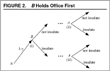
). To specify the equilibrium conditions leading to inefficient insulation, recall that a party only has the option of insulating the first time it comes to power and consider the subgame in which B comes to power in the first round and, therefore, before A. This subgame is outlined in Figure 2.
Evaluating A's decisions, suppose that A is deciding whether to insulate when it first comes to power, i.e., at (ii) in Figure 2.
19 de Figueiredo's equilibrium analysis assumes that A either insulates or not regardless of whether B has ever been in office before. But A knows whether B has held power before and, therefore, whether B will have the option of insulating when it next comes to power. Accordingly, A can condition its decision on this information. This affects the cut points that define the equilibrium conditions at which a party insulates but does not affect de Figueiredo's general conclusions.
If
A insulates, it obtains α in the current period plus an expected continuation payoff of
. If A does not insulate, B's unique best response is to overturn A's policies whenever possible. (With
, there are no gains to cooperating on not overturning each other's policies.) This leaves A with a payoff of one whenever it is in power and zero whenever it is out of power. This yields 1+δγ/(1−δ). A, therefore, weakly prefers to insulate at (ii) if
or, equivalently, if α[ges ]αA|N≡[1−δ(1−γ)]/[1−δ(1−γ)(1−β)]. Similarly, A weakly prefers to insulate at (iii) if α[ges ]αA|I≡1−δ(1−γ). Clearly, αA|I<αA|N.
Now consider B's decision at (i) if A overturns B's policy whenever possible. Assume further that αA|I<α<αA|N which means that A only insulates if B did. Then B weakly prefers to insulate if
. Algebra then shows that α′B>αA|N. B, therefore, prefers not to insulate if α∈(αA|I, αA|N). This implies that all the equilibria in subgame (i) are inefficient only if α>αA|N.
A similar analysis of the subgame in which A comes to power in the first round demonstrates that there will be insulation here only if α>αB|N. The fact that
then gives αA|N[les ]αB|N. Hence, the equilibrium condition needed to ensure inefficiency is that α>αA|N or, equivalently, that A2 holds strictly.
To compare this to (1), consider node (ii) where A has come to power for the first time and B did not insulate when it had the chance. Let MA denote A's minmax payoff starting from this state. As for the upper bound on A's continuation payoff defined by the right side of (1), observe that, because B's policy is in place when A comes to power at (ii), the maximum of the sum of the two players' continuation payoffs is one in each period. This gives Bk=1/(1−δ). Moreover, the minimum B can get at (ii) if A plays efficiently (i.e., does not insulate) is zero. And B's expected minmax payoff starting in the next period is what it obtains if each player always overturns the other's policy: (1−γ)/(1−δ). Condition (1) then becomes
Proposition 1 shows that there are no efficient equilibria whenever A3 holds. Consequently, the only difference between A2 and A3 can occur if there are no efficient equilibria (αA|N<α) and if A3 still does not hold. But α>αA|N and A2 imply that A's best reply to being minmaxed is to insulate. So,
. Thus, A3 is identical to A2 if
, and the slack between these conditions is due to the nonlinearity of the Pareto frontier that arises if
.
20 If
, there are gains from cooperation and equilibria in which the parties do not always overturn each others' policies. This increases A's potential payoff if A does not insulate at (ii), and this raises αA|N. The maximum of the sum of the two players' continuation payoffs also increases to Bk=2β/(1−δ). This makes comparing (1) and the equilibrium conditions with
very complicated and tedious.
As shown above, bargaining breaks down in war in Powell's model if
This inequality is equivalent to condition (1): The left side is the declining state's minmax payoff which it can obtain by attacking. Since the size of the pie is one in every period, Bk=1/(1−δ). The rising state's minimum payoff in any period along any efficient path is zero. And the rising state's minmax payoff in the next period is what it can obtain by fighting at that time: (pt+Δ−r)/(1−δ).
Turning to the equilibrium condition, there is a status quo distribution of territory q in Powell's model, i.e., the rising state controls q∈[0, 1] of the territory at the outset of the game. This means that the declining state obtains a payoff of 1−q if does not fight in the last period, say t, prior to the rising state's having a credible threat. Thereafter the declining state keeps the rising state indifferent between fighting and accepting the rising state's offer in each period. Thus, the declining state's continuation payoff if it does not fight at time t is 1−q+δ[1/(1+δ)−(pt+Δ−r)/(1−δ)], where (pt+Δ−r)/(1−δ) is the rising state's payoff to fighting in the next period when its probability of prevailing has increased to pt+Δ. This implies that the equilibrium condition that yields fighting is
The slack between this equilibrium condition and (1) is due solely to payoffs in the initial period and this difference goes to zero as the discount factor goes to one.
I appreciate helpful comments and criticisms from Daron Acemoglu, Jonathan Bendor, Rui de Figueiredo, James Fearon, Sven Feldman, Jeffry Frieden, Kira Markiewicz, Dan Reiter, James Robinson, Gerard Roland, Chris Shannon, Timothy Simcoe, Leo Simon, and Barry Weingast. I also gratefully acknowledge the support of the National Science Foundation (SES-0315037).






Comments
No Comments have been published for this article.