
Introduction
Enterobius vermicularis, also known as pinworm and one of the most prevalent intestinal helminths in humans, poses public health concerns worldwide. This parasite is widely distributed from the Arctic to the tropics, in developing and developed countries, and affects approximately half a billion people worldwide, predominantly preschool and school-aged children (Lukes et al., Reference Lukes, Horák and Scholz2005; Bethony et al., Reference Bethony, Brooker, Albonico, Geiger, Loukas, Diemert and Hotez2006).
The earliest human infections were documented in prehistoric populations of both the Americas (Reinhard et al., Reference Reinhard, Araujo and Morrow2016; Morrow and Reinhard, Reference Morrow and Reinhard2018) and the Old World (Horne, Reference Horne2002). Transmission of the helminth is by three principal pathways – hand-anus-mouth, inhalation of eggs and retroinfection (Cook, Reference Cook1994; Botero and Restrepo, Reference Botero and Restrepo2012). The disease due to this parasite is known as enterobiasis or oxyuriasis. Although enterobiasis is asymptomatic in most infected adults, who typically have low worm burdens, it can cause significant morbidities in children, particularly in those with heavy infections (e.g. high worm burden), with neurological symptoms including nervousness, restlessness, irritability and distraction, influencing child growth and wellbeing (Cook, Reference Cook1994; Botero and Restrepo, Reference Botero and Restrepo2012; Wendt et al., Reference Wendt, Trawinski, Schubert, Rodloff, Mössner and Lübbert2019). The predominant clinical symptoms include anal itching and urinary tract infections especially in girls. The disease typically has a benign evolution with rare complications, and anthelmintic therapies are effective in the majority of cases (Cook, Reference Cook1994; Georgiev, Reference Georgiev2001; Botero and Restrepo, Reference Botero and Restrepo2012). Ectopic locations are uncommon, but pinworms can occasionally be detected in the appendix (Tapia and Muñoz, Reference Tapia and Muñoz2011; Levens et al., Reference Levens, Schurink, Koetse and van Baren2014; Hamdona et al., Reference Hamdona, Lubbad and Al-Hindi2016; Lala and Upadhyay, Reference Lala and Upadhyay2016), kidney, liver, lung, urinary tract, female genital tract (Cook, Reference Cook1994; Das et al., Reference Das, Pathan, Hira, Madda, Hasaniah and Juma2001; Craggs et al., Reference Craggs, De Waele, De Vogelaere, Wybo, Laubach, Hoorens and De Waele2009; Powell et al., Reference Powell, Sarmah, Sethi and Ganesan2013; Kashyap et al., Reference Kashyap, Samantray, Kumar, Jhamb, Singh and Kaur2014; Ngui et al., Reference Ngui, Ravindran, Ong, Chow, Low, Nureena, Rajoo, Chin, Amir, Ahmad, Lim and Mahmud2014; Pigac et al., Reference Pigac, Masic and Masic2017), mesenteric lymph node (Zafar et al., Reference Zafar, Tariq and Ahmed2018) and caecal polyp (Elsaid et al., Reference Elsaid, Mahmood, Tekkis and Tan2014), which are all potential reservoirs of this parasite.
Enterobius vermicularis is widely distributed, with an overall human prevalence of infection of about 20% worldwide, and up to 50% in children with socio-sanitary deficiencies (Cook, Reference Cook1994; Georgiev, Reference Georgiev2001; Botero and Restrepo, Reference Botero and Restrepo2012). In Latin America, the prevalence of pinworm ranges between 2.5 and 60% (Requena-Certad et al., Reference Requena-Certad, Lizardi, Mejía, Castillo and Devera2002; Knudson et al., Reference Knudson, Lemos, Ariza, Salazar, del Pilar Chaves, López, Quintana, Moncada, López and Sánchez2003; Bórquez et al., Reference Bórquez, Lobato, Montalvo, Marchant and Martínez2004; Cazorla et al., Reference Cazorla, Acosta, Zarraga and Morales2006; Soto and Quiñones, Reference Soto and Quiñones2015). Studies in Argentina, the second largest Latin American country after Brazil, reported 10–60% enterobiasis infections in schoolchildren from suburban and rural regions, with the most vulnerable being those living in socio-economically disadvantaged conditions (Soriano et al., Reference Soriano, Barbieri, Pierangeli, Giayetto, Manacorda, Castronovo, Pezzani, Minvielle and Basualdo2001; Lazarte et al., Reference Lazarte, Christian, Oquilla and Gonzalez2006; Bracciaforte et al., Reference Bracciaforte, Fernanda Diaz, Vottero Pivetta, Burstein, Varengo and Angel Orsilles2010; Gamboa et al., Reference Gamboa, Zonta and Navone2010; Rivero et al., Reference Rivero, De Angelo, Nunez, Salas, Motta, Chiaretta, Salomon and Liang2017a, Reference Rivero, De Angelo, Nunez, Salas and Liang2018). However, most studies have focused on reporting the prevalence of infection and lack inferential analyses regarding risk-associated factors. Consequently, there is not sufficient understanding to inform specific surveillance and control at different scales.
Puerto Iguazú is a subtropical border city in the northeast region of Argentina, which has the highest poverty and indigence levels in the country (INDEC, 2016). Iguazú population is one of the fastest growing populations, with the highest percentage of children and young people in Argentina (INDEC, 2010). A wide spectrum of neglected and vector-borne diseases are endemic in the region and there is a pressing need for improved knowledge of disease burdens and associated risk factors to inform the control and prevention strategies for reducing negative impacts on health, social and economic welfare (Salomón et al., Reference Salomón, Acardi, Liotta, Fernández, Lestani, López, Mastrángelo, Figueroa and Fattore2009; Rivero et al., Reference Rivero, De Angelo, Nunez, Salas, Motta, Chiaretta, Salomon and Liang2017a, Reference Rivero, De Angelo, Nunez, Salas and Liang2018; Orellano et al., Reference Orellano, Vezzani, Quaranta, Cionco, Reynoso and Salomon2018a, Reference Orellano, Vezzani, Quaranta, Reynoso and Salomón2018b). Researchers emphasize the need for studies that identify specific determinants of each pathogen, elucidate predisposing factors and possible interactions between them (Salomón et al., Reference Salomón, Acardi, Liotta, Fernández, Lestani, López, Mastrángelo, Figueroa and Fattore2009; Rivero et al., Reference Rivero, De Angelo, Nunez, Salas, Motta, Chiaretta, Salomon and Liang2017a), and use such knowledge pragmatically to inform prevention and control strategies. The main objective of this study was to evaluate E. vermicularis prevalence, employing an oviscopic technique with serial sampling. Infection and its relation with individual, family and community factors were assessed integratively to explore associated variables, which individually or combined may determine the persistence of this parasite in urban, rural and indigenous village settings. The goal was to unravel eco-epidemiological drivers underlying the heterogeneity in pinworm infections and risk factors among children in Puerto Iguazú, through an analytical approach capable to incorporate the potential complexity of these relationships at the different levels involved. The national status of enterobiasis was assessed and the analysis of the situation observed in terms of the public health implications was performed.
Materials and methods
Scoping review and eligibility criteria
To summarize the current stage of knowledge of E. vermicularis at country level, studies assessing the prevalence of the parasite through specific techniques for the detection of pinworm eggs (anal swabs or cellophane adhesive tape) during the last decade were systematically searched and gathered from four databases: LILACS, PubMed, Scopus and Argentina SciELO. The search followed the PRISMA-P (Preferred Reporting Items for Systematic review and Meta-Analysis Protocols) guidelines (Moher et al., Reference Moher, Shamseer, Clarke, Ghersi, Liberati, Petticrew, Shekelle and Stewart2015), using ‘Enterobius vermicularis’, ‘pinworm’ AND ‘Argentina’ as keywords. References from 2010 to December 2020 were reviewed and analysed. The date of the last search was 26 March 2021. A manual search was also performed, and the reference lists of the original and review articles were examined. When more than one report was published based on the same study, only one was included in the review. Original articles published in journals with ISSN, in Spanish, Portuguese or English languages, were included. Theses and summaries of the same authors of published papers, presented at congresses or in university thesis libraries were not included, to avoid duplication of partial and/or total results. We did not include literature reviews or papers referring to a general prevalence of parasitosis or helminths without explicitly stating the prevalence of E. vermicularis.
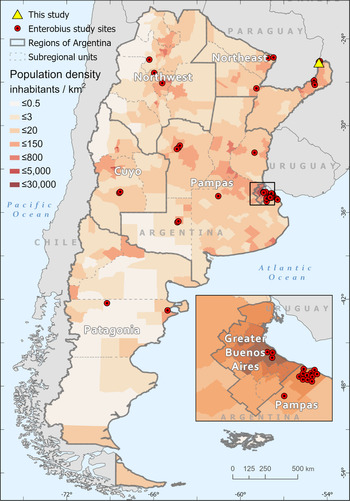
All data extracted were organized in Microsoft Excel datasheets, and binary or multiple codifications were assigned according to survey location, study design, study population, and pinworm detection methodology. We used the country region classification defined by the National Institute of Statistics and Censuses of Argentina (INDEC) according to geographical data (e.g. population, housing and economic aspects), climate and political-territorial-administrative organization: Pampa, Northwest (ANW), Northeast (ANE), Patagonia, Greater Buenos Aires (GBA), Cuyo and the Antarctic region (Fig. 1) (INDEC, 2018, 2019). The eligible publications reviewed about pinworm spanning the last decade were mapped to these regions (Table S1). Each study was geo-referenced and, when the locality name or geographical coordinates of the study area were not specifically described, the locality mentioned on the manuscript title was used to pinpoint the survey on the map.
Distribution of study sites of eligible publications and the present study by INDEC region of Argentina. Circles indicate E. vermicularis in Argentinian human surveys from 2010 to 2020. Insert shows studies in Buenos Aires, where there was the highest number of surveys about this issue. The study area of the present work, the Iguazú Municipality located in the tri-border area of Argentina, Brazil and Paraguay, is depicted as a triangle. The map of Argentina was constructed using population density data from the last National Census, INDEC (2010), and was created with ArcGIS Pro 2.8 (www.arcgis.com).

Study area and population
Argentina is a South American country that extends from 22° to 55° south latitude and meridians 53° to 74° west longitude and presents a wide variety of climatic and socio-economic conditions (INDEC, 2018, 2019; Rivero et al., Reference Rivero, Feliziani, De Angelo, Tiranti, Salomon and Touz2020). The present study was conducted in Misiones province, part of the Upper Parana Atlantic Forest eco-region and the most biodiverse area in Argentina (Olson and Dinerstein, Reference Olson and Dinerstein1998; Bertonatti and Corcuera, Reference Bertonatti and Corcuera2000). The population of this region is among the most impoverished and indigent in the country (INDEC, 2016). At its northwest point is located Puerto Iguazú, a subtropical city (25°35′52″S and 54°34′ 55″W) bordering with Brazil and Paraguay. The urban area lacks town planning and has grown rapidly in recent decades (INDEC, 2016). Most houses are of cement, but precarious constructions of wood with sheet metal roofs are interspersed in most of the city neighbourhoods. Although there are public services, not all the city has sewage or water networks. The rural area to the south is characterized by simple wooden buildings with dirt floors, and water from wells. Farm animals are raised for family sustenance as well as some small-scale crops of cassava, corn, other vegetables and fruits. The indigenous group Mbyá-Guaraní is an ancient ethnicity with Amazonian roots, located to the east and southeast of Iguazú city; they constitute almost half of the indigenous population of Misiones province (INDEC, 2010), with very fragile sanitary and building conditions.
Study design
Subject recruitment
This cross-sectional survey was conducted from January 2018 to May 2019 in the urban, rural and indigenous communities of Iguazú. Child sampling was randomized in the Public Health Care Centre (PHCC) areas in urban-periurban, rural and indigenous villages of the municipality. From their population records, we estimated overall that about 6370 children <13 years of age were in the PHCC study areas. The minimum sample size was calculated using the formula for population-based surveys (Dean et al., Reference Dean, Sullivan and Soe2013), considering the population size, the expected frequency of enterobiasis (50%) and a confidence level of 95%, which corresponds to 10.14% of the children of urban and rural settings. In indigenous villages, after receiving authorization from the ‘cacique’ (the maximum political authority) of each village, recruitment included all the families who voluntarily agreed to participate (35.84% of the indigenous families). Houses were selected by simple random sampling and were visited by an interdisciplinary and intercultural team. Families with children under 13 years of age, without gastrointestinal symptomatology nor under parasitological treatment, were invited to participate. During household visits, the team provided information about the study, materials for sample collection (disposable collection kit), an epidemiological questionnaire and requested written informed consent for each child. In indigenous villages, all the activities were conducted in the mother tongue with the collaboration of the PHCC staff.
Sample collection
Parents were instructed to follow a serial perianal swab method shortly after the child's waking, before defecation or bathing, every other day during one week, to collect three samples in total. A collection kit was provided for each child. Parents were requested to place the gauzes in a plastic bottle containing formaldehyde 5%, previously labelled with the child's name and an identification code. Oral and written bilingual (Spanish/Mbyá-Guaraní) explanations about sample collection, as well as illustrated instructions, were provided with the collection kit. Field staff gathered the samples, following proper hygienic and bio-safety procedures. All samples were delivered to and processed at the laboratory of Parasitology and Zoonotic Diseases of the National Institute of Tropical Medicine (PZD-INMeT) in Puerto Iguazú.
Questionnaire
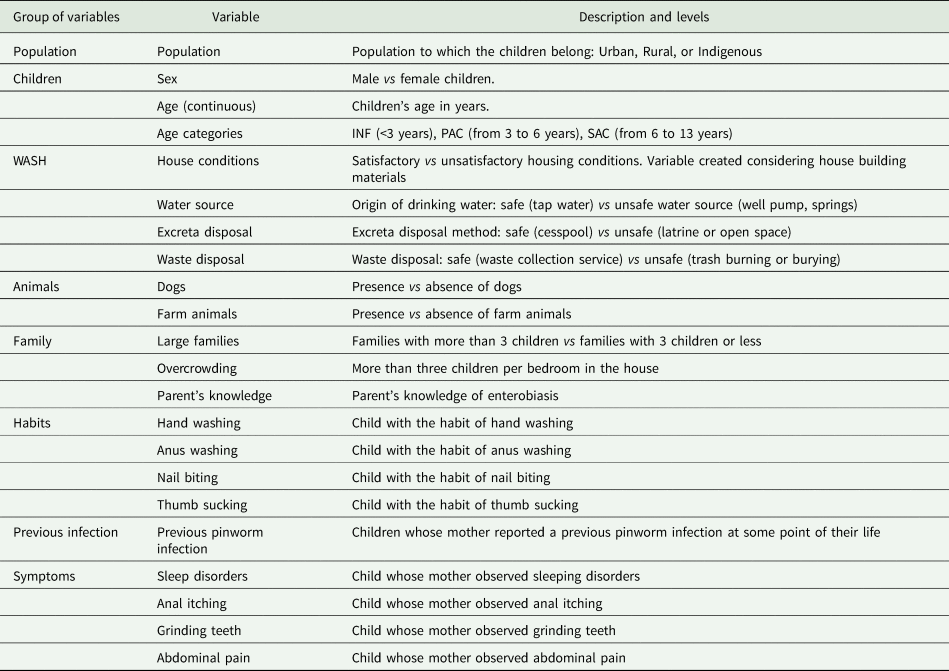
Demographic and socio-economic data were obtained with a pre-tested and structured questionnaire administered to children's mothers or legal guardians during house-to-house visits. The questionnaire surveyed personal and family variables (e.g. child gender and age, family composition, parents’ work situation and educational level), including child's play, habits and personal hygiene (e.g. playing with soil, hand washing, thumb sucking, nail biting, anus washing), and household features (e.g. house building construction, water supply, excreta disposal, waste disposal). Information on previous enterobiasis, signs and symptoms as well as previous treatments were also recorded for risk evaluation (Table 1). All questionnaire data were double-entered into a database and cross-checked. The grouped analysis provided new categorical variables that were included in the analysis.
Socio-demographic variables analysed at different levels for explaining pinworm infections

Assessing E. vermicularis infection
First, exhaustive macroscopic examinations were performed under a stereoscopic magnifier. Serial perianal gauzes were then subjected to centrifugation at 1500 rpm for 10 min and the pellet was observed under light microscopy. Examinations were performed over the entire area under the coverslip using a PrimoStar Zeiss optical microscope with dry 10× and 40× objectives. Identification of parasites was performed through the morphological and morphometric characteristics. Photographic and morphometric characterizations of adult worms were also registered. Samples were classified as positive if a worm was detected during the macroscopic analyses or if an egg or worm was observed in the pellet resulting from the swab-centrifugation. Microscopic observations were conducted in duplicate by two experienced microscopists. As a quality control, a random 10% of the total samples were re-examined by a senior laboratory researcher. Gauze analysis results were reported in triplicate: parents/legal guardians of the subjects received oral and written notification of the results, a copy was attached to each child's PHCC file, and a copy was kept in the INMeT research files.
Statistical analyses
The presence/absence of E. vermicularis was the main response variable. Variables characterising children's conditions, habits and their local environments (Table 1) were included in the analysis as explanatory variables (fixed effects) in generalized linear mixed-effects models (GLMM), with the household as a random effect to consider the dependence of the data and nested factors (children belonging to each household) (Zuur et al., Reference Zuur, Ieno, Walker, Savilev and Smith2009). To select the most important variables (Magalhães et al., Reference Magalhães, Clements, Patil, Gething and Brooker2011), univariate analysis was performed to describe general associations between the response and independent variables. To discern the most important combination of factors conditioning the persistence of E. vermicularis, the significant independent variables (P < 0.05) from the univariate models were analysed by groups in subsequent multivariate GLMM analyses (see groups in Table 1). As we included children from contrasting populations (urban, rural and indigenous), the effect of these populations and their potential interactions in relation to other independent variables was also evaluated. Before incorporating variables in multivariate models, multicollinearity inferred by the variance inflation factor (e.g. >5) was assessed (Zuur et al., Reference Zuur, Ieno, Walker, Savilev and Smith2009). When two or more correlated variables were detected for candidate models, only the most significant variables in the univariate models were included in further models. The models obtained for each group of variables and their possible combinations were compared hierarchically using the Akaike Information Criterion corrected for small samples (AICc), to identify the best-fit models containing only the most important and uncorrelated variables of each group (Burnham and Anderson, Reference Burnham and Anderson2002). When more than one candidate model for each group was obtained, a model averaging these candidate models was used, and those variables that demonstrated a significant effect (i.e. 95% confidence interval of the β estimate that did not include zero) were retained. To know which combination of factors was the most important for explaining E. vermicularis infection in the children, as a final step we combined the selected models for each group in one global model, eliminating non-significant or correlated variables and comparing this global model with the group models by their AICc. The number of children per family was considered as a weight argument in these models to balance potential bias in household-level factors caused by families with a high number of children (Zuur et al., Reference Zuur, Ieno, Walker, Savilev and Smith2009). The presence of E. vermicularis was modelled as a binary response variable with a logit-link function. Statistical analyses were carried out with R software (R Development Core Team, 2016) through library lme4 (Bates et al., Reference Bates, Mächler, Bolker and Walker2015) and model comparisons, and averaging through library MuMIn (Barton, Reference Barton2020). The odds ratios (OR) and their confidence intervals were calculated for each model using the R package broom.mixed (Bolker and Robinson, Reference Bolker and Robinson2021) for evaluating the degree of association between the E. vermicularis infection and the independent variables, where 0 < OR < 1 indicates a negative association, OR = 1 indicates lack of association, and OR > 1 indicates a positive association. Model fit and model assumptions were validated using the R package DHARMa (Hartig, Reference Hartig2021).
Results
Enterobiasis in Argentina during the decade 2010–2020
A total of 105 studies were initially identified, following PRISMA screening recommendations (Moher et al., Reference Moher, Shamseer, Clarke, Ghersi, Liberati, Petticrew, Shekelle and Stewart2015). Of these, 26 studies reporting E. vermicularis presence at 39 localities from 2010 to 2020 met the inclusion criteria (Fig. S1) and were included in the subsequent analysis. This nematode was reported, through specific technique detection, in 11 of the 23 Argentine provinces. During these 10 years, the presence of pinworm has been steadily reported in studies with up to four publications per year. Most surveys were performed in the child population up to 15 years of age in urban, periurban and/or rural areas of different provinces of Argentina, and in indigenous child populations residing in the north region of the country. Overall, 12 629 children were evaluated during the decade with a median prevalence of 31.7%. The parasite was detected mainly in the Pampa and ANE regions, while ANW, Patagonia, Cuyo and GBA regions showed lower frequencies of E. vermicularis (Fig. 1). The average prevalence in the different regions of the country varied between 18.45 and 39.7% over the 10-year period. The Pampa region ranked first, with some provinces such as Córdoba (Bracciaforte et al., Reference Bracciaforte, Fernanda Diaz, Vottero Pivetta, Burstein, Varengo and Angel Orsilles2010; Rustan et al., Reference Rustan, Altamira, Gili, Peralta, Zitta and Varengo2011) and La Pampa (Gamboa et al., Reference Gamboa, Zonta and Navone2010; Navone et al., Reference Navone, Zonta, Cociancic, Garraza, Gamboa, Giambelluca, Dahinten and Oyhenart2017) with median values close to 50%. The ANW and Patagonia regions had lower enterobiasis values, close to 20% (Dib et al., Reference Dib, Oquilla, Lazarte and Gonzalez2012, Reference Dib, Fernandez-Zenoff, Oquilla, Lazarte and Gonzalez2015; Navone et al., Reference Navone, Zonta, Cociancic, Garraza, Gamboa, Giambelluca, Dahinten and Oyhenart2017; Cociancic et al., Reference Cociancic, Zonta and Navone2018).
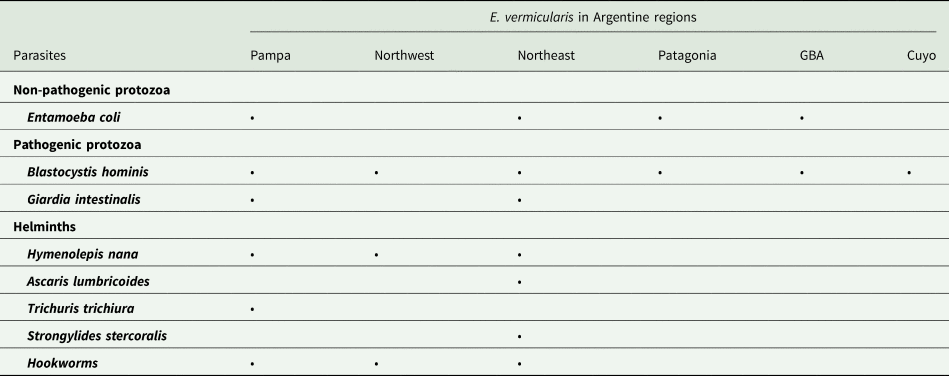
Of the 26 articles reviewed, only six carried out inferential statistics. Regarding the main risk factors of E. vermicularis infection, several variables had been positively associated with thumb sucking, female gender, anal itching and grinding teeth (Rivero et al., Reference Rivero, De Angelo, Nunez, Salas and Liang2018), children above 6 years old (Garbossa et al., Reference Garbossa, Pia Buyayisqui, Geffner, Lopez Arias, de la Fourniere, Haedo, Marconi, Frid, Nesse and Bordoni2013; Molina et al., Reference Molina, Pezzani, Ciarmela, Orden, Rosa, Apezteguía, Basualdo and Minvielle2011; Cociancic et al., Reference Cociancic, Zonta and Navone2018), onychophagia, children whose parents’ literacy was incomplete (Garbossa et al., Reference Garbossa, Pia Buyayisqui, Geffner, Lopez Arias, de la Fourniere, Haedo, Marconi, Frid, Nesse and Bordoni2013; Cociancic et al., Reference Cociancic, Zonta and Navone2018), children whose mothers were the breadwinners (Gamboa et al., Reference Gamboa, Giambelluca and Navone2014), and participants who lived in houses without piped water (Cociancic et al., Reference Cociancic, Torrusio, Zonta and Navone2019). Nevertheless, other studies in Argentina did not identify those risk factors when tested (Ferioli et al., Reference Ferioli, Perazzo and Paulin2020). Additionally, pinworm was reported as the most common parasite associated with protozoa parasites such as Giardia intestinalis, Blastocystis hominis and/or Entamoeba coli in all the country (Table 2). Child coinfection with Hymenolepis nana and Trichuris, hookworms and/or Ascaris lumbricoides was also reported (Table 2) (Bracciaforte et al., Reference Bracciaforte, Fernanda Diaz, Vottero Pivetta, Burstein, Varengo and Angel Orsilles2010; Pezzani et al., Reference Pezzani, Ciarmela, Apezteguía, Molina, Orden, Rosa and Minvielle2012; Oyhenart et al., Reference Oyhenart, Garraza, Bergel, Torres, Castro, Luis, Forte, Gamboa, Zonta, Cesani, Quintero, Luna and Navone2013; Rivero et al., Reference Rivero, De Angelo, Nunez, Salas, Motta, Chiaretta, Salomon and Liang2017a, Reference Rivero, Salas, Valente, Nores, De Angelo, Arrabal, Costa and Salomon2017b, Reference Rivero, De Angelo, Nunez, Salas and Liang2018; Cociancic et al., Reference Cociancic, Torrusio, Zonta and Navone2018; Zonta et al., Reference Zonta, Cociancic, Oyhenart and Navone2019).
Most common helminths and protozoan parasites reported in association with E. vermicularis in Argentine regions during 2010–2020

Socio-demographic characteristics of the study population
The enrolment process involved 980 children aged between 1 month and 13 years old. Of these, 93.5% (916) provided proper gauze samples, complete information in the socio-demographic questionnaires and a signed informed consent. The children were from 470 families with a mean of 1.80 ± 0.91 children per family. There were 379 urban, 189 rural and 348 indigenous children corresponding to 201, 131 and 138 families, respectively. Overall, 55.02% of the study population were boys (n = 504/916) and 44.98% girls (n = 412/916), with a mean age ± s.d. of 5.9 ± 3.6 years old. By age ranges, 25.55% were infants (INF, from 0 to 3 years old), 28.93% pre-school-age children (PSAC, from 3 to 6 years old) and 45.52% school-age children (SAC, from 6 to 13 years old). In total, 34.61% (n = 317/916) of the children were from large families with more than three siblings, with overcrowding present in 52.07% (n = 245/470) of the households.
The employment situation is precarious, and many families receive subsistence support from national subsidies. In indigenous villages, the employment circumstances are highly unstable, typically with temporary and casual work. Regarding household construction materials, 75.98% (n = 696/916) of the children reside in unsatisfactory conditions, with no or only one main component (walls, ceiling or floor) of cement, with mud and wood being the other predominant materials. Drinking water, excreta and waste disposal were unsafe in 56.55% (n = 266/470), 44.65% (n = 210/470) and 55.46% (n = 260/470) of the households, respectively. Farm animals were present in 52.62% (n = 247/470) of the households, and 81.33% (n = 382/470) of the families have dogs.
Enterobius vermicularis prevalence in Iguazú children
The overall prevalence of pinworm infection detected through the serial perianal swab method among Iguazú children was 29.91% (n = 274/916). There was a significant effect of the population on the presence of E. vermicularis (χ 2 = 6.44, d.f. = 2, P = 0.04). Indigenous children presented the highest prevalence at 34.48% (n = 120/348), being those children 50% more likely to be infected than urban children (OR = 1.51, 95% CI 1.10–2.08). In children in urban and rural areas, the prevalence was 25.86% (n = 98/379) and 29.63% (n = 56/189), respectively. The prevalence of E. vermicularis was slightly higher in girls than in boys [31.80% (n = 131/412) vs 28.37% (n = 143/504)]. The probability of infection increased with the age of the children (β = 0.06, z = 2.94, P < 0.001) and by age categories (PSAC: β = 0.720, z = 3.38, P < 0.001; SAC: β = 0.880, z = 4.47, P < 0.001) (Tables S2). Considering all the Iguazú children, SAC children were 2.4 times more likely to be infected (35.25%, n = 147/417, OR = 2.42, 95% CI 1.64–3.56) than INF children (18.38%, n = 43/234), followed by PSAC children (31.70%, n = 84/265, OR = 2.06, 95% CI 1.35–3.14) (Tables S2). Considering the age rates in each setting, urban PSAC and SAC children were 3.9 and 2.7 times more prone to infection than the INF children, respectively (Tables S2). However, in indigenous and rural settings, SAC children were the most affected group. Indigenous children presented higher probabilities in all age ranges (OR = 2.62, 95% CI 1.21–5.65).
Household sanitary conditions
Enterobius vermicularis infection was 30% less likely to occur in houses with satisfactory conditions (OR = 0.68, 95% CI 0.48–0.96), 40% more likely to occur in houses with latrine or no excreta disposal system (OR = 1.42, 95% CI 1.07–1.88), and 57% more likely where there was no waste collection service (OR = 1.57, 95% CI 1.17–2.1), regardless of the population where the house was located (Tables S2). When combined, the waste disposal model alone was the most important model representing the effect of WASH variables (Tables S3 and S4).
In relation to family characteristics, the E. vermicularis infection risk increased by 88% in large families with more than three children (OR = 1.88, 95% CI 1.41–2.52), and by 35% in families with overcrowding (OR = 1.35, 95% CI 1.02–1.80), and also this infection was two times more likely to be present in families who declared prior knowledge of enterobiasis (OR = 2.04, 95% CI 1.30–3.21) (Tables S2). The effect of large families varied according to the population, with the most important positive effect found on the large rural families (Tables S2). This interaction of population and family size combined with parent's previous knowledge constituted the most important model for this group of variables (Tables S3 and S4).
Child's habits and personal hygiene behaviour
All variables of this group were important predictors for E. vermicularis infection, independently of the population (Tables S2). Hand washing and anus washing habits showed protective effects reducing by 57 and 43% by E. vermicularis infection risk, respectively (hand washing OR = 0.43, 95% CI 0.29–0.63; annus washing OR = 0.57, 95% CI 0.39–0.83) (Tables S2). On the contrary, children with nail-biting habits were two times more likely to be infected (OR = 2.00, 95% CI 1.41–2.84), and 43% more likely if the children had thumb-sucking habits (OR = 1.43, 95% CI 1.03–1.98) (Tables S2). The combination of hand washing (not) and nail-biting habits constituted the strongest model for habits and personal hygiene behaviour variables (Tables S3 and S4).
Previous infections, signs and symptoms associated with E. vermicularis infection
Children previously treated for intestinal parasites were 2.4 times more likely to be infected by E. vermicularis (OR = 2.37, 95% CI 1.49–3.76) than those never treated. A clear association was also found between pinworm infection and the presence of the signs and symptoms evaluated (Tables S2). Enterobius vermicularis was associated with sleep disorders (OR = 1.85, 95% CI 1.27–2.68), anal itching (OR = 3.52, 95% CI 2.53–4.91), grinding teeth (OR = 2.47, 95% CI 1.67–3.64) and abdominal pain (OR = 1.57, 95% CI 1.13–2.19) (Tables S2). The combination of anal itching and grinding teeth showed the strongest association in multivariate models (Tables S3 and S4).
Multi-level determinants of pinworm infection
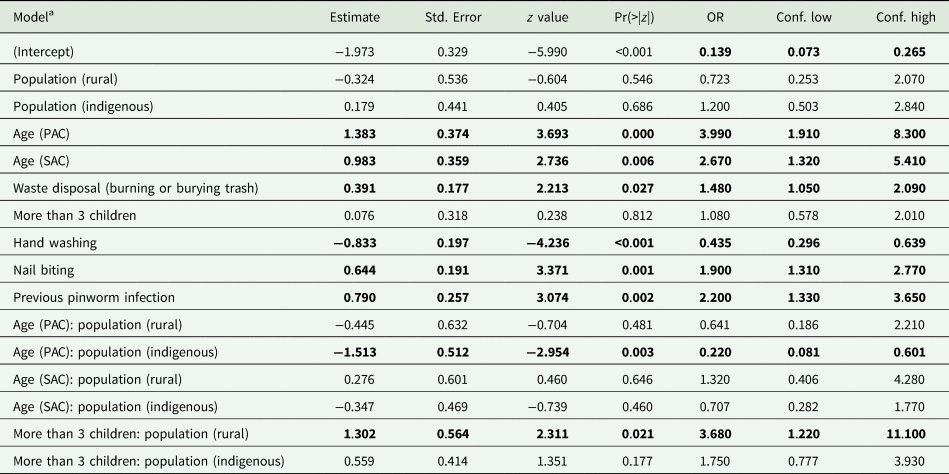
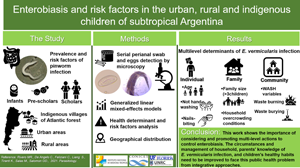
The best final model, generated by combining the selected models by group, involved multilevel variables associated with pinworm infection and had the highest support among all the tested models (Table 3 and Table S3). At individual level, child age was the most important determinant of infection, but also it was important to consider the interaction between age categories and population. Additionally, previous pinworm infection, and nail baiting were variables of high importance included in the final model. At household level, family size (>3 children) and WASH variables (waste disposal) were also maintained as important predictors of parasite infection, but family size was important considering its interaction with child population (Table 3).
Simple GLM models analysing the effect of different variables on the presence of Enterobius vermicularis (univariate models), and the potential interaction of each variable with the population where the children live (univariate models by population)

a DHARMa non-parametric dispersion test: value = 1.005, P value = 0.896, deviation = n.s.; uniformity k-test: D = 0.019, P value = 0.893, deviation = n.s.; DHARMa outlier test: outliers at both margin(s) = 7, observations = 916, P value = 1, deviation = n.s.
Significant variables marked in bold (P < 0.05). The columns to the right show the estimated odds ratio (OR) and the 95% confidence interval.
Discussion
The prevalence of E. vermicularis among children from a heterogeneous population in subtropical Argentina was reported and the epidemiological situation of this parasitosis depicted at country level. Based on studies reported from 2010 to 2020, the prevalence of E. vermicularis infection was above 30% (±10%) across all Argentina. The child population with socio-economic vulnerabilities of the northeast and the Pampa regions was the most affected. Similarly, this analysis of enterobiasis infections among urban, rural and aboriginal children of Iguazú, using the serial swab sampling basis technique, evidenced pinworms in almost 30% of the population. This represented a higher E. vermicularis prevalence among children than previous studies in the area (Rivero et al., Reference Rivero, De Angelo, Nunez, Salas, Motta, Chiaretta, Salomon and Liang2017a, Reference Rivero, De Angelo, Nunez, Salas and Liang2018). Since E. vermicularis can affect the entire household, the finding in children provides a conservative estimate of parasite endemicity in the region.
The three sub-population groups studied had a similar prevalence range of variability, but a statistically significant difference for the indigenous population. Importantly, the results showed that the gap between pinworm prevalence in children from urban and rural areas seemed to be minimal, coinciding with the global pattern reported in the last decades (Park et al., Reference Park, Han, Kim, Shin, Guk, Kim and Chai2005; Pezzani et al., Reference Pezzani, Ciarmela, Apezteguía, Molina, Orden, Rosa and Minvielle2012; Moosazadeh et al., Reference Moosazadeh, Abedi, Afshari, Mahdavi, Farshidi and Kheradmand2017; Laoraksawong et al., Reference Laoraksawong, Pansuwan, Krongchon, Pongpanitanont and Janwan2020). The accelerated and unplanned growth of urban areas, resulting in communities living with multiple economic and sanitary constraints, contributes to the propagation and maintenance of infectious diseases (Eisenberg et al., Reference Eisenberg, Desai, Levy, Bates, Liang, Naumoff and Scott2007). Nevertheless, the situation in indigenous villages highlights important epidemiological implications associated with the higher prevalence of enterobiasis in all age ranges of the child population, suggesting that it may be affecting the entire community. Indeed, they face precarious housing, socioeconomic difficulties, substandard hygiene and sanitation, a lack of or limited access to health care, as well as malnutrition (Navone et al., Reference Navone, Gamboa, Oyhenart and Orden2006; Rivero et al., Reference Rivero, De Angelo, Nunez, Salas and Liang2018), a critical situation with poor prospects for near term changes. At the same time, the high prevalence of other pathogenic nematodes, such as hookworms and Strongyloides stercoralis affecting the villages, presents a complex scenario in these communities where children's health and development are constantly threatened (Navone et al., Reference Navone, Gamboa, Oyhenart and Orden2006; Brandelli et al., Reference Brandelli, Carli, Macedo and Tasca2012; Rivero et al., Reference Rivero, De Angelo, Nunez, Salas and Liang2018). In this regard, the findings match those of many other studies which stress that, in communities in highly vulnerable conditions, it is necessary to conduct studies focusing on the whole community, and not simply on captive groups such as PSAC and SAC, with the object of proposing more suitable and effective control strategies (Song et al., Reference Song, Cho, Kim, Choi and Hong2003; Brandelli et al., Reference Brandelli, Carli, Macedo and Tasca2012; Romero-Sandoval et al., Reference Romero-Sandoval, Ortiz-Rico, Sánchez-Pérez, Valdivieso, Sandoval, Pástor and Martín2017). The holistic understanding of the interaction between diseases and individuals involves factors related to each individual (e.g. age, nutritional status, etc.), their proximal circumstances (e.g. family composition, household characteristics, etc.), their neighbourhood (e.g. socio-economic conditions) and the environment potentially acting at different levels (Eisenberg et al., Reference Eisenberg, Desai, Levy, Bates, Liang, Naumoff and Scott2007; Ross, Reference Ross, Mackenzie, Jeggo, Daszak and Richt2012; Mwangi et al., Reference Mwangi, de Figueiredo and Criscitiello2016). In the present study, a hierarchical approach was used and made it possible to consider all these levels with the potential multiple factors involved concurrently, to account for the complexity of factors underlying pinworm transmission.
The multilevel modelling analysis of pinworm infection included individual, family and household variables. Indeed, the final models, including the multiple factors comprising these levels, further support the paradigm of an integrative approach for understanding and preventing parasitic diseases. On an individual level, age group, personal hygiene habits (e.g. no hand washing), nail biting and previous treatment were significantly associated with the presence of E. vermicularis. Host age is a determining factor in pinworm presence among children, consistent with recognition that enterobiasis risk is universally related to children's age, especially in the PSAC and SAC groups (Remm and Remm, Reference Remm and Remm2010; Laoraksawong et al., Reference Laoraksawong, Pansuwan, Krongchon, Pongpanitanont and Janwan2020). Interestedly, although PSAC and SAC-age children were the most parasitized group, children under 3 years old showed higher prevalence, suggesting the importance of adding this group when assessing the epidemiology and interventions of entero-parasitosis (Pullan and Brooker, Reference Pullan and Brooker2008; Worrell et al., Reference Worrell, Wiegand, Davis, Odero, Blackstock, Cuellar, Njenga, Montgomery, Roy and Fox2016). This may be related to age-specific hygiene and playing habits that facilitate greater contact with the transmission routes of parasite infective stages. Hygiene habits, especially related to hand washing, are not well ingrained in the infant population, and are a substantial determinant of parasite acquisition (Curtis et al., Reference Curtis, Danquah and Aunger2009; Gelaw et al., Reference Gelaw, Anagaw, Nigussie, Silesh, Yirga, Alem, Endris and Gelaw2013). Similarly, children who bite their fingernails are at higher risk for ingesting eggs from the environment, which is another risk factor of pinworm infection (Cook, Reference Cook1994; Sung et al., Reference Sung, Lin, Huang, Wang and Lu2001; Cranston et al., Reference Cranston, Potgieter, Mathebula and Ensink2015; Rivero et al., Reference Rivero, De Angelo, Nunez, Salas, Motta, Chiaretta, Salomon and Liang2017a).
Host traits that may promote higher susceptibility are closely related with host exposure to risk factors and immune defense (Vaumourin et al., Reference Vaumourin, Vourc'h, Gasqui and Vayssier-Taussat2015). Remarkably, children having had past pinworm infection were an important predictor for their current infection, suggesting that intrinsic or extrinsic conditions favouring its maintenance remain unresolved (Rivero et al., Reference Rivero, De Angelo, Nunez, Salas, Motta, Chiaretta, Salomon and Liang2017a, Reference Rivero, Salas, Valente, Nores, De Angelo, Arrabal, Costa and Salomon2017b, Reference Rivero, De Angelo, Nunez, Salas and Liang2018). Due to the efficiency and widespread nature of the parasite transmission, total eradication of pinworm is difficult and very unlikely. Elimination of the parasite from a family often poses problems, and reinfection is common even after deworming (Cook, Reference Cook1994; Botero and Restrepo, Reference Botero and Restrepo2012; Moffa et al., Reference Moffa, Cronk, Fejfar, Dancausse, Padilla and Bartram2019).
Among the signs and symptoms potentially related to enterobiasis reported by mothers, anal itching and grinding teeth showed a clear relation with E. vermicularis. Additionally, abdominal pain analysed as a single symptom was significantly related to pinworm presence. Indeed, this parasite can cause severe abdominal pain, mimicking appendicitis, and numerous case reports worldwide act as a cautionary reminder of the importance of considering potential E. vermicularis in children with abdominal pain (Dunphy et al., Reference Dunphy, Clark and Raja2017; Efared et al., Reference Efared, Atsame-Ebang, Soumana, Tahiri, Hammas, El Fatemi and Chbani2017).
Thus, although the common infection has a good prognosis, educational interventions at community level and the dissemination of epidemiological knowledge in the medical sphere are essential (Nithikathkul et al., Reference Nithikathkul, Akarachantachote, Wannapinyosheep, Pumdonming, Brodsky and Sukthana2005; Kang et al., Reference Kang, Kim, An, Son, Cho, Park, Kang, Kim and Yu2012; Kim and Yu, Reference Kim and Yu2014; Rivero et al., Reference Rivero, Salas, Valente, Nores, De Angelo, Arrabal, Costa and Salomon2017b). In the case of ectopic presentations, diagnosis may be difficult, mainly because of the lack of clinical suspicion. These actions thus contribute to reducing parasite prevalence and reinfection and enable medical professionals to better complete the clinical diagnosis and guide treatment.
Considering the three populations under study, family variables such as size and household overcrowding were identified as risk factors. Large family size (with more than three children) was associated with a higher presence of E. vermicularis, and school age siblings also increase pinworm infection risk (Sung et al., Reference Sung, Lin, Huang, Wang and Lu2001; Rivero et al., Reference Rivero, De Angelo, Nunez, Salas, Motta, Chiaretta, Salomon and Liang2017a; Laoraksawong et al., Reference Laoraksawong, Pansuwan, Krongchon, Pongpanitanont and Janwan2020). This pattern is closely related with overcrowding, usually associated with the higher prevalence and chronicity of intestinal parasite infections (Duflo et al., Reference Duflo, Galiani and Mobarak2012; Halpenny et al., Reference Halpenny, Koski, Valdés and Scott2012; Rivero et al., Reference Rivero, De Angelo, Nunez, Salas, Motta, Chiaretta, Salomon and Liang2017a).
Although in the study population, household deficiencies were evidenced to a greater or lesser degree according to the settings – indigenous villages, rural or urban – when WASH variables (water origin, excreta and waste disposal) were considered, only poor waste management had a strong effect related to parasite infection at household level in the final model. In the study area, waste generally accumulated for subsequent burning and burying near the houses. Although it is difficult to associate this variable with pinworm morbidity, it is well known that improper waste management and disposal has a ripple effect on the environment, and can greatly affect the health of the population living near the polluted area, contributing to the spread of diseases (Makoni et al., Reference Makoni, Ndamba, Mbati and Manase2004; UNEP, 2009; Odonkor et al., Reference Odonkor, Frimpong and Kurantin2020). Therefore, the elimination of inappropriate practices, and policy inputs on strategies to ensure a clean and safe environment through proper disposal, are required. The design of new models for effective waste management in the study area will improve the household environment and, therefore, community health.
In conclusion, it is evident that a combination of elements acts at different levels for the persistence of E. vermicularis in urban-rural and indigenous villages in subtropical Argentina. Implementing a solid statistical inference with a multilevel analysis certainly allowed an integrative understanding of this infectious disease. Enterobiasis is one of the most prevalent, but underrated, parasitic diseases in children in Argentina. It has a negative impact on children's development and welfare, especially in vulnerable populations and it should therefore not be regarded merely as a nuisance. Identifying the determinants of infectious diseases affecting these sensitive populations, as well as their interactions, presents the challenge of formal interdisciplinary languages for modelling complex realities. Awareness of socio-economic conditions at household level and of children's healthcare is of great relevance. Parents’ and children's exposure to poverty and associated stressors demands the commitment of scientists, policy makers and practitioners to alleviate the costs of poverty for human development. From the public health perspective, the great impact that needs to be achieved involves bridging the gap between knowledge and action.
Although analysing studies by country regions shows trends in pinworm prevalence, it is important to note that they do not represent the whole region but only the sites analysed and that there may be biases in representativeness. Future research could explore factors that underlie the reality of each region. Associated data about immunity to co-infections, anaphylaxis-autoimmunity and physical-cognitive development framed in each region will substantially increase the knowledge of the impact of this pathogen in Argentina.
Strategies need to be developed or validated to mitigate adverse epidemiological situations, promoting operational solutions at local level and respecting cultural diversity. Short- and long-term implementation strategies will be guided by evaluating the differential impact of mass and targeted deworming, by direct actions to tackle the risk factors detected, and by the combination of these in different settings. Undoubtedly, the framework to evaluate the effectiveness, sustainability and scalability of those strategies highlights the substantive methodological challenges that need to be addressed to promote sustained health monitoring.
Supplementary material
The supplementary material for this article can be found at https://doi.org/10.1017/S0031182021001955.
Acknowledgements
We would like to thank the PHHC health workers and families who participated. We are grateful to all the indigenous health promoters for the mother tongue translation and their collaboration in the field. We thank the ESRI Conservation Program and the Society for Conservation GIS for software licences.
Author contributions
M.R.R. conceived, designed and supervised the study. M.R.R., C.F. and M.M.S. conducted investigation and data gathering. M.R.R. and C.D.A. performed data curation, statistical analyses and designed the maps. M.R.R., C.D.A. and C.F. wrote the article. S.L. and K.T. performed visualization and validation activities. M.R.R., C.D.A., S.L., K.T. and O.D.S. reviewed and edited original draft.
Financial support
This research was funded by the National Scientific and Technical Research Council, CONICET PIP-11220150100741CO and the National Agency for the Promotion of Science and Technology ANPCyT (FONCyT), PICT-2017-1125 and PICTO-2017-0094 to M.R.R and the National Ministry of Health.
Conflict of interest
None.
Ethical standards
Ethical approval was obtained from the Bioethical Committee of Misiones province, Argentina. The Helsinki Declaration and national regulations concerning personal data protection (national law No. 25.326), Indigenous Policy, and Support to Indigenous Communities (national laws Nos. 23.302 and 24.071) were followed. Treatment was provided to the children detected positive and to their families following standard clinical practice according to the National Ministry of Health and under the guidance of a physician.