INTRODUCTION
Head and neck cancer has a significant impact on patients' quality of life. After treatment, these patients are faced with considerable challenges in adapting to changed functions of swallowing, chewing, eating and speaking, as well as to their changed appearance. Previous research found that the disfigurement associated with disease and subsequent treatment is one of the major concerns reported by patients with head and neck cancer (Koster & Bergsma, Reference Koster and Bergsma1990; Gamba et al., Reference Gamba, Romano and Grosso1992; Hagedoorn & Molleman, Reference Hagedoorn and Molleman2006).
Patients' perceptions of disfigurement may result in many difficulties involving social adjustment. Hagedoorn and Molleman (Reference Hagedoorn and Molleman2006) demonstrated that a considerable number of patients with disfigurement feel stigmatized, and other people often behave negatively toward them (e.g., making negative remarks, staring at them, and avoiding them) (Gamba et al., Reference Gamba, Romano and Grosso1992; Clarke, Reference Clarke1999). Vickery et al. (Reference Vickery, Latchford and Hewison2003) noted that such disfigurement can become linked to how head and neck cancer patients perceive themselves, how they perceive others, and how they engage in social interactions. Some patients may isolate themselves out of fear of negative reactions from others (De Boer et al., Reference De Boer, Pruyn and Vandenborne1995; Hagedoorn & Molleman, Reference Hagedoorn and Molleman2006).
Various questionnaires about body image have been proposed to study the psychology of this population (Katz et al., Reference Katz, Irish and Devins2000; Chandu et al., Reference Chandu, Smith and Rogers2006; Millsopp et al., Reference Millsopp, Brandom and Humphris2006). An observer-rated questionnaire has been developed (Dropkin et al., Reference Dropkin, Malgady and Scott1983; Katz et al., Reference Katz, Irish and Devins2000); however, our study attached more importance to the self-perception of appearance because the cognitive aspect of a patient's appearance is important in psychological care. Most quantitative studies have captured self-perception of disfigurement as one aspect of a comprehensive multidimensional picture of quality of life. In the European Organization for Research and Treatment Cancer questionnaire (EORTC QLQ-H&N35) (Bjordal et al., Reference Bjordal, Ahlner-Elmqvist and Tollesson1994; Toth et al., Reference Toth, Sakaguchi and Mikami2005) and the University of Washington Quality of Life Questionnaire (UW-QOL) (Hassan & Weymuller, Reference Hassan and Weymuller1993; Rogers et al., Reference Rogers, Gwanne and Lowe2002), attributions about perception of disfigurement are captured along with other physical aspects, including pain, swallowing, and taste. The Derriford Appearance Scale (DAS24) (Carr et al., Reference Carr, Moss and Harris2005) was developed in a population awaiting plastic surgery for an objectively identifiable abnormal appearance. This scale can assess multiple dimensions of social distress, such as how patients feel about themselves, how patients think others view them, and how they avoid social contact. However, only one scale, the EORTC QLQ-H&N35, has been translated and validated in Japan (Toth et al., Reference Toth, Sakaguchi and Mikami2005).
Only a few studies have investigated Japanese head and neck cancer patients' perceptions of their disfigurement; three were qualitative studies (Kaneko, Reference Kaneko2003; Ogama, Reference Ogama2005; Sato et al., Reference Sato, Kaneko and Kaneko2008) and one was a case study (Otaki et al., Reference Otaki, Kabashima and Kasahara1986). To improve psychological quality of care for Japanese head and neck cancer patients, it is necessary to evaluate the social distress of these patients. In addition, it is necessary to investigate negative perceptions of appearance that is related to the treatment separately from social avoidance that is representative of their behavior. So it is hypothesized in the present study that social avoidance and distress about appearance are different subscales of social distress. The aims of this study were to assess the factor structure, internal consistency, and concurrent and discriminant validity of a scale used to measure the social distress of Japanese head and neck cancer outpatients with facial disfigurement.
MATERIALS AND METHODS
Participants and Procedure
A cross-sectional anonymous questionnaire was administered to 244 head and neck cancer outpatients at six hospitals in Tokyo, Japan, from September 2008 to March 2009. Eleven individuals refused to participate and four questionnaires were not returned. Among the 229 respondents, four were excluded because of missing data. Therefore, 225 responses were analyzed (effective response rate: 92.2%).
We established two inclusion criteria and three exclusion criteria. The inclusion criteria were as follows: (1) outpatient in oral surgery, head and neck surgery, or otolaryngology departments for the treatment of head and neck cancer (malignant tumor of the oral cavity and maxillary sinus, pharynx, larynx, and salivary gland); and (2) 20 years of age or older. The exclusion criteria were as follows: (1) participant might suffer serious psychological distress from completing the questionnaire as judged by the primary care doctor; (2) participant was incapable of completing the self-reported questionnaire (for example because of dementia); and (3) participant was not informed of the diagnosis of malignancy.
The ethical and scientific validity of this study was approved by the institutional review boards of medicine at Tokyo University and each participating hospital. Researchers first explained the purpose of this research and the ethical concerns to each patient. Patients who expressed their willingness to participate were asked to sign a consent document. Patients then either completed the questionnaire in a room at the hospital or were allowed to complete it at home. The patients who took the questionnaire home returned it by mail or brought it with them to the next visit. As part of the consent process, medical records of the patients were obtained by the researchers.
Measures
A preliminary study was conducted to investigate if the language in the questionnaire was appropriate for head and neck cancer patients. Findings from this preliminary study indicated that the language of the attribution of the social distress scale was easy to understand and answer. In addition, it was indicated that the attributions of the social distress scale to suit circumstances of head and neck cancer patients, and to highlight components of social adjustment of them. We therefore considered the scale to be appropriate for participants. Participants answered whether they had the postoperative scar on the surface of their neck or face. Participants were assessed on three psychological measures: social distress, the Japanese version of the EORTC QLQ-H&N35, and the Hospital Anxiety and Depression scale (HADS). Medical information about the patients was extracted from the patients' medical records.
The social distress scale evaluated how participants avoided social contact and how much distress they felt about their appearance following head and neck cancer surgery. Nine potential attributes were investigated (i.e., “I avoid going out of the house;” “I avoid social contact with my friends;” “I avoid social contact with my family;” “I avoid going out in public;” “My features cause me physical pain/discomfort;” “My features limit my ability to do things I want to do;” “I get distressed when I see myself in the mirror/window;” “I get distressed when my friends or others talk about my features;” and “I get distressed at social events and shopping.”). Participants responded using a four-point Likert scale (1: absolutely disagree, 2: somewhat disagree, 3: agree, 4: absolutely agree). The attributes were generated from a previous study. Based on previous qualitative studies (Kaneko, Reference Kaneko2003; Ogama, Reference Ogama2005; Sato et al., Reference Sato, Kaneko and Kaneko2008); quantitative studies (Bjordal et al., Reference Bjordal, Ahlner-Elmqvist and Tollesson1994; Katz et al., Reference Katz, Irish and Devins2000; Katre et al., Reference Katre, Johnson and Humphris2008); and a literature review (Chandu et al., Reference Chandu, Smith and Rogers2006; Millsopp et al., Reference Millsopp, Brandom and Humphris2006); we concluded that the concept of social distress is made up of two subscales: “social avoidance” and “distress about appearance.” The face validity of our scales was evaluated by one dentist, one nurse, and one clinical psychologist. In addition, we conducted a literature review to ensure the content validity of the scales.
The Japanese version of the EORTC QLQ-H&N35 (Toth et al., Reference Toth, Sakaguchi and Mikami2005) was used to examine concurrent validity of the social distress scale because the social contact subscale of the EORTC QLQ-H&N35 was hypothesized to be conceptually related. The EORTC QLQ-H&N35 is a self-rated questionnaire using a four-point Likert scale (1: not at all, 2: a little, 3: quite a bit, 4: very much). The EORTC QLQ-H&N35 consists of seven subscales (pain, swallowing, sense, speech, social eating, social contact, and sexuality) that measure the quality of life of head and neck cancer patients. Examples of items from the social contact subscale include: “Has your appearance bothered you?”, “Have you had trouble having social contact with your family?” and “Have you had trouble having social contact with friends?”
The HADS (Zigmond & Snaith, Reference Zigmond and Snaith1983) was used to examine discriminant validity of the social distress scale. The HADS is a 14-item self-assessment scale for measuring psychological distress. It has two subscales, anxiety and depression; items are scored using a four-point Likert scale. The Japanese version of the HADS was translated by Kitamura (Reference Kitamura1993) and was validated by Kugaya et al. (Reference Kugaya, Akechi and Okuyama1998).
Demographic data including gender, marital status, occupational status, income level, educational level, and past experience of smoking and drinking before illness were obtained. Medical variables were assessed retrospectively based on medical records. Medical variables included T stage of the tumor, primary site of the tumor, type of surgery, recurrence and metastasis, treatment with radiation or chemotherapy, and the time since initial diagnosis.
Statistical Analysis
For item reduction purposes, we deleted items for which the inter-item correlation with at least one other item was >0.75 because a high inter-item correlation indicates item redundancy. We then conducted an exploratory factor analysis using the maximum likelihood estimation with a promax rotation. Attributes that resulted in factor loadings of = 0.4 from the exploratory factory analysis on more than one factor were deleted. Then, we discussed the final results of attributes with regard to clinical validation.
To examine the reliability of the social distress scale, we calculated Cronbach a coefficients and averages of inter-item correlations. To examine concurrent validity, we calculated Pearson's correlation coefficients between the social distress scale and the EORTC QLQ-H&N35. In addition, we calculated Pearson's correlation coefficients between the social distress scale and the HADS to examine discriminant validity. We set the threshold for psychological distress at 11/12 (Hosaka et al., Reference Hosaka, Awazu and Aoki1999). We divided the score into binary variables (whether the score exceeded a cutoff value or not) and used it as a dependent variable. All analyses were performed using the statistical package SPSS 12.0 for Windows (SPSS Inc., 1989–2003).
RESULTS
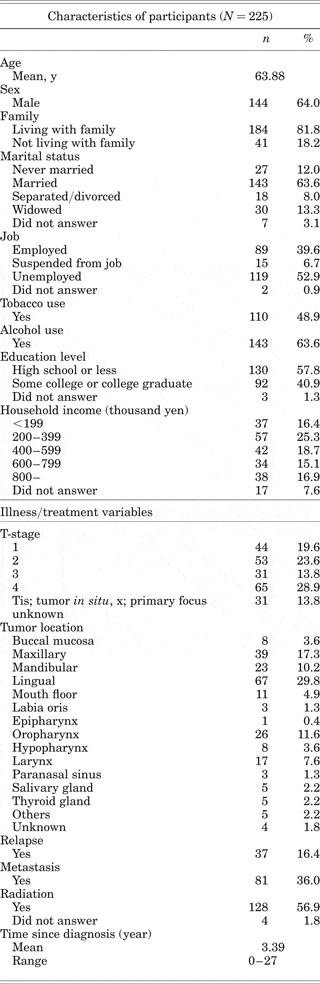
Participant characteristics are shown in Table 1. Descriptive statistics are as follows. Mean age ± standard deviation (SD) was 63.88 ± 12.48 years. Males made up 64% of the total (n = 144). More than half of the sample (57.8%; n = 130) had a high school education or less. The proportion of the sample with a household income of <600 million yen (U.S. $62,000) was 60.4% (n = 136). Of those participants who could be staged (Tx), 42.7% were T3 or T4. The most common diagnosis in this sample was cancer of the tongue (29.8%). The mean time ± SD elapsed since diagnosis was 3.39 ± 4.10 years. Of the 225 participants, 57.3% (n = 129) had disfigurement, 41.3% (n = 93) were not disfigured, and 1.4% (n = 3) did not answer the questions.
Characteristics of participants and illness/treatment variables

Scale Structure and Internal Consistency
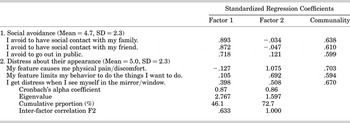
For the inter-item correlations, Pearson's correlation coefficients between each item of the social distress scale ranged from 0.430 to 0.794. Two items (“I avoid going out of the house” and “I get distressed at social events and shopping”) were dropped because their correlation coefficients with other attributes were ≤ 0.75. According to the results of the exploratory factor analysis, three items for social avoidance and three items for distress about appearance were selected; one item (“I get distressed when my friends or others talk about my features”) was dropped because it loaded on both factors above 0.40. The social avoidance subscale accounted for 46.1% of the variance, and the distress about appearance subscale accounted for 26.6% of the variance. The results of the exploratory factor analysis for social avoidance and distress about appearance are shown in Table 2. The average of the inter-item correlations for the social avoidance subscale was 0.693; the average of the inter-item correlations for the distress about appearance subscale was 0.675. The internal consistency was excellent for both the social avoidance subscale (Cronbach α = 0.87) and the distress about appearance subscale (Cronbach α = 0.86).
Exploratory factor analysis of social distress scale (N = 129)

Relationships between the Social Distress and Demographic and Medical Variables
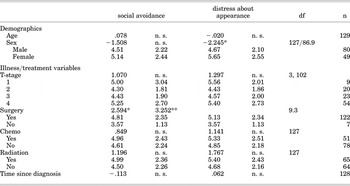
To investigate relationships among social distress, demographic and medical variables, and correlations, t-tests and a one-way analysis of variance were performed. Results are shown in Table 3. Regarding the demographic variables, female scored higher than males in distress about their appearance [t(86.9) = −2.245, p < .05]. Regarding medical variables, participants who underwent surgery were more likely to feel social distress than those who did not; this was true for both social avoidance [t (9.3) = 2.594, p < .05] and distress about appearance [t (9.3) = 3.252, p < .01].
Relations between the social distress subscales and demographics and disease/treatment variables (N = 129)

*p < .05, **p < .01. F, t, and r statictics are shown
Concurrent and Discriminant Validity
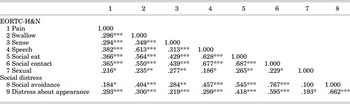
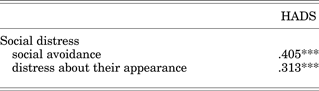
Table 4 shows the concurrent validity. The correlation between the two subscales of the social distress scale and the social contact subscale of the EORTC QLQ-H&N35 were high; they ranged from r = 0.418 to r = 0.767. The social avoidance subscale of the social distress scale was especially related to the social contact score of EORTC QLQ-H&N35 (r = 0.767, p < 0.001). Correlations between the social distress scale and the subscales that were theoretically less related were moderate; they ranged from r = 0.184 to r = 0.545. Pearson's correlation coefficients between the two subscales of the social distress scale were significant (r = 0.662, p < 0.001). As for discriminant validity (Table 5), the correlation between the two subscales of the social distress scale and the subscales of HADS were positive and significant; this was true for both social avoidance (r = 0.405, p < 0.001) and distress about appearance (r = 0.313, p < 0.001).
Correlation between EORTC-H&N and social distress scale (n = 129)

*p < .05, **p < .01, ***p < .001
Correlation between HADS and the social distress subscales (N = 129)

***p < .001
DISCUSSION
This study aimed to develop an instrument assessing the social distress among head and neck cancer patients with facial disfigurement in Japan. Factor analysis resulted in two subscales: social avoidance (3 items) and distress about appearance (3 items). Both subscales were reliable based on internal consistency and inter-item correlations.
The relationship with demographic/treatment variables and the social distress scale were largely significant and supported previous research. Both subscales were associated with treatment; the distress about appearance subscale was associated with gender. Participants who underwent surgery were more likely to feel social distress, whereas neither the experience of chemotherapy nor radiotherapy was significantly associated with social distress. It is not surprising given that the surgical treatment may more directly impact appearance, and indirectly, social distress. Regarding gender, the finding that females were more likely to feel distress about their appearance after an alteration in their appearance is consistent with previous research (Katz et al., Reference Katz, Irish and Devins2003). The subscales of social distress were not associated with family status, job status, marital status, use of tobacco and alcohol, level of education, household income, or any treatment variables except surgery. It is not surprising that the variable about social relationships, including family status, job status, and marital status (Kugaya et al., Reference Kugaya, Akechi and Okamura1999, Reference Kugaya, Akechi and Okuyama2000), might be related to social distress because their disfigurement might influence head and neck cancer patients' social functioning in various situations. It is assumed that the quality of patients' social functioning or relationships may be more important than the presence of a family or spouse.
This study also provides evidence on the concurrent validity of the subscales; moderate-to- high correlations were found consistently with constructs that were theoretically expected to be related to the subscales. Regarding the social contact subscale of the EORTC QLQ-H&N35, the social avoidance subscale of the social distress scale showed especially high correlations and the distress about appearance subscale of the social distress scale showed moderate correlations. This may suggest that each subscale of social distress is complementarily related and that evaluation of both subscales is recommended.
As for discriminant validity, both subscales of the social distress scale were highly correlated with the HADS. This supports suggestions made in previous research about the relationship between social relationships aggravated by disfigurement and patients' psychological distress (Kugaya et al., Reference Kugaya, Akechi and Okamura1999, Reference Kugaya, Akechi and Okuyama2000). Therefore, we believe that this brief assessment of social distress may be useful in quantitative research and clinical assessment of the psychological burden of head and neck cancer patients with disfigurement.
Further research is necessary to improve the quality of psychological care of head and neck cancer patients in Japan. We found a negative relationship between social distress and psychological symptoms. The psychological factors that buffer social distress for psychological symptoms should be investigated.
This study has several limitations. The first limitation is that this study was conducted in a single area of Japan. Therefore, our findings cannot be generalized. The second limitation was that participants had head and neck cancer at various sites; this might affect the ability to conduct reliable quantitative research. Third, this study was cross-sectional. Partridge (Reference Partridge1998) and Clarke (Reference Clarke1999) have suggested that the tendency for social avoidance results from the active sequential interaction among self-image, reactions from other people, and the patient's own behavior. A longitudinal study is necessary to investigate the sequential interaction of these variables. Moreover, further understanding of the test–retest reliability of this scale is necessary.
CONCLUSIONS
The social distress scale is a brief but reliable and valid tool for assessing head and neck cancer patients' social avoidance and distress regarding their appearance following treatment. In addition, the social distress scale seems to highlight components of social adjustment that have implications in coping with cancer. However, the validation of the social distress scale conducted in this study does have several limitations that must be considered. Further clinical and research attention will help researchers and clinicians better understand patients' social distress following facial disfigurement and therefore help design and evaluate interventions for head and neck cancer patients with facial disfigurement.
ACKNOWLEDGMENTS
This research was supported by the Grant-in-Aid for Cancer Research endowed to Mitsunori Miyashita from the Ministry of Health, Labor and Welfare (MHLW), Japan. The MHLW had no further role in study design; in the collection, analysis and interpretation of data; in the writing of the report; or in the decision to submit the paper for publication. The authors express gratitude to Kei Hirai for advising on the plan of the study, Masako Tsukakoshi for coordinating the study, and Yukari Tosaka and Fumiko Takashita for helping with the research.