Introduction
Cucullanus Müller, 1777 comprises more than 100 species of fish parasites in the world (Timi & Lanfranchi, Reference Timi and Lanfranchi2006), including 27 species described for the Neotropical region, and 16 specifically from Brazil (Giese et al., Reference Giese, Furtado, Lanfredi and Santos2010). Although none of these species were recorded in the Tocantins River Basin, a sub-basin of the Amazon River Basin, three of them were found to be parasitizing Siluriform fishes in the Amazonas River Basin: C. grandistomis Ferraz & Thatcher, 1988 parasite of Oxydoras niger (syn. Pseudodoras niger) (Valenciennes, 1821); C. oswaldocruzi Santos, Vicente & Garden, 1979 parasite of Zungaro zungaro (Humboldt, 1821) and C. ageneiosus Giese, Furtado, Lanfredi & Santos, Reference Giese, Furtado, Lanfredi and Santos2010 parasite of Ageneiosus ucayalensis Castelnau, 1855 (Giese et al., Reference Giese, Furtado, Lanfredi and Santos2010). Cucullanus spp. recorded in Brazil parasitize almost exclusively Siluriform fishes, with the exception of C. rhamphichthydis Moravec, Kohn & Fernandes, 1997 described in Rhamphichthys rostratus (Linnaeus) (Gymnotiformes) and C. cassinensis Pereira Jr & Costa, 1996 parasite of Micropogonias furnieri (Desmarest, 1823) (Perciformes). In this study, a new species of Cucullanus is described and compared with other species of the genus recorded in the same zoogeographical region and the same group of hosts (Perciformes), as suggested by Moravec et al. (Reference Moravec, Sasal, Würtz and Taraschewski2005).
Materials and methods
A total of 25 specimens of Cichla piquiti Kullander & Ferreira, 2006 were captured in the Lajeado reservoir (10°66′55″S 48°42′36″W), Tocantins River, in October 2009. Fish were necropsied and their parasites were collected alive with the aid of a stereomicroscope, following the methodology summarized by Eiras et al. (Reference Eiras, Takemoto and Pavanelli2006). Fourteen specimens of the cucullanid were collected from the intestine of C. piquiti and fixed in a solution of ethanol, formaldehyde and acetic acid (AFA) (93:5:2) at 60°C and thereafter kept in 70% ethanol. Temporary study slides were made of nematodes in lactic acid for morphological and morphometric studies. Drawings were performed with the aid of a drawing tube coupled to the light microscope Nikon Alphashot 2 YS2 (Melville, New York, USA). For scanning electron microscopy (SEM), three specimens were post-fixed in 2.5% glutaraldehyde in 0.1 m sodium cacodylate buffer and 2% osmium tetroxide, dehydrated in a graded series of alcohol, critical point dried using liquid CO2, and examined using a scanning electron microscope (Zeiss DSM-940A, Oberkochen, Baden-Württemberg, Germany) at EMBRAPA (Clima Temperado, Pelotas, RS, Brazil). All measurements are given in millimetres, with the mean ± standard deviation followed by a range in parentheses.
Cucullanidae Cobbold, 1864; Cucullanus Müller, 1777; Cucullanus tucunarensis n. sp
Description
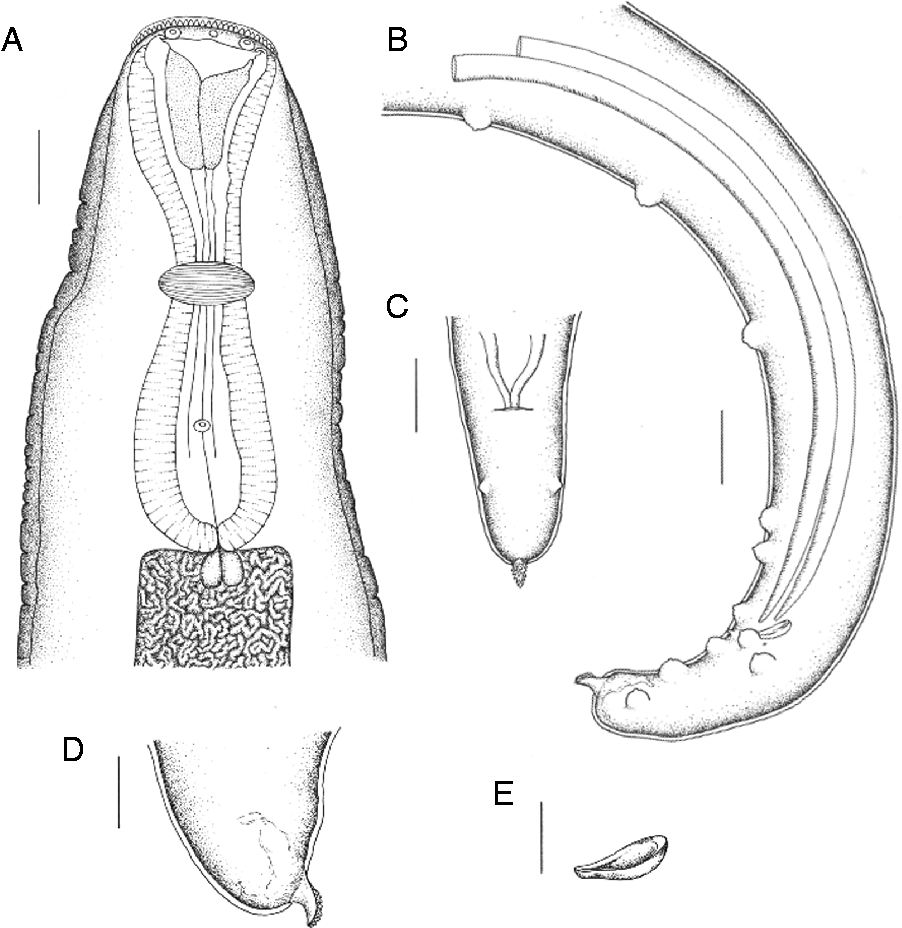
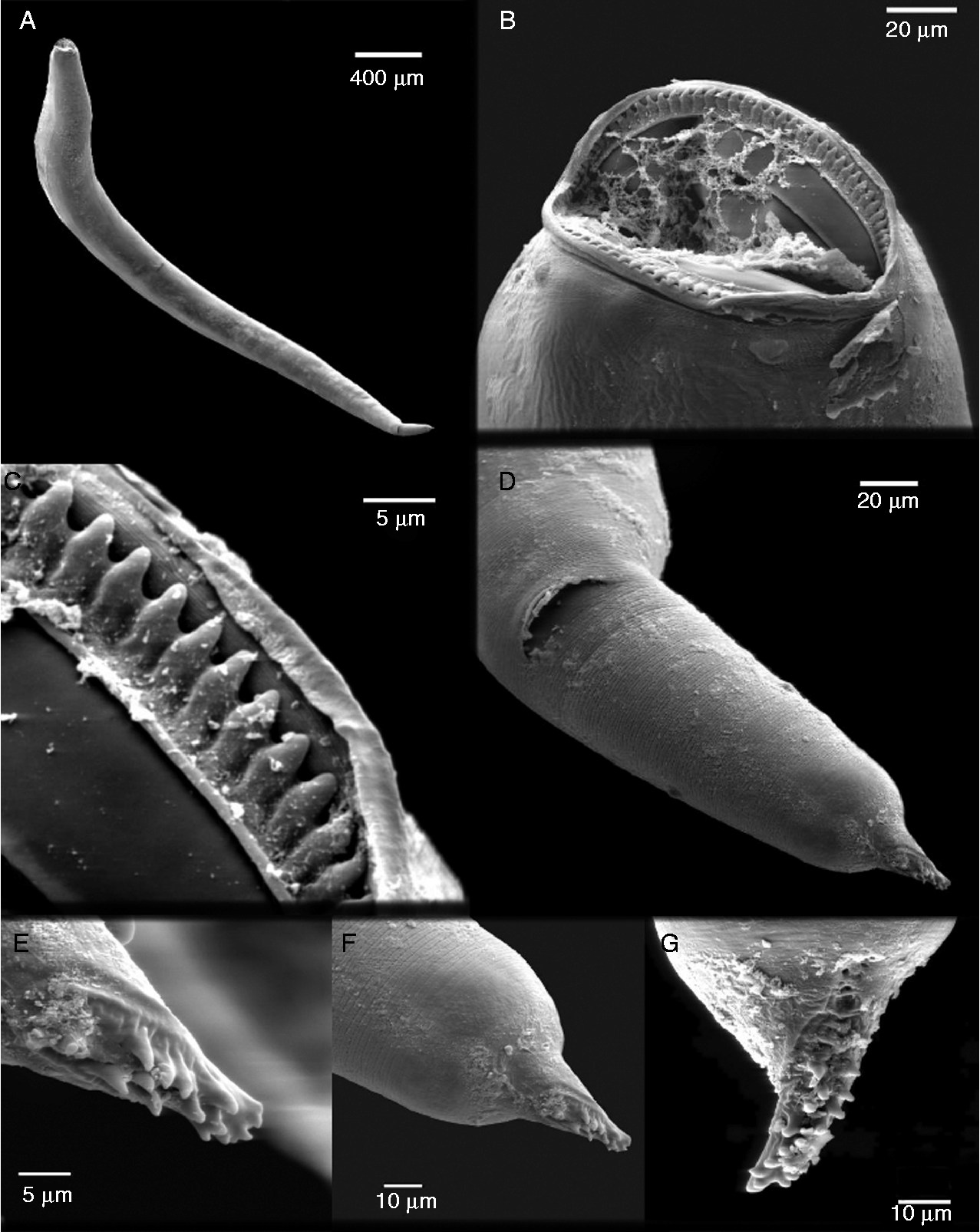
Medium-sized nematodes (figs 1–3). Lateral alae absent. Male smaller than female. Cephalic extremity rounded. Pseudobuccal capsule (oesophastome) laterally narrowed, surrounded by cuticular ring (collarette) internally delimited by one row of small teeth-like structures. Lips absent. Two pairs of cephalic papillae, submedian. One pair of lateral amphids at level of papillae. Oesophagus muscular, expanded at both extremities, anterior extremity wider to form the oesophastome, opening into intestine through a small valve. Nerve ring encircling oesophagus at distance from anterior extremity representing 35–46% of oesophagus length. Intestinal caecum absent. Deirids not observed. Excretory pore situated between the second half and the distal end of oesophagus. Tail tip conical, provided with several sclerotized spine-like processes on its ventral side.
Cucullanus tucunarensis n. sp.: (A) anterior extremity, ventral view; (B) posterior extremity of the female, ventral view; (C) posterior extremity of the male, lateral view; (D) posterior extremity of the male, lateral view; (E) gubernaculum of the male. Scale bars = 0.1 mm.

Scanning electron micrographs of female Cucullanus tucunarensis n. sp. showing (A) entire worm; (B) sub-apical view of the anterior end; (C) collarette; (D) posterior extremity, ventral view; (E, F, G) sclerotized spine-like processes at the posterior extremity.
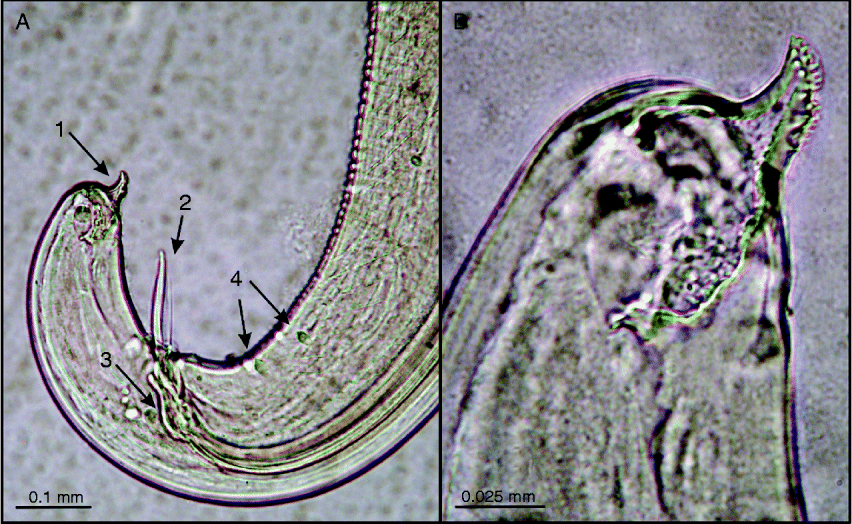
Posterior extremity of a male of Cucullanus tucunarensis n. sp. showing (A) sclerotized structure (1), spicules (2), gubernaculum (3) and caudal papillae (4); (B) sclerotized structure.
Male (based on three specimens). Length of body 5.00 ± 0.69 (4.50–5.87), maximum width 0.27 ± 0.06 (0.27–0.37). Oesophagus length 0.66 ± 0.06 (0.65–0.75) and 0.10 ± 0.01 (0.09–0.12) wide (largest portion), representing 13% (13–15%) of whole body length; oesophastome 0.16 ± 0.01 (0.14–0.17) long and 0.11 ± 0.01 (0.11–0.12) wide. Distance of the nerve ring from the anterior extremity 0.30 ± 0.03 (0.26–0.32), representing 45% of the oesophagus length. Excretory pore 0.58 from the anterior extremity. Precloacal sucker not observed. Spicules subequal with pointed distal end, smaller spicule 1.05 ± 0.07 (0.96–1.10) and larger spicule 1.18 ± 0.09 (1.10–1.28) long. Gubernaculum sclerotized, spoon shaped in lateral view 0.08 ± 0.01 (0.08–0.10) long. Caudal papillae: 6 pairs of preanal, 2 pairs of adanal and 4 pairs of postanal. Conical tail: 0.17 ± 0.01 (0.16–0.18), with a sclerotized structure at the end: 0.07 ± 0.01 (0.06–0.08) provided with spines on the ventral portion.
Female (based on five specimens). Body 5.25 ± 0.90 (4.75–7.00) long and 0.47 ± 0.05 (0.40–0.55) wide. Oesophagus 0.80 ± 0.02 (0.78–0.84) long and 0.12 ± 0.02 (0.11–0.13) wide (largest portion); oesophastome 0.19 ± 0.01 (0.17–0.20) long and 0.16 ± 0.01 (0.15–0.18) wide; oesophagus represents 15% (12–16%) of the body length. Distance of the nerve ring from the anterior extremity 0.33 ± 0.06 (0.23–0.39), representing 41% of the oesophagus length. Excretory pore at 0.68 ± 0.01 (0.67–0.68) from the anterior extremity. Vulva post-equatorial 2.80 ± 0.26 (2.45–2.95) from the anterior extremity of the body, with slightly projected lips. Vagina muscular 0.42 ± 0.08 (0.36–0.48) long and 0.05 (0.05–0.06) wide. Amphidelphic (uteri opposed). Eggs 0.04 ± 0.03 (0.02–0.06) long and 0.03 ± 0.02 (0.01–0.04) wide. Tail conical 0.21 ± 0.02 (0.18–0.22), provided with a pair of lateral phasmids. The tail ends in a sclerotized structure 0.06 ± 0.02 (0.03–0.07) long, provided with spines on the ventral portion.
Type host. Cichla piquiti Kullander & Ferreira, 2006.
Infection site. Intestine.
Prevalence. 35% (7 out of 25 examined fish).
Mean intensity of infection. 2.0 (1–4).
Type locality. Lajeado reservoir, Tocantins River (10°66′55″S 48°42′36″W).
Type specimens. Coleção Helmintológica do Instituto Oswaldo Cruz, FIOCRUZ, Rio de Janeiro (holotype and allotype: CHIOC 35877a–b), Colección Nacional de Helmintos de la Universidad Nacional Autónoma De México, UNAM, Mexico (paratypes: CNHE 6874).
Etymology. The name of the new species refers to the common name of the host, tucunaré azul.
Discussion
A mouth perpendicular to the body axis, the absence of an intestinal caecum and sclerotized plaques in the pseudobuccal capsule are the most important features to allocate a nematode within the genus Cucullanus (Petter, Reference Petter1974). Moravec (Reference Moravec1998) also included at most seven pairs of preanal papillae in the male as a character of the genus, in contrast to at least nine pairs observed in the genus Neocucullanus. Since the nematodes of the present material possess all of these morphological traits, they have been allocated within the genus Cucullanus.
Body measurements of C. tucunarensis n. sp. are larger (more than five times) than C. cassinensis and smaller (more than three times) than C. oswaldocruzi, being similar to C. ageneiosus. However, other features distinguish C. tucunarensis n. sp. from C. ageneiosus. The new species has larger spicules, almost ten times longer than in C. ageneiosus and two pairs of adanal papillae, which are absent in C. ageneiosus; Additionally, C. tucunarensis n. sp. is recorded parasitizing a freshwater cichlid, while C. ageneiosus parasitizes a catfish (Siluriformes) from brackish water.
The only species of the genus recorded parasitizing a perciform fish in Brazil is C. cassinensis. Besides the disparity in body measurements, the species differ in the shape of the gubernaculum and number of papillae. Cucullanus tucunarensis n. sp. has a spoon-shaped gubernaculum, while C. cassinensis presents an I-shaped one, and the proportion of preanal, adanal and postanal papillae is 6:2:4 for C. tucunarensis n. sp. and 3:4:4 for C. cassinensis. Finally, the new species is unique and differs from all its congeners by having a tail tip provided with several sclerotized spine-like processes on its ventral side, present in both the male and female.
Acknowledgements
The authors thank Elineide E. Marques for field assistance, Paula Marchetti for the scientific illustration (fig. 1) and Antônio L.S. Castro for the SEM images. Funding for this research was provided by the National Council for Scientific and Technological Development (CNPq) (process 47,1138/ 2007-0). A.C.F.L. was supported by PhD and PDEE (process 2298/10-4) scholarships from the Coordination for the Improvement of Higher Education Personnel (CAPES). R.M.T., M.L.M. and G.C.P. were supported by productivity grants from CNPq. N.M. was supported by a CAPES PhD scholarship.