1. Introduction
The rapid expansion of global industrialization and urbanization has significantly heightened the risk of accidental hazardous gas leakages within complex industrial infrastructures. Fugitive emissions of toxic industrial chemicals (TICs) and volatile organic compounds (VOCs) originating from processing units, storage facilities, and transportation pipelines pose severe threats to public health and compromise ecological stability. Consequently, rapid and precise localization of these emission sources is paramount for mitigating safety hazards and ensuring public health, a fact underscored by recent industrial incidents [Reference Francis, Li, Griffiths and Sienz1–Reference Chen, Yang, Huang, Leng and Fu3].
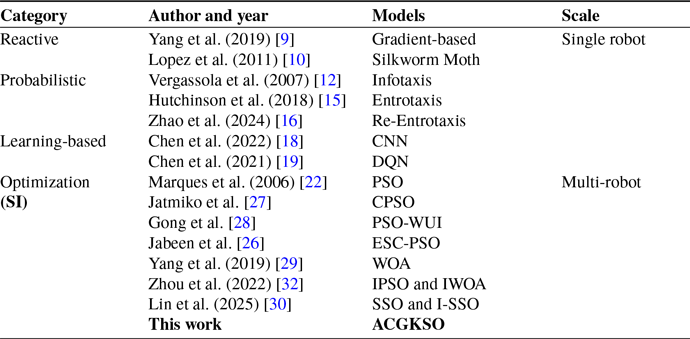
Existing strategies for leak source localization can be broadly categorized into two paradigms: fixed sensor networks (FSNs) and mobile robotic olfaction (MRO) [Reference xing Chen and Huang4]. Although FSNs yield stable and reliable concentration data in specific scenarios, their practical utility is often constrained by prohibitive deployment and maintenance costs, limited spatial coverage, and sparse sensor density [Reference Hutchinson, Oh and Chen5]. In contrast, mobile robots have emerged as a pivotal solution for odor source localization (OSL) in complex and hazardous environments by capitalizing on their superior mobility, flexibility, and scalability [Reference Ngae, Kouichi, Kumar, Feiz and Chpoun6]. Contemporary MRO methodologies are generally classified into four distinct categories [Reference Jing, Meng and Ishida7], as shown in Table I: reactive methods, probabilistic inference, learning-based methods, and optimization algorithms.
Analysis of representative OSL methodologies.

Table I Long description
A table categorizing odor source localization methodologies by author, model, and scale. The table has four rows and three columns. The columns are labeled Category, Author and year, Models, and Scale. The categories include Reactive, Probabilistic, Learning-based, and Optimization. Under Reactive, Yang et al. (2019) used Gradient-based models for single robot scale, and Lopez et al. (2011) used Silkworm Moth models. Under Probabilistic, Vergassola et al. (2007) used Infotaxis, Hutchinson et al. (2018) used Entrotaxis, and Zhao et al. (2024) used Re-Entrotaxis, all for single robot scale. Under Learning-based, Chen et al. (2022) used CNN and Chen et al. (2021) used DQN, both for single robot scale. Under Optimization, Marques et al. (2006) used PSO, Jatmiko et al. used CPSO, Gong et al. used PSO-WUI, Jabeen et al. used ESC-PSO, Yang et al. (2019) used WOA, Zhou et al. (2022) used IPSO and IWOA, and Lin et al. (2025) used SSO and I-SSO, all for multi-robot scale. This work used ACGKSO for multi-robot scale.
Prevalent in early OSL investigations, reactive methods rely on a direct mapping between real-time sensor observations and robotic actuation. These strategies broadly bifurcate into pure chemotaxis and hybrid chemotaxis–anemotaxis categories. The former, typified by gradient-based algorithms [Reference Russell, Thiel, Deveza and Mackay-Sim8], for example, Yang et al. [Reference Yang, Feng, Cai, Xu, Li, Deng, Yan and Li9] demonstrated the practicality of these algorithms in indoor environments with stagnant airflow conditions, while the latter enhances plume tracking by simulating the olfactory behaviors of natural organisms [Reference López, Vouloutsi, Chimeno, Marcos, Bermúdez i Badia, Mathews, Verschure, Ziyatdinov and i Lluna10, Reference Grasso and Atema11]. Nevertheless, the efficacy of these mechanisms diminishes drastically in high-turbulence environments, where sensory noise and signal intermittency precipitate search instability and compromised localization precision.
To mitigate these issues, probabilistic inference methodologies frame the source location as latent states, leveraging sequential observations to perform recursive Bayesian updates. Representative frameworks include Infotaxis [Reference Vergassola, Villermaux and Shraiman12] and Particle Filters (PFs) [Reference Zhu, Wang, Du, Zhang and Wang13, Reference Chen and Huang14]. To address the issues of high computational cost and reliance on prior information, Hutchinson et al. [Reference Hutchinson, Oh and Chen15] and Zhao et al. [Reference Zhao, Zhou, Cheng, Cao and Yang16] proposed Entrotaxis and Re-Entrotaxis, respectively. Neumann et al. [Reference Neumann, Bennetts, Lilienthal, Bartholmai and Schiller17] combined wind direction information (Anemotaxis-PF) with PFs to improve positioning accuracy. However, these algorithms are computationally expensive and require precise location of sampling points, which necessitates high sensory acquisition precision.
Learning-based methods for robotic OSL have significantly advanced, leveraging deep learning (DL) and reinforcement learning (RL) to enhance robots’ ability to detect and locate odor sources efficiently. Chen et al. [Reference Chen, Du, Peng, Cao, Wang and Wang18] mapped concentration information from peripheral sensors onto images as input to a convolutional neural network (CNN) to determine the location and wind direction of the leak source in a chemical industrial park with complex obstacles. Chen et al. [Reference Chen, Fu and Huang19] proposed a search policy based on Deep Q-Networks, which approximates the optimal action-value function by incorporating historical measurement sequences as state inputs. However, these methods typically demand extensive training datasets and protracted offline learning phases. Consequently, they often fail to satisfy the requirements for real-time response and domain transferability in emergent leakage scenarios.
In recent years, the inherent advantages of optimization algorithms in solving complex engineering problems have increasingly attracted attention from the academic community [Reference Xiao, Cui, Khurma, Hussien and Castillo20, Reference Xiao, Khurma, Cui and Camacho21]. This method treats the robot source search task as a global optimization problem, using swarm intelligence (SI) to heuristically identify source locations. Multi-robots could have obvious advantages over single robots in terms of efficiency and robustness. Particle swarm optimization (PSO) has been widely adopted due to its efficiency [Reference Marques, Nunes and de Almeida22–Reference Gong, Zhang and Qi28]. To mitigate this, researchers have developed various adaptive variants. For instance, Jatmiko et al. [Reference Jatmiko, Sekiyama and Fukuda27] and Gong et al. [Reference Gong, Zhang and Qi28] introduced Charged PSO (C-PSO) and PSO with Wind Utilization Information (PSO-WUI), respectively, both effectively enhancing swarm exploration via inter-particle repulsion or directional biasing. Furthermore, hybrid frameworks such as ESC-PSO [Reference Jabeen, Meng, Hou and Li26] have been proposed to combine perturbation-based extremum seeking control with swarm heuristics, enabling robust localization in dynamic outdoor settings. Beyond the PSO family, more advanced meta-heuristic algorithms have demonstrated superior potential in navigating nonlinear search landscapes. Yang et al. [Reference Yang, Zhang, Feng, Cai, Jiang, Zhou, Li, Liu and Li29] introduced the whale optimization algorithm (WOA), designing specific strategies for plume tracking based on concentration gradients. More recently, Lin et al. [Reference Lin, Wu, Wu, Wang and Zhang30] proposed an Improved Shark Smell Optimization (I-SSO) algorithm to address interference sources in indoor environments. A significant milestone in this evolution is the GKSO [Reference Hu, Guo, Wei and Abualigah31], which employs a multi-stage architecture simulating wandering hunting, moving, parabolic foraging, and self-protection. This structure establishes a natural, isomorphic mapping to the classic operational sub-tasks of robotic OSL: plume finding, tracking, and source declaration.
Despite these advancements, a significant gap persists between idealized laboratory models and real-world industrial applications. Many current OSL algorithms decouple plume finding and plume tracking into disconnected sub-tasks through heterogeneous strategies, which frequently results in transition failures or signal loss during stage switching. Furthermore, gas plume transport is governed by advection–diffusion dynamics modulated by structural occlusions and turbulent wind fields, causing concentration fields to exhibit multiple deceptive pseudo-sources. Under these conditions, conventional SI algorithms often struggle with rigid parameter configurations and vulnerability to local optima, leading to premature convergence.
Despite recent advancements, research addressing OSL in the presence of multiple interference sources remains highly limited. In practical industrial scenarios, structural occlusions and turbulent wind fields severely distort gas plume advection–diffusion dynamics, generating complex concentration fields with numerous pseudo-sources. Consequently, closely related OSL algorithms exhibit the following critical research gaps:
-
• Several recent OSL frameworks decouple plume finding and tracking into distinct stages. This heterogeneous approach frequently causes transition failures or severe signal loss during stage switching in intermittent fields.
-
• Existing SI algorithms typically optimize toward a single global peak. In multi-modal environments, this susceptibility frequently traps swarms in local extrema (pseudo-sources), inevitably causing premature convergence.
-
• Conventional SI methods rely on rigid parameter configurations. These static mechanisms fail to dynamically adapt to complex spatial dispersions, restricting the swarm’s ability to navigate obstacle-dense terrains.
To address these deficiencies and enhance search efficiency, we propose an adaptive perturbation strategy that dynamically modulates perturbation intensity based on real-time swarm dispersion monitoring. Furthermore, we develop a dual-modal experience sharing mechanism to facilitate efficient information exchange. By integrating individual historical optimum with elite neighborhood information, this strategy simultaneously accelerates search convergence and mitigates the risk of premature stagnation. Finally, validations using computational fluid dynamics (CFD) simulation data demonstrate that the proposed adaptive collaborative Genghis Khan shark optimizer (ACGKSO) outperforms other SI methods, achieving superior localization success rates and search efficiency. In summary, the main contributions of this paper are as follows:
-
• An adaptive perturbation strategy is proposed for mitigating entrapment in local extrema by adaptively regulating perturbation intensity through real-time swarm dispersion monitoring.
-
• A dual-modal experience sharing strategy is devised for promoting efficient information exchange by fusing individual historical optimum with elite neighborhood information, simultaneously accelerating search convergence and mitigating the risk of premature stagnation.
-
• Evaluations using CFD simulation data demonstrate that the proposed ACGKSO outperforms other SI methods, achieving superior localization success rates and search efficiency.
The remainder of this paper is organized as follows. Section 2 mathematically formulates the OSL problem. Section 3 details the proposed ACGKSO algorithm, elaborating on the adaptive perturbation and dual-modal experience sharing mechanisms. Section 4 presents the CFD simulation setups, parametric analyses, ablation studies, and comprehensive performance comparisons. Finally, Section 5 concludes the paper and outlines potential avenues for future research.
2. Problem definition
OSL is an information-driven search task characterized by the challenge of inferring source coordinates in a complex physical environment. Formulated as an optimization problem, OSL is dynamic, nonlinear, and complex problem. The objective is to identify the spatial coordinates that maximize the time-varying odor concentration. The search space is defined as a
 $d$
-dimensional domain
 $\mathcal{S} \subseteq \mathbb{R}^d$
, where the vector
 $\mathbf{x} = [x_1, x_2, \dots , x_d]^\top \in \mathcal{S}$
denotes a candidate position. Driven by advection–diffusion dynamics, the concentration distribution evolves over time
 $t$
, as described by:
 \begin{equation} C(\mathbf{X}, t) \,:\, S \times \mathbb{R}^+ \rightarrow \mathbb{R}_0^+ \end{equation}
The objective of OSL is to identify the coordinates that maximize the gas concentration [Reference Lin, Wu, Wu, Wang and Zhang30]. Consequently, the source localization task is formulated as a dynamic multivariate optimization problem, defined as follows:
 \begin{equation} X_{\mathrm{best}} = \mathop {\arg \max }_{\mathbf{x} \in S} C(\mathbf{x}, t) \end{equation}
Each agent (corresponding to a Genghis Khan shark) is modeled as a mobile sensing node within the search space
 $\mathcal{S}$
. Using onboard gas sensors, each agent evaluates the objective function at its current position. The primary objective is to devise a search strategy that coordinates the swarm’s movement relying solely on discrete, local concentration data. By balancing exploration and exploitation, the algorithm guides the swarm toward the global optimum
 $\mathbf{X}_{\text{best}}$
, thereby localizing the odor source.
3. Proposed method
Figure 1 illustrates the operational framework and execution workflow of the ACGKSO. To ensure efficient source discovery, the four optimization stages of ACGKSO are integrated with these specific operational phases:
-
• Plume finding: Employing the Wandering Hunting operator, the robot conducts global exploration initiated from randomized coordinates. Mathematically formalized as an adaptive Gaussian perturbation operator Eq. (11), this phase mimics the shark’s omnidirectional sensing. Upon detecting any concentration level exceeding the detection threshold, the system confirms plume acquisition and triggers the transition to the tracking phase.
-
• Plume tracking: The Moving and Foraging operators drive the population’s convergence toward high-concentration zones. These biological behaviors are rigorously mapped to the collaborative position update utilizing Eqs. (12) and (14). Simultaneously, self-protection mechanism abstracted as a stochastic neighborhood mutation operator in Eq. (15), identifies stagnation states and updates the global optimum record, thereby reinforcing the algorithm’s robustness against entrapment in local extrema.
-
• Source declaration: When any robot exceeds the termination threshold, the swarm converges for collaborative verification. The final global maximum is designated as the estimated source and validated against ground truth.
3.1. Adaptive perturbation mechanism
In complex odor environments, the turbulent nature of gas plumes necessitates exceptional algorithmic adaptability. However, the standard GKSO regulates the exploration–exploitation trade-off via a rigid mechanism reliant solely on the monotonic decay of iteration counts. This static strategy is agnostic to the population’s evolutionary state, failing to capture the complex search dynamics required in time-varying environments. To circumvent this limitation, an adaptive perturbation strategy is proposed to modulate perturbation intensity based on real-time population distribution and optimization feedback. The magnitude of this perturbation is governed by the interplay of two metrics: swarm dispersion, which quantifies the spatial dispersion of the swarm to gauge immediate exploration needs, and convergence rate, which monitors the optimization trajectory to detect stagnation or rapid improvements. Synthesizing these metrics enables GKSO to dynamically adjust search granularity in response to evolutionary states, thereby enhancing robustness and efficiency in complex odor fields. The framework of this strategy is illustrated in Figure 2.
Complete system of the source localization strategy.

Adaptive perturbation mechanism.

Figure 2 Long description
A diagram of the adaptive perturbation mechanism. The diagram represents a process involving swarm dispersion and convergence rate. Panel A shows swarm dispersion with points scattered within a square, labeled D(t), which undergoes linear amplification. Panel B depicts convergence rate with a graph showing exponential decay, labeled R(t). These two inputs feed into a central hexagon labeled Adaptive Perturbation using Eq. (6). The output of this central process is directed towards a target with concentric circles representing exploitation and exploration zones. The step size is indicated by an arrow pointing outward from the center, labeled Step Size δ. The diagram illustrates the relationship between swarm dispersion, convergence rate, and adaptive perturbation, showing how these factors influence the exploration and exploitation phases in odor source localization.
The dispersion of the swarm quantifies the spatial dispersion of search agents in the solution domain at the current iteration. A high value of
 $D^{(t)}$
signifies a widely distributed population, characterizing a phase of global exploration. Conversely, a low
 $D^{(t)}$
implies population aggregation and a transition into intensive local exploitation, a state susceptible to premature convergence. This metric is mathematically formulated as follows:
 \begin{equation} \overline {X}^{(t)} = \frac {1}{n} \sum _{i=1}^{n} X_i^{(t)} \end{equation}
 \begin{equation} D^{(t)} = \frac {1}{n} \sum _{i=1}^{n} \left \| X_i^{(t)} - \overline {X}^{(t)} \right \|^2\quad \end{equation}
Here,
 $\overline {X}^{(t)}$
represents the centroid of the population. The variance-based metric
 $D(t)$
quantifies the population spread relative to its centroid. Compared to Shannon entropy or average pairwise distance,
 $D(t)$
is computationally efficient, which is essential for resource-constrained robotic processors. Moreover,
 $D(t)$
avoids the resolution bias inherent in grid-based entropy measures by directly reflecting the physical coverage radius in continuous Cartesian space.
The convergence rate quantifies the magnitude of improvement in the global optimum between the previous iteration
 $t-1$
and the current iteration
 $t$
. In OSL tasks, the optimization objective is to progressively approach the region with the highest gas concentration. Therefore, the improvement of the global best solution provides a direct indication of whether the swarm is moving closer to the odor source. A high value of
 $R^{(t)}$
indicates that the current search trajectory is effectively converging. Conversely, a value approaching zero implies potential algorithmic stagnation, necessitating intensified exploration to escape local extrema. This metric is mathematically formulated as follows:
 \begin{equation} R^{(t)} = \frac {f_{\text{best}}^{(t)} - f_{\text{best}}^{(t-1)}}{\left |\, f_{\text{best}}^{(t-1)} \right |} \end{equation}
Synthesizing these metrics, the adaptive perturbation scale is formulated as follows:
 \begin{equation} \delta _{i}^{(t)} = \delta _{\text{max}} \cdot \exp \left ( -\gamma R^{(t)} \right ) \cdot \left ( 1 + \beta \cdot \frac {D^{(t)}}{D^{(0)}} \right ) \end{equation}
where
 $\delta _{max}$
represents the preset maximum step size, while
 $\gamma$
and
 $\beta$
are used to adjust the adaptive perturbation scale. Specifically,
 $\gamma$
controls the nonlinearity of perturbation decay, while
 $\beta$
adjusts the influence of population dispersion, thereby adjusting the search scale according to population diversity. The initial population dispersion
 $D^{(0)}$
is initialized to a strictly positive value to ensure numerical stability. Choosing
 $\gamma = 2.0$
and
 $\beta = 0.5$
establishes the optimal dynamic equilibrium for the localization task. Sensitivity analysis shows that
 $\gamma$
controls the cooling rate of the search process; values less than 1.0 lead to slow convergence and overshoot, while values greater than 4.0 cause premature stagnation of the search granularity. Choosing 2.0 is beneficial for achieving a transition that matches the typical nonlinear concentration decay curve of the plume. Regarding the amplification factor
 $\beta$
, when its value is 0.5, the maximum diversity-driven enhancement will be limited to 1.5 times the nominal scale, thus providing sufficient momentum to eliminate spurious sources without violating the maximum velocity limit.
The adaptive disturbance strategy establishes a dynamic control mechanism for the search process. In the initial phase, it facilitates extensive global exploration by maximizing the disturbance scale
 $\delta _{i}^{(t)}$
. This scale is jointly attenuated by the search progress
 $R^{(t)}$
and the decreasing swarm dispersion
 $D^{(t)}$
to ensure a smooth transition to local exploitation. Unlike a linear decay, this
 $\exp (-\gamma R(t))$
serves as a nonlinear sensitivity amplifier that aligns with the nonlinear concentration decay profile of turbulent gas plumes. This ensures that even incremental search progress
 $R^{(t)}$
triggers a rapid refinement of search granularity to accurately lock onto localized peaks. A distinct feature of this strategy is its inherent robustness against premature convergence. Functioning as a state-aware feedback loop, the mechanism automatically reduces the disturbance scale upon a sharp decline in diversity
 $D^{(t)}$
, thereby suppressing ineffective large perturbations. Conversely, it permits the disturbance scale to increase following diversity restoration, providing the algorithm with the capability to escape local extrema.
3.2. Dual-modal experience sharing strategy
The position update mechanism of GKSO relies primarily on
 $X_{\text{best}}$
, whereby individual search trajectories are driven by the unidirectional attraction of the current global best. Although this centralized topology facilitates rapid convergence, it intrinsically neglects both the accumulated historical experience of individuals and the local cooperative interactions within the swarm. Consequently, this informational deficit renders the algorithm highly susceptible to entrapment in local extrema when searching complex odor concentration fields. To address these limitations, a dual-modal experience sharing mechanism is proposed to enhance search efficiency and effectively mitigate stagnation at pseudo-sources.
This mechanism encapsulates individual historical experience via the following vector, which represents the coordinates yielding the optimal fitness achieved by the
 $i$
-th agent up to the current
 $t$
:
 \begin{equation} X_{i, \text{best}} = \arg \max _{t' \le t} f\left ( X_{i}^{(t')} \right ) \end{equation}
To foster social learning, an optimal neighborhood position is introduced, denoted as
 $X_{j,\text{best}}$
. Diverging from architectures reliant on a solitary global leader, this component serves as a high-quality guide derived from an elite sub-population. Operationally, the algorithm isolates the top 10% agents based on their individual historical fitness rankings. From this elite pool, one candidate is stochastically selected to function as
 $X_{j,\text{best}}$
:
 \begin{equation} X_{j, \text{best}} \in \left \{ X_{k, \text{best}} \mid f_k \text{ is among the top 10}\% \right \} \end{equation}
The integration of these two experience vectors prevents agents from uncritical convergence toward swarm consensus, thereby safeguarding individually discovered high-value regions. Concurrently, this mechanism mitigates the risk of premature population homogenization. By synthesizing these vectors via linear combination, search dynamics are regulated through a dual-faceted control strategy. Specifically, the experience guidance term, denoted as
 $\Delta X_i^{\text{exp}}$
, is formulated as follows:
 \begin{equation} \Delta X_i^{\text{exp}} = \lambda _1 (X_{i,\text{best}} - X_i) + \lambda _2 (X_{j,\text{best}} - X_i) \end{equation}
To improve movement guidance, we introduce an experience centroid term
 $G_i^{\text{exp}}$
, which supersedes the individual best position:
 \begin{equation} G_i^{\exp } = \lambda _1 X_{i,\text{best}} + \lambda _2 X_{j,\text{best}} \end{equation}
The weighting coefficients
 $\lambda _1$
and
 $\lambda _2$
balance the influence of the cognitive and social components, respectively. For the
 $i$
-th agent, the centroid
 $G_i^{\textrm{exp}}$
serves as a dynamic reference target. The agent’s trajectory is then guided toward this position, which integrates its own historical success with the collective experience of the elite group.
3.3. ACGKSO for OSL
The core mechanisms described above are systematically integrated into the four operational stages of the GKSO algorithm. This integration transforms the conventional framework into an adaptive optimization architecture characterized by environmental awareness. To address the specific challenges of OSL tasks, the algorithmic enhancements for each stage are detailed as follows:
Hunting phase: The primary objective of this phase is to execute efficient stochastic exploration across the global search space, thereby maximizing the probability of initial plume acquisition. The standard GKSO utilizes a random walk strategy, wherein the step size decays monotonically with the iteration count. However, this static decay mechanism lacks the capacity to restore swarm dispersion during stagnation periods. Consequently, this strategy is superseded by a state-aware adaptive perturbation model, governed by the adaptive scale
 $\delta _i^{(t)}$
, formulated as:
 \begin{equation} XP1_{i}^{(t+1)} = X_{i}^{(t)} + \delta _{i}^{(t)} \mathcal{N}(0, I_d) \end{equation}
where
 $\mathcal{N}(0, I_d)$
denotes
 $d$
-dimensional standard normal random vector. This Gaussian perturbation facilitates omnidirectional, isotropic stochastic transitions, ensuring continuous coverage of unexplored regions. By dynamically regulating perturbation magnitude based on convergence rates and swarm dispersion, the mechanism effectively calibrates the search amplitude across distinct evolutionary phases.
Moving phase: The transition to this stage is initiated when any agent, executing the search protocol defined in Eq. (11), detects a concentration exceeding the validity threshold (i.e., C > Cmin). To optimize the position update strategy, the experience guidance term
 $\Delta X_i^{\text{exp}}$
and the experience centroid term
 $G_i^{\text{exp}}$
are incorporated, supplementing the baseline global optimum guidance and predecessor coordination mechanisms. By synthesizing individual historical optimum with neighborhood experience, this integration effectively mitigates the algorithm’s over-reliance on a solitary global optimum during the exploitation phase, thereby significantly bolstering tracking robustness. The reconfigured position update formula is expressed as:
 \begin{equation} XP2_{i}^{(t+1)} = \begin{cases} s \left ( G_{i}^{\text{exp}} - X_{i} \right ) + \Delta X_{i}^{\text{exp}}, & i = 1, \\[8pt] \dfrac {s \left ( G_{i}^{\text{exp}} - X_{i} \right ) + X_{i-1} + \Delta X_{i}^{\text{exp}}}{2}, & i \gt 1, \end{cases} \end{equation}
where
 $s$
represents the olfactory intensity coefficient. In the proposed framework, this parameter is rigorously grounded in the biological attractive model of the GKS [Reference Hu, Guo, Wei and Abualigah31]. In the original GKSO,
 $s$
is an abstract parameter; however, to align with robotic OSL requirements, we redefine
 $s$
as a physical variable directly coupled to real-time environmental concentrations. This formulation follows chemotactic principles, where a predator’s responsive intensity increases as the chemical signal strengthens. The modified definition of
 $s$
is formalized as:
 \begin{equation} s = m \left |\, f(X_{i}, t) \right |^r \end{equation}
where
 $m=1.5$
denotes the basal olfactory coefficient, providing the necessary drive for aggressive pursuit. The instantaneous concentration
 $\left |\,f(X_i,t)\right |$
functions as the biological attribute strength (
 $I$
) [Reference Hu, Guo, Wei and Abualigah31], representing the perceived intensity of the scent patches emitted by the prey. The stochastic variable
 $r\in [0,1]$
mimics the biological absorption rate of odor molecules by the shark’s olfactory organs.
Parabolic foraging phase: Inspired by the predation dynamics of GKSs, this stage initiates a parabolic search trajectory after detecting a high-concentration area, thereby achieving efficient local exploitation. Mathematically modeled as a nonlinear position update mechanism, this behavior ensures precise fine-tuning within the vicinity of the global optimum. In contrast to the standard algorithm’s reliance on a static parameter
 $p$
governing step sizes around the global best
 $X_{\text{best}}$
, ACGKSO optimizes the exploitation–avoidance trade-off by superseding this static reference with the agent-specific experience centroid
 $G_i^{\text{exp}}$
, while simultaneously integrating the adaptive scalar
 $\delta _{i}^{(t)}$
to dynamically regulate movement magnitude. The reconfigured formulation is expressed as:
 \begin{equation} XP3_{i}^{(t+1)} = G_{i}^{\text{exp}} + r_2 \cdot \left ( G_{i}^{\text{exp}} - X_{i}^{(t)} \right ) + \lambda \cdot \delta _{i}^{(t)} \cdot \left ( G_{i}^{\text{exp}} - X_{i}^{(t)} \right ) \end{equation}
Self-protection phase: Inspired by the defensive chromatic adaptation of the GKS, the self-protection mechanism is formalized as a neighborhood mutation operator designed to enhance swarm dispersion and facilitate escape from local extrema. The procedure entails generating a diverse set of candidate positions for each agent by integrating global best information, neighborhood intelligence, and stochastic spatial perturbations. Within the ACGKSO architecture, this behavior is defined as follows:
 \begin{equation} XP4_{i}^{(t+1)} = \begin{cases} X_{i}^{(t)} + \Delta X_{i}^{SP} , & \text{if } a_1 \lt 0.5, \\ G_{i}^{exp} + \Delta X_{i}^{SP} , & \text{otherwise}, \end{cases} \end{equation}
where
 $\Delta X_{i}^{SP}$
denotes the local perturbation vector inherited from the baseline GKSO. Specifically,
 $\Delta X_i^{SP}$
is synthesized by combining the influence of the global best
 $X_{best}$
, the neighborhood intelligence
 $X_k$
, and the stochastic components
 $X1$
and
 $X2$
:
 \begin{equation} \Delta X_i^{SP} = k_1(a_1 X_{best} - a_2 X_k) + k_2 \rho (a_3 (X2_i - X1_i)) +\bigg(\frac {a_2(X_{u1}-X_{u2}}{2}\bigg). \end{equation}
The values
 $a_1$
,
 $a_2$
, and
 $a_3$
are random numbers determined using the following formula:
 \begin{equation} \left \{ \begin{aligned} a_1 &= l_1 * 2 * rand + (1 - l_1) \\ a_2 &= l_1 * rand + (1 - l_1) \\ a_3 &= l_1 * rand + (1 - l_1) \end{aligned} \right . \end{equation}
where
 $\textit {rand}$
is a randomly generated number within the range
 $[0, 1]$
, while
 $l_1$
denotes a binary parameter with a values of
 $0$
or
 $1$
.
Two stochastic solutions
 $X1_i$
and
 $X2_i$
are generated based on the search space bounds
 $[lb, ub]$
, and two stochastically chosen solutions
 $X_{u1}$
and
 $X_{u2}$
and a neighborhood solution
 $X_{k,i}$
is computed as:
 \begin{equation} X_{k,i} = l_2 \cdot (X_p - X_r )+ X_r, \end{equation}
where
 $X_p$
and
 $X_r$
are randomly selected members from the current population, and the
 $l_2$
is a binary random number either 0 or 1.
To maintain search stability, a greedy update rule is implemented, whereby a candidate position is accepted only if it yields a higher odor concentration than the current state,
 $f(XP4) \gt f(X_i^{(t)})$
. This mechanism ensures that the algorithm invokes high-intensity spatial jumps only when they offer a definitive escape from local extrema. While this approach parallels mutation operators in differential evolution (DE) that utilize differential vector perturbations to enhance diversity, the proposed self-protection operator is specifically tailored for OSL. Unlike the standard DE mutation applied in every generation, this operator functions as a biologically inspired stagnation-avoidance mechanism embedded within the GKSO framework. By integrating environmental feedback directly into the candidate generation process, the operator maintains a superior balance between exploration capability and search precision in intermittent chemical plumes.
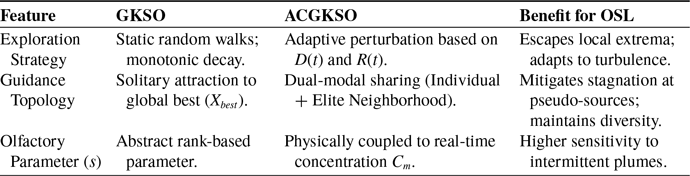
Table II summarizes the precise distinctions between the baseline GKSO and the proposed ACGKSO framework. These modifications are specifically tailored to address the challenges of multi-modal odor concentration fields in complex industrial environments.
Comparative analysis of mechanisms between the baseline GKSO and the proposed ACGKSO.

Table II Long description
A table comparing mechanisms between GKSO and ACGKSO frameworks. The table has three columns and four rows. The columns are labeled Feature, GKSO, ACGKSO, and Benefit for OSL. The rows are labeled Exploration Strategy, Guidance Topology, and Olfactory Parameter. Row 1: Exploration Strategy, Static random walks; monotonic decay., Adaptive perturbation based on D(t) and R(t)., Escapes local extrema; adapts to turbulence. Row 2: Guidance Topology, Solitary attraction to global best (X_best)., Dual-modal sharing (Individual + Elite Neighborhood)., Mitigates stagnation at pseudo-sources; maintains diversity. Row 3: Olfactory Parameter (s), Abstract rank-based parameter., Physically coupled to real-time concentration C_m., Higher sensitivity to intermittent plumes.
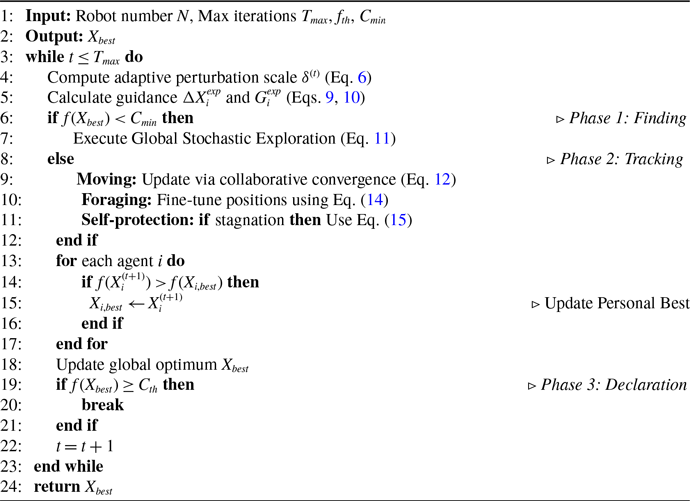
Collectively, the synergistic integration of adaptive perturbation and dual-modal experience sharing establishes a self-evolving search framework, achieving a precise tripartite equilibrium among global exploration, local exploitation, and stagnation avoidance. The pseudocode for ACGKSO is presented in Algorithm 1.
ACGKSO for OSL

Algorithm 1: Long description
The pseudocode outlines the ACGKSO algorithm with inputs and outputs. It starts with a while loop that iterates until the maximum number of iterations is reached. Inside the loop, it computes adaptive perturbation scale and guidance, then checks a condition to execute global stochastic exploration or update via collaborative convergence. It includes phases for finding, tracking, and declaration with specific equations for each step. The algorithm updates personal and global optima based on certain conditions and breaks the loop if a threshold is met.
3.4. Assumptions and constraints
Each robot is modeled as a point mass to focus on the core search strategies within the OSL framework. This abstraction simplifies computational complexity by neglecting physical interactions, such as robot collisions and morphology-induced aerodynamic disturbances. Kinematic feasibility is maintained through a velocity constraint of
 $V \in [0, 5]$
m/s, which is implemented by limiting the maximum displacement per iteration
 $d_{max}$
.
To ensure that generated trajectories remain within the physical limits of the robotic hardware, a velocity clamping procedure is applied. Following the constraint strategy in ref. [Reference Zhang, Chen, Li, Wang and Zhao33], the final displacement magnitude in each iteration is truncated to a maximum value
 $d_{max}$
:
 \begin{equation} \Delta \mathbf{X}_{i, \text{final}}^{(t)} = \begin{cases} \mathbf{V}_{i, \text{total}}^{(t)}, & \text{if } \|\mathbf{V}_{i, \text{total}}^{(t)}\| \le d_{max} \\ d_{max} \cdot \dfrac {\mathbf{V}_{i, \text{total}}^{(t)}}{\|\mathbf{V}_{i, \text{total}}^{(t)}\|}, & \text{if } \|\mathbf{V}_{i, \text{total}}^{(t)}\| \gt d_{max} \end{cases} \end{equation}
where
 $d_{max}$
represents the maximum distance a robot can travel during a single sampling interval, which is set to 5 m in this study. This procedure ensures that the robot maintains its intended search direction while strictly adhering to kinematic feasibility.
To facilitate robust OSL in obstacle-congested environments, ACGKSO employs a hierarchical control architecture that decouples high-level search logic from low-level motion planning. Following the coordination principles in ref. [Reference Zhang, Chen, Li, Wang and Zhao33], the position update for agent
 $i$
is formalized as a vector superposition of the algorithmic search increment and a reactive motion correction:
 \begin{equation} X_i^{final} = X_i^{update} + F_{APF}(X_i), \end{equation}
where
 $X_i^{update}$
represents the displacement vector generated by the ACGKSO operators. The term
 $F_{APF}(\!\cdot\! )$
denotes the repulsive displacement produced by an APF to navigate structural obstacles [Reference Zhang, Chen, Li, Wang and Zhao33]. Within this framework, the APF serves as a trajectory refiner that enables autonomous collision avoidance by dynamically adjusting the search path to maintain efficiency. This decoupled architecture ensures that the swarm maintains its search performance while strictly adhering to environmental safety constraints. Finally, the resultant displacement is subjected to the truncation mechanism to ensure kinematic feasibility.
To bridge the simulation-to-reality gap, a nonideal gas sensor model is adopted. In this formulation, the measured concentration
 $C_{\text{m}}$
is characterized by a nonlinear sensitivity function
 $S(\!\cdot\! )$
applied to the truth
 $C_{\text{true}}$
and is corrupted by additive Gaussian noise
 $e_{\text{r}}$
. The model is defined as:
 \begin{equation} C_{\text{m}} = S(C_{\text{true}}) + e_{\text{r}} \end{equation}
Here,
 $C_{\text{true}}$
denotes the ground truth concentration, while
 $S(\!\cdot\! )$
represents the nonlinear transducer function. Based on the transducer function theory for oxide semiconductor sensors [Reference Yamazoe and Shimanoe34], the nonlinear sensitivity function
 $S(\!\cdot\! )$
is formulated as a power-law response model
 $S(C_{true}) = \alpha \cdot C_{true}^n$
. In this study, the gain coefficient
 $\alpha$
and sensitivity exponent
 $n$
are set to 1.0 and 0.5, respectively. The latter value represents the electron depletion process on gas sensors grains, as validated in ref. [Reference Yamazoe and Shimanoe34]. This configuration emulates the characteristic square-root response, wherein the sensor exhibits peak sensitivity at low concentrations followed by gradual saturation as
 $C_{true}$
increases. By adopting these empirically grounded parameters, the simulation replicates the compressed signal gradients prevalent in practical industrial deployments, thereby providing a rigorous benchmark for evaluating the anti-stagnation mechanisms within ACGKSO.
3.5. Computational complexity analysis
The computational complexity of ACGKSO is determined by three main components: initialization, fitness evaluation, and position updating. For the standard GKSO, the overall TC is calculated as
 $\mathcal{O}(N \times D) + \mathcal{O}(4 \times T \times N \times D)$
, accounting for initialization and the four sequential search behaviors (hunting, moving, foraging, and defense mechanism) [Reference Hu, Guo, Wei and Abualigah31]. The proposed ACGKSO introduces an additional linear operations for the adaptive mechanism and a sorting operation. Therefore, the overall theoretical TC of ACGKSO is rigorously unified as follows:
 \begin{equation} \begin{aligned} \mathcal{O}(\text{ACGKSO}) &= \mathcal{O}(\text{initialization}) + \sum _{t=1}^{T} \big [ \mathcal{O}(\text{adaptive mechanism}) \\ &\quad + \mathcal{O}(\text{elite sorting}) + \mathcal{O}(\text{four update stages}) \big ] \\ &= \mathcal{O}(N \times D) + T \times \big [ \mathcal{O}(N \times D) + \mathcal{O}(N \log N) + \mathcal{O}(4 \times N \times D) \big ] \\ &= \mathcal{O}(N \times D) + \mathcal{O}\big (T \times (5 \times N \times D + N \log N)\big ) \end{aligned} \end{equation}
Although the mathematical complexity increases slightly due to the sorting term, this addition is justified for robotic OSL applications. The swarm size is typically small in robotic missions, making the
 $\mathcal{O}(N \log N)$
computational overhead negligible relative to the physical movement time of the robots. In practical missions, a reduction in physical search steps directly translates to shorter task durations and lower power consumption.
To assess the scalability of ACGKSO for large swarm sizes, the computational efficiency of the introduced operators must be analyzed. The elite selection process requires sorting the population fitness values, yielding a complexity of
 $O(N \log N)$
when employing standard sorting algorithms. Furthermore, the neighborhood operations within the dual-modal sharing and self-protection mechanisms are characterized by a linear structure. Each agent updates its position through interaction with a stochastically selected elite member or the sub-population centroid, necessitating only
 $O(D)$
operations per agent. Consequently, the total per-iteration complexity is
 $O(ND + N \log N)$
. For large-scale swarms, this quasi-linear growth is significantly more efficient than the
 $O(N^2)$
complexity inherent in algorithms requiring all-to-all pairwise distance calculations or global covariance matrix updates. Although a compact swarm size of
 $N \approx 10$
is maintained for hardware efficiency in this OSL mission, the analysis demonstrates that the ACGKSO framework remains computationally tractable and scalable for high-dimensional optimization problems.
4. Simulations and results
In this section, Fluent is used for gas diffusion simulation and MATLAB R2024a for algorithmic evaluation. ACGKSO is first benchmarked against standard GKSO in a single-interference environment, followed by an extended comparison with multiple SI algorithms under both single- and multi-interference conditions.
4.1. Experiments settings
The experimental evaluation is structured around two distinct scenarios within a unified simulation environment: Case 1 (single-interference source) and Case 2 (multi-interference sources). The simulation domain spans a
 $100 \times 50 \text{ m}^2$
rectangular region populated with fixed, impermeable obstacles. The complex turbulent flow dynamics are resolved using the RNG
 $k-\varepsilon$
model [Reference Hargreaves and Wright35], with methane (
 $\text{CH}_4$
) selected as the target analyte. Specifically, the target source emits at a constant rate of
 $2 \text{ kg/s}$
, while the interference sources maintain release rates of
 $0.5 \text{ kg/s}$
. The ambient wind velocity is stabilized at
 $2 \text{ m/s}$
. Figure 3 visualizes the resulting gas diffusion profiles for both scenarios. Criteria for plume finding and source declaration are established relative to the maximum concentration, where
 $C_{\text{min}}$
and
 $C_{\text{th}}$
are set to 10% and 90% of the maximum concentration, respectively [Reference Yang, Zhang, Feng, Cai, Jiang, Zhou, Li, Liu and Li29].
The model of the
 $\text{CH}_4$
concentration distribution map. (a)–(b) Early stage for Case 1 and Case 2, respectively. (c)–(d) Intermediate stage. (e)–(f) Final stage characterized by fully developed plumes.

To quantitatively evaluate algorithmic performance, this study employs two metrics: Success Rate (SR) and Average Search Steps (ASS). To ensure statistical reliability, results are aggregated from 100 independent trials for each experimental scenario. A trial is deemed successful if the robot converges to within a
 $1\text{ m}$
of the ground truth source location within a maximum of 200 iteration. ASS characterizes convergence efficiency by calculating the mean number of iterations required for successful localization.
4.2. Parametric analysis
To assess the stability and adaptability of the proposed ACGKSO, this section presents a systematic sensitivity analysis of key parameters. Specifically, we evaluate the impact of population size, sensor latency and noise, and initial deployment strategies on the algorithm’s search performance.
4.2.1. Analysis of population size
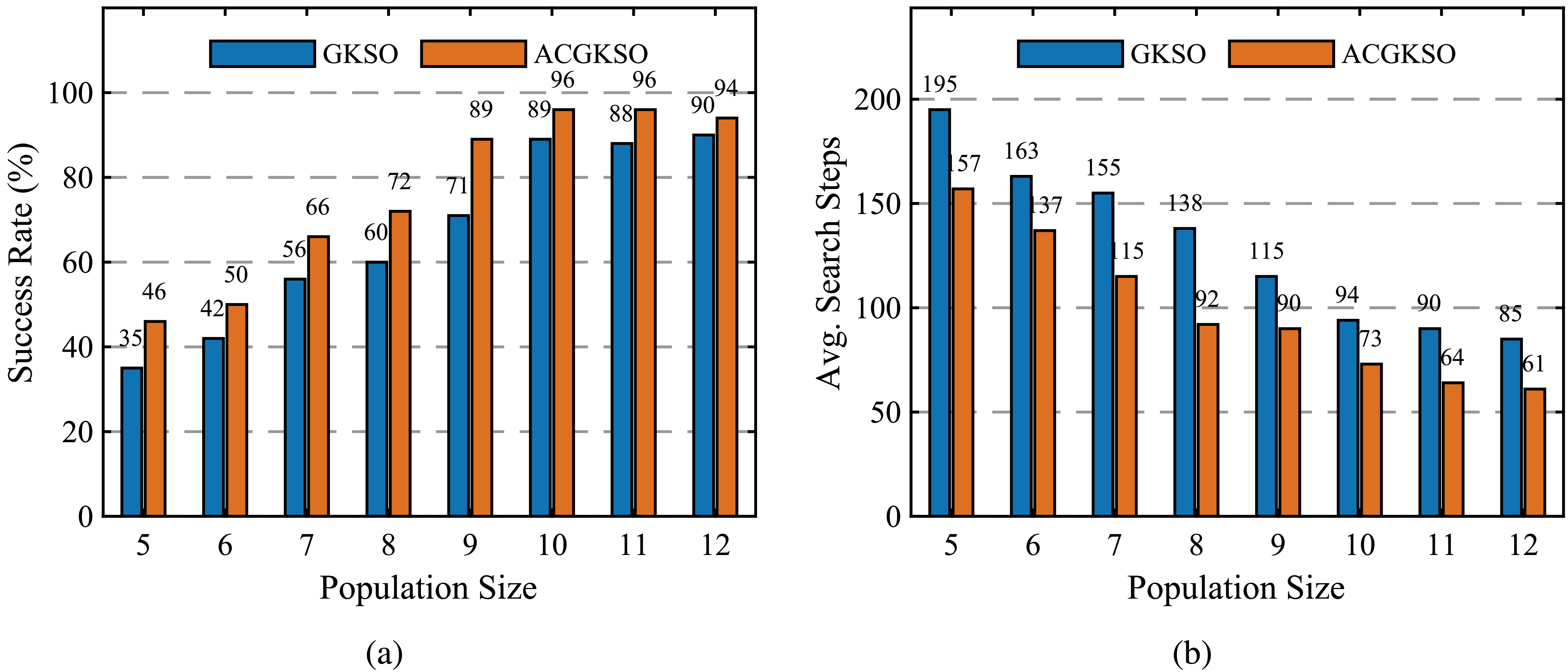
This section compares the performance of the baseline GKSO and the proposed ACGKSO in Case 1, focusing on sensitivity to population size. All trials are conducted under identical conditions: same random initial coordinates,
 $1\%$
measurement noise, and
 $2\text{ s}$
response latency. The influence of swarm scale is assessed by testing eight population sizes,
 $N \in \{5,6,7,8,9,10,11,12\}$
.
Performance evaluation of the algorithms with different popualtion sizes.

Figure 4 Long description
Two bar graphs depict the performance evaluation of the GKSO and ACGKSO algorithms with different population sizes. Panel A: The bar graph shows the success rate in percent on the vertical axis and population size on the horizontal axis. The success rate increases with population size for both GKSO and ACGKSO algorithms. ACGKSO consistently outperforms GKSO across all population sizes, with success rates ranging from 42 percent to 96 percent for ACGKSO and 35 percent to 90 percent for GKSO. Panel B: The bar graph shows the average search steps on the vertical axis and population size on the horizontal axis. The average search steps decrease with increasing population size for both algorithms. ACGKSO requires fewer search steps compared to GKSO, with values ranging from 57 to 90 for ACGKSO and 195 to 85 for GKSO.
As depicted in Figure 4(a), the SR exhibits a positive correlation with population size. This trend aligns with theoretical expectations, as larger swarm scales enhance spatial coverage of the search domain, thereby increasing the probability of source discovery. However, a pronounced performance disparity is evident between the two algorithms. ACGKSO consistently surpasses the baseline GKSO across the entire spectrum of tested population configurations. Even under constrained population conditions, ACGKSO maintains a distinct advantage. This gap widens at medium scales; specifically, at N = 9, ACGKSO achieves an SR of
 $89\%$
, significantly outperforming the
 $71\%$
recorded by GKSO. Furthermore, ACGKSO attains a peak stability of
 $96\%$
at
 $N \in \{10, 11\}$
, whereas the baseline algorithm plateaus at a maximum SR of
 $90\%$
.
In Figure 4(b), the ASS metric exhibits an inverse correlation with population size for both algorithms, a trend consistent with the fundamental principles of SI. Corroborating the SR analysis, ACGKSO demonstrates superior convergence efficiency. Throughout the evaluated spectrum, the proposed algorithm systematically minimizes the iteration count required for localization relative to the baseline GKSO. This efficiency gap is particularly prominent under constrained population conditions. Specifically, at N = 5, ACGKSO converges within an average of 157 steps, representing a significant improvement over GKSO, which requires 195 steps. As the population size increases, the efficiency of ACGKSO improves progressively, reaching a minimum of 61 steps at N = 12. These results demonstrate that the enhanced information sharing and adaptive exploration mechanisms enable the swarm to exploit spatial cues more effectively, thereby generating trajectories that converge more directly toward the true source. These findings validate that the proposed adaptive mechanisms confer superior robustness and search efficacy compared to the standard framework.
Population size of N = 10 establishes an optimal trade-off among task SR, search efficiency, and computational resource expenditure, thereby representing the ideal operating point for overall system performance. Consequently, in all subsequent comparative experiments requiring a fixed swarm scale such as sensor robustness evaluation and initialization strategy analysis, N = 10 is uniformly adopted as the standardized configuration. This approach ensures that all comparative assessments are conducted upon a consistent and rigorous baseline.
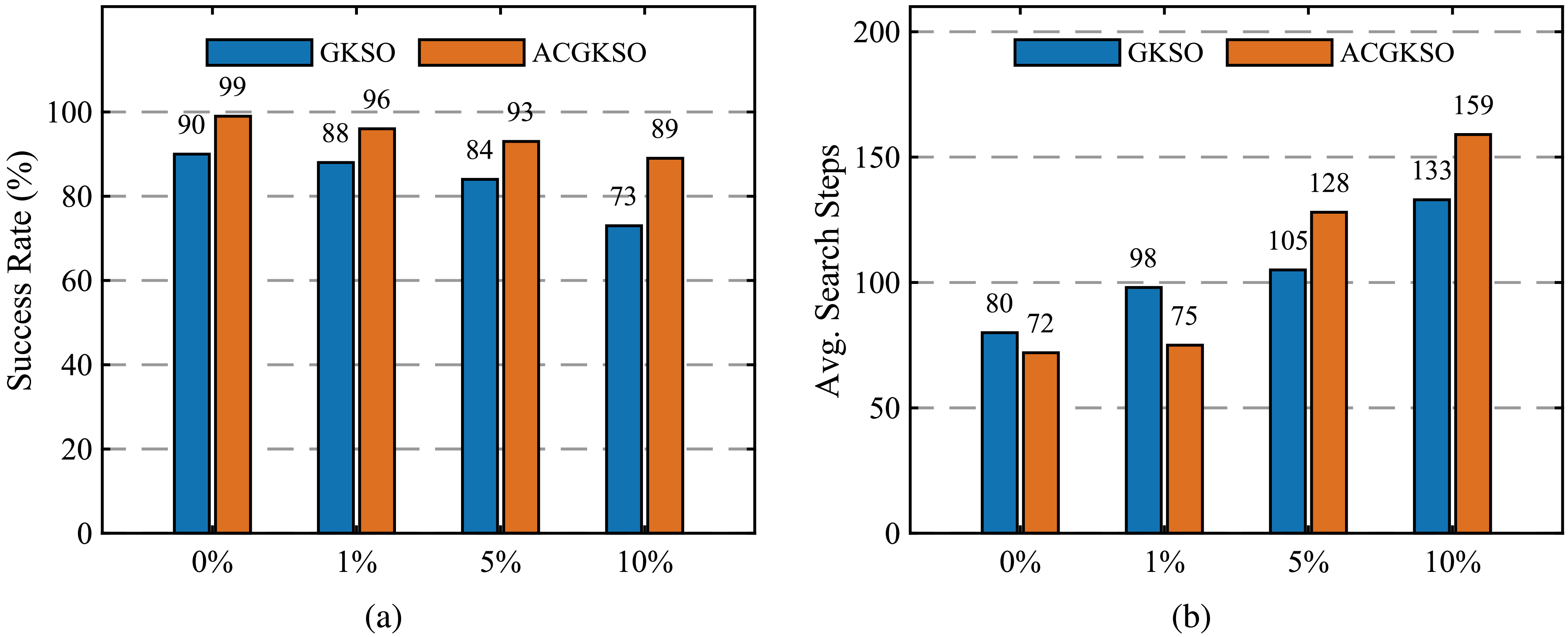
Performance evaluation of the algorithms under varying intensities of measurement noise.

4.2.2. Influence of sensor latency and noise
Sensor acquisition in practical scenarios is inevitably subject to stochastic measurement noises. To emulate realistic operational conditions, random noise is injected into sensor observations at four discrete intensity levels:
 $0\%$
,
 $1\%$
,
 $5\%$
, and
 $10\%$
relative to the instantaneous concentration magnitude. Maintaining a constant sensor response latency of
 $1\text{ s}$
, this study quantifies the impact of measurement uncertainty on localization precision and conducts a comparative robustness analysis between the baseline GKSO and the proposed ACGKSO across varying noise regimes.
As depicted in Figure 5(a), comparisons of localization SR across four distinct noise levels reveal that while both algorithms exhibit resilience to sensor noise, ACGKSO maintains a decisive performance advantage. Specifically, under ideal noise-free conditions, ACGKSO achieves a SR approaching
 $100\%$
, preserving this stability even as noise magnitudes rise to
 $5\%$
. Most notably, under high-intensity noise conditions (
 $10\%$
), the SR remains robust at
 $89\%$
. This minimal degradation attests that the adaptive search mechanisms intrinsic to ACGKSO effectively attenuate stochastic interference, thereby preserving the structural integrity of concentration field assessment. Conversely, the baseline GKSO displays a lower performance ceiling and heightened sensitivity to perturbations. Despite starting at
 $90\%$
in ideal scenarios, its performance experiences pronounced degradation, falling to
 $84\%$
and
 $73\%$
at noise levels of
 $5\%$
and
 $10\%$
, respectively. These findings confirm that noise adversely affects GKSO, leading to both premature convergence and entrapment in local extrema. Figure 5(b) reveals that measurement noise exerts a detrimental impact on search efficiency. In (
 $0\%$
) scenarios, ACGKSO maintains superior efficiency, achieving convergence in an average of 72 steps compared to 80 for GKSO. However, as noise intensity escalates, a divergent trend emerges. Specifically, under noise levels of
 $5\%$
and
 $10\%$
, ACGKSO requires averages of 128 and 159 steps, respectively, exceeding the 105 and 133 steps recorded for GKSO. This phenomenon indicates a strategic trade-off within the ACGKSO framework under high-entropy conditions: the algorithm prioritizes rigorous exploration and verification over premature convergence. While this extends the decision-making horizon, it effectively secures the superior localization SR observed in Figure 5(a), ensuring valid convergence to the global optimum despite sensory interference.
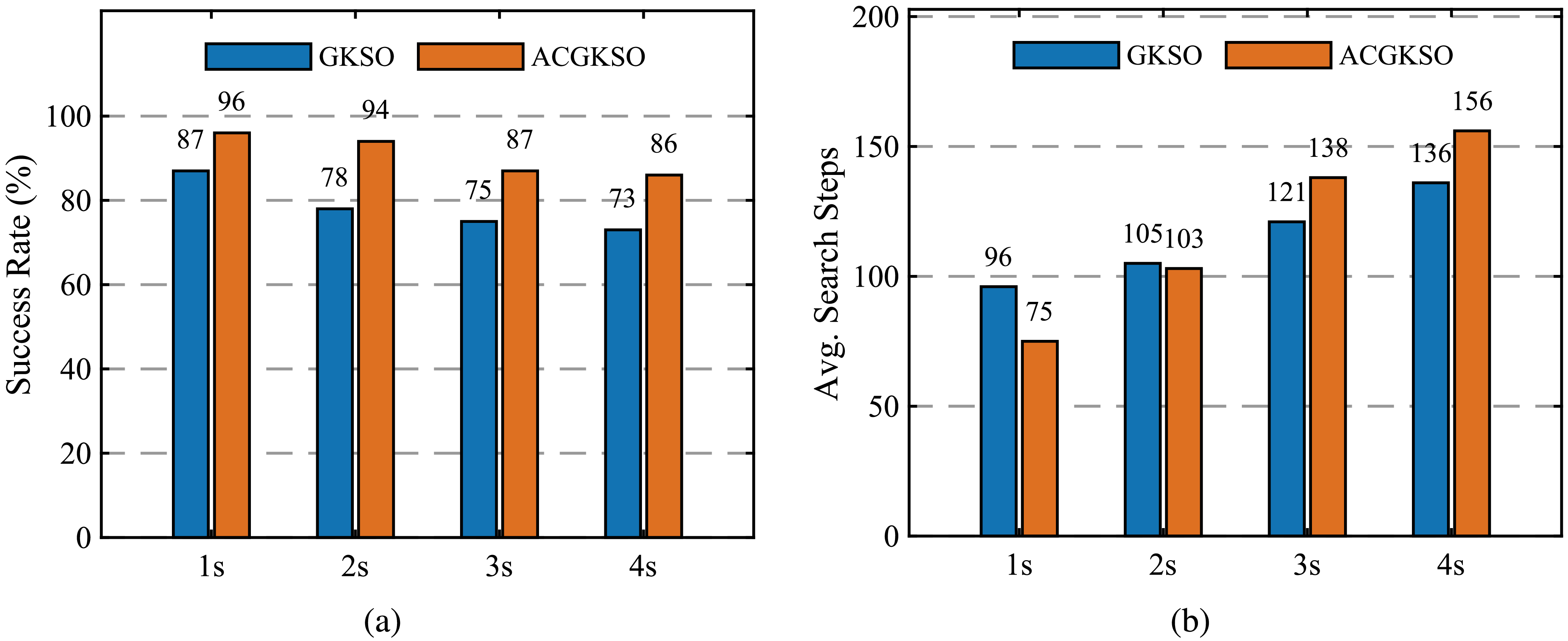
Performance evaluation of the algorithms under different sensor latency.

In practical deployments, finite sensor sampling frequencies and inherent processing latencies preclude continuous concentration measurement. Consequently, robotic perception becomes a discrete process governed by the total latency (
 $t$
), defined as the sum of travel duration (
 $t_1$
) and the sensing duration (
 $t_2$
), that is,
 $t = t_1 + t_2$
. This study investigates the impact of varying latency (
 $1\text{ s}$
,
 $2\text{ s}$
,
 $3\text{ s}$
, and
 $4\text{ s}$
) on localization performance, with sensor measurement noise constant at a baseline of
 $2\%$
.
Figure 6(a) illustrates that localization success rates for both algorithms decline as sensor latency increases. However, ACGKSO demonstrates significantly superior resilience to these latency-induced constraints. With a baseline SR of
 $96\%$
at
 $1\text{ s}$
latency, ACGKSO exhibits only minimal degradation as the delay extends. This stability confirms the effectiveness of the dual-modal experience sharing strategy. By integrating individual historical trajectories with elite neighborhood cues, this mechanism mitigates the desynchronization caused by perceptual latency and ensures coherent search patterns. Conversely, GKSO displays pronounced sensitivity to feedback delays. Despite an initial SR of
 $87\%$
at
 $1\text{ s}$
, its performance deteriorates rapidly as latency is prolonged. Consequently, the efficacy gap between the two algorithms widens with increasing latency, highlighting ACGKSO’s superior adaptability in temporally constrained sensing environments. As illustrated in Figure 6(b), prolonged response intervals impose a significant computational penalty, monotonically increasing the average iteration count for successful localization. This degradation arises because navigational commands derived from time-delayed, discrete observations are inherently suboptimal, necessitating extensive backtracking and re-exploration to sustain plume tracking. At the baseline latency of
 $1\text{ s}$
, ACGKSO retains superior efficiency, averaging 75 steps versus 96 for GKSO. At
 $2\text{ s}$
, the performance metrics align, reflecting comparable tracking impediments under moderate delay. However, under high-latency regimes (
 $3\text{ s}$
and
 $4\text{ s}$
), the iteration burden of ACGKSO surpasses that of GKSO. This apparent efficiency inversion must be contextualized by the SR analysis: at a
 $4\text{ s}$
delay, ACGKSO maintains an
 $86\%$
SR, whereas GKSO falls to
 $73\%$
. This indicates that ACGKSO strategically incurs additional computational costs to rectify latency-induced deviations, effectively prioritizing convergence reliability over temporal minimization.
4.2.3. Effect of initial deployment
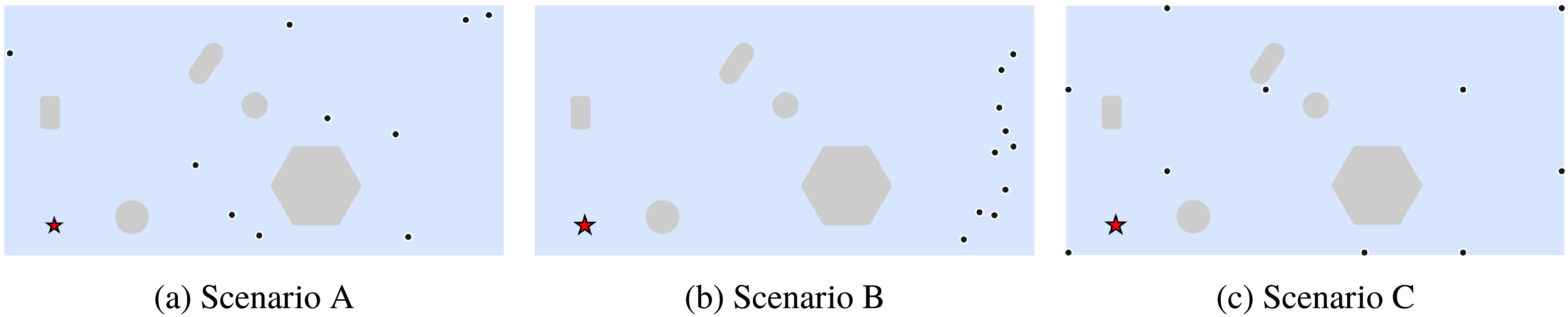
The initial deployment of robotic agents is a critical determinant of algorithmic performance. To evaluate the robustness of the algorithm to varying starting configurations, this subsection investigates the impact of three representative deployment strategies, illustrated as Scenarios A, B, and C in Figure 7. To ensure comparative consistency, all experiments are conducted under standardized conditions: a fixed population size of
 $N=10$
, a sensor latency of
 $2\text{ s}$
, and a measurement noise of
 $1\%$
.
-
• Scenario A: Agents are stochastically dispersed across the search domain, simulating routine inspections for sporadic leakage events.
-
• Scenario B: Agents are initialized as a cluster in a safe, low-concentration zone distal to the source, simulating an emergency localization mission.
-
• Scenario C: Agents are distributed in a uniform grid pattern, simulating a systematic monitoring task designed to ensure comprehensive area coverage.
Illustration of three typical initial deployment strategies used in the simulation. The red star indicates the actual odor source, and the black dots correspond to the starting positions of the agents.

Performance evaluation of the algorithms across different initial deployment.

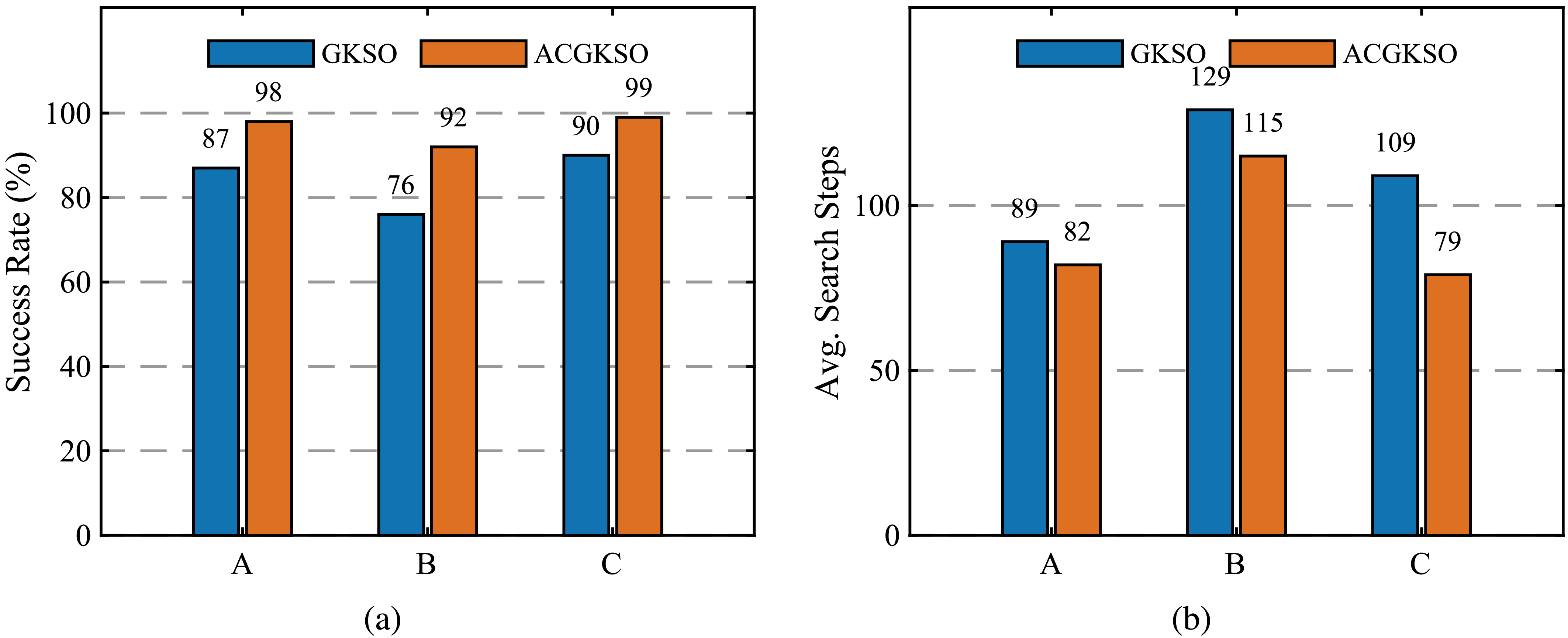
Figure 8(a) illustrates the impact of initial deployment strategies on the success rates of both algorithms. In Scenario A, ACGKSO achieves a SR of
 $98\%$
, compared to
 $87\%$
for GKSO. These results indicate that while both methods demonstrate reliability under agnostic initialization conditions, ACGKSO exhibits superior overall robustness. This performance disparity is amplified in the more challenging Scenario B. GKSO experiences distinct degradation, dropping to
 $76\%$
. This decline stems not only from the increased traversal distance but also from the heightened probability of encountering interference sources, which increases the risk of entrapment in local extrema. This limitation exposes GKSO’s insufficient mechanisms for escaping local basins of attraction. In contrast, ACGKSO maintains a robust SR of
 $92\%$
, demonstrating resilience against adverse initialization. This stability suggests that its adaptive mechanisms sustain necessary global exploration even upon detection of local concentration peaks, effectively preventing premature convergence toward interference sources. Under the Scenario C, the comprehensive spatial coverage ensures immediate access to high-concentration cues. Consequently, success rates peak at
 $99\%$
and
 $90\%$
, respectively, indicating that when initial information is abundant, the local exploitation capabilities of both algorithms are effectively leveraged.
Figure 8(b) provides a further comparative analysis of the algorithms from the perspective of convergence efficiency. In Scenarios A and C, ACGKSO significantly outperforms GKSO, particularly in grid-based environments where the average iterations are curtailed by 27.5% (from 109 to 79). Scenario B provides critical insights into algorithmic robustness: while GKSO’s performance degrades to a 76% SR over 129 iterations due to local extrema entrapment, ACGKSO maintains high reliability (92%) with fewer iterations (115). This inverse correlation between computational cost and SR in Scenario B highlights the efficiency–reliability advantage of ACGKSO. The results validate that the proposed architectural enhancements effectively balance global exploration and local exploitation, facilitating rapid escape from deceptive local extrema.
4.3. Ablation studies
To quantify the specific contributions of the proposed enhancements, we conduct an ablation study based on Case 1. This analysis systematically evaluates the impact of individual modules. To ensure rigorous validation under challenging conditions, all trials employ Scenario B, with sensor measurement noise fixed at
 $1\%$
and a response latency of
 $2\text{ s}$
.
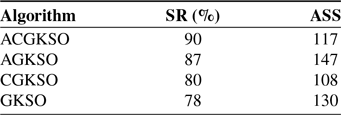
As detailed in Table III, GKSO exhibits limited efficacy in complex plume environments, recording an SR of
 $78\%$
and an ASS of
 $130$
. Its primary limitation is its susceptibility to premature convergence and the difficulty in escaping local extrema. In contrast, AGKSO enhances robustness, increasing the SR to
 $87\%$
. This improvement confirms that dynamic step size modulation enables the swarm to overcome local stagnation and facilitates escape from pseudo-sources. However, this enhanced reliability incurs a computational overhead, reflected in an elevated ASS of
 $147$
. This increase results from intensified exploration behaviors triggered during stagnation. While this mechanism is essential for ensuring global search success, it inherently extends the convergence duration. Conversely, CGKSO yields the lowest ASS (
 $108$
), indicating significantly optimized search efficiency. The dual-modal information flow accelerates swarm aggregation toward high-concentration regions. However, the improvement in SR is marginal (
 $80\%$
vs.
 $78\%$
). This suggests that relying solely on cooperation accelerates convergence but risks rapid convergence on pseudo-sources due to the absence of adaptive regulation. Ultimately, ACGKSO integrates both strategies to achieve optimal performance, attaining a maximum SR of
 $90\%$
while maintaining a competitive ASS of
 $117$
. This result strongly validates the synergistic coupling effect between the mechanisms: the adaptive perturbation strategy preserves the diversity and reliability of the elite set used in experience sharing, preventing collective entrapment. Simultaneously, the experience sharing strategy ensures that once a superior region is identified via perturbation, the swarm can rapidly transition to exploitation. Consequently, ACGKSO mitigates efficiency drawbacks while retaining high success rates, demonstrating that the synergistic integration of exploration and exploitation mechanisms is critical for resolving complex OSL challenges.
4.4. Comparison with other swarm intelligent algorithms
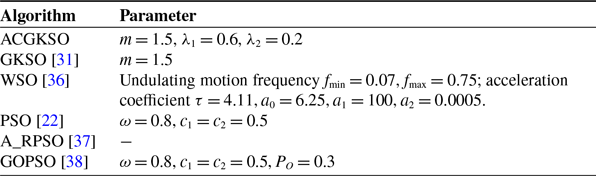
This subsection conducts a comprehensive comparative evaluation of the proposed ACGKSO against established benchmarks including WSO [Reference Braik, Hammouri, Atwan, Al-Betar and Awadallah36] and PSO [Reference Marques, Nunes and de Almeida22] and A_RPSO [Reference Dadgar, Jafari and Hamzeh37] and GOPSO [Reference Wang, Wu, Rahnamayan, Liu and Ventresca38] across both single- and multi-interference scenarios. These configurations were primarily derived from the original literature where each algorithm was first proposed, ensuring that each method operates at its peak intended performance. The robot initiates the search at coordinates (90 m, 25 m), subject to a fixed sensor measurement noise of
 $1\%$
and a response latency of
 $2\text{ s}$
. Table IV summarizes the detailed parameter configurations for each algorithm.
Ablation studies of the ACGKSO.

Table III Long description
A table comparing the performance of different algorithms based on success rate (SR) and average solution size (ASS). The table has four rows and three columns. The columns are labeled Algorithm, SR (%), and ASS. The row labels are ACGKSO, AGKSO, CGKSO, and GKSO. Row 1: ACGKSO, SR 90 percent, ASS 117. Row 2: AGKSO, SR 87 percent, ASS 147. Row 3: CGKSO, SR 80 percent, ASS 108. Row 4: GKSO, SR 78 percent, ASS 130. The table shows that ACGKSO has the highest SR at 90 percent and a moderate ASS of 117. AGKSO has a high SR of 87 percent but the highest ASS of 147. CGKSO has the lowest ASS at 108 but a lower SR of 80 percent. GKSO has the lowest SR at 78 percent and a moderate ASS of 130.
Parameter settings for the compared algorithms.

Table IV Long description
A table comparing parameter settings for different algorithms. The table has two columns: Algorithm and Parameter. It contains six rows, each representing a different algorithm and its corresponding parameters. Row 1: ACGKSO, m equals 1.5, lambda 1 equals 0.6, lambda 2 equals 0.2. Row 2: GKSO, m equals 1.5. Row 3: WSO, Undulating motion frequency f min equals 0.07, f max equals 0.75; acceleration coefficient tau equals 4.11, a 0 equals 6.25, a 1 equals 100, a 2 equals 0.0005. Row 4: PSO, omega equals 0.8, c 1 equals c 2 equals 0.5. Row 5: A RPSO, no parameters listed. Row 6: GOPSO, omega equals 0.8, c 1 equals c 2 equals 0.5, P O equals 0.3.
Performance comparison of different algorithms under Case 1 and Case 2.

Table V Long description
A table comparing the performance of different algorithms under Case 1 and Case 2. The table has 7 rows and 5 columns. The columns are labeled Algorithm, SR (%), ASS, SR (%), and ASS. The rows are labeled with different algorithms: ACGKSO, GKSO [31], WSO [36], PSO [22], A_RPSO [37], and GOPSO [38]. Row 1: ACGKSO, 94, 76, 83, 127. Row 2: GKSO [31], 85, 97, 70, 161. Row 3: WSO [36], 76, 128, 58, 164. Row 4: PSO [22], 58, 136, 40, 178. Row 5: A_RPSO [37], 82, 79, 72, 139. Row 6: GOPSO [38], 77, 104, 70, 148.
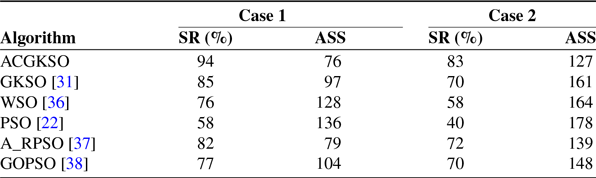
Table V presents the SR and ASS for each algorithm under single- and multi-interference scenarios. In the single-interference scenario, ACGKSO demonstrates superior efficacy, achieving a peak SR of
 $94\%$
. This result significantly surpasses the baseline GKSO (
 $85\%$
) and the second-best performing A_RPSO (
 $82\%$
). In contrast, classic meta-heuristic algorithms, such as PSO and WSO, exhibit marked limitations, with success rates ranging from
 $58\%$
to
 $76\%$
. This pronounced disparity indicates that traditional algorithms are highly susceptible to entrapment in local extrema induced by interference plumes, thereby precipitating premature convergence. Furthermore, leveraging its novel dual-modal experience sharing strategy, ACGKSO demonstrates dominant search efficiency, requiring only 76 iterations to localize the target fewer than WSO (
 $158$
) and PSO (
 $136$
).
Subsequently, the experimental complexity is escalated to a multi-source configuration. This setup not only increases the density of local extrema but also induces complex superposition effects between the concentration fields of the primary and interference sources. Consequently, this imposes a stringent test on the algorithms’ global exploration and local extrema escape capabilities. Relative to the single-source baseline, all algorithms exhibit performance degradation; however, ACGKSO demonstrates the highest robustness, maintaining an SR of
 $83\%$
. Although this represents an
 $11\%$
decrease compared to Case 1, the magnitude of degradation is substantially lower than that of the comparative algorithms. Notably, the success rates of PSO and WSO deteriorate precipitously to
 $40\%$
and
 $58\%$
, respectively, indicating that these algorithms are rendered virtually ineffective by multiple deceptive cues. Conversely, the mechanisms intrinsic to ACGKSO effectively mitigate entrapment in complex landscapes. Regarding search efficiency, ACGKSO retains a significant advantage. In Case 2, its average convergence time is 127 steps, representing a reduction of approximately
 $21.1\%$
compared to the baseline GKSO (
 $161$
) and significantly outperforming PSO (
 $178$
). These results demonstrate that the proposed strategies accelerate effective information propagation within the population, enabling agents to rapidly converge upon the ground truth direction, thereby significantly minimizing redundant exploration near interference sources.
The source localization process of the ACGKSO algorithm in environment case 2.

The source localization process of the GKSO algorithm in environment case 2.

Figure 10 Long description
The image consists of four panels showing the source localization process of the GKSO algorithm in a simulated environment with obstacles. Each panel represents a different time step in the process. Panel A: At time t = 3, the environment contains several obstacles of different shapes and sizes. A red star marks the starting point, and small black dots represent the initial positions of the robots. Green arrows indicate the direction of movement. Panel B: At time t = 47, the robots have moved closer to the obstacles, and the concentration gradients are visible as green and blue plumes around the obstacles. The red star remains at the starting point. Panel C: At time t = 127, the robots have further navigated through the environment, and the concentration gradients have become more pronounced. The red star is still at the starting point. Panel D: At time t = 160, the robots have successfully localized the source, and the concentration gradients are well-defined around the obstacles. The red star remains at the starting point.
Figures 9 and 10 visualize the spatiotemporal evolution of the ACGKSO and GKSO during an OSL mission in a complex environment containing obstacles and multi-interference sources. Although both algorithms initialize from identical starting positions, fundamental performance differences become apparent during the early exploration phase. By
 $t=47$
, the ACGKSO has successfully tracked the plume and located the interference source. In contrast, the GKSO is merely transitioning from blind search to plume tracking. This divergence intensifies as agents navigate the complex turbulent peaks generated by obstacles (
 $t=95$
). Leveraging adaptive perturbation and dual-modal experience sharing mechanisms, the ACGKSO demonstrates superior flexibility in bypassing interference sources to maintain the plume trajectory. Conversely, the GKSO remains entrapped near the interference source, only escaping after
 $t=125$
. Ultimately, these behavioral disparities dictate the final outcome: ACGKSO achieves tight, accurate convergence at the true source by
 $t=136$
, whereas GKSO requires up to
 $t=160$
to identify the source. These results strongly suggest that, unlike the baseline GKSO which exhibits limited efficacy in high-entropy environments, the proposed ACGKSO possesses the robustness and adaptability essential for efficient OSL in complex scenarios.
5. Conclusions
To address the inherent challenges of OSL within complex, dynamic environments, this article proposes the ACGKSO algorithm. This methodology proposes a state-driven adaptive perturbation mechanism to augment global exploration capabilities, synergized with a dual-modal experience sharing strategy to expedite convergence. Based on experimental validation in CFD environments, the primary conclusions are summarized as follows:
-
(1) Incorporating an adaptive perturbation mechanism together with a dual-modal experience sharing strategy improves the algorithm’s SR and shortens the search time. When applied jointly, these strategies demonstrate stronger robustness across different initial positions, response latency, measurement noise, and multi-interference sources.
-
(2) The ACGKSO outperforms competing algorithms (including GKSO, PSO, and WSO). In particular, under highly complex multi-interference scenarios, ACGKSO maintains a high SR of
 $83\%$
and achieves the fastest convergence (an average of
$127$
steps).


Despite the promising simulation results, this study acknowledges certain limitations. First, the evaluation relies primarily on high-fidelity CFD environments, which simplifies real-world complexities such as sensor response hysteresis and non-Gaussian noise distributions. Second, the current ACGKSO framework assumes ideal communication, neglecting potential bandwidth constraints and packet loss in large-scale distributed robotic networks. To address these limitations, future work will focus on the experimental deployment of the ACGKSO algorithm within physical multi-robot systems. Key objectives include addressing implementation constraints, particularly limited communication bandwidth and hardware kinematics. Furthermore, the framework will be extended to dynamic environments, encompassing moving source tracking and cooperative multi-source search. These initiatives aim to bolster system responsiveness and adaptability in real-world applications. Validating the algorithm on physical micro-robot platforms to assess its robustness against hardware-induced latency and mechanical noise.
Author contributions
Jingsen Dou and Lusuo Zhang both conceptualized the research question, method, and experiments. Liang Liu and Yongqiang Zhu evaluated the feasibility of the experimental methodology and provided constructive suggestions on the manuscript writing. Shuaiyong Li is the senior author on this paper. He regularly participated in discussions on the proposed research, method, and results and edited the paper. All authors contributed to the manuscript preparation and approved the final version.
Financial support
This work was supported in part by the Science and Technology Innovation Key R&D Program of Chongqing (No. CSTB2025TIAD-STX0030), Chongqing Natural Science Foundation Innovation and Development Joint Foundation (No. CSTB2024NSCQ-LZX0035), Science and Technology Research Project of Chongqing Education Commission (No. KJZD-M202300605), New Chongqing Youth Innovation Talent Plan Project (No. CSTB2024NSCQ-QCXMX0053), and Special general project for Chongqing’s technological innovation and application development (CSTB2025TIAD-KPX0027, CSTB2024TIAD-KPX0073, CSTB2024TIAD-KPX0101, and CSTB2024TIAD-KPX0027).
Competing interests
The authors declare that no conflicts of interest exist.




 CH4