Introduction
The post-earthquake cholera outbreak in Haiti has raised questions of whether earthquakes contribute to cholera outbreaks. Hydrometeorological disasters such as floods, which directly affect water supplies, were previously studied and are associated with changes in cholera rates.Reference Schwartz, Harris and Khan1, Reference Anbarci, Escaleras and Register2 However, geophysical disasters such as earthquakes, which do not routinely affect water sources, have not been clearly associated with cholera. Although cholera outbreaks are feared after earthquakes, particularly when accompanied by large-scale population displacement, critical sanitation infrastructure damage, and increased risks to water resources, there is ongoing debate regarding this likelihood.Reference Sharma3-Reference Watson, Gayer and Connolly5
Expert opinion from case-based experience suggests that the risk of infectious disease outbreaks after natural disasters is often overestimated.Reference de Ville de Goyet6, Reference Floret, Viel, Mauny, Hoen and Piarroux7 There is, unfortunately, a paucity of empirical studies on this question. One study assessed the association of geophysical disasters and disease outbreaks by compiling published reports of outbreaks noted in Medline, World Health Organization (WHO) and related databases, and reports from humanitarian agencies. The authors did not find an association between geophysical disasters and subsequent outbreaks mentioned in the above sources.Reference Floret, Viel, Mauny, Hoen and Piarroux7 Subsequently, a review of the 30 highest-fatality disasters from 1995-2004 found that one of the 10 earthquake disasters was associated with a cholera epidemic.Reference Spiegel, Le, Ververs and Salama8 The previous studies provide initial insights into whether there is an association between certain disasters and cholera outbreaks; however, they are limited because of their descriptive nature. To the best of the authors’ knowledge, no study has yet analyzed primary, country-level disease data using regression analysis to control for potential confounders.
Given the limited evidence based on geophysical disasters and infectious disease outbreaks, post-earthquake cholera control recommendations continue to be debated.Reference Wiwanitkit4, Reference Chaignat and Monti9-11 In this article, longitudinal country-level cholera data from the World Health Organization (WHO) and earthquake data from the WHO Collaborating Centre for Research on the Epidemiology of Disasters12 were analyzed to provide initial, exploratory estimates of the association between earthquakes and cholera outbreaks.
Methods
Cholera Cases
The number of annual cholera cases by country was obtained from the WHO online data repository.13 International health regulations mandate cholera reporting to the WHO.14 Data for the 15-year period, 1995-2009, for low- and middle-income countries according to the World Bank's 2009 analytical income classification was analyzed.15 Notably, this time period does not include the Haitian, post-earthquake cholera cases, removing bias from this large and potentially unique event. The main dependent variable of interest for logistic regression analyses was coded as a binary event: whether the country-year period had a greater than average cholera rate (compared to the entire 15-year period for each country). This specification was chosen to identify within-country spikes in cholera rates. Data on whether the country-year period had elevations in the cholera rate to various other degrees were reported as a secondary measure. The dataset includes a small number of imported or laboratory-acquired cholera cases. To exclude these, the archived WHO Weekly Epidemiological Record was used to calculate the figures for the number of non-imported/non-laboratory acquired cases when any discrepancies occurred.16 Only in one instance did the WHO online data repository list a single imported case for Russia that was not noted in the WHO Epidemiological Record. In this instance, the WHO data repository figure was used. Where no cholera cases were reported for a country-year, this figure was recorded as zero. Lastly, a small number of nations that did not have cholera present in their country before the year 1995 according to the WHO online database were excluded from the analysis, as an outbreak of cholera is unlikely to occur in the absence of a pre-existing cholera reservoir.
Earthquake Events
Annual earthquake disaster data is available from the International Disaster Database (EM-DAT), housed by the WHO Collaborating Centre for Research on the Epidemiology of Disasters (CRED) at the School of Public Health of the Université Catholique de Louvain in Brussels, Belgium.12 Only earthquake events defined as shaking of the ground due to seismic waves were included; any tsunami events were excluded due to the potential for confounding given the known association between hydrometeorological events such as flooding and cholera rates. The presence of an earthquake event is recorded in the database if one of the following criteria is met: ≥10 people killed; ≥100 people affected; declaration of a state of emergency; or call for international assistance. To assess the effect of earthquakes of various magnitudes on cholera rates using regression analysis, each country-year period was classified into a series of binary variables indicating the number of people affected by an earthquake in that country in that year: ≥100, ≥2500, ≥5000, ≥7500, or ≥10,000 people. For the cases in the EM-DAT database where the number affected in an earthquake was missing, these values were left as missing. Lastly, using the historical EM-DAT data available from the start of the 20th century, countries that have never had a qualifying earthquake disaster were excluded from the analyses; this helped to assure that only countries that potentially could have experienced the exposure were analyzed.
Covariates
Potentially confounding covariates were collected and controlled for as suggested by the literature. These were Gross Domestic Product (GDP) per capita, percent of population using an improved water and sanitation source, presence of a flooding event, percent of population living in an urban area, and under-five child mortality as a proxy for general health systems strength.Reference Anbarci, Escaleras and Register2, 17-Reference Borroto and Martinez-Piedra19 All covariates were obtained from either the United Nations or WHO online database13, 20 or the World Bank's World Development Indicators21 except for the presence of a flooding event in a country-year period, which was available from the EM-DAT database.12 All covariates were measured annually except the official Millennium Development Goal indicator scores for water and sanitation infrastructure.22 These figures, collected in waves, were generally available for most countries for the years 1995, 2000, 2005, and 2008. Where missing, annual figures were linearly interpolated from these available data.
Statistical Analysis
Fixed-effects, logistic regression modeling was employed using Stata's xtlogit command for panel data to estimate odds ratios (ORs) for the effect of earthquake events on cholera levels (Stata version 12.0, StataCorp, College Station, Texas, USA). Bootstrapped robust standard errors that accounted for clustering by country were used.23 All models included both country- and year-level fixed effects. A fixed-effect approach was utilized, as fixed-effect models allow for control of all time-invariant characteristics of a country that may influence cholera rates, helping to protect against omitted variable bias. Additionally, with the fixed-effects approach, factors such as global climatic changes potentially affecting all countries also would have been controlled for. Fixed-effects models only analyze countries in which there is variation in the outcome variable; thus, countries that had no cholera infections over the entire 15-year period were automatically excluded from the regression analysis.
Unadjusted and adjusted regression models were fitted, where “adjusted” refers specifically to adjusting for potential confounders. Specifically, the following potential confounding factors were all included in the adjusted models: GDP per capita, water and sanitation score, presence of flooding events, percent of population living in an urban area, and under-five child mortality as a proxy for health systems strength. To test for an effect of earthquakes of increasing magnitude on cholera infections, separate models were estimated for various specifications of the number of individuals affected by an earthquake in a country-year period: ≥100, ≥2500, ≥5000, ≥7500, or ≥10,000 people. In each model, the referent group was those country-year periods having less than the specified number of people affected by an earthquake. This study was deemed exempt from review by the Institutional Review Board of Duke University.
Results
Sixty-three nations met the inclusion criteria of being a low- or middle-income nation, having historically had the presence of cholera before the start of the study period, and having historically had an earthquake disaster qualifying for EM-DAT inclusion. Figure 1 displays the 63 countries in the dataset by region, and shows the total number of individuals in each country affected by earthquakes over the 15-year period, 1995-2009. Of the 63 countries, 48 had at least one year with reported cholera infections during the 15-year study period. Of these 48 countries, 36 had at least one earthquake disaster during the 15-year study period. Of the 945 country-years included in the dataset, only six were missing all information on the number of individuals affected in a particular year by an earthquake event.
Total population affected by earthquake disasters for 63 low- and middle-income study countries, 1995-2009. Numbers represent crude population counts affected by earthquake disasters for each country over the period 1995-2009.
*Data missing on population affected.

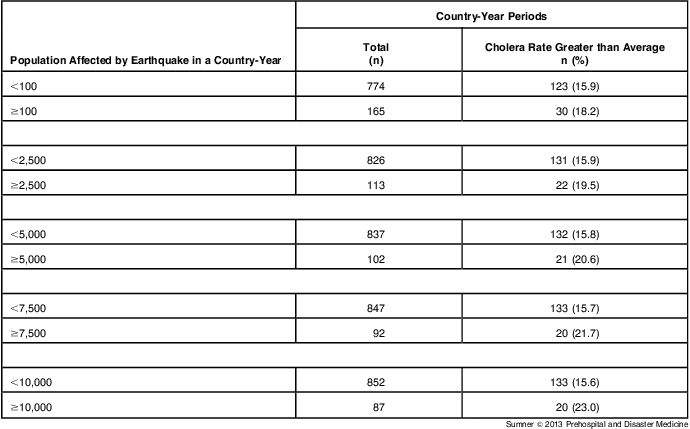
For each country-year period, Table 1 provides the distribution with which earthquakes of various effect sizes are associated with having a greater than average cholera rate for the 15-year period. A trend of gradually increasing risk of greater than average cholera rates is noted when a higher cut-off for population affected by an earthquake is used. While 18.2% of country-years that have ≥100 individuals affected by an earthquake are associated with a higher than average cholera rate, 23.0% of country-years that have ≥10,000 individuals affected by an earthquake are associated with a higher than average cholera rate.
Characteristics of Earthquake Size and Cholera Rates in a Country-Year Period, 1995-2009Footnote a
a Data from 63 low- and middle-income nations; 6 country-years missing all data, yielding 939 country-year periods total
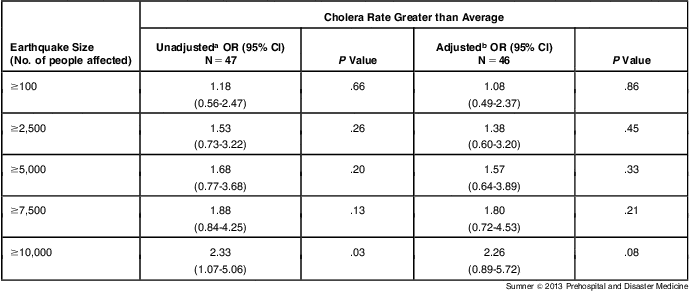
Table 2 presents unadjusted and adjusted odds ratios (OR) for the association between earthquakes of various sizes and the presence of a cholera rate that for the country-year is greater than average. Forty-seven nations were analyzed in the unadjusted models presented; 15 nations that had no cholera cases for any of the 15 years and one nation that had no cholera cases for any of its 14 years of observation (one year missing data) were excluded from the regression as they show no within-country variation in the outcome variable. In the adjusted models, 46 of the 47 countries were analyzed, as one country was dropped due to missing covariate data. After controlling for the effect of potential confounders, there was a trend of increasing risk of greater than average cholera rates with higher cut-offs for population affected by an earthquake; however these findings did not reach statistical significance at traditional levels.
Unadjusted and Adjusted ORs for the Association Between Earthquake Size and Cholera Rates in a Country-Year Period
Abbreviations: OR, odds ratio
aAdjusted for only country and year fixed-effects
bAdjusted for GDP per capita, water and sanitation score, urbanization, child mortality rates, flooding, and country and year fixed-effects
Figure 2 shows a plot of the odds ratio for the association between large earthquakes affecting ≥10,000 persons in a country-year and cholera rate increases to various levels. A general observed trend was that as greater thresholds of cholera rate increases were selected, the association between earthquakes and cholera outbreaks appeared to weaken. This suggests that large-scale increases in cholera rates are less common than smaller increases in cholera rates, although due to small numbers, confidence intervals for the point estimates are wide and any trend seen may be coincidental.
Adjusted Odds Ratios for the Association Between an Earthquake Affecting ≥10,000 Persons in a Country-Year Period and Various Levels of Cholera Rate Increase
It should be noted that alternate strategies were attempted to model the effects of earthquakes on cholera rates. Primarily, modeling cholera infections using a negative binomial regression with the count of cholera cases as the main dependent variable, offset by the country's population, was attempted. Modeling cholera as such did not reveal an association between increasing population affected by an earthquake and increasing cholera rates. Lastly, as a sensitivity analysis, beyond controlling for year fixed effects (factors that may have influenced all countries in a given year), an autoregressive form of the fixed-effects model that included a one-year lag of the dependent variable as an explanatory variable was estimated.Reference Ludwig and Cook24 No substantive change in outcome was observed.
Discussion
There has been debate regarding whether earthquake events are associated with cholera outbreaks. To the best of the authors’ knowledge, this analysis is the first to explore this question using primary cholera case data and regression analysis. The findings suggest a nuanced picture.
In the descriptive tabulations of Table 1 and the unadjusted and adjusted odds ratios of Table 2, a trend of increasing risk of having a greater than average cholera rate for earthquakes of greater effect size is observed. However, these relationships do not reach statistical significance at the traditional five percent significance level and may be due to chance. It should be noted that to maintain maximal statistical power, given the small number of countries in the analysis, the main exposure variable was not categorized into more than two levels. As noted in the methods section, separate models for various specifications of the number of individuals affected by an earthquake in a country-year period were estimated, with the referent group for each model being the country-year periods with less than the specified number of people affected by an earthquake, so that the referent group changed for each comparison. Thus, in the analysis there is the potential for spuriously significant results due to multiple comparisons. However, it would be uncommon for the clear trend of increased statistical significance at each level tested to occur by chance, which raises the suggestion of an underlying relationship between earthquakes and cholera that was unable to be detected robustly due to lack of statistical power.
In Figure 2 there is a general trend indicating that the association between large earthquakes and cholera rates weakens as a greater cutoff for the cholera-rate-increase is tested. Similar to the results in Table 2, the data points of Figure 2 were calculated from multiple regression analyses and random error may have been present due to the fact that multiple comparisons were made. Due to small numbers, confidence intervals are wide and any trend noted may be coincidental. Nonetheless, if there is a true association between earthquake disasters and cholera outbreaks, it is probable that most earthquake disasters would only increase cholera rates to a limited degree and would not commonly reach epidemic proportions. The trends observed in Figure 2 align with this intuition. It is also possible that any slight increase in cholera rates after an earthquake can be due simply to improved epidemiologic surveillance and cholera case-finding after a disaster occurs, as health authorities are more attuned to the region.
In summary, these exploratory results provide a starting point for continued hypothesis generation and empirical analysis in this new area of investigation. Although there seemed to be a trend toward higher cholera rates after larger earthquake disasters, there is not strong evidence for frequent, large-scale cholera epidemics after earthquake events. This finding confirms previous expert opinion and descriptive research suggesting that major outbreaks are not particularly common.Reference de Ville de Goyet6, Reference Floret, Viel, Mauny, Hoen and Piarroux7 This finding is intuitive, especially for cholera outbreaks, as the risk of outbreak depends highly on the alignment of local factors including local disease prevalence, environmental vulnerability, and severity of population pressures as a result of the earthquake, all of which contribute to the propagation of an outbreak.
Limitations
The results of this study depend on accurate cholera reporting to the WHO. Unfortunately, significant underreporting of cholera is believed to occur as there may be adverse trade and economic consequences for nations experiencing cholera outbreaks. In some countries with known cholera but limited capacity to confirm cholera cases, cholera is not reported to the WHO. Nonetheless, bearing in mind the limitations of the data, the WHO figures are the official and best cross-country data available to perform a regression analysis to attempt to explore associations, and are a starting point for further exploration of this topic. Additionally, without more refined, local-level data, it is difficult to estimate the precise effect of an earthquake on the number of cholera cases experienced in an outbreak. Unfortunately, the WHO data on cholera cases is reported by year; thus, a more detailed, temporal investigation of cholera cases associated with an earthquake cannot be assessed easily.
Limitations with the study design should also be mentioned. First, as with any ecological analysis, only associations can be explored, and not causal relationships. Secondly, as with any cross-country analysis, there is potential for selection bias as only countries and time periods with available data can be included. Thus, the results of this study are most applicable to the countries analyzed and any extrapolations should be done with caution. Additional investigations are needed and should ideally focus on analyzing more robust local-level longitudinal data for individual countries with both detailed cholera monitoring and earthquake data. Thirdly, with ecological analyses at the international level, there is a de facto limitation in power to detect differences as there are only a limited number of nations that can be included.
Conclusion
Although exploratory analyses detected a trend of increasing risk of greater than average cholera rates when more people were affected by an earthquake in a country-year, these findings did not reach statistical significance and may be due to chance. Frequent large-scale cholera outbreaks after earthquake disasters appeared to be relatively uncommon.