Kentucky bluegrass (Poa pratensis L.) is an invasive grass that is increasing on northern Great Plains rangelands (Murphy and Grant Reference Murphy and Grant2005; Travnicek et al. Reference Travnicek, Lym and Prosser2005). As a result, rangelands in central North Dakota, which were dominated by native graminoids in 1984, are now dominated by Kentucky bluegrass (DeKeyser et al. Reference DeKeyser, Meehan, Clambey and Krabbenhoft2013). U.S. Department of Agriculture, Natural Resources Conservation Service (USDA-NRCS) monitoring indicated that Kentucky bluegrass was present on most of their sampling sites in the northern Great Plains (Toledo et al. Reference Toledo, Sanderson, Spaeth, Hendrickson and Printz2014). Invasive grasses, such as Kentucky bluegrass, can disrupt ecosystem function by altering nitrogen cycling and reducing carbon storage (Wedin and Tilman Reference Wedin and Tilman1996) and lowering plant diversity (Pritekel et al Reference Pritekel, Wittemore-Olson, Snow and Moore2006; Vaness and Wilson Reference Vaness and Wilson2007).
Prescribed burning has been used to control invasive perennial grasses (DiTomaso et al. Reference DiTomaso, Brooks, Allen, Minnich, Rice and Kyser2006), including Kentucky bluegrass (Rice Reference Rice2005). An early comparison of spring-burned and unburned areas in Kansas (Hensel Reference Hensel1923) found a rapid dominance of Kentucky bluegrass on the unburned areas. In the Kansas Flint Hills, Kentucky bluegrass cover was 15 times greater in controls than in burned plots (McMurphy and Anderson Reference McMurphy and Anderson1965), and burning also reduced the amount of Kentucky bluegrass from 14% to 2% of the species composition (Towne and Owensby Reference Towne and Owensby1984). Sixteen months after burning, Kentucky bluegrass biomass was 1.7 to 4 times greater in control plots than in spring-burned plots in the Nebraska loess hills (Schacht and Stubbendieck Reference Schacht and Stubbendieck1985). In a mixed-grass prairie in South Dakota, control plots had at least 4.5 times more Kentucky bluegrass biomass than late spring or early summer-burned plots (Engle and Bultsma Reference Engle and Bultsma1984). Three years after a fall burn in South Dakota, Kentucky bluegrass cover was still reduced by 50% compared with the unburned control (Bahm et al. Reference Bahm, Barnes and Jensen2011).
Burning has been shown to successfully reduce Kentucky bluegrass, but treatment timing is also critical. In Nebraska, burning smooth brome (Bromus inermis Leyss.) before tiller elongation did not reduce tiller density, but burning at later morphological stages did (Willson and Stubbendieck Reference Willson and Stubbendieck2000). Based on its presence on dormant season–burned sites, the invasive warm-season introduced grass, yellow bluestem [Borthriochloa ischaemum var. songarica (Rupr. ex Fisch. & C.A. Mey.) Celarier & Harlan], appears to tolerate dormant-season burns (Gabbard and Fowler Reference Gabbard and Fowler2006), but is reduced by growing-season burns (Ruckman et al. Reference Ruckman, Schwinning and Lyons2012; Simmons et al. Reference Simmons, Windhages, Power, Lott, Lyons and Schwope2007). Other research on yellow bluestem–invaded grasslands did not identify an optimal burn phenology for yellow bluestem but did indicate it was more sensitive to a summer burn under drought conditions than the native grass, little bluestem [Schizachyrium scoparium (Michx.) Nash] (Havill et al. Reference Havill, Schwinning and Lyons2015). In the northern Great Plains, a more thorough evaluation of the impact of season of burning on Kentucky bluegrass abundance is needed.
Imazapic and glyphosate are herbicides used to control invasive perennial grasses. Imazapic reduced Kentucky bluegrass cover by half compared with controls in a Kentucky grassland (Adkins and Barnes Reference Adkins and Barnes2013). After three growing seasons, a spring application of imazapic and imazapyr reduced Kentucky bluegrass cover by 33% compared with control plots (Bahm et al. Reference Bahm, Barnes and Jensen2011). Glyphosate reduced abundance of Kentucky bluegrass by 98% in eastern Nebraska (Waller and Schmidt Reference Waller and Schmidt1983). Because glyphosate is a broad-spectrum herbicide, it can be difficult to use in stands that still contain desired species (Bahm et al. Reference Bahm, Barnes and Jensen2011). For example, glyphosate is often used to kill species such as tall fescue [Lolium arundinaceum (Schreb.) S.J. Darbyshire] before reseeding (Washburn and Barnes Reference Washburn and Barnes2000). But in the northern Great Plains, introduced cool-season grasses can begin growth before native cool-season grasses (Frank et al. Reference Frank, Sedivec and Hofmann1993). This difference in plant development may provide a window of opportunity for applying herbicides in early spring.
Combining prescribed burns with herbicides can also effectively reduce invasive cool-season grasses (Rice Reference Rice2005). In Kentucky, tall fescue was effectively eliminated by a spring burn followed by imazapic application (0.21 kg ha−1) and greatly reduced when the spring burn was followed by glyphosate application (2.24 kg ha−1) (Washburn et al. Reference Washburn, Barnes and Sole1999). In North Dakota, a spring burn combined with imazapic reduced Kentucky bluegrass cover by 16.8% the year after treatment (Hendrickson and Lund Reference Hendrickson and Lund2010). Herbicide applications can also be used to enhance fuel load to carry a fire (Glass Reference Glass1991). In southeastern North Dakota, enhanced fuel load can allow for burning during the spring when weather conditions can make burning difficult.
Little emphasis has been placed on how the level of invasion and timing of treatments impact effectiveness of invasive-grass control treatments. Burning, in areas without a native warm-season grass component, is often ineffective at reducing cool-season invasive grasses (Schacht and Stubbendieck Reference Schacht and Stubbendieck1985; Willson and Stubbendieck Reference Willson and Stubbendieck2000). Hendrickson and Lund (Reference Hendrickson and Lund2010) found the effectiveness of burning and imazapic treatments in reducing Kentucky bluegrass abundance depended on vegetative community. For example, burning plus imazapic slightly increased Kentucky bluegrass abundance in communities dominated by Kentucky bluegrass. However, in communities dominated by smooth brome, the same treatment combination reduced Kentucky bluegrass.
The Sheyenne National Grassland is administered by the U.S. Forest Service and managed by the Sheyenne Valley Grazing Association (Edland Reference Edland2002). The primary commercial use of these grasslands is beef production. The Sheyenne National Grassland contains some of the last tallgrass prairie in public ownership. These grasslands were originally dominated by dense vegetation comprising tall grasses, including big bluestem (Andropogon gerardii Vitman), little bluestem, switchgrass (Panicum virgatum L.), and yellow indiangrass [Sorghastrum nutans (L.) Nash ex Small], and several forb species (Kuchler Reference Kuchler1964). However, cool-season introduced grasses, primarily Kentucky bluegrass, have invaded and now dominate most of the landscape.
The objectives of this study were (1) to determine the effect of time of burning on Kentucky bluegrass and native grass relative basal cover; (2) to determine whether combining herbicides with burning would increase the effectiveness of restoration treatments compared with burning alone; and (3) to evaluate the impact of initial Kentucky bluegrass cover on treatment responses.
Materials and Methods
Study Area
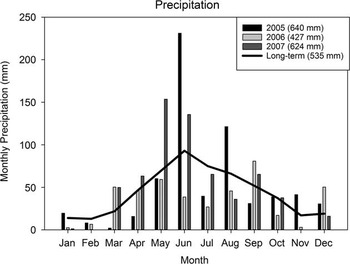
The study was conducted on three research sites, each with a different level of Kentucky bluegrass invasion on the Sheyenne National Grassland in southeastern North Dakota, approximately 16 km east of Lisbon, ND. This area has a subhumid continental climate and is characterized by cold winters and warm summers (Edland Reference Edland2002). Weather data were taken from a NOAA cooperative weather station 17 to 19 km west of the sites. Long-term (1903 to 2013) average annual precipitation is 535 mm, with 75% occurring from April through September (Figure 1). Long-term monthly maximum average temperatures for the 125-d growing season ranged from 12.9 C in April to 28.9 C in July. Precipitation during the study period was 120%, 80%, and 117% of the long-term average for 2005, 2006, and 2007 respectively (Figure 1). Two of the research sites were located within 370 m of each other (46.399827 °N, 97.465133 °W; 46.397037 °N, 97.467567 °W ), while the third was located 7.63 km to the NNE of these sites (46.465127 °N, 97.438386 °W). Each research site was fenced in fall 2004 to prevent livestock grazing during the study period.
Monthly precipitation (mm) for 2005, 2006, and 2007 and long-term (1903–2013) average monthly precipitation recorded at a weather station 17 km west of the plots in Lisbon, ND. Numbers in parenthesis behind year are the annual total precipitation for each year and the long-term average.

The Sheyenne National Grassland is part of the Lake Agassiz Plain, sand-delta and beach ridges eco-region. Predominant soils at each site were Hecla-Garborg loamy fine sand (sandy, mixed, frigid Typic Endoaquolls and sandy, mixed, frigid Oxyaquic Hapludolls) (USDA-NRCS 2015). The research sites had level to slightly sloping topography with high water tables and few poorly drained depressions. Rangelands in the Sheyenne National Grassland can vary in soil and topography within a relatively short spatial distance (J Printz, USDA-NRCS, personal communication), and several different ecological sites (i.e., spatial unit in which climate, soil, and relief are sufficiently uniform to produce a unique plant community [USDA-NRCS 2015]) occurred within each research site. However, the primary ecological site was Subirrigated Sands on all three research sites (Sedivic and Printz 2012).
Experimental Design
Each research site visually had a different level of Kentucky bluegrass invasion. Following the initial visual estimates, Kentucky bluegrass cover was quantified in July 2005 using fifty 10-point frames (Cook and Stubbendieck Reference Cook and Stubbendieck1986) to estimate a baseline relative basal cover within each subplot (see below for subplot definition) at each research site. When this method is used, each of the 10 points within the frame contacts either plant, litter, bare ground, or rocks. Plant hits are considered only when one of the pins touches the base of the plant or tiller as it emerges from the soil (basal hits). Total cover uses all hits within a frame (plant basal hits, litter, bare ground, and rock) to calculate percent coverage of litter, bare ground, rock, and basal plant hits. However, relative species composition is calculated only as plant basal hits and excludes hits on litter, bare ground, or rocks. Since 96% of the introduced grasses encountered were Kentucky bluegrass, the term “Kentucky bluegrass” will be used in place of introduced grass hereafter. Each basal hit was grouped into Kentucky bluegrass (KBG), native grass (NG), native forb (NF), introduced forb (IF), or native shrub or semishrub (NS) categories, and relative species composition was determined using these categories.
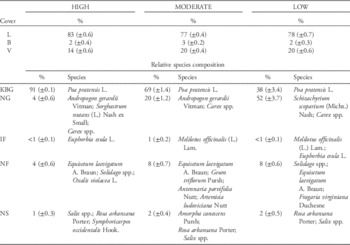
In 2005, Kentucky bluegrass made up 38%, 69%, and 91% of the species composition and native grasses made up 52%, 20%, and 4% of the species composition in the LOW, MODERATE, and HIGH sites, respectively (Table 1). Introduced forbs (IF) were a minor portion of the initial relative species composition at all three sites as were native shrubs and semishrubs (NS). Native forbs (NF) made up 4% to 8% of the relative species composition (Table 1).
Percent litter (L), bare ground (B), and basal cover (V) of the three sites in 2005 prior to the imposition of treatments.Footnote a

a Basal cover is divided into vegetative categories representing the groups of Kentucky bluegrass (KBG); native grass (NG); introduced forb (IF); native forb (NF); and native shrub or semishrub (NS). Numbers in parentheses are standard errors. Also listed are the most dominant species within each vegetative category listed in order of dominance. Data were collected from 1,400 10-point frames within each site.
The experiment was designed as a split-plot design with a 2 by 3 factorial arrangement of treatments augmented with a control. Therefore there was a total of seven treatments. Four strips (20 by 60 m) within each research site were used as a replicate block. Times of burning (spring vs. fall) were main plot effects, and these were randomly applied to one of two (10 by 60 m) plots in each replicate block. Fall burns were conducted on October 26, 2005, and spring burns on April 19, 2006. Conditions during the October 26, 2005, burn were: wind speed 8 km h−1, temperature 10 C, and relative humidity at 76%. Conditions during the April 19, 2006, burn were: wind speed 16 km h−1, temperature 9 C and relative humidity at 38%.
Herbicide treatments were randomly assigned to 10 by 20 m subplots within each of the plots assigned a fall or spring burn. These treatments were (1) imazapic at 0.42 L ha−1, (2) glyphosate at 2.81 L ha−1, and (3) no herbicide application. Herbicides were applied on May 5, 2006, for plots burned in October 2005; herbicides were applied on October 21, 2005, for plots burned in May 2006. Therefore the fall-burned plots had herbicides applied after the burn, but the spring-burned plots had herbicides applied prior to burning. Control plots (5 by 60 m) were not burned and had no herbicides applied to them. Treatments were (1) control, (2) fall-burned, no herbicide (FALL+NO), (3) fall-burned plus imazapic (FALL+IMA), (4) fall-burned plus glyphosate (FALL+GLYPH), (5) spring-burned, no herbicide (NO+SPRING), (6) spring-burned plus imazapic (IMA+SPRING), and (7) spring-burned plus glyphosate (GLYPH+SPRING).
Sampling
In July 2006 and 2007, relative basal cover was estimated for each subplot at each research site using 50 individual 10-point frames, with 7.5-cm pin spacing (Cook and Stubbendieck Reference Cook and Stubbendieck1986). The 50 frames were randomly located within each subplot. Species composition was determined using relative basal cover. Baseline relative basal cover was recorded in July 2005, prior to treatment application, and also in July 2006 and 2007, the first and second years after treatment application. KBG, NG, NF, IF, and NS were measured as percentage of basal cover for each of the plots.
Statistical Analysis
Species composition data (KBG, NG, and NF) collected from the 10-point frames were fitted to a doubly-repeated-measures linear mixed model using the 2005 pretreatment cover of each species composition as a covariate. Species composition and year were the repeated-measures factors. Species composition was fit as a repeated measure to incorporate the multivariate response of KBG, NG, and NF. The model incorporated the split-plot nature of the experimental design, including the blocks for the burn treatments, the whole plots associated with the burn treatments, and the control and split plots associated with the herbicide treatments, all modeled as random effects. An unstructured covariance structure was assumed for both repeated-measures factors. Each individual species composition was also fit separately to a repeated-measures linear mixed model using pretreatment cover as a covariate, but with year being the only repeated-measures factor. Least-squares means adjusted for pretreatment conditions were computed for the burn/herbicide treatment combinations from the fitted model, and multiple comparisons were performed using Tukey’s method.
Results and Discussion
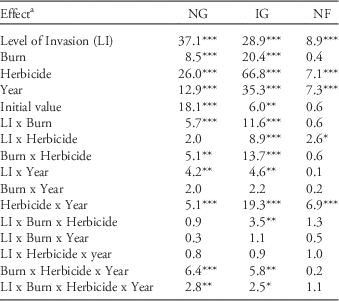
Analysis of the doubly repeated-measures mixed model revealed the species composition factor (identified as “cover” in the model) was significant, as was its interaction with year by treatment (P<0.0001) and site by treatment (P<0.0001), indicating that treatment effects were different among the species compositions and these differences depended on both year and site. Thus, separate models for each species cover were warranted. We fit the repeated-measures linear mixed model separately to percent KBG, NG, and NF, excluding the control treatment. Table 2 summarizes model fits for these data. Significant four-way interactions among year, site, burn, and herbicide for KBG and NG suggest post hoc comparisons of treatments should be conducted by year and site. To facilitate comparisons by year and site, we refit the model after coding the burn and herbicide treatment combinations into a single treatment factor and included the control. Post hoc comparisons of treatment means based on this model fit are provided in Figures 2 and 3.
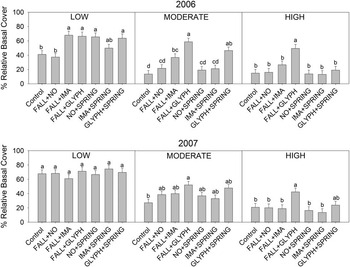
Estimated mean percent basal cover of native grass adjusted for pretreatment (2005) and percent basal cover for sites with LOW, MODERATE, and HIGH levels of Kentucky bluegrass invasion for 2006 and 2007. Letter groupings over bars indicate significant differences among treatment means within a year and Kentucky bluegrass invasion level at a 0.05 level of significance.

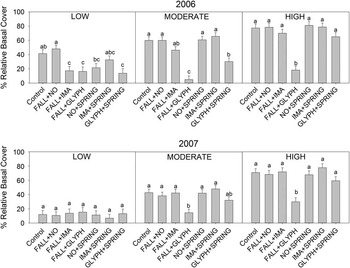
Estimated mean percent basal cover of Kentucky bluegrass adjusted for pretreatment (2005) and percent basal cover for sites with LOW, MODERATE, and HIGH levels of Kentucky bluegrass invasion for 2006 and 2007. Letter groupings over bars indicate significant differences among treatment means within a year and Kentucky bluegrass invasion level at a 0.05 level of significance.

F-statistics and associated P-values from model fits for testing effects of year and treatment on percent of species composition based on relative basal cover of native grass (NG), Kentucky bluegrass (KBG), and native forb (NF).

a Level of Invasion referred to three sites that had different levels of Kentucky bluegrass invasion (LOW, MODERATE and HIGH) evaluated in study, Burn referred to either a spring or fall burn and Herbicide referred to no herbicide, imazapic or glyphosate application. Initial Value is the covariate used in the analysis.
*P ≤ 0.10.
**P ≤ 0.05.
***P ≤ 0.01.
Effect of Time of Burning on Kentucky Bluegrass and Native Grass Relative Basal Cover
We found no statistically significant differences among mean KBG and NG basal cover between fall-burned without herbicide (FALL+NO), spring-burned without herbicide (NO+SPRING), and the unburned control for the MODERATE and HIGH sites (Figures 2 and 3). However, for the LOW site in 2006, mean NG cover was greater on spring-burned plots (NO+SPRING) than fall-burned (FALL+NO) or control plots (Figure 2). Mean KBG cover was also lower on NO+SPRING plots than FALL+NO plots (Figure 3). By 2007, treatment differences had disappeared for the LOW site.
The lack of response to burning in our study was surprising. Previous research indicated burning reduces KBG cover (Bahm et al. Reference Bahm, Barnes and Jensen2011; McMurphy and Anderson Reference McMurphy and Anderson1965; Towne and Owensby Reference Towne and Owensby1984), and this response was noted for both spring (Engle and Bultsma Reference Engle and Bultsma1984; Schacht and Stubbendieck Reference Schacht and Stubbendieck1985) and fall (Bahm et al. Reference Bahm, Barnes and Jensen2011) burns. Many of these studies (McMurphy and Anderson Reference McMurphy and Anderson1965; Schacht and Stubbendieck Reference Schacht and Stubbendieck1985; Towne and Owensby Reference Towne and Owensby1984) were conducted in the Central Great Plains and had a different KBG phenological development and warm- and cool-season grass ratio. For example, in Nebraska, seed stalks of KBG often appear in early May (Stubbendieck et al. Reference Stubbendieck, Nichols and Roberts1985), which is almost a month earlier than in our study area. In our study, the spring and fall burns were conducted during the dormant season for warm-season grasses (i.e., late fall or early spring). However, these burns may have been too early or too late to damage the Kentucky bluegrass. In smooth brome, another invasive cool-season grass, early burning (i.e., prior to tiller elongation) did not reduce tiller density (Willson and Stubbendieck Reference Willson and Stubbendieck2000). The LOW site was dominated by warm-season grasses (Table 1), and a spring burn may have increased soil temperatures, enhancing their competitive advantage. Burning has been reported to increase soil temperatures 1 C to 3 C compared with unburned sites during the growing season on sandy soils in Oklahoma (Vermeire et al. Reference Vermeire, Wester, Mitchell and Fuhlendorf2005).
Combining Herbicides with Burning
Glyphosate has been used to control other cool-season grasses, such as tall fescue (Washburn et al. Reference Washburn, Barnes and Sole1999), but there are concerns about it injuring native vegetation. Our data indicate that dormant-season glyphosate applications, in early spring or late fall when warm-season grasses are dormant, combined with burning is a powerful vegetation management tool in the northern Great Plains. Fall burning plus spring glyphosate application (FALL+GLYPH) was particularly effective at increasing native grasses and decreasing Kentucky bluegrass in MODERATE and HIGH sites in both 2006 and 2007 (Figures 2 and 3). Fall burning may have reduced standing dead vegetation, resulting in better spring efficacy for the glyphosate application (DiTomaso et al. Reference DiTomaso, Brooks, Allen, Minnich, Rice and Kyser2006; Robertson et al. Reference Robertson, Hickman, Harmoney and Leslie2013).
A fall glyphosate application followed by a spring burn (GLYPH+SPRING) increased native grass (NG) cover and decreased KBG cover compared with fall-burned plots (FALL+NO) or untreated controls in the LOW and MODERATE sites in 2006 (Figures 2 and 3). Unfortunately, by 2007, this effect had disappeared (Figures 2 and 3). The GLYPH+SPRING treatment was not effective at changing species composition in the highly invaded site (HIGH). In general there is a lack of information about the impacts of a fall herbicide application followed by a spring burn, and our data would not support this management strategy. Glass (Reference Glass1991) suggested that using herbicides prior to burning may increase fuel load, which would potentially provide more burning opportunities in the relatively short spring-burning season in southeast North Dakota. While this may occur, the lack of response in our data suggests resources would be better used to focus on fall burns followed by glyphosate applications.
In contrast to glyphosate, the responses of relative basal cover to imazapic were generally no different than fire alone or the unburned control. Working in mixed-grass prairie, Hendrickson and Lund (Reference Hendrickson and Lund2010) found a spring fire followed closely by an imazapic application increased native grass abundance, especially in communities with a large established native grass component. In this study, a fall burn followed by a spring application of imazapic (FALL+IMA) did provide greater native grass abundance and lower Kentucky bluegrass abundance than untreated controls in the LOW site (Figures 2 and 3), and the FALL+IMA treatment also increased native grass abundance in the MODERATE site (Figure 2). However, as with the SPRING+GLYPH, treatment effects had disappeared by 2007 (Figure 2).
We also hypothesized that the largest improvement in species composition (i.e., increase in native grasses and decrease in Kentucky bluegrass) would occur at lower levels of invasion. Because of three- and four-way interactions, we could not test this hypothesis directly. However, the FALL+GLYPH treatment reduced Kentucky bluegrass basal cover by more than 50 percentage points and increased native grass abundance 35 to 45 percentage points compared with the controls during the first year after treatment in the MODERATE and HIGH sites (Figures 2 and 3). The most effective treatment on the LOW site the first year after treatment was the fall burn followed by a spring imazapic application (FALL+IMA), which increased native grass cover by 27 percentage points and reduced Kentucky bluegrass basal cover by 24 percentage points (Figure 3). The larger treatment responses on the MODERATE and HIGH sites may be the result of litter removal by fire, as previously noted, or an artifact of the amount of Kentucky bluegrass in the species composition.
The dominance of Kentucky bluegrass on the HIGH and MODERATE sites (Table 1) indicates that its control would have a large impact on relative changes in species composition. On the LOW site, however, low Kentucky bluegrass and high native grass cover implies that absolute changes in relative basal cover are not possible to the same degree as in the MODERATE and HIGH sites.
Regardless of the underlying mechanism, heavily invaded plots (HIGH) treated with a fall burn and spring application of glyphosate changed from being dominated by Kentucky bluegrass to being dominated by native grasses the year after treatment (Figures 2 and 3). Switches in dominance from introduced to native grass within a year have been reported for other locations in North Dakota (Hendrickson and Lund Reference Hendrickson and Lund2010), but none of those plots were as invaded as the HIGH and MODERATE sites in this study.
The second year after treatment, treatment differences began to disappear on the MODERATE and HIGH sites (Figures 2 and 3). Several factors could have led to the moderation of treatment differences. First, as best illustrated by the LOW site, regardless of treatment, native grasses made up a larger percent and Kentucky bluegrass made up a smaller percent of the species composition in 2007 (Figures 2 and 3). This was true not only for the LOW site, but also to a lesser degree in the treatments on the MODERATE and HIGH sites, especially the controls (Figures 2 and 3). The broad-based responses of Kentucky bluegrass and native grasses suggest this change may be driven primarily by environmental factors. Since 2006 was drier than average (Figure 1), this may have reduced Kentucky bluegrass abundance and benefited native grasses, as increased precipitation appears to be a driver of Kentucky bluegrass increase (Printz and Hendrickson Reference Printz and Hendrickson2015). In perennial grasses, changes in tiller responses in the current year may be the result of impacts or actions of the previous year (Hendrickson et al. Reference Hendrickson, Moser and Reece2000). On the other hand, Kentucky bluegrass starts growth early in the spring, prior to native species (DeKeyser et al. Reference DeKeyser, Meehan, Clambey and Krabbenhoft2013), and does well in moist conditions (DeKeyser et al. Reference DeKeyser, Dennhardt and Hendrickson2015). Kentucky bluegrass also has a shallow root system that often forms a dense root mat (DeKeyser et al. Reference DeKeyser, Clambey, Krabbenhoft and Ostendorf2009) and increased allocation to root biomass compared with native species (Dong et al. Reference Dong, Patton, Wang and Peterson2014), both of which provide Kentucky bluegrass an advantage in wetter periods. Second, the effects of the fall burn with a spring application of glyphosate (FALL+GLYPH), the most promising treatment in 2006 for the MODERATE and HIGH sites, either stayed the same or regressed in 2007 (Figures 2 and 3).
The transient nature of the treatment effects supports Smart et al. (Reference Smart, Scott, Clay, Clay, Ohrtman and Mousel2013), who indicated the importance of applying treatments annually in the northern Great Plains. However, in 2007, Kentucky bluegrass abundance for this treatment (FALL+GLYPH) was still less than the initial amount of Kentucky bluegrass in the LOW site (Figure 3 and Table 1).
The treatments, especially the FALL+GLYPH, did provide dramatic changes in species composition the first year following treatment application. Coupling these relatively aggressive treatments with a better understanding of the impact of environment on Kentucky bluegrass abundance may provide a window of opportunity for applying other management treatments such as grazing. Data from the USDA-ARS Northern Great Plains Research Laboratory showed a delay in Kentucky bluegrass invasion on heavily grazed versus moderately grazed sites (DeKeyser et al. Reference DeKeyser, Dennhardt and Hendrickson2015). A similar window of opportunity, in this case for reseeding, was developed using an herbicide in a reed canarygrass (Phalaris arundinacea L.)-dominated wetland (Foster and Wetzel Reference Foster and Wetzel2005).
The size of our burn plots was 10 by 60 m. It is uncertain whether the size of our plots had any influence on fire behavior. Kral et al. (Reference Kral, Limb, Hovick, McGranahan, Field and O’Brien2015) compared multiple small-scale experimental approaches to prescribed fire and found that temperature characteristics were similar for most of the small scale-approaches and a prescribed fire. Kentucky bluegrass–dominated areas tend to have a relatively homogeneous stand of cured Kentucky bluegrass litter, and the amount of senesced grass was reported to impact fire spread (Cheney et al. Reference Cheney, Gould and Catchpole1993). However, ecological sites on the Sheyenne National Grassland can change within a relatively short distance (JL Printz, personal communication, 2013), which can impact litter-production characteristics. The LOW sites were impacted least by fire and had the least amount of Kentucky bluegrass. Therefore, they may have been most impacted by changes in fire characteristics caused by scale. However, the fire-only treatments (FALL+NO and NO+SPRING) did not differ significantly from the controls, which suggests that even if plot size influenced fire behavior, it was constant across different levels of Kentucky bluegrass invasion.
Impacts in Native Forbs (NF)—Change in Relative Species Composition
Relative species composition had a year by herbicide by site interaction for NF (Table 2). These interactions were driven by treatment differences in the MODERATE site in 2006 but not in any other site or in 2007. In the MODERATE site in 2006, FALL+GLYPH (24.15±2.94%) had greater native forb cover than did FALL+NO (10.63±2.89%) or IMA+SPRING (8.83±2.89%).
Herbicides such as glyphosate and imazapic can also negatively impact native forbs. A high rate of imazapic has been reported to reduce native forbs by 84% when used to control downy brome (Bromus tectorum L.) in Wyoming big sagebrush (Artemisia tridentata Nutt. ssp. wyomingensis Beetle & Young) (Baker et al. Reference Baker, Garner and Lyon2009). Our data indicated herbicide impact on native forbs depended on site, and by 2007 there were no differences between any of the treatments. Therefore, it appears any damage to forbs was fairly short-lived.
Acknowledgments
This research was funded in part by the U.S. Forest Service. U.S. Department of Agriculture, Agricultural Research Service, Plains Area, is an equal opportunity/affirmative action employer and all agency services are available without discrimination. At the time of the research, CB Ereth was a graduate student in the Department of Range Science, North Dakota State University, Fargo, ND.