


Introduction
Metaphors compare one thing with another (Soskice, Reference Soskice1985, p. 15). They are fundamental and pervasive in human communication (Lakoff and Johnson, Reference Lakoff and Johnson1980). Intentional use of metaphors is an important therapist skill, which may be particularly effective in helping to change clients’ distorted views (Elliott et al., Reference Elliott, Adams and Hodge1992).
Metaphor has long been of interest to many schools of psychotherapy (see Kopp, Reference Kopp1995; O'Hanlon and Hexum, Reference O'Hanlon and Hexum1990; Törneke, Reference Törneke2017; Winnicott, Reference Winnicott1989) with numerous potential benefits asserted including: enhancing conceptualization (Berlin et al., Reference Berlin, Olson, Cano and Engel1991); expression of emotion (Siegelman, Reference Siegelman1990); building alliance (Brooks, Reference Brooks1985); transforming meaning (Lyddon et al., Reference Lyddon, Clay and Sparks2001); being memorable (Bonanno, Reference Bonanno1990) and providing compact communication (Pearce, Reference Pearce1996).
Within cognitive behaviour therapy (CBT), there has been growing interest in the value of metaphor, with CBT experts advocating for increased use in therapy (Kuyken et al., Reference Kuyken, Padesky and Dudley2009). One focus has been on therapist's use of metaphor (Blenkiron, Reference Blenkiron2010; Stott et al., Reference Stott, Mansell, Salkovskis, Lavender and Cartwright-Hatton2010). A second focus has been on the need for attention to client metaphors, bringing them into case conceptualizations as a shared reference point (Butler et al., Reference Butler, Fennell and Hackmann2008; Kuyken et al., Reference Kuyken, Padesky and Dudley2009) and as a way of increasing alliance, given that alliance has been found in numerous studies to be an important predictor of outcome (Horvath and Bedi, Reference Horvath and Bedi2002).
To date, there has been very little empirical basis for advocating the value of metaphor, apart from our previous paper, which was the first empirical study of the effects of metaphor in CBT. The results suggested that metaphor may enhance the feeling of being understood for the client, thus strengthening the therapeutic bond. This finding was based on alliance ratings by role played ‘clients’ and ratings of therapist competence in CBT by an external rater.
The present small-scale study extends empirical research on the use of metaphor in CBT into the domain of therapist training. To our knowledge, this study is the first in the CBT – or the broader psychotherapy – literature, which has sought to train experienced therapists in the use of metaphor. The aim was to determine if two half-day workshops focusing on client metaphors and co-constructing shared metaphors would make a difference to therapist's use of metaphor with their clients following the workshops.
This article describes the metaphor training workshop, and reports on therapists’ evaluations of the training and their use of metaphor post-training. The metaphor training was based on a growing literature on therapist training, suggesting that best practice involves: (1) use of a variety of methods to enhance declarative and procedural skills such as didactic teaching, live and video demonstration, interactive exercises, and role-play and self-practice of skills (Bennett-Levy et al., Reference Bennett-Levy, McManus, Westling and Fennell2009a; Padesky, Reference Padesky and Salkovskis1996; Sudak et al., Reference Sudak, Codd, Ludgate, Sokol, Fox, Reiser and Milne2016); (2) ongoing consultation or supervision to enhance learning post-workshop (Beidas et al., Reference Beidas, Edmunds, Marcus and Kendall2012; Lyon et al., Reference Lyon, Stirman, Kerns and Bruns2011; Mannix et al., Reference Mannix, Blackburn, Garland, Gracie, Moorey and Reid2006) and (3) the value of structured post-workshop reflection worksheets (Bennett-Levy and Padesky, Reference Bennett-Levy and Padesky2014; Bennett-Levy et al., Reference Bennett-Levy, Thwaites, Chaddock, Davis, Stedman and Dallos2009b; Kolb, Reference Kolb1984; Schon, Reference Schon1983).
The purpose of the programme was to train therapists to bring metaphors into shared CBT conceptualizations. Following the training, we asked them to rate their experience of the training. Over the next 3 months we collected data to determine if there was any change in: awareness of metaphor, intentional use of metaphor and confidence in metaphor use, and increased intentional use of metaphoric language. These ratings were also intended to serve as a structured method of promoting ongoing reflection. Our research questions were:
(1) Does the training increase ratings of awareness, confidence and frequency of application of metaphor use?
(2) Is there a change in perceived importance of metaphor in therapy as a result of training?
(3) Does the training in applying metaphor in case conceptualization generalize to other areas of therapy over time?
(4) What is the pattern (if any) of uptake of training?
(5) What barriers did therapists identify to metaphor use and how were they addressed?
(6) How did the therapists rate the content and delivery of the workshop itself?
Method
Sample
Twelve clinical psychologists with a minimum of 3 years experience in using CBT were recruited using professional networks.
Of the 12 participating therapists, 11 were female and one was male. All therapists had at least Masters level qualifications in clinical psychology. The therapists were all mature and experienced therapists, with a mean therapist age of 45 years (range 36–60) and mean of 13.1 years of clinical experience (range 6–24 years).
Training process
The psychologists completed two half-day training workshops, held 2 weeks apart, on metaphor-enhanced CBT. These were delivered by an experienced clinical psychologist and postgraduate CBT trainer (F.M.), and were based on best practice CBT training. In line with best practice CBT training (Sudak et al., Reference Sudak, Codd, Ludgate, Sokol, Fox, Reiser and Milne2016), the training consisted of formal teaching, discussion, small group skill practice, video demonstrations, homework practice and structured self-reflection.
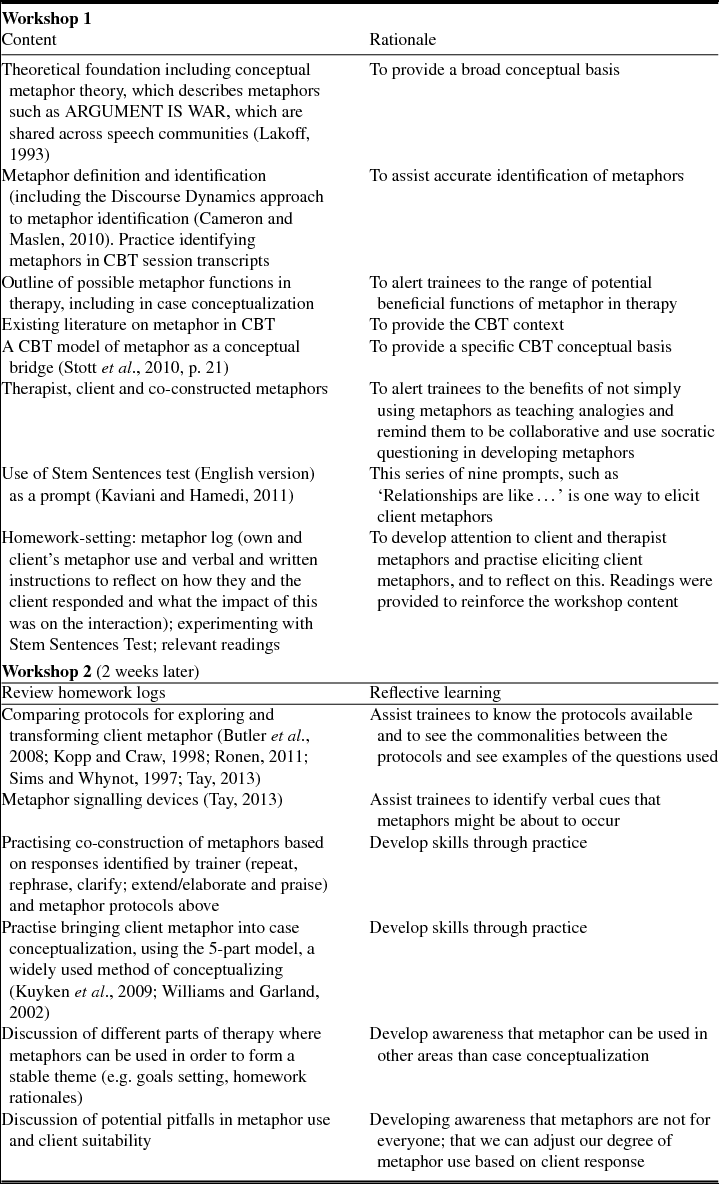
The workshop content is summarized in Table 1. Further details of the training are available from author F.M. on request.
Workshop content and rationale
Measurement
The therapists completed Likert scale ratings (0: not at all to 4: extremely) of their extent of intentional metaphor use, awareness of metaphors occurring, their view on the importance of metaphor in therapy, and their confidence regarding intentional use of metaphor in CBT and in developing shared metaphors in CBT conceptualization. These core ratings were made pre-training (T1), immediately after training (T2) and at 1 month (T3) and 3 months post-training (T4). The Likert scale measures were bespoke measures, developed specifically for this study.
Immediately post-training (T2), in addition to the core ratings, the therapists were asked to rate the training workshop itself (again using 0: not at all to 4: extremely Likert scale ratings) in terms of: the degree to which it stimulated interest; used appropriate teaching methods; provided relevant content; provided useful readings and handouts; balanced theoretical and applied learning; provided content at an appropriate level of difficulty; covered a manageable amount; was paced appropriately; provided enough practice; and the likelihood that they would recommend the workshop to a friend. In addition, they were asked to identify any barriers to implementing metaphor-enhanced CBT and how they would address these.
During the training, the therapists were encouraged to use the Stem Sentence Test (Kaviani and Hamedi, Reference Kaviani and Hamedi2011) with their clients. The Stem Sentences Test is a nine-item series of prompts, such as ‘My life is like. . .’ that can invite a metaphorical comparison. An English version of the test was provided by the authors of the test and did not require tailoring for this study.
At 1 month (T3) and 3 months (T4) post-training, in addition to the core ratings the therapists were asked to rate their application of training (using the same Likert scales), to what extent: their frequency of metaphor use had increased; clients had responded well to metaphor-enhanced conceptualizations; they had used the Stem Sentence Test as a prompt; they had used the metaphor protocols provided; they had spent more time elaborating on client-generated metaphors; they had intentionally used metaphors during engagement, goal setting, 5-part model (conceptualization), in rationales for thought records, during problem solving, in rationales for behavioural experiments and in relapse prevention. They were again asked to describe barriers to using metaphors and how future workshops could address these. The T2–T4 questionnaires also had a section for other comments regarding metaphor experiences.
The latter T3 and T4 questionnaires were administered via email. Copies of the questionnaires are available from the corresponding author.
Ethical approval
The therapists and role play ‘clients’ provided written informed consent.
Data analysis
We calculated the estimated marginal means on the five core ratings and used a repeated measures ANOVA comparing total scores on the five core ratings, across T1, T2, T3 and T4, to test the effect of time. Mauchly's assumption of sphericity was confirmed (p = .588, F = .5635 with 3 and 33 degrees of freedom).
We also used repeated measures ANOVAs and pairwise comparisons to test the effect of time for each of the specific core questions. We conducted Mauchly's test of sphericity for each of these and it was assumed for all items except the question: Do you intentionally use metaphors in therapy?
The application ratings were analysed using paired samples 2-tailed t-tests.
Results
Therapist ratings of workshop quality
Likert scale ratings by the therapists of the quality of the workshop itself suggested that it was well received with means (based on Likert scale ratings from 0: not at all to 4: extremely) as follows: stimulated my interest in using metaphors (3.4); used appropriate teaching methods (3.1); provided content relevant to my clinical work (3.2); provided useful additional readings and handouts (3.5); balanced theoretical and applied learning (2.8); provided content at an appropriate level of difficulty (3.1); covered a manageable amount of material (2.8); paced the content appropriately (3.2); provided enough opportunity to practise clinical skills (2.7) and likelihood of recommending the workshop to a colleague (3.1). Several additional written comments noted that therapists attending the workshop would have liked less theory and more role play practice, more workshop time, more written or video examples to observe and discussion of each other's use of metaphors in practice. Some therapists commented that role plays of a second therapy session were challenging, as they had not been able to do the usual engagement and information-gathering that would occur in a first session.
Core question results
The core questions rated the extent of intentional use; awareness of metaphors; importance of metaphor; confidence regarding intentional use of metaphor in CBT and in developing shared metaphors in CBT (rated at T1, T2, T3 and T4).
The overall ANOVA for the total scores on the five core question ratings was statistically significant (p < .005) with a small to medium effect size (based on Cohen's guidelines; Cohen, Reference Cohen1988, pp. 284–287)). Mauchly's assumption of sphericity was confirmed. Pairwise comparisons of the total scores on the core ratings indicated that ratings increased, with statistically significant differences between T1–T2, T1–T3 and T1–T4.
There was no significant difference between T2–T3, T2–T4 or T3–T4. This means we found a significant difference between pre-training and post-training mean of the overall total scores on the core questions, and pre-training and 3 months post-training means of overall total scores on the core questions. The assumption was made that this is multivariate normal, but we were unable to test this due to the small sample size. The results are shown in Fig. 1. The biggest increase was between T1 (pre-training) and T3 (1 month post-training), with a slight drop off at T4 (3 months post-training).
Mean total scores of core questions across T1 (pre-training), T2 (immediately post-training), T3 (1 month post-training) and T4 (3 months post-training).

Individual specific question results for the five core questions
For the specific question: Do you feel confident to respond intentionally to metaphors in your clinical work?, pairwise comparisons indicated statistically significant differences between T1 and T3 and T1 and T4, with a small to medium effect size for the overall ANOVA. This means confidence improved between baseline and 1 month and held up as significantly different at 3 months.
For the specific question: Are you aware of metaphoric language occurring in treatment sessions?, pairwise comparisons indicated significant differences between T1 and T3, with a small to medium effect size for the overall ANOVA. This means awareness increased significantly between pre-training and 1 month post-training. T1–T2 was trending as was T1–T4. The T4 mean was lower than the T2 mean, suggesting a drop-off in awareness, although this was not significant.
The overall ANOVAs for the other specific questions were not significant, although the effect size was large (d = .43) for the question: Do you think metaphors are important in therapy?
For the question: Do you feel confident to develop shared metaphors with clients?, we could not assume sphericity (p = .156), therefore pairwise comparisons were not appropriate.
The significant findings regarding increases in awareness and confidence followed a similar pattern to that shown in Fig. 1. The raw data are given in Table 2.
Data table showing core question totals and individual item results
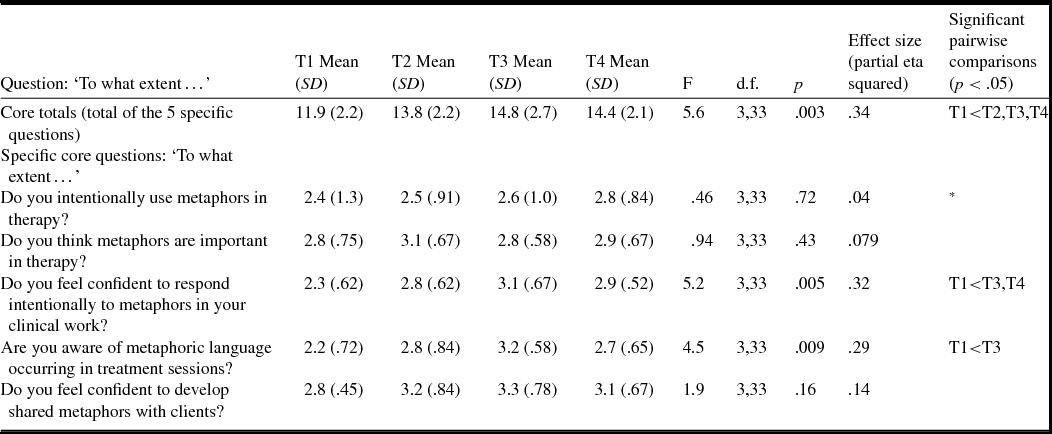
Effect size is partial eta squared. *Mauchly's test of sphericity was not accepted, therefore pairwise comparisons not appropriate.
Ongoing application of learning results (administered at T3 and T4)
Overall, 11/14 means for the application questions increased between T3 and T4. None decreased significantly. There was a significant increase (p < .005) between T3 and T4 in terms of the amount of reported time spent elaborating on client-generated metaphors. There was also a significant increase between T3 and T4 of reported use of metaphors (p < .05) during use of the 5-part model. There was also a small but statistically significant increase in use of the Stem Sentences Test (p < .05)(a method of prompting clients to generate metaphors; Kaviani and Hamedi, Reference Kaviani and Hamedi2011). There were no significant reported changes in the extent to which metaphors were intentionally used during: problem solving; goal-setting; in rationales for automatic thought records; rationales for behavioural experiments or in relapse prevention, nor were there significant changes in ratings of frequency of intentional metaphor use or use of metaphor protocols provided during training.
Identified barriers and solutions
Identified barriers to implementing metaphor enhanced CBT identified by therapists immediately post-training were: the cognitive capacity of the client; identifying metaphors in the first place; and the appropriateness for the client considering therapy goals. Several therapists did not respond to this question. At 1 and 3 months post-training, identified barriers were: limited opportunity due to the nature of work being done (assessment only role); lacking time to go through the workshop materials; not remembering to consciously attend to subtle metaphors; lack of client uptake of metaphorical work; the challenge of integrating new behaviour and clinician work overload/fatigue. One therapist noted that not having a handy set of questions to ask to assist elaboration of metaphor was a barrier to use.
Solutions identified by therapists included: keeping metaphors in mind and actively reflecting; knowing it is alright to pull back when clients do not respond positively to metaphor exploration and elaboration and sharing with others about their metaphor use.
Quotes from therapists
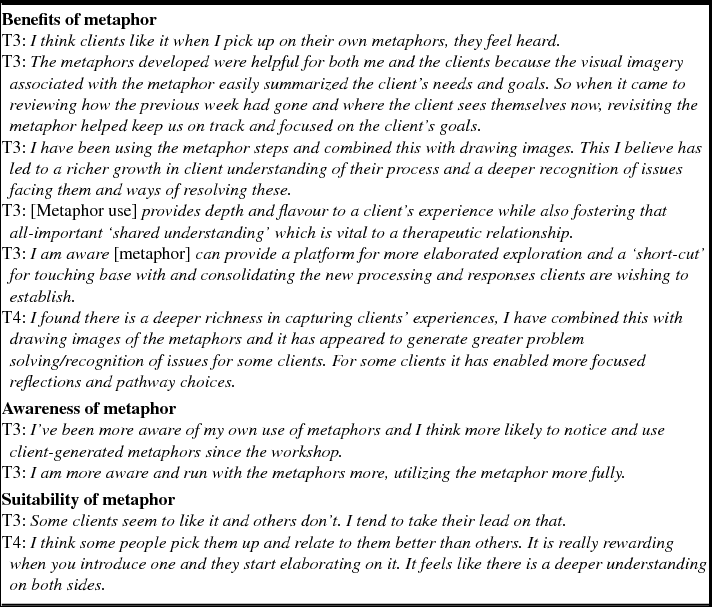
The quotes in Table 3 from therapist participants post-workshop provide some qualitative support for the increases in confidence reported and suggest that a degree of post-workshop reflection was occurring. (T2 indicates immediately post-workshop; T3 is 1 month post-workshop; T4 is 3 months post-workshop.) These have been grouped into themes of: benefits of metaphor, awareness of metaphor and suitability of metaphor.
Selected post-workshop comments by therapists on their experience of intentional metaphor use in therapy
Discussion
As far as we are aware, the present study is the first in the literature to describe a metaphor training programme for therapists and evaluate its effectiveness. Participants rated the quality of the workshop positively. They reported increased awareness of metaphors occurring in treatment sessions and increased confidence in responding intentionally to metaphors and bringing them into shared conceptualizations, as a result of training. The pattern of uptake of training alongside regular reflection (although not compared with a control group in this study) is consistent with the results reported by Bennett-Levy and Padesky (Reference Bennett-Levy and Padesky2014).
The improvement in the scores on awareness and confidence provide an indication that the training programme was useful, though it is possible that increases in confidence may have been due to the therapist workshop attendees being self-effacing in relation to their existing use of metaphors prior to the workshop. The lack of significant change in ratings of importance of metaphor may have been because the therapists were a self-selecting group, who are unlikely to have attended the training unless they already believed metaphor to be important in therapy.
In terms of the follow-up reports regarding application of workshop learning at 1 and 3 months, there were significant changes in terms of relatively structured application of training (use of the Stem Sentences Test, use of metaphors during conceptualizing with the 5-part model, and increase in time spent elaborating on client-generated metaphors). These were all specifically taught and practised at the workshop, whereas there was only brief mention of application at other stages of therapy such as relapse prevention. It is possible that generalization of learning to other stages in therapy will occur at a later stage.
This small-scale study found promising results regarding the impact of training experienced therapists in metaphor-enhanced CBT. However, more research is needed, using control groups, larger samples and potentially comparing experienced CBT therapists with less experienced therapists and looking at the impact of training over a longer period. Ideally, if evaluating training using video-recorded roleplays, or simply practising skills, the therapists would role play both sessions 1 and 2, rather than session 2 alone, as therapists fed back that they found this difficult, due to not having developed engagement and drawn out client metaphor in the first session. Less certainty and confidence regarding their understanding of the ‘client’ compared with how they would be feeling at session 2 in a usual clinical therapy interaction could affect their ability to demonstrate skill development.
In future studies, an expanded qualitative study is recommended to provide a richer and more rigorous examination of participants’ responses.
Limitations of this study were the small sample size (due to the limited number of experienced local psychologists with an interest in and availability to attend the training) and that there was no control group to assess to what extent the ongoing learning was as a result of the reflection process itself. The Likert scale ratings were a bespoke, un-validated measure developed for this study (due to the unavailability of existing validated measures), and self-report measures are prone to bias. However, small feasibility studies such as this study do provide necessary preliminary information to identify problems, fine-tune processes and provide some preliminary data to inform subsequent phases of the research including control group studies with larger samples (Tickle-Degnan, Reference Tickle-Degnan2013).
Retention and uptake of future skills-based training could be improved by offering supervised practice post-workshop or offering feedback on an ongoing self-monitoring/ reflective record of metaphor use. Future workshops would also be improved by allowing more time and increasing the number of audio or video therapy excerpts so therapists can further practise identifying metaphors and ways of responding to them. Having a handy metaphor protocol to guide exploration of identified client metaphors, may also prove useful for some therapists, particularly in the early stages of applying metaphor enhanced CBT. Further specific teaching and practice of metaphor at other stages of therapy than conceptualization may also be useful in aiding generalization.
CBT continues to evolve, with the development of so-called ‘third wave’ CBT related therapies over the past 20 years. Most recently, ‘process-based therapy’ has been proposed as a way forward, i.e. an evidence-based search for powerful and coherent change processes (Hayes and Hofmann, Reference Hayes and Hofmann2017). Further exploration of the effects of metaphor use in therapy fits well with this direction through trying to enhance outcomes by identifying and enhancing potent elements of therapy.
Conclusion
Based on therapist self-report, training in metaphor-enhanced CBT, supported by ongoing structured reflection on learning, appeared to have an ongoing impact for 3 months post-training, particularly in terms of increased awareness and confidence. It would seem that training workshops of this sort are one way that therapists can learn to keep metaphors in mind.
Main points
(1) Training therapists to intentionally attend and respond to metaphors and bring them into case conceptualization led to increases in awareness and confidence in metaphor use.
(2) Post-workshop reflection by means of a structured questionnaire is one way to assist ongoing uptake of learning.
Acknowledgements
We thank the therapists who participated in the workshops, also Associate Paul Merrick, advisor.
Ethical statement
The authors have abided by the Ethical Principles of Psychologists and Code of Conduct as set out by the APA. Ethical approval was granted by the University of Otago Ethics Committee, Category A 15/017.
Conflicts of interest
The authors have no conflicts of interest with respect to this publication.
Financial support
This work was supported by the Oakley Mental Health Research Foundation (F.M.), a University of Otago PhD scholarship (F.M.) and a University of Otago PhD Supervision Grant-in-aid of research (M.S.).
(1) Intentional use of metaphor may enhance CBT conceptualizations.
(2) Therapists can be trained to respond to metaphors intentionally during case conceptualization, leading to increases in ratings of awareness of metaphors and confidence in metaphor use.
(3) Post-workshop reflection on training is one way to assist application of workshop learning.




Comments
No Comments have been published for this article.