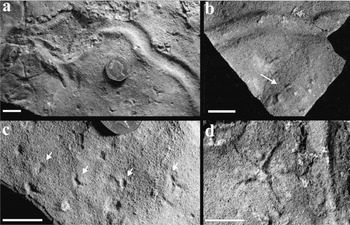
Williams et al. (Reference Williams, Smellie, Johnson and Blake2006) reported asterozoans preserved in Late Miocene volcanic tuffs of the James Ross Island Volcanic Group. The material, from the north-west of James Ross Island at 64°01.9′S 58°20.07′W, was sourced from the newly named Asterozoan Buttress locality, and represented reconnaissance collecting. The volcaniclastic sediments in which the fossils are found are fine- to medium-grained volcanic sandstones with planar, laterally continuous beds 0.5–8 cm thick containing decimetre-scale ripple cross-lamination. In the absence of part and counterpart rock slabs, Williams et al. (Reference Williams, Smellie, Johnson and Blake2006) hypothesised that the fossils represented the external moulds of starfish or brittlestars pinioned by rapid sedimentation of volcanic tuffs. They noted that these tuffs represented a potential untapped source of fossil material for interpreting Neogene marine shelf environments on the northern Antarctic Peninsula. New fossil material collected at Asterozoan Buttress in February 2007 (by Anna Nelson) includes part and counterpart rock slabs, and demonstrates that the asterozoans are resting traces of animals, referable to the ichnogenus Asteriacites, and not external moulds of entombed animals (Fig. 1a & d). We reinterpret the ‘detached’ arm and ‘current-entrainment’ specimens of Williams et al. (Reference Williams, Smellie, Johnson and Blake2006, fig. 5c & d) as representing a possible scull mark and movement of the asterozoan across the sediment surface respectively (see Bell Reference Bell2004, text-fig. 11 for comparison).
a. Sinuous locomotion track on bedding surface of British Antarctic Survey (BAS) rock slab D6.283.4a from Asterozoan Buttress, James Ross Island. To the bottom left of the rock slab is the resting trace of an asterozoan (Asteriacites), and below the fifty pence coin (2.5 cm diameter) are the paired marks shown in part c. b. BAS rock slab D6.283.4c, partial counterpart of track from part a, preserved in the succeeding ash fall tuffs (as a sole structure), and to bottom of image (arrowed), partial counterpart of paired marks shown in part c. c. Four sets of paired marks are visible as shallow cavities (arrowed) on sediment surface. d. BAS rock slab D6.283.4b, counterpart of Asteriacites trace in part a. Two thin sections through the rock slab (BAS D6.283.4a.1 and D6.283.4a.2) show no burrowing or bioturbation within the ash sediment below the trace fossil horizon. All scale bars are 2 cm.

The asterozoan resting traces form part of a group of three kinds of trace fossils in these shallow shelf deposits, all apparently occupying the ripple-bedded surface of a recently deposited tuff, and preserved by a subsequent ash fall (Fig. 1a–d). The two other types of trace fossil previously unreported from these rocks comprise crawling traces: a sinuous track with levees (Fig. 1a & b); and a track of four paired marks (Fig. 1c). These crawling traces, the absence of vertical burrows or grazing trails, and the shallow shelf setting of the tuff deposits suggest the trace fossil assemblage might identify the Cruziana ichnofacies (Frey & Seilacher Reference Frey and Seilacher1980), though we require more data to confirm this.
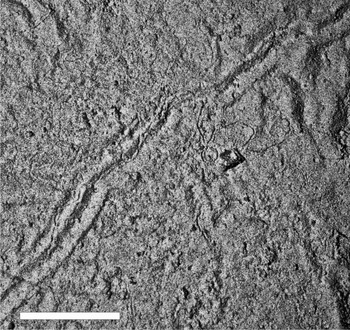
The sinuous crawling track is about 1.5 cm in width (2.5 cm including its levees), and 0.3 mm deep (Fig. 1a & b). It crosses some 28 cm of sediment surface, but appears to have extended much further. Similar tracks are typical of the locomotion traces left by gastropods ploughing over sediment surfaces (Jensen et al. Reference Jensen, Droser and Gehling2005). Tracks with this structure are also recorded in modern marine Antarctic environments, though in much deeper water (Fig. 2; Brandt et al. Reference Brandt, Gooday, Brandão, Brix, Brökeland, Cedhagen, Choudhury, Cornelius, Danis, De Mesel, Diaz, Gillan, Ebbe, Howe, Janussen, Kaiser, Linse, Malyutina, Pawlowski, Raupach and Vanreusel2007, supplementary fig. 1). The organism that made this track in the James Ross Island Volcanic Group is unknown.
Modern organism trace on the Antarctic seabed recorded during the RV Polarstern cruise ANDEEP III during 2005. The organism that formed the track is unknown. The pictures were taken at ANDEEP III station PS67-059-3 in 4522 m of water depth, at latitude 67°31.03′S, longitude 6°0.00′E, to the north of Dronning Maud Land (photo Lawrence W. Carpenter on behalf of Robert J. Diaz, College of William and Mary, Virginia Institute of Marine Science, VA 23062, USA). Scale bar is 10 cm.

The paired marks comprise small, shallow cavities 1.5 cm apart. There are four of these paired marks arranged closely together across the sediment surface, each pair spaced at about 2.5 cm, and sub-parallel to the sinuous crawling track (Fig. 1a & c). The paired marks form a track about 8 cm long. The track appears to be weakly sinuous and crosses at least one ripple-crest. Although the organism that made the trace fossil is unknown, the morphology of the track is reminiscent of those made by some amphibious arthropods (Walker Reference Walker1985, MacNaughton et al. Reference MacNaughton, Cole, Dalrymple, Braddy, Briggs and Lukie2002), though the specimen shows no central groove between the paired cavities.
Goldring et al. (Reference Goldring, Cadée, D'Alessandro, de Gibert, Jenkins, Pollard and McIlroy2004) identified latitude-controlled assemblages of marine trace fossils, providing examples from the Mesozoic to the Pleistocene. They characterized three climatically related associations: the tropical-subtropical association characterized by pellet-lined burrows, echinoid burrows and other traces; the temperate association with thalassinidean (crustacean) burrows; and the arctic cold water association with only annelid and mollusc trace fossils. The trace fossil assemblage from the James Ross Island Volcanic Group is difficult to characterize in these terms because of the paucity of information from the site, though the deposits adjoining the trace fossil horizon show no evidence of burrow systems. The fauna at Asterozoan Buttress may represent a transient marine assemblage that occupied the sea bed between successive inputs of volcanic ash. At present, it represents the only in situ fossil data for faunal activity on the sea bed of the northern Antarctic Peninsula during the Late Miocene.