Patients with cyanotic CHD often have aortopulmonary collaterals to compensate for decreased pulmonary blood flow. These collaterals require closure immediately before definitive intracardiac repair not only to create a bloodless field during cardiac surgery but also to ensure early and uneventful weaning off from cardiopulmonary bypass and ventilator support. At present, coil embolisation is widely used and is the most preferred technique. For collateral embolisation, adequate entry inside the collateral is mandatory. These collaterals have variable origin with variable angulations and tortuosity, requiring different catheters with different manipulative techniques for their selective hooking. Sometimes, selective hooking despite best efforts is not possible. We describe a case in which we used a new approach for percutaneous collateral embolisation in a difficult situation.
Case summary
A 14-year-old boy presented to us with complaints of central cyanosis since early infancy associated with squatting and dyspnoea. His clinical workup and echocardiography were consistent with the diagnosis of Tetralogy of Fallot. Cardiac computerised tomographic angiography confirmed the diagnosis and revealed the presence of multiple aortopulmonary collaterals. We planned for coil embolisation of the collaterals followed by intracardiac repair.
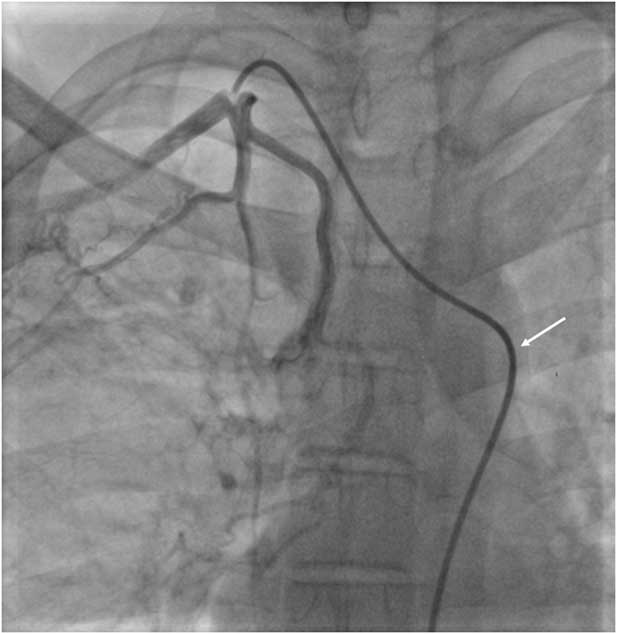
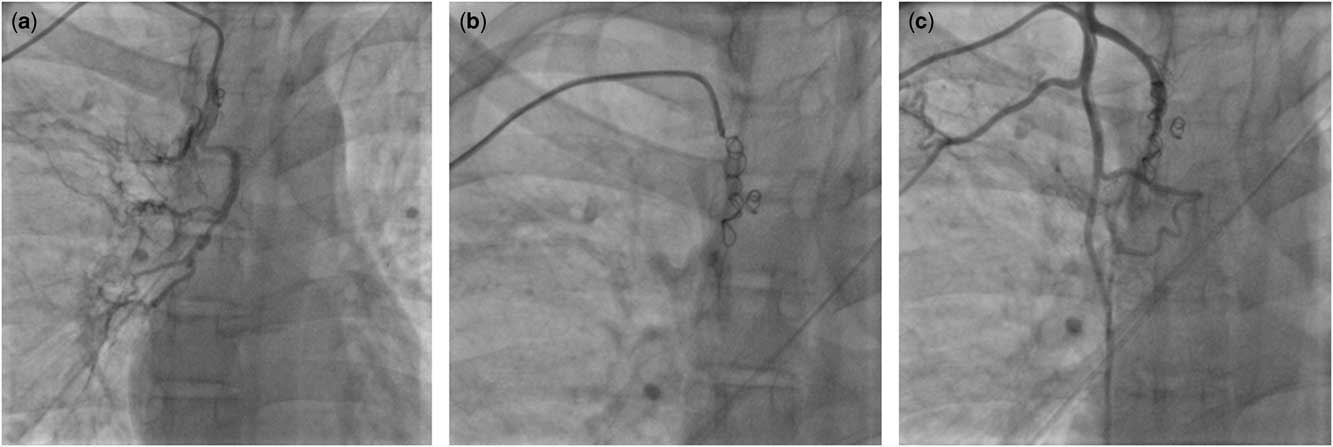
Aortogram and bilateral subclavian artery angiograms revealed the presence of one significant collateral from the descending thoracic aorta and another one from the right internal mammary artery. The collateral originating from the descending horacic aorta was successfully closed by a single, 3×3-mm Hilal platinum coil (Cook Medical Inc., Bloomington, United States of America) using a 5-F Multipurpose catheter (Medtronic Inc., Minneapolis, United States of America) through the right transfemoral approach. Subsequently, we attempted to close the other collateral originating from the right internal mammary artery. Several catheters including Judkin’s right, Multipurpose, Internal mammary artery catheter (Medtronic Inc.), Judkin’s left, and Tiger catheter were tried to cannulate the collateral, but because of the abnormal take-off angle they failed (Fig 1). All the used catheters made a hinge curve in the aorta (arrow in Fig 1), because of which catheter manipulation and selective cannulation of the collateral was not possible. We attempted entry with 0.32 and 0.25 polytetrafluoroethylene-coated Terumo wires (Terumo, Tokyo, Japan), but the catheters de-hooked because of poor support. Re-attempts were made to wire the collateral using a 0.018-inch, curved hydrophilic Terumo wire and percutaneous transluminal coronary angioplasty Whisper wire (Abbott, Illinois, United States of America) to enable sliding of the catheter over the wire into the collateral; however owing to poor catheter support (Supplementary video 1), the whole system failed. Following this, access was changed to the transradial approach, and a 5-F vascular sheath was inserted into the right radial artery. Optitorque TIG catheter, Tiger catheter (Terumo, Tokyo, Japan), was used to cannulate the collateral. To our surprise, the Tiger catheter directly entered deep inside the collateral without any extra effort and manipulation. The collateral was successful closed using two 5×5-mm Hilal platinum coils (Fig 2). Subsequently, the patient underwent successful, uneventful intracardiac repair.
Right subclavian artery angiogram showing an attempt to selectively cannulate the collateral arising from the proximal internal mammary artery using internal mammary artery catheter via the transfemoral route. Note that the catheter made a hinge curve in the aorta (arrow), because of which catheter manipulation and selective cannulation of the collateral failed using different types of catheters through the transfemoral route.

Selective cannulation of the collateral using Tiger catheter via the transradial approach. ( a ) Easy, super-selective, and deep cannulation of the collateral. The tiger catheter directly entered deep inside the collateral without any extra effort and manipulation because of the perfect configuration of the primary and the secondary curves of the catheter with the collateral origin and its take-off. ( b ) Deployment of two coils into the collateral, ( c ) After coil embolisation, cessation of collateral blood flow with the coils in situ.

Discussion
This case demonstrates that the transradial approach is a useful alternative to the transfemoral approach for coil embolisation of collaterals in difficult situations. Appropriate selection of catheters keeping in mind the shape and angle of origin of the collateral is key for successful collateral cannulation. This is probably the first reported case where a transradial approach was used for coil embolisation of a collateral.
In our case, the abnormal origin of the collateral and its abrupt take-off angle prevented stable cannulation via the transfemoral approach. In contrast, the transradial approach facilitates easy cannulation of a collateral and its embolisation because of perfect configuration of primary and secondary curves of the Tiger catheter with the collateral origin and its take-off. Our case demonstrates that the transradial approach should be preferred for coil embolisation of all the collaterals originating from subclavian arteries whenever possible. The major limitation of this technique, however, is that it cannot be utilised in neonates, infants, and young children where transradial catheterisation is not possible.
Sometimes, a few other tricks might be useful, although they have not been tried in this particular case; one can use a Pigtail catheter (Medtronic Inc., Minneapolis, United States of America) after partially cutting its tip to selectively engage the target vessel by its favourably curved distal end, similar to hooking high-origin patent ductus arteriosus in cases of Tetralogy of Fallot with pulmonary atresia. Another possible solution is to introduce an exchange length, 0.014″, coronary angioplasty guide wire selectively into the collateral through the diagnostic catheter; it is feasible even if there is non-selective engagement of the internal mammary artery. Next, exchange this diagnostic catheter with a 2.4-F Microcatheter (Finecross; Terumo, Tokyo, Japan) over the angioplasty wire. The angioplasty wire is then removed, and subsequently the collateral can be embolised using 0.018″ Hilal coils through the Microcatheter. In Infants and young children, if all efforts through the femoral route fail, one may use axillary artery/brachial artery to selectively engage difficult collaterals arising from the subclavian artery or its branches.
With expanded understanding and improved techniques and technology, use of the transradial approach is extending to structural interventions and peripheral vascular and endovascular interventions.Reference Sanghvi, Kovach and Patel 1 In our case, a transradial approach was advantageous in the same way as it has been for performing internal mammary artery interventions.Reference Patel, Shah and Patel 2 Previously, a perimembranous ventricular septal defect had been closed using the transradial approach with relatively easier crossing of the defect.Reference Sanghvi, Selvaraj and Luft 3 The transaxillary/transbrachial artery approach can also be considered for neonatal ductal stenting of patients with duct-dependent circulation.
This case also highlights the versatility of the Tiger catheter. Tiger catheters are popularly used during transradial coronary angiograms for hooking both the right and the left coronary arteries. This catheter has one end hole and one side hole and is uniquely designed for coaxial engagement of the ostium. In addition, this catheter can take different shapes by push, pull, torque, and rotation. We found this catheter to be useful in “hooking” vertically oriented collaterals originating from the subclavian artery. Its shape and easy manoeuverability make it an ideal catheter for such purposes.
Conclusion
The transradial approach should be preferred for coil embolisation of all collaterals originating from subclavian arteries whenever possible. Appropriate selection of the catheter keeping in mind the shape and angle of origin of the collateral is key for successful collateral cannulation.
Acknowledgements
None.
Financial Support
This research received no specific grant from any funding agency or from commercial or not-for-profit sectors.
Conflicts of Interest
None.
Ethical Standards
The authors assert that all procedures contributing to this study comply with the ethical standards of the relevant national guidelines on human experimentation and with the Helsinki Declaration of 1975, as revised in 2008, and has been approved by the institutional committees.
Supplementary material
To view the supplementary material for this article, please visit http://dx.doi.org/10.1017/S1047951117000713