Atrial septal defect (ASD) is one of the most common CHD. It occurs not only in isolation but also in the presence of other heart defects.Reference Greenway, McLeod and Hume 1 The aetiology of atrial septal defects remains unknown. Some researches in patients with sporadic atrial septal defects have identified pathogenic mutations in several susceptibility genes, for example, GATA4, Nkx2.5, GATA6, and TLL1.Reference Garg, Kathiriya and Barnes 2 – Reference Schott, Benson and Basson 5
Cx43 is one of the most prevalent connexin proteins in the mammalian heart.Reference Salameh, Blanke and Daehnert 6 It has been proved to be important for normal murine heart development.Reference Ewart, Cohen and Meyer 7 – Reference Huang, Wessels, Smith, Linask, Ewart and Lo 9 Researchers established a Cx43 knockout mice, and the fetal mice died at birth because of severe heart malformations.Reference Ewart, Cohen and Meyer 7 , Reference Huang, Wessels, Smith, Linask, Ewart and Lo 9 A functional gap junction channel containing six connexin subunits, the subunits, can form a hemi-channel in the plasma membrane of a cell.Reference Salameh, Blanke and Daehnert 6 Two hemi-channels from nearby cells dock to form an entire channel, which allows for the passage of molecules and ions between the cytoplasm of the two cells.Reference Paznekas, Boyadjiev and Shapiro 10 Gap junctions also have a vital role in the synchronised contraction of the heart and in embryonic development.Reference Schulz, Gorge, Gorbe, Ferdinandy, Lampe and Leybaert 11 Cx43 is mainly expressed in atrial and ventricular myocytes and less expressed in the conduction system such as Purkinje fibres.Reference Severs, Bruce, Dupont and Rothery 12
Although studies showed that Cx43 missense mutations in the coding region was associated with severe heart malformations such as visceroatrial heterotaxia, hypoplastic left heart syndrome, atrioventricular septal defect,Reference Dasgupta, Martinez, Zuppan, Shah, Bailey and Fletcher 13 , Reference Britz-Cunningham, Shah, Zuppan and Fletcher 14 the relationship between genetic variant in non-coding region of Cx43 and atrial septal defect was unclear.
In order to solve this question, we explored whether genetic variants in Cx43 promoter region correlated patients with atrial septal defects.
Materials and methods
Patient characteristics collection
Patients with atrial septal defects were recruited from the Children’s Hospital of Fudan University, Shanghai, China from June, 2013 to March, 2016. Human samples were collected from consenting individuals. The research programme was approved by the Shanghai Medical College of Fudan University. Protocols used in this work were reviewed and approved by the Ethics Committee of Children’s Hospital of Fudan University, Shanghai Medical College of Fudan University before the commencement of the study. All parents or guardians of the recruited children signed a written consent.
Deoxyribonucleic acid sequencing
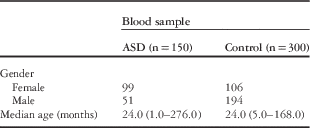
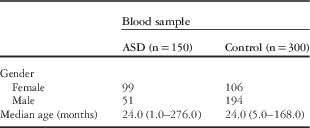
Genomic deoxyribonucleic acid from 150 patients with atrial septal defects (with median age 24.0 months) and 300 healthy controls (with median age 24.0 months) was extracted from peripheral blood leucocytes using the QIAamp DNA Blood Mini Kit (QIAGEN, Germantown, Maryland, United States of America). The base information of the patients is listed in Table 1. The promoter region ranging from −1000 bp to transcriptional start site of Cx43 was amplified with primers in all patients and controls (Table 2). The programme of polymerase chain reaction cycles have been described previously.Reference Wu, Ma and Wang 15 The polymerase chain reaction products were sequenced by Shanghai Invitrogen Co. Ltd (Shanghai, China). The sequence results were analysed using Mutation Surveyor demo software (SoftGenetics, Nittany Valley, Pennsylvania, United States of America). All variants found by sequencing were filtered from the National Center for Biotechnology Information human single nucleotide polymorphism database and the 1000 Genome Project database. 16
Basic characteristic of the atrial septal defect (ASD) patients and controls.
Primer pairs of the Cx43 for sequence

Statistical analysis
Data were analysed using Statistic Package for Social Science (version 19.0; IBM, Armonk, New York, United States of America) and GraphPad Prism (version 5.0; GraphPad Software, La Jolla, California, United States of America). Genotype and allele frequencies were assessed by the χ2 test. Hardy–Weinberg equilibrium was assessed by the χ2 test on the website for Hardy–Weinberg disequilibrium test (http://ihg.gsf.de/cgi-bin/hw/hwa1.pl). All statistical analyses were two-sided, and p<0.05 was considered statistically significant.
Results
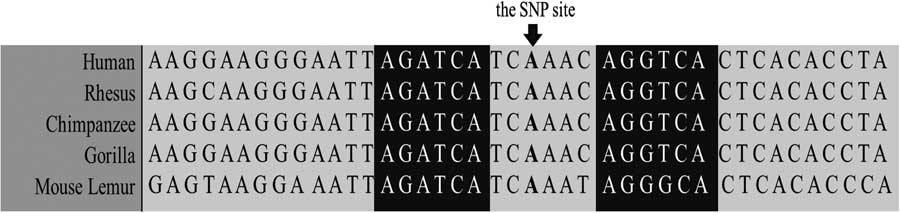
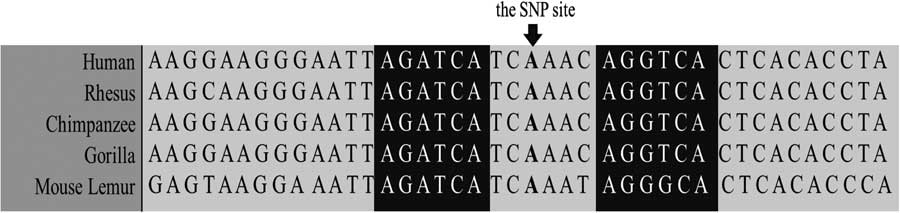
In the present study, 150 patients with atrial septal defects and 300 healthy controls were recruited. In the control group, distribution of genotype for rs2071166 was in line with Hardy–Weinberg equilibrium (p=0.204). A total of 1000 base pairs of Cx43 promoter region from transcriptional start site were sequenced after polymerase chain reaction. In this region, no mutation was detected in any of the participants. According to our research data, single nucleotide polymorphism rs2071166 located at −416 base pair from the transcriptional start site of Cx43 with minor allele frequency>0.05 in Chinese Han Beijing population. The association of both single nucleotide polymorphism genotypes and allelotypes with the risk for atrial septal defect was analysed. And the single nucleotide polymorphism rs2071166 located within a functional retinoic acid response element (Fig 1, repeating element with black background). 17 , Reference Gu, Xu and Lin 18
Retinoic acid response element sequence of Cx43. The alignments showed the retinoic acid response element sequence of Cx43 was conserved among primates (repeating element with black background). The SNP site was marked by bold-type letter.
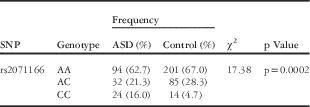
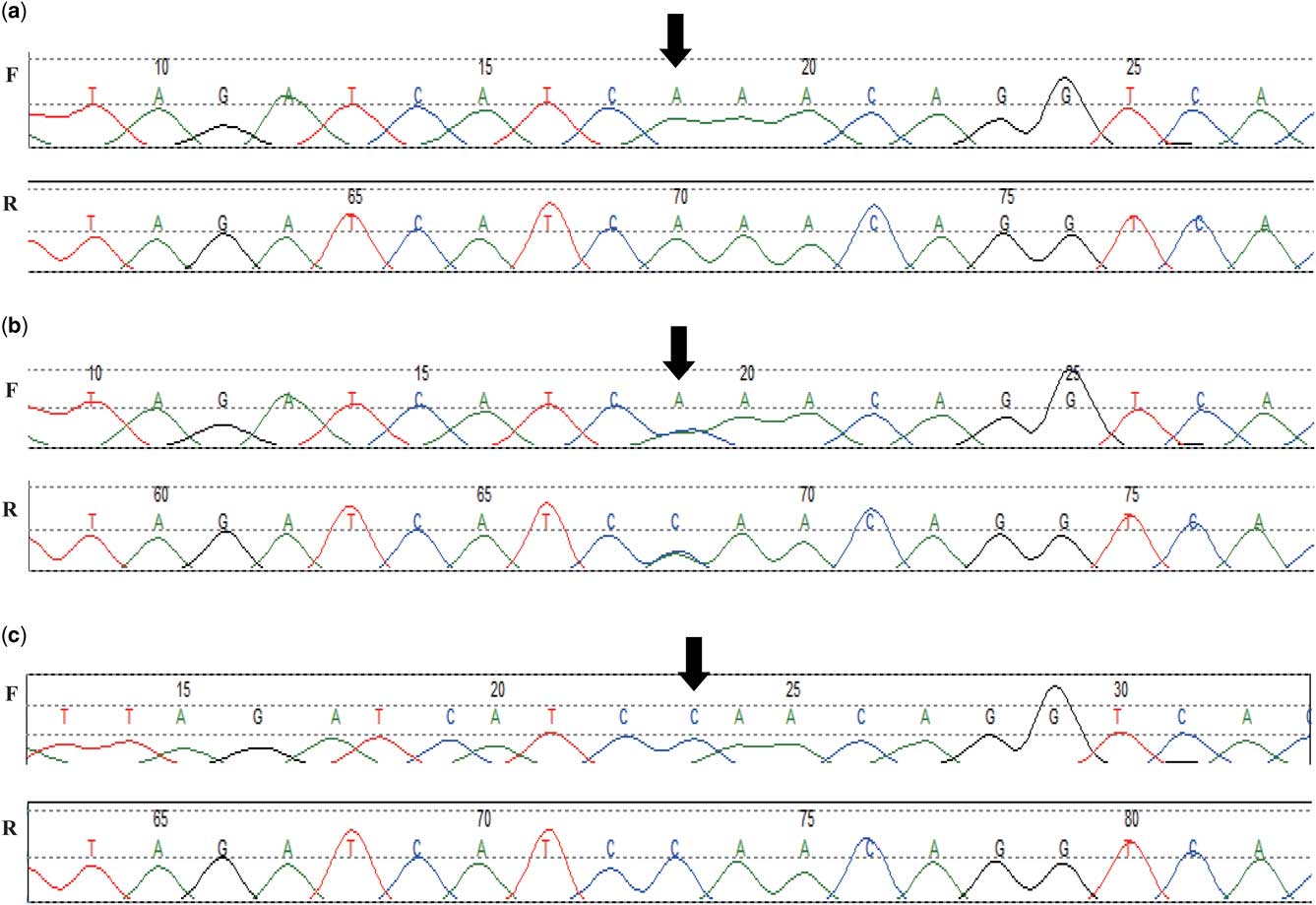
We identified two alleles (A and C) and three genotypes (AA, AC, and CC) at rs2071166 in both groups (Fig 2, Table 3). The frequency of Cx43 rs2071166 genotypes were 62.7% (AA), 21.3% (AC), 16% (CC) in patients with atrial septal defects and 67.0% (AA), 28.3% (AC), 4.7% (CC) in healthy controls (Table 3). The frequency distribution of three genotypes had significant difference between atrial septal defect cases and healthy controls (p=0.0002, Table 3). The logistic regression analysis revealed that CC genotype was correlated with atrial septal defect (p<0.0001, odds ratio=3.891, 95% CI 1.948–7.772, Table 4). As shown in Table 5, the minor allele C of rs207116 showed a significantly higher frequency in the patients with atrial septal defects than in the control group (p=0.007), and the logistic regression analysis revealed that C allele was correlated with atrial septal defect (p=0.007, odds ratio=1.567, 95% CI 1.129–2.175).
Sequence diagram of rs2071166 site with different genotype. Arrows indicated the single nucleotide polymorphism site. Genotype: ( a ) AA; ( b ) AC; ( c ) CC. Green, black, red, and blue, respectively, represented A allele, G allele, T allele, and C allele.
Association between genotypes of rs2071166.
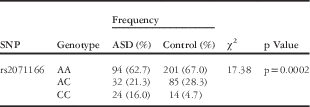
ASD=atrial septal defect
Association between genotypes of rs2071166 and the risk of atrial septal defect (ASD).

Association between allelotypes of rs2071166 and the risk of atrial septal defect (ASD).

Discussion
The reported Cx43 mutations include missense, nonsense, insertion, and deletion mutations.Reference Paznekas, Boyadjiev and Shapiro 10 , Reference Huang, Xie and Linask 19 , Reference Paznekas, Karczeski and Vermeer 20 Mutations in the coding region can affect the protein function or inhibit its expression; most of the relative researches focus on this genetic region. Mutations in Cx43 coding region have been proved in patients with oculodentodigital dysplasia.Reference Paznekas, Boyadjiev and Shapiro 10 In that study, cardiac abnormalities were rare; only one patient with Gly21Arg mutation was associated with atrioseptal defects.Reference Paznekas, Boyadjiev and Shapiro 10 Our previous study found no amino acid altering mutation or deoxyribonucleic acid variants in Cx43 gene in 300 patients with CHD.Reference Huang, Xie and Linask 19 We also generated knock-in mouse models with point mutations at serine residues in our previous study; however, both heterozygous and homozygous knock-in mice did not show overt CHD.Reference Huang, Xie and Linask 19 Although patients with hypoplastic left heart syndrome, visceroatrial heterotaxia, or double outlet right ventricle were found to exhibit point mutations in Cx43 at protein residues,Reference Dasgupta, Martinez, Zuppan, Shah, Bailey and Fletcher 13 , Reference Britz-Cunningham, Shah, Zuppan and Fletcher 14 , Reference Chen, Xie, Huang, Zhao and Chang 21 the clinical findings were not replicated in subsequent studies.Reference De Luca, Sarkozy and Consoli 22 – Reference Debrus, Tuffery and Matsuoka 24 Therefore, the contribution of Cx43 mutations at the coding region in human CHD remains open to debate.
Recently, investigators thought that the non-coding regions containing 5′-untranslated regions (UTR), 3′-untranslated regions, promoter region, and enhancer region also play an important role in the occurrence of CHD.Reference Cao, Wang and Wei 25 The mutations or genetic variants in these regions can reduce the protein physiological levels of the gene by lowering the protein transcription efficiency, impacting ribonucleic acid splicing, disrupting the combination of transcription factors with cofactors, or changing the methylation status of deoxyribonucleic acid.Reference Huang 26
In recent studies, single nucleotide polymorphisms were identified to influence the development of CHD, such as polymorphisms in gene MTHFR, eNOS, VEGF, SERPINE1, and other related genes.Reference Muntean, Toganel and Benedek 27 – Reference Loukanov, Hoss and Tonchev 31 They were associated with pulmonary valve stenosis, hypoplastic left heart syndrome, coarctation of the aorta, aortic valve stenosis, tetralogy of Fallot, and ventricular septal defect.Reference Rossaak, Van Rij, Jones and Harris 30 , Reference Lambrechts, Devriendt and Driscoll 32 – Reference Wang, Hou, Wang, Wei, Li and Jiang 34 As a result, researchers thought that single nucleotide polymorphisms might have an effect on cardiac phenotype, but they could not explain consistently the phenotypic diversity in different disease.Reference Muntean, Toganel and Benedek 27
This is the first time we detected a genetic variant in the non-coding region of Cx43 among human patients with sporadic atrial septal defect. We identified the rs2071166 was significantly associated with the risk for atrial septal defects. According to our results, C allele of this single nucleotide polymorphism was a risk factor for causing atrial septal defect. We exploring the genotype further, data showed patients with the CC genotype of atrial septal defect were at a higher frequency than those with AA/AC genotype.
Genome-wide association studies demonstrated that a large number of non-coding variants might contribute to an increase in the risk for various common diseases, often by disrupting cis-regulatory elements that control the expression of nearby genes.Reference Harismendy, Notani and Song 35 – Reference Lubbe, Pittman and Olver 37 Cx43 was dosage-sensitive during embryonic development. Less or too much expression of Cx43 would lead to heart development abnormalities.Reference Ewart, Cohen and Meyer 7 – Reference Huang, Wessels, Smith, Linask, Ewart and Lo 9 , Reference Kolcz, Drukala, Bzowska, Rajwa, Korohoda and Malec 38 The rs2071166 is located within a functional retinoic acid response element.Reference Gu, Xu and Lin 18 The retinoic acid response element was critical in retinoic acid regulating Cx43 transcription activity and expression level.Reference Gu, Xu and Lin 18 Thus, we speculated that this single nucleotide polymorphism might change the efficiency of Cx43 transcription through damaging the function of the retinoic acid response element in Cx43. To further investigate our hypothesis, more molecular biology experiments such as luciferase transfection assay, electrophoretic mobility shift assay (EMSA), and transgenic knock-in animal models should be carried out to figure out the mechanism in CC genotype at rs2071166 affecting the retinoic acid response element in Cx43 and analyse the phenotype of the embryo heart.
In conclusion, Cx43 genetic polymorphisms rs2071166 may be relevant with an increased atrial septal defect risk.
Acknowledgements
The authors are grateful to all patients for their contribution to the work.
Authors’ Contribution
Conception and study design: G.H., X.M., and R.G. Data analysis: R.G. Drafting: R.G. and W.S. Final approval: R.G., W.S., X.M., and G.H.
Financial Support
This work was granted by the Natural Science Foundation of China (81670279, 81370198) and the National Key Research and Development Program of China (2016YFC1000500).
Conflicts of Interest
The authors declare that they have no competing conflicts and interests.
Ethical Standards
The research program was permitted by the Shanghai Medical College of Fudan University. Protocols used in this work were reviewed and approved by the Ethics Committee of Children’s Hospital of Fudan University, Shanghai Medical College of Fudan University prior to the commencement of the study. Patient informed consent from the parents or guardians of the children was obtained.