


I
Since the mid 1800s there have been dramatic changes in the number, location and structure of financial exchanges in the United States. On one hand, some periods exhibit many new exchanges such as the early 1900 mining exchanges in the western United States and more recently alternative trading systems (ATS). On the other hand, other periods exhibit consolidation of exchanges as seen with merger activity after the emergence of the US Securities and Exchange Commission (SEC) in the early 1930s. The goal of this article is to better understand the historical patterns and commonalities in exchange dynamics in the United States. To achieve this goal, we first construct a list of 327 US exchanges and when they operated between 1855 and 2012 and describe their evolution. Second, we document factors associated with entry of new exchanges and with consolidation of existing exchanges. Our hope is that this knowledge will provide historical perspective and context which, in turn, might aid interpretation of future developments in global financial markets.
Interestingly, the existence of expansionary periods runs counter to predictions within classic industrial organization that economies of scale will, in the long run, force exchanges to consolidate through exit/merger; specifically, exchanges that attract more trading volume will lower their average costs and generate more liquid markets relative to their competitors. Indeed, the recent acceleration of exchange mergers provides some support for theories of consolidation in the industry. However, the literature on market fragmentation offers no ex-ante reason to believe that the number of exchanges will decline monotonically over time. Given the mixed empirical evidence and contradictory motives faced by financial exchanges, their desire to expand into new markets on one hand and their quest for efficiency and economies of scale on the other, it is natural to question how exchanges have responded to these forces in the past.
In this article, we investigate the historical exchange industry by analyzing the economic forces driving exchange existence, entry and exit for a novel sample of 327 financial exchanges within the United States from 1855 to 2012. The basis/foundation for our statistical analysis is the extensive hand-collected dataset that we constructed utilizing numerous sources including, but not limited to, work by financial historians, business news outlets, government reports, the annual Moody's Manual and current websites to identify exchanges existence, entry and exit.Footnote 1
Our investigation begins by first documenting the evolutionary pattern of the number of exchanges as well as entry and exit events. Next, we test the dual hypotheses, that after controlling for the relevant exogenous factors, (1) exchange entry is concentrated in periods of economic growth, broadening capital investment and heightened uncertainty, and (2) exchange exit occurs during periods of increased regulation and emerging communications technology. To test these hypotheses, we execute a linear time series regression to explain the number of exchanges, exchange entry and exchange exit.
Our results show that the historical record is not consistent with convergence to a single financial exchange, or steady growth in the number of exchanges over time. Consistent with our hypothesis, we find that entry is positively associated with growth measures and negatively associated with regulation, while exit is associated with advance in regulation and communication technology. We find that US exchanges are more likely to exit after the passage of the Securities Exchange Act, but a 1 percent increase in the growth of telephone lines leads to a 0.171 percent reduction in the likelihood of exit. In summary, we find that economic growth, regulation and communication are robustly related to financial exchange dynamics.
The remainder of the article is organized as follows. Section II discusses the related literature. Section III develops our hypotheses for exchange entry and exit. Section IV details our historical exchange data. Section V provides model results and Section VI concludes.
II
Our work relates to two strands in prior literature. The first strand focuses on liquidity provision in capital markets. Research in this area predicts consolidation within the market to provide liquidity. For example, technology places an emphasis on cost minimization, which forces financial exchanges to consolidate through exit/merger to exploit economies of scale (Pirrong Reference Pirrong1999; Macey and Hara Reference Macey and O'Hara1999; Reference Macey and O'Hara2000; Hasan and Malkamaki Reference Hasan and Malkamaki2001). Exchanges that can attract incremental order flow will lower their costs at the margin, thus reducing trading costs for market participants and in turn further attracting even more order flow. According to these arguments, fragmentation of order flow among competing exchanges should be a temporary phenomenon associated with newly developed financial markets or emerging economies. Other research in this area argues for market fragmentation due to entry by low-cost startup exchanges (Clayton et al. Reference Clayton, Jorgensen and Kavajecz2006; Stoll Reference Stoll2008; Weber et al. Reference Weber, Davis and Lounsbury2009). Therefore, on balance, the existing literature contains conflicting theoretical predictions about how the number of exchanges should change over time, thus leaving the answer to this question as an empirical issue.
The second strand that is quite naturally related to this work is the literature on the history of financial exchanges in the United States. Closely related prior research to our analysis investigates the number of regional stock exchanges prior to the Securities Exchange Act of 1934 (Cole Reference Cole1944); the number of US regional exchanges under the Securities Exchange Act (Angel Reference Angel1998); the distribution of trading volume surrounding exit events and mergers among nine US regional exchanges from the 1930s through the 1990s (Arnold et al. Reference Arnold, Hersch, Mulherin and Netter1999); the extent of market integration from 1865 to 1885 for major stock exchanges of the United States (Chabot Reference Chabot1999); and the equity premium in the context of international equity markets from 1920 to 1996 (Jorion and Goetzmann Reference Jorion and Goetzmann1999).Footnote 2 O'Sullivan (Reference O'Sullivan2007) analyzes number of stocks traded and trading volume on exchanges in ten metropolitan US areas from 1885 to 1930. Regarding regional exchanges, she finds that East Coast exchanges outside New York declined in importance prior to World War I, while regional exchanges grew rapidly outside the East Coast after World War I. We contribute by identifying a larger number of US exchanges, including exchanges outside the larger cities. White (Reference White2013) also investigates the theoretical prediction that improved information technology leads to concentration of orders on one exchange with lower transaction costs from 1900 to 1933, but finds that technological changes significantly increased the number of new issues. Finally, other studies do in-depth analysis of individual stock exchanges. For example, the Geneva stock exchange responded to increased competition from other cantons in Switzerland between the world wars (Oosterlinck and Pirotte Reference Oosterlinck and Pirotte2018). La Porta et al. (Reference Laporta, Lopez-De-Silanes and Shleifer2008) promote the importance of protection of investors’ rights for market development, in particular the rights of minority shareholders. However, their view is challenged because US securities regulation in 1933 and 1934 did not appear to improve stock market development (Cheffins et al. Reference Cheffins, Bank and Wells2013).
Compared to this literature, our work yields two important insights. First, the existing literature does not explicitly address the economic factors associated with exchange entry and exit, and therefore the dynamics of the market for exchange services. Second, we find substantially more local and regional exchanges through our data collection process than previously documented, suggesting that our analysis is more comprehensive than the prior literature.Footnote 3
III
The life cycle of a financial exchange, from entry to exit, is a dynamic process which is potentially influenced by many factors; thus, we develop hypotheses regarding specific factors that affect growth in the number of exchanges as well as exchange entry and exit events. Specifically, we investigate (1) macroeconomic fluctuations and the need for efficient capital allocation, (2) periods of resource exploration and discovery associated with heightened uncertainty, (3) advances in communications technology and (4) shifts in regulatory regimes. We discuss each in turn.
Economic growth and financial market development have been shown to be positively correlated (Greenwood and Jovanovic Reference Greenwood and Jovanovic1990; Levine Reference Levine1991; King and Levine Reference King and Levine1993). Financial exchanges facilitate the flow of capital into high-growth sectors by redirecting funds from other less productive sectors of the economy. We conjecture that economic expansion is associated with increased entry as firms demand more capital for their operations, which in turn increases the demand for trading services; the reverse applies for exit. Within our framework, economic expansions are associated with entry, while recessions are associated with exit. Controlling for other factors, we should observe a positive correlation between output fluctuations and exchange entry in the data.
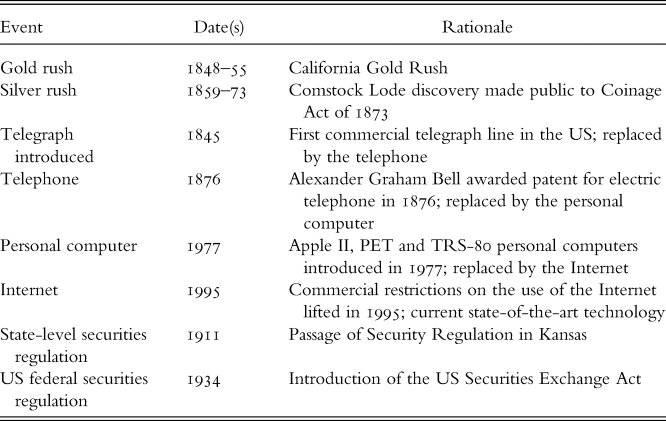
We argue that financial exchanges provide more than transaction services; specifically, they supply implicit certification of actively traded securities. The reputation of an exchange provides the basis for market participants to trust the information, trades and counterparties they deal with on the exchange, a similar concept to reputation effects (Edelen and Gervais Reference Edelen and Gervais2003). While existing exchanges would always like to trade more securities to exploit economies of scale in trading volume, an exchange may refrain from doing so, absent further information about the security, because the cost of trading a fraudulent security is primarily borne by all other securities traded on the exchange. In this case, the benefit of additional trading volume is more than offset by the potential long-run reputational cost of fraud. When existing financial exchanges choose not to trade new securities, an opportunity arises for entrant exchanges. An entrant can step in to provide liquidity and transaction services for market participants willing to trade the new risky securities. By facilitating trade in the new securities, an entrant can over time identify viable securities for incumbent exchanges to trade without the older exchanges having to risk paying a reputational cost due to fraud. We argue that the role of entrant exchanges is particularly critical during periods of extreme uncertainty that often accompany dramatic changes in the set of investment opportunities. Relevant historical examples include periods such as the California Gold Rush (1848–55), Comstock Lode (1859–73) and the US Internet boom (1995–2000). Therefore, we conjecture that exchange entry is likely to increase during periods characterized by heightened uncertainty in the valuation of firms/assets, with the opposite true for exit.
One of the fundamental tasks of any financial exchange is to match the trading interests of buyers and sellers. Operationally, this involves both the buyer and seller communicating their trading intent to the exchange and the exchange matching the purchase and sell orders. Thus, the ease with which market participants and the exchange can communicate, both in terms of time and cost, is likely to impact the productivity and overall efficiency of an exchange's trading operations. Indeed, before the development of mass near-instant communication, new exchanges were typically located at or near the site of the risky asset being priced to minimize both transportation and communication costs. A common example is an entrant exchange located adjacent to a newly discovered mine that trades claims to the uncertain amount of gold embedded in a discovered vein. The emergence of new, more efficient and cost-effective communications technologies induces competing effects for exchanges. For large incumbent exchanges with lower variable costs, new communications technologies allow trade to occur from more remote locations, allowing for an increase in market share, eventually driving out small local competitors. As an example, many small local exchanges experienced liquidity drains as trades were redirected over novel communications methods to larger regional exchanges. However, improvements in communications technology also lower entry costs for startup exchanges, which would encourage entry and increase the total number of exchanges. Taken together it is unclear what effect advances in communications technology will have on both entry and exit; again, leaving the question to empirics.
Not surprisingly, the regulatory environment is another factor to consider when discussing the dynamics of financial exchanges. At first glance, the direction of the net effect is indeterminable. On one hand, regulation may ultimately increase the viability of exchanges that can comply with the increased regulatory burden by creating a stable supportive environment for them to operate. On the other hand, regulation may inhibit market entry by startups and force some exchanges to close or merge if they cannot shoulder the increased compliance burden. For example, after the implementation of the Securities Exchange Act of 1934, which gave jurisdiction of exchange oversight to the US Securities and Exchange Commission (SEC), many exchanges voluntarily closed rather than submit to a review by the newly formed regulator. We hypothesize that regulatory oversight is associated with a decrease in entry, with an ambiguous effect on exit.
In summary, we believe that macroeconomic fluctuations, periods of heightened uncertainty, communication advances and enhanced regulation represent the primary factors that affect exchange dynamics. However, it is important to also recognize that major military conflicts such as World War II halted exchange entry and led to temporary suspensions of trading and exit. During such conflicts, centralized war planning led to a reduced need for private capital reallocation within an economy, thus demand for the associated trading services provided by exchanges abates. In the empirical work, we account for this by adding war dummies as control variables within our analysis.
IV
We define a financial exchange as any formal organization whose objective is to facilitate trade and economic activity through the pricing and trading of uncertain, inherently risky claims. While this definition allows for a broad characterization of exchanges, formally we only include exchanges that traded corporate or government financial securities. From a research perspective all we know about the life cycle of a financial exchange is the timing and duration of its operation.Footnote 4 Consider a hypothetical exchange that enters the market then operates for some period. This exchange can leave the dataset in three ways: it can exit, go missing or survive to the end of the sample (2012). In exit, the exchange is explicitly noted as going out of business and ceasing operations or merging with another exchange. Going missing is more ambiguous: in this case, we note the last recorded mention of the exchange in any of our sources for those cases where the exchange does not have an exit date. Thus, an exchange can only go missing if its exit was not directly observed. Survival to the end of the sample is straightforward and easy to detect since these exchanges were currently operating as of 2012.
To start the data collection process, we identify currently operating exchanges based on the list in (Clayton et al. Reference Clayton, Jorgensen and Kavajecz2006) as well as the Handbook of World Stock, Derivative and Commodity Exchanges (2001). When possible, we verify operational status by viewing the exchange's website.Footnote 5 Typically, contemporary exchanges make their historical information publicly available, which provides entry and merger dates along with merger partners. This is our first option for identifying defunct exchanges; these sources, however, provide only merger dates and not entry dates for absorbed merger partners.
After exhausting the available information derived from active financial exchanges, we then searched for inactive and defunct exchanges. Multiple data sources provide historical information on exchanges. Some sources yield direct positive (entry) or negative (exit) outcomes, while others provide indirect evidence of operational status at a particular date without explicitly listed entry or exit dates. While these sources identify many defunct exchanges, the information they provide on entry and exit dates is often incomplete. In some cases, a source references an exchange, so we infer that the exchange existed, but provides no entry or exit dates. We began with the strongest sources that confirm the entry or exit of an exchange. These sources, however, suffer from a common bias: exchange entry dates are reported much more frequently than exit dates because the popular press typically covers celebratory exchange entry and overlooks unceremonious exit events.
To further address data incompleteness, we examine historical print media. Specifically, we searched the electronic versions of the New York Times, Wall Street Journal and Washington Post as far back as 1850 for any reference to a financial exchange. The procedure involved database queries with keywords such as ‘exchange’, ‘trading’ and so on. The results added entries to our dataset; however, as would be expected from mainstream and financial press sources, newly discovered entry dates far exceeded exit dates due to the selection issue mentioned previously.
Our next approach was to search legal and regulatory documents pertaining to financial exchanges. The information contained in these documents is detailed and unambiguous, thus serving as an excellent source. Unfortunately, these documents are a relatively recent phenomenon (latter half of the twentieth century), typically commissioned on an ad hoc basis. As a result, relatively few of these documents are available, limiting their widespread use in constructing the dataset. They are, however, likely to be our most reliable source of information on exit events. The SEC has published the Annual Report of the Securities and Exchange Commission each fiscal year ending 30 June since 1935. This report contains, among other data, a list of all registered exchanges and exempt exchanges.Footnote 6
Having exhausted the availability of regulatory and exchange-specific data, we also look to sources that provide evidence solely of operational status without revealing entry or exit dates. The Moody's securities manuals, published annually since 1900, list many publicly traded and privately held US companies. Included in a company's description is often a listing of the exchanges where its shares traded. While originally intended to be a general guide for investors, today Moody's is probably best known for providing credit ratings for some, but not all, of the securities listed in the manuals. The Moody's manuals allow us to infer the existence of, and active trading on, exchanges that may not exist today or have been closed in the interim. Specifically, any Moody's manual indicates for each security issued by a company (stock, preferred stock, or bond) the domestic and foreign exchanges on which the security is traded for most, but not all, companies included in the manual. However, the usefulness of this information is limited because the manuals can only provide dates over which a particular exchange was operating; entry and exit dates are not explicitly provided for each exchange. Nevertheless, we utilize the Moody's data to estimate bounds on the set of feasible years for an exchange's entry and exit dates.
The Moody's 1903 manual, for example, states that Chatham Bank was traded on the Savannah (GA) Cotton Exchange, that Chrystal Consolidated was traded on the Oregon Mining Exchange and that Orange (NJ) Mutual Trust Co. was traded on the Newark (NJ) Market. As an aside, cross-listing of securities on multiple exchanges is not a recent phenomenon. Armour & Co., to cite one example, was quoted in Louisville (KY), Omaha (NB), Philadelphia (PA) and St Louis (MO) in 1932.
The Moody's manuals were parsed by reading through the early years (1900, 1901 and 1903) and 1932. We created a list of exchanges whose starting date could not be verified from other sources. For each of these exchanges, we listed all currently traded companies and then tracked them to see whether they were included in prior or subsequent years of the Moody's manuals. The Moody's 1903 manual, for example, lists three companies traded on the Albany (NY) Market: Consolidated Car Heating Co., Hudson River Telephone Co. and Rathbone Sard & Co. Tracking these companies through subsequent manuals, we verified that trading continued for at least one of them in Albany until 1908. Similarly, Russell & Erwin Manufacturing and Torrington Co. traded on the Hartford Market from 1903 through 1907 and 1910, respectively. Furthermore, Buffalo & Niagara Falls Electric Light & Power Co., Niagara Falls Power Co. and Taylor Signal were trading in Buffalo (NY) in 1903, and this was verified from 1901 to 1907.
If an exchange previously reported as a listing venue for all previously listed stocks and bonds disappears from mention in the Moody's manuals, we consider the exchange closed. To illustrate this, consider the case of the Fall River Market in Massachusetts. We know that trading took place at least as early as the beginning of the twentieth century since 38 (31) companies were listed in Moody's Industrial Manual 1900 (1903); the listed firms were mostly milling or related manufacturing companies. According to the Moody's manuals from 1929 and 1937, each listed company had its stock transferred and registered at the company's office. Occasionally, stock price ranges (high/low) are provided for the year, and often the number of shareholders is recorded (around 100 to 300). The stocks of some companies were reported in Moody's as ‘quoted in Fall River’ in previous years, but by 1940 no companies are listed in Moody's under Fall River Market and we deem the exchange closed.Footnote 7
We acknowledge that as a source for data on financial exchanges, the Moody's manuals have limitations. First, the criteria for inclusion of a company have undoubtedly changed over time; the coverage of Moody's increased in the first years of the publication of the manuals. Four Oil Co., for example, was trading on the California Stock and Oil Exchange (San Francisco, CA), according to Moody's Industrial Manual 1903, but the company is not listed in 1901 or 1913. Second, the manuals are probably geographically biased towards exchanges on the East Coast of the United States. They fail, for example, to report many of the local Western mining exchanges mentioned in Sears (Reference Sears1969, Reference Sears1973). We do not claim that the Moody's manuals constitute a comprehensive list of financial exchanges; we simply view inclusion in the manuals as indirect evidence of the existence of an exchange.
Thus, our financial exchange data consist of the entry, exit, merger and missing dates that we could confirm for the exchanges identified in our sample. Our current sample consists of 327 US exchanges. A comprehensive list of the exchanges in our sample, their respective entry, exit, missing and merger dates, if known, is included in the Appendix.Footnote 8
As data incompleteness is a salient problem, we construct three alternative subsamples of the exchange data: restricted (R); unrestricted A (UR-A); and unrestricted B (UR-B). The restricted, R, dataset includes exchanges only when complete information is available: entry date as well as an explicit exit date, if the exchange is not currently operating. The unrestricted A, UR-A, dataset consists of all exchanges with at least an entry date and an exit or missing date. We assume that an exchange exits immediately upon going missing from the dataset. Consequently, more exchanges are included in the unrestricted A dataset since many exchanges have missing dates instead of exit dates. Finally, the unrestricted B, UR-B, dataset, consists of all exchanges with an entry date. For UR-B, if an exchange does not have an exit date or a missing date, we assume that the exchange exited the sample three years after entry (i.e. the exchange is ‘short-lived’). Thus, R is a subset of UR-A, which in turn is a subset of UR-B.Footnote 9 To provide some perspective on these samples, 91 percent of the exchanges have entry dates, 39 percent have explicit exit dates corresponding to the restricted subsample and 61 percent have exit or missing dates corresponding to subsample A.
The financial exchange data are supplemented with two sets of explanatory variables demarcated by when they begin. The first set begins in 1855 and includes information on output growth, major advances in communications, regulatory events and periods of elevated uncertainty during commodity rushes and the Internet boom. For a list of included relevant historical events and their respective dating used in the article, see Table 1.
Timing of relevant historical events

Note: Events listed detail the introduction and activity of significant historical events over our sample period.
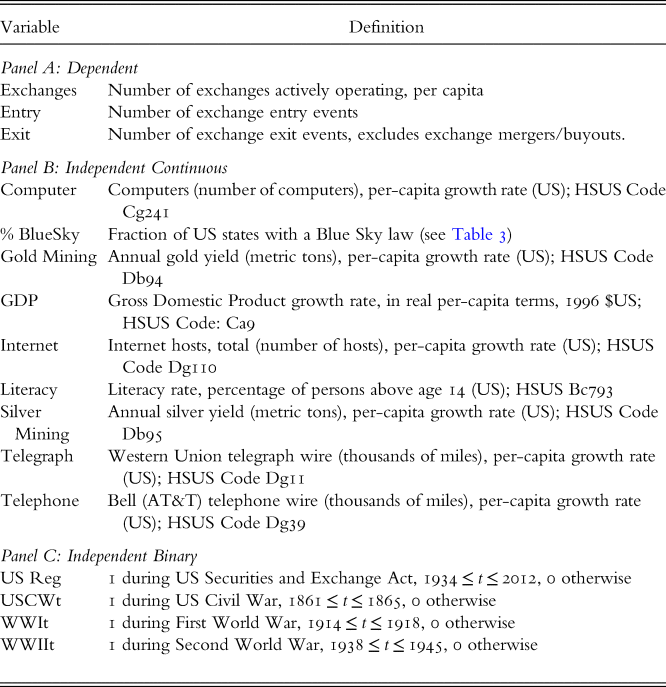
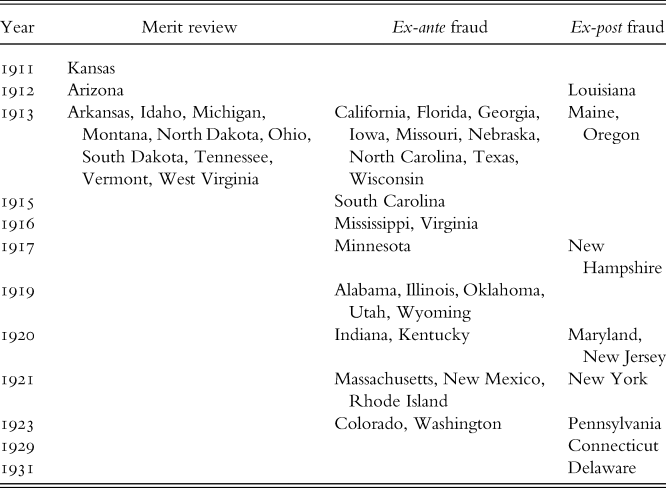
From the Historical Statistics of the United States, Millennial Edition online database, we include the following explanatory variables, measured in per-capita growth rates; see Table 2. For output growth, we utilize real GDP (GDP) in 1996 US dollars. We consider three communications variables: thousands of miles of Western Union telegraph wire (Telegraph); thousands of miles of Bell (AT&T) telephone wire (Telephone); number of computers (Computer). We include two security regulation variables; the first (US Reg) measures federal securities regulation and is marked by periods when financial exchanges were directly monitored by the Securities Exchange Act of 1934 (1934–2012), the second measures state-level securities regulation which begins with the Kansas adoption in 1911 and is measured as the fraction of states having adopted Blue Sky securities regulation law (% BlueSky).Footnote 10 Table 3 reproduces the timing of Blue Sky legislation passed for each state found in Mahoney (Reference Mahoney2003).
Variable definitions and sources

Note: All variables listed are available from 1855–2012 on an annual basis. Continuous US variables sourced from the Historical Statistics of the United States, Millennial Edition, where ‘HSUS Code’ corresponds to the specific series code used.

Periods of heightened uncertainty are measured by three variables, silver (Silver Mining) and gold (Gold Mining) commodity rushes measured by metric tons mined of silver and gold respectively, and the number of Internet hosts (Internet). Finally, we include a proxy for education and financial acumen measured by the literacy rate as a percentage of persons above age 14.
The second set of explanatory variables begins after World War II and includes more detailed security market data. Specifically, we include tax rates applicable to the top bracket for capital gains for the longest holding period (Capital Gain) and corporate income (Corporate Tax Rate) read off the annual tax code. We also include growth in business numbers (Business Count).Footnote 11 Further, we include growth in business activity (Business Activity) measured by demand for trading services (NYSE Shares Sold) measured by shares sold on the New York Stock Exchange (NYSE) and a proxy for valuations measured by the average dividend yield of stocks trading on the NYSE (NYSE Div. Yield). These data in the second set are obtained from the Archival FRED Database at the Federal Reserve Bank of St Louis.
V
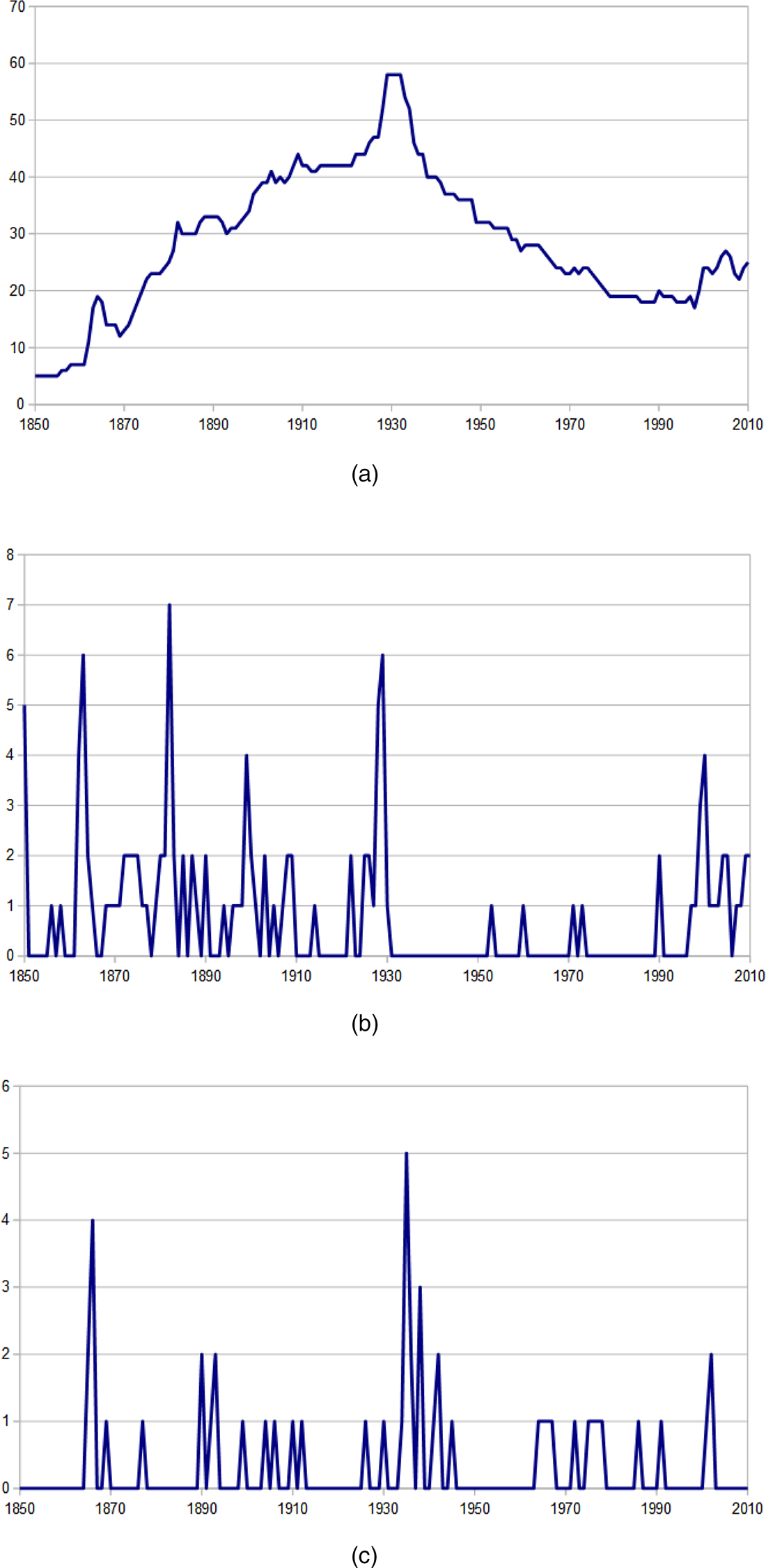
To begin we display the number of exchanges over time. Figure 1 reports the total number, entry and exit of financial exchanges in our dataset. In Figure 1a, we observe an extended upward trend in the number of exchanges through the second half of the nineteenth century, followed by comparatively little change. Apart from the long-term trend, the figure shows periods with relatively dramatic fluctuations in the number of exchanges. If consolidation towards a limited number of exchanges is indeed occurring through exit, this convergence did not begin until after the 1930s.
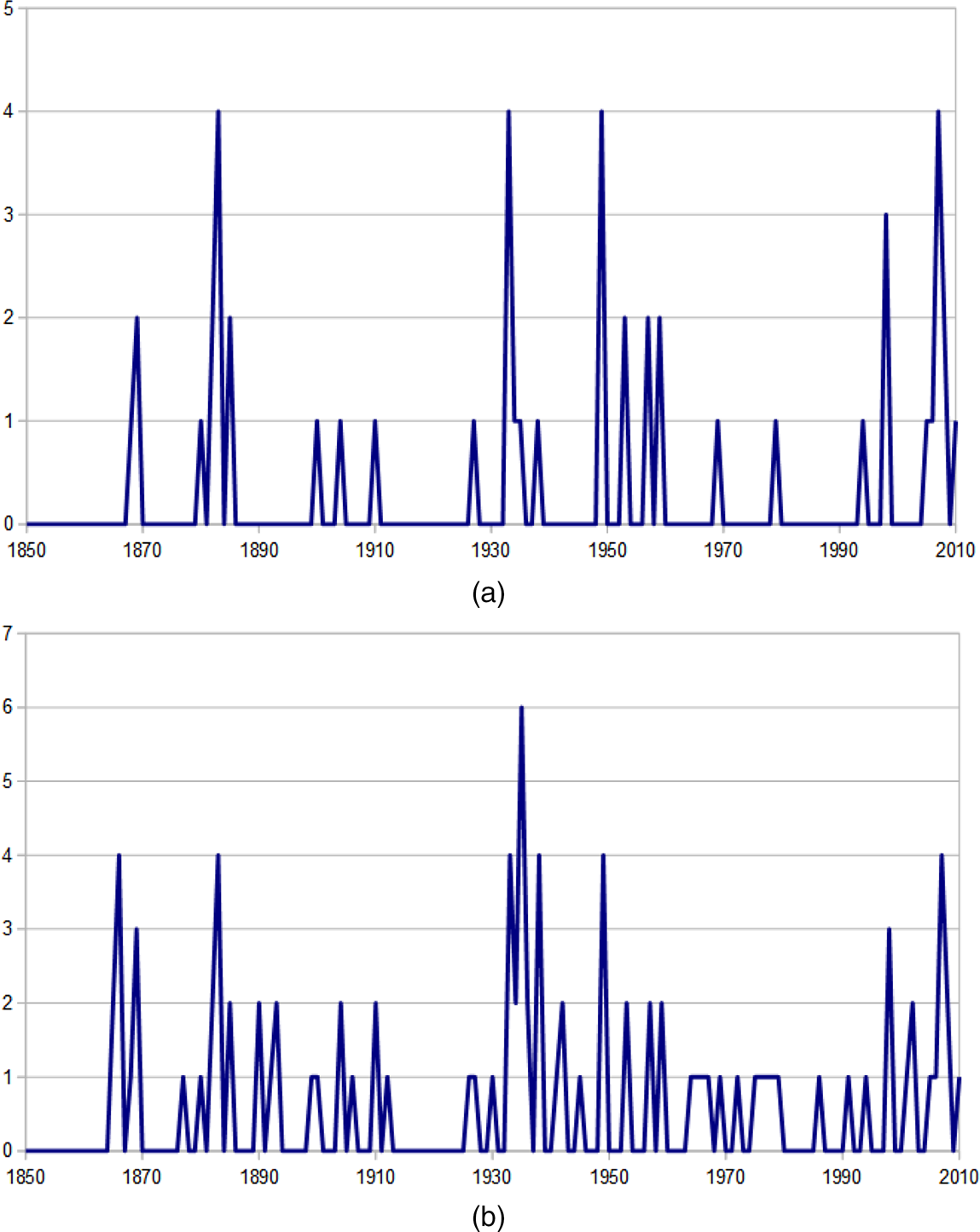
Number of exchanges, entry and exits events in the United States, 1850–2012 (a) Number of US exchanges (b) Entry of US exchanges (c) Exit of US exchanges

Figures 1b and c plot the number of confirmed financial exchange entry and exit events respectively from 1850 through 2012. Looking at the number of exchange entry events from 1850 to the present, we see distinct fluctuations in the rate of entry around its long-run trend, particularly from the end of the Civil War to 1905. Many of these exchanges were mining exchanges formed during the late nineteenth century, though smaller clusters of new exchanges emerged during the stock market rallies of the 1920s and 1990s. Many of the newly formed exchanges from the 1920s disappeared following the stock market crash of 1929. Despite having fewer confirmed exit dates, Figure 1c demonstrates distinct periods of exit via shutdowns.
Figure 2 provides a closer view of exchange exit events partition the data by shutdowns (Figure 2a) and mergers (Figure 2b). Shutdowns dominate exits in the early part of the sample while mergers dominate the latter half of the sample. It is plausible that the rationale for this distinct pattern is that communication technology early in the sample was not advanced enough to allow mergers to be feasible.
United States exchange shutdown and merger events, 1850–2012
(a) displays exchange shutdown (exits plus merger) events and (b) displays only merger events.

We utilize two complementary analyses to test our hypotheses. The first analyzes the entire dataset over the period 1855–2012 while the second investigates the exchange data since the end of World War II. For both samples we execute linear regressions models to analyze exchange dynamics. The regression model for the first analysis is given below:
 $$\eqalign{ Dependent\ Variable_t& = \beta _0 + \beta _1GDP_t + \beta _2Silver\;Mining_t + \beta _3Gold\;Mining_t \cr & \quad+ \beta _4Internet_t + \beta _5Telegraph_t + \beta _6Telephone_t + \beta _7Computer_t\cr &\quad + \beta _8Literacy_t + \beta _7\% BlueSky_t + \beta _8US\;Reg_t + \beta _W{W}_t + \varepsilon _t\;} $$
where ɛ t is a forecast error and Wt ≡ [USCW t, WWI t, WWII t]′ includes war dummies USCW t for the US Civil War, WWI t for World War I, and WWII t for World War II.
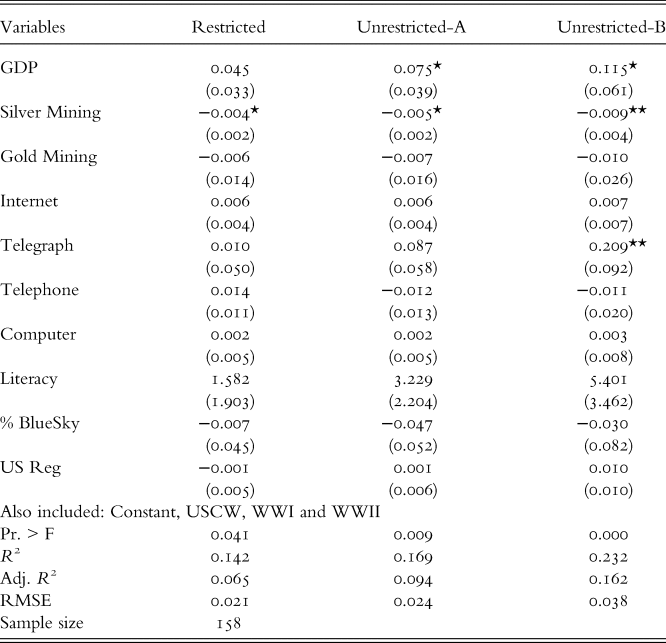
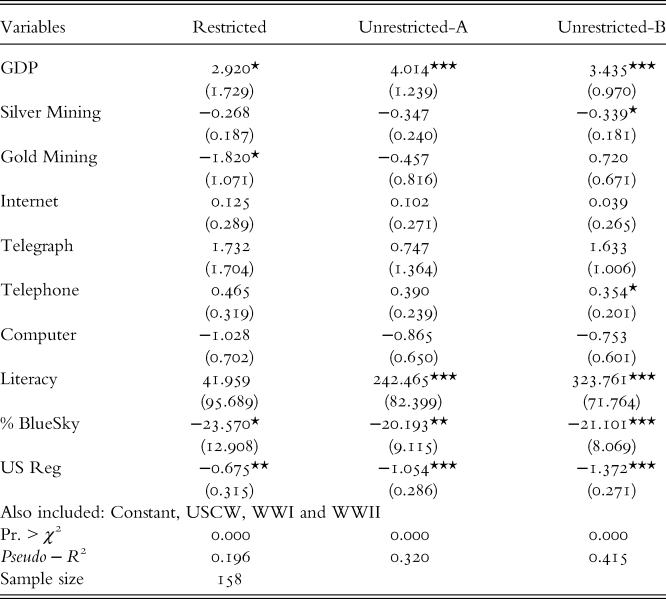
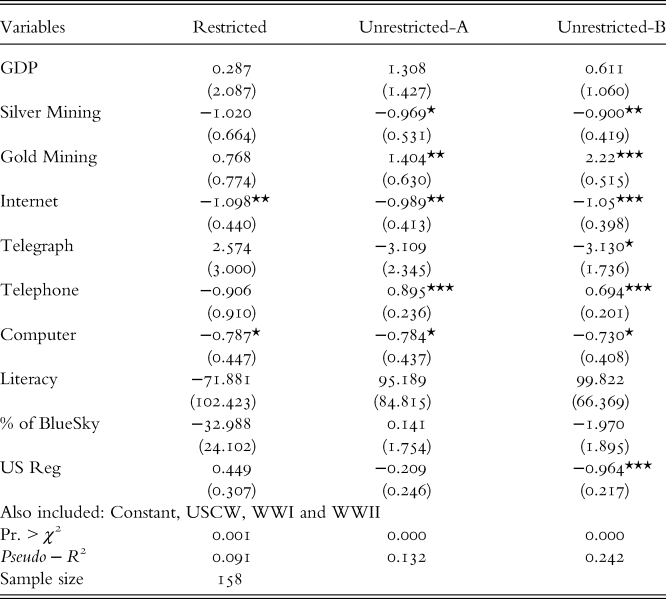
The above regression model is utilized for our three dependent variables: the aggregate number of financial exchanges (Exchanges) measured as per-capita growth, the log of the annual exchange entry events, log(Entry t), and the log of the annual exchange exit events, log(Exit t). The results for exchanges, entry and exit are displayed in Tables 4, 5 and 6, respectively.
Linear time series regression of the number of exchanges: continuous controls

Note: The dependent variable is the number of Exchanges (cumulative entry minus exit events). Restricted: counted as missing unless an explicit exit date is provided (or survived to the end of the sample period, 2012). Unrestricted-A: counted as missing unless an explicit exit or missing date is provided. Unrestricted-B: counted as missing unless an entry date is provided. Continuous variables are in growth rates, in per-capita terms. Significance levels denoted by: α = 0.10 (*), 0.05 (**), 0.01 (***). Robust standard errors are reported in parentheses.
Poisson time series regression of exchange entry: continuous controls.

Note: The dependent variable is the number of Entry events. Restricted: counted as missing unless an explicit exit date is provided (or survived to the end of the sample period, 2012). Unrestricted-A: counted as missing unless an explicit exit or missing date is provided. Unrestricted-B: counted as missing unless an entry date is provided. Continuous variables are in growth rates, in per-capita terms. Significance levels denoted by: α = 0.10 (*), 0.05 (**), 0.01 (***). Robust standard errors are reported in parentheses.
Poisson time series regression of exchange exit: continuous controls

Note: The dependent variable is the number of Exit events, which is defined as the sum of exchange shutdowns and mergers year-by-year. The term ‘shutdown’ is defined as the permanent shutdown of an exchange due to prevailing market conditions, not a merger or buyout; the exchange halts trading and its assets are liquidated. Restricted: counted as missing unless an explicit exit date is provided (or survived to the end of the sample period, 2012). Unrestricted-A: counted as missing unless an explicit exit or missing date is provided. Unrestricted-B: counted as missing unless an entry date is provided. Continuous variables are in growth rates, in per-capita terms. Significance levels denoted by: α = 0.10 (*), 0.05 (**), 0.01 (***). Robust standard errors are reported in parentheses.
The results for the number of exchanges highlights the positive impact of economic output and the corresponding need for capital flows. Silver mining also helps to explain the number of exchanges although with a negative rather than positive sign. Despite being contrary to our hypothesis, it may be the case that by the time the tonnage of silver mining began to rise substantially, the role that entrant exchanges play during periods of uncertainty may have already run its course; whereby viable companies may have switched trading to larger more established exchanges leaving the entrant exchanges to cease operations. Within our communication variables, only the telegraph is significant. Interestingly, the expansion of the telegraph across the country increased, rather than decreased, the number of exchanges, which appears inconsistent with our hypothesis of advances in communication technology consolidating the number of exchanges.
The results for exchange entrant events are stronger, with numerous economically significant variables which are consistent with our hypotheses. Similar results on the number of exchanges, economic output and the need to facilitate capital flows exhibit a positive and significant association with exchange entry. The proxy for education and financial acumen (Literacy) significantly increases the number of potential market participants and associated demand for exchange services. Lastly, both federal and state-level regulation variables are significant deterrents to exchange formation, which we conjecture is due to the added regulatory compliance burden.
The results for exchange exits are less clear. Considering the proxies for uncertainty, consistent with our hypothesis silver mining and the Internet slowed exchange exits as more exchanges were needed to help resolve which companies were viable. However, gold mining appears to have increased exchange exits, perhaps owing to the depletion of the stores of gold within the US. From a communication perspective, on one hand, expansion of the telephone significantly accelerates exchange exits consistent with our hypothesis; on the other hand, the proliferation of the personal computer slowed exchange exits perhaps because it opened the possibility of electronic trading. Finally, US federal regulation significantly slowed exchange exits, lending support to the argument that regulation offers a stable environment to operate for those exchanges that can shoulder the compliance burden.
The regression model for the second analysis is given below:
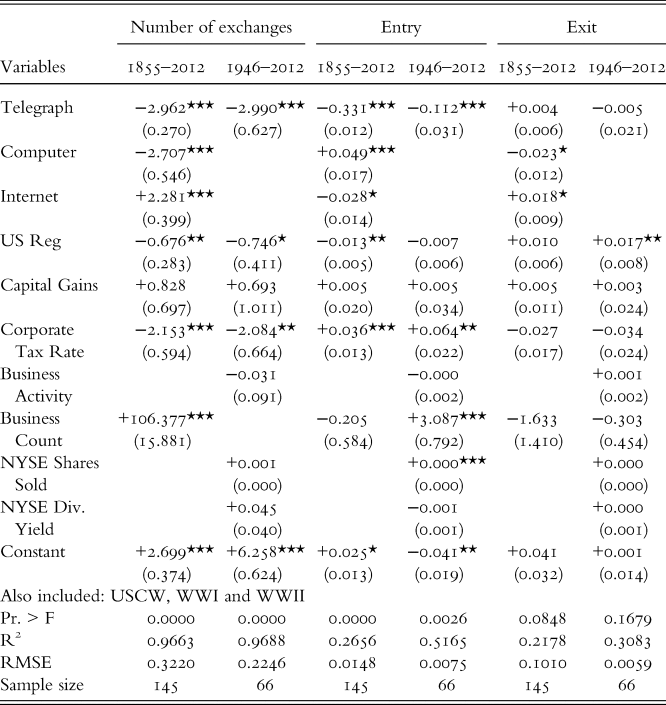
 $$\eqalign{Dependent\ Variable_t& = \beta _0 + \beta _1Telegraph_t + \beta _2Computer_t + \beta _3Internet_t + \beta _4US\ Reg_t \cr & \quad + \beta _5Capital\ Gains_t + \beta _6Corporate\ Tax\ Rate_t \cr & \quad+ \beta _7Business\ Activity_t + \beta _8Business\ Count_t \cr & \quad+ \beta _9NYSE\ Shares\ Sold_t + \beta _{10}NYSE\ Dividiend\ Yield_t\cr & \quad + \beta _W{\vector W}_t + \varepsilon _t\;\;} $$
where ɛ t is a forecast error and Wt ≡ [USCW t, WWI t, WWII t]′ includes war dummies USCW t for the US Civil War, WWI t for World War I, and WWII t for World War II.
Again, the above regression model is utilized for our three dependent variables: the aggregate number of financial exchanges (Exchanges) measured as per-capita growth, the log of the annual exchange entry events, log(Entry t), and the log of the annual exchange exit events, log(Exit t). The results of our second analysis are displayed in Table 7.
Linear time series regression of the number of exchanges, entry and exit

Note: The dependent variable is Exchanges (cumulative entry minus exit events), Entry and Exit in columns 1, 2; 3, 4; and 5, 6, respectively. The two regressions for each of the dependent variables differ by the sample period. Significance levels denoted by: α = 0.10 (*), 0.05 (**), 0.01 (***). Robust standard errors are reported in parentheses.
The results in Table 7 in large part corroborate the results of the first analysis as well as our hypotheses. For example, the expansion of the telegraph reduces the number of exchanges and entry, while the expansion of the personal computer increases entry and reduces exit. Similarly, federal security regulation reduces the number of exchanges and entry and increases exit events. Turning to the new explanatory variables, the corporate tax rate which proxies for the cost of doing business decreases the number of exchanges and yet adds to entry events. Finally, not surprisingly, the higher the number of business entities in the economy, the greater the need for exchange services, thereby increasing both the number of exchanges and entry events.
VI
Using a novel panel dataset, we document the historical dynamics of 327 financial exchanges and quantify the economic forces associated with entry and exit. The historical record is not consistent with convergence to a single financial exchange in the US, or steady growth in the number of exchanges over time. We document periods of exchange entry and exit and consider various classes of models to explain these periods.
We find that entry is affected positively by output growth and literacy, negatively by regulation. Exit is associated with gold mining and telephone lines. We find that US exchanges are 4.6 percent more likely to exit per year after the passage of the Securities Exchange Act, but a 1 percent increase in the growth of telephone lines leads to a 0.171 percent reduction in the likelihood of exit. In summary, we find that the telephone, literacy and regulation are robust predictors of financial exchange dynamics in the US.
These results suggest that the predicted long-run consolidation or fragmentation of exchanges, through sustained exit or entry, respectively, may be only a transitory phenomenon. We predict that if some demand for liquidity provision services goes unmet by incumbent exchanges, new exchanges will enter to meet that demand. Advances in telecommunications technology may render consolidation through shutdowns and mergers more attractive to firms in the financial exchange industry. However, we predict that such technological advances will not eliminate the role for competing entrant exchanges to resolve uncertainty about the viability of risky claims. This suggests that the economic role for competition among exchanges, including the dynamics of entry and exit, is not yet fully understood by the existing literature, and could be explored further in future work.