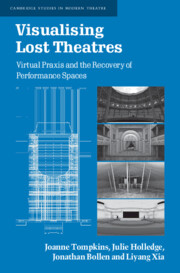


Visualising Lost Theatres studies venues that have been ‘lost’, whether through demolition or substantial remodelling. Once a theatre building is lost, its theatrical, social, and cultural worlds fade. Some fragments may remain, but their capacity to tell the story of a venue’s role in performance is limited. In researching this book, we learned how venues are living systems rather than passive containers of performance, and that their contribution to the creation of live performance has been underestimated. We studied how the contours of theatre venues cultivated social cohesion within them and forged connections with the cultural and political worlds beyond. To recover what is lost when a venue is no longer in existence, we turned to three-dimensional (3D) visualisation technology to recreate the venue in virtual form, so that we can reactivate dynamic facets of its performance space. This volume thus explores the creative interactions that exist between architecture, artists, and audiences. In addition to their aesthetic importance, venues shape behaviour in the auditorium: audience reception becomes habituated within a venue, prompting recognisable cultures of spectatorship to emerge.
We argue that evaluating venues is fundamental to interpreting performances from the past. The theatres we examine – from diverse social, geographical, and historical contexts – have prompted significant cultural transformations, shaping some of the most enduring theatrical genres of world theatre and cultural production. But we cannot comprehend these transformations until we ‘inhabit’ the venues. As Robert Hume argues, regarding early modern theatres, ‘unless one has a feel for the size, the nature of the space, the scenic and machine arrangements and the lighting, one really cannot begin to imagine how a play would work in performance. Any performer understands that cubage, configuration and sightlines are critical’ (2007: 24). A visualisation – effectively a virtual reconstruction – can provide the visual and immersive feel of a venue, as well as revealing performance logistics for actors and audience alike.
Before we establish the role of venues and how we use 3D visualisation technology to activate new knowledge through theatre practice, we introduce the five theatres. We have chosen them not for their significant architectural history but because of a convergence of venue, artists, and audiences that creates a theatrical transformation. We begin with the Rose Theatre in 1590s London, where Christopher Marlowe’s plays contributed to an eruption of playwriting. The second, Komediehuset in Bergen, Norway, is where Henrik Ibsen learned how to be a playwright in the 1850s. The Queen’s Theatre, built in 1841, represents an empire-building movement in Adelaide, South Australia. Just a decade later, Cantonese opera performances in circus tents in Australia’s goldfields evoked a different, distant land, linking Chinese miners with home. Finally, we examine the showroom at the Stardust Hotel in 1950s Las Vegas to investigate the shaping of commercial theatre for a tourist audience by artists who themselves toured internationally.
Theatre frequently flows across national lines: plays, productions, and performers move. This movement may result from a form being itinerant, from actors travelling to find work, or from performers’ inherent interest in exploring what lies beyond political and/or aesthetic boundaries. Artists look for new audiences across borders; artists who tour tend to adapt to different cultures of spectatorship. Venues also contribute significantly to the ‘flow’ that live performance provides, whether within a socio-political moment or within a genre. In this book, we focus on what happens when the flow of an art form becomes caught and converges in a single location, even in a single venue. This is what we call convergent flow, where performance in a specific venue captures the theatrical, social, and/or political movement of performers and audience.
What does it mean for a theatrical performance when a flow of different ideas concentrates in a single venue? How does it affect the socio-political context and the art form itself? We maintain that a venue shapes performer-and-audience relationships as well as the performance; that this shaping results from multiple forces gathering and being held there for a time before the flow continues; and that it may leave in a different direction altogether. When a flow is caught in a venue, audiences and actors can find a connection in the theatre that may be political or philosophical or may evoke a different affect altogether. Something happens in these venues that changes the forces around them; it differs depending on the venue, the environment, and the context. In some instances, a new genre is developed by an interaction of material constraints. In others, it is a revision of form. The venue acts as a crucible fashioned by the strength of the flows it contains, facilitating the examination – from a new perspective – of the different theatrical and cultural imaginaries that emerge. While our use of the metaphor of flow varies from chapter to chapter, in each case it illustrates in different ways how venues are living forms, not static containers.
To appreciate how flows converge in theatre, we need to ‘enter’ the venues to examine the movement in them, the pooling of flow, and what emerges as a result. Investigating lost venues through virtual reality is a means to achieve this. We begin inside each venue, addressing how a venue conveys the social constructs that shape performance in a culture, from its configuration, to the different areas in the auditorium, to decor and relationships between performers and audience. From a venue’s interior, we broaden to study the audience, the stage, and beyond. The next section provides an overview of venues as objects of analysis.
Theatre Venues
A venue is essential because performance must take place somewhere, whether in a building established for theatre or in site-specific or virtual locations. A performance generates a setting, even when it is conjured in the imagination and not via stage machinery, scenery, and props. Venues dictate the scale of a performance, the special effects that are possible, the configuration of performer–audience relationships, how audiences move through them, and who mixes with whom in the process. There are critical accounts of how space, place, and architecture define theatre as a genre,Footnote 1 but much less survives about the function of venues if they no longer exist. Once a venue is demolished or even significantly renovated, we lose our grasp of its theatrical operations, from how the machinery worked to what types of performance converge in it.
Our research acknowledges shifts in the practice of architecture over time. The idea of disposable architecture reinforces the merits of investigating prominent venues from the past to understand the creation and circulation of culture.Footnote 2 Established venues can be destroyed to make way for the new, even where heritage listing operates. Yet ‘destruction’ is relative: venues in Las Vegas regularly renovate to attract returning patrons with something new. Some venues may resist preservation: Cantonese opera in the mid-nineteenth century was itinerant and its traces in Australia are scant.
A theatre’s architecture represents the societies that fill it; class, race, gender, and age all find reflections in the access, exclusions, and preferential placings. Theatre architecture is instrumental in determining social divisions, opening dialogue between social history and performance analysis. We can infer the social contract between audience and performers, establishing the metonymic construction of a society through the stage. The act of sitting in an auditorium is also associated with developing community and interactive skills; even barriers like armrests contribute to this, separating patrons from physically touching, yet details like whether or not there were armrests are frequently lost from the record of theatres of the past. How the sociality of a venue created atmosphere and contributed to its success (or otherwise) often evades documentation.
The venue is the principal object of our research; once we have examined each venue, we explore performance through the embodied relationships between performers and spectators, and the social context that a performance venue developed and fostered. We recover not only the lost theatres but also the cultural memories and functions associated with them, linking theatre history and practice, audience–performer social relationships, and architecture. We analyse the venues and their legacies by means of digital technology to enhance both theatre history and the value of contemporary performance in our cultures.
For each lost venue, we have researched multiple historical sources, from accounts of particular theatres to types of venues, heritage reports, reviews, and other sources. A fascinating avenue has been investigating the history of stage machinery, a technology that transformed as regularly as opportunities for creating new spectacles emerged. The introduction of the new often means the abandonment of the old. The difficulty of re-establishing a technology (working out how gas lighting or movable scenery were installed in a particular venue) that hasn’t existed for over a century except in museum theatres reinforces that when a venue is lost, so, often, are its contributions to a culture of spectatorship.Footnote 3
There are many ways to investigate theatre venues beyond entering actual buildings, from Reference LeacroftRichard Leacroft’s (1973) architectural drawings of historical English theatres to miniatures (Reference StewartStewart, 1992), including architectural scale models and even the toy theatres built and sold by Benjamin Pollock. The most ambitious recreation is Shakespeare’s Globe in London.Footnote 4 Our alternative is to reconstruct spaces through virtual reality (VR), taking advantage of digital technologies in a manner more akin to a laboratory experiment than a surrogate experience. A VR model, or visualisation, provides an extension of Leacroft’s illustrations in a form that enables us to ‘inhabit’ a close-to lifelike experience of a venue; it feels like we are immersed in the actual thing. Both Leacroft’s work and ours require in-depth research on construction, performance, historical realities, and an imaginative activation of space. We have conducted workshops with performers (as research assistants) working ‘inside’ a virtual theatre; these laboratories reinforce the complex relationship between architecture, genre, and audience as we gauge the performers’ responses to inhabiting the virtual venues. The actors and dancers have helped us establish the material conditions of and for performance, although our aim has never been to re-enact specific performances. The next section introduces our ‘visualisation methodology’.
Visualisation as Methodology
This volume strengthens the foundations for interpreting theatre and performance venues and takes this research into the immersive sphere. Digital technologies are introducing widespread social changes as people inhabit virtual worlds for entertainment, education, and work (hastened by the COVID-19 pandemic), through visualisation in particular. Virtual reality has been used extensively in archaeological reconstructions, real estate and interior design, and urban planning (Reference Liu, Mateo and DarchenLiu, Mateo-Babiano, and Darchen, 2018; Reference O’Donaghue and ProcterO’Donaghue and Procter, 2017). Theatre is particularly appropriate for deploying visualisation, and current technologies enable us to explore the form’s visuality, spatiality, and temporality.Footnote 5 Visualisation facilitates a simultaneous reduction and expansion of forms within our worlds, intersecting with Thea Brejzek and Lawrence Wallen’s reading of ‘the physical scale model in theatre and architecture’ through what they call ‘cosmopoiesis’ or ‘world-making’ (2018: 1); it expands our understanding of theatrical worlds and specifically how a venue shapes spectatorship.
Visualisation is not without its critics, for whom it approaches ‘“edutainment,” and even the “Disnification” of culture’, positions refuted by Reference Cameron, Kenderdine, Cameron and KenderdineFiona Cameron and Sarah Kenderdine (2010: 11). Our visualisations, embedded in historical analysis, are not an end in themselves. Rather, they are part of a new, complex archive and laboratory for research and analysis; our virtual models facilitate the identification of a research-based ‘feel of the space’ that enables active investigation. In the process of enabling 3D immersion in the models (versus two-dimensional display), we isolate crucial historical aspects. Determining a changing balcony shape or the stage relationship to backstage, for example, is part of this strategy, while detail about the decoration of an auditorium is arguably less central to a model’s ability to elicit past social, political, and theatrical practice. Visualisation complements and extends the research record about the actual function(s) of these theatres.
Like any methodology, visualisation requires clear parameters. The London Charter for the Computer-based Visualisation of Cultural Heritage stipulates that visualisations adhere to six principles: implementation, aims, methods, research sources, sustainability, and access (London Charter, 2009). Cultural visualisations ‘should accurately convey to users the status of the knowledge that they represent, such as distinctions between evidence and hypothesis, and between different levels of probability’ (quoted in Reference Denard, Bentkowska-Kafel, Denard and BakerDenard, 2016: 60), thus ‘distinguish[ing] between fact and fiction’ (62). Hugh Denard argues that visualisations contribute to the conclusions we can make about cultural heritage:
A visualization is essentially a complex set of dependency relationships, and it is this which makes a visualization at once such a powerful empirical instrument … The process of visualization, when documented, gives us in fact greater, not lesser, liberty to try out possibilities, because when a hypothesis is published along with its rationale and evidence base, it acquires a recognizable standard of methodological validity.
In accordance with these guidelines, our practice is to use a range of evidence to create an accurate model; we then draw logical inferences to known construction methods of the day to fill in data that is otherwise unavailable. We do not attempt to recreate perfectly an original venue (which is impossible), but we remain alert to opportunities to learn more about the venues to enhance our understanding of culture, heritage, and art forms of the past and present. This approach presents a methodology to test theories in a manner hitherto unavailable.
To embed the deployment of visualisation ‘as’ research, we combine Denard’s view with Diana Taylor’s foundation for examining digital technologies in theatre. She repositions her concepts of the archive and the repertoire in the digital age. For Taylor, digital technologies ‘offer new futures for our pasts’ (Reference Taylor2010: 2). She argues that in addition to the ‘embodied cognition’ of the repertoire and the rational linearity of the archive, ‘digital technologies constitute yet another system of transmission that is … raising new issues around presence, temporality, space, embodiment, sociability, and memory (usually associated with the repertoire) and those of copyright, authority, history, and preservation (linked to the archive)’ (3). Visualisation generates a ‘system of transmission’ and a dynamic reading strategy that ‘draws on, and simultaneously alters both’ the archive and the repertoire (Reference TaylorTaylor, 2010: 3). The models are, then, much more than passive stand-ins for the real thing. Here are three aspects that they can provide:
Models as accumulations of architectural knowledge: as visual-spatial expressions of what we know about the size, scale, shapes, volumes, materials, look-and-feel of the venues. This is the model as a building site in its construction phase. It is the experience of working from many types of documentary evidence and using 3D design software to build up the model, piece-by-piece, space-by-space, from the evidence available. This is where ‘material choices’ and ‘design intentions’ come into play (Reference Brejzek and WallenBrejzek and Wallen, 2018: 3).
Models as sites of cultural production: as venues for past performance, as material constructions set in historical contexts, as social settings for action, representation, and interaction. This is the model as a focus in researching theatre history. It collects our knowledge about play scripts and styles of production, about companies of performers, directors, and designers, about audience engagement, social formations, cultural forces, and so on, and provides a dynamic medium for arranging artefacts of performance to form historical accounts.
Models as spaces for performance research: as virtual environments mapped through VR technology to physical space in a studio. This is the experience of research through creative practice in rehearsal that will be familiar to artists and scholars who work with performance in theatre, dance, music, and screen production. This is the model as a virtual laboratory for practice, a ‘space of action’ in Brejzek and Wallen’s terms (Reference Brejzek and Wallen2018: 3).
Our study draws on all three aspects. Using visualisation as an interpretive tool involves layering practical, visual, and embodied information. Taylor explores the virtual in performance, noting that ‘the embodied, the archival, and the digital overlap and work together and mutually construct each other’ (Reference Taylor2010: 3). Too often, aspects of theatre are analysed in isolation. A virtual model offers a site to consider different perspectives and enable modifications as new insights arise. Visualising Lost Theatres makes this complex layering explicit in the visualised venues to interpret historical venues and their social development, particularly against moments when flow is caught or arrested.
Visualisation reinforces the collaborative nature of digital humanities, since historically, few individuals have had all the requisite skills (Reference Spiro and GoldSpiro, 2012: 26). This volume is no exception, with four authors, a director, a designer, a drafter, modellers to create the visualisations, and actors and dancers testing the results in workshops. We note the essential contributions of Mary Moore, the project’s designer, and Peter Kelly, who with Moore interpreted the archival evidence to provide the computer-aided-design (CAD) drawings for the modellers of the Queen’s. Ortelia’s Lazaros Kastanis and Darren Pack technically produced the venue models, which are openly accessible at https://ortelia.com; Komediehuset is also listed as a resource on its venue record in IbsenStage (https://ibsenstage.hf.uio.no/pages/venue/15488); the Queen’s is available as a resource on its venue record in AusStage (https://www.ausstage.edu.au/pages/venue/3145). We have designed a website that includes fly-throughs of each of the models to accompany this book: see https://losttheatres.net. These multiple access points may keep them active for longer than many digital projects remain live. The book is designed to be read without visualisations, but we encourage readers to engage with the models (in Mac, PC, or VR formats) for a richer experience.
Our analyses begin with the virtual reconstructions that we have generated from archaeology, photographic records, sketches, descriptions, and/or other resources that reinforce structure, appearance, and spatial dynamics. The first layer in constructing the models is a close connection with architectural and building constraints of real buildings; this has required learning about the construction of historic theatre venues. A second layer comprises analysing the spatial dynamics of auditoria – entrances, exits, seating arrangements – which throws light on social organisation and cultures of spectatorship. The third layer involves studying stage spaces, machinery, and relationships between stages and auditoria. Theatre history provides some material understanding of lost theatres, but adding performance aspects of a venue offers far more insight; a major contribution of this study is this combination of historical research with theatre praxis. By recreating the conditions of performance in virtual spaces,Footnote 6 we engage in a practice of ‘genre archaeology’. We treat the virtual models as if they are actual stages. We read across the layers to determine how textual and archival materials translate dynamically into spatial relations, visual effects, and embodied forms inside the VR models.
Virtual research praxis deploys digital technology to help translate textual traces into spatial, visual, and embodied data to enrich qualitative interpretations of performance history. For some of our venues, there are limited or even no visual records of performance; written traces such as scripts, reviews, and artists’ reminiscences are all that remain. But VR technology can turn these textual traces into reconstructed moments of performance in spatial, visual, and embodied form, taking us a few steps closer to a visceral connection with a lost past. Even when there are photographs and film recordings of performance, the virtual models afford insights into the embodied experience of a venue.
When we read archival documents about a performance in a lost theatre, it is easy to make assumptions, but trying to translate a written description into a 3D form highlights numerous practical problems rarely addressed in print. Filling these gaps for a virtual model has involved additional tasks like determining how many lumen were emitted by the gas flares in a particular theatre; where the slots were cut into the stage for a carriage-and-wing mechanism; how many spectators sat on a single bench in the pit; and how many stagehands were employed on a show. Answering each of these questions triggers new research directions; when the evidence trail falters, creative choices must be made based on theatrical practices of the period.
This project uses a double-dissemination strategy that augments a traditional narrative with high-quality visualisations that have an interactive component. A model on its own cannot relate the full story, since much material needs to be elucidated discursively. To produce new ways of understanding performance history inside virtual spaces, we implement a ‘venue–design–body’ articulation made possible through collaboration with artist researchers. We worked with a variety of artists, most notably the Australian theatre, dance, and opera designer Mary Moore; Adelaide-based actors (Emma Beech, Jermaine Hampton, Jamie Harding, Jude Henshall, Ashton Malcolm, Paul Reichstein, Nadia Rossi, and Stephen Sheehan); and Sydney-based dancers (Erin Brannigan, Raghav Handa, Julie-Anne Long, Lillian Shaddick, Lisa Synnott, and Alexandra Tálamo). Inside our models – effectively virtual laboratories – we found that visualisation (when users wear a VR headset) heightens the haptic effect (or the ‘feel’ of the space, which appears so ‘real’ that users tend to want to touch it), making the experience visually comparable to walking into an actual physical venue and looking around. Given the detail, accuracy, and hapticity of the VR, our performer-researchers suspend their disbelief and work within the virtual model ‘as if’ it is an actual venue. In the virtual theatres, they can choose not to ‘see’ any of the technical glitches in the virtual environment and repress the contradiction between their sensory awareness of the space and their limited physical presence within it. The function of using this ‘as if’ approach to sensing the space in this project was to conduct practical research experiments that teach us how the venues came alive in performance. Having suspended their spatial disbelief, artists use this ‘as if’ approach to apply the same techniques to investigate the virtual environment as they use within actual venues. These techniques involve sensing the space and treating its proportions and features as the crucial raw materials that will underpin their creative choices in their performance.
Sensing the space offers a particular focus for designers. Whatever the genre of a production (an illusory fictional world or a metatheatrical framing), designers generate a performing space that sits within the architectural form of the theatre building. To integrate these two ‘places’, designers create a relationship between the proportions of each while simultaneously fashioning the spatial logic that will shape the movement of performing bodies. Their tools are enhanced by a venue’s stage machinery. Today, this machinery is associated with fly towers, hydraulics, and movable seating; in previous eras, it was mechanisms for changing wings, flats, borders, and the dropping and rolling of stage cloths. Lighting and sound designers are also constrained by the dimensions of the stage and auditorium and the available technology; even costume designs are tied to the size of the venue if they are going to ensure that spectators absorb the information about character, place, and time that is signified through clothing.
Venue architecture is intrinsic to the performance choices that performers make. The techniques used to project the natural voice are determined by the acoustics of a venue; decisions about the size and shape of physical expression are controlled not only by the distance between the performers and spectators but also the configuration of the auditorium seating. For these reasons, performers’ rehearsal preparations involve spending time in a venue and sensing the space. Although the richness of the sensory information gathered by performers is often expressed impressionistically in descriptions of the space as intimate or cavernous, friendly or forbidding, they are able to make very accurate judgements about performance techniques that will work on the stage by drawing on their spatial memories of past venues.
Visualising Lost Theatres
This final section provides a more nuanced introduction to and justification for the choice of our case studies.Footnote 7 Chapter 1 examines London’s Rose Theatre (1587–1603), a venue which contributed significantly to the development of western theatre. We explore Marlowe’s Doctor Faustus in the intimacy of the Rose against his large-scale imagined worlds. Visualisation highlights the importance of physical proximity as a factor in reception; collective emotional responses were likely encouraged by closeness alone, given the venue’s capacity of about 2,200. Our source materials are the venue’s foundations, archaeology, scripts, and the diary of the owner, Philip Henslowe. We address philosophical questions about place and subjectivity that mark the movement from the end of the medieval era into the early modern era. The methodological focus is on blocking and how a virtual model can determine possibilities for movement and action on this stage, against both a physical and metaphysical attention to subjectivity. In a cauldron-like venue, Doctor Faustus arrests the flow of ideas by rehearsing the profound shifts of subjectivity from God-centred to human-centred. The amphitheatre demonstrates a convergence of flows of multiple forms, ideas, and audiences. Our particular interest is in how this convergence is expressed in the physical techniques used by performing bodies on the stage of the intimate Rose Theatre.
The next three theatres are from the nineteenth century, and for all three we began with scripts, reviews, newspaper articles, and artists’ reminiscences. Chapter 2 addresses Komediehuset in Bergen, Norway in its 1850–1909 iteration. Built by an amateur dramatic society in 1800 and destroyed by a 1944 British bombing raid, it has a twofold historical importance: it housed the first professional Norwegian theatre company, and it is where the young Henrik Ibsen, a writer who has attained an international legacy equivalent to Shakespeare, learned his craft. We consider the theatre’s high point as a social space for audiences and artists to create a national identity for a newly independent Norway. This chapter focuses on set design, specifically in Olaf Liljekrans, an early play by Ibsen. We analyse how Ibsen used space and movement to elucidate the discourses within his plays. In the famous social dramas written after he left Norway, Ibsen perfected this technique of writing meanings into bodies and imaginary stage spaces. The arrest of mid-nineteenth century flows of European theatre in Komediehuset pertains to the birth of Norwegian nationalism on stage and the beginnings of a new flow of modern drama.
Chapter 3 moves from Europe to one of its colonies via the Queen’s Theatre, Adelaide, where we investigate colonial actors’ performances on the 1841 opening night. The Queen’s is the oldest extant theatre on mainland Australia. Its establishment reflected the South Australian colony fashioning itself as the only settlement in Australia that did not begin as a prison. We delve into the performance possibilities in this imported, Regency-style venue, which opened with Shakespeare’s Othello, performed when race relations were particularly volatile. This play and the events outside the Queen’s centralise the black body. While we do not lose sight of that embodiment, we turn to a different form of corporeality in the shape of the audience about whom we were able to isolate considerable information. We worked with actor-researchers to reconstruct a culture of spectatorship across the auditorium by producing responses of the distinctive 1841 audience of Adelaide. The arrested flow in this example is the attempt to make in the Queen’s, and the rest of Adelaide, a better version of Britain, against the backdrop of the suppression of Indigenous peoples, a matter that took on an even more macabre setting after the theatre’s closure, when it became the court that adjudicated on frontier political events.
Chapter 4 moves away from European culture and fixed venues to the travelling form of Cantonese opera in the Guangdong region of south China in the nineteenth century. We address the genre’s wide geopolitical context by combining it with the form as toured on the Australian goldfields in Victoria in circus-style tents. Over thirty Cantonese opera troupes set up temporary bamboo theatres in the grounds of temples in mid-nineteenth-century south China; fourteen companies toured Victorian mining camps in the 1850s to 1870s to entertain miners who hoped to find fortune and return to China. The virtual reconstruction of a tent theatre set up for the opening of a joss house (or temple) in Victoria demonstrates less of a transformation of form from the Pearl River Delta to the goldfields than we anticipated; this chapter exemplifies a flow that resists capture. We examine the sophisticated techniques used by this sojourner company to minimise the disruptions that a touring schedule with multiple and dissimilar sites of performance creates. Carrying a portable stage/backstage platform and orientating the audience–performer relationship according to a metaphysical logic, the company created a spatial layering of two geographies to support its sacred and secular repertoire.
The final chapter, on the showroom at the Stardust Hotel in Las Vegas (1958–2006), investigates the international production of theatrical revue for a tourist audience. The showroom exemplifies the modernist design of twentieth-century theatre architecture, with an aesthetic of curved planes and smooth surfaces designed to facilitate the flow of people through performance and level the encounter between artists and spectators (Reference WrightWright, 2012). The venue was subject to numerous renovations, but we focus on the initial 1958–9 design, which accommodated the latest stage technologies, including a swimming pool, an ice rink, a waterfall, and a firework show. The Stardust became the venue for the Lido de Paris, the long-running revue, which played in various editions until 1991. While the showroom was demolished with the Stardust in 2007, our reconstruction illustrates the evolution of theatre venues shaped by the capitalist development of international tourism (Reference BennettBennett, 2005: 425–7). The showroom’s closeness in time to the present means that a greater visual record has remained. The model embodies insight into the design of the Stardust showroom as a tourist attraction and the choreography that made a gendered spectacle of international relations.
In each chapter, we deal with three factors via the visualisations: what the venue reveals, the embodiment that the venue facilitates (for performers and audience), and how the venue becomes a crucible for the arrest of flow. Once we establish the architecture in virtual form, we can ascertain much more about a lost venue’s operation. In the process of our research, we discovered that venues produce a far greater influence on an audience than we had realised, and our analyses incorporate this. This use of visualisation as a research methodology is new, so we employ this technology to interrogate different aspects of live performance, thus demonstrating the value of VR to researchers in our field. Finally, the combination of information that we have uncovered in these analyses enables us to examine the national/transnational flow of performance shaped by these venues.
We have selected a single performance in each chapter (with a slightly wider frame for the Stardust) to focus the analysis. In different historical and geographical moments, these venues reveal the emergence of social formations, and how individuals, societies, and nations think about themselves. It takes time for a venue to exert influence over a flow of performance as it involves human repetition and habituation, hence the importance in our study of ensembles of performers, and audiences held together either through communities of interest or geography. While each of our venues is characterised by a consistency in its spectators, these social groups could not be more different; they include European citizens, nationalists, colonialists, sojourners, and tourists. Although we focus on moments of arrest in transnational flow and processes of slow change, the concepts of touring, gender, and race weave through the book as much as digital technologies and theatrical space.
Against the many advantages that visualisation provides our research, we note that visualised space can be interpreted as disembodied. There is a Cartesian sensory effect for the head while the body remains somewhat detached (or deferred to the handset). While we continue working with material conditions of performance, corporeality needs to be explored in greater detail in subsequent research. Even though VR is usually billed as a personal experience, it can provide a meeting place and experience of spectatorship.
Modelling lost theatres has enabled us to provide a repertoire of space relations that can only be accessed in this way because we cannot enter the actual venues as they were. We contribute, then, to an archive of spatial interactions by tapping into examples from the past to inform the experience of the virtual today. We plan for the VR models to be available for others to engage with and to see in them different potential for exploration. The immersive experience helps us look at the making of performance now and the documenting of historical work in a more comprehensive manner than has been possible. This project will, we hope, reinforce for readers the detailed operation of theatre venues, as well as their historical functions, in addition to the depth of analysis that is available through visualisation. Inhabiting virtual worlds will increasingly become part of our entertainment, education, and working lives. We are experimenting with visualisation to answer our questions, but we look forward to how others use it to engage with their own.
