Background
Adolescence is a high-risk period in the development of suicidal thoughts and behaviors. It has been estimated that approximately one in five adolescents, aged 12–14, experience suicidal thoughts (Garrison et al., Reference Garrison, Addy, Jackson, McKeown and Waller1991). Suicidal thoughts have a strong association with subsequent suicide attempts (Lewinsohn et al., Reference Lewinsohn, Rohde and Seeley1994; King, Reference King, Maris, Silverman and Canetto1997), and suicide a leading cause of death for persons between 15–24 years (Navaneelan, Reference Navaneelan2010).
A broad literature suggests that internalizing and externalizing pathology early in the life course may predict subsequent suicidal thoughts and behaviors (Sourander et al., Reference Sourander, Klomek, Niemelä, Haavisto, Gyllenberg, Helenius, Sillanmäki, Ristkari, Kumpulainen, Tamminen, Moilanen, Piha, Almqvist and Gould2009; Chronis-Tuscano et al., Reference Chronis-Tuscano, Molina, Pelham, Applegate, Dahlke, Overmyer and Lahey2010; Dykxhoorn et al., Reference Dykxhoorn, Hatcher, Roy-Gagnon and Colman2017). Much of this research, however, has focused on those who meet thresholds for a clinical diagnosis, potentially missing less severe groups which still may be at risk. Therefore it may be more meaningful to explore patterns of internalizing and externalizing behaviors with continuous indicators, to better capture a full spectrum of behaviors that place children at risk. When using continuous indicators of internalizing and externalizing, research has identified both internalizing-only patterns of problems, as well as externalizing-only patterns (Willner et al., Reference Willner, Gatzke-Kopp and Bray2016). Additionally, constructs of co-occurring internalizing/externalizing, such as the Child Behavior Checklist (CBCL) Dysregulation profile have also been identified (Biederman et al., Reference Biederman, Wozniak, Kiely, Ablon, Faraone, Mick, Mundy and Kraus1995). This is a widely replicated profile of problem behavior in which children score high on symptoms of emotional and behavioral self-regulation (De Caluwé et al., Reference De Caluwé, Decuyper and De Clercq2013; Masi et al., Reference Masi, Pisano, Milone and Muratori2015; Bianchi et al., Reference Bianchi, Brambilla, Garzitto, Colombo, Fornasari, Bellina, Bonivento, Tesei, Piccin, Conte, Perna, Frigerio, Castiglioni, Fabbro, Molteni and Nobile2017). Beyond the types of symptoms exhibited, there has also been variation in severity, where mild, moderate, and severe levels of internalizing, externalizing, and co-occurrence between the two has been observed, supporting nuance beyond diagnostic thresholds (DiStefano and Kamphaus, Reference DiStefano and Kamphaus2006; Ostrander et al., Reference Ostrander, Herman, Sikorski, Mascendaro and Lambert2008; Mindrila, Reference Mindrila2016).
Beyond understanding the constructs of internalizing and externalizing at various points in childhood, an additional interest is one of understanding how children move between different patterns of internalizing/externalizing across time and how the constructs of those patterns change. In the literature, both heterotypic and homotypic transitions of internalizing/externalizing symptoms have been observed (Keenan et al., Reference Keenan, Shaw, Delliquadri, Giovannelli and Walsh1998, Mesman et al., Reference Mesman, Bongers and Koot2001, Briggs-Gowan et al., Reference Briggs-Gowan, Carter, Bosson-Heenan and Guyer2006, Vaillancourt et al., Reference Vaillancourt, Brittain, McDougall and Duku2013, Mian et al., Reference Mian, Wainwright, Briggs-Gowan and Carter2011, Basten et al., Reference Basten, Tiemeier, Althoff, van de Schoot, Jaddoe, Hofman, Hudziak, Verhulst and van der Ende2016, Willner et al.,Reference Willner, Gatzke-Kopp and Bray2016). Homotypic stability, defined as staying in the same pattern of symptoms across time, has been observed from toddlers up to adolescence. While stability has been observed in both internalizers and externalizers, it seems that the highest stability is found in individuals with co-occurring symptoms of both (Briggs-Gowan et al., Reference Briggs-Gowan, Carter, Bosson-Heenan and Guyer2006, Basten et al., Reference Basten, Tiemeier, Althoff, van de Schoot, Jaddoe, Hofman, Hudziak, Verhulst and van der Ende2016, Willner et al., Reference Willner, Gatzke-Kopp and Bray2016). Heterotypic stability has also been observed, where one set of symptoms shifts towards another across time. The most common of these reported in the literature is when children transition from externalizing to internalizing symptom patterns (Mesman et al., Reference Mesman, Bongers and Koot2001). Additionally, it has been identified that subsets of children display patterns of symptoms that persist from childhood, through adolescence, and into adulthood (Campbell and Ewing, Reference Campbell and Ewing1990; Shaw et al., Reference Shaw, Keenan and Vondra1994; Wittchen et al., Reference Wittchen, Kessler, Pfister and Lieb2000; Hofstra et al., Reference Hofstra, Van der ende and Verhulst2002; Weeks et al., Reference Weeks, Cairney, Wild, Ploubidis, Naicker and Colman2014, Weeks et al., Reference Weeks, Ploubidis, Cairney, Wild, Naicker and Colman2016).
While a wealth of research has been conducted that investigated patterns of internalizing and externalizing symptoms in children, and how they change across time, less research has looked at how these temporal sequences of internalizing and externalizing symptoms relate to suicidal thoughts. Identification of such patterns, and how they change across time, may serve as useful predictors of suicidal thoughts, highlighting potential target groups for intervention. One relevant study recently conducted by Orri et al. (Reference Orri, Galera, Turecki, Forte, Renaud, Boivin, Tremblay, Côté and Geoffroy2018) used mixture modeling to explore the role of internalizing symptoms and irritability scores, and how they relate to suicidal thoughts in adolescence. The authors found that high scores on internalizing and irritability increased the odds of subsequent suicidal ideation and attempts. To add to such research, similar methods were utilized in the present investigation with the addition of including externalizing symptoms of conduct problems and hyperactivity/inattention in the modeling.
The present study investigated patterns of internalizing and externalizing symptoms at two time points in childhood, at ages 6 and 10 years, and the stability of these symptoms across this period. These unique profiles, as well as the transition patterns between them, were then examined as possible predictors of suicidal thoughts in early adolescence. It was hypothesized that profiles of internalizing-only, externalizing-only, and co-occurring internalizing and externalizing symptoms would be observed at ages 6 and 10. Additionally, it was hypothesized that all symptomatic groups would be associated with suicidal thoughts, but that the symptom co-occurring groups that persisted across time would have the strongest association.
Methods
Participants
Participants were selected from the National Longitudinal Survey of Children and Youth (NLSCY), a prospective and representative cohort of Canadian children across eight biennial cycles from 1994/95 to 2008/09 (Statistics Canada, 1995a). Participant's ages ranged from 0–11 years at the time of enrollment. Eligible participants included children who had complete data on internalizing/externalizing symptoms at age 6/7 years (n = 10 234) and follow-up data on suicidal thoughts at age 14/15 (n = 5692; see online Supplementary Fig. S1).
Measures
Childhood internalizing and externalizing symptoms
Three types of symptoms were assessed throughout childhood: (1) conduct disorder/physical aggression (6 items), (2) hyperactivity/inattention (7 items), and (3) depression/anxiety (7 items) based on caregiver report. We refer throughout this paper to conduct disorder/physical aggression and hyperactivity/inattention as externalizing symptoms. Response options for each item were ‘Never or not true’ (=0), ‘Sometimes or somewhat true’ (=1), and ‘Often or very true’ (=2). Scores were summed for each of the three symptom types to form three scales. These items that comprised these scales were taken from the Ontario Child Health Survey and the Montreal Longitudinal Survey, which were initially drawn from items in the CBCL (Achenbach, Reference Achenbach1991, Statistics Canada, 1995a, Université de Montréal, 2007, Statistics Canada, 2017). Factor analyses were conducted to identify these unique scales of internalizing and externalizing symptoms for individuals aged 4–11 years (National Longitudinal Survey). Factor analyses were conducted on two NLSCY subsamples of ~6600 cases each (Statistics Canada, 1995b). These measures have been shown to have good reliability, with Cronbach's Alpha ranging from 0.76–0.78, 0.78–0.84, and 0.69–0.79, for conduct disorder/physical aggression, hyperactivity/inattention, and depression/anxiety, respectively (Statistics Canada, 1995b). These items were reported by the primary caregiver.
Suicidal thoughts
Suicidal thoughts were assessed at ages 12/13 and 14/15, with the question ‘In the past 12 months, did you seriously consider attempting suicide?’ asked of the youth respondent (Statistics Canada, 1999). The outcome of suicidal thoughts was a combined measure from both ages 12/13 and 14/15. If the adolescent responded ‘yes’ at either 12/13 or 14/15, they were considered to have experienced suicidal thought; participants who responded ‘no’ at both ages formed the comparison group. Those who were missing at one time and ‘no’ at another were treated as missing; a sensitivity analysis was conducted where these cases were treated as ‘no’. These items were self-reported by the youth themselves.
Additional covariates
In order to mitigate potential confounding, the following covariates were adjusted for: sex, parental status of the home (i.e. one v. two parent households), socioeconomic status (SES), stressful life events, high-parental depressive symptoms, and high-parental alcohol use. Sex was also explored as a potential effect modifier in the association between internalizing/externalizing symptoms and suicidal thoughts.
Socioeconomic status is a derived variable created by Statistics Canada using information on caregiver education, caregiver occupation, and household income. This variable was dichotomized and the sample in the ⩽10th percentile was classified as having low SES. In order to capture stressful life events, when the child was 10/11 years, the caregiver responded to a question which asked them if in the past 2 years, there have been any events in their child's life that caused the child a great amount of worry or unhappiness. This was a dichotomous yes or no response. A short-form version of the Center for Epidemiologic Studies Depression (CES-D) Scale was used to capture parental depressive symptoms (>95% of caregivers were mothers). Based on the previous use of this variable in the NLSCY, individuals with scores at or above the 90th percentile were deemed to have high-parental depressive symptoms (Weeks et al., Reference Weeks, Cairney, Wild, Ploubidis, Naicker and Colman2014). Lastly, caregivers who reported having five or more drinks on one occasion, more than once per month, were classified as having high-parental alcohol use. Both parental depressive symptoms and alcohol use were captured by the mother when the child was 10/11 years of age.
Statistical analyses
Latent profile analysis
Two latent profile analyses were conducted at ages 6/7 and 10/11 years, where item variances were constrained to be equal across profiles, but allowed to vary between items. Multiple fit indices were utilized: bootstrapped likelihood ratio testing, Bayesian information criterion, entropy, profile sample size (requiring that each unique profile had to be > = 1% of the overall sample), and that an additional profile should differ substantively from other profiles. To increase the sample size, partial respondent data (i.e. at least one complete scale of internalizing or externalizing symptoms) were included through the use of full information maximum likelihood estimation under the missing at random assumption. Cases were assigned into their most-likely profile of belongingness based on posterior probabilities. This analysis was carried out using MPlus Software, version 7.4 (Muthén and Muthén, Reference Muthén and Muthén2011).
Measurement invariance
Prior to measurement invariance testing, class enumeration was determined based on the results of each time point latent profile analysis (i.e. at 6/7 and 10/11). In order to assess for measurement equivalence across the latent profiles identified at each time point, measurement variant and measurement invariant models were explored. This was done by conducting latent transition analyses with imposed model constraints on the mean scores of the indicator variables, across time, and comparing with a different model in which mean scores were not constrained. The Bayesian information criterion fit index was used to select the best fitting model, supported by the large sample size (Nylund et al., Reference Nylund, Asparouhov and Muthén2007; Kim et al., Reference Kim, Cao, Wang and Nguyen2017). This analysis was carried out using MPlus Software, version 7.4 (Muthén and Muthén, Reference Muthén and Muthén2011).
Multivariable logistic regression
In order to investigate the association between childhood internalizing and externalizing symptoms and early adolescent suicidal thoughts, multivariate logistic regression modeling was used. Three unique independent variables were modeled for suicidal thoughts and included the profile of internalizing and externalizing symptoms at age 6/7 and 10/11 years, as well as internalizing and externalizing symptom transition groups which are unique types of transitions between profile belongingness at age 6/7 and profile belongingness at age 10/11 years (e.g. heterotypic, homotypic, stable-low). Both unadjusted and adjusted models were computed for each logistic regression. Due to the known association with both childhood internalizing and externalizing and adolescent suicidal thoughts, multivariate logistic regression models were adjusted for sex, socioeconomic status, stressful life events, parental depressive symptoms, parental alcohol use, and single parent households. All analyses were conducted in SAS software, version 9.4, using PROC SURVEYLOGISTIC (SAS Institute Inc., 2013). Multinomial outcomes were modeled using the GLOGIT function. All regression analyses were computed using study survey weights in order to take into account the sampling frame of the NLSCY, accounting for the unique sample and design effects.
Non-response analyses
In order to investigate differences between those that dropped out of the NLSCY survey, individuals were compared on key variables. Those who had dropped out by age 10/11 were compared to those who did not on internalizing and externalizing profiles and sociodemographics at age 6/7. Similarly, those who were missing outcome data in adolescence were compared to those who were not on internalizing and externalizing profiles in childhood and sociodemographics.
Results
At age 6/7 years of age, 10 234 individuals had complete data on at least one of the three indicators of internalizing and externalizing symptoms and were included in latent profile analysis. By 10/11 years, 15.4% of this original sample were lost to follow-up (n = 1575; online Supplementary Fig. S1).
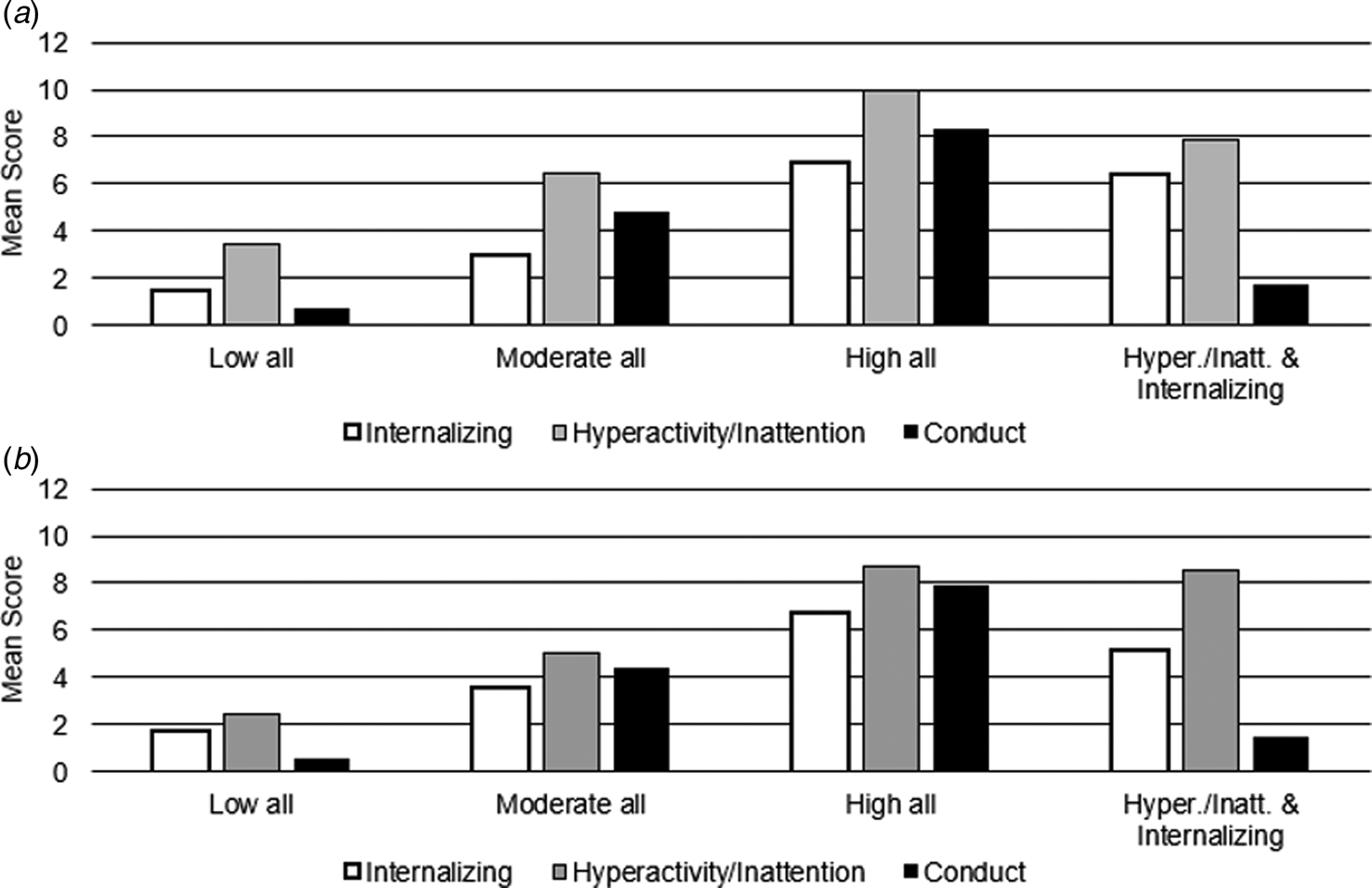
Latent profile fit indices supported a best-fitting, 4-profile model at both ages 6/7 and 10/11 years (online Supplementary Table S1; Figures 1a and 1b). Similar profiles of symptoms were identified at both time points. The first profile, defined as the ‘Low’ group, was the largest profile at both time points and was characterized by individuals who scored low on all three indicators of internalizing and externalizing. The second and third profiles, defined as the ‘Moderate’ and ‘High’ groups, were characterized by consistent elevated scores across time on all three indicators of internalizing and externalizing. Lastly, the final profile was defined as the ‘Hyperactivity/internalizing’ group. These individuals showed patterns of high hyperactivity/inattentiveness, high internalizing, but lower levels of conduct problems. A test of measurement invariance supported a model in which the within-class item means were longitudinally invariant (BIC = 36 075. 77), compared to a variant model (BIC = 44 759.70), suggesting the profiles have the same interpretation and are comparable over time.
(a) Latent profiles at age 6/7 years and (b) latent profiles at age 10/11 years.

With four profiles being identified at each time point, a possible 16 unique transitions were possible (e.g. ‘Low’ to ‘Low’). In order to account for some cell combinations being rare, and similar to what has been done in other research, a collapsing approach was employed whereby 16 transition groups were reduced into five larger transition cluster groups based on the broader qualities of symptomatic changes (Lanza and Collins, Reference Lanza and Collins2008; online Supplementary Table S2). These clusters included (1) stable low symptoms; characterized by being in the ‘Low’ profile at both time points (60.8%), (2) decreasing to low symptoms; characterized from transitioning from any of the three groups experiencing internalizing and externalizing symptoms at age 6/7 to the ‘Low’ profile at age 10/11 (15.7%), (3) increasing from low to symptoms; characterized by individuals who were in the ‘Low’ group at age 6/7 and transitioned into any of the other internalizing and externalizing groups by age 10/11 (9.8%), (4) homotypic; characterized by staying in the same internalizing and externalizing profile across time (7.5%), and (5) heterotypic; transitioning into a different internalizing and externalizing profile across time (6.2%).
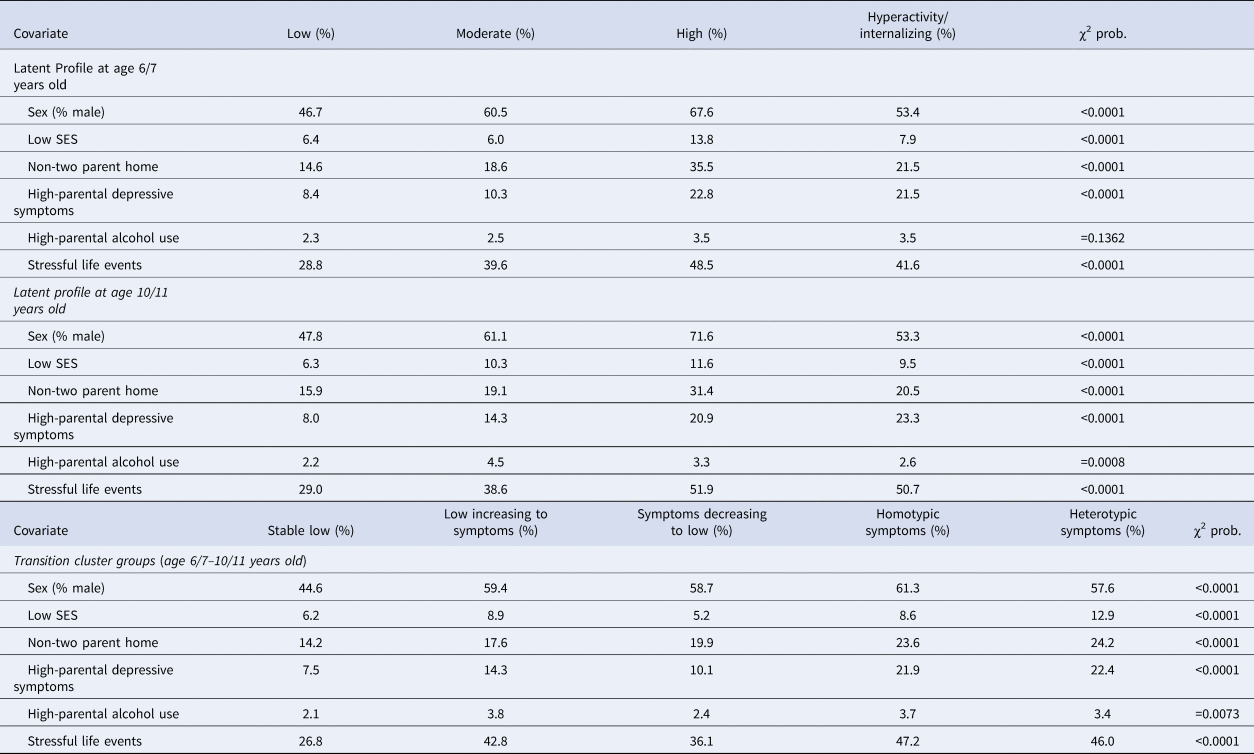
Of those who had complete data on all covariates (n = 7926; 340 cases removed via listwise deletion (4.1%)), 50.5% of the sample were female, 7.1% were from low-SES homes, 17.1% were from single parent homes, 10.5% had a mother with high-depressive symptoms, 2.6% had parental alcohol use, and 32.8% had experienced stressful life events. Several significant and similar associations were found between covariates and latent profiles (at both time points), as well as the transition cluster groups, such that the symptom groups had the higher proportions of low SES, non-two parent homes, high-parental depressive symptoms, and stressful life events, compared with low and stable low groups. Higher proportions of males were observed in the more symptomatic groups (Table 1).
Distribution of covariates in latent profile and transition groups with respective chi-squared (χ2) tests of independence (N = 7926)

Hyperactivity/internalizing: hyperactivity/inattention and internalizing
SES: socioeconomic status
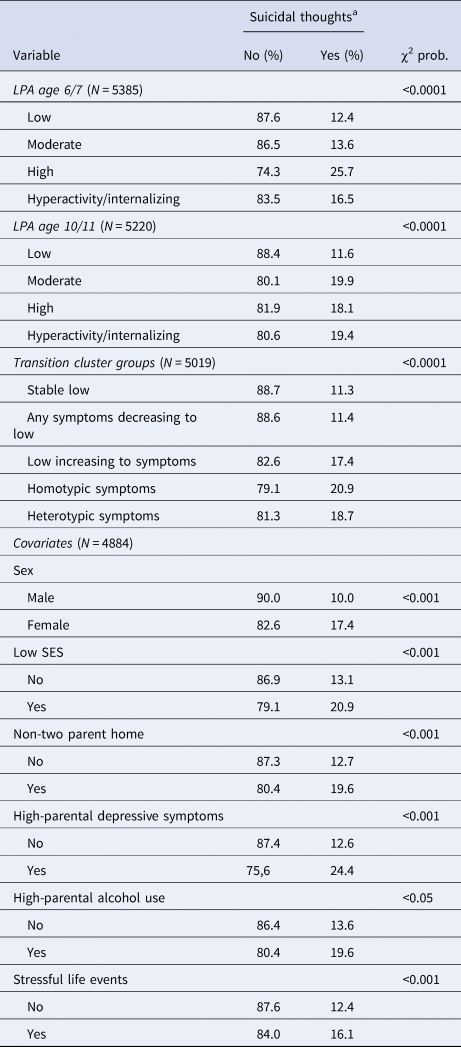
The combined prevalence of suicidal thoughts from ages 12/13 to 14/15 years was 13.8%. The prevalence of suicidal thoughts was higher in the symptomatic profiles/transition groups (Table 2). In relation to the covariates, individuals experiencing suicidal thoughts were more likely to be female, come from non-two parent homes, low-socioeconomic status backgrounds, have a caregiver with high-parental depressive symptoms and high-alcohol use, and to have experienced stressful life events.
Distribution of covariates among adolescents with and without suicidal thoughts, with respective χ2 tests of independence

LPA: latent profile analysis
SES: socioeconomic status
a Prevalence rates are weighted to take into account complex survey design
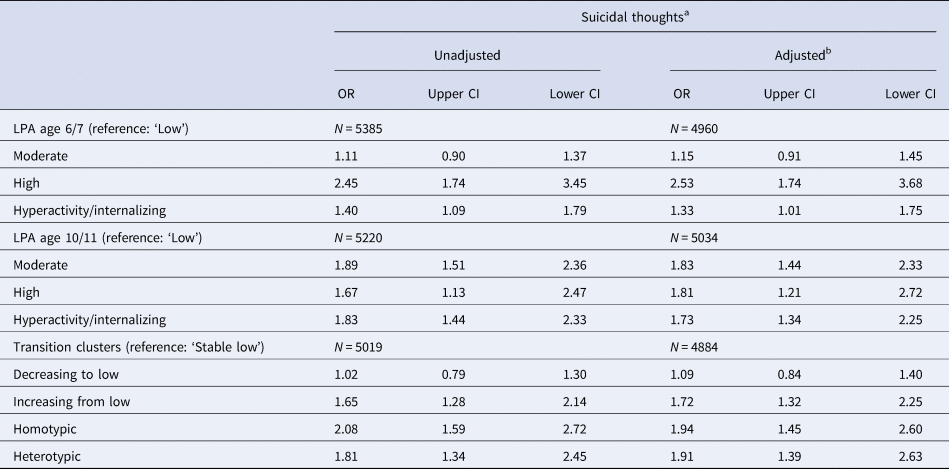
Relative to those in the ‘Low’ profile at age 6/7, individuals in the ‘High’ group showed a two and half fold increase in the odds of suicidal thoughts, while the ‘Hyperactivity/internalizing’ group showed a 33% increase in the odds of suicidal thoughts (Table 3). Increased odds of suicidal thought were not observed in the ‘Moderate’ group. At ages 10/11, belonging to any of the three internalizing and externalizing groups was associated with a 73–83% increase in the odds of suicidal thoughts in adolescence. Similarly, heterotypic, homotypic, and increasing internalizing and externalizing symptom transitions were all associated with between 72–94% increased odds of suicidal thoughts in adolescence compared to those who stayed in the ‘Low’ profile at both time points. Individuals who decreased from an internalizing and externalizing symptom group at age 6/7 to the ‘Low’ profile at age 10/11 did not have increased odds of suicidal thoughts, relative to those who stayed low across both time points. No evidence suggested that there was a difference in the strength of the association with suicidal thoughts based on which significant internalizing and externalizing symptom profile/transition groups the individual belonged to. Sex was not identified as an effect modifier in any association with suicidal thoughts and internalizing/externalizing symptom profiles/transitions. The sensitivity analysis using only those with complete data on suicidal thoughts at both ages 12/13 and 14/15 showed similar results to the original model (online Supplementary Table S3).
Unadjusted and adjusted logistic regression models showing the association between latent profile(s) and transition clusters on suicidal thoughts

CI, confidence interval
Hyperactivity/internalizing: hyperactivity/inattention & internalizing
LPA: latent profile analysis – profiles of internalizing and externalizing symptoms
n: sample size
OR: odds ratio
a Analyses weighted to take into account complex survey design
b Adjusted for gender, socioeconomic status, stressful life events, high-parental depressive symptoms, high-parental alcohol use, and non-two parent household
Non-response analysis
Individuals who dropped out by age 10/11 years were more likely to come from low-socioeconomic backgrounds (p < 0.001) and had significantly higher scores of conduct problems at age 6/7 years (p < 0.05). These individuals did not differ on sex, parental status of the home, hyperactivity/inattention, nor internalizing. When comparing dropouts and responders on outcome data, results showed that dropouts were more likely to be male (p < 0.001), from low-socioeconomic backgrounds (p < 0.001), come from non-two parent homes (p < 0.001), and have mothers who reported more depressive symptoms (p < 0.001). Additionally, dropouts were more likely to belong to the ‘Low’, ‘High’, and ‘Hyperactivity/internalizing’ groups at age 6/7 years (p < 0.0001), but no differences were observed in profile belongingness at age 10/11 years (p = 0.39).
Conclusions
The present study sought out to identify unique profiles of internalizing/externalizing symptoms in childhood, how they changed across time, and their relationship to suicidal thoughts in early adolescence. The results identified four unique profiles of symptoms that were structurally similar at ages 6/7 and 10/11 years. Interestingly, all of them were characterized by varying levels of internalizing and externalizing co-occurrence. Indeed, a commonly reported profile in the CBCL literature is one characterized by high scores of internalizing, conduct problems, and hyperactivity/inattention, often referred to as the dysregulation profile (Biederman et al., Reference Biederman, Wozniak, Kiely, Ablon, Faraone, Mick, Mundy and Kraus1995). The dysregulation profile has been empirically replicated in numerous population and clinical samples (Ayer et al., Reference Ayer, Althoff, Ivanova, Rettew, Waxler, Sulman and Hudziak2009; Althoff et al., Reference Althoff, Rettew, Ayer and Hudziak2010a; De Caluwé et al., Reference De Caluwé, Decuyper and De Clercq2013; Masi et al., Reference Masi, Pisano, Milone and Muratori2015; Bianchi et al., Reference Bianchi, Brambilla, Garzitto, Colombo, Fornasari, Bellina, Bonivento, Tesei, Piccin, Conte, Perna, Frigerio, Castiglioni, Fabbro, Molteni and Nobile2017). While the dysregulation profile is most in line with the ‘High’ profile of the present findings, other latent profile analyses have identified less severe co-occurring groups, similar to our ‘Moderate’ profile (DiStefano and Kamphaus, Reference DiStefano and Kamphaus2006; Mindrila, Reference Mindrila2016). The final profile identified in the present research, defined as the ‘Hyperactivity/internalizing’ profile has also been replicated in other latent research, in which an ‘internal inattentive’ group was identified, characterized by clinically significant levels of depression with moderate symptoms of inattention and anxiety (Ostrander et al., Reference Ostrander, Herman, Sikorski, Mascendaro and Lambert2008). Additionally, other research has reported extensively on the co-occurrence of internalizing symptoms and hyperactivity/inattention in children, particularly in clinical settings (Biederman, Reference Biederman2005; Jarrett and Ollendick, Reference Jarrett and Ollendick2012; Meinzer et al., Reference Meinzer, Pettit and Viswesvaran2014; Steinberg and Drabick, Reference Steinberg and Drabick2015).
The finding that the majority of children stayed in the ‘Low’ group from ages 6/7–10/11 years is consistent with other research (Luby et al., Reference Luby, Mrakotsky, Heffelfinger, Brown, Hessler and Spitznagel2003; Althoff et al., Reference Althoff, Rettew, Faraone, Boomsma and Hudziak2006, Reference Althoff, Verhulst, Rettew, Hudziak and van der Ende2010b; Basten et al., Reference Basten, Althoff, Tiemeier, Jaddoe, Hofman, Hudziak, Verhulst and van der Ende2013, Bonadio et al., Reference Bonadio, Dynes, Lackey, Tompsett and Amrhein2016; Weeks et al., Reference Weeks, Ploubidis, Cairney, Wild, Naicker and Colman2016; Bianchi et al., Reference Bianchi, Brambilla, Garzitto, Colombo, Fornasari, Bellina, Bonivento, Tesei, Piccin, Conte, Perna, Frigerio, Castiglioni, Fabbro, Molteni and Nobile2017). The largest proportion of individuals who were in the ‘Moderate’ or the ‘Hyperactivity/internalizing’ profiles at age 6/7 years also ended up in the ‘Low’ profile by age 10/11 years. This suggests that a substantial proportion of young children may experience a desistance of their elevated internalizing and externalizing symptoms across development. It is also important to note that the largest proportion of individuals in the ‘High’ profile at the first time point was still in this profile at age 10/11 years. This is in line with other research which has showed that children exhibiting high levels of co-occurring internalizing and externalizing are more likely to show persistence in these symptoms across time, relative to those experiencing less severe symptoms (Keenan et al., Reference Keenan, Shaw, Delliquadri, Giovannelli and Walsh1998; Briggs-Gowan et al., Reference Briggs-Gowan, Carter, Bosson-Heenan and Guyer2006; Althoff et al., Reference Althoff, Verhulst, Rettew, Hudziak and van der Ende2010b; Basten et al., Reference Basten, Tiemeier, Althoff, van de Schoot, Jaddoe, Hofman, Hudziak, Verhulst and van der Ende2016).
At age 6/7 years, the ‘High’ and ‘Hyperactivity/internalizing’ profiles were associated with suicidal thoughts. By age 10/11 years, all three of the internalizing and externalizing symptom profiles (‘Moderate’, ‘High’, and ‘Hyperactivity/internalizing’) were associated with suicidal thoughts. While this research cannot determine how these symptoms are related to suicidal thoughts, it does suggest that different patterns of co-occurrence present similar risks in the development of suicidal thoughts. While synergistic effects cannot be accounted for, the fact that the ‘Hyperactivity/internalizing’ showed comparable odds of suicidal thoughts relative to the other two high-symptom profiles, suggests that symptoms of hyperactivity, inattention, and internalizing may be the symptoms of the ‘Moderate’ and ‘High’ profiles which are most strongly associated with suicidal thoughts. Indeed, the literature does support strong associations between internalizing disorders and suicidal thoughts and behaviors, while other research has found similar associations in children with hyperactivity/inattention (Chronis-Tuscano et al., Reference Chronis-Tuscano, Molina, Pelham, Applegate, Dahlke, Overmyer and Lahey2010; Balazs and Kereszteny,Reference Balazs and Kereszteny2017). A systematic review which explored the association between ADHD and suicide found that more than half of ADHD patients also showed patterns of suicide (Balazs and Kereszteny, Reference Balazs and Kereszteny2017). Relevant to the present findings, this research also demonstrated that the association was stronger in the presence of other psychiatric co-occurrences, such as symptoms of internalizing.
Relative to the ‘Stable low’ transition pattern, all transitions were associated with suicidal thoughts except for the ‘Decreasing to low’ transition. The fact that those in the ‘Increasing from low’ group had similar odds of suicidal thoughts to those in the persistent transitions (heterotypic or homotypic), and that the associations were similar to the profiles at age 10/11 years, suggests that the most recent profile/assessment may be as useful of a predictor of suicidal thoughts as the dual-time point transitions. The identification of an association between the age 6/7-year profile and suicidal thoughts may be an indirect one, in that the age 6/7-year profile is associated with the age 10/11-year profile, which in turn, is associated with suicidal thoughts. This suggests that the profile in which an individual is in by late childhood may be more important than earlier patterns of symptoms or transition patterns, at predicting adolescent suicidal thoughts.
Methodological considerations
Drop-out occurred across the eight years of follow-up for this study. Some key differences were identified between those with and without outcome data, such as dropouts being more likely to be males from low-SES, non-two parent households and also have higher rates of parental depressive symptoms. Considering these factors are associated with both the exposure and outcome, the present findings underestimate the true association between internalizing/externalizing symptoms and subsequent suicidal thoughts.
Another limitation of the study was relying on only one reporter at collection of internalizing/externalizing symptoms (i.e. mothers) and suicidal thoughts (i.e. self-reported by child). One contrary finding to some of the other literature studies was the inability to identify an internalizing only profile. Relying only on mother report may be an explanation as it is possible that the symptoms of internalizing are inherently more difficult to identify for an observer, relative to externalizing symptoms. However, evidence does support that caregivers are the best informant when it comes to childhood psychopathology (Smith, Reference Smith2007). Additionally, self-reporting of suicidal thoughts presents the possibility of social desirability bias, and underreporting of the true rate. It is important to note, however, that the respondents were informed that their responses would be kept confidential and following the independent completion of the survey, the respondent sealed their survey in an envelope. Such collection strategies have been suggested as useful precautions to mitigate bias and increase validity (Krumpal, Reference Krumpal2013).
Additionally, cases were grouped into latent profiles based on their most probable profile membership. None of the cases had a perfect posterior probability (p = 1.0) of modal assignment (i.e. belonging to their particular profile), introducing measurement error. However, the literature does support assigning cases to their most probable profile when entropy scores are high, confirming good class delineation (Celeux and Soromenho, Reference Celeux and Soromenho1996; Clark and Muthén, Reference Clark and Muthén2009).
These limitations are offset by some notable strengths, including the large population-based sample, the prospective data collection, and the extensive number of measures and covariates assessed.
Implications
The first noteworthy implication of the present study is that the profiles of internalizing and externalizing symptoms identified emphasize high levels of co-occurrence between internalizing and externalizing symptoms. Despite a large sample and a significant number of symptoms assessed, we were unable to identify profiles of children that could be characterized as only internalizing or only externalizing. As such, it is important that domains of both internalizing and externalizing are considered by stakeholders when designing and implementing population level interventions. Targeting these symptoms earlier in the life course may help to reduce the risk of suicidal thoughts later in adolescence. Beyond this, the findings highlighted that males from impoverished and unstable households were at the highest risk for belonging to symptomatic profiles. This research highlights the need for societal and community changes that positively improve the outlook for at-risk groups, such as community and school programs built to foster self-esteem and resiliency.
Another implication of the present study was the significant proportion of individuals whose internalizing and externalizing symptoms decreased from ages 6/7 to 10/11. Approximately 30% of the sample was in a symptomatic profile at age 6/7, however by age 10/11, half of those had transitioned to the ‘low’ symptom profile. Additionally, these children were not at increased risk of suicidal thought when aged 12 to 15. Alternatively, children who had increasing symptoms or stable symptoms from 6/7 to 10/11 had similar increased risk of suicidal thought. Consequently, symptoms in later childhood may be a more useful predictor of suicidal thought than prediction based on earlier childhood variables or trajectories across two time points. Focused interventions targeted at children with symptoms of mental disorder may be most effective in reducing suicidal thought if delivered in early adolescence (Lewinsohn et al., Reference Lewinsohn, Rohde and Seeley1994; King, Reference King, Maris, Silverman and Canetto1997).
Future research
While the present investigation taken into account the role of internalizing and externalizing trajectories and how they were associated with subsequent suicidal thoughts, future research can expand on this modeling. While the present investigation chose to take a more general approach to problem behaviors in childhood, instead looking at how covariates differed among profile belongingness, future research should explore whether the constructs themselves differ among sex, socioeconomic class, attachment styles, and household structures. Furthermore, it may be interesting to include other indicators of internalizing/externalizing in the model such as relational aggression, or including hyperactivity and inattention as unique constructs – a limitation of the NLSCY dataset. Additionally, it may be interesting to expand on the temporal modeling by exploring the role of neglect/abuse in the household and peer relationships at mediating the effects between internalizing/externalizing and subsequent suicidal thoughts.
Supplementary material
The supplementary material for this article can be found at https://doi.org/10.1017/S0033291719002733