




1 Introduction and result
The Piatetski-Shapiro sequence is defined by
 $$ \begin{align*}\mathbb{N}^c=\{\lfloor n^c \rfloor : n\in\mathbb{N}\},\end{align*} $$
where
 $c\in \mathbb {R}$
is nonintegral,
 $c>1$
and
 $\lfloor z\rfloor $
denotes the integer part of
 $z\in \mathbb {R}$
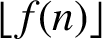
. This sequence was first introduced by Piatetski-Shapiro [Reference Piatetski-Shapiro8] to study prime numbers in a sequence of the form
 $\lfloor f(n) \rfloor $
, where
 $f(n)$
is a polynomial. A positive integer is called square-free if it is a product of distinct primes. The distribution of square-free numbers in the Piatetski-Shapiro sequence has been studied by many authors. Stux [Reference Stux11] was the first to show that, as x tends to infinity,
 $$ \begin{align} \sum_{\substack{n\leq x\\ \lfloor n^c \rfloor \, \text{is square-free}}}1 =\bigg(\frac{6}{\pi^2}+o(1)\bigg)x, \quad \text{for}\ 1<c< \frac{4}{3}. \end{align} $$
In 1978, Rieger [Reference Rieger9] improved the range of validity of (1.1) to
 $1<c<3/2$
, by showing that for real
 $x>1$
, the right-hand side of (1.1) can be replaced by
 $$ \begin{align*} \frac{6x}{\pi^2}+O(x^{{(2c+1)}/{4}+\varepsilon}),\quad \text{for}\ 1<c<\frac{3}{2}. \end{align*} $$
Recently, in [Reference Cao and Zhai2, Reference Cao and Zhai3
], Cao and Zhai used the method of exponential sums to improve this range to
 $1<c< 149/87$
. In another direction, in 2018 Dimitrov [Reference Dimitrov5] proved that for any fixed c with
 $1<c< 7/6$
, there exist infinitely many consecutive square-free integers of the form
 $\lfloor n^c \rfloor , \ \lfloor n^c \rfloor +1$
, by showing that
 $$ \begin{align} \sum_{\substack{x/2 <n\leq x\\ \lfloor n^c \rfloor, \, \lfloor n^c \rfloor+1 \text{ are square-free}}}1=\frac{1}{2}\prod_ p\bigg(1-\frac{2}{p^2}\bigg)x+O(x^{{(6c+1)}/{8}+\varepsilon}),\quad \text{for}\ 1<c<\frac{7}{6}. \end{align} $$
In the present paper, we use Rieger’s technique in [Reference Rieger9] to improve the range of c and the error term in Dimitrov’s result in (1.2).
Theorem 1.1. For
 $1<c< 3/2$
and sufficiently small
 $\varepsilon>0$
,
 $$ \begin{align*} \sum_{\substack{n\leq x\\ \lfloor n^c \rfloor, \, \lfloor n^c \rfloor+1 \, \text{\rm are square-free}}}1=\prod_ p\bigg(1-\frac{2}{p^2}\bigg)x+O(x^{{(2c+1)}/{4}+\varepsilon})\quad \mbox{as } x\to \infty. \end{align*} $$
In passing, let us mention that Heath-Brown in [Reference Heath-Brown7] has derived an asymptotic result about the distribution of consecutive square-free numbers with the same main term as ours.
2 Preliminaries
Throughout, let
 $\varepsilon $
be an arbitrary, small positive number, not necessarily the same in different occurrences. We use the notation
 $f(x)=O(g(x))$
and
 $f(x)\ll g(x)$
if for all
 $x\geq 1$
there exists a positive
 $C\in \mathbb {R}$
such that
 $|f(x)|\leq Cg(x)$
. We allow the constants implied by O and
 $\ll $
to depend on
 $\varepsilon $
.
The main ingredient in our proof is an estimate for the number of integers n up to x such that
 $\lfloor n^c \rfloor $
belongs to an arithmetic progression. The approach of Rieger is refined by Deshouillers in [Reference Deshouillers4, Claim 1] as given in the following lemma.
Lemma 2.1. [Reference Deshouillers4]
For
 $1<c<2$
, let x be a positive real number and let q and a be two integers such that
 $0\leq a<q\leq x^c$
. Then
 $$ \begin{align*} \sum_{\substack{n\leq x\\ \lfloor n^c \rfloor\equiv\, a\pmod q }}1=\frac{x}{q }+\begin{cases} O \bigg(\dfrac{x^{(c+4)/7}}{q^{1/7}}\bigg)\quad & \text{for } q<x^{c-5/4}, \\[8pt]O \bigg(\dfrac{x^{(c+1)/3}}{q^{1/3}}\bigg) \quad&\text{for }\, x^{c-5/4}\leq q<x^{c-1/2}, \\[8pt]O \bigg(\dfrac{x^{c}}{q}\bigg)\quad &\text{for } x^{c-1/2}\leq q<x^{c}. \end{cases} \end{align*} $$
We will also use the following upper bound.
Lemma 2.2. [Reference Shapiro10, Exercise 9, page 50]
For each
 $\varepsilon>0$
, there exists a constant
 $C_\varepsilon>0$
such that for all
 $n\geq 1$
,
 $$ \begin{align*}d(n)\leq C_\varepsilon n^\varepsilon.\end{align*} $$
Lemma 2.3. For a fixed real
 $y>1$
,
 $$ \begin{align*} \sum_{\substack{d,\,t \\ \gcd(d,t)=1 \\ dt\leq y}} \frac{\mu(d)\mu(t)}{d^2t^2}=\prod_{p\ \text{prime}}\bigg(1-\frac{2}{p^2}\bigg)+O(y^{-1+\varepsilon}). \end{align*} $$
Proof. We have
 $$ \begin{align*} \sum_{\substack{d,\,t \\ \gcd(d,t)=1 \\ dt\leq y} } \frac{\mu(d)\mu(t)}{d^2t^2}&=\sum_{\substack{d,\,t \\ \gcd(d,t)=1}}\frac{\mu(d)\mu(t)}{d^2t^2}-\sum_{\substack{dt> y \\ \gcd(d,t)=1}}\frac{\mu(d)\mu(t)}{d^2t^2}\\ &=\sum_{\substack{d,\,t \\ \gcd(d,t)=1}}\frac{\mu(d)\mu(t)}{d^2t^2}+O\bigg(\Big|\sum_{m> y }\frac{d(m)}{m^{2}}\Big|\bigg). \end{align*} $$
In view of Lemma 2.2, the error term can be replaced by
 $$ \begin{align*}O\bigg(\Big|\sum_{m> y}m^{-2+\varepsilon}\Big|\bigg)= O(y^{-1+\varepsilon})\end{align*} $$
and so, using also [Reference Apostol1, Theorem 11.7, page 231],
 $$ \begin{align*} \sum_{\substack{d,\,t \\ \gcd(d,t)=1 \\ dt\leq y} } \frac{\mu(d)\mu(t)}{d^2t^2} =\sum_{m=1 }^{\infty}\frac{\mu(m)d(m)}{m^2}+O(y^{-1+\varepsilon})=\prod_{p}\bigg(1-\frac{2}{p^2}\bigg)+O(y^{-1+\varepsilon}).\\[-64pt] \end{align*} $$
Lemma 2.4. Let
 $1<c<2$
and let x be a positive real number.
-
(I) If
 $A_{c}^{2}(x)$
denotes the number of quadruples
$d,t,u,v$
of positive integers satisfying the conditions (2.1)then
$$ \begin{align} t^2v-d^2u=1,\quad d^2u\leq x^c,\quad x^{c/2}<dt\leq x^{2c/3}, \end{align} $$
$$ \begin{align*} A_{c}^{2}(x)\ll x^{2c/3+\varepsilon}. \end{align*} $$
-
(II) If
$A_{c}^{3}(x)$
denotes the number of quadruples
$d,t,u,v$
satisfying the conditions (2.2)then
$$ \begin{align} t^2v-d^2u=1,\quad d^2u\leq x^c,\quad dt> x^{2c/3}, \end{align} $$
$$ \begin{align*} A_{c}^{3}(x)\ll x^{2c/3+\varepsilon}. \end{align*} $$


Proof. (I) For any fixed choice of positive integers d and t satisfying (2.1), the condition
 $d^2u \equiv -1 \pmod {t^2}$
fixes the value of u modulo
 $t^2$
. Thus, by the conditions in (2.1), the total number of possibilities for u is
 $O(1+x^c/d^2t^2)$
. By (2.1), the value of v is fixed for any given
 $d, t, u$
. Thus,
 $$ \begin{align*} A_{c}^{2}(x)\ll \sum_{x^{c/2}< dt \leq x^{2c/3}}(1+x^c/d^2t^2)\ll x^{2c/3+\varepsilon}+x^{c/2+\varepsilon}\ll x^{2c/3+\varepsilon}. \end{align*} $$
(II) From (2.2),
 $uvd^2t^2\leq x^c(x^c+1)$
, whence
 $uv\leq x^c(x^c+1)x^{-4c/3}$
for any quadruple counted by
 $A_{c}^{3}(x)$
. The total number of choices for
 $u,v$
is therefore bounded by
 $O(x^{2c/3+\varepsilon })$
, by a divisor argument. For any such choice of
 $u, v$
, the number of solutions in
 $d, t$
of the equation
 $t^2v-d^2u=1$
is
 $O(x^\varepsilon )$
(see, for example, [Reference Estermann6]).
3 Proof of Theorem 1.1
For
 $1<c< 3/2$
and
 $x\geq 1$
, let
 $$ \begin{align*} T_{c}(x):=\sum_{\substack{n\leq x\\ \lfloor n^c \rfloor, \, \lfloor n^c \rfloor+1 \, \text{are square-free}}}1. \end{align*} $$
Since, from [Reference Shapiro10, page 290],
 $$ \begin{align*}\sum_{d^2\mid n}\mu(d)=\mu^2(n)=\begin{cases}1&\text{if}\ n\ \text{is square-free},\\ 0&\text{otherwise} \end{cases} \end{align*} $$
is the characteristic function of the set of square-free numbers,
 $$ \begin{align*} T_{c}(x)&=\sum_{n\leq x}\sum_{d^2\mid \lfloor n^c \rfloor}\mu(d)\sum_{t^2\mid \lfloor n^c \rfloor+1}\mu(t)=\sum_{\substack{d,\,t \leq x^{c/2} \\ \gcd(d,t)=1}}\mu(d)\mu(t)\sum_{\substack{n\leq x \\ \lfloor n^c \rfloor\,\equiv\, 0 \pmod {d^2}\\ \lfloor n^c \rfloor+1\,\equiv\, 0 \pmod {t^2}}}1\\ &=\bigg(\sum_{\substack{d,\,t\leq x^{c/2} \\ \gcd(d,t)=1\\dt\leq x^{c/2}}}+\sum_{\substack{d,\,t \leq x^{c/2} \\ \gcd(d,t)=1\\x^{c/2}<dt\leq x^{2c/3}}}+\sum_{\substack{d,\,t \leq x^{c/2} \\ \gcd(d,t)=1\\dt>x^{2c/3}}}\bigg)\mu(d)\mu(t)\sum_{\substack{n\leq x \\ \lfloor n^c \rfloor\,\equiv\, 0 \pmod {d^2}\\ \lfloor n^c \rfloor+1\,\equiv\, 0 \pmod {t^2}}}1. \end{align*} $$
In view of Lemma 2.4,
 $$ \begin{align} T_{c}(x)=\sum_{\substack{d,\,t \leq x^{c/2} \\ \gcd(d,t)=1\\dt\leq x^{c/2}}}\mu(d)\mu(t)\sum_{\substack{n\leq x \\ \lfloor n^c \rfloor\,\equiv\, 0 \pmod {d^2}\\ \lfloor n^c \rfloor+1\,\equiv\, 0 \pmod {t^2}}}1+O(x^{2c/3+\varepsilon}). \end{align} $$
By the Chinese remainder theorem, there is a positive integer
 $\alpha $
, unique modulo
 $d^2t^2$
, satisfying the congruence system
 $\alpha\, \equiv \, 0 \pmod {d^2}$
and
 $\alpha +1\,\equiv \, 0 \pmod {t^2}$
. Thus,
 $$ \begin{align} &\sum_{\substack{d,\,t \leq x^{c/2}\\ \gcd(d,t)=1\\dt\leq x^{c/2}}}\mu(d)\mu(t)\sum_{\substack{n\leq x \\ \lfloor n^c \rfloor\,\equiv\, 0 \pmod {d^2}\\ \lfloor n^c \rfloor+1\,\equiv\, 0 \pmod {t^2}}}1 :={\sum_{dt\leq x^{c/2}}}^{\!\!\!*} \,\mu(d)\mu(t)\sum_{\substack{n\leq x \\ \lfloor n^c \rfloor\,\equiv\, \alpha \!\pmod{d^2t^2} }}1, \end{align} $$
where we use the abbreviated summation sign
 $\sum ^*=\sum _{d,\,t \leq x^{c/2}, \,\gcd (d,t)=1}$
. Next we use Rieger’s technique to strategically split the right-hand sum of (3.2) into three sub-sums, so that the right-hand side of (3.2) becomes
 $$ \begin{align} \bigg({\sum_{ dt\leq x^{c/2-5/8}}}^{\hspace{-10pt}*}\quad +{\sum_{ x^{c/2-5/8}<dt\leq x^{c/2-1/4}}}^{\hspace{-23pt}*} \qquad +{\sum_{ x^{c/2-1/4}<dt\leq x^{c/2}}}^{\hspace{-17pt}*} \quad \ \bigg) \mu(d)\mu(t) \sum_{\substack{n\leq x \\ \lfloor n^c \rfloor\,\equiv\, \alpha\;(\bmod d^2t^2)}} 1. \end{align} $$
Computing the three sums in (3.3) using Lemma 2.1 gives
 $$ \begin{align} &{\sum_{dt\leq x^{c/2-5/8} }}^{\hspace{-10pt}*}\quad \mu(d)\mu(t)\bigg(\frac{x}{d^2t^2}+O(x^{(c+4)/7}d^{-2/7}t^{-2/7})\bigg)\notag\\ &\qquad +{\sum_{x^{c/2-5/8}<dt\leq x^{c/2-1/4}}}^{\hspace{-23pt}*}\qquad\ \mu(d)\mu(t)\bigg(\frac{x}{d^2t^2}+O(x^{(c+1)/3}d^{-2/3}t^{-2/3})\bigg) \notag\\ \notag &\qquad +{\sum_{x^{c/2-1/4}<dt\leq x^{c/2}}}^{\hspace{-18pt}*} \qquad \mu(d)\mu(t)\bigg(\frac{x}{d^2t^2}+O(x^{c}d^{-2}t^{-2})\bigg)\\ \notag &\quad =x {\sum_{dt\leq x^{c/2}}}^{\hspace{-4pt}*}\ \ \frac{\mu(d)\mu(t)}{d^2t^2}+O\bigg(x^{(c+4)/7}{\sum_{dt\leq x^{c/2-5/8}}}^{\hspace{-10pt}*}\quad d^{-2/7}t^{-2/7}\bigg)\\ &\qquad +O\bigg(x^{(c+1)/3} {\sum_{x^{c/2-5/8}<dt\leq x^{c/2-1/4} }}^{\hspace{-23pt}*} \qquad d^{-2/3}t^{-2/3}\bigg)+O\bigg(x^c {\sum_{ x^{c/2-1/4}<dt\leq x^{c/2} }}^{\hspace{-18pt}*}\quad d^{-2}t^{-2}\bigg). \end{align} $$
Using similar computations together with Lemma 2.2,
 $$ \begin{align} {\sum_{dt\leq x^{c/2-5/8}}}^{\hspace{-10pt}*}\quad d^{-2/7}t^{-2/7} &\ll \sum_{m\leq x^{c/2-5/8}}d(m) m^{-2/7} \ll \sum_{m\leq x^{c/2-5/8}} m^{-2/7+\varepsilon}\ll x^{5c/14-25/56+\varepsilon} , \end{align} $$
 $$ \begin{align} {\sum_{x^{c/2-5/8}<dt\leq x^{c/2-1/4}}}^{\hspace{-23pt}*}\qquad d^{-2/3}t^{-2/3} &\ll \sum_{ x^{c/2-5/8}<m\leq x^{c/2-1/4}}m^{-2/3+\varepsilon}\ll x^{c/6-1/12+\varepsilon}, \end{align} $$
 $$ \begin{align} {\sum_{x^{c/2-1/4}<dt\leq x^{c/2}}}^{\hspace{-18pt}*}\qquad d^{-2}t^{-2} &\ll \sum_{x^{c/2-1/4}<m\leq x^{c/2}}m^{-2+\varepsilon}\ll x^{-c/2+\varepsilon}. \end{align} $$
Inserting (3.5), (3.6) and (3.7) into (3.4), we get from (3.1),
 $$ \begin{align*} T_{c}(x)\notag &=x{\sum_{dt\leq x^{c/2}}}^{\hspace{-5pt}*}\ \ \frac{\mu(d)\mu(t)}{d^2t^2}+O(x^{c/2+1/8+\varepsilon})+O(x^{c/2+1/4+\varepsilon})+O(x^{2c/3 + \varepsilon})\\ &=x{\sum_{ dt\leq x^{c/2}}}^{\hspace{-5pt}*}\ \ \frac{\mu(d)\mu(t)}{d^2t^2}+O(x^{c/2+1/4+\varepsilon}). \end{align*} $$
The theorem follows at once by appealing to Lemma 2.3.