Introduction
It is widely acknowledged that the military machines of nation-states in the Great War lived and died by their urban constituencies. Large industrial populations filled the ranks of the armed forces; they manufactured the material for war by attrition. Scholarship continues to open up new ways of understanding the importance of ‘the urban’ to national war efforts: the resilience of wartime societies is explicated in terms of urban hierarchies and elites; urban spaces can be explored experientially to view the cultural processes that bound nations together and alleviated war's pressures.Footnote 1 Considering this new emphasis on the centrality of the city, and the totalizing nature of the war experience, however, we know less about how the legacy of the Great War played out within these mobilizing leviathans than we probably should. A great deal of the literature on commemoration is predicated on urban examples;Footnote 2 historians of war and remembrance are increasingly turning their attention city-wards.Footnote 3 But there is little evidence that urban historians are similarly preoccupied with the Great War. Brad Beaven has recently examined urban mobilization during both the Boer War and the Great War to analyse urban imperial patriotism, but an integrated account of war memory and urban space remains long overdue.Footnote 4
This article will argue that uniting perspectives on war commemoration and urban history can enrich both areas of scholarship. The example of Glasgow's military associations, and their public culture, shows how urban contexts shaped memory and remembrance. Cities, through their political and social dynamics and their patterns of militarization, generated alternative channels for the veteran associational impulse to the British Legion, which has generally been seen as synonymous with the veterans’ movement in Britain. A growing reassessment of the continuing importance of inter-war urban society, government and civic identity within urban history presents an opportunity to rethink veteran politics and identity, as well as war commemoration, in Britain.Footnote 5 Cities spun their own war myths; they did not follow a national template when it came to war commemoration. But the story of Glasgow's military associations and their veteran communities also illuminates inter-war civic-ness from another vantage point, highlighting the particular urban dynamics of that period and the interrelationship between civic and military. This is the story of how Glasgow's military associations dominated representations of the veteran in the city's public culture. This activity throws light on civic culture of the twentieth century and the ‘mythological nexus’ that constituted the public imaginary of war after 1918. Footnote 6
Patterns of veteran association in Glasgow
Glasgow housed a substantial veteran population after 1918. The city had carried the torch for Scotland's mobilization in the voluntary phase, spearheaded by its large industrial workforce but sustained by the commercial and local government workforce.Footnote 7 In total, the city contributed 26.6 per cent of Scotland's total manpower to the British army in the period up to December 1915, some 83,318 men.Footnote 8 But its importance as a transport and distribution hub, and significant links to the war machine, probably did much to lower recruitment levels in Scotland from 26.9 per cent in the voluntary phase to 14.6 per cent after 1916.Footnote 9 Even so, at the end of 1918, before demobilization depleted the ranks, the Return of Parliamentary and Local Government Electors listed 102,739 absent naval and military voters in Glasgow, nearly a third of all male voters in the city and 24 per cent of all Scottish counties.Footnote 10 Veteran population was, of course, likely to be far higher: the Return did not encompass men who, whether from illness or injury, had been discharged before the war ended. In 1927, Glasgow's King's Roll Scheme boasted of 9,000 such men, which is suggestive of a far higher number.Footnote 11 Two years later, the closure of the Ministry of Pensions’ Bellahouston hospital (a wartime construction in the city's south-side park) occasioned a storm of protest from those who understood the high levels of local need.Footnote 12
Numbers fluctuated during the years, but certainly remained high. Those departing from Glasgow's quaysides to seek better fortunes overseas, at a peak in the 1920s, must have contained a significant veteran section: they were predominately drawn from the city's young, single men whose age would have qualified them for service, at least in the latter part of the war.Footnote 13 However, with so many drawn from the skilled workforce of the shipyards and subsidiary industries, it is likely that the ex-service element was proportionally lower than it might otherwise have been.Footnote 14 Additionally, the Depression's global reach did much to keep men where they were, whilst simultaneously returning a fair number of the 1920s exodus to their origins.Footnote 15 Differences in union membership and local government housing conspired to keep many men north of the border, and Glasgow's relatively diverse economy, which offered vitality in areas such as commerce and the service sector, probably attracted many to the city from elsewhere.Footnote 16
Despite the strength of their numbers, Glasgow's veterans seemed disinclined to align their interests with party politics – a tendency certainly not unique to the ‘Second City’.Footnote 17 The veteran, in the guise of the newly demobilized skilled worker without prospects, was the cause célèbre of the Scottish Trade Union Congress and Clyde Worker's Committee strike in demand for the 40-hour working week. But government fears that grievances of demobilization would unleash a maelstrom of discontent on the city's streets proved unfounded: ‘Red Clydeside’ in 1919 had more to do with the anxieties of engineers.Footnote 18 If Glasgow's ex-service population failed to fan the flame of revolution, neither did they buck the Scottish trend of avoiding the British Legion (Scotland). Figures are hard to come but the city's membership was certainly low: not one of the city's nine branches had reached the 200 mark by 1930.Footnote 19 Aggregate membership may have exceeded the desultory 2 per cent participation rate estimated by Niall Barr for Scotland, but it was hardly a beacon of associational vibrancy.Footnote 20
Neither the left, nor the Legion, represented the only channels for the associational impulse, however. Whilst the plethora of urban pursuits available to the ex-serviceman probably did sap the Legion's strength, as Barr has suggested, another draw came from urban-based rival groups.Footnote 21 Most important in terms of membership and public reach were the various and diverse manifestations of military associations in the city. Foremost in these were ‘regimental associations’. Emanating from the idiosyncratic organization of the British regimental system, and steered by colonels and commanding officers, these constructed and disseminated notions of the regimental family through cultural work.Footnote 22 Veterans, and their support, mattered to these associations, not least because they had an important ideological role within the military group: they represented the future of a military career. Taking as an example the aims of the Argyll and Sutherland Highlanders, who were explicit on the issue, the commitment to ‘help old soldiers. . .when in difficulties financial or otherwise’ was partly ‘to assist recruiting [my italics] by showing that the interests of men who have served in the Regiment are not forgotten when they return to civilian life’.Footnote 23 This had ramifications at ground level. In their quest to create the regimental family, and promote foundational military virtues such as comradeship and esprit de corps, executives authorized voluntary branches. Groups of interested veterans could apply for recognition to create branches in local areas. Local Territorial units, of which Glasgow boasted many, might also found independent ‘Old Comrades Associations’ for the same purpose.
Glasgow did well for regimental associations. By the mid-1920s, 11 Scottish infantry regiments and 1 yeomanry regiment fielded branches in the city: Argyll & Sutherland Highlanders, Black Watch, Cameronians (Scottish Rifles), Gordon Highlanders, Highland Light Infantry (HLI), King's Own Scottish Borderers (KOSB), Queen's Own Cameron Highlanders (QOCH), Royal Scots Fusiliers, Royal Scots Greys, Royal Scots Regiment, Scots Guards, and Seaforth Highlanders. Additionally, support units – the Royal Army Service Corps, Royal Engineers (RE) and Royal Artillery – also formed branches in that decade. Territorial units (the 6th and 7th HLI) had their own regular associations. Further service-based associations joined these in the 1930s: a Scottish branch of the Royal Tank Corps Comrades Club was founded in the city in 1932;Footnote 24 Glasgow formed its own branch of the RAF Comrades in 1934, two years after the foundation of the national association;Footnote 25 a Glasgow & District Naval Association predated the formation of a national organization by a number of years.
Membership levels are difficult to establish. Niall Barr relied on affiliation fees in his estimation of membership in the British Legion – this methodology cannot be replicated in the case of diverse associations with no centralized bureaucracy.Footnote 26 Of course, that these aforementioned branches sustained life over two decades is suggestive: a branch of the London Scottish in Glasgow, for instance, initiated in the early 1920s, had to be revived in 1936.Footnote 27 But we can glean enough information from regimental journals and newspaper reports that offer some idea of the significance of this form of veteran association, as well as a sense of the ebb and flow of membership. In 1926, the HLI Association noted club membership at over 500, the majority of which would have been veteran members.Footnote 28 The Seaforths returned just over 360 members at the end of 1926.Footnote 29 This had dipped to 270 by the end of 1932, but rose again to 307 by the end of the decade.Footnote 30 The RE branch, established in the later part of the 1920s, recorded a rise in membership from c. 150 in 1927 to 247 in 1928.Footnote 31 Aggregate QOCH Association (Glasgow branch) can be counted at 866 from 1920 to 1939 – they recorded all new members in their journal.Footnote 32 In 1927, the Scots Guards Association celebrated 852 members joining since foundation in 1910.Footnote 33 Some branches were smaller than others: the KOSB, which annually published its figures in its journal, maintained a membership of just under 150 throughout the latter part of the 1920s.Footnote 34
Regimental branches were not the only option for the veteran keen to reconnect with service past. Those who had served in units specific to wartime manifested their own associational life. An association was founded around the 15th HLI, which had been raised from the city's Tramways department, by the mid-1920s: their society was based in the city's Tramways depots.Footnote 35 Its members’ roll had reached 401 by the start of 1926; it stood at over 600 by 1933.Footnote 36 The 16th and 17th HLI battalions also had their associations, with a regular social life, although less can be known about them.Footnote 37 About 150 members of the 17th HLI Association sat down to dinner in 1924, which is suggestive of a higher total membership.Footnote 38 Some met only annually. A group of 12 wounded members of the 5th QOCH's Loos contingent, who met in 1916 in one of Glasgow's military hospitals, founded a reunion that was to be observed each year by a growing band of comrades.Footnote 39 In 1930, the 6th QOCH followed suit with the establishment of the 6th QOCH Reunion Club. Their membership roll, although containing 364 names, listed 269 men who were engaged in reunion life: half of these had attended at least one out of two gatherings from 1931 to 1939.Footnote 40 Some 80 members of the 1/5th Seaforths first met in Glasgow in 1937.Footnote 41 The 10th Black Watch, although not a home-grown unit, met every year in the city from 1935: in 1938, they attracted 170 former members.Footnote 42 All of these were separate from regimental associations, but they retained important cultural and social links.
This is not an exhaustive account of military associations in the city. In fact, there were probably upwards of 36 operating in the city regularly in the inter-war years. The diversity of regimental system obscures the existence of many. The 404 Highland RE and 9th (Service) battalion Cameronians were advertising for former members in the Daily Record in December 1934, for instance, but their history has been difficult to trace. Additionally, there were associations that, whilst not directly related to past or present military infrastructure, shared organizational and cultural roots. Branches of the national level Military Medallists, War Honours Association and DCM League (for recipients of the Distinguished Conduct Medal) were founded in Glasgow in the early 1930s. A branch of the national South African War Veterans Association, which encouraged local endeavours in a similar way to regimental associations, had arrived on the scene by 1934.
These associational forms flowed from historic patterns of urban militarization, and civic-military effort, in Glasgow that dated back well before the Great War. It is no surprise, for instance, that the HLI's branch did well: the regiment had been tied to the city since the nineteenth century, when the volunteer movement, itself a significant civic force, had been harnessed to it. Five battalions received war honours for South Africa (1899–1902), their members added to the roll of 1034 of those who were awarded burgess tickets for their voluntary efforts.Footnote 43 After 1907, Glasgow possessed five HLI Territorial battalions, and most of the city's service battalions were raised under regimental auspices. Such links remained strong after 1918. In 1920, the regiment cemented its Cardwell–Childers connections by moving its base to Maryhill, a northern suburb of Glasgow. Such grounding probably helped sustain momentum within the regimental association, as the pool of potential members was always increasing.Footnote 44 The same could be said of the Cameronians, which recruited from Lanarkshire, and which fielded two Territorial battalions, with similar civic-military credentials, in the city after 1920. Associations of the specialist support arms, like the Royal Engineers or Artillery, may have benefited from the high levels of skilled recruitment in the city during the war, but these too had volunteer traditions, including service in South Africa, and Territorial infrastructure, to sustain them. All these connections fostered a wider associational growth, notably service battalions, but also the South African War Veterans Association branch, which may have originated with those volunteer veterans: the branch met in the Territorial drill halls and maintained close social links with these units.
This was a multilayered legacy of militarization. The new connections between the city and regiments forged during the Great War, especially the QOCH and the Seaforth Highlanders, shone through the associational record. But there was a general reinvigoration of martial tradition in play. The tendency of Scottish men to serve in Scottish units may have concentrated veteran communities in a way that encouraged such associational life.Footnote 45 Four regimental branches in Glasgow, after all, had predated the war: the Gordon Highlanders (1897), the QOCH (1900), the KOSB (1908) and the Scots Guards (1910). The volunteer phase of the Great War had not only played on these traditions; the army had institutionalized them afterwards. It is likely that post-1917 recruitment and drafting procedures circulated Scottish men within the regiments of Scottish Command.Footnote 46 Whatever the city's veteran population, therefore, it was always likely to contain high numbers of men who had served in a set number of regiments. This encouraged regiments to concentrate resources.
These factors generated recruitment potential, but what made the choice for those veterans who joined was what the associations had to offer. Both associations and Legion presented routes to employment and relief, should veterans fall on hard times. Many regimental associations had affiliated with the British Legion (Scotland) by the latter part of the 1930s to co-ordinate these efforts, although membership was counted separately.Footnote 47 As Barr has shown, lack of control of patronage constrained the Legion in Scotland.Footnote 48 It may be that regimental associations, many of which had access to various low-level pots of charity, might have trumped the Legion in this regard. But what sustained branch life, underpinning notions of ‘comradeship’ in times of peace, was the lively programme of social events and recreational pursuits, which drew directly from urban leisure forms. Both associations offered concerts, whist drives, teas and dances to ‘dancin’ daft’ Glaswegians.Footnote 49 Both encouraged a familial atmosphere, running Christmas treats for children and family picnics in the summer. In the competition for veteran leisure, however, military associations were better resourced to found clubs in the city, a few with generous licensing permits. By 1938, roughly 15 per cent of Glasgow's 74 licensed clubs belonged to military associations.Footnote 50 All offered billiards tables, and inter-associational matches. Billiards was obviously popular in Glasgow – the city registered 98 halls in 1932.Footnote 51
These tactics did not create Glasgow in micro, neither did they resurrect the armies of 1914–18. Biographical research is difficult to conduct across the board, but many branch secretaries seem to have been drawn from the former professional non-commissioned officer (NCO) – itself a liminal social identity in the civilian world. Former officers, most of them volunteers rather than professionals, provided leading figures on committees: Norman Macleod, president of the QOCH branch for over 20 years, was a prominent chartered accountant; Iain Galbraith, president and secretary for the Scots Guards, was a solicitor and city councillor; Edward Cotching, a wartime officer of the Seaforth Highlanders who sat on the committee, was a city wine merchant. Both these presided over associations that were dominated by a spectrum of middle-class identities. There were strong membership clusters in the city's public service: the 15th HLI Association's connections with Tramways has been outlined, but the Seaforths and Scots Guards had strong connections with Glasgow's Police. A small occupational sample of QOCH membership, the only regiment to publish such details with regularity, can be obtained from 68 service records and 22 entries from Kelly's Directory, which are all that can be identified with certainty. This suggests that the association was evenly divided between working-class, lower-middle-class and upper-middle-class occupations.Footnote 52 This was socially distinct, but diverse enough to realize ‘comradeship’ as an inter-class military virtue.
The prevalence of lower-middle-class membership is suggestive. It may be that ‘the spirit of 1914’, in terms of middle-class patriotism, was making itself felt in this British context. It was, after all, service battalions most connected with middle-class volunteer action that associated.Footnote 53 A small sample of medal index cards of those listed on the QOCH members roll from the 5th, 6th and 7th (Service) battalions reveals a bias towards those who were first off the boat in France.Footnote 54 Perhaps those who joined before war's meaning became complicated by industrial slaughter could retain belief in the cause; perhaps the connections between place, military infrastructure and people that had produced the units in the first instance were replicating themselves afterwards. For these men, it was not that the low-grade militarism of the British Legion, or their memories of the war, deterred them from joining the umbrella organization; the Legion was not specific or military enough.
The public culture of military associations
Even when the diversity of veteran associations is acknowledged, their public life is never realized. Recently, John Horne recognized the existence of veterans’ ‘organisations by civil profession and also by rank and regiment’ but continues to say: ‘with a few exceptions, the associations that prevailed at a national level over-rode this basic complexity’.Footnote 55 National, and international, stages were crucial to veteran politics, but a new emphasis on inter-war urban society, municipal government and civic identity can lead us to appreciate another important arena where this legacy of the war played out in inter-war Britain. As this example shows, civic contexts were integral in shaping representations of veteran-hood in the post-war world. Glasgow's veteran membership of military associations found themselves supported by a number of different civic elements, reflective of the tensions within the political and religious life of the city. If inter-war Glasgow's public culture has been firmly associated with leftist politics, gang warfare, sectarian and football violence, this history reveals the latent conservatism that was a prominent part of its corporate identity in the inter-war years.
Glasgow's various military associations asserted identity and claims for civic recognition in two very public ways: through reunions and via remembrance parades. This perspective on the two pillars of post-war commemoration goes against the grain of scholarship, which has tended to emphasize the emotional, rather than the ideological, functions of such acts.Footnote 56 Reunions are usually related in terms of their interiority, with autobiographical and academic accounts noting their emotional, subjective power.Footnote 57 Likewise, congregating around war memorials has rarely been seen as a primary moment of veteran identity politics: historians who have studied Armistice Day refer to the ‘marginalization’ of ex-service elements in favour of the bereaved.Footnote 58 Glasgow's veteran public culture is interesting, not only because it offers clear examples of ways in which veterans dominated remembrance at other times and how the urban sphere was a productive arena for commemoration. It also indicates how war's legacy took another political route, and the indivisibility of the emotional from the ideological.
By 1930, the social traffic relating to the reunion culture of military associations had become so considerable that the Daily Record inaugurated an ‘Old Comrades Association’ column to reduce the pressure on their classifieds pages. This did not encompass the totality of veteran sociability (some groups, for instance, did not advertise in it), but examining it can give some idea of the way in which remembrance was a year-round affair in city life. Reunions clustered around existing urban practices of sociability in the winter and spring periods, seasons of work place, employer or associational dinners and dances, very much part of Glasgow's corporate identity in the inter-war years (Figure 1).Footnote 59 December, which in 1934 was particularly lacking in reunions, saw these groups engage in the practice of annual Christmas treats for members’ families. In this, military associations were little different from other urban groups: their reunions joined the dinners and dances of work places, political and associational groups in the urban calendar.
Glasgow-based annual reunions advertised in the ‘Old Comrades Associations’ column of the Daily Record, 1934.

Such public congregations were crucial ways of underlining vitality, and local belonging, but also celebrating the ‘wonderful spirit of comradeship’ that each association claimed to exemplify.Footnote 60 Care was taken, therefore, to ensure attendance was as large as possible. This necessitated making efforts to put evening dining, even more socially exclusive in the inter-war years, within the reach of as many as possible.Footnote 61 Dinners and gatherings were ticketed, but prices were kept relatively low to attract the most members: costs varied anywhere between 1s and 5s.Footnote 62 Press notices advertising them usually specified a ‘lounge suit’, rather than no dress code, but neither sartorial direction nor price were out of reach of the working man – as long as he was earning a wage. There are occasional references to the subbing of unemployed members, but philanthropy was rarely made part of the public face of reunion culture if it did take place.
Such reunions, however, were far from class-less. The middle-class consistency of associational hierarchy made itself felt when it came to the choice of venue. Most reunions took place in fashionable eateries: they entered Clydeside's employers’ culture that was still very much part of the public life of the city in the 1920s and 1930s.Footnote 63 The Ca' D'oro, the Grand Hotel, Sloan's Arcade and Ferguson & Forresters stand out as most often secured by associations for reunion gatherings. Scottish Country Life eulogized ‘Ferguson's & Forresters’ – where the 5th QOCH met each year until its closure in the late 1920s – as ‘an institution of most notable repute for more than ¾ of a century’.Footnote 64 The Ca' D'oro occupied two floors of a spectacular Victorian warehouse, near Central Station. Its collection of dining, smoking and concert rooms was advertised to the city elite of the business districts, for both intimate business lunches and large functions.Footnote 65 Sloan's promoted itself as ‘Scotland's most famous restaurant and the best appointed outside of London’, particularly appealing to ‘BUSINESS MEN’ in its full-page advertisement in The Bulletin & Scots Pictorial.Footnote 66 (Figure 2) The Grand Hotel in Charing Cross, another popular choice, provided hospitality for a number of city groups, including branches of the Unionist Association.
Sloan's Arcade Café (1922), full-page advertisement in The Bulletin, 3 Feb. 1922, 18. © The British Library Board, 1915–23, NEWS10898 NPL.

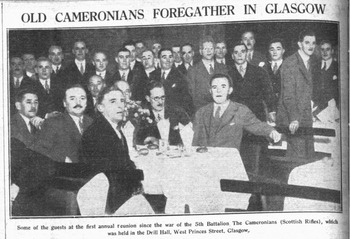
The formality of middle-class public sociability was recalled in performance. Those gathering in drill halls, for instance, could achieve the same effect with a little decorative invention and sense of occasion, as the example of the 1/5th Cameronians shows (Figure 3). Most associations put great care into the programme of proceedings. The committee of the 6th QOCH Reunion Club, for instance, met three times each year in order to organize its annual reunion.Footnote 67 They secured guest speakers six months before, monitored attendance and catering, as well as printing dinner menus as souvenirs.Footnote 68 This group, originating with the university companies of the QOCH, was perhaps more accustomed to such practices, but they were not alone. All reunions held by regimental associations in Glasgow ran to a strict programme of proceedings, with pre- and post-dinner speakers sermonizing on the value of the association and regiment, and a series of entertainments, usually culminating with allocated time for informal intercourse.
Reunion at the 1/5th Cameronians Drill Hall, The Bulletin & Scots Pictorial, 6 Nov. 1933, 26. © The British Library Board, 1924–60, NEWS10899 NPL.

Such performances gave them a footing in civic life. Civic figures defended municipal agendas, and recognized various local associations, through after-dinner speeches. Business leaders presented annual triumphs (or comforting strategies) to local audiences through the same means. Each was broadcast to the wider civic public by an attentive local press. Such fixation was understandable. Glasgow's press was not only oriented towards a middlebrow, unionist perspective during this time: as one of the few areas of economic dynamism, the hospitality scene presented an image of Glasgow that was both modern and dynamic – a vision that was worth investing in during a time of economic hardship.Footnote 69 Reunions synergized nicely with these strategies and bias. Staged portrait scenes, usually of the high-ranking members of committees, as with the Scots Greys’ annual reunion photo in Figure 4, or smiling veterans around tables, intermingled with other photographs of Rotary Club get-togethers, Unionist gatherings and conferences that presented an image of convivial local society within pictorial pages.
Reunion of the Scots Greys at the Grand Hotel, The Bulletin & Scots Pictorial, 27 Oct. 1934, 17. © The British Library Board, 1924–60, NEWS10899 NPL.

The public nature of reunion gatherings was reinforced through civic participation, which also fuelled press interest. Not all associational gatherings captured the attendance of public figures, but a good number boasted at least one important personage who would speak of the veteran's place in local and national life. This was indicative of the bent of Glasgow's politics for much of the period, as well as the related social character of civic leadership. For most of the inter-war period, the council remained in the hands of a ‘Moderate’ anti-socialist coalition largely dominated by Unionist elements.Footnote 70 It was not until the Scottish Protestant League split the vote in 1933 that Labour could change the political balance, and not until 1935 that Labour could vote in its first lord provost. The annual gathering of the Scots Guards was particularly well observed by civic leadership, probably because of its aristocratic ties. In 1929, Lord Provost Kelly attended with the sheriff substitute of Lanarkshire and Bailie, Thomas Scott Park, senior magistrate. The lord provost's speech bestowed praise on military service, past or present: ‘No man could come to an assembly of Ex-Service men without feeling an affection and love for those who had fought for their country.’Footnote 71
Military reunions were, therefore, caught in city politics, and, perhaps unsurprisingly, engaged to underline the viewpoints of the political right. In 1934, Thomas Kelly's successor, Alexander Swan (businessman, Unionist and the first lord provost to preside over a Labour-dominated council) used the Scots Guards reunion to present an image of forthright Moderate strength in the face of massive socialist victories. Employing the language and imagery of the patriarch, probably bolstered by his military audience, Swan noted that, as soon as Labour's victory had become clear, ‘he had called for. . .and warned the socialist leader that he would be wrong to make municipal work in Glasgow. Glasgow, he had told him, had been built up by profit-making industries which had enabled people to expand their business and employment.’Footnote 72
But reunion dinners congregated a host of different civic elements in the city around ‘comradeship’. Much of this was conservative in nature, particularly concerning the politics of the representatives of the two major Presbyterian churches (united as the Church of Scotland after 1929).Footnote 73 Most associations were able to call on the services of wartime chaplains, themselves veterans, active in Glasgow's religious society throughout the period, or had established relations with local ministers since. Such speakers validated both the war and military service – they were guardians of regimental history and purpose. The Rev. P.D. Thomson of Kelvinside Church in the wealthy western suburb, who apparently never sat down in the Church of Scotland's General Assembly without his chaplain's scarf and war medals over his robes, praised the ‘honour. . .distinction [and] tremendous record’ of the Scots Guards at their annual dinner at the Ca'doro [sic] in 1930, as well as the ‘restraint and reticence’ they had displayed during this and other conflicts.Footnote 74 Others, like Rev. A. Boyd Scott, minister of Landsdowne Church and territorial chaplain, likewise involved themselves in reunion life.
Crucial in this participation was the Rev. Dr Lauchlan Maclean Watt: poet, author, Moderator of Glasgow Cathedral from 1922 to 1934 and the General Assembly in 1933, who was an exceptionally active and respected public figure in civic affairs. He was a keen advocate of social order, if not as stringent as the Rev. Dr White with regard to trade unionist agitation. He was also keenly invested in local military society. Watt had served as a chaplain to the Gordon Highlanders during the war. He wrote war poetry, and penned several tomes of regimental history before and after 1918. During his post-war tenure, he performed at military rituals, blessed military flags and memorials and maintained close relations with Glasgow's military associations. On his retirement in 1934, these banded together to purchase a portable gramophone as thanks for his efforts, presented to the minister in a formal ceremony at the city library. It was, as Norman Macleod iterated, a ‘token of appreciation’ of all his work for soldiers and ex-servicemen, but also a memento of his time spent in socializing: ‘on any occasions they wanted his help at their functions. . .they found him willing to give both time and energy. . .When he listened to its music they hoped he would recall his soldier friends in Glasgow.’Footnote 75
This congregation of conservative elements was witnessed beyond the walls of restaurant and eateries. In time-honoured fashion, military associations took to the streets to assert their identity and claims for civic recognition. Their ability to claim such from urban spaces was, as Simon Gunn has argued, somewhat in doubt during this time, as fractious politics eroded the ability of city streets and squares to express collective unity.Footnote 76 Glasgow's inter-war spaces, perhaps more than any other UK city, were wrought with political, social and religious tensions, with regular leftist protest against unemployment, annual Orange marching (still attracting tens of thousands in the inter-war years) and the habitual eruption of sectarian violence after Saturday football.Footnote 77 But, if there was one place where notions of the ‘civic’ could still be meaningful, it was around the war memorial, which was largely saved from political contestation out of respect for the dead.Footnote 78 This is not to suggest that it was without politics. Glasgow's cenotaph was created in 1920, at a time of enormous ‘Moderate’ strength in council. The war memorial committee, which almost entirely lacked Labour or Union representation, had guaranteed that this vision would express both pride in military achievement and a Scottish-British, imperial identity: it boasted imperial insignia, couchant lions and inscriptive boast of how many men the city had raised for the effort.Footnote 79
The greatest contribution regimental associations made to the urban ceremonial scene came in their joint effort. The Combined Regimental Association and British Legion remembrance parade, held ostensibly in remembrance of the Somme, was instigated in 1925. This was a spectacular realization of regimental associational identity within city space. Numbers varied, usually falling between 1,500 and 2,500 each year, but regimental associations dominated personnel and iconography. Detachments, limited to 50–100 per association to ensure containment, still numbered far greater than the Legion element. These congregated in Blythswood Square and marched their regimental banners through the central district to George Square. After the service and speech making, they laid elaborate wreaths in the form of regimental symbols, badges or mottos at the foot of the city's cenotaph and progressed in military style to a post-service inspection, march past and salute at the Wellington statue in front of the Royal Exchange.
This was the largest manifestation of veteran identity within city space, but it was not the only one. Most associations fostered connections with local churches, holding annual church parades that were often represented in the city's press. More prominent, however, were the ritual parades held around the city's war memorials in remembrance of the Great War. Like reunions, these rituals extended the calendar of remembrance beyond Armistice Day. The Cameronians’ Association switched their regimental ritual of remembrance from November to August in 1931, to memorialize the unveiling of their war memorial by Earl Haig in August 1924. Former service battalions, particularly, pressed their own identity through ritualized remembrance of important anniversaries of military action of the Great War. The 15th HLI Association paraded around Glasgow's cenotaph each April from 1925 in memory of Ayette (1918), which had been an important victory for the battalion, if not the British army. In the latter part of November, the 16th HLI marked the defence of Frankfurt Trench, when D company had been left to fend for themselves for a week during the fighting around Beaumont Hamel in November 1916. This had not been a victory (all survivors were captured), but this ‘Epic of Frankfurt Trench’, a tale of heroic grit, which had secured a number of military distinctions, provided Chapter V of the battalion's history.Footnote 80 Both services drew in wider elements: representatives from the HLI Association as well as participation from the regiment.
In doing so, these associations related key messages regarding their individual and collective identities. Pride in military service and achievement was imparted through military gait in the march, or upright stance at the inspection. Associations issued strict instructions that ‘medals and decorations must be worn’ on parade.Footnote 81 In this, and in their choice of smart dress (the inter-war suit), they imparted key messages regarding the ‘respectability’ of, and respect due to, their collective status.Footnote 82 The inter-class ‘comradeship’ of associations was an important part of the public image. Various sartorial markers, such as ill-fitting suits, and the proliferation of different hats, would all have been suggestive to an inter-war audience (Figure 5).Footnote 83 But the group's iconography was dominated by the bowler, which was probably both indicative of the strength of the lower-middle-class constituency within associations, and a conscious affiliation to notions of order and civic responsibility (Figure 6). Glasgow's magistrates had worn bowlers during a particularly wet Armistice Day ceremony. William Gallacher, presumably in reference to local experience, mocked it as a hallmark of the ‘petit bourgeois patriot’ in his 1934 autobiography.Footnote 84
The Cameronians’ contingent for the Regimental Associations parade, 1927, The Covenanter, Nov. 1927, 92. © The British Library Board, P.P.4039.lfb.

Inspection of the Guard of Honour, Regimental Associations parade, 1932, The Bulletin & Scots Pictorial, 7 Jun. 1932, 6. © The British Library Board, 1924–60, NEWS10899 NPL.

Their claims to civic recognition were met by a host of largely conservative elements. The Combined Regimental Association and British Legion parade was the most important in this respect, hallowed as it was by the upper echelons of Scottish military aristocracy. The role of chief inspecting officer, itself demanding a certain panache for military pageantry, was shared between the earl of Atholl, Lord Horne, earl of Glasgow, Lord Methuen, Brigadier-General Norman Orr Ewing and Iain Colquhoun of Luss. Iain Hamilton joined the milieu on several occasions, his colonelcy of the Gordon Highlanders emphasized over his leadership of the British Legion. Joining these stalwarts were other civic elements: the current civic chief, and an assembly of past incumbents, dressed in the uniforms of the deputy lieutenants and notable religious figures, frequently led by Maclean Watt and, after 1934, his successor Rev. A. Neville Davidson. In its first year, the Combined Regimental Associations parade made the front page of the majority of Glasgow's newspapers, including a full spread in the city's pictorial, The Bulletin & Scots Pictorial. In 1927, the Glasgow Herald declared that ‘today it has a special place in the civic calendar second only to the great day of national commemoration in Armistice Day’.Footnote 85 Four years later, the parade was part of the official programme of Glasgow's ‘Empire and Civic Week’, the lord provost meeting the president of the Joint Council for a public lunch before his attendance.Footnote 86
Other parades may not have amassed such luminaries, but they still managed to invite patronage. The parade of the 15th HLI Association usually congregated the manager of Tramways, convenor of the Transport Committee and a representative from the local military barracks at Maryhill to lend some flair to the occasion. The parade of the 16th HLI, in memory of Beaumont Hamel, attracted consistent religious patronage, as well as military participation from the HLI depot at Maryhill, who supplied pipers and buglers. Professor Archibald Main, the Chair of Ecclesiastical History at the University of Glasgow and chaplain to the regiment, often took the service of the Cameronians Association; in 1930, he compared the work of such associations in Glasgow to St Paul in Corinth.Footnote 87 The civic press, too, reliably furnished all associational parades, including some church parades, with coverage. Even if press interest ebbed somewhat in the early 1930s, their presence in the pictorials was guaranteed.Footnote 88
These figures distilled the key messages from military associations. If it was customary for the press to remark that veterans ‘made bright the flames of nationhood’Footnote 89 and describe chests ‘ablaze with medals’,Footnote 90 pictorial reportage focused on key moments, such as the inspection, which exacerbated the emphasis on military achievement. The man who was patriotic, proud of his military past, who positioned himself to support the status quo whatever the vagaries of his post-war existence, was made to count in Glasgow's civic culture because he fitted nicely within governing strategies. For public figures who were encouraging municipal populations to face economic hardship with ‘cheerful patience and resolution’, like Maclean Watt at the kirking of the council in 1931, veterans of a conflict recognized to be the bloodiest in human history were perfect exemplary material.Footnote 91 The sheer horror of the war underlined gritty determination. These veterans had, in Iain Colquhoun's conception, persevered in dark times: ‘no matter how dark the outlook, those men never had a thought in their head but victory’.Footnote 92 They provided, according to Atholl, ‘a spirit and atmosphere which time could only increase. . .which by emulation they might come to share and intensify’.Footnote 93 As the Daily Record’s headline declared simply, they were ‘MEN WHO DID THEIR DUTY’.Footnote 94
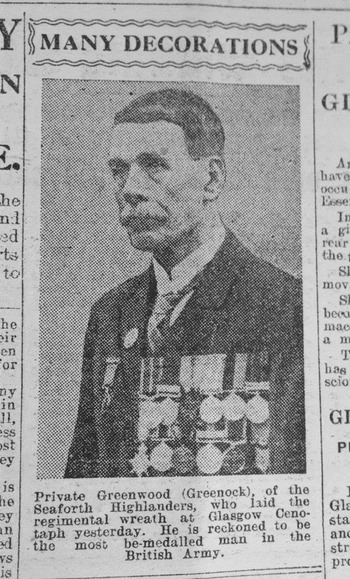
How these interactions informed the tonalities of war memory is perhaps no better demonstrated than the story of ‘Private Greenwood’. This veteran, actually a former sergeant, became the public face of the Regimental Associations’ parade in memory of the Somme in 1925 (Figures 7 and 8). The branch committee of the Seaforth Highlanders Association had selected Greenwood by dint of his being ‘the most be-medalled man’ in the British army – a story then seized on by most papers of the Outram Press and the Daily Record.Footnote 95 The 16 medals on his chest betokened service begun in 1878 and undertaken in Afghanistan, Egypt, South Africa, as well as during the Great War. That this 66-year-old man could come to represent the soldier of the Somme, a battle so connected with ‘high-hearted youth’Footnote 96 in local and national mythology, exemplifies many important things about remembrance cultures on the urban level, not least that the Great War's legacy was mapped onto an existing civic-martial culture, and its mythology was articulated within those narratives.
‘Private Greenwood’, The Bulletin & Scots Pictorial, 6 Jun. 1925, 8. © The British Library Board, 1924–60, NEWS10899 NPL.

‘Private Greenwood’, Daily Record, 6 Jul. 1925, 19. © The British Library Board, 1902–54, NEWS2082 NPL.

This coalition of conservative civic and military forces that produced ‘Private Greenwood’ remained strong even after the ascendancy of Labour. There were some signs in the early 1930s of a withdrawal of press interest in military associations. In 1933, even the Glasgow Herald only provided photographic coverage of the Regimental Associations’ parade – it is possible that the politics of the earl of Glasgow (who commanded the parade that year) were too much to take, even for the Herald. However, in the context of accelerating rearmament and remobilization, military associations found greater purpose and presence. As war clouds gathered, they offered reassuring visions of victory, but also of survival. In June 1938, Glasgow Corporation paid for a civic lunch for 70 of Glasgow's South African war veterans, who held their annual conference at the Empire Exhibition.Footnote 97 Happily coinciding with the visit of the secretary of state for war, the event articulated the presence of a long-standing martial tradition that was still strong. Praising their military demeanour, Hore Belisha joked: ‘I wish you were still in the army. So do we all. You look pretty fit for the next campaign.’Footnote 98
Conclusion
Glasgow's patterns of veteran association and its public culture, whilst not exhaustively relayed in this article, suggests we should look under the national and international level to grasp the possibilities of these impulses. Indeed, this history testifies to long-standing affinities between martial and civic cultures, as well as pointing to the social engagement of the military in inter-war life. This itself suggests that the role of the military as a ‘governing institution’ in British society penetrated further than we imagine after the war.Footnote 99 In Glasgow's case, the activity of military associations highlights the conservative tinged public culture of inter-war society, but also an arena of cultural intervention of the church. Whilst this still significant institution remained officially ‘silent’ on major social and political questions of the day, its ministers were more active in asserting a model of civic behaviour with conservative hues.Footnote 100 But this history also shows the depth of elite involvement in the production of remembrance.Footnote 101 War memory, in this guise, presented another ideological strand that informed notions of citizenship and was a more frequent visitor to urban space than has been realized. This steered public war memory away from ‘disenchantment’, which may have been articulated within other Scottish contexts, and towards a more positive vision of the war experience that underlined achievement, whilst recognizing struggle.Footnote 102