

Although it forms an important constituent part of the history of the medieval and early modern English Church, the taxation of its clergy – taxed separately from the laity until 1664 – remains a much-neglected subject. The subject's unpopularity is due in large part to its situation on the periphery of the fields of both ecclesiastical and economic history and, with few exceptions, it has not attracted the attention of practitioners of either discipline. Equally to blame, however, is the absence – or, rather, inaccessibility – of the chief source material. While figures for the total yields of clerical taxes can be extracted easily enough from the large enrolled accounts of the royal tax collectors in the crown records at The National Archives,Footnote 1 more valuable information about the measurement of clerical wealth, assessment and collection procedures, the forms and types of taxes levied and the identities of the taxpayers themselves have lain buried, to some extent, within the poorly-catalogued series of miscellaneous records subsidiary to the enrolled accounts – the documents of the E 179 series. Because they were ill-kept prior to their arrival at the Public Record Office on Chancery Lane in 1863, many of these rolls and files had been broken into pieces and damaged, and some are only legible with the aid of ultraviolet lamps.Footnote 2 It is little wonder, therefore, that few historians have consulted them.Footnote 3
With the completion of the ‘E 179 project’ in early 2013, however, this important series of records has become far more accessible. Funded by large grants from the Arts and Humanities Research Council and the Leverhulme Trust, two researchers employed by the University of York have fully catalogued the documents of the E 179 clerical series in an online database freely available on the website of The National Archives, also adding to the series over five hundred new items from unsorted miscellanea.Footnote 4 The work began with the creation of a register of all grants of taxation made by the English and Welsh clergy to the crown and papacy, to which the individual E 179 records could be linked, under a pilot project carried out in 2004. This linking of each document with the tax to which it related was the first task of the cataloguers, who then proceeded to date and describe each document, and cite all printed editions. The final task was the indexing of all place names listed in the document – i.e. churches, chapels, chantries, monastic houses etc. – using an authoritative, hierarchical table of modern place names. This identification of places taxed in the document with their modern place names counts as one of the project's most important achievements.
The purpose of this paper is three-fold: to call attention to the work of the project, alert ecclesiastical and other historians to the potential of these records as sources for the history of the medieval and early modern Church in England and Wales, and draw preliminary conclusions on the history of the taxation of the clergy. It is divided into two parts. The first will provide an overview of the history of clerical taxation based upon research undertaken for the register of tax grants, a unique resource compiled primarily from the records of convocation and crown and the documents of the E 179 series. The second part offers an analytical guide to the contents of the E 179 records with several pointers towards possible research topics.
The history of clerical taxation: the register of tax grants
Because the roots of royal clerical taxation are firmly planted in the history of papal taxation, the register of tax grants includes both papal subsidies imposed upon the English clergy and royal taxes granted by the same clergy to successive English monarchs. It begins with the papal subsidy imposed by Pope Alexander iii in 1173 and ends with the clerical subsidies granted to Charles ii in 1663, thus covering nearly five hundred years. It provides a summary account of the circumstances of each tax grant or imposition, the basis and process of assessment and the dates of collection. Each entry contains references to notable documents relating to the tax in both the E 179 series and elsewhere, and ends with reference citations, including the reference code of the enrolled account. For the tenths levied in the fifteenth century, the long lists of exemptions included in the texts of the tax grants – especially of grants made by the northern clergy – have been reproduced in the register, and they in themselves form an interesting subject of study.Footnote 5 There are plans to edit this register for publication.
The earliest taxes on the income of the English clergy were imposed by the papacy, almost always in connection with crusades to the Holy Land; details of these impositions are often sketchy.Footnote 6 Gradually, the English kings began to make incursions upon papal taxes. It is only with the three papal tenths imposed from between 1254 and 1257, and collected by English bishops, that we have detailed information about their assessment, known as the ‘valuation of Norwich’, after the bishop who oversaw their administration.Footnote 7 The three papal tenths imposed by Boniface viii in 1301 set an important precedent, when, for the first time, the king was granted a share without promising to undertake a crusade – an arrangement which proved useful whenever Edward i or his successors were faced with a clergy refusing to grant subsidies.Footnote 8 Continuous papal tenths were imposed by the papacy from 1305 to 1336, largely on behalf of the English kings.Footnote 9 It was only with the onset of the French wars in 1337 that Edward iii was able to persuade the clergy to make regular grants of taxation and the imposition of papal tenths ceased.
Sporadic royal requests to the clergy for direct grants of taxation had become more frequent from the 1280s, and convocations of the whole clergy of each province developed as representative forums for the granting of taxation, in exchange for the redress of clerical grievances. Before the valuation made in 1291 for the six papal tenths imposed by Nicholas iv, both papal and royal taxes on the clergy were levied according to various earlier assessments. A valuation made in 1217 was used until the new assessment of 1229, which in turn held sway until the ‘valuation of Norwich’ of 1254.Footnote 10 More rigorous assessments were made for papal tenths in 1267–9 and 1276, but they proved highly contentious and clerical taxes were still being paid according to the 1254 valuation in 1290.Footnote 11 The earliest valuations were simply estimates made according to the conscience of the clergy as to the value of their livings, but the 1254 valuation marked a departure in the verification of these appraisals by rural deans. The far more comprehensive valuation of ecclesiastical wealth made by especially-appointed assessors in 1291, known as the ‘Taxatio’, became the basis of assessment for all papal and clerical subsidies from 1294 to 1523.Footnote 12
This fossilisation of the 1291 assessment, like that made for the lay fifteenth and tenth in 1332, was an excellent short-term measure, which guaranteed a certain amount of revenue to the crown (about £16,000) each time a tenth was levied.Footnote 13 Over time, however, it became an increasingly inaccurate reflection of the distribution of clerical wealth and income. This was particularly true in the north, and when Pope John xxii granted a papal tenth to Edward ii in 1317 it was levied in the three northern dioceses of York, Durham and Carlisle according to a new valuation known as the ‘Nova taxatio’, which took account of the devastation caused by Scottish raids. Reducing the yield of the tenth there by nearly a third, it was employed henceforth for the collection of both clerical and papal taxes. In the diocese of York, the yield was reduced yet further in 1328 by a revaluation made in the wake of renewed hostilities with Scotland.Footnote 14 The lion's share of clerical taxes was paid by the more prosperous south, and by the latter part of Edward iii's reign the crown felt the need to increase its yield by taxing those not liable under the assessment of 1291.
The clerical subsidy of £50,000 was an ambitious experimental tax that Edward iii forced upon both convocations in 1371 ‘by a mixture of coercion and bargaining’, which aimed to raise more than three times the net proceeds of a tenth. Taxing both the benefices unassessed in 1291 and unbeneficed clergy, such as stipendiary chaplains, it raised the considerable sum of £42,000, despite some resistance.Footnote 15 The more well-known clerical poll taxes of 1377, 1379 and 1380–1 were similarly designed to ensnare in their net these same hitherto untaxed clergy,Footnote 16 especially chantry priests whose income had risen markedly after the Black Death.Footnote 17 In view of their notorious unpopularity, Richard ii understandably had no further appetite for experiments in taxation, but under Henry iv the income of the unassessed and unbeneficed was again tapped.
In 1404 incumbents of unassessed benefices in the province of Canterbury worth £5 or more were required to pay a tenth, as they were in 1406, when the unbeneficed clergy, including religious stipendiaries and mendicant friars, paid a flat rate of 6s. 8d.Footnote 18 The same tax was levied in the northern province in 1406, but the unassessed in the north paid only one more subsidy, in 1418, and the northern convocation did not agree to tax unassessed clergy again until 1523. Such taxes were, perhaps, more trouble than they were worth in less prosperous regions.Footnote 19
In the south, however, taxes on benefices unassessed in 1291 became fairly regular from 1415, and were automatically included in grants of tenths from the reign of Edward iv, even though collectors accounted for them separately. Stipendiary priests, on the other hand, were required to pay poll taxes only four more times in the fifteenth century – in 1419, 1429, 1435 and 1449 – and in 1429 and 1435 they paid according to graduated rates.Footnote 20 In 1450 the net widened to include another category of clergy which had previously escaped taxation – monastic clergy with royal exemptions from tenths – and five times in the latter half of the fifteenth century a further group of taxpayers was targeted: heads of religious houses who had purchased exemptions from appointment as collectors.Footnote 21 These levies were blatant attempts at blackmail; monastic heads had to pay an extra quarter of a tenth unless they renounced their letters of exemption forever. If the fifteenth century saw sustained attempts to collect tax from categories of clergymen not included in the 1291 assessment, convocation also recognised that benefices had declined in value over the centuries in real terms and permanently raised the minimum threshold of liability in the southern province from six to twelve marks in 1425.Footnote 22
The clergy generally granted tenths after the laity had made their own tax concessions in parliament, with the northern dioceses usually following the lead of the south – albeit, at times, more grudgingly – at the prompting of the king's councillors who are known to have visited the clergy during their deliberations. Consequently, periods of heavy lay taxation, such as the reign of Edward iv, laid equal burdens on the clergy, and experimental lay taxes often coincided with clerical innovations, as in 1435 and 1450.Footnote 23 Throughout Edward iv's reign, the clergy granted traditional tenths even when the laity paid highly innovative taxes,Footnote 24 but under Henry vii the clergy of the south found itself paying fixed quota taxes in 1489, 1497 and 1504, like the laity. The northerners, however, stuck with the traditional tenth, except in 1497, when the monastic clergy of the three border counties with tax exemptions paid a unique subsidy.Footnote 25 At the end of 1512, a year of heavy taxation, the southern clergy granted Henry viii a complex, graduated poll tax on the unbeneficed, while the beneficed paid four tenths.Footnote 26
This was the beginning of Cardinal Wolsey's tax revolution, when the systems of both lay and clerical taxation were overhauled. In 1523 the clergy of both provinces were compelled to grant an unprecedented £100,000 over five years, based on a new assessment of the net income of individual clerics rather than benefices, with allowable deductions for repairs to church buildings and payments such as synodalia and procurations.Footnote 27 In 1531, despite considerable opposition, the same subsidy was granted again, although the last £20,000 was remitted with the passage of the Act of First Fruits and Tenths in December 1534.Footnote 28
The clergy now lost its privilege of consenting to taxation in convocation, and the king's assumption of the title of ‘supreme head’ of the Church allowed him to appropriate the first fruits of benefices (that is, the first year's income) previously paid to the pope. The act also provided for the institution of tenths as an annual and permanent levy upon all ecclesiastical income, based on the valuation made in 1535 by royal commissioners known as the Valor ecclesiasticus.Footnote 29 In 1555, after the accession of Mary, first fruits were abolished, although tenths continued to be levied, but they returned when Elizabeth came to the throne, and both first fruits and annual tenths were paid by the clergy until 1640.Footnote 30
The clergy's tax burden was increased further, however, from 1540; henceforth, they were also asked to pay clerical subsidies whenever lay subsidies were demanded in parliament. Using the values of all benefices, offices and dignities established by the Valor ecclesiasticus, beneficed clergy paid a tenth on nine-tenths of their income (subtracting the tenth which they already paid to the Court of First Fruits and Tenths), with allowable deductions for charitable outlays. Stipendiary clergy were charged a flat rate of 6s.8d. and a tax of 10 per cent was also levied on the pensions of the ex-monastic clergy.Footnote 31 These subsidies continued to be granted and paid until 1635, although over the succeeding years adjustments were made to the basic formula to take account of changed economic circumstances.
In Edward vi's reign, a series of exemptions and reductions for economic hardship was instituted. In 1549 incumbents whose benefices were valued at 10 marks or less annually paid the same flat rate tax as the unbeneficed for their subsidy, and in 1553 benefices valued at £5 or less were declared exempt. In 1566 the minimum threshold of liability rose to 10 marks, and partial exemptions were introduced for vicars, at two tiers, with the minimum threshold for all incumbents of benefices rising again to £8 in 1581.Footnote 32 During the reign of Mary the bishops themselves were allowed to reassess and reapportion the tax burden in the case of decayed benefices, although this right seems to have been withdrawn under Elizabeth.Footnote 33 From 1571 outlay for the maintenance and repair of church buildings became allowable deductions from the tax liability of all benefice- and office-holders.Footnote 34
In Mary's reign too a minimum threshold of liability of £8 was instituted for stipendiary clergy, who, in 1555, were asked to pay at four graduated rates. Elizabeth did away with graduated rates in 1566 and lowered the minimum threshold of liability to 10 marks, although a two-tiered system was put in place in 1593 and the threshold of liability raised to £10.Footnote 35 Ex-monastic clergy (and ex-chantry priests) continued to pay a tax of a tenth of their pensions, but a threshold of liability was set at 40s. per annum in 1545, which increased to £4 in 1576 and to £5 in 1585. In 1606, under James i, however, the taxes on both stipendiary and ex-monastic clergy ceased to be levied, most of the latter having died by then.Footnote 36 The clergy's burden rose significantly during the inflationary crisis of the latter part of Elizabeth's reign, beginning in 1597, when the subsidy was levied twice per year until the onset of civil war and the suspension of convocation.Footnote 37 During the Interregnum the clergy was taxed with the laity, but after the Restoration, in 1663, Charles ii was granted four clerical subsidies over four years. The grant was cancelled after the first year, however, when the clergy surrendered its privilege of separate taxation and henceforth paid taxes with the laity.Footnote 38 To be sure, this privilege had always been something of a myth, as clerics had been forced to contribute on numerous occasions to lay taxes and loans in both the medieval and early modern eras – most notably, perhaps, the ‘free and voluntary present’ imposed by Charles ii in 1661.Footnote 39
The E 179 records of taxation
Taxatio assessments and papal tenths
Few records of the early papal or royal levies on the clergy dating from before the 1291 Taxatio assessment are found here, and those that are probably came from ex-monastic archives absorbed into the crown records after the dissolution of the monasteries. This is surely the case with E 179/277/63, a receipt given to the prior of Anglesey by the collector in Ely diocese of the three papal tenths imposed by Pope Clement iv between 1266 and 1269, and one of the many documents from the archive of Anglesey Priory now spread among several series in The National Archives.Footnote 40 Only two E 179 documents relate to early assessments of the clergy. The first is a copy of the assessment of the diocese of Durham made for the papal tenths imposed from 1254 for Henry ii's promised crusade to the Holy Land.Footnote 41 The second is a contemporary copy of two writs dating from 1276 sent to the dean of Kidderminster by the assessors of the diocese of Worcester, who had been appointed by papal legates, ordering him to assemble the clergy of his deanery in Worcester Cathedral to make oaths as to the value of their goods for the six papal tenths imposed from 1274.Footnote 42 Why these documents are among the crown's records is not clear.
There is a separate subseries of Taxatio assessment rolls in the E 179 series and the task of cataloguing them benefitted enormously from collaboration with J. H. Denton, who worked for twenty years on a definitive edition of the Taxatio by collating all copies of the three major manuscript versions (diocesan, papal and Exchequer), with full critical apparatus, before his untimely death in 2009.Footnote 43 Particularly useful was Denton's authoritative identification of the churches, chapels and prebends taxed as spiritual income. He omitted from consideration, however, the temporalities of the monasteries, bishoprics and cathedral chapters, which formed an important component of ecclesiastical income and about which the Taxatio rolls are a key source of information. The identification of ecclesiastical temporalities by the E 179 project researchers in the roughly ninety copies of the Taxatio in the E 179 series therefore breaks new ground, using resources such as the English Monastic Archives database hosted by University College London.Footnote 44 It is of particular significance for locating monastic property in the Welsh dioceses – a subject still badly served by the secondary literature.
Among the Taxatio assessments in the E 179 series are many early rolls, several of which were marked as ‘original’ and kept in the Exchequer as authoritative copies.Footnote 45 In the early fifteenth century the contents of these rolls were copied into two volumes for ease of reference.Footnote 46 There are, however, also later copies of the rolls in the series, probably either submitted by the collectors with their accounts, or from ex-monastic archives. Certainly the former is the case for one fifteenth-century copy. In 1450 the sheriffs of London and Middlesex were appointed to collect the tenth because the abbot of Bermondsey, initially chosen, had successfully petitioned the king's council for an exemption from doing so. Since these sheriffs had never collected a clerical tenth, they had to be supplied with a copy of the Taxatio, which they submitted with their certificates when rendering account, no doubt expecting (and certainly hoping) that they would never need it again.Footnote 47
It is difficult, even in the case of early copies of the Taxatio, to associate them with the levy of particular taxes. The first tax to be collected in accordance with the Taxatio assessment was the moiety (or tax of one-half) granted to Edward i by the clergy of both provinces in 1294. In exchange for this grant, the king had to agree to raise the minimum threshold of liability from six marks to less than ten marks (for holders of single benefices), a condition that necessitated the attachment of schedules of exemptions to the assessments, in order to inform the collectors of the benefices to be excluded – helpful indicators that particular rolls were used to collect the moiety. It takes little imagination to envisage how unpopular this tax was and it proved very difficult to collect, as did the tenth granted to Edward in 1295 – the first tenth collected according to the Taxatio assessment. Collectors of the arrears of both taxes were appointed in 1297 and schedules of arrears were drawn up to assist them, many of which survive in the E 179 series. E 179/67/1 is a large file of writs appointing the collectors, schedules of arrears and the returns made to them from ten different dioceses, many naming the defaulting incumbents. Others scattered throughout the series may have once been part of this file.Footnote 48
A handful of Taxatio assessments adapted for the levy of the three papal tenths imposed by Pope Boniface viii in 1301 are also recognisable.Footnote 49 This tax was levied on a wider section of the clergy – the minimum threshold of liability having been lowered to two marks – and schedules with assessments of benefices valued at between two and six marks, now included for the first time, were often appended to the 1291 assessments. These schedules provide unique information, therefore, about very small and poorly documented churches. The levy of Boniface's tenths has left a sizeable legacy of other types of documents as well: schedules of arrears, receipts and other records providing evidence of assignments made on the proceeds, mostly dating from after 1303 when Edward i claimed them upon the death of Boniface, ordering them to be paid into his wardrobe.Footnote 50 Counterparts of the receipts given to the collectors by the keeper of his wardrobe John de Drokensford, for example, make up the greater part of a file of 122 membranes, which includes also letters, warrants and petitions documenting the financing and conduct of the Scottish wars in 1305–6. The latter provide details, notably, of the detention of Scottish prisoners in English castles.Footnote 51 The greater involvement of the Exchequer in the collection of subsequent papal tenths means that several receipts and wardrobe debentures associated with the levy of these taxes up to 1339 also survive in the E 179 series.Footnote 52
The effects of the Scottish wars are, of course, also reflected in the extant copies of the Taxatio assessment of the northern dioceses. Perhaps the most significant are those in E 179/67/9, a large file containing the reassessments made throughout the whole province in 1317–19 and in York diocese in 1327–9, sometimes giving details of the specific damage suffered, and providing much more information than is available in the printed edition of the Taxatio. The file also includes royal writs citing petitions for hardship from the clergy, which prompted Edward ii and Edward iii to order the reassessments.Footnote 53
Poll tax returns, 1377–81
Apart from copies of the Taxatio assessment, there are few records in the E 179 series relating to the levy of clerical tenths until the latter part of the fourteenth century and the onset of experimental taxes. The sole surviving document from the highly controversial subsidy of £50,000 levied in 1371 is a long list of defaulters in Norwich diocese publicly denounced after forty days of contumacy by Bishop Henry Despenser.Footnote 54 It is with the levy of the four poll taxes of 1377–81 that we begin to find plentiful returns. These taxes required fresh assessments to be made and the submission of nominal returns to the Exchequer, and a number survive from many dioceses, although it is uncommon to find a full set from every archdeaconry in a given diocese for any of the four taxes. For the first poll tax, granted to Edward iii in 1377 and levied at two rates (on the beneficed and unbeneficed), there are only a handful of returns, some of them partial or fragmentary.Footnote 55 Luckily, they are more numerous for the graduated poll tax granted to Richard ii in 1379, which levied a long tariff of rates on every category of clergy, according to income bracket.Footnote 56 There are full returns from the northern dioceses of Carlisle and Durham and a host of other (mostly partial) returns from twelve southern dioceses. A particular feature of the full return from Ely diocese is the assessment of rectors studying at Cambridge colleges.Footnote 57
Often overlooked is what is sometimes referred to as the ‘hybrid poll tax’ granted in February and April 1380, although the records of its levy have valuable information to impart. This tax combined a traditional tenth with a poll tax on unbeneficed clergy and the returns accordingly furnished the names (and sometimes surnames) of the latter.Footnote 58 Returns again survive from Carlisle and Durham, twelve southern dioceses and the jurisdiction of St Albans.Footnote 59 Most plentiful of all are the extant returns made to the most fiercely contested of these taxes: the poll tax granted in December 1380 in the south and February 1381 in the north, levied at much higher rates. All but the archdeaconry of Nottingham is included in the surviving assessments of York diocese, and there is a full return from Northumberland archdeaconry in Durham diocese.Footnote 60 Particularly notable among the assessments of the southern province are the substantial returns from the dioceses of Canterbury, Lincoln, London and Norwich,Footnote 61 with partial assessments also from nine others.Footnote 62
Some of these returns are in print – most notably the assessments of the clergy of Lincoln and London dioceses edited by Alison McHardy.Footnote 63 It is just as well that there are not more such editions, since the E 179 researchers discovered several previously unidentified poll tax returns – chiefly loose membranes and fragments, but sometimes wrongly categorised whole documents – which would likely have been omitted. Two portions of the assessment of Leicester archdeaconry for the December 1380 tax, for example, not printed by McHardy, have now been located,Footnote 64 and, similarly, a new fragment for the same tax from London.Footnote 65 From Rochester diocese, there were two new discoveries of poll tax assessments. The first of these is an additional piece of the assessment for the December 1380 tax, incorrectly dated in the nineteenth-century list as ‘tempus Edward iii’, which includes the inhabitants of three nunneries in the diocese,Footnote 66 and secondly, an entire assessment of the February 1380 ‘hybrid tax’, wrongly listed as 3 Henry v (instead of 3 Richard ii).Footnote 67 In the diocese of York, the only remaining section of the assessment of Nottingham archdeaconry for the 1377 poll tax has turned up in a packet of miscellaneous fragments, mostly relating to lay taxes levied in the reign of Henry viii. Crucially, since it is one of only five remaining fragments of the York assessment, it reveals the total numbers of beneficed (1,790) and unbeneficed (1,481) clergy taxed in the entire diocese on its dorse.Footnote 68
In a few cases whole assessments which had been broken up and arranged under different piece numbers have been reconstructed electronically in the database. This is true, most notably, of the returns for the December 1380 poll tax from Norwich diocese. The collector's ‘particulars of account’ (in effect, a fair copy of the assessment) for the archdeaconries of Suffolk and Sudbury once comprised a roll of eight membranes, two of which had become detached. All of the constituent parts have now been located, spread among three different documents in the E 179 series, and their original order has been reconstructed as far as possible in the place-name indices for each document on the database, together with notes explaining the rationale behind the reconstruction.Footnote 69 The reconstruction of the particulars of account for the rest of the diocese – that is, Norwich and Norfolk archdeaconries – is even more dramatic. It was once a well-organised roll of three rotulets that listed the clergy in four separate categories: beneficed clergy (rot. 1); unbeneficed chaplains (rot. 1d); bishop and monastic clergy (rots 2–2d); and unbeneficed clerks (rot. 3). The first membranes of each rotulet, still joined together by the original parchment tie, survive as E 179/45/5A, but the rest now comprise eight different documents.Footnote 70
Of course, it is not only the assessments and particulars of the poll taxes that list individual clergy, but sometimes also schedules of arrears. A schedule of defaulters of the 1379 poll tax in Berkshire archdeaconry, for example, appears to list all the residents of two secular colleges – St George's Chapel, Windsor, and Wallingford College – who probably claimed exemptions.Footnote 71 Another type of poll tax document of value is the ‘view of account’ (visus compoti), a form of interim account. A visus from Winchester archdeaconry (mis-catalogued as tempus Henry vi), reveals that there were 212 unbeneficed clergy taxed there for the hybrid poll tax of February 1380 – information that is especially valuable in the absence of an assessment.Footnote 72 The time is now right for a published edition of all these poll tax returns.
Returns of poll taxes on unbeneficed clergy, 1406–49
The experimental poll taxes of the first half of the fifteenth century on unassessed benefices and unbeneficed clergy also generated valuable nominal returns. Interesting assessments survive also for the 1404 tenth on unassessed benefices – including chantry chapels – from four dioceses and the deanery of Arches in London. The assessment of chantries in the latter also lists founders’ names.Footnote 73 Many other valuations of unassessed benefices survive for subsequent levies.Footnote 74
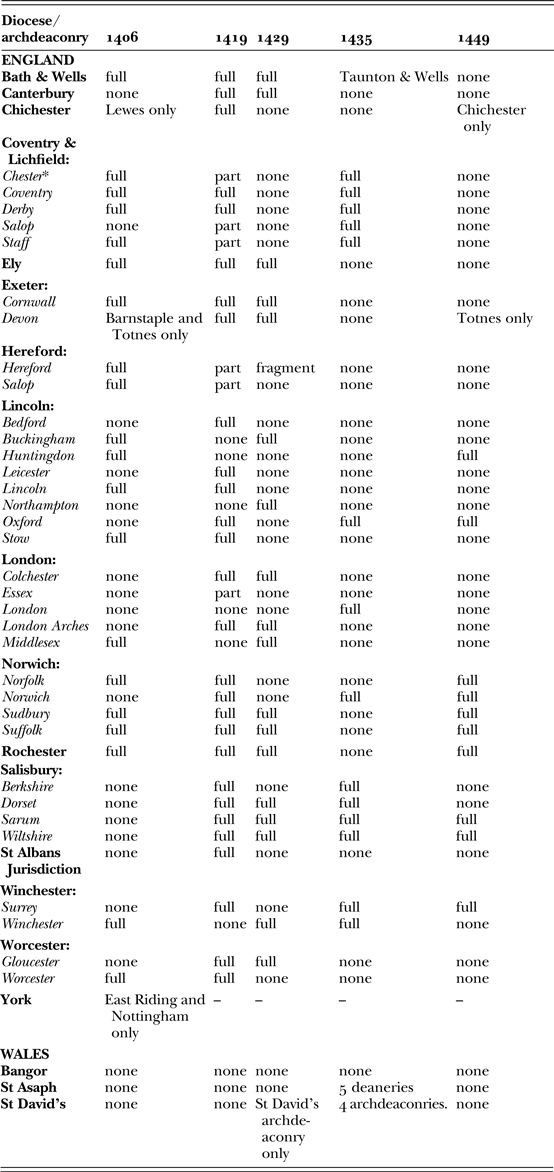
One of the chief points of interest in the E 179 clerical series is undoubtedly the returns for the five fifteenth-century poll taxes on unbeneficed clergy. Bishops were required to return nominal assessments to the Exchequer and their survival rate, by and large, is good – especially for the first two, granted in 1406 and 1419.Footnote 75 Moreover, often where there are gaps, they can be filled, to some extent, by summary and enrolled accounts that provide details of the number of clergy taxed. Good coverage is available for the dioceses of Bath and Wells, Exeter, Norwich, Rochester and Salisbury, in particular. The fullest set is from Rochester; only the assessment made in 1435 is lacking, but a summary account gives the total number of clergy assessed in that year in each income bracket.Footnote 76
Many of these assessments have lost their headings and consist only of lists of clergy with the amounts of tax that they were assessed to pay. The nineteenth-century cataloguers found it difficult, therefore, to categorise and date them. Because all five taxes were granted with (sometimes subtly) different terms and conditions, it has now been possible to identify to which tax every assessment relates with a high degree of certainty and date it accordingly. To take just two of many examples, the 1406 return from Chester archdeaconry had been described as ‘tempus Richard ii’, while that from Lewes archdeaconry for the same tax was formerly listed as ‘27–28 Henry vi’.Footnote 77
One of the unusual provisions that help to identify the documents is the liability of friars in receipt of stipends for the taxes granted in 1406 and 1449 only; they appear in the returns from a number of dioceses.Footnote 78 Required to pay all five of the taxes were private household chaplains, such as the two priests employed by Sir John Pelham in Lewes archdeaconry in 1406 – presumably at his seat at Pevensey Castle.Footnote 79 Also found in these rolls are priests serving in secular and chantry colleges, such as the twelve vicars choral in the royal chapel of St Stephen's Westminster and the thirteen chaplains at Winchester College, named in the 1406 returns.Footnote 80 Clergymen ministering to the elderly and infirm in hospitals were also held liable to pay these levies, including, for example, John Norton, schoolmaster, one of two priests employed at the hospital of St John the Baptist in Warwick in 1406,Footnote 81 as well as chaplains working at monastic houses, particularly nunneries.Footnote 82 Also noteworthy, finally, is the 1406 return from Ely, which assesses the clerks of the bishop's household, and numerous chaplains serving in the cathedral priory and its chantries.Footnote 83
Fifteenth-century taxes: rise in documentation
The onset of the fifteenth century saw a dramatic increase in the range and volume of the E 179 documents. By far the most numerous survivals are the original accounts rendered by the collectors, which were later copied onto the large enrolled accounts (E 359). They appear with great regularity from 1401 and the first grant of taxation to Henry iv, whereas their counterparts from the reign of Richard ii are only sporadic. Although the extant accounts from the tenths levied throughout the fifteenth and early sixteenth centuries were sorted and arranged in the E 179 series by the nineteenth-century cataloguers by date and diocese, they were originally at the Exchequer in files and bundles.Footnote 84 Although they duplicate information entered onto the enrolled accounts, they are useful in identifying the names of collectors and the attorneys – usually laymen, but sometimes monks – who rendered account for them.Footnote 85
Under the terms of the tax grants, the bishops were required to submit certificates naming the collectors whom they had appointed, and these were gathered together into files at the Exchequer for each tax levied. Many files, dating from before the fifteenth century, were left intact by the nineteenth-century cataloguers.Footnote 86 The view of account, together with the onus, another form of interim account showing what a collector still owes, have also left their mark in the E 179 series. They were drawn up, in most cases, to indicate when assignments were made on clerical tax revenue, often for repayments of loans, but also for extraordinary expenditure by the crown, and they are found especially at times of political crisis, such as in the mid-fifteenth century and in the early part of Edward iv's reign. Views of account of the tenth collected in Chichester diocese in 1449, for example, record payments of nearly £200 made to Adam Moleyns, the highly political bishop of Chichester, just before his murder at Portsmouth by the soldiers bound for France whom he was sent to pay, in January 1450, reportedly after a dispute over wages.Footnote 87
The amount of documentation that bishops were required to submit to the Exchequer rose dramatically at the beginning of Henry vi's reign, particularly in the southern provinces, where there was a rising tide of benefices whose incumbents could no longer afford to pay the full Taxatio values, as well as a marked increase in hardship exemptions. Specific exemptions for poverty had been increasingly included in the texts of the tax grants made by both convocations, and from 1425 all the taxes were granted with an increased minimum threshold of liability in the south. Here all benefices worth less than twelve marks were excused from this date until 1497, which meant that the bishops had to issue lists of them to both the collectors and the Exchequer, and many of those issued to collectors, together with their letters of appointment, often also ended up at the Exchequer during the accounting process, with the result that they survive in great numbers in the E 179 series. These lists also include specific exemptions granted by the bishops for poverty, vacancy or in the event of natural disasters such as floods or fires. Particularly notable are the schedules from Chichester diocese which routinely list the many benefices excused because they had been damaged by flooding throughout the period.Footnote 88
A number of specific exemptions attached to the tax grants have produced other interesting documentation. It was a regular provision that incumbents not resident at their benefices because they had been given licence to study at university were exempt from paying tax on these livings and occasionally lists of benefices excused payment are annotated that it was because their rectors were at university. In a schedule of exemptions in Norwich diocese from the three-quarters of a tenth granted in 1433, a separate list of nineteen non-resident incumbents was made.Footnote 89 That this privilege was open to abuse is indicated by an investigation ordered by the barons of the Exchequer into the twenty-one incumbents returned as non-resident by the abbot and convent of Cockersand, collectors in Richmond archdeaconry (York diocese) of the tenth granted in the north in 1436.Footnote 90 Specific exemption was granted in the 1472 tax grant for clergymen whose possessions had been damaged by rebels in the Lincolnshire uprising in 1470 and an extant certificate excuses two priories and a rector in that county.Footnote 91
Finally, one particular type of exemption that resulted in the issuing of many certificates was for clergy indicted, accused or imprisoned by the laity. First provided under the tax grant made by the southern province in 1429, this exemption was thereafter in force for every levy of a tenth until 1497 and was a manifestation of the prevailing belief that the clergy suffered chronically from malicious indictments made by laymen. The general phenomenon was explored by R. L. Storey, but without the considerable evidence provided by records in the E 179 series. In many dioceses, bishops submitted certificates documenting such indictments, especially in the latter part of the reign of Edward iv, when the burden of taxation was particularly high. They provide evidence of presentments made before justices of the peace and stewards of manorial courts for crimes such as assault, theft, rape and even eavesdropping.Footnote 92
From the northern dioceses, however, no exemption certificates of any type survive because there was a marked difference in the way in which the northern convocation dealt with the issue of hardship exemptions. All exemptions and exceptions were written into the texts of their tax grants, together with the fluctuating minimum threshold of liability,Footnote 93 almost certainly as a result of representations made at convocation, whereas in the south many of the exemptions were granted by individual bishops after convocation met – perhaps because of the high volume of business dealt with at the London convocations. In contrast to their southern counterparts, who submitted exemption certificates with their accounts, collectors in the northern dioceses merely petitioned to be allowed the exceptions granted at convocation, listing benefices and amounts to be discharged, and citing the grant itself as their authorisation.Footnote 94
Early Tudor tax records
If the northern dioceses did not produce the same volume of tax collecting documentation in the fifteenth century, they more than made up for it in the early Tudor period. Whereas there is a paucity of evidence from the southern dioceses for the experimental taxes levied on income in 1512 and 1524–8, because they were administered by the archbishop of Canterbury rather than the Exchequer, the same is not true of the taxes levied in these years in the north. The year 1512 ushered in a period of high taxation in both the north and south, when wars raged in France and Scotland. Unusually, the northern clergy granted two tenths, which were clearly earmarked for the Scottish war effort, since on 8 August 1512, a week after the first payment was due, Henry viii issued ‘letters of placarde’ under his signet appointing Edmund Thornton, abbot of St Mary's, York, as general receiver of the tax monies, and Master Thomas Magnus, archdeacon of the East Riding, as overseer, and ordering the collectors to pay all proceeds to them, receiving in exchange a tripartite indenture of receipt, sealed by all three parties.Footnote 95 The abbot became in effect the king's chief war administrator, disbursing the funds that he received. The collectors meanwhile presented their indentures at the Exchequer in order to receive acquittances. The arrangement worked so well that it was also employed for the three tenths granted in 1513 and the two tenths granted in 1516; more than sixty tripartite indentures survive from the levy of all three taxes.Footnote 96
Constituting a prelude to Cardinal Wolsey's ingenious new clerical subsidy were the ‘first’ and ‘second’ forced loans of 1522–3, imposed by Henry viii upon both laity and clergy. While no lists of clerical contributors survive in the E 179 series from any southern dioceses, E 179/239/224A is a schedule of contributors to the first loan in the northern province; they gave over £6,000 in total.Footnote 97 Records are similarly scarce for Wolsey's three-tiered graduated tax on the income of every cleric, levied from 1524 to 1528. The taxes were administered by appointed receivers in both provinces: in the south receipts were paid to the archbishop of Canterbury and bishop of London at St Paul's Cathedral, and in the north to the abbot of St Mary, York, and Thomas Dalby, archdeacon of Richmond, at the abbey in York and Ripon College. No assessments can now be found among the crown records from the southern dioceses, and understandably so, since they were never sent to the Exchequer.Footnote 98
None the less, full or partial assessments from the dioceses of York and Durham have made their way into the Exchequer records for all five years that the tax was levied.Footnote 99 They were almost certainly the personal copies of Thomas Wolsey himself, then archbishop of York, and they came into the crown's hands after his death, along with many other documents from his archive.Footnote 100 The most impressive assessment is of the archdeaconry of York, made in 1524 and in full and perfect condition; it lists over 1,000 individual taxpayers in three categories: (1) beneficed clergy and chantry holders earning £8 or more annually; (2) beneficed clergy earning less than £8; and (3) stipendiary clergy. Monastic clergy are not listed, as they were not taxed individually; the tax was paid by the house as a whole, at graduated rates, according to income.Footnote 101 Also surviving from York diocese are thirteen indented receipts given to the subsidy collectors by the receivers.Footnote 102 The same arrangements were in place for the levy of the identical subsidy from 1531 to 1534, but no assessments survive among the crown's records, although a few have been located in diocesan archives.Footnote 103
For the administration of clerical tenths, payable annually to the crown from Christmas 1534, a new office was established – the treasurer of First Fruits and Tenths, expanded in 1540 to the Court of First Fruits and Tenths – and the records relating to their collections are found largely in separate series (E 331–E 348). It was sometimes difficult, however, for nineteenth-century cataloguers to distinguish between clerical tenth and subsidy records, and about thirty-five strays from the First Fruits and Tenths now reside in the E 179 series – for example, E 179/43/275, a list of arrears in London diocese from 1539 to 1547.Footnote 104 By the same token, because the clerical subsidies levied from 1540 to 1554 were administered by the Court of First Fruits and Tenths, most, though not all, of the records relating to them are now to be found among the records of that court.Footnote 105
Before moving on to these post-Reformation clerical subsidies, it is worth noting the significant presence in the E 179 clerical series of lists of contributions to the ‘devotion money’ – a benevolence imposed by Henry viii in 1543 to fund a Turkish crusade. After a six-week preaching campaign, the money was gathered up by the churchwardens of each parish (usually named in the collection lists), overseen by a diocesan official. He then conveyed these proceeds to the county sheriff for delivery to the royal receiver Sir Edmund Peckham, all of which was attested in counterpart indentures. Because of this joint lay-clerical administration, the nineteenth-century cataloguers confusedly catalogued the indented lists of receipts in both the lay and clerical series, but their survival rate is excellent and both counterparts can be found from many, if not all, deaneries. The full set of returns from York diocese is particularly notable, complete with a covering letter from Edward Lee, archbishop of York, apologising for the paucity of the collection and explaining some of the difficulties involved.Footnote 106
Clerical subsidies, 1555–1635
From 1555, when the Exchequer became involved in the administration of clerical subsidies, their documentation in the E 179 series grew massively. With the levy of each subsidy payment, the bishops’ deputy collectors – almost always laymen – submitted certificates of their appointment, often attached to schedules of benefices that had been granted statutory full or partial exemptions because they were vacant or their value fell under the minimum thresholds of liability, as well as schedules of defaulters. The latter name individual incumbents who had not paid their subsidy when due and give details of the statutory warning administered to them by the collectors. While these schedules ostensibly provide evidence of individuals refusing to pay their taxes – and there are numerous examples of repeat offenders – a note of caution should be sounded. The monitory procedure was automatic and often defaulters (termed ‘recusants’) turn out to be incumbents who had vacated or exchanged their benefices, or were entitled to exemptions, as often revealed in schedules submitted for subsequent subsidy payments.
Some of these ‘recusants’, therefore, appear as compounders in another type of document delivered to the Exchequer by the collectors: schedules of compositions for benefices which had been compiled from the records of the Court of First Fruits and Tenths. Listing the names of new incumbents, the dates that they had compounded for the benefices (that is, paid the equivalent of a year's income as First Fruits) and the amount of their compositions, these paper schedules informed the Exchequer of incumbents entitled to exemption from that year's subsidy payment. Included also within the rolls of certificates and schedules submitted by the collectors – often still in their original white leather pouches – are certificates of allowable deductions from the liability of cathedral chapters for charitable outlays, and, after 1571, for the maintenance of the fabric of church buildings. In a few instances, account books covering several years (‘onus compoti’), drawn up by Exchequer auditors, duplicate all the information in the certificates and schedules in a form that is easier to consult and they give a better picture of how the system of exemptions worked in practice.Footnote 107
Like the medieval tenths, the clerical subsidies were based on a valuation of ecclesiastical benefices necessarily exclusive of the unbeneficed clergy, although the latter were required under each subsidy act to pay a poll tax. Bishops had to submit lists of these stipendiary clergy, therefore, for every subsidy payment, together with the tax payable, whenever graduated rates were in place.Footnote 108 These lists also form part of the contents of the collectors’ pouches and are an important source of information about these otherwise obscure clergymen, although the survival rate of these lists is not uniform throughout the country, and sometimes only the curacies and not the names of the individual curates were given. There was a tendency for the numbers of curates to fall in the course of the 1560s and 1570s. In Durham, for example, they fell from ninety-eight in 1564 to thirty-six in 1567 and to just two in 1578, and in Carlisle from thirteen in 1564 to two in 1572, while after 1582 they disappeared from York diocese altogether.Footnote 109 The phenomenon was not confined to the north, although in the large Lincoln diocese, the great decline in numbers does not seem to have taken place until in the 1580s.Footnote 110 These findings are perhaps unsurprising, given the declining number of men recruited to the ranks of the clergy in the Elizabethan period.Footnote 111
Finally, one other type of schedule completes the contents of the collectors’ pouches: assessment lists of pensioners from dissolved monastic communities, chantries and hospitals who were liable to pay a subsidy of 10 per cent on their pensions. They do not appear with regularity, and those that do survive mostly relate to subsidies granted in 1555 or 1558. None of the lists of chantry or hospital priests state where these clergymen had served, but often the monastic houses in which the ex-religious had resided are disclosed.Footnote 112 It may have proved difficult to collect such subsidy payments, and the job was devolved to specially-appointed receivers operating in groups of counties. Thomas Badby, esquire, was, for example, appointed to collect the arrears of subsidy payments due from pensioners in Suffolk and Cambridgeshire from 1563 to 1574; these totalled over £156, as indicated in a debt schedule drawn up at the Exchequer.Footnote 113
Post-Restoration and Exchequer-generated records
During the Civil War and Interregnum the clergy paid taxes with the laity, but in 1663 the old system for gathering clerical subsidies was once more put into place, and a host of certificates and schedules (mostly of defaulters) survive for the first and only year that the tax was levied. This was the end of the clerical subsidy, but one other post-Restoration tax that has made its mark in the E 179 series should also be mentioned: the ‘free and voluntary present’ imposed on both the clergy and laity by Charles ii in 1661. All prospective contributors were called before the appointed commissioners in each county and diocese at meetings held in the inns and churches of the larger towns, where they agreed to make contributions, either on the spot, or more often, by ‘subscribing’ to pay them by a certain date, normally within six to eight weeks. The subscription lists were annotated when the money was paid and submitted with the proceeds to the Exchequer. Lists of clerical subscribers survive from thirteen dioceses in the E 179 series, while four others were recently located in the E 178 series,Footnote 114 as well as schedules of defaulters and arrears, and a ‘state of account’, drawn up for the Lord High Treasurer in 1664, giving sum totals from all dioceses and counties.Footnote 115
Although documents submitted to the Exchequer by bishops and collectors make up the bulk of the records in the E 179 series, a sizeable number of others – such as the state of account just described – were generated by Exchequer clerks and officials. For example, there are annotated lists of collectors, headed ‘status of collectors’, to keep track of their appearances at the Exchequer to account for specific taxes.Footnote 116 One was the result of an initiative under Henry v to chase up arrears in the Welsh dioceses dating back to Richard ii's reign, while a whole file of certificates of inability to collect and other documents was compiled in about 1419 as part of an investigation into the continuing problem of collecting clerical taxes in Wales.Footnote 117
Audits and investigations into collectors’ debts in the early modern period are also documented here. A schedule of debts owed for both clerical tenths and subsidy payments, drawn up in 1554, sheds light on the politically-charged proceedings against a host of staunchly Protestant bishops in March 1554, many of whom had been imprisoned,Footnote 118 while a series of documents relating to the debts of Ambrose Coppinger, a deputy collector of clerical tenths and subsidies in Winchester and Norwich dioceses in the 1580s and 1590s, shows the dire financial circumstances in which a clerical tax collector could find himself.Footnote 119
Arrears of clerical taxes are only some of the matters addressed in the bundles of auditors’ papers occasionally found in both the clerical and lay E 179 series, which can be highly informative of the activities of the early modern auditors. For example, the papers of the Elizabethan auditor John Wyskard in the clerical series reveal that he combined his business as an auditor with a sideline as a record agent, furnishing copies of Exchequer records to private individuals.Footnote 120 Of singular interest is the bundle of papers once belonging to the auditor Hugh Sexey. They provide details of his enterprising scheme to wrest additional tenth and subsidy payments from incumbents in Salisbury diocese, based on discrepancies between the valuations established in the Valor ecclesiasticus and compositions for benefices over the past fifty years.Footnote 121
Finally, there are a host of valuable strays in the E 179 clerical series, none more so than the series of inquests into alien clergy made during the Hundred Years’ War, when confiscations of their lands were ordered by successive kings for the duration of war. Although several of such inquests were placed in a special record series earmarked for alien priories and clergy (E 106), many more were mistakenly catalogued in E 179.Footnote 122
Armed with the detailed information presented here of the rich, untapped sources in the E 179 series for research into the medieval and early modern Church – whether economic, environmental, political, administrative, social or prosopographical – ecclesiastical historians are urged to take advantage of the far greater accessibility of these documents provided by the E 179 database to feed their own research. The database can be interrogated either singly or in combination in the following categories: (1) by date, bringing up all documents associated with particular grants of taxation, or that fall within a specified range of dates; (2) by type of document, choosing from over 100 different options; (3) by place, selecting from the authoritative table of modern place-names; or (4) by all documents in which individual taxpayers are named.
Equally, the register of tax grants provides much essential information for understanding the context of the history of clerical taxation and for interpreting the assessments, accounts, schedules, certificates and other records in the E 179 series. This history is complex and varied over the nearly five hundred years traced here, but there is a surprising degree of continuity from the medieval to the post-Reformation period, reflected in the similar, if more elaborate, forms of documentation required of the later collectors. A gradual secularisation of clerical tax collection can also be perceived, although in truth the systems of clerical and lay taxation had always run parallel and sometimes overlapping courses, and faced similar obstacles in achieving both fair and effective taxation.
APPENDIX
Surviving Returns of the Fifteenth-Century Poll Taxes, by Diocese and Archdeaconry