Introduction
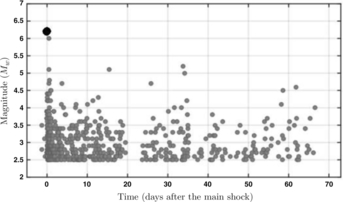
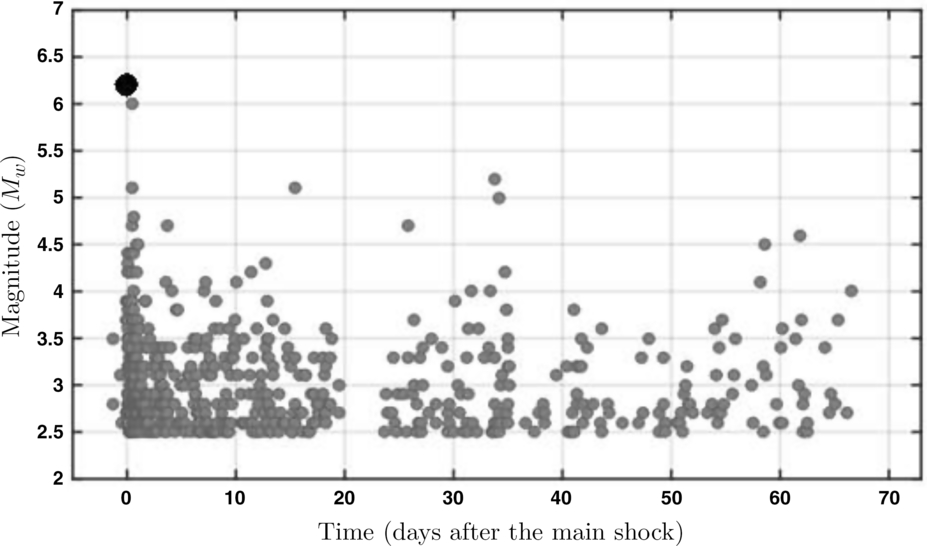
On December 1, 2017, at 12:13pm, an earthquake shook Hojedk, a region in southeast Iran. The shock had a moment magnitude of 6.6. The earthquake destroyed some of the mud and mud houses, and although nobody was killed, 51 people were injured due to the earthquake and its consequences. After the main earthquake, dozens of aftershocks larger than 2.5 Richter occurred daily. 1 According to the Iranian Seismological Center, Institute of Geophysics, Tehran University (Tehran, Iran), more than 1,000 aftershocks occurred during 67 days after the main earthquake in Hojedk (Figure 1).
Hojedk 2017 Earthquake Aftershocks.
Ethics
This report followed “The Revised International Guidelines for Ethical Health-Related Human Research” standards. Accordingly, the authors received written consent from the parents of the children to participate in the research.
Case Report
Patients included three children under the age of five. The first patient was a 5-year-old girl, the second patient was a 4-year-old girl, and the third patient was a 5-year-old boy; all had been referred to the Imam Sajjad Rehabilitation and Speech Therapy Clinic affiliated to Kerman’s Welfare Organization (Kerman, Iran) for stuttering treatment. All patients had symptoms of discontinued speech, including repeated sound, syllable, and words. After history-taking and diagnostic evaluations, stutter was diagnosed by a speech and language therapist, as well as a neurologist. According to the medical records of the patients, there was no history of stuttering, speech, or language problems; nor was there neurological disease or medical injuries due to the earthquake. All three patients were living in villages near the town of Hojedk, which was close to the center of the earthquake. The children’s parents stated that the children had symptoms of crying, severe fear, lack of talking for a short time, severe dependence on parents, and urine incontinent after the earthquake. They initially thought that the children’s speech would improve over time, but after two months, not only was there no changes in the children’s speech, but they were also repeating words and there were interruptions in their speech. After worsening of the children’s speech, worried parents attended the Imam Sajjad Rehabilitation and Speech Therapy Center.
Discussion
Stuttering is a mental disorder of speech’s rhythm and speed, and in most cases, it involves involuntary speech interruptions that begin early in life. Since stuttering is involuntary and socially affects the person, it has a significant and negative effect on the psychology, emotional, and mental health of an individual and causes him/her to be anxious.Reference Langevin, Packman and Onslow 2 The cause of stuttering is unknown; nevertheless, brain imaging shows that there is a problem in the neural process of speech associated with functional or structural abnormalities of the brain, particularly in areas that are responsible for language. Various factors are associated with the incidence of stuttering, including genetics, speech’s control-motor growth, linguistic growth, social-emotional functioning, and cognitive development.Reference Guitar 3 Since the children in this study had begun to stutter suddenly, without any physical trauma, while they had no history of stuttering in themselves or their families, it seems that the earthquake had been the trigger of stuttering in these children.
Although disasters are fundamentally different, they are destructive, stressful, and distressing events that affect children’s mental health.Reference Gorji, Jafari, Heidari and Seifi 4 Children who are more-exposed to injuries show more-severe psychological responses.Reference Heir and Weisæth 5 For most people, these acute responses and reactions are normal and decrease over time, but a small percentage of people will experience these psychological complications in the long run. In children, these conditions can turn into more serious problems than in adults.Reference Harada, Shigemura, Tanichi, Kawaida, Takahashi and Yasukata 6 Ultimately, a disorder can cause stress and trauma in children, which can be exacerbated by seeing the stress of their parents. For children, such a situation can lead to mental health problems that can, in turn, affect their physical health and education. The effects of a disaster on children are influenced by the children’s personal characteristics, the family, the community and the country’s circumstances, and the nature and severity of the disaster.Reference Kousky 7
Although it cannot be said that negative emotional experiences have been the cause of stuttering in these children, the importance of negative emotional experiences (such as the earthquake) in stuttering of children should be considered.
Conclusion
Natural disasters always have irreparable mental effects on people, especially children. Earthquakes, which are one of the most destructive natural disasters, lead to more significant consequences in this regard. Given the fact that stuttering can have a major impact on the quality of life of children, mental support, especially for children, should be provided by responsible institutions and families in the early days after an event to minimize the psychological effects of disasters. It is also necessary to carry out empirical studies to determine the prevalence of stuttering in children after a natural disaster.
Conflicts of interest
none