INTRODUCTION
Research on worker precarity has increased in recent years. In addition to facing significant disparities in income and wealth, workers are taking jobs with fewer health and safety protections, less security and scheduling flexibility, fewer opportunities for mobility, and a diminished sense of autonomy over their daily tasks (Kalleberg Reference Kalleberg2011). The key source for this precarity, scholars typically presume, is private sector employers seeking to extract maximum profits by reducing labor costs. When scholars consider the state’s role in fostering worker precarity, they often concentrate on the state’s inactivity, or lack of political will, to regulate employer behavior. In addition to the increasing deregulation of the market in the neoliberal era and inadequate worker protections, scholars also point to the erosion of the state’s ability to enforce existing worker protections (Gleeson Reference Gleeson2016). In the United States, for example, understaffed labor standards enforcement agencies must rely overwhelmingly on workers’ claims to identify violations (Weil Reference Weil2016), a passive stance that limits their reach and effectiveness (Griffith Reference Griffith2011).
Within this context, immigrant workers provide a unique window into the state’s role in worker precarity. Immigrants are a significant population in the United States, currently standing at about forty-four million overall and 17 percent of the workforce. Additionally, 10.6 million immigrants are estimated to be unauthorized (Warren Reference Warren2020),Footnote 1 eight million of whom work in the private sector, composing 5 percent of that workforce (Krogstad, Passel, and Cohn Reference Krogstad, Passel and Cohn2016). These unauthorized immigrants are subject to federal efforts to surveil, apprehend, and deport them, efforts intensified by collaborations with local law enforcement officials that funnel migrants into the deportation pipeline through everyday policing interactions (Armenta and Alvarez Reference Armenta and Alvarez2017).
The state also targets this “shadow labor force” of unauthorized immigrants via a range of surveillance efforts at the worksite. These tactics stem from policies put in place under the 1986 Immigration Reform and Control Act (IRCA), which required employers to verify the work authorization of their hires and instituted sanctions for those employers who knowingly employ unauthorized immigrants. These policies have fueled workplace-based immigration enforcement efforts, including high-profile surprise raids at job sites and also quieter and more encompassing audits of employers’ hiring records. The government’s strategy of enforcing immigration laws in the workplace stimulates worker fear of rocking the boat with their employers, thereby dampening workers’ ability to challenge unjust working conditions individually (Gleeson Reference Gleeson2016) and collectively (Durazo Reference Durazo2006; Bacon and Hing Reference Bacon and Hing2010).
The immigration state generates precarity not only for unauthorized workers (Hall et al. Reference Hall, Greenman and Yi2019) but also for guest workers who participate in visa programs connecting immigrants to employment opportunities. In the United States, “high-skilled” and “low-skilled” industries ranging from the tech sector to agriculture rely on foreign guest workers (Griffith Reference Griffith2009), and this is even more the case in places like Canada (Vosko Reference Vosko2018) and throughout the Middle East (Martin Reference Martin2017). US immigration policy gives low-wage guest workers no flexibility in finding other employment with their current visas, even if they face intolerable working conditions. If they leave their employer sponsor, they have a very limited time to exit the country before they lapse into an unauthorized status and become deportable. Even “high-skilled” guest workers are beholden to an employment contract—regulated by the Department of Labor—if they are to remain in the country legally. These dynamics benefit employers, who are able to rely on a captive workforce and competitive labor supply of migrants vying for a visa.
Yet, the immigration state does not simply operate through coercion of workers, and employers do not always willingly engage and benefit from the immigration state. In fact, this article argues that the state also contributes to worker precarity through its regulation and control of employers. Both mundane bureaucratic processes and coercive enforcement initiatives can increase the costs and risks associated with hiring even those workers who are authorized to work and do not require a visa application. As a result, employers do not always willingly engage with and benefit from the immigration state. They are sometimes subjects of the immigration state. We present the case of workers with temporary reprieves from deportation and work authorization, concentrating on workers in the United States with Temporary Protected Status (TPS). The legal status/work authorization of a TPS worker is not linked to any specific employer. Instead, it is managed by an unpredictable and confusing bureaucracy that both TPS workers and their employers must navigate.
For almost two decades, TPS has provided a form of humanitarian relief from deportation, as well as work authorization, for individuals from certain countries that have experienced catastrophes such as war, environmental disaster, or other short-term crises. The secretary of the US Department of Homeland Security can designate certain countries as eligible, and Congress can also do so legislatively. The status lasts for six to eighteen months, depending on the country, and can be renewed until the federal government terminates the country’s TPS designation. There are more than a million individuals who benefit from various types of temporary deportation relief and work authorization, 400,000 of whom are TPS holders (Heeren Reference Heeren2015). Despite their relatively small numbers, these immigrants are an important and frequently studied group given their concentration in certain low-wage labor markets, such as care work, hospitality, and construction. While scholars have long concentrated on TPS holders and the liminal legality they embody, they have focused less on their actual experiences in the workplace.
Temporary Protected Status is a strategic case within the immigration state because it is a status that should be more secure than other nonpermanent immigration statuses. These temporary immigrants are neither unauthorized, as are certain immigrant workers, nor immobile in the labor market, as are guest workers. TPS workers should therefore be less precarious than unauthorized workers because they are further removed from the state’s deportation machinery, though they are not completely free from its reach. They should also be less precarious than low-wage guest workers because they are not tied to one employer and do not require an employer sponsor. Furthermore, TPS is an important object of analysis because it represents the dominant model that has been adopted by both political parties as a way to expand the channels of legal migration, often with little to no discussion about the associated costs and challenges migrants with this type of temporary status currently face. Focusing on this population also reveals the spillover effects of state coercion and bureaucratic processes on workplace precarity, effects that extend far beyond the unauthorized and guest workers.
In this article, we contend that although they are authorized to work and are not tied to particular employers through visa requirements, TPS holders face a more complicated employment prospect than do permanently authorized low-wage workers. Their employers must navigate an unpredictable and confusing immigration bureaucracy, which often involves frequent work authorization renewals, in order to abide by work authorization laws. This study draws on an analysis of the legal framework surrounding TPS and federal immigration enforcement in the workplace, as well as on interviews with 121 low-wage TPS workers and their advocates in the New York City metropolitan area. Our findings reveal that when employing TPS workers, employers must engage with coercive and bureaucratic arms of the immigration state, which are intertwined and operate in tandem. The state’s policies and actions make TPS workers a more risky and costly proposition for employers, thereby exacerbating the job insecurity that TPS workers already face due to an at-will employment regime void of state-required employment security protections.
In what follows, we first examine the existing approaches to understanding the state’s role in creating worker precarity. We then propose a new “employers-as-subjects” approach, one focusing on how employers contend with the coercive and bureaucratic elements of the immigration state. In the methods section, we elaborate why TPS is a strategic case and why employment insecurity is a key source of precarity. We outline our approach to interviewing 121 TPS workers (from Central America and Haiti) and twenty-four advocates. In our findings, we lay out the coercive and bureaucratic aspects of the immigration state and the challenges they pose for employers, identifying how these challenges drive employment instability for workers. While undocumented and guest worker peers absolutely also face workplace insecurity, the factors driving this precarity may not necessarily be uniform across workers of various statuses (Griffith and Gleeson Reference Griffith and Gleeson2017). Even though much of the current research focuses on the need for a more hardline enforcement approach to employers, we encourage recognizing the downstream effects of such a punitive turn. As such, we conclude by encouraging scholars to further examine how employers’ role as subjects of both the coercive and bureaucratic arms of the state fosters worker precarity.
Existing Approaches to Understanding State Power
Existing theories of how the state generates precarity have disaggregated the various elements of state power, notably separating coercive from seemingly more mundane bureaucratic actions. These theories often consider the ways the state incentivizes private actors to extend its power. In the realm of immigration, employers are seen as willing deputies carrying out coercive immigration enforcement efforts and thereby generating worker precarity. Scholars have also shown the ways the seemingly more mundane bureaucratic elements of the state can foster worker precarity, but have focused little on employers as subjects of the state. We propose an approach that considers employers as sometimes grudging subjects of these aspects of the immigration state. The immigration state might not just incorporate employers to advance the state’s objectives but could also ensnare them as subjects of both its coercive and bureaucratic power. We use the example of authorized migrant workers with TPS to demonstrate that employers’ attempts to mitigate the associated risks and costs of hiring TPS migrants complicate migrants’ ability to get and keep a job, or to secure a better job.
We proceed by first reviewing the ways in which the state exerts coercive power, then examine bureaucracy’s role in institutionalizing state power. We draw on general theories of the state, then home in on the context of immigration. Our proposed employers-as-subjects approach views employers as central actors, along with the state, in creating migrant worker precarity. We therefore argue that employers are not only extensions of the immigration state but also bear risks and costs generated by its policies, with implications for worker precarity.
Coercive Elements of the State
A dominant strain of the literature focuses on the state’s coercive and punitive power in shaping behavior and structuring inequality under the guise of maintaining law and order. These analyses frequently discuss the state’s role in enforcing existing laws (such as drug policies and rules around public space) and exacting penalties. These law enforcement efforts often disproportionately impact vulnerable communities. We know, for example, that policing initiatives target certain communities of color, often with lethal consequences (Epp, Maynard-Moody, and Haider-Markel Reference Epp, Maynard-Moody and Haider-Markel2014). In the realm of immigration enforcement, research tends to highlight the federal surveillance strategies that intensify detention and deportation efforts, often with the help of local governments (such as police) and private actors (such as employers) (Lahav Reference Lahav1998).
Accordingly, much of the literature on the immigration state examines the targeting and removal of unauthorized individuals. Scholars have long highlighted the role of employers as a willing partner in these efforts, particularly since the enactment of the 1986 Immigration Reform and Control Act (IRCA). IRCA’s regime grants employers broad powers to verify an immigrant’s work authorization, which in turn gives many workers the impression that their employers are part of the state’s enforcement apparatus. These workplace records allow immigration agents to locate and detain unauthorized migrants. In fiscal year 2018 alone, the Department of Homeland Security initiated 6,848 worksite investigations and 5,981 I-9 audits. Audits can lead to mass firings and, in some cases, mass arrests (US Immigration and Customs Enforcement 2018; Zhang Reference Zhang2019).
We know that employers often hire unauthorized workers because of the pliant and flexible labor they provide (Waldinger and Lichter Reference Waldinger and Lichter2003; Rodriguez Reference Rodriguez2004). We also know that employers can use fear about the state’s deportation power to dampen worker dissent. For example, it is not uncommon for employers to produce notices about “mismatched” Social Security Numbers at strategic moments of worker organizing or layoffs (Durazo Reference Durazo2006; Bacon and Hing Reference Bacon and Hing2010). They may make explicit or implicit threats to call immigration authorities if their workers make demands about wages and working conditions. Some employers also voluntarily implement E-Verify, an electronic verification program that is considered inaccurate by its critics, as a way to demobilize workers and discourage worker complaints. According to Goldstein and Alonso-Bejarano (Reference Goldstein and Alonso-Bejarano2017), E-Verify operates as a “biopolitical tool for ‘soft’ immigration enforcement that works in concert with ‘hard’ geopolitical border control in order to balance the competing political priorities of deporting the undocumented while maintaining a disciplined undocumented workforce in the United States.” Indeed, employers assume enhanced power under immigration law, allowing them to foster fear among their workers (Lee Reference Lee2009; Saucedo Reference Saucedo2010).
Bureaucratic Elements of the State
Just as coercive elements of the state shape migrant precarity, the more mundane bureaucratic elements of the state “shape the implementation of legal mandates” (Cohen, Cuellar, and Weingast Reference Cohen, Cuellar and Weingast2006, 677). For example, studies show how seemingly “colorblind”—and deeply entrenched—bureaucratic policing processes are used to justify the targeting of immigrants and other communities of color.
Similarly, welfare state scholars trace how the entire system of public provision, rather than simply bad actors within agencies, creates and perpetuates inequality in vulnerable communities. Street-level bureaucrats in a range of institutions—such as social service organizations, healthcare providers, and schools—are responsible for interpreting the rights and benefits afforded to individuals (Lipsky Reference Lipsky1984). These actors “discipline” poor clients through state procedures designed to track and influence their behavior in gendered and racialized ways (Soss, Fording, and Schram Reference Soss, Fording and Schram2011). This systematic disciplining occurs as agents are tasked with determining individuals’ eligibility for basic benefits (Gilliom Reference Gilliom2001), and it has intensified as technological advancements aggregate mass amounts of data while eroding privacy protections (O’Neil Reference O’Neil2016; Eubanks Reference Eubanks2018). Again, these bureaucratic processes are often billed as objective and accurate. However, we should remember that people program and execute these often confusing and cumbersome systems, and therefore human biases inevitably work their way in (Ajunwa Reference Ajunwa2019).
The immigration bureaucracy—considered even more complex than the tax code (Manning and Stumpf Reference Manning and Stumpf2018)—is challenging even for authorized immigrants to navigate and can disadvantage them in multiple spheres of their lives. For instance, a complicated and highly discretionary administrative bureaucracy inefficiently processes migrants applying for lawful permanent residence or naturalization, as well as those granted asylum (Department of Homeland Security 2018b). Legal scholar Lenni Benson (Reference Benson2002) highlights how the delays and complexity of this immigration bureaucracy can lead to “the denial of a fundamental right: namely, to make an independent choice of where to live, work, and travel” (207), even for the most privileged of those migrants proceeding through the “right” channels (e.g., spouses of US citizens).
Bureaucratic aspects of the state can help enact—just as they obscure—the punitive imperatives of the state. They can also exacerbate various aspects of precarity. For example, ethnographic research by Rosales (Reference Rosales2020) argues that largely unauthorized immigrant street vendors must also compete with one another for limited access to local markets. In addition, these vendors are subject to complex bureaucracies surrounding health codes and public space permits, as well as immigration enforcement by local policing, which spurs additional conflict. In the healthcare arena, Light (Reference Light2012) similarly highlights how “embedded inequalities lead to institutional ambivalence in the provision of services and to permanently failing institutions that work poorly, waste resources, or provide uneven quality….” These bureaucratic features, mediated by doctors and insurers, in the end severely disadvantage immigrants and other uninsured patients.
Studies of TPS highlight the central role of state bureaucracy in worker precarity. This stands in contrast to unauthorized workers, whose “central legal institutional context” involves coercive elements of the state (Griffith and Gleeson Reference Griffith and Gleeson2017, 115). Nonetheless, coercive and bureaucratic dynamics openly collide around TPS migrants. A form of “semi-legality” (Kubal Reference Kubal2013, 555), TPS is often overlooked in the authorized versus unauthorized legal status binary predominant in migration research. But as Coutin (Reference Coutin2017) describes, TPS migrants do not fit neatly into this conception; they “experience a legal limbo: lawfully present but without the benefits that would normally come from legal status.” Despite its benefits, Temporary Protected Status fosters a “liminal legality” that creates uncertainty for immigrants (Menjívar Reference Menjívar2006, 999) and precarity across a range of social arenas (Hallett Reference Hallett2014). Menjívar and Abrego (Reference Menjívar and Abrego2012) argue that the “normalized but cumulatively injurious effects” of TPS’s uncertain and unpredictable processes (i.e., of regularly mandated application renewal) constitutes “legal violence” for the immigrants they impact (1380). As such, the TPS bureaucracy creates fear among immigrants, who in turn avoid accessing services and other forms of community support, given the ever-present threat of deportation looming in the background (Menjívar Reference Menjívar, Roberto and Sigona2017).
A major, though often overlooked, driver of TPS precarity is employer behavior. Employers hiring these workers must navigate both the TPS bureaucracy and coercive employer sanctions policies. While past studies often portray private sector employers either as willing extensions of the state’s apparatus, or as opportunistically playing on the fear generated by the coercive state to keep immigrant workers in check, employers themselves are also subjects of the state’s regulation. As such, they have incentives to respond in risk- and cost-averse ways that disadvantage migrant workers.
Proposed Approach: Employers as Subjects of State Coercion and Bureaucracy
Our approach considers how the state’s coercive and bureaucratic power shapes employers’ incentives around hiring and retention. Employers are subject to investigation and face liability exposure if they do not follow paperwork review procedures, or if they fail to terminate TPS workers who lost their status. While many industries have simply accepted the risk of immigration enforcement as the cost of doing business, employers could become subject to an audit and/or sanctions for employing unauthorized employees, and may therefore have less appetite for risk. Employers must keep abreast of a turbulent immigration policy regime as their TPS workers renew their status every six to eighteen months, according to the will of political leaders. The documentation that TPS workers are given to prove work authorization is often misleading, which can make it challenging for employers to ensure they are properly following employee authorization requirements. Employers have few market incentives to assume the risks and costs of hiring and verifying TPS workers, especially in the absence of a collective bargaining agreement. Furthermore, the weak discrimination protections for noncitizens make it easier to pass over—or let go—a TPS worker. Instead of viewing employers’ treatment of immigrants as simply taking part in the state’s deportation machinery, we argue that employers are also subject to the penalties and costs of the immigration state. This state-employer interplay in turn generates employment insecurity, even for authorized TPS workers.
To build our approach, we draw from scholars who have revealed that state power can create systemic effects that shape behavior regardless of the intentions of specific individuals. For example, based on an ethnographic analysis of policing, Armenta (Reference Armenta2017) shows that undocumented immigrants can find themselves caught in a pipeline of deportability over seemingly benign encounters with law enforcement, such as a routine traffic stop. While officers have discretion in theory, they often view their actions as hemmed in by institutional policies. They often have little understanding of the consequences of their actions for the deportability of the migrants they arrest and detain. Rather, the structural aspects of the profession (and the various incentives and disincentives that drive law enforcement within a particular institution) in effect racializes the largely Latino unauthorized population.
Similarly, regardless of the various biases and intentions of individual employers, they are bound by the state’s rules and regulations with respect to the 1986 employer sanctions regime. These rules, which human resources departments and hiring managers must follow, subject employers to the state’s coercive and bureaucratic power around immigration enforcement. They require employers to verify the work authorization of their employees or face significant civil and/or criminal penalties. The state can then audit and inspect these employer records to ensure compliance, exacting penalties where they detect irregularities.
Employers are also operating within a system of labor regulation, characterized by low unionization rates and weak protections under labor and employment law. At-will employees are not entitled to legally mandated “for cause” job security protections. That is, employers are not required to give a reason for firing them, and they are allowed to do so for any reason, as long as they do not run afoul of the few legally mandated protections. In this context, employers have little incentive to assume the additional liability risks and costs posed by the coercive and bureaucratic apparatus of the immigration state. While many employers are willing to assume these risks and costs for some workers, they certainly have a large pool to choose from, thus allowing them to determine for whom such outlays are worthwhile.
Longstanding observations in organizational theory also support our employers-as-subjects approach. Pfeffer and Salancik’s (Reference Pfeffer and Salancik1978) classic account of resource dependence argues that organizations adapt when they perceive a certain resource becoming more costly or uncertain (see also Hillman et al. Reference Hillman, Withers and Collins2009). Scholarship on high-skilled immigrant workers, which has interrogated how employers intersect with the complex immigration bureaucracy (see also Rissing and Castilla 2014; Reference Rissing and Castilla2016), finds that the costs associated with sponsoring such employees decreases employers’ willingness to hire them. This is especially the case with inherently risky endeavors like startups (Roach and Skrentny Reference Roach and Skrentny2019). If we consider that worker pay is a reflection of this differential cost to the organization, it is telling that immigrants garner differential earnings based on their prior visa status. Simply put, temporary work authorization seems to carry a particular tax. Holding all else constant, those workers with prior temporary visas earn less than workers with more stable statuses. This may reflect green card holders’ greater mobility in the US labor market (their work visa status is not dependent upon a sponsoring employer) or also the costs of uncertainty (Mithas and Lucas Reference Mithas and Lucas2010).
We follow the call from Kerr et al. (Reference Kerr, Kerr and Lincoln2014) to recenter the firm as a critical actor in immigrant employment prospects. We consider employers within the broader legal institutional context of immigration law and policy. We draw on the perspective of workers who must navigate their relationships with their employers and advocates who mediate the concerns of both workers and employers. We offer the case of low-wage TPS workers as an important corrective to a body of research that is overwhelmingly concentrated on temporary, “high-skilled,”Footnote 2 employment-based visa holders (who have a unique path to permanent residence under US law). We also offer it as a corrective to a body of research, described above, largely focused on the unauthorized and low-wage guest worker populations.
Here we suggest that even temporary authorized migrants, who are authorized to work and are free to navigate the open labor market, face consequences when the state pressures employers. Employers’ attempts to dodge the coercive arms of the immigration state, and to minimize the costs associated with immigration bureaucracies around work authorization documentation, exacerbate job insecurity for this population. In line with previous scholarship, we separate the state’s coercive and bureaucratic elements, but we also argue that they cannot be understood independently. Rather, these elements often intersect and are interdependent. This is especially the case at the point of hire, but remains relevant throughout a worker’s tenure. Employers are required to verify, and reverify, TPS workers’ authorization through a series of confusing and delayed bureaucratic renewal processes. They are subjected to surveillance and potential sanctions if they fail to verify their employees properly. These seemingly banal bureaucratic processes are not only potentially costly but are also a hassle for employers. Given this burden, any analysis of the relationship between the immigration state and worker precarity that ignores the state’s impacts on employers is insufficient.
Data/Methods
Below we detail why TPS provides such a valuable lens through which to view the role of the coercive and bureaucratic state in shaping worker precarity. We then share our rationale for examining employment insecurity as a key element of worker precarity. Finally, we explain the role that each of our two primary interview groups—individual workers themselves and worker advocates (who often must mediate between TPS immigrants and their employers)—play in our analysis.
Why TPS?
TPS is a strategic case for understanding the state’s role in shaping worker precarity because it implicates multiple actors within the immigration regime and demonstrates employers’ complex regulatory role in immigration enforcement. The TPS case involves several arms of the state, some of which are more coercive/enforcement-driven, others more administrative/bureaucratic. It will be helpful here to outline briefly how TPS status is assigned and verified. First, the leadership of the Department of Homeland Security (DHS) designates which countries receive TPS humanitarian relief, often for six to eighteen months at a time, with a potential (but no promises) for renewal. This relief was extended to migrants in our study who arrived from Honduras and Nicaragua (before December 30, 1998), El Salvador (before February 13, 2001), and Haiti (before January 12, 2011) (Warren and Kerwin Reference Warren and Kerwin2017, 591, Table A). Second, the designation is then handed down to an agency within DHS, US Citizenship and Immigration Services (USCIS), that processes and issues work permits for individuals with temporary authorization. Third, Immigration and Customs Enforcement (ICE)—another DHS agency—investigates employers to ensure that they have properly verified the work authorization documentation of their workforce. Meanwhile, the US Department of Justice Civil Rights Division allows employers to give preference to some categories of authorized workers over TPS workers but prohibits employers from requiring TPS workers to produce additional documentation beyond what the law specifies. Therefore, state power is omnipresent for TPS workers, not simply through the power of the deportation machinery (i.e., the coercive law enforcement arms of the state) but also through a complex bureaucracy that employers must navigate in order to hire them.
Undoubtedly, all bureaucracies are by nature complex, inefficient, and a hassle for those involved. In the case of TPS, however, there is a unique bureaucratic disarticulation. As detailed above, the arm of the state that documents TPS employment authorizations is distinct from that which renews TPS eligibility. There are also significant delays between when a country’s renewal is announced and when the actual documentation—an updated employment authorization card that confirms an individual is authorized to work—is issued. In the meantime, TPS workers are left with just a copy of the obscure Federal Register as the sole proof of their status renewal, rather than an actual employment authorization card with a viable end date. Moreover, the timing of the immigration bureaucracy is frequently out of step with everyday employer practices, which typically verify employment authorization at the start of employment and whenever work authorization renewals occur.
Bureaucratic processes around TPS work authorization are particularly salient because they can trigger coercive elements of the state. As outlined above, if ICE conducts a worksite investigation and finds that an employer of a TPS worker has not properly verified work authorization, ICE could sanction or, in extreme cases, arrest that employer. In sum, given its position in the broader legal context, the TPS case can reveal how the immigration state’s coercive and bureaucratic powers jointly ensnare employers, and by extension their TPS workers.
Why Employment Insecurity?
We turn now to employment insecurity, which we use to draw attention to the dynamics of getting and keeping a job. An examination of employment insecurity, rather than other forms of workplace precarity (such as wages or occupational health), may seem odd in the case of TPS workers, as data confirm that they have high levels of labor force participation. Warren and Kerwin’s (Reference Warren and Kerwin2017) analysis from the Census Bureau’s American Community Survey shows that TPS migrants have a much higher-than-average labor force participation rate. TPS workers are concentrated especially in low-wage industries such as construction, food service, landscaping, childcare, and grocery stores. The median household income is modest, with that of Salvadoran migrants at $50,000, followed by Haitians ($45,000), and Hondurans ($40,000).
We consider the employment insecurity of TPS workers for two main reasons. First, getting and keeping a job was a dominant concern of the 121 TPS workers we interviewed. Because we interviewed respondents from two of the largest populations of TPS recipients (Haitians and Central Americans) in the New York City metropolitan area, one of the most supportive immigrant destinations in the country, this concern is likely felt more acutely in areas with fewer resources for immigrant integration and workers’ rights. Second, employment insecurity is a strategic focus because immigration law intersects with employers most prominently at the point of hire and retention. This allows us to examine how multiple arms of the state interface with employers and impact employment security.
Lastly, difficulties in finding a job, as well as the possibility of sudden job loss, plague TPS workers. How difficult employers find their obligation to verify the work authorization of a TPS immigrant hinges on the DHS Secretary’s power to designate/cancel TPS, along with USCIS’ ability to provide documentation. Employers must then revisit this verifying task at every regular renewal. In other words, as long as immigrants are not permanently authorized to work, they require constant rescreening at regular intervals when their employment authorization document (EAD) expires. Given the risks to employers detailed above, the stakes and hassle of compliance are relatively high.
Worker Interviews – Examining Precarity from the Ground Up
To identify key dynamics of precarity, from July 2016–April 2019 we interviewed a diverse low-wage sample of TPS workers in the New York City metropolitan area. Interviewers queried workers about their migration histories, experiences with immigration enforcement and obtaining/renewing their legal status, job search strategies, and employment conditions. Interviews were fully transcribed and coded in Atlas.ti.Footnote 3
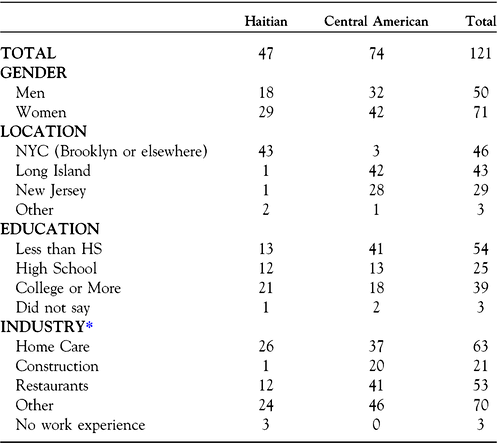
We interviewed 121 TPS-holders hailing from Central America (seventy-four) and Haiti (forty-seven), the two regions supplying the vast majority of TPS recipients Chishti et al. Reference Chishti, Bolter and Pierce2017). (See Table 1.) Of the interviewees, seventy-one (59 percent) were women. We concentrated our interviews in the communities where these two populations live and work. Our Central American sample hailed from New Jersey’s commuter communities and Long Island, NY (which was less urban and more isolated). The Haitian sample was overwhelmingly concentrated in Brooklyn, NY. The demographic and human capital profiles of each group varied. Only 28 percent of Haitians reported an educational attainment of less than a high school degree (compared to 55 percent of (Central Americans). Home care was an important industry for both sets of respondents, although with different occupations within the industry. About half of our Haitian and Central American respondents who reported their job type had been employed in domestic care (Haitian respondents mostly in home healthcare and Central American respondents mostly in childcare) at some point. Restaurants were key for both groups, although to varying degrees, with twelve of forty-seven Haitian respondents having worked in that industry and forty-one of seventy-four Central American respondents as well. Occupations within the restaurant industry ranged from fast-food preparation to dishwashing.
Key Sample Characteristics

Cell counts represent major categories for analysis, based on available data
* Represents any industry in which the respondent has worked in the United States.
The New York City region was a strategic location for this study as it facilitated access to two major groups of TPS holders. The region is a key destination for Central American and Haitian migrants, as an estimated 16,200 (of a national total of 195,000) Salvadoran TPS migrants and 5,200 (of a national total of 50,000) Haitian TPS migrants are located in New York state (Warren and Kerwin Reference Warren and Kerwin2017). Moreover, TPS workers in New York City represent a “critical case” for understanding the challenges posed by the program (Patton Reference Patton2002, 236). New York City has one of the densest concentrations of civil society and legal aid in the country, along with some of the strongest worker and immigrant protections. Together, these characteristics provide a conservative “best case scenario” for our analysis. That is, if immigrants in this region face particular challenges with their employers, they are almost certainly also likely to face the same challenges elsewhere.
We sampled Central American and Haitian respondents with the help of several legal aid organizations, who assisted us in reaching out to potential participants through mailings and on-site outreach. We also followed up on snowball referrals from study respondents. Our bicultural and bilingual research assistants based in New York City assured clients that their participation in the project was entirely voluntary and confidential. We provided respondents with a $50 honorarium to compensate them for their participation in a one-hour interview.
While this recruitment strategy limits the sample to those with connections to referral organizations and legal advocates, it is well suited to studying precarious immigrants who are concentrated in particular communities and industries and who would otherwise not be well represented through a random sampling approach. This approach is also not likely to introduce significant bias into our sample, given that a majority of TPS migrants rely on legal assistance to navigate the complicated immigration bureaucracy. That said, we argue that any challenges experienced by this “connected” sample are also likely to be found—and perhaps more keenly felt—in TPS populations unconnected to legal advocates.
Organizational Interviews – Characterizing the Employment Relationship
Interviews with workers provided insight into how employers interacted with the coercive and bureaucratic elements of the state. Interviewing employers and management undoubtedly would also provide important insight, as scholars have done in several excellent accounts of worker precarity (e.g., Waldinger and Lichter Reference Waldinger and Lichter2003; Rodriguez Reference Rodriguez2004; Carré and Tilly Reference Carré and Tilly2017). Nonetheless, we were cognizant of the confidentiality and safety concerns for the precarious migrant workforce we interviewed. Employers of TPS workers are a relatively small and diffuse population, and only a small part of their workforce is likely to have TPS. This makes it difficult and inefficient to sample a broad cross-section of relevant employers. As a result, for both methodological feasibility and research ethics reasons, we did not interview employers.
In order to better understand the sources of employment insecurity for TPS holders, we focus our analysis on workers’ experiences and the perspectives of the advocates who help broker workers’ relationships with employers. TPS holders often turn to advocates when they face the possibility of losing their job due to complications with their paperwork. To be sure, interviews with legal experts and service providers cannot be used as a proxy for the perspective of employers. This is not our intent. However, advocates regularly liaise with workers and employers; as such, they have direct insight into the challenges that emerge around hiring and retention decisions. They are often called on to interact with employers on behalf of their clients. Sometimes they send demand letters/emails to employers, and other times they call employer representatives to try and hash out a solution to an employment dilemma. Employers sometimes even call them for help. Therefore, advocates are a valuable source for understanding employer concerns regarding the complexities and liabilities they face vis-à-vis the immigration state.
We identified these advocates through a census of service providers critical to the Central American and Haitian immigrant community in the New York City region. Five worked with Central Americans (primarily on Long Island, NY), and another five of these advocates served the Haitian community (primarily in Brooklyn, NY). Sixteen were practicing attorneys, while the rest were community organizers, union leaders, and elected officials.
Finally, to gain additional insight into the conditions surrounding employers’ hiring and retention decisions, we reviewed the (ever-in-flux) laws and policies surrounding TPS, examined public information from the US Department of Justice directed at employers with questions about TPS authorization, and consulted publicly available advisories created by employer-side law firms on this issue (mostly from law firm websites). Together, these various data points allow us to triangulate the dynamics between workers and their employers as they navigate the coercive and bureaucratic labyrinth of the TPS program.
Findings
Interviews with TPS workers across our sample revealed that employers contend with a variety of labor market incentives (and disincentives) when deciding whether to employ (or continue to employ) workers with temporary work authorization. They weigh the benefits of a flexible, at-will employment regime against the regulatory hurdles imposed by the immigration state. Risk-averse employers have reason to avoid the surveillance and sanctions imposed by the coercive arm of the immigration state. They may also simply wish to avoid the unpredictability that comes with TPS status (which is dependent on political whims) or lack the resources to manage the shifting and confusing bureaucratic processes that come with verifying (and reverifying) a TPS worker’s work authorization.
State power mechanisms disincentivize employers from employing, or maintaining, this population of workers. To be sure, TPS workers have a high labor force participation. The challenges created by the immigration state, however, shape the kinds of jobs to which they have access and introduce a constant sense of instability into their employment prospects. Workers across our sample all confirmed these anxieties, as did advocates who provide assistance to TPS workers and to the employers looking to employ them.
Below we draw from our interviews to unpack the ways that the coercive and bureaucratic aspects of the immigration state relate to the employment stability of TPS workers. First, we discuss how state coercion (fear of liability, fines, and the risk of criminal prosecution) collides with bureaucratic systems meant to ensure compliance, generating costs for both employers and their workers. Second, we present the ways that mundane bureaucratic requirements imposed by a temporary immigration policy regime that is unpredictable, delay-prone, and confusing further burdens employers and, in turn, disadvantages TPS workers in the labor market. We review each of these dynamics below, focusing on the costs to employers as interpreted by their workers and workers’ advocates.
The Costs of State Coercion
The state’s coercive power over employers was a recurring theme in our interviews. As one advocate put it, employers have to constantly interact with “the enforcement wing” of the immigration state and need to “mak[e] sure their bases are covered.” As a result, they often “pause” employment relationships—effectively firing a worker for a time—even in cases where they are not legally required to do so. In effect, they would rather err on the side of caution than risk surveillance or punishment. Employers voiced these same concerns during a conference of large and high-profile service sector employers, which we attended.Footnote 4
TPS workers we spoke to indeed felt the effects of the state’s coercive power over employers. Gessica, a Honduran TPS holder from a suburb north of New York City, talked about the anxiety she experienced around renewal periods because her EAD card would show an expired date.Footnote 5 She recounted that during every renewal period, the human resources staff of the wholesale grocery company she worked for would threaten her job if they did not receive her new EAD on time, which was completely out of her control. Similarly, Marta, a Salvadoran TPS holder from Long Island who works in elder care, reported losing a job opportunity because her card expired during a renewal period.Footnote 6 Carmen, a Nicaraguan TPS holder from Long Island, lost her job at a major fast-food hamburger chain because the supervisor demanded an actual EAD and refused her offer to supply the (legally sufficient) copy of the Federal Register as temporary proof of work authorization.Footnote 7 For her and others, work stoppages, even if brief, further exacerbated the already insecure work environment faced by low-wage and at-will employees. The economic consequences of these disruptions were significant. As one advocate for low-wage Haitian workers confirmed, missing a paycheck “because you’re put on hold … throws everything [out of] whack” because low-wage TPS workers “live paycheck to paycheck.”Footnote 8
A primary source of this insecurity, and employer fear about liability, are the ways that the coercive state intersects with the bureaucratic apparatus that implements work authorization. Advocates were often called upon to educate employers and allay their concerns about falling out of compliance and being hit with employer audits and/or sanctions. These worker allies often had to explain legal details to wary employers, for example that other documentation could demonstrate authorization in the absence of a current EAD. Employers “don’t know really the nuances” of TPS, one advocate explained.Footnote 9 Even for unionized workers, union leaders had to regularly clarify for employers that—per the official DHS policy recorded in the Federal Register—workers were eligible to continue working even after their authorization card termination date passed. In some cases, this assurance was enough to allay employer fears, but many still seemed unwilling to assume additional and unnecessary risk.
For some employers, the risk of government surveillance and sanctions outweighed their interest in keeping workers with expired work authorization cards on staff. One advocate estimated that the organization was successful in allaying employer concerns only about half of the time. In cases where employers responded negatively, workers were granted perhaps a couple of weeks to sort out their affairs. After that, these workers would “have to wait” and “can’t come back to work until they have the proper documentation to continue working.”Footnote 10 According to many employers who interacted with our interviewees and their advocates, the only “proper documentation” was a work authorization card with a viable end date.
In sum, our findings confirm that the immigration state’s coercive power imposes significant costs on risk-averse employers, and thus perceptions of job stability among workers with TPS. For many employers, the primary method of mitigating the omnipresent threat of fines or criminal prosecution is maintaining clean and transparent records for their employees in case of an audit or inspection. In addition to these punitive costs that enhance concerns around surveillance and sanctions, our interviews also illustrate that the seemingly benign TPS bureaucracy imposes real and opportunity costs that reduce incentives for employers to take on these workers regardless of state coercion.
The Costs of State Bureaucracy
The sensational headlines about enhanced worksite enforcement, employer audits, and criminal arrests of both workers and employers are evidence of the coercive and punitive power of the immigration state. However, our interviews also illuminate other downstream effects of the seemingly mundane bureaucracy that regulates immigrant work authorization. The bureaucracy’s problem is twofold: it is unpredictable and ever-changing, as well as confusing and delay-prone. Faced with such a system, employers may simply be unwilling to invest the necessary resources to master the ins and outs of hiring, and retaining, a TPS worker.
An Unpredictable Bureaucracy
All of immigration law is arguably in flux, but TPS is by definition fluid. TPS renewals are subject to political negotiation and shifting political winds, with officials determining statuses on a country-by-country basis every six to eighteen months. As such, it is hard to keep track of what aspects of the program are changing or remaining the same. Many workers we interviewed reported that this unpredictability gives pause to many prospective and current employers. In effect, the unsettled nature of TPS takes control of the hiring process away from employers, who are used to being able to define how long they will employ someone.
As a result, many workers were aware that they posed hiring complications for employers. Some faced difficulties securing a job, while others were hesitant to leave their job and seek better prospects. Robenson, an unemployed Haitian man with TPS who lives in New York City, likened his extended job search to “running into a wall.”Footnote 11 Similarly, Wilmer, a Salvadoran TPS holder who works construction jobs on Long Island, noted that while some employers can handle the complications, others “don’t want to employ people with this (temporary) status…. They don’t know when it expires and what is going to happen.”Footnote 12 The program’s uncertain future added an additional hurdle for his job search. Though not all employers value long employment relationships with their staff, private employers certainly prefer the ability to decide when and for how long they can employ someone.
Interviews with advocates also provided insight into how the unpredictable timelines of TPS impact workers’ job prospects. One advocate for Haitian TPS workers recounted: “If somebody is trying to get employment somewhere, they cannot even tell [employers] how long they are going to be here.”Footnote 13 Another advocate highlighted the reluctance to hire someone whose work authorization expires soon when employers could hire someone without such a limitation:
If you’re trying to get a new job, and let’s say you have four months left on your work permit … a new employer might not hire you because they see that you only have a short amount of time left …. So, they are not going to take on an employee that they know they will just have to replace in four or five, six months when they could just get someone else who could potentially work for a long period of time. So, that has been another issue that we’ve seen in trying … to secure new employment.Footnote 14
This unpredictable temporary immigration policy regime impacted not only new hires but also currently employed TPS workers. For example, in the midst of discussions to end TPS, one Haitian community advocate noted that even though the federal government had not yet terminated the program, some employers were already (over)reacting to the potential termination: “A lot of people actually have been threatened either [with losing] their jobs, or they’ve already lost their jobs or have been put on hold.”Footnote 15 Indeed, with a large labor supply of low-wage workers waiting in the wings, these employers have little incentive to willingly shoulder bureaucratic burdens.
In line with organizational theory, these narratives suggest that the unpredictable prospect that TPS workers pose for employers translates into less certainty for workers about obtaining and keeping their job or finding a better one. This heightened sense of job insecurity is a construct of the state’s immigration policy regime and exacerbates existing precarity in the competitive low-wage—and mostly nonunionized—labor market.
A Delayed and Confusing Bureaucracy
Beyond the unpredictable nature of the TPS bureaucracy, respondents also discussed the bureaucratic burdens imposed by the slow and confusing work authorization process. As we have already established, it is often not clear to employers whether and when TPS holders are eligible to work. Employers may avoid workers with TPS because of concern over liability, but they may also pass over a TPS applicant or may terminate a current employee because the bureaucracy associated with employing them is a costly hassle. Interviewees reported that work authorization documentation was often delayed, and sometimes was lost in the mail due to address changes and other complications.
The delays in the TPS bureaucracy were exacerbated by the costs associated with renewals, as some workers were simply unable to afford the nearly $500 renewal fee every six to eighteen months. This financial burden made securing new cards ahead of their expiration date even harder. Abel, a Haitian TPS worker in Brooklyn, highlighted how TPS’s financial pressures intensified the precarity of his employment as a security guard. Employers often ordered him and others to stop work when their EAD deadline approached. Abel was told not to “come back until you renew your TPS.” He noted the cruel irony of such a predicament: “How you gonna get that money ($500) to renew that card,” he wondered, if he was no longer allowed to work?Footnote 16 At the time of his interview he had left his security guard job to drive for a ride-sharing company.
Workers also discussed how bureaucratic delays with their work permits decreased their attractiveness to employers. For example, Julian, a Salvadoran TPS holder who works as a mechanic on Long Island, described the prolonged waiting period for his new EAD as always a “stressful” time.Footnote 17 This sentiment was expressed over and over again in the interviews. Workers were understandably uneasy about their future and frustrated with the inefficient bureaucracy to which they and their employers were subject. They accordingly felt at the mercy of their employers deciding whether it was worth it to hire them.
In sum, our findings reveal that the TPS bureaucracy exacerbates workplace precarity. Employers fear incurring liability and penalties, have imperfect information about the precise status of the program, and are often unwilling to assume the cost and hassle of navigating a lumbering and confusing bureaucracy. All this destabilizes TPS migrants’ job prospects, causes devastating financial impacts, and exacerbates their existing fears of falling out of status and becoming deportable.
DISCUSSION AND CONCLUSION
This article has presented the case of low-wage TPS migrants in order to highlight an underexplored link between the state, employers and worker precarity. The state’s deportation machinery and the bureaucracy that fuels it are well-established fixtures that are crucial to our understanding of migrant precarity. However, by focusing on hiring and retention practices for TPS migrants, we also illustrate how the state drives worker precarity through its simultaneous targeting of employers. Unlike studies highlighting the role of employers as deputized enforcers of the work authorization regime, our analysis reveals that employers are also subjects of the immigration state who must contend with its coercive and bureaucratic elements. Requiring employers to screen work authorization and maintain records for eligible employees is both mundane and costly for employers, imposing negative downstream effects on workers. The TPS bureaucracy is unpredictable, slow, and confusing, creating compliance complications and potential liabilities for employers. Once we situate employers as subjects of the immigration state, we can see how worker precarity is generated not only by bad apple employers, such as those who leverage state power in order to exploit their workforce, but by the immigration system itself, which targets even the best-intentioned employers.
By examining TPS, we also illustrate that—contrary to popular wisdom—workers with temporary status should not be viewed as uniformly privileged over unauthorized workers (due to their authorization to work) or to guest workers (due to their relative freedom in the labor market). Instead, workers with TPS face unique barriers because of their employers’ burdensome relationship with the immigration state that destabilizes their employment prospects. While guest workers’ authorization is built into their visas, TPS workers must rely on periodically expiring work authorizations that can be exceedingly difficult to verify. In contrast to unauthorized workers, who need to establish “facially valid” work authorization only once at the point of hire, TPS workers must do so repeatedly, a task that proves difficult even with valid documents.
The case of TPS workers has critical policy implications for both sides of the aisle in the immigration debate. Both sides tend to find common ground with each other around temporary grants of relief. TPS represents a normative type of discretion for executive programs like the embattled Deferred Action for Childhood Arrivals Program (DACA), as well as everyday discretionary grants of relief that scholars like Heeren (Reference Heeren2015) and Wadhia (Reference Wadhia2015) have researched extensively. Even though the TPS program may not survive the Trump administration, this temporary framework for deportation relief (temporary status with flexibility across employers) has for decades dominated stalled congressional discussions around a more comprehensive reform solution. For more restrictionist political forces, temporary work authorization is a more politically palatable, pragmatic solution than sweeping paths to citizenship. As for many worker advocates who remain skeptical of reviving large-scale guest worker plans, moving away from tying a visa to a particular employer is presumed to give workers additional freedom to navigate the labor market. In these discussions, the pressures brought to bear on employers by the state are often overlooked or deemed a preferable alternative to targeting workers. Our findings, however, suggest that when employers incur these costs, workers are negatively impacted too. Here we have untangled the coercive and bureaucratic mechanisms of the immigration state that pressure employers and drive migrant precarity.
Our approach produces new insights, but also comes with tradeoffs. Our analysis of the broader institutional context relies on workers’ and advocates’ voices to ascertain salient forms of precarity and to identify how the immigration state shapes the context surrounding employers’ hiring and retention decisions. Yet, our reliance on interviews with workers and their advocates no doubt limits the scope of our study. We need additional research on employers’ decision-making around TPS but also on other factors that impact hiring and firing, without compromising worker safety and confidentiality. In the future, firm-level analyses can further help our understanding of the employer’s role in fueling worker precarity. Among other things, these studies could sort out why employers in some industries tolerate the risk associated with TPS and others do not.
By focusing on the commonalities among a diverse group of workers with TPS—experiences of job insecurity generated by the state’s relationship with employers—we have established a common pattern of precarity across different subgroups of TPS migrants, a diverse population indeed. Yet this analysis does not address the differences in worker experiences. Race, gender, national origin, and location may very well foster key differences in workers’ experiences of precarity. Deep ethnographies such as Ribas (Reference Ribas2015) are still needed to understand more about how legal status impacts competition between workers of different statuses and the strategies workers adopt to mitigate the challenges that their immigration status poses on a daily basis. Furthermore, while we interviewed two of the largest groups of TPS workers (Central Americans and Haitians), we do not provide insight into how TPS plays out for other national origin groups who may face more uncertain futures under the program (such as Somalis, Syrians, and Libyans, to name a few). These groups may face distinct challenges as well.
Moving forward, future research should consider employers as subjects (rather than merely protagonists) of the immigration regime. Here we proposed that the immigration state generates costs for employers that foment job insecurity among immigrants with temporary status. Future research could investigate the outer limits of this proposition: To what extent does the immigration state create incentives for employers to disfavor broader groups of “foreign-seeming” applicants, in contravention of US civil rights protections? How might these dynamics impact other aspects of the workplace experience beyond hiring, such as wages, health and safety, harassment, employee expression, and collective activity? In sum, future scholarship should take care to consider not only the ways that employers exert power over their employees through the immigration regime but also the ways that heightened immigration compliance mandates and the bureaucratic processes that implement them may alter employer behavior and worker experience in unexpected ways.
Acknowledgements
The authors would like to thank the individuals who provided interviews as well as our excellent team of interviewers; James-Alaindy Gourdet, Patricia Campos-Medina, Alicia Canas, Darlene Dubuisson, Kennys Lawson, Jessica Santos, and Lynne Turner. Research assistance by Dolores Eslava, Christina Jean-Louis, Sophonie Joseph, Valerie Silva Parra, and Vivian Vázquez, and feedback from Ming Hsu Chen, Leslie Gates, Ben Rissing, and Steve Yale-Loehr helpfully contributed to the project. We appreciate Anneliese Truame and Claire Concepcion for their administrative support and Matt Seidel for editorial assistance. The following entities for providing funding (IRB Protocol # 1604006305); the Russell Sage Foundation, the Cornell Institute for the Social Sciences, the Cornell Population Center, the Mario Einaudi Center for International Studies Faculty Seed Grant, and the Worker Institute at Cornell.