The goal of this research is to provide statistical data on graduate students' perceptions that can be used as a basis for actions aimed at increasing the proportion of students successfully completing doctoral degrees. The correlates of graduate student satisfaction suggest the importance mentoring plays in improving retention and success rates. This article is the first of two on this topic. Citations, appendices, and table 1–3 are available on the APSA web site: www.apsanet.org/PS/July03/Hesli.CFM.
Data that suggest demographic patterns underlay differential success rates give impetus to this work. Women have nearly reached parity with men in political science graduate enrollment, yet they are under represented to a considerable extent in doctoral degrees awarded (Simmons 1996). Although women have been enrolling in political science graduate programs in greater proportions, they either have not stayed to complete their Ph.D. degrees at the same level as men or are taking a much longer time for degree completion.
Because men are more likely to complete their Ph.D.s than women, we hypothesized that women face different obstacles in their graduate careers than men and that these obstacles do account, in part, for the smaller number of Ph.D.s conferred upon women. Research findings to date suggest several causes for higher attrition rates among females: lack of sufficient women faculty for role models and mentoring (Chenery 1990; Valos 1991); lack of true incorporation of women into the discipline—i.e., beyond tokenism (Tetreault 1997; Committee on the Status of Women 1992; Guy 1992; Sarkees and McGlen 1992; Jaquette 1971); and lack of a critical mass of cohorts to provide support and sharpen analytic skills through debate and resource sharing (Preston and Woodard 1984; National Research Council 1991).
The decision to leave graduate school prior to Ph.D. completion is, of course, multi-faceted. While there are many good reasons for graduate students to leave a program prior to the attainment of a Ph.D., an improper reason would be that the climate of the department is systematically less hospitable to the professional advancement of women as compared with men. Further, since poor retention rates among female graduate students have been linked to the limited advancement of women in the profession (Hesli and Burrell 1995), important normative questions could be raised if the doctoral attainment rates of women continue to lag behind those of men.
Several studies have tackled the question of what graduate students need for successful matriculation and socialization into the profession. Davis (1997) classifies the necessary resources into four categories: economic capital (money grants and scholarships); social capital (mentors and valuable communication networks); symbolic capital (prestige, awards, and credibility in the community); and cultural capital (knowledge and skills).
Cultural Capital
Typically, departments have used undergraduate GPAs and standardized test scores as predictors of graduate student achievement. These measures, however, have been unreliable in consistently and validly predicting performance beyond the first year (Arrow 1993). With regard to attrition rates, to date no evidence exists that indicates systematic attrition from graduate programs is caused by lack of academic performance (National Research Council 1992; Hornig 1987; Zwick 1991).
The hypothesis that we derive from this review of previous research is that symbolic and social capital have a greater effect than economic and cultural capital on the disparity in retention and attrition rates among graduate students and on overall levels of satisfaction with the graduate student experience.
We undertook a survey in spring 1997 to determine ways to improve retention and success rates among graduate students. The study's target population was all active graduate students in Ph.D.-granting institutions in the Midwest region (Appendix A on the APSA web site). Among the questions asked in a mailed questionnaire,1
A copy of the questionnaire that was mailed to graduate students is available from the authors of this report. The questionnaire went through several revisions and was pilot tested among graduate students before being finalized. Standard procedures for such surveys were followed, including guarantees of anonymity and follow-up mailings to increase response rates.
was a query about whether the student had ever seriously considered leaving graduate school before completing their degree objective. Women were more likely than men to report having seriously considered leaving (61.8% of women and 53.4% of men). We also asked in an open-ended format, what the primary reason would be if the student should decide to quit graduate school. For men, the single most frequently cited reason is the lack of employment opportunities; for women, it is an unfriendly (unsupportive) work environment. Women are more likely than men to speculate about dropping out because of dissatisfaction with political science as a field of study, problems with relations in the department, and reappraisal of their choice of career track (Table 1 on the web site).
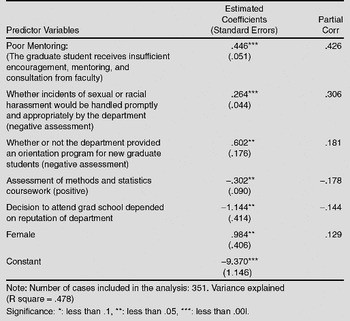
Although we do not know whether those who report having seriously considered leaving graduate school will indeed leave at some point, we use this question as one of two indicators of expected attrition. Using this first indicator, we evaluated the responses to other items in our questionnaire to identify which factors are related to the serious consideration of leaving graduate school before completing the degree objective. In Table 2, we present the set of factors that best predicts the probability of giving serious thought to quitting graduate school.2
Other factors that were tested but were not found to be significantly related (in a mulitvariate model) to the serious thought of leaving graduate school are: degree plan upon entering graduate school (M.A., Ph.D. or other), criteria used in selecting the graduate program (such as reputation or cost), level and type of funding (graduate/teaching assistantship or fellowship), the number of hours the student works for pay outside of any assistantship or fellowship, the student's career goals, what the student's highest academic degree was before entering the current program, undergraduate major, previous degree, most recent GPA, GRE scores, frequency of participation in social get-togethers, involvement in a personal relationship, whether minorities or women are on the faculty, assessment of methods and statistics coursework, year of birth, gender, and race.
Good mentoring appears to be the most effective tool against attrition. Negative reports about the availability of faculty encouragement and consultation (Poor Mentoring) are significantly tied to a higher probability of serious consideration of leaving graduate school (see Appendix B for items used in the scales).
While good mentoring works against attrition, the most important factor that contributes to the thought of leaving graduate school is knowledge of inappropriate conduct (either in terms of physical behavior or verbal communication) by a department member. Respondents were asked whether they know of any person in their department who has been the recipient of inappropriate behavior. Given the inequality of power between graduate students and faculty members, such inappropriate behavior, especially when it occurs as part of a pattern, is considered harassment by most institutions. For this query, 50% of women and 36% of men said they had knowledge of such inappropriate behavior (Table 3).
Evaluations of the availability of sufficient mentoring also show gender differences, with males registering higher levels of satisfaction with the degree of encouragement and consultation (Table 3). Thus, the two strongest predictors of the possibility of leaving graduate school before degree completion are embedded with a gender component.
Within the questionnaire, students were also asked: “Since entering graduate school have you (yourself) ever been involved in an interaction with a department member which involved behavior you perceived as inappropriate either in terms of physical conduct or verbal communication?” While a majority of both sexes respond negatively to this query, a profound difference emerges between the experiences of men and women. Women were much more likely to report an experience with or personal knowledge of inappropriate behavior than were men. That is, women are significantly more likely to have experienced inappropriate behavior by a faculty member (28%) than men (18%). However, it is the query about whether the respondent knows of any person in his/her department who has experienced such behavior towards them
that emerges as the significant predictor of the possibility of leaving graduate school before completing the degree objective. Knowledge of harassment has a statistically significant effect on expected attrition. Thus, a climate of inappropriate behavior can contribute to lower completion rates.
Another factor that is significantly related to the serious consideration of quitting graduate school is having come directly to graduate school from a baccalaureate program (Table 2). Those who either worked for a while or who were in a previous graduate program are less likely to think about leaving their current program. A fourth factor influencing expected attrition is whether a department offers an orientation program to incoming students. This finding provides additional evidence that what departments do to help their graduate students does matter. The provision of an orientation program significantly reduces the probability of seriously thinking about leaving.
A fifth factor, however, is beyond the department's control—the number of children that a graduate student has. The more children one has, the less likely one is to consider leaving graduate school.3
The number of children is related to age, with older graduate students being more likely to have children.
The last significant factor that emerges in the multivariate model is the department's record in placing their graduates—the better the placement record, the less likely students will consider leaving. As one would expect, those who report having seriously considered leaving graduate school also reveal higher levels of dissatisfaction with their graduate student experience. To investigate this further, we developed an index of dissatisfaction with the graduate student experience using seven questionnaire items (Appendix B). The index of dissatisfaction, therefore, is used as our second indicator of who will successfully complete their degree objectives. The results in
Table 4 reveal that the single best predictor of level of dissatisfaction with the graduate student experience is whether the graduate student receives sufficient encouragement, mentoring, and consultation from faculty. (The items included in the Poor Mentoring scale serve to measure the accessibility of faculty members, the positive or negative evaluations of mentoring, and advising relationships between faculty and students—Appendix B). Thus, good mentoring by faculty is the best way to improve the satisfaction levels of graduate students just as it is the best way to reduce serious thoughts of leaving a program. Encouragement, mentoring, and consultation are very much within the realm of factors that can be controlled in a positive way by faculty initiative.
The second best predictor of dissatisfaction in graduate school is a scale that measures whether the respondent thinks that incidents of sexual or racial harassment would be handled promptly and appropriately by the department. The scale consists of five questions about the expected response of the department to sexual and racial harassment. In essence, we find that perceptions about the degree to which the formal organizational structure would address inappropriate behavior are powerful predictors of satisfaction with the graduate student experience. A negative perception of departmental response has a significant deleterious effect on satisfaction with one's graduate program. Because women more frequently experience such inappropriate behavior, the argument may be posited that, for them, the effect is more onerous.
Related again to the findings in Table 2, the provision of an orientation program for incoming students helps reduce the average level of dissatisfaction (Table 4). A more sophisticated statistical analysis of these relationships (not presented here) reveals that the presence of an adequate orientation program increases satisfaction with the graduate experience among women more than men. This gender disparity may very well reflect the greater isolation that women face in informal network structures, which would make a comprehensive formal orientation program all the more important for women.
Returning again to Table 4, we see that negative assessments or experiences with methods and statistics course materials work against satisfaction. Satisfaction is also related to whether the decision to attend graduate school depended upon the reputation of the department. The respondent could select from among several alternative criteria used to choose their graduate program. We had expected that the student's own a priori expectations about the department would affect his or her current satisfaction levels; indeed, this is the case. Those who selected their current program on the basis of reputation are more likely to be satisfied with their graduate student experience. If one selected the department for reasons other than reputation, such as for cost or location, then, on average, one is more likely to be dissatisfied. This finding supports conventional wisdom that more committed students are more satisfied with their program.
The last important independent factor is gender; males tend to have higher levels of satisfaction and females tend to have lower levels of satisfaction. This finding becomes even more telling when we recognize that controls have been introduced for other factors that we expected to be relevant, such as the quality of the mentoring relationships. The data reveal that the graduate student experience is different in the eyes of men than the eyes of women, and that women are unhappier on average than men. Is it that women are more disgruntled than males, do they have different evaluative standards, or are they experiencing a different environment that causes them to evaluate their departments differently? Previous research suggests the last explanation and terms it a chilly or hostile climate.
The finding that the receipt of an assistantship or fellowship has no impact on satisfaction levels is surprising. The data indicate that greater financial support, i.e. economic capital, does not affect satisfaction levels or a considered decision to leave a program in the same way that it appears to affect completion rates in other (non-political science) graduate programs. Our findings also suggest that women and men do not differ significantly with regard to degree objectives. Seventy-eight percent of women and 82% of men planned to get a Ph.D. upon entering graduate school. Once the degree is completed, however, men do have somewhat higher career goals than women. We will come back to this and other findings in part 2 of this article. This first part has shown clearly that faculty mentoring and departmental orientation programs do contribute to a favorable experience for graduate students. In part 2, we will also discuss ways to make both mentoring and orientation experiences as valuable as possible for graduate students.