1. INTRODUCTION
Since the 20th century, there has been little change in major maritime shipping routes. As a result, the patterns of global cargo transportation depend largely on the choice between the Suez and Panama canals. Because of the rise of international trade worldwide, the maritime traffic on traditional shipping routes has become busy and congested. The shipping industry has always shown interest in finding alternative routes. New shipping routes mean alternative choices and competitive advantages. On the other hand, new shipping routes also mean unknown dangers and uncertainty. Shipping companies have to control risks when they develop new shipping routes. Those who can effectively manage risks, recognise the changing environment, and utilise alternative shipping routes will gain advantage.
New and potentially huge commercial opportunities in energy resource extraction, shipping, and tourism are becoming possible as the area of ice melting grows larger due to climate changing effects (Arctic Council, 2009). Reports and discussions about Arctic shipping routes attract global attention as energy prices are expected to be higher in the long term. The abundant energy resources deposited in the Arctic region is another factor in establishment of regular and safe shipping activities. According to Lloyd's report (2012) on Arctic opportunities and risks, there could be significant investment in the Arctic region in the near future. Beside all the enthusiasm, there are some questions remaining to be answered before Arctic shipping routes can be realised. These questions are: (1) will ice melting continue at an accelerating speed; (2) will profit prevail over cost by using Arctic shipping routes; and (3) will seasonal navigable shipping routes serve the purposes of shipping companies?
The uncertainty of the ice-free season is quite a risk for shipping companies. Insufficient infrastructure around the Arctic region means inadequate support for shipping operations. The Canadian Coast Guard ice-breaking rescue ship had a 500 nautical mile transit to assist the grounded Canadian cruiser Clipper Adventure in August 2010 (Stewart and Dawson, Reference Stewart and Dawson2011; Lloyd's, 2012). The ability to search and rescue when disaster happens is greatly influenced by supportive and available infrastructure and locally deployed assets. The possibility of disasters happening in the Arctic region may not be higher than those of other maritime regions but the consequences often involve a higher level of fatalities (Maybourn, Reference Maybourn1981). The phenomena of ice forming and ice melting are different from one year to the next. This makes the established knowledge base obsolete and reveals the need to update related information about Arctic region shipping frequently.
The impacts of climate change upon the Arctic region are not just problems of science and economy; they are also political and social issues. Different countries around the region execute their jurisdiction on Arctic shipping routes in different ways. The International Maritime Organization (IMO, 2014) has recently adopted the International Code for Ships Operating in Polar Waters (Polar Code) to try to resolve this problem. A coordinated and consistent approach to enforcement measures is expected of shipping companies who operate in this area.
The phenomena of ice melting are complex in Arctic region. The speeds of ice melting vary in different sea areas (Rogers et al., Reference Rogers, Walsh, Rupp, Brigham and Sfraga2013). This phenomenon makes Arctic routes both unique and dangerous. Therefore it is important to enforce the Polar Code for the purpose of avoiding risks of catastrophic accidents by ships without trained and qualified personnel and suitable technology (Wanerman, Reference Wanerman2015). On the other hand, ship mobility is enhanced by new ship building technology. More ships have the capability to navigate into Arctic regions. To attain sustainable development in the Arctic region while considering changing climate and ship mobility, updated and accurate data are needed for policy making, industry development and academic research.
The main shipping routes that connect Asia and Europe all navigate through the Suez Canal, which is getting more congested as international trade increases. Arctic shipping routes can greatly reduce the navigation distance from East Asia to Europe. For example, the navigation distance from Yokohama to London is 11,400 nautical miles (nm) by way of the Suez Canal; 12,580 nm by way of the Panama Canal; and 7,200 nm by way of the Northern Sea Route (NSR) (Schøyen and Bråthen, Reference Schøyen and Bråthen2011). Verny and Grigentin (Reference Verny and Grigentin2009) compared transportation costs per container between Shanghai and Hamburg. The five alternatives chosen are the Royal Route (via Suez), Trans-Siberian railway, NSR, sea and air (via Dubai), and air (direct). The shipping route by way of the Suez Canal is still the best choice, while the trans-Siberian railway and NSR are in the second best group. The shipping industries have different views about uncertainties around the Arctic shipping routes to those of academics, media, and governments. Lasserre and Pelletier (Reference Lasserre and Pelletier2011) conducted an empirical study into the attitudes of shipping companies toward opening Arctic shipping routes. They investigated shipping companies having business in the northern hemisphere in order to understand their positions on Arctic shipping routes. The majority of shipping companies showed little interest in opening new shipping routes through Arctic regions.
Arctic shipping is still a new topic for the shipping industry. There are insufficient studies into the related issues for stakeholders to make decisions. Ice melting is becoming obvious because of climate change effects, and thus Arctic shipping routes are more available than ever. The shipping industry is losing its strategic advantages in the existing maritime transportation chain. Therefore we have to search for new niches for competition. To open Arctic shipping routes could bring new opportunities. What are the key assessment factors for shipping companies when they open Arctic shipping routes? This is the main issue in this study.
In order to evaluate the key factors affecting the building of Arctic shipping routes, we use the Analytic Hierarchy Process (AHP) (Saaty, Reference Saaty1980) to assess the relative weights of the various assessment factors. However, in view of the qualitative characteristics of these factor questions, and the inherently fuzzy nature of individuals' subjective views, it would be very difficult to express the importance of assessment factors in terms of precise values. Determining the importance of key factors constitutes a multiple criteria problem in which information is incomplete or imprecise and views may be subjective or endowed with linguistic characteristics. This study therefore applies fuzzy set theory (Zadeh, Reference Zadeh1965) in conjunction with the AHP method in a fuzzy AHP model to assess the key factors influencing Arctic shipping routes. The results of this study may be used to assist in the decision-making of developing Arctic shipping routes for shipping companies. Some background information concerning this issue is provided. Section 2 presents the preliminary assessment factors, and Section 3 describes the fuzzy AHP model. Section 4 contains our empirical study, and the final section presents the study's conclusions.
2. ASSESSMENT FACTORS
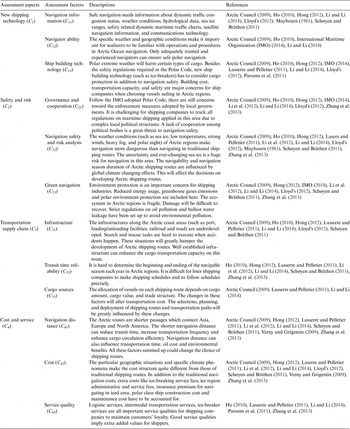
To fully understand the key assessment factors in opening Arctic shipping routes, we collected and analysed related literature (Arctic Council, 2009; Ho, Reference Ho2010; Hong, Reference Hong2012; Lasserre and Pelletier, Reference Lasserre and Pelletier2011; Li et al., Reference Li, Jin, Ma, Tang, Li and Li2012; Li and Li, Reference Li and Li2014; Lloyd's, 2012; Maybourn, Reference Maybourn1981; Parsons et al., Reference Parsons, Dinwoodie and Roe2011; Schøyen and Bråthen, Reference Schøyen and Bråthen2011; Verny and Grigentin, Reference Verny and Grigentin2009; Zhang et al., Reference Zhang, Shou and Zhou2013). We determined a set of preliminary factors from the literature survey. Based on this set, we interviewed maritime shipping experts to modify these preliminary assessment factors. We then proposed twelve assessment factors which are categorised into four assessment aspects. These four assessment aspects are ‘new shipping technology,’ ‘safety and risk,’ ‘transportation supply chain,’ and ‘cost and service.’ There are three assessment factors under each assessment aspect. Table 1 lists all assessment aspects, assessment factors and their descriptions.
Preliminary factors assessing the building of Arctic routes.

Note: The code names of each assessment aspect and assessment factors are shown in parentheses.
3. METHODOLOGY
Some of the concepts and procedures of the fuzzy AHP model adopted to determine key assessment factors for building Arctic shipping routes are briefly described in this section.
3.1. Triangular fuzzy numbers and their algebraic operations
Fuzzy set theory (Zadeh, Reference Zadeh1965) is designed to deal with the extraction of the primary possible outcome from a multiplicity of information that is expressed in vague and imprecise terms. Fuzzy set theory treats uncertain data as a possibility distribution in terms of set membership. Once determined and defined, the sets of memberships in possibility distributions can be effectively used in logical reasoning.
In a universe of discourse X, a fuzzy subset A of X is defined by a membership function f A (x), which maps each element x in X to a real number in the interval [0, 1]. The function value f A (x) represents the grade of membership of x in A.
A fuzzy number A (Dubois and Prade, Reference Dubois and Prade1978) in real line ℜ is a triangular fuzzy number if its membership function
 $f_A :{\Re} \to [0,\;1]$
is
 $$f_A (x) = \left\{ {\matrix{ {{{(x - c)} / {(a - c)}},\quad c \le x \le a} \cr {{{(x - b)} / {(a - b),\quad a \le x \le b}}} \cr {0,\quad \quad \quad \quad \quad \quad otherwise} \cr}} \right.$$
with − ∞ < c ≤ a ≤ b < ∞. The triangular fuzzy number can be denoted by (c, a, b).
Let A 1 = (c 1, a 1, b 1) and A 2 = (c 2, a 2, b 2) be fuzzy numbers. According to the extension principle (Zadeh, Reference Zadeh1965), the algebraic operations of any two fuzzy numbers A 1 and A 2 can be expressed as
-
• Fuzzy addition, ⊕ :
 $$A_1 \oplus A_2 = (c_1 + c_2, \;a_1 + a_2, \;b_1 + b_2 );$$
-
• Fuzzy subtraction, ⊖ :
$$A_1 \ominus A_2 = (c_1 - b_2, \;a_1 - a_2, \;b_1 - c_2 );$$
-
• Fuzzy multiplication, ⊗ :
$$k \otimes A_2 = (kc_2, \;ka_2, \;kb_2 ),\quad k \in \Re, \;\;k \ge 0;$$
$$A_1 \otimes A_2 \cong (c_1c_2,\;a_1a_2,\;b_1b_2),\quad c_1 \ge 0,\;\;c_2 \ge 0.$$
-
• Fuzzy division, ∅ :
$$A_1 \emptyset A_2 \cong ({{c_1} / {b_2}}, \;\, {{a_1} / {a_2}}, \;\,{{b_1} / {c_2}} ),\quad c_1 \ge 0,\;\;c_2 \gt 0.$$


3.2. Fuzzy AHP model
The systematic steps for evaluating relative weights using the fuzzy AHP model (Ding, Reference Ding2006; Hsu, Reference Hsu1998) to be taken are described below.
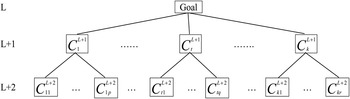
Step 1. Establishing a hierarchical structure. In this paper, a hierarchical structure is the goal on the L layer and is with k assessment aspects on the L + 1 layer and p + · · · + q + · · · + r assessment factors on the L + 2 layer, respectively. The hierarchy of preliminary assessment factors in Table 1 can be constructed as shown in Figure 1.
Hierarchy structure.

Step 2. Compiling pair-wise comparison matrices of decision attributes. We chose experts to compile pair-wise comparison matrices of decision attributes, which represented the relative importance of each pair-wise attribute.
-
(1) Let
$x_{ij}^h \in [{\textstyle{1 \over 9}},\;{\textstyle{1 \over 8}},\; \ldots, \;{\textstyle{1 \over 2}},\;1] \cup [1,\;2,\; \ldots, \;8,\;9],$
h = 1, 2, …, n, be the relative importance given to assessment aspect i to assessment aspect j by expert h on the L + 1 layer. Then, the pair-wise comparison matrix is defined as
$[x_{ij}^h ]_{k \times k} $
. -
(2) Let
$x_{uv}^h \in [{\textstyle{1 \over 9}},\;{\textstyle{1 \over 8}},\; \ldots, \;{\textstyle{1 \over 2}},\;1] \cup [1,\;2,\; \ldots, \;8,\;9]$
, h = 1, 2, …, n, be the relative importance given to assessment factor u in comparison with assessment factor v by expert h on the L + 2 layer. Then, the pair-wise comparison matrix with respect to each assessment aspect, i.e.
$C_1^{L + 1} $
,
$C_t^{L + 1} $
,
$C_k^{L + 1} $
, is defined as
$[x_{uv}^h ]_{p \times p} $
,
$[x_{uv}^h ]_{q \times q} $
,
$[x_{uv}^h ]_{r \times r} $
.





Step 3. Transforming relative importance into triangular fuzzy numbers. Geometric means are more effective in representing multiple decision-makers’ consensus opinions (Saaty, Reference Saaty1980). To aggregate information from all differing opinions, the triangular fuzzy numbers characterised by using the min, max and geometric mean operations are used to convey the opinions of all experts (Ding, Reference Ding2006; Reference Ding2009; Ding et al., Reference Ding, Tseng and Hsu2014 Hsu, Reference Hsu2012; Reference Hsu2015). Let
 $x_{ij}^h \in [{\textstyle{1 \over 9}},\;{\textstyle{1 \over 8}},\; \ldots, \;{\textstyle{1 \over 2}},\;1] \cup [1,\;2,\; \ldots, \;8,\;9]$
, h = 1, 2, …, n,
 $\forall i,\;j = 1,\;2,\; \ldots, \;k$
, be the relative importance given to assessment aspect i in comparison with assessment aspect j by expert h on the L + 1 layer. After integrating the opinions of all n experts, the triangular fuzzy numbers can be denoted by
 $$ {\tilde A}_{ij}^{L + 1} = (c_{ij}, \;a_{ij}, \;b_{ij} )$$
where
 $c_{ij} = \min \{ x_{ij}^1, \;x_{ij}^2, \; \ldots, \;x_{ij}^n \} $
,
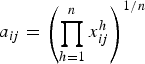 $a_{ij} = \left( {\prod\limits_{h = 1}^n {x_{ij}^h } } \right)^{1/ n}$
,
 $b_{ij} = \max \{ x_{ij}^1, \;x_{ij}^2, \; \ldots, \;x_{ij}^n \} $
.
Using the same concept, we can integrate the opinions of all n experts on the L + 2 layer, i.e. the triangular fuzzy numbers can be denoted by
 $${\tilde A}_{uv}^{L + 2} = (c_{uv}, \;a_{uv}, \;b_{uv} ),\,\forall u,\;v = 1,\; \ldots, p;\;\; \cdots ;\;\;\forall u,\;v = \;1,\; \ldots, \;q;\;\; \cdots ;\;\;\forall u,\,v = 1,\; \ldots, \;r,$$
where
 $c_{uv} = \min \{ x_{uv}^1, \;x_{uv}^2, \; \ldots, \;x_{uv}^n \} $
,
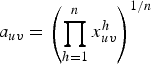 $a_{uv} = \left( {\prod\limits_{h = 1}^n {x_{uv}^h}} \right)^{1/n}$
,
 $b_{uv} = \max \{ x_{uv}^1, \;x_{uv}^2, \; \ldots, \;x_{uv}^n \} $
.
Step 4. Constructing fuzzy positive reciprocal matrices. We use the integrated triangular fuzzy numbers to build fuzzy positive reciprocal matrices. For the L + 1 layer, the fuzzy positive reciprocal matrix can be denoted by
 $$A = \left[ {{\tilde A}_{ij}^{L + 1}}\right] = \left[{\matrix{ 1 & {{\tilde A}_{12}^{L + 1}} & \cdots & {\tilde A}_{1k}^{L + 1} \cr {{1 / {\tilde A}_{12}^{L + 1}}} & 1 & \cdots & {\tilde A}_{2k}^{L + 1} \cr \vdots & \vdots & \ddots & \vdots \cr {{1 / {\tilde A}_{1k}^{L + 1}}} & {{1 / {\tilde A}_{2k}^{L + 1}}} & \cdots & 1 \cr}}\right],\quad where\;{\tilde A}_{ij}^{L + 1} \otimes {\tilde A}_{\,ji}^{L + 1} \cong 1,\quad \forall i,\;j = 1,\;2,\; \ldots, \;k.$$
To save space, the equations of fuzzy positive reciprocal matrices are omitted by reason of analogy on the L + 2 layer.
Step 5. Calculating the fuzzy weights of the fuzzy positive reciprocal matrices.
Let
 ${\tilde Z}_i^{L + 1} \cong \left( {{\tilde A}_{i1}^{L + 1} \otimes {\tilde A}_{i2}^{L + 1} \otimes \cdots \otimes {\tilde A}_{ik}^{L + 1}} \right)^{1/k}, \quad \forall i = 1,\;2,\; \ldots, \;k,$
be the geometric mean of triangular fuzzy number of the ith
assessment aspect on the L + 1 layer. Then, the fuzzy weight of the ith
assessment aspect can be denoted by
 $${\tilde W}_i^{L + 1} \cong {\tilde Z}_i^{L + 1} \otimes \left( {\tilde Z_1^{L + 1} \oplus \tilde Z_2^{L + 1} \oplus \cdots \oplus \tilde Z_k^{L + 1}} \right)^{ - 1} $$
For convenience, the fuzzy weight is denoted by
 $\tilde W_i^{L + 1} = (w_{ic}, \;w_{ia}, \;w_{ib} )$
. To save space, the equations of fuzzy weights are omitted by reason of analogy on the L + 2 layer.
Step 6. Defuzzifying the fuzzy weights to crisp weights. The Graded Mean Integration Representation (GMIR) method, proposed by Chen and Hsieh (Reference Chen and Hsieh2000), is used to defuzzify the fuzzy weights.
Let
 $\tilde W_i^{L + 1} = (w_{ic}, \;w_{ia}, \;w_{ib} ),\,\forall i = 1,\;2,\; \ldots, \;k,$
be k triangular fuzzy numbers. The GMIR of crisp weights k can be denoted by
 $$G(\tilde W_i^{L + 1} ) = \displaystyle{{w_{ic} + 4w_{ia} + w_{ib}} \over 6},\,\forall i = 1,\;2,\; \ldots, \;k.$$
To save space, the defuzzifications of fuzzy weights are omitted by reason of analogy on the L + 2 layer.
Step 7. Normalising the crisp weights. To facilitate comparison of the relative importance of each layer, the crisp weights are normalised and denoted by
 $$NW_i^{L + 1} = \displaystyle{{G(\tilde W_i^{L + 1} )} \over {\sum\limits_{i = 1}^k {G(\tilde W_i^{L + 1} )}}} $$
Step 8. Calculating the integrated weights for each layer. Let
 $NW_i^{L + 1} $
and
 $NW_u^{L + 2} $
be the normalised crisp weights on the L + 1 and L + 2 layers. Then,
-
(1) The integrated weights of each assessment aspect on the L + 1 layer is
$$IW_i^{L + 1} = NW_i^{L + 1}, \,\forall i = 1,\;2,\; \ldots, \;k.$$
-
(2) The integrated weights of each assessment factor on the L + 2 layer is
$$IW_u^{L + 2} = NW_i^{L + 1} \times NW_u^{L + 2}, \,\forall i = 1,\;2,\; \ldots, \;k;$$
$$\forall u = 1, \ldots ,p;\,\,\, \cdots; \,\forall u = 1, \ldots q;\,\, \cdots ;\,\forall u = 1, \ldots ,r.$$


4. EMPIRICAL STUDY
In this section, an empirical study to assess key factors for building Arctic shipping routes is performed.
4.1. Questionnaire and data collection
This study aims to discover the major decision concerns when a shipping company in Taiwan assesses the feasibility of opening an Arctic route. The related importance of factors was investigated through questionnaires to determine the key factors in decision-making processes of establishing Arctic routes. AHP questionnaires were distributed to industry personnel and scholars with ship captain experience in this study.
An AHP questionnaire with four assessment aspects and twelve assessment factors was used to compile pair-wise comparison matrices of each layer and express the relative importance of each assessment factor. Respondents were asked to rate related importance between aspects and between assessment factors under each aspect. We invited some scholars to pre-test this AHP questionnaire for the purpose of checking the clarity of expressions/words and the completeness of questions. The AHP questionnaire was finalised with careful consideration, discussion and inclusion of all correction opinions.
This survey was conducted in the period between April and October 2014. The questionnaires were distributed through the recommendations of experts, and the investigation was conducted by one-on-one meetings. The returned questionnaires were checked to identify whether both the Consistency Index (CI) and the Consistency Ratio (CR) of each matrix of every layer were lower than 0·1 (Saaty, Reference Saaty1980). When the CI and CR values of a matrix are higher than 0·1, this implies that the respondent had made an inconsistent pair-wise comparison of two assessment aspects or assessment factors. To prevent the occurrence of errors, the authors helped such respondents to correct their judgments until the CI and CR values of each matrix were lower than 0·1. Robbins (Reference Robbins1994) recommended that at least five to seven experts are required to obtain good results in studies of group decision-making. In this study, a total of 25 questionnaires were distributed, and all were recovered, for a recovery rate of 100%. Among the respondents, ten were scholars with ship captain experience and 15 were employees of shipping companies. The results of this study can effectively provide representative views according to the recommendations of Robbins.
4.2. Results
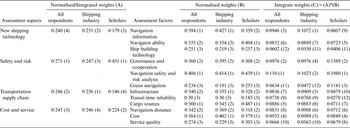
The fuzzy AHP approach illustrated in Section 3.2 is used to obtain the ordered importance among assessment aspects and among assessment factors. The results are shown in Table 2.
The normalised weights and integrated weights of each layer.

Remark: Numbers in parentheses are ranks.
The findings of this survey can be described into three groups. The first group of findings is opinions among scholars with sea captain experience. The second group of findings is opinions among shipping industry personnel. And the third group is the syntheses of results from previous groups.
4.2.1. Findings obtained from scholars with ship captain experience
‘Safety and risk’ ranks top of all the assessment aspects among the scholars with ship captain experiences. ‘Cost and service’ is ranked in the second place, and ‘new shipping technology’ is ranked in third place. ‘Transportation supply chain’ is the lowest ranked. The integrated weight value of ‘safety and risk’ is 0·451. This indicates that scholars felt this aspect was very important. The integrated weight values of ‘new shipping technology’ and ‘transportation supply chain’ are 0·179 and 0·146 respectively. This indicates that scholars viewed these two aspects as having almost the same importance.
For the ‘safety and risk’ aspect by the normalised weights, ‘navigation safety and risk analysis’ is the critical assessment factor. For the ‘cost and service’ aspect, ‘cost’ is the critical assessment factor. For the ‘new shipping technology’ aspect, ‘navigator ability’ is the critical assessment factor. For the ‘transportation supply chain’ aspect, ‘cargo sources’ is the critical assessment factor.
Daniel (Reference Daniel1961) believed that there are two to six key success elements in most industries. Any company wishing to be successful in an industry must apply great efforts to these key elements. According to this statement, we used the following two rules to select important assessment aspects or assessment factors. Firstly the criterion with total weights greater than the average 8·33%, which means relative importance greater than average. Secondly the maximum number chosen is six on the basis of Daniel's viewpoint. In this group (i.e. scholars with ship captain experience), we took 8·33% of total weights of all 12 assessment factors as a threshold for selection of the most important criteria. As a consequence, we chose four of the 12 assessment factors that met this condition as the key factors. The total weight of these factors was 53·59%. The top four key assessment factors influencing Arctic route establishment of a shipping company in Taiwan are ‘navigation safety and risk analysis,’ ‘governance and cooperation,’ ‘green navigation’ and ‘cost,’ respectively.
4.2.2. Findings obtained from shipping industry personnel
‘Transportation supply chain’ ranks top of all the assessment aspects among the shipping industry personnel. ‘New shipping technology,’ ‘safety and risk’ and ‘cost and service’ are ranked in the second, third and fourth places. The integrated weight values of all aspects fall in the range of 0·246–0·256. This indicates that the shipping industry viewed all the aspects as having almost the same importance.
For the ‘transportation supply chain’ aspect by the normalised weights, ‘infrastructure’ is the critical assessment factor. For the ‘new shipping technology’ aspect, ‘navigation information’ is the critical assessment factor. For the ‘safety and risk’ aspect, ‘navigation safety and risk analysis’ is the critical assessment factor. For the ‘cost and service’ aspect, ‘cost’ is the critical assessment factor.
To satisfy Daniel's (Reference Daniel1961) suggestion, we took 9·08% (top six) of the total weights of all twelve assessment factors as a threshold for selection of the most important criteria. As a consequence, we chose six of the twelve assessment factors that met this condition as the key factors. The total weight of these factors was 58·77%. In the views of shipping industry, the top six key assessment factors influencing Arctic route establishment by a shipping company in Taiwan are ‘navigation information,’ ‘navigation safety and risk analysis,’ ‘cost,’ ‘governance and cooperation,’ ‘infrastructure’ and ‘navigation distance,’ respectively.
4.2.3. Findings obtained from all respondents
‘Safety and risk’ is ranked top of all the assessment aspects among all respondents. ‘Transportation supply chain,’ ‘cost and service’ and ‘new shipping technology’ are ranked in the second, third and fourth places. Only ‘safety and risk’ shows a higher integrated weight value, the other three assessment aspects are all within the range of 0·240–0·246. There is not much difference in importance rating among these assessment aspects.
For the ‘safety and risk’ aspect by the normalised weights, ‘navigation safety and risk analysis’ is the critical assessment factor. For the ‘transportation supply chain’ aspect, ‘cargo sources’ is the critical assessment factor. For the ‘cost and service’ aspect, ‘cost’ is the critical assessment factor. For the ‘new shipping technology’ aspect, ‘navigation information’ is the critical assessment factor.
To satisfy Daniel's (Reference Daniel1961) suggestion, we took 8·52% (top six) of total weights of all twelve assessment factors as a threshold for selection of the most important criteria. As a consequence, we chose six of the twelve assessment factors that met this condition as the key factors. The total weight of these factors was 57·53%. In the views of all respondents, the top six key assessment factors influencing Arctic route establishment of a shipping company in Taiwan are ‘navigation safety and risk analysis,’ ‘governance and cooperation,’ ‘navigation information,’ ‘cost,’ ‘cargo sources’ and ‘navigator ability,’ respectively.
4.3. Discussions
The results in the previous section show that there exist different opinions between the shipping industry and the academics. First, we present discussions on the assessment factors chosen in any group composition. Next, we discuss the differences between the industry and the academics.
4.3.1. Discussions on key assessment factors
4.3.1.1. Navigation safety and risk analysis
The Arctic is far away from Taiwan. It is a foreign place to most people and even to maritime transportation experts in Taiwan. At the same time, Arctic shipping routes are more unpredictable and less safe than traditional shipping routes from the search and rescue point of view (Arctic Council, 2009). These days, accompanied by the climate changing effects, the conditions of Arctic shipping routes have become more complicated. As a result, it is important for the shipping industry to have the means to obtain accurate local geographic and meteorological data. With comprehensive data analysis, the shipping industry can reduce the uncertainties related to navigation safety, and then the shipping industry can more effectively manage the risks. Therefore, this assessment factor is the most important among all respondents in deciding the viability of the Arctic shipping route.
4.3.1.2. Governance and cooperation
There are eight countries in the Arctic region. They all desire to secure their own national advantage (Arctic Council, 2009; Lloyd's, 2012). Some non-Arctic countries with navigation interests in the area and local people also want to have a say in Arctic matters. Although the Arctic council was founded to seek cooperation in developing and protecting the Arctic region, there still discrepancies in individual nation's approaches. In such complex situations, it is hard for a shipping company to overcome the barriers of various regulatory rules set up by different countries. This will become a major obstacle for the route planning of a shipping company. An integrated governance and regulatory framework is needed for the benefit of shipping industries (Ho, Reference Ho2010). To provide an integrated governance and regulatory framework, the IMO (2014) adopted the Polar Code in 2014. It is vital for a shipping company to track the enforcement measures of local governments in the Arctic region for successful route plans.
4.3.1.3. Navigation information
In the Arctic region, ice forms in the winter and melts in the spring/summer. These phenomena make shipping routes change as the seasons change. Accurate, real-time and detailed navigation data is required for a shipping company to design a safe and suitable shipping route (Ho, Reference Ho2010). Especially in the ice-melting season, drifting icebergs are major threats for ships navigating in the area. This makes it hard to set up traditional aids to navigation, which may directly affect safety.
4.3.1.4. Cost
The main reason to open an Arctic shipping route is to support cargo transportation between East Asia and West Europe and between North America and West Europe. Transportation cost is always a critical factor in shipping route planning. The particular geographic situations and specific climate phenomena make the cost structure quite different from those shipping routes by way of the Panama and Suez Canals (Verny and Grigentin, Reference Verny and Grigentin2009; Schøyen and Bråthen, Reference Schøyen and Bråthen2011). In addition to the traditional navigation costs, extra costs like ice-breaking service fees, ice region administrative and service fees, insurance premium for navigating in an iced area, polar class ship construction cost and maintenance cost have to be accounted for. Too much extra cost could erode the profit of a shipping company and makes the new shipping route unfavourable.
4.3.1.5. Cargo sources
The navigation direction of Arctic shipping routes is opposite to that of traditional routes, and the extreme polar climate could damage certain types of cargo. These conditions bring limitations for cargo that can be transported through Arctic shipping routes. The structure of cargo allocation in this new shipping route will differ from that of a traditional shipping route. The amount of cargo, the value of cargo and the structure of international trade will change the setup of vessel allocation and then affect the transportation cost. The choice of shipping routes depends on the total cost of cargo transportation. The new shipping routes will eventually alter the whole planning and allocation of all shipping routes.
4.3.1.6. Navigator ability
The special conditions of the polar climate and specially built vessels for the polar area construct a unique navigation situation for navigators. Navigating in Arctic regions is quite different from navigating in other sea regions. Additional certifications are required for seafarers (IMO, 2014) to improve navigation safety. Sufficient numbers of seafarers with the appropriate certifications will be required before shipping companies can comfortably deploy ships on the Arctic routes (Ho, Reference Ho2010). Without this, companies could face labour shortages which may then endanger their cargo shipping plans.
4.3.1.7. Green navigation
Environmental protection is a major and important issue for marine transportation especially in the Arctic regions (Arctic Council, 2009; IMO, 2014). The operations of shipping companies have to satisfy international requirements on pollution prevention. After the reduction of allowed greenhouse gas emissions, there is now the need for less overall energy usage. The Arctic shipping routes are much shorter than the traditional routes between East Asia and Western Europe and between North America and Western Europe. Thus fuel consumption can be reduced by using the new Arctic routes. The ecosystem in the Arctic region is very delicate. It is very difficult to re-establish when damages occur (Lloyd's, 2012). Strict rules on green transportation (such as oil pollution avoidance and ballast water leakage prevention) are adopted around this region. The shipping industry should acknowledge the challenges of navigating in the Arctic region and make efforts to protect the environment.
4.3.1.8. Infrastructure
The infrastructures along the Arctic coast areas (such as port, loading/unloading facilities, railroad and road) are underdeveloped. Search and rescue tasks are hard to execute when accidents happen. It is difficult to receive adequate logistic services along the shipping routes in the Arctic regions. These situations will greatly hamper the deployment of Arctic shipping routes.
4.3.1.9. Navigation distance
The Arctic routes are shorter passages which connect Asia, Europe and North America. The shorter navigation distance can reduce transit time, increase transportation frequency and enhance cargo circulation efficiency (Verny and Grigentin, Reference Verny and Grigentin2009; Schøyen and Bråthen, Reference Schøyen and Bråthen2011). Navigation distance can also influence transportation time, oil consumption, and greenhouse gases emissions. All these factors summed up could change the choice of shipping routes.
4.3.2. Different views between the industry and the academics
For scholars, ‘safety and risk’ is viewed as the most important assessment aspect. Yet, the industry ranked this assessment aspect in third place. On the other hand, for the industry, ‘transportation supply chain’ is viewed as the most important assessment aspect. This assessment aspect is ranked lowest in the academics group. In the industry expert group, the relative importance is almost the same for all assessment aspects with integrated weight value all in the interval 0·246–0·256. The fact that the ranking order may not be that absolute could be the reason.
The assessment aspect ‘safety and risk’ is composed of three assessment factors which are ‘governance and cooperation,’ ‘navigation safety and risk analysis’ and ‘green navigation.’ These assessment factors are from important academic research interests. Therefore academics are more familiar with these topics and know the importance of this assessment aspect.
The assessment aspect ‘transportation supply chain’ is composed of three assessment factors which are ‘infrastructure,’ ‘transit time reliability’ and ‘cargo sources.’ These assessment factors are considered in the daily operations of the industry. Therefore, shipping industry personnel are more familiar with these matters and aware of their importance to them.
The relative importance of the assessment aspect ‘safety and risk’ is much greater than the other three assessment aspects among scholars. Therefore only four assessment factors pass the chosen threshold. There are six assessment factors chosen in the industry group according to Daniel's suggestions. When we compare the relative importance in the level of assessment factors, further findings are listed below.
4.3.2.1. Same chosen assessment factors among expert groups
‘Navigation safety and risk analysis,’ ‘governance and cooperation’ and ‘cost’ are relatively important for both expert groups. All these assessment factors express uncertainties. They also imply the unknown matters are huge barriers for new routes.
4.3.2.2. Different chosen assessment factors between two expert groups
The differences may represent the characteristics of expertise in each expert group. Scholars showed more concerns about the developing issues. The shipping industry focuses more on issues influencing current operations. The greatest difference happens at the assessment factor ‘green transportation.’ In the scholars group, it is ranked in third place. But in the industry group, it is ranked lowest. There is no fully established shipping on the Arctic routes at this time, which makes it hard to evaluate the shipping industry impact on green transportation on daily operations. This could be the reason for the lowest ranking in the industry group. As of the assessment factor ‘navigation information,’ it is ranked first in the industry group. But in the scholars group, it is ranked in ninth place. Researchers in this field collect more detailed knowledge than their peers in the industry; therefore they are more confident in handling this assessment factor. The assessment factor ‘navigation distance’ in both expert groups is ranked in sixth place. It passes the chosen threshold in the industry group but it fails to pass the chosen threshold in the scholars’ group.
4.3.2.3. Key assessment factors not chosen by either expert group
The key assessment factors ‘cargo sources’ and ‘navigator ability’ chosen for this study are chosen neither by the industry nor by the scholars. ‘Cargo sources’ is under the assessment aspect ‘transportation supply chain’ and ‘navigator ability’ is under the assessment aspect ‘new shipping technology.’ These are the two assessment aspects with different ordered relative importance between the two expert groups and they are ranked first by scholars in either assessment aspect. This could mean that scholars have more clearly ordered relative importance in Arctic shipping matters.
5. CONCLUDING REMARKS
Affected by climate change, Arctic ice melting has become more and more obvious. As a result, the feasibility of Arctic shipping route navigation is being more closely examined than ever. The shipping industry in Taiwan is well positioned in global shipping markets. To gain and keep strategic advantages in global shipping markets, the shipping industry has to study the Arctic shipping routes and should establish a blueprint of Arctic shipping strategies. At the moment, Taiwan's ports are in a weakening position in global shipping routes allocation due to the rise of ports of mainland China. We have to start studying key assessment factors for building Arctic shipping routes and making recommendations to all stakeholders.
In our empirical study, we adopted an AHP questionnaire to systematically evaluate the relative importance of assessment factors for opening Arctic shipping routes. We obtained the following results:
-
1. ‘Safety and risk’ is the most important assessment aspect for Taiwan's shipping industry in considering open Arctic shipping routes.
-
2. The six most important assessment factors for opening Arctic shipping routes are ‘navigation safety and risk analysis,’ ‘governance and cooperation,’ ‘navigation information,’ ‘cost,’ ‘cargo sources,’ and ‘navigator ability.’
Based on the conclusions in the previous discussions, we make the following recommendations.
Recommendations for Taiwan government. As the global climate change continues to accelerate, the possibility of connecting Asia and Europe through Arctic shipping routes is gaining more and more support. To support building strategic advantages for the shipping industry in Taiwan, government agencies should systematically build up databases consisting of various Arctic navigation-related data. Shipping companies can then make assessments and plan completely and accurately. At the same time, maritime transportation authorities should actively participate in international meetings on Arctic affairs through all channels to follow up the changing trends in Arctic governance and regulations. To prepare a competent labour force in time for the shipping industry, transportation authorities should coordinate all seafarer training institutions to set up training courses.
Recommendations for the shipping industry in Taiwan. To be successful in establishing Arctic shipping routes, shipping companies should begin the processes of risk identification, risk assessment and risk analysis. Shipping in the new unfamiliar region will only be safe with effective and comprehensive risk management strategies. Shipping companies should possess the knowledge of laws and regulations in Arctic regions for a correct estimation of transportation cost. Shipping companies should also carefully consider issues of navigable seasons, shipping routes allocation, cargo allocation and their interactions.
The interview surveys performed in this study were conducted among scholars and shipping company staff in Taiwan. The results obtained present the views of experts in Taiwan. The researchers may do similar investigations outside Taiwan for comparisons among different countries and regions. Furthermore, risk management is an important issue for ocean carriers, who may be engaged to deploy Arctic shipping routes in the future. The researchers may collect risk incident data in the Arctic region to further understand risk types, risk frequencies, and risk severity since ‘navigation safety and risk analysis’ was the most important assessment factor obtained from this study.