Health care providers in the United States are accustomed to extensive documentation of the patient encounter; an hour a day spent in completing medical charts is not uncommon,Reference Hripcsak, Vawdrey, Fred and Bostwick1 and some physicians spend more time on documentation than on direct patient care.Reference O'Leary, Liebovitz and Baker2, Reference Oxentenko, West, Popkave, Wineberger and Kolars3 The history and physical examination, along with proposed workups and treatment plans, rarely consider anything other than the individual patient's needs and what will provide the best outcome for that individual. Procedures are typically performed and documented by providers who have relevant training, experience, and expertise, and are conducted in well-resourced environments that are structured to provide optimal outcomes. All of this may change during a disaster. Limited available medical resources can force conflicts between patient autonomy and community needs, and the standard of care and scopes of practice will reflect the available resources and capabilities.Reference Hanfling, Altevogt and Gostin4-Reference Schultz and Annas8
Documenting decisions based on limited resources is an unusual situation that is made especially difficult when conflicts exist with the needs of other individuals. Few practitioners have experience requesting that patients consent to risky procedures in poor conditions, and rarely are these practitioners in the position of recommending a procedure in which they are not skilled. A suggested legal standard is that care providers should act as a “reasonably prudent physician” would in the same situation, with comparable available resources. This standard presumes similar qualifications and acknowledges the limitations imposed by the situation.Reference Annas7, Reference Schultz and Annas8 A situation-specific example of such a standard might be performing an amputation with a hacksaw during a disaster.Reference Schultz and Annas8
In spite of the challenging environment that health care providers and disaster victims experience, what the so-called reasonably prudent physician does during a disaster will be evaluated in hindsight. For example, the 2010 earthquake in Haiti led to an estimated 1500 limb amputations.9 While it is unknown if any were done by hacksaw, questions have arisen about the indications, informed consent, surgical techniques, management, and postoperative care of these patients.Reference Hanfling, Altevogt and Gostin4, Reference Van Hoving, Wallis, Docrat and De Vries10-Reference Sonshine, Caldwell, Gosselin, Born and Coughlin13 During Hurricane Katrina, care deemed appropriate and compassionate by the provider was later called criminal and negligent by others.14, Reference Okie15 Sorting out these conflicts following a disaster can be difficult for many reasons, one of which is the lack of an adequate record. Appropriate real time documentation of the justification and the rationale for certain decisions might mitigate or prevent these controversies.
Unique Disaster Documentation Issues.
Protection from criticism or litigation is only part of the reason for documentation during a disaster. More importantly, the medical record allows for the reconstruction of patient responses to treatments and with expected ongoing needs and care. It allows for the collection of epidemiological data to improve care and response. Minimum documentation guidelines for an international medical response in an austere environment have been published to include the preoperative assessment, consent, operative note and anesthetic record, and postoperative and discharge plan.Reference Chackungal, Nickerson and Knowlton16
Methods
Literature Search
A PubMed search of the literature was performed using the key word terms “Disaster” AND “Informed Consent”, “Disaster” AND “Standards”, “Disaster” AND “Documentation” to provide a baseline assessment of current relevant publications on the topic. One of us (R.M.Z.) reviewed these articles. Because no articles specifically devoted to the topic of disaster documentation were available, individual articles related to medical documentation, disaster care, and disaster triage were reviewed. Also considered relevant were non-peer reviewed articles, federal and Medicare guidelines, and articles in legal journals. Documentation recommendations were developed by both of us, based on the literature review, coupled with our respective experience in disaster management and response (R.M.Z.), medical-legal standards (C.M.B.), and transplant standards (C.M.B.).
Results
Current US Requirements, Guidelines, and Needs
Documentation of the patient encounter is a daily routine for most providers. The medical record is the medium in which patient-specific issues such as care rendered and treatment plans are communicated.Reference Brett17-Reference Dawson, Carter, Brewer and Lawson19 The Centers for Medicare and Medicaid Services (CMS) require the medical record to “contain sufficient information to identify the patient; support the diagnosis/condition; justify the care, treatment, and services; document the course and results of care, treatment, and services; and promote continuity of care among providers.”20 Requirements of reimbursement and medical coding have added to the role of the medical record, and documentation of an extensive history and physical has become our current standard.Reference Brett17, Reference Dawson, Carter, Brewer and Lawson19
Patient Care Issues and the Impact of Disaster on Documentation
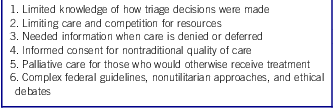
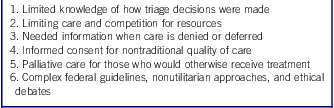
Many challenges to optimal patient care and resource allocation occur during a disaster. The following 6 patient care issues are likely to create unfamiliar issues for medical record documentation.
1. Limited Knowledge of How Triage Decisions Were Made. In the early hours of a sudden impact disaster, critical decisions may be made about limiting treatment, or even the withdrawal of care based on the needs of others who also need the same resources. Triage officers should be forming decisions with the best available overview of the event, including an assessment of available resources.Reference Devereaux, Dichter and Christian21, Reference Christian, Toltzis and Kanter22 The surgeon, anesthesiologist, and practitioner on the wards or in the intensive care unit will need to follow through with these decisions, but without documentation by the officers, they may not know the rationale for the care provided.Reference Devereaux, Dichter and Christian21
2. Limiting Care and Competition for Resources. Limiting care is a likely scenario during a disaster, and patients may be competing for limited resources. Other than during times of disasters, few providers are confronted with the reallocation of resources based on another individual having priority.Reference Hanfling, Altevogt and Gostin4, Reference Devereaux, Dichter and Christian21-Reference Hick, Hanfling and Cantrill23 Depending on the disaster, issues with allocation such as intensive care unit beds, medications, surgical services, or blood may arise. Specifically, patients who desperately need available, but limited, resources will not receive them because other patients have somehow been deemed more appropriate. The Task Force for Mass Critical Care has suggested that “There should be an explanation and rationale for why patients who had their critical care resources reallocated were selected, compared with those who were not.”Reference Devereaux, Dichter and Christian21 If this information is known, is this conduct allowed by the Health Insurance Portability and Accountability Act (HIPAA)? Does HIPAA allow this conduct in a disaster? What can and should be documented?
3. Needed Information When Care Is Denied or Deferred. Objective predictive data for patient outcomes and resource demands would be of great value for utilitarian resource allocation, and they have been suggested to help guide decision making.Reference Devereaux, Dichter and Christian21, Reference Hanfling, Altevogt and Viswanathan24 However, these population-based metrics were not designed as indicators of survival for any one individual. If they are used, how should their usage be documented?
4. Informed Consent for Nontraditional Quality of Care. Informed consent and patient autonomy do not disappear during a disaster. Disasters may lead to expectations that medical providers exceed their usual level of expertise,Reference Annas7, Reference Schultz and Annas8 and care may be provided with resources that, in better times, would be considered inadequate. The informed consent process takes on a new dimension when expertise and resources are less than those expected in usual circumstances. It would seem reasonable that patients be informed of the existing suboptimal skills or resources.
5. Palliative Care for Those Who Would Otherwise Receive Treatment. Under normal conditions, specialists providing palliative care have been accused of murder.Reference Goldstein, Cohen, Arnold, Goy, Arons and Ganzini25 After Hurricane Katrina, palliative care was a specific topic of controversy.14 Nonspecialists who aggressively provide comfort rather than curative care should have reasons for concern, and should provide documentation to support their choice of care.
6. Complex Federal Guidelines, Nonutilitarian Approaches, and Ethical Debates. Federal disaster-related guidelines have been formulated with the intent to protect vulnerable populations such as the disabled, minorities, and those with limited English proficiency.Reference Hodge, Garcioa, Amderspm and Kaufman26 Balancing approaches that emphasize similar protective elements for at-risk or marginalized populationsReference Hanfling, Altevogt and Gostin4 may be in direct conflict with utilitarian approaches that attempt to create the “greatest good for the greatest number”.Reference White, Katz, Luce and Lo5, Reference Moskop and Iserson6, Reference Caro, DeRenzo, Coleman, Weinstock and Knebel27 In addition, it has been suggested that community standards affect decision making,Reference Hanfling, Altevogt and Viswanathan24 but a national standard of careReference Hodge and Courtney28 may create another potential conflict.
Discussion
Little has been written regarding appropriate disaster documentation. Even the concept of optimal documentation may be challenged, because any real-time charting might be impossible for many reasons. Patient needs may be overwhelming, and time may be critically limited. This situation is not entirely unique to disasters; the patient with major exsanguinating injuries may be taken to the operating room for damage control surgery and the patient with an acute myocardial infarction may be taken to the cardiac catheterization laboratory without a medical chart. After the Boston Marathon bombing, a minimal amount of information was written directly on the torsos of the patients.29 Eventually, a chart will be generated and the medical care will be thoroughly documented. These events are not so unique as to be unfamiliar to the provider. The disaster surge, however, may be far greater than a trauma surge or mass casualty incident; also, it may last longer and likely have fewer resources.
The vulnerable resources include the hospital's physical plant. Disasters such as the Northridge earthquake, Hurricane Katrina, the Joplin tornado, and super storm Sandy have demonstrated how hospitals are at risk during disasters.Reference Schultz, Koenig and Lewis30-Reference Hartocollis and Bernstein34 Documentation becomes nearly impossible if one is working by flashlight and without electricity, and the electronic medical record (EMR) loses its value. Patients may be evacuated from one facility to another, and keeping a written record with them, or having a useable EMR, is problematic. Information might also be written on preexisting triage tags. Health care facilities should have documentation within their disaster plans, including an off-site backup of their EMRReference Abir, Mostashari, Atwal and Lurie35 and provision for paper documentation, if necessary. Plans should include how this documentation will move with the patient.36
In the event of extreme time constraints, adequate information for the continuity of patient care should be the priority. Also vital are information regarding what procedure is to be (or has been) performed and what future care is necessary and would be a minimally reasonable expectation.Reference Knowlton, Gosney and Chackungal11, Reference Chackungal, Nickerson and Knowlton16 Further information should be provided when more time allows.
While documenting patient care is a common task, documenting critical allocation of life-sustaining resources and limiting care is not. In spite of decades of discussion about allocating donated organs when the resources and needs are known, conflicts remain regarding their ethical distribution.Reference Ankeny37-Reference Veatch47 Ethical frameworks about how resources should be allocated may be diametrically opposed, making it impossible for decisions to be consistent with all of them. What is important is to provide chart documentation that appropriately justifies the care given and minimizes the pitfalls with these controversies. Multiple publications have discussed ethical issues in disasters.Reference Hanfling, Altevogt and Gostin4, Reference Moskop and Iserson6, Reference Devereaux, Dichter and Christian21-Reference Hick, Hanfling and Cantrill23, Reference Antommaria, Powell, Miller and Christian48-Reference Sztajnkrycer, Madsen and Alejandro Baez57
Decisions involving medical care during times of disasters are not immune from the risk of provider liability.Reference Hanfling, Altevogt and Gostin4, Reference Schultz and Annas8, Reference Devereaux, Dichter and Christian21, Reference Hodge and Courtney28, Reference Gostin and Hanfling58, Reference Pope and Palazzo59 Media attention and scrutiny of medical care is almost a certainty during these incidents. As discussed, a proper medical record remains important during a disaster, provides justification for difficult decisions made under duress, and ultimately may offer some protection from future litigation.Reference Weaver60-Reference Knowlton63
Documentation Recommendations for Specific Disaster Issues
1. Limited Knowledge of How Triage Decisions Were Made. There are items that can be documented when knowledge of how triage decisions were made is limited. The charting should be restricted to what the author of the medical record is specifically aware of, or the assumptions on which those decisions are based. Referring to triage decisions might include the following:
• Relevant hospital policy
• Prehospital triage decisions, include triage tags in chart, if available
• Discussion of presumed community needs
• Discussion of what resources the involved patient needs
• Current known limitations and presumed expectations
2. Limiting Care and Competition for Resources. While allocation decisions may reflect direct competition between patients for a resource, documentation should not directly compare patients. HIPAA privacy rules only allow health care providers to share patient information during disasters as necessary to provide “treatment.”64
Treatment includes sharing information with other providers (including hospitals and clinics), referring patients for treatment (including linking patients with available providers in areas where the patients have relocated), and coordinating patient care with others (such as emergency relief workers or others who can help in finding appropriate health services for patients).64
These rules, however, do not allow the provider to use the identities of patients or their medical conditions in another patient's chart, even if that is the justification for treatment (or nontreatment). Because the HIPAA privacy rule ensures that individuals have access to their own medical records, this cross-referencing would become a breach of confidentiality.65
Although HIPAA regulations make it unwise to make statements in one patient's medical record about the condition of another patient, this information could, in general terms, be documented elsewhere for use in assessing the triage system and patient outcomes based on the decisions made at that point in time.
The relevant preexisting model for information required in resource allocation is organ transplantation, in which the need for organs is well in excess of the available supply.Reference Satel66, 67 As in a disaster, allocations may be lifesaving for some and fatal for others.Reference Veatch47
Both the CMS and a private organization, United Network for Organ Sharing (UNOS), which is contracted by the federal government to help facilitate scarce solid organ allotment in the United States, have strict criteria for communication and documentation of patient notification of their status for available transplant, including denial of services.
CMS Condition 482.9 X088 and X089,68 the condition of participation: patient and living donor management, specifies the following:
For each patient who receives an evaluation for placement on a center's waiting list, the center must document in the patient's record that the patient (and in the case of a kidney patient, the patient's usual dialysis facility) has been informed of his or her transplant status, including notification of:
(i) The patient's placement on the center's waiting list;
(ii) The center's decision not to place the patient on its waiting list; or
(iii) The center's inability to make a determination regarding the patient's placement on its waiting list because further clinical testing or documentation is needed.
The transplant program must document in the medical record the rationale for the decision and that the transplant program discussed with the individual any changes that he or she could make to meet the program's selection criteria (for example, smoking cessation, changes to alcohol consumption, weight changes).
These guidelines would seem easily adapted to a disaster situation, where it could be documented if a patient is in line for a resource or not, followed by the rationale. The criteria should be kept as objective as possible. Certain criteria have been commonly accepted, including the following:
• Likelihood of benefit
• Impact of treatment on quality
• Duration of benefit
• Urgency of condition
• Amount of resourceReference Hick, Hanfling and Cantrill23, 69
It is also important to remember that components of social worth, which may include topics such as employment, education, and homelessness are consistently considered noncriteria.Reference Hick, Hanfling and Cantrill23, Reference Kinlaw and Levine50, 69 If these noncriteria are documented, particular care must be given to indicate that they were not part of any allocation strategy.
3. Use of Population-Based Predictive Data. The documentation of scoring systems for patient status is a common practice. However, it is extremely important to remember that many were never intended to be predictors of patient outcomes, and, of those that are, the probability for any individual typically provides a range of probability. While validating a scoring tool during a disaster, panels have accepted the use of predictors in disasters as beneficial.Reference Hand18, Reference Devereaux, Dichter and Christian21 If used, a reasonable approach would be to acknowledge the use of scoring systems as part of the criterion in decision making.Reference Veatch47
4. Informed Consent for Nontraditional Quality of Care. The documentation of informed consent requires consideration of several issues. It is important to remember that patient autonomy still exists during a disaster, and is not in conflict with the needs of the community; the patient's resource needs may be in competition, but not the autonomy. Care and subsequent outcomes are likely to be less than optimal if the environment is substandard, resources are limited, or providers undertake treatments or procedures outside their normal practice (eg, amputation of a limb by an emergency medicine physician rather than an orthopedic surgeon). The consent process is based on the need to inform and protect individuals who undergo medical procedures, and providers should discuss and document the pertinent aspects, including barriers to optimal care.Reference Weaver60, Reference Lyons, Martinez and O'Leary61
From a liability perspective, the standard of care for determining medical malpractice is based on how a similarly qualified practitioner would have performed under the same or similar circumstances.Reference Hanfling, Altevogt and Gostin4 Increasingly, legal precedent suggests that patients should be advised when their health care provider may not be experienced in the type of care offered.Reference Berlin70 Furthermore, patients should be informed that due to the suboptimal environment existing during times of mass casualty disasters, treatment may need to occur without the benefits of sterility, antibiotics, or pain control. Some guidance for this may come from federal guidelines on emergency consent, which suggest documenting, “…that a determination be made as to lack of an available alternative method of therapy that may save the life of the subject.”71 Health care providers are obligated to disclose their limitations to provide appropriate informed consent, and, in the process, may add liability protection.
A related concern is the documentation associated with denial or limitation of care. This aspect is not currently required for organ transplants, and it would unlikely be required for patients refused lifesaving treatment during times of scarce medical resources.
5. Palliative Care for Those Who Would Otherwise Receive Treatment. Plans for ongoing care are vital,Reference Chackungal, Nickerson and Knowlton16 even if the patient is denied potentially lifesaving treatment. Palliative and comfort care, to the extent available, should be provided and documented.Reference Eyssallenne72, Reference Matzo, Wilkinson, Lynn, Gatto and Phillips73 To avoid accusations of euthanasia, recording the doses of pain medications and anxiolytics would be prudent, along with clear documentation of the basis for their intended use. The wise clinician will remember that patients who have requested “do not resuscitate” status still merit comfort care, as available. Also, because of the deaths that occurred during Hurricane Katrina, this population may likely receive extra scrutiny.
6. Complex Federal Guidelines, Nonutilitarian Approaches, and Ethical Debates. Conflicts between federal guidelines and various ethical principles are very likely. Age-related issues can potentially be avoided within a discussion concerning a “duration of benefit” section. Other issues are more difficult, such as the conflict between the potential amount of benefit expected and preexisting disability. Few clinicians would use their last ventilator for a chronically bed-ridden patient who is demented over someone who has a chance for a return to good health. To enhance objectivity, Devereaux etal have recommended the use of scoring systems, even if the utility for individual prognostication is uncertain.Reference Devereaux, Dichter and Christian21 In the absence of other specific guidance, the best one can do is document what criteria was used in decision making, emphasizing the factors that have been generally best accepted throughout the years, as discussed in limiting care and competition for resources (No. 2).
Avoiding conflicts with more egalitarian values may also be problematic. Many of these lack consensusReference Daniels74, Reference Barshes, Hacker, Freeman, Vierling and Goss75 and, as discussed, may be in direct conflict with other value systems. Because most people agree that social worth should not be a criterion, health care providers and triage officers would be well-advised to document only the social history components that are directly relevant to patient care and management.
Conclusions
Medical documentation is not a priority during a disaster, but it will benefit continuity of care, and potentially has an impact on patient outcomes. In addition, it is likely to affect postdisaster reimbursement and assessments of care. Awareness of how these unusual situations are best documented to provide both optimal care and an efficient, appropriate record will benefit clinicians. How best to achieve the most efficient and appropriate medical chart is still uncertain, and this topic would gain from further study. Input from individuals with expertise and experience in disaster events from multiple fields, including medical practitioners, public health professionals, attorneys, ethicists, and administrators also would be beneficial. Bringing together such a group to develop a set of consensus-based guidelines might help comfort both patients and practitioners that the difficult care decisions during a disaster are being made in a transparent and ethical manner.