At 4:31 AM on January 17, 1994, a magnitude 6.7 earthquake struck Northridge, California, a suburb north of Los Angeles in the San Fernando Valley. Reports of fatalities from the earthquake ranged from 33 to 73, and the estimated number of injured people ranged from 8000 to 12 000.Reference Shoaf, Sareen, Nguyen and Bourque1 Damage from the earthquake was significant, totaling $44 billion.Reference Eguchi, Goltz and Seligson2 Sections of major freeways collapsed, about 25 000 dwellings became uninhabitable, and 22 000 people were left homeless. Severe structural damage resulted in the closure of 9 hospitals and a loss of 2500 inpatient beds from the Los Angeles area.Reference Stephenson and DuFrane3
The Veterans Health Administration Medical Center (VAMC) at Sepulveda, a 431-bed acute care hospital was 1 of the 9 hospitals that was forced to close. Situated within 2 mi of the earthquake's epicenter, the building sustained extensive structural damage and was subsequently condemned. Despite the darkness and amid the rubble and rising water from burst pipes, Sepulveda VAMC staff safely evacuated all 331 patients to the grounds, guiding and carrying hospitalized patients down multiple flights of stairs in the dark and during repeated aftershocks, emptying the building in less than 2 hours.Reference Chavez and Binder4 Within hours of the earthquake, all of the evacuated patients were transferred with their medical records and current medications to neighboring VAMCs and local community hospitals.
In addition to acute inpatient and long-term care, the Sepulveda VAMC provided a full range of ambulatory care and ancillary services to local veterans. Before the earthquake, the Primary Ambulatory Care and Education (PACE) program provided integrated primary care to more than 19 000 veterans from a broad catchment area that spanned most of southern California and included some addresses in Arizona, Nevada, and Utah.Reference Rubenstein, Yano and Fink5Reference Rubenstein, Lammers, Yano, Tabbarah and Robbins6 After the earthquake, outpatient clinics were closed until inspections and cleanup permitted ambulatory services to resume in buildings that were intact and remained on the campus. Meanwhile, VAMC medical staff visited temporary shelters and local earthquake “camps” in parks and other open areas to provide direct medical services to veterans and nonveterans displaced by the disaster.
Concern for the well-being of veterans who used the Sepulveda VAMC for their care prompted evaluators of the PACE program to develop a postearthquake health and needs assessment questionnaire to assess the impact of the earthquake on veterans who lived in the area. This prospective study examines the impact of the earthquake on the mental health of veterans in this cohort, including veterans with preexisting mental health needs and those with functional limitations and adverse physical health conditions.
A 2002 review of the disaster mental health literature conducted by Norris and colleagues concluded that disasters have a significant impact on mental health and that the intensity of the impact is related to the magnitude of the disaster.Reference Norris, Friedman, Watson, Byrne, Diaz and Kaniasty7 Those who have had severe personal exposure to the disaster, in particular, injury, threat to life, and extreme loss, and those who are living in a highly disrupted or traumatized neighborhood or community, are more likely to experience mental health effects as a result of a disaster. In addition to disaster magnitude and exposure to the disaster injury and damage, Norris et al identified various subgroups of the population that are more disposed to experience mental health effects from a disaster. These include people with high secondary stress, both acute and chronic, and those who possess few, weak, or deteriorating social resources. In this study, we use data collected by the PACE program evaluators in 1994 to assess the impact of such factors on the postearthquake mental health of veterans.
METHODS
Study Design
The survey was a repeated measures follow-up design that took advantage of an existing clinic cohort of male veterans for whom there were 2 years of previous sociodemographic, utilization, and health status data. The availability of baseline assessment data allowed us to examine whether earthquake-related problems were associated with certain respondent characteristics and also made unique pre- and postearthquake comparisons possible.
Participants and Procedures
Immediately after the earthquake, evaluators of the PACE program developed a postearthquake health and needs assessment questionnaire to assess the impact of the earthquake on veterans who received care at the Sepulveda location. The questionnaire also provided those in need of assistance as a result of the earthquake with information about how to obtain help for themselves and their families from the Sepulveda VAMC or from disaster-relief agencies operating in the community. The Post-Earthquake Health and Needs Assessment Survey focused exclusively on a sample of 1800 PACE veterans for whom there were previous utilization, sociodemographic, and health status data. These 1800 individuals were a subgroup of approximately 11 000 general medicine patients who participated in the PACE program during 1993. Survey data were obtained on 1144 veterans (64% of 1800). Participants were English-speaking male veterans who were continuing patients in the clinic, excluding those who were hearing impaired, in acute distress, showed signs of memory loss at enrollment, or were homeless.
The Post-Earthquake Health and Needs Assessment Survey was administered by telephone to veterans or their proxies by experienced data collectors. Fewer than 3% of responses for individual veterans were provided by proxy (most often the spouse), whereas about 6% of responses for individual veterans were provided by a combination of the individual and his proxy. The 28-item questionnaire was designed so that any adult who lived in the home could respond for the veteran. Before the earthquake, trained interviewers had been planning a follow-up to a survey of the participants in the PACE program that was conducted in 1993. Instead, the interviewers were redirected to conduct the Post-Earthquake Health and Needs Assessment Survey starting 4 weeks after the earthquake. During a period of 8 weeks, trained interviewers made up to 6 attempts to contact participants by telephone to conduct the survey. The Post-Earthquake Health and Needs Assessment Survey was designed to measure the extent and duration of problems meeting basic survival needs (eg, problems obtaining food or water for ≥24 hours postearthquake), physical and mental health needs (eg, serious injury, pain lasting ≥2 days, mental or emotional stress lasting ≥2weeks, including inability to sleep and loss of appetite), and access to health services (eg, problems obtaining medical treatment, problems refilling medications, medical equipment broken or lost during earthquake).
The survey data were augmented by preearthquake hospital, long-term care, and outpatient utilization data obtained from the Austin Automation Center, the Veterans Health Administration centralized repository for administrative data in Austin, Texas, for 1993, using scrambled participants' Social Security numbers. The surveys conducted in the year before the Northridge earthquake were the source of sociodemographic (eg, age, race, educational status, income) and clinical/health status (eg, history of stroke, cancer, myocardial infarction, depression) data.
Measures
Demographics
Age in years and 2 socioeconomic status (SES) indicators of education and income were used as background predictors. Education was indicated on a scale of 1 to 13, ranging from 1 = no formal school to 13 = postgraduate collegiate work. Income was assessed as yearly household income after taxes (1 = <$15 000, 2 = $15 000–<$30 000, 3 = ≥$30 000). Education and income were used as indicators of a latent variable, SES. Marital status and employment status were tested as possible predictors; however, they were not associated with any of the mediators or outcome variables, so they were not retained in the final model.
Preearthquake Physical and Emotional Health
Emotional distress was measured by responses to the 5-item subscale from the RAND Health Survey SF-36,Reference Ware and Sherbourne8 which assesses mood in the previous 4 weeks, and the RAND Mental Health Inventory (MHI).Reference Rumpf, Meyer, Hapke and John9Reference Cuijpers, Smits, Donker, ten Have and de Graaf10Reference Berwick, Murphy, Goldman, Ware, Barsky and Weinstein11 Scores range from 1 (“all of the time”) to 6 (“none of the time”) and were reverse scored for 2 items so that higher scores consistently indicated more distress. Sample items included “I was downhearted and blue,” and “I was a happy person.” All 5 items were used as a separate indicator of a latent variable, RAND MHI (coefficient α = .84).
Functional limitations were assessed with the 13-item Beth Israel/University of California, Los Angeles, Functional Status Questionnaire,Reference Jette, Davies and Cleary12Reference Yarnold, Bryant, Repasy and Martin13Reference Yarnold, Stille and Martin14 which measures basic activities of daily living, intermediate activities of daily living, and social activities (coefficient α = .95). Typical items included “moving out of a bed or chair,” and “walking several blocks.” Because using 13 indicators for 1 latent variable would have been cumbersome, items were combined at random into 4 parcels that were used as indicators of a functional limitations latent variable. Parceling is acceptable, especially when coefficient αis high as it was in this case.Reference Yuan, Bentler and Kano15
The veterans were questioned about 14 potential health conditions and symptoms they may have experienced in the last 4 weeks or chronically. The total number of “yes” responses to the items was calculated and used as an index representing their physical health problems. Typical items included chest pain, shortness of breath, stroke, and cancer.
Earthquake-Related Variables
The latent variable of “quake impact” was assessed with 5 indicators. The first item assessed the degree to which “things had changed” for the respondent since the earthquake (0 = not at all, 1 = very little, 2 = somewhat, 4 = very much). The other 4 items were dichotomous (1 = no, 2 = yes) and assessed whether the veteran had experienced, as a result of the earthquake, a minor injury, a more serious injury, pain present for at least 2 days, or severe mental and emotional stress for ≥2 weeks (coefficient α = .61).
The number of difficulties after the earthquake was summed for each person to create a count variable indicating the “sum of earthquake hassles.” Typical difficulties included inability to obtain medical help, difficulties in obtaining medications, medical equipment that was broken or lost, lack of food or water, and loss of housing.
Emotional Health Outcome Variable
The participants were administered the RAND MHI again after the earthquake as described above. Responses to the 5 items were used as indicators of an emotional health latent variable.
Analyses
The EQS structural equation modeling program (Multivariate Software, Encino, CA) was used in the analysis.Reference Bentler16 Goodness-of-fit of the proposed model was assessed using the comparative fit index (CFI), the maximum likelihood chi square (ML χ2), and the root mean square error of approximation (RMSEA). CFI values ≥.95 are desirable and indicate good fit. The RMSEA is a measure of lack of fit per degrees of freedom, controlling for sample size. RMSEA values <.06 are another indication of a close-fitting model. We also report a robust statistic, the Satorra-Bentler chi square (S-B χ2), which corrects for multivariate nonnormality because the multivariate kurtosis estimate was high in the data set (Mardia's normalized estimate 82.38).
An initial confirmatory factor analysis (CFA) was performed, with each hypothesized latent construct predicting its proposed manifest indicators. All of the latent constructs and single-item variables were included in the CFA. This analysis assessed the adequacy of the proposed factor structure (measurement model) and the relations among the latent and single-item variables. Once the factor structure was confirmed, we tested a predictive latent variable path model based on the mediated path model. Nonsignificant paths and covariances were gradually dropped until only significant paths and covariances remained.
RESULTS
The average age of respondents was 61 years (range 22-90; veterans aged 90 or older were coded as 90 years of age to ensure respondents' confidentiality). The sample was 75% white, 6% African American, 6% Hispanic, and 13% Native American, Asian, or “other” races and ethnicities. The modal response for education was 12th grade or high school graduate. Fifty percent of the veterans were married. Nearly 40% had a paying job. Owing to the age of the sample, this was to be expected because many were retired. A total of 24% of the veterans received Supplemental Social Security and 35% received veteran's disability payments.
Confirmatory Factor Analysis
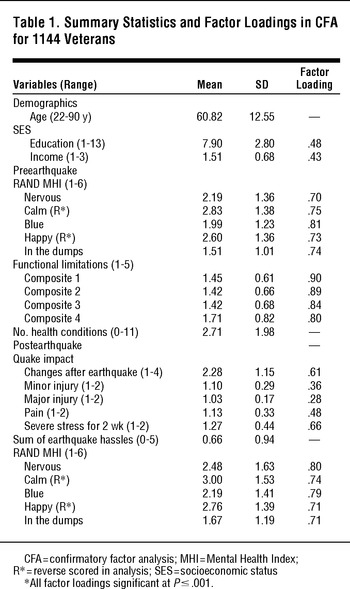
A preliminary CFA model estimated the factor structure and relations among all of the latent variables in the model. Table 1 reports the means, standard deviations, ranges, and factor loadings for each measured variable. All of the factor loadings were significant (P ≤ .001). Fit indexes were good: ML χ2 = 699.84, 222 df; CFI = 0.95, RMSEA = 0.048; S-B χ2 = 574.77 df; robust CFI = 0.95, RMSEA = 0.041. Note that mean values for the RAND MHI items were higher postearthquake than preearthquake.
Summary Statistics and Factor Loadings in CFA for 1144 Veterans

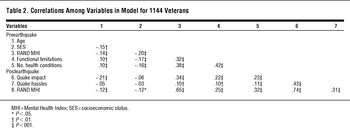
Table 2 reports the bivariate correlations among constructs of the model without any directionality of influence among them. Noting the significant correlations, older participants reported lower SES and more functional limitations and health conditions, but less emotional distress (RAND MHI). They also reported being less affected by the Northridge earthquake. A higher SES was associated with lower emotional distress both pre- and postearthquake, fewer functional limitations, and fewer health conditions. Preearthquake emotional distress was associated with more functional limitations, health conditions, more earthquake impact, more earthquake hassles, and, as expected, postearthquake emotional distress. Also expected was that functional limitations were associated with more health conditions. Furthermore, functional limitations were associated with more earthquake impact and earthquake hassles and more emotional distress postearthquake. The count variable on health conditions was positively associated with earthquake impact and hassles and with greater postearthquake emotional distress. Quake impact was associated with hassles and highly associated with postearthquake emotional distress (0.74). Quake hassles were significantly associated with more postearthquake emotional distress (0.31), but only modestly associated with preearthquake emotional distress (0.10).
Correlations Among Variables in Model for 1144 Veterans

Path Model
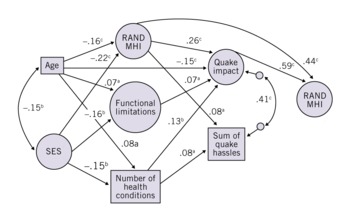
The final trimmed predictive structural equation model is presented in the Figure; nonsignificant paths were gradually dropped until only significant ones remained. As with the CFA model, fit indexes were acceptable: ML χ2 = 719.91, 231 df; CFI = 0.95, RMSEA = 0.048; S-B χ2 = 593.24, 231 df; robust CFI = 0.95, RMSEA = 0.041. The background factors of age and SES both significantly predicted all of the intermediate health-related items (eg, preearthquake emotional distress, functional limitations, health conditions); in turn, these 3 intermediate items predicted perceived earthquake impact. A younger age also predicted less impact. Hassles were only weakly predicted by emotional distress and the number of health conditions. The outcome variable of postearthquake emotional distress was predicted by preexisting emotional distress as expected and by earthquake impact. The regression coefficient from earthquake impact to postearthquake RAND MHI was larger than that of the stability coefficient from preearthquake RAND MHI (0.59 vs 0.44). This model explained 72% of the variance in veterans' emotional distress as indicated by the RAND MHI. To determine whether these 2 paths (earthquake impact to postearthquake RAND MHI, and preearthquake RAND MHI to postearthquake RAND MHI) were statistically different from one another, we tested whether there was a significant decrement in fit after constraining the 2 paths to make them equivalent. The regression coefficient from earthquake impact to postearthquake emotional distress was significantly greater than the stability coefficient from preearthquake emotional distress to postearthquake emotional distress (χ2 = 14.80, 1 df, P < .001).
Structural equation model assessing impact of earthquake-related variables, demographics, and preexisting conditions on mental distress at follow-up (N = 1144 veterans).

Earthquake-related variables were assessed postearthquake; all other variables were measured preearthquake. Large circles represent latent variables; rectangles represent single items. Single-headed arrows represent significant directional regression coefficients; double-headed arrows represent correlations. Regression coefficients and correlations are standardized (a = P ≤ .05, b = P ≤ .01, c = P ≤ .001).
There also were some significant indirect effects mediated through the intermediate predictors. There was a significant effect of a lower SES on more earthquake impact (P < .001) and on earthquake hassles (P < .01). Postearthquake emotional distress also was affected indirectly (through quake impact) by preearthquake emotional distress (P < .001), number of health conditions (P < .01), younger age (P < .001), and lower SES (P < .001).
DISCUSSION
The impact of a disaster on emotional health is a complex phenomenon. Our study sought to understand the effects of a particular earthquake upon veterans by examining the role of age, SES, and preearthquake emotional distress, particularly as mediated by the disaster's effects on injuries, lack of food or water, and other factors. As Norris and colleagues note, controlling for predisaster psychological symptoms when assessing the effect of exposure, as our study does by measuring preearthquake emotional distress, yields the strongest design possible in studies of postdisaster psychological symptoms.Reference Norris, Friedman, Watson, Byrne, Diaz and Kaniasty7 We found that postearthquake emotional health was not related solely to preearthquake emotional distress. Indeed, our results indicate that quake impact had a larger effect on postearthquake emotional distress (coefficient of 0.59) than did preearthquake emotional distress (coefficient of 0.44). Thus, the postdisaster emotional health of veterans who experienced greater earthquake impact likely would have benefited from postdisaster outreach, regardless of their predisaster emotional health.
The impact of the earthquake was greater among those veterans with more preearthquake emotional distress, those with more health conditions, and, to a lesser extent, those with more functional limitations. Similarly, we observed the direct effect of greater preearthquake emotional distress and more health conditions on hassles associated with the earthquake. These subpopulations with generally poor predisaster physical and emotional health are therefore more vulnerable to experiencing heightened postearthquake emotional distress, and our results suggest that these groups should be targeted for psychological care after a disaster.
Indirectly, the impact of age on postdisaster emotional distress was mediated through all 3 of the intermediate health-related items, including predisaster emotional distress. Accordingly, our study suggests that younger veterans, because of their greater predisaster emotional distress than older veterans, may be an appropriate population to explicitly reach out to through interventions to decrease the overall psychological burden of a disaster on a community. As more soldiers and sailors return from service in Iraq and Afghanistan, the population of young veterans is increasing. These young veterans may be at heightened risk for additional emotional distress after future disasters. Most studies of adults have found that the effects of disasters decline with increasing age.Reference Norris, Friedman, Watson, Byrne, Diaz and Kaniasty7
The predictive model shows that SES played a complex, multifaceted role in the effects of the Northridge earthquake on veterans. Specifically, SES affected quake impact, through the 3 intermediate health-related items; quake hassles, through a veteran's number of health conditions; and postearthquake emotional distress, through quake impact. These findings suggest that veterans with lower SES were disproportionately likely to experience more effects from a disaster than veterans of higher SES, including, for example, more postdisaster emotional distress, to experience greater changes after a disaster, and to experience more injuries, pain, and stress. They also are more likely to experience difficulties such as refilling medications, needing medical equipment replaced, or not receiving needed medical care, because they experience more health conditions than veterans with higher SES. As Norris and colleagues noted, most studies have not examined the effects of SES on postdisaster mental health.Reference Norris, Friedman, Watson, Byrne, Diaz and Kaniasty7 Of the few studies that have examined SES (14 of 160), most report that lower SES is associated with greater postdisaster distress. Norris and colleagues identified 2 prior studies that found, as in our study, that the adverse effects of exposure grow stronger as SES decreases.Reference Phifer17Reference Ginexi, Weihs, Simmens and Hoyt18
The results of our model suggest that response activities that reach out to veterans with more functional limitations and health conditions would be particularly effective at reducing postdisaster emotional distress among those with lower SES, even without explicitly considering predisaster emotional distress. Veterans in need of assistance after a disaster may be more willing to accept assistance with functional limitations or other health conditions rather than services explicitly targeted at emotional distress. Our model suggests that such assistance would lead to reduced postdisaster emotional distress.
Norris and colleagues categorized the 1994 Northridge earthquake as a low-impact disaster and reported that most studies of the earthquake found that it had minimal effects on mental health in the general population.Reference Norris, Friedman, Watson, Byrne, Diaz and Kaniasty7 Only 1 of the prior 6 studies of this earthquake found even moderate levels of impairment; however, most of these studies included few individuals who experienced serious structural damage or injuries,Reference Knight, Gatz, Heller and Bengtson19Reference Ullman and Newcomb20 or they assessed mental health 6 to 14 months after the event.Reference Knight, Gatz, Heller and Bengtson19Reference Siegel, Shoaf and Borque21Reference Asarnow, Glynn and Pynoos22 In contrast, our study assessed veterans 1 to 3 months after the earthquake and included many individuals who were near the epicenter. The 1 study that found moderate effects,Reference McMillen, North and Smith23 specifically criterion-level intrusion and arousal symptoms and marked levels of posttraumatic stress disorder (13%), included a sample recruited from the area that experienced the greatest damage. Sample participants, however, were generally highly educated and affluent, unlike those in our study, who included veterans of various levels of SES. Highly educated and affluent individuals would have greater resources available to help them to cope with the effects of a disaster, and thus the prior study may have underestimated the total effects of the earthquake. Accordingly, our study provides a more complete understanding of the impact of the earthquake than previous studies of the disaster and allowed us to estimate the influence of differing levels of SES on earthquake impact and emotional health.
The variation in functional status and health conditions that we observed in our sample was expected because veterans who use VAMCs for health care have more health needs than both non-VAMC users and the general population. For example, a study by Wilson and KizerReference Wilson and Kizer24 found that among VAMC users, 60% rated their perceived health status as poor or fair, whereasile for non-VAMC users and the general population, the figures were 25% and 11%, respectively.
One strength of our study was that it permitted us to ascertain the role of various levels of health status on postdisaster emotional distress. Our study provides evidence that people with poorer physical health are at risk for greater postearthquake emotional distress. Another advantage of this study is the administration of the RAND MHI before and after the earthquake. This was used as the emotional health indicator and uses the follow-up potential of this sample because changes could be observed over time. Our study thus uses a true pre-post panel design (ie, the same respondents interviewed repeatedly over time). As such, this study also contributes to the literature because it adds to the small number of studies that include true predisaster measures. In an update to the 2002 review, Norris identified only 10 studies of 225 samples (4%) that used predisaster measures.Reference Norris25
Our study has limitations. It is unknown how the results of our study would generalize to nonveterans. We could not assess the impact of sex because the sample examined only men. Future studies should include female veterans to ascertain whether sex plays a differential role in emotional distress. Our sample excluded veterans who were hearing impaired, in acute distress, showed signs of memory loss at enrollment, or were homeless, and our results would not generalize to those populations. Future studies should consider research designs that would permit the study of these groups. The data are relatively old. Nevertheless, the results are likely generalizable to today's VAMC users, bearing in mind the changes in the population of veterans who have received primary care from VAMC since 1994.Reference Yano, Simon, Lanto and Rubenstein26 Moreover, the MHI-5, our outcome measure of postearthquake emotional distress, is still in use. Our study does not indicate how long the observed effects on postdisaster emotional distress may persist. Future studies should include repeated postdisaster assessments.
Although the directionality of our model is logical, structural equation modeling alone cannot definitively determine either causation or directionality of influence. Other models and directionality of influences, including bidirectionality, may be equally reasonable.Reference MacCallum, Wegener, Uchino and Fabrigar27 For instance, more postearthquake emotional distress or depressive affect could lead to the heightened perception of more earthquake impact on the part of the veteran. Similarly, it is possible that poorer health status or more functional limitations could lead to lower SES insofar as income is 1 indicator of SES in our model.
CONCLUSIONS
Our study provides evidence of postdisaster psychological vulnerability among certain groups of veterans. Future studies should seek to provide a greater understanding of vulnerability and test targeted interventions for these vulnerable groups after a disaster to determine how to mitigate postdisaster emotional distress. Because many veterans use non-VAMC health care providers for at least some of their health needs, future disaster planning for both VAMC and non-VAMC health care providers should incorporate interventions (eg, outreach programs) targeted at veterans who experience greater earthquake impact, greater preearthquake emotional distress, more functional impairment, and more health conditions. Our study suggests that hospitals and other health care facilities develop proactive programs to address postdisaster patient needs before a disaster, to limit the impact of such events on patients' mental health.
Disclaimer: The views expressed in this article are those of the authors and do not necessarily reflect the position or policy of the Department of Veterans Affairs or the US government.
Author Disclosures: The author reports no conflicts of interest.
Acknowledgments: This material is based upon work supported by the Department of Veterans Affairs, Veterans Health Administration, Office of Public Health, and the Department of Veterans Affairs, Western Region. The authors thank Angela Olive for administrative assistance and Gisele Pham for production assistance.