1. Introduction
Bangladesh is a flood prone country. Eighty per cent of the country consists of floodplains of the Ganges, Brahmaputra, Meghna, and several other rivers. These floodplains sustain a predominantly poor rural population. Approximately 75 per cent of the total population of 124 million people (in 2001) live in these rural areas, earning on average US$ 325 per capita per year (Bangladesh Bureau of Statistics, 2005). Once every few years roughly one-third of the country gets severely affected by floods, while in catastrophic years such as 1988, 1998, and 2004 more than 60 per cent of the country is inundated, that is an area of approximately one hundred thousand square kilometres for a duration of nearly three months (e.g. Rasid and Paul, Reference Rasid and Paul1987). Floods cause social disruptions and result in scarcity of drinking water as surface water gets contaminated by organic and inorganic substances. Cases of diarrhoea, cholera, and other intestine diseases increase markedly during and after floods (e.g. Kunij et al., Reference Kunij, Nakamura, Abdur and Wakai2002).
After the catastrophic floods in 1988, the Government of Bangladesh adopted an elaborate World Bank sponsored scheme of flood alleviation measures through their Flood Action Plan (FAP) (NEDECO, 1993). The main objective of this FAP is to regulate flood levels inside proposed flood-control compartments. One of the critiques on the FAP is that it does not take into account the interests and views of floodplain residents (Rasid and Mallik, Reference Rasid and Mallik1995). Two surveys, one carried out between 1991 and 1994 (Rasid, Reference Rasid and Parke2000) and one in 1996 (Rasid and Haider, Reference Rasid and Haider2003), investigated public preferences for flood protection and found that a majority of floodplain residents – mainly farmers – prefer regulated flood levels instead of total flood prevention, where the preferred level of inundation corresponds with the ideal flood depth for the cultivation of floodplain rice.
In a large-scale survey carried out in 2005 in the south-east of Bangladesh, we asked almost 700 floodplain residents currently living without any flood protection along the river Meghna for their preferences for a flood alleviation scheme using the contingent valuation (CV) method, i.e. asking them for their willingness to pay (WTP) to reduce current and future flood risks. CV studies of flood risks and flood risk reductions are rare (Daun, Reference Daun2000). A considerable CV literature exists, however, regarding the economic value of the floodwater retention capacity of wetlands and floodplains (e.g. Brouwer et al., Reference Brouwer, Langford, Bateman and Turner1999; Brouwer and Bateman, Reference Brouwer and Bateman2005), which shows a positive relationship between stated WTP and the provision of flood protection. Alternative valuation methods include the hedonic pricing method, which has been used extensively to value flood risks using house price data (e.g. MacDonald et al., Reference MacDonald, White, Taube and Huth1990; Bin and Polasky, Reference Bin and Polasky2004; Daniel et al., Reference Daniel, Florax and Rietveld2005). This valuation method is of less practical relevance to the present case study due to the very low numbers of transactions in the housing market and the absence of house price data. Flood risk reductions are also valued using the avoided damage cost approach. Although this method has simplistic appeal, it accounts for material damage costs only, and does not account for public risk aversion. These latter well-being effects, measured in economics through the concept of society's WTP to avoid a risk or protect itself against a risk, should be added to the expected damage costs in order to obtain the all-inclusive correct welfare measure of the benefits of flood risk reduction (Shabman and Stephenson, Reference Shabman and Stephenson1996; Pearce and Smale, Reference Pearce, Smale, Brouwer and Pearce2005).
The main objective of this paper is to estimate WTP for reduced flood risks and to investigate to what extent stated WTP varies depending on different flood risk exposure levels, taking into account the challenges identified in the international literature when applying the CV method in the developing world (e.g. Georgiou et al., Reference Georgiou, Whittington, Pearce and Moran1997; Whittington, Reference Whittington1998). Flood risk exposure levels are measured in this case study in different ways, including the distance floodplain residents live from the river Meghna, the level of flooding during the rainy season, and corresponding annual flood damage. The temporal stability and reliability of the stated WTP values are furthermore tested in a follow-up survey six months after the original valuation study was carried out. Although the test presented here covers a longer time period, previous CV research in developing countries suggests that giving respondents time to think significantly lowers stated WTP (Whittington et al., Reference Whittington, Smith, Okorafor, Okore, Long Liu and McPhail1992).
The remainder of this paper is organized as follows. Section 2 introduces the case study, while section 3 discusses the set-up of the CV study. Section 4 presents the general characteristics of the floodplain residents, and section 5 the CV results. Finally, section 6 concludes.
2. The case study
The case study is carried out in a low-lying, severely flood prone fluvial delta located in the south-east of Bangladesh in the sub-district Homna, approximately 70 km from Dhaka. The floodplain delta covers an area of approximately ten thousand hectares and is bordered by the Meghna river in the north-west and its tributaries the Titas river in the north and south and the Kathalia river in the west.
The area's topography varies between 1.5 and 4.0 meters above sea level. Average annual rainfall is 2025 mm of which 75 per cent falls during the monsoon from June to October. Heavy monsoon rainfall generates excessive flows in the rivers and thereby causes floods almost every year. These floods cause damage to houses, agricultural crops, and the infrastructure in the area. During the 2004 flood, Homna was identified in the Rapid Flood Assessment as one of the most severely affected areas in Bangladesh in terms of percentage of area inundated, inundation depth (≥2 meter), and percentage of people affected (Centre for Policy Dialogue, 2004). More than four hundred thousand people live in the area (2001 population census). Most of them are farmers. Almost three quarters of the land is used for farming, mainly rice. Other crops include wheat, vegetables, pulses, oil seeds, and maize. Some livestock farming is also present, but on a very small scale. Communities of fishermen are found along the rivers. Furthermore, creeks and canals are found in the area, which are also utilized for fishing.
3. Contingent valuation of reduced levels of flood risk exposure
The application of CV to value changes in individual risk exposure is fairly widespread nowadays (e.g. Jones-Lee and Loomes, Reference Jones-Lee, Loomes, Nau, Gronn, Machina and Bergland1997; Beattie et al., Reference Beattie, Covey, Dolan, Hopkins, Jones-Lee, Loomes, Pidgeon, Robinson and Spencer1998; Carthy et al., Reference Carthy, Chilton, Covey, Hopkins, Jones-Lee, Loomes, Pidgeon and Spencer1999). A money measure of a change in risk is identified, defined as a positive or negative payment, which holds expected utility constant under different risk levels. The higher the utility obtained from risk reductions, the greater we expect this amount to be, ceteris paribus (Johansson, Reference Johansson1995). Typically, existing studies investigate the consistency between stated WTP and the changes in risk exposure levels using probabilistic representations of risk levels. Based on evidence that lay public may find such probabilistic representations of risk levels difficult to understand and interpret (e.g. Tversky et al., Reference Tversky, Sattath and Slovic1988), ‘natural experiments’ have been proposed to test the sensitivity of public preferences to hypothesized changes in risk in cases where different groups of individuals are at different, pre-existing levels of real-world risks (e.g. Rosenzweig and Wolpin, Reference Rosenzweig and Wolpin2000). This approach is especially appealing in this case study, where regular flooding is an annually recurring event and disaster floods occur once every five to ten years, and the problems in economic valuation of low probability, high impact events (e.g. Ganderton et al., Reference Ganderton, Brookshire, McKee, Stewart and Thurston2000) are largely absent.
In general, the level of risk exposure faced by an individual (Ri) depends on two main factors: an exogenous and endogenous element. The former refers to facts or factors, which are beyond an individual's control (X), and the latter to the fact that people can take actions (Pi) that reduce the likelihood of an undesirable event occurring (self-protection), and reduce the costs of the event to them if it occurs (self-insurance) (Shogren and Crocker, Reference Shogren and Crocker1991). Obviously, individual risk-reducing behaviour will influence the realized risk level affecting each person. In equilibrium, economic theory predicts that individuals equate the marginal benefits of self-protection or insurance (expected avoided disutility) with the marginal costs (price of self-protection or insurance), subject to their budget constraint.
In terms of WTP for a risk reduction, the relevant measurement of risk is people's subjective assessment of risk, rather than a scientifically observed measure. As Smith (Reference Smith, Bromley and Segerson1992) points out, the use of subjective rather than objective risk assessment is more correct if one assumes that the general model of decision-making under uncertainty is prospective reference theory as an extension of standard expected utility theory (Viscusi, Reference Viscusi1989). Hence, theory tells us that WTPi for a reduction in risk exposure depends on (i) the realized level of risk, R, which is itself determined by exogenous risk, X, and self-protection activities, Pi, (ii) income, Yi, and (iii) individual's disutility from risk exposure (risk aversion), Si, such that we obtain equation (1)

In the case study presented here, exogenous flood risk exposure is measured through the distance people live from the river. Different groups have different exogenous risk exposure levels dependent upon their location. Individuals can self-protect by moving further away from the river and taking measures to anticipate flooding and flood damage such as building houses on terps. It is less obvious to see how people can self-insure against the consequences of flood risks once a flood disaster hits them, as flood insurance is currently not available in Bangladesh. We aim to control for the endogenous risk element through the information collected in our survey. Once this control is in effect, we obtain our natural experiment by presenting groups who face differing exogenous flood risk exposure levels with a scenario in which the risk is reduced to a common and readily comprehended new level. While we deliberately avoid attempts to explain the actual risk probabilities to which individuals are exposed, we test the hypothesis that WTP values for such risk reductions will nonetheless be consistent with variations in exogenous risk levels across groups of people.
Variations in realized flood risk alone, however, are unlikely to be sufficient to empirically explain variations in WTP for risk reductions. First, WTP depends partly on ability to pay, thus differences in income and wealth could matter. Second, an individual's subjective view of the realized risk level is likely to depend on experiences with flooding, corresponding flood damage, and the acceptance of this damage. Third, preferences are likely to be heterogeneous towards risk reductions as a result of the economic interests in the floodplain area (e.g. natural fertilization of floodplains through flooding or the presence of floodplain fish), which may influence people's attitudes to flood risk and their risk−income trade-off rate. The empirical analysis presented here aims to make use of variables that control for all of these factors in addition to variations in realized risk. Our expectation is that when we adjust for factors such as income differentials, occupation, and other economic interests in the floodplain, WTP should be highest for those who are most exposed to the risk of flooding, i.e. live closest to the river and face the highest levels of flooding and flood damage during the rainy season.
4. General survey and sample characteristics
4.1. Survey set-up and sampling procedure
The CV study was part of a wider rural household survey investigating flood problems and coping mechanisms, agricultural land use and fish production systems in flood plains, and demographic and socio-economic characteristics of floodplain residents in one of the most flood prone areas in Bangladesh. In total 672 people were interviewed face-to-face from the last week of March until and including the second week of May 2005 by local interviewers based upon a stratified sampling procedure. Three pre-test rounds were used to finalize the household questionnaire over a period of two and a half months. Additionally, a workshop was organized with local experts and stakeholders to discuss the design of the questionnaire survey.
The questionnaire consists of five sections, two general sections and three sections designed for specific occupational activities. Hence, each respondent answered three sections: a general introductory section, including questions about respondent demographic and socio-economic characteristics, a section specifically dealing with flood risk and flood risk reduction, and an occupational section. The flood-related questions examine the extent and nature of the impacts of flooding on life and livelihood, including health-related impacts and damage costs, and floodplain resident perception regarding the management and funding of an existing flood alleviation plan in Homna. For a more detailed description of the analysis of floodplain resident vulnerability, the interested reader is referred to Brouwer et al. (Reference Brouwer, Akter, Brander and Haque2007).
Besides asking respondents about the importance of reducing flood risk exposure, they were also asked for their WTP for the proposed flood protection scheme, embanking the sub-district Homna.Footnote 1 First they were asked for their WTP in principle for the flood protection scheme, and respondents who replied ‘yes’ were subsequently asked to pay a specific bid amount using a dichotomous choice (DC) model in the form of a voluntary community contribution. The WTP questions were specified as follows:
‘Are you willing to pay in principle for the proposed flood protection scheme in Homna, which will fully protect you and your family and your property against future flooding?’
0. No (skip the next question)
1. Yes
‘Are you willing to pay . . . Taka each year as a voluntary community contribution for the flood protection scheme for the whole of Homna on behalf of your entire household?’
0. No
1. Yes
In view of the fact that there exists no information about flood probabilities in Bangladesh for protected and unprotected areas, we were unable to refer to these probabilities in the survey. Instead, we used a common and easily understood target level of protection, emphasizing that the flood protection scheme provides full protection against future flooding.
The use of an appropriate payment vehicle was thoroughly pre-tested. However, the absence of a public payment structure in rural Bangladesh made institutional embedding of the payment, for instance in the form of a local tax, impossible. Furthermore, trust in public bodies and the effective use of the money towards implementation of the proposed flood alleviation scheme appeared to be a serious problem during the pre-tests. Therefore, a voluntary community contribution was used as the payment mode in our hypothetical market design without specifying the name of the organization responsible for the collection of the payments and its effective use. It was emphasized during the interview that the amount of money would be solely used to finance the costs of building an embankment in Homna. Ten different bid levels were used: 10, 20, 50, 100, 200, 500, 1000, 2000, 3000, and 5000 Taka (BDTK) per household per year.Footnote 2 To put these amounts in context, average annual household income in the study area is around BDTK 60,000 (US$ 950). These bid amounts were randomly allocated across respondents and were based on thorough pre-testing of the WTP question in an open-ended format before the survey was carried out.
After each WTP question respondents were asked in an open-ended question why they were or why they were not willing to pay. The sequence of WTP questions was based on previous research (e.g. Brouwer and Bateman, Reference Brouwer and Bateman2005) and allowed, among other things, investigation of protest and legitimate zero bidders. This is considered essential in CV research, but even more so in this particular case study in view of the fact that people are not used to paying for flood protection, and the study area is located in one of the poorest countries in the world and income constraints are therefore believed to significantly constrain WTP (Whittington, Reference Whittington1998).
In order to test the temporal stability of stated WTP and the reliability of the application of the CV method in this specific developing country context, a follow-up CV survey was carried out six months after the original survey. Face-to-face interviews were conducted with 89 randomly selected respondents who also participated in the original household survey (13 per cent of the original sample population). In this unannounced follow-up survey, respondents were asked whether they remembered the WTP question in the original survey and their answer to the WTP question, which money amount they were asked to pay, whether they were still willing to pay or not, how clear it was what they were being asked to pay for, how certain they were about their reply, and, if they wanted to change their original reply, why they wished to change it. Those respondents who were not willing to pay in the original survey were asked more specifically about the reasons why they were not willing to pay and whether they would be willing to contribute in ways other than in money terms − that is, in kind − for instance by providing household labour or paying with part of their harvest.
4.2. General floodplain resident characteristics, flood problems and flood damage
Average annual per capita income of the survey respondents is US$ 150 (BDTK 9,433), which is substantially lower than the national average mentioned in the introduction of this paper (US$ 325 or BDTK 20,440). Based on the Basic Cost Need (BCN) poverty threshold calculated by the Bangladesh Bureau of Statistics (US$ 105 or BDTK 6,605 per capita per year), 55 per cent of the floodplain residents included in the sample live below this poverty line.
A majority of 96 per cent of the floodplain residents are exposed every year during the rainy season to flooding, and a quarter of the population mentions flooding as the main problem faced by the region, followed by other important problems such as bad roads (23 per cent), unemployment (20 per cent), and lack of electricity (17 per cent). In more than one-third of the cases the water comes waist high during the rainy season (1.5 feet) and in another one-third of the cases even up to the shoulders (3 feet). Almost half of the population (46 per cent) furthermore indicates that they suffer each year from diarrhoea during the rainy season, and seek medical treatment for this.
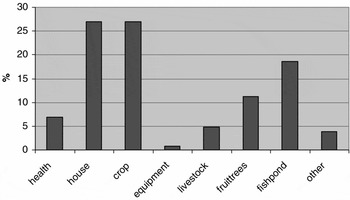
Respondents were asked to specify the flood damage they suffered in the previous disaster flood year (2004) across a number of impact categories (e.g. loss of crops, medical treatment, damage to houses etc.) and to state the monetary costs of each type of damage. Average household flood damage costs are US$ 190 (BDTK 11,950). These average flood damage costs equal approximately 17 per cent of average household annual income. Most flood damage is caused by property and crop damage, followed by damage to fishponds (loss of fish stock) (see figure 1). The other damage category includes loss of income from day labour and trade.
Relative contribution of different damage categories to total household flood damage costs in 2004

When relating flood risk exposure levels (measured through the distance people live from the river) to experienced flood problems during the 2004 disaster flood (measured through inundation depth, flood damage, and health problems) and household income as an important indicator of household socio-economic status (based on Spearman's rho) a number of interesting results are found. First, there exists a small but significant positive relationship between risk exposure level measured via the distance people live from the river and annual household income (r = 0.11; p < 0.01). This means that on average households with higher income levels live further away from the river. This income differential cannot be attributed to one specific occupational group such as farmers or fishermen. Farmers and fishermen earn significantly different incomes, but there exists no significant relationship between occupation and the distance to the river, although we expected fishermen to live closer to the river.
As expected, a negative relationship is found between distance and flood damage (the further away, the less damage), but this relationship is not significant at the 10 per cent level. Possibly due to the significant relationship between income and distance, we also find that higher income groups face lower inundation levels during floods (r = −0.19; p < 0.01). The highest correlation is found between household income and the self-reported 2004 flood damage costs (r = 0.43; p < 0.01), implying that higher income groups suffered more damage. On the other hand, higher household income is negatively correlated with catching diarrhoea during the rain season (r = −0.14; p < 0.01), suggesting that higher income groups are better able to cope with the negative health impacts of flooding. A small but significant positive relationship exists furthermore between the estimated market value of household dwellings and the distance the dwelling is located from the river (r = 0.17; p < 0.01), suggesting that flood risk exposure has a negative impact on house prices.
When asking floodplain residents about their attitude towards flood protection, 80 per cent of the respondents said that they consider flood protection important to very important. Thirteen per cent believe that it is not important at all (n = 91). Interestingly, comparing those who consider flood protection is not important at all with those who believe it is (very) important, the latter live significantly further away from the river than the former and earn significantly more income.Footnote 3 In the case of inundation depth during floods and the experienced flood damage in 2004, the relationships are as expected, i.e. those who believe flood protection is (very) important face significantly higher inundation depths during the rainy season and suffered significantly more damage during the 2004 disaster flood.Footnote 4
Finally, when asking respondents who in their opinion is responsible for flood protection in their region and who should pay for the proposed embankment, a majority of 82 per cent referred to the central Government, followed by foreign aid agencies (12 per cent). Less than 5 per cent said they believe that local residents should pay.
5. Contingent values and models for reduced flood risk exposure
5.1. Reasons why floodplain residents are not willing to pay for flood risk reduction
After respondents were asked for the importance they attach to flood risk reductions in their region, they were presented with two WTP questions (section 4.1). First, respondents were asked whether they were willing to pay in principle for a flood protection scheme in Homna. Those who said ‘yes’ were subsequently asked in a DC question whether they were willing to pay a specific bid amount every year on behalf of their entire household.
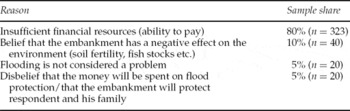
Forty per cent of all respondents replied positively to the first WTP question. A majority (80 per cent) of those who said ‘no’ to the first WTP question refused to pay because of lack of financial resources (table 1). From an economic point of view, this is a legitimate zero bid. We tested this explicitly and respondents who indicated that their income is too low have indeed a significantly lower annual household income (average income of US$ 760 or BDTK 47,800) than those respondents who said ‘yes’ to the first WTP question (average income of US$ 1,080 or BDTK 67,925).Footnote 5 Ten per cent refuse to pay because they believe that an embankment will be harmful to the environment. About 60 per cent of these respondents are floodplain farmers, who may be worried about reduced soil fertility as a result of the embankment (and hence higher production costs), and 14 per cent are fishermen, who may be worried that they lose fishing opportunities. Five per cent of those who said ‘no’ do not consider flooding a problem or consider other issues more important such as improved electricity supply and infrastructure. Almost 5 per cent appeared to protest against the imposed market construct and the hypothetical WTP question by stating reasons such as ‘I don't believe the money will actually be spent on the embankment’ or ‘I don't believe the embankment will protect me and my family’. Special attention was paid to possible ‘yes, but . . .’ answers reported elsewhere in the literature (Whittington, Reference Whittington1998), but these answers were not found in this CV application.
Most important reasons why respondents are not willing to pay for flood protection

Hence, more than half of the sample population does not want to pay for the proposed flood alleviation scheme in principle, because they lack the financial resources. This finding seems to confirm that applying CV in developing countries may result in a high number of zero bids as a result of severe income constraints (e.g. Georgiou et al., Reference Georgiou, Whittington, Pearce and Moran1997). However, we do not find any evidence in this study that there is something fundamentally wrong with asking the WTP question given the low number of protest bidders (<5 per cent).Footnote 6 The question is, however, how useful the exercise is in view of the fact that the data are highly skewed. The high number of zero bidders and the issue of financial income constraints were therefore addressed and analyzed in more detail in the small-scale follow-up survey. Those respondents who indicated in the original survey that their financial resources were insufficient to pay for the proposed flood protection scheme were asked whether they were willing to contribute in kind, for example with household labour or by giving up part of their harvest. Forty per cent of these respondents said that they would. Three-quarters prefer to pay with their own labour, 20 per cent are willing to pay with part of their harvest, and 5 per cent are willing to give up part of their land for the construction of the embankment. Although there is no indication in the pre-test of the survey of limited money-economy experiences, this finding suggests that a non-monetary measure of WTP would have substantially reduced the number of zero bids.
Another important issue addressed in the follow-up survey is to what extent strategic bias played a role when stating a zero WTP. Most floodplain residents in the original survey indicated that the central Government is responsible and should pay for flood protection in the region before answering the WTP question (section 4.2). None of these respondents, however, referred to this statement when they were asked to explain why they were not willing to pay for the proposed flood protection scheme. In the follow-up survey, respondents were asked whether their original WTP reply was in any way affected by their belief that others should pay for the flood protection scheme, such as the central Government. Twenty-two per cent of those respondents who claimed to have insufficient financial resources to pay for the flood protection scheme answered yes to this question and repeated that the central Government should pay. Relating this percentage to the total number of respondents who said no to the original WTP question, this equals 17 per cent of the original sample population. Hence, some degree of strategic bias may also have influenced the high share of zero stated WTP.
5.2. Willingness to pay for reduced flood risk exposure
The DC CV model does not reveal the maximum WTP amount, only a discrete indicator of maximum WTP. Mean and median WTP are inferred from the underlying statistical distribution of the probability that respondents say ‘yes’ or ‘no’ to the different bid levels (Hanemann, Reference Hanemann1984). Various parametric and non-parametric statistical models exist to estimate these underlying distributions, which usually produce significantly different results and are an important source of statistical model specification bias in the analysis of CV results. In order to test for this bias, mean and median WTP are estimated using the (parametric) logistic probability model and the (non-parametric) Turnbull model (Haab and McConnell, Reference Haab and McConnell1997).
In the case of DC models, conventionally calculated confidence intervals are usually used (i.e. assuming a normal distribution). However, small numbers of observations per bid level, as we have to some extent in this case study, quickly make the assumption of normally distributed random parameters unlikely. Bootstrap procedures were used to produce more accurate inferences regarding confidence intervals on the basis of simulated parameter estimates for the non-parametric model (Efron and Tibshirani, Reference Efron and Tibshirani1993). The median WTP estimate using a log-logistic regression model is US$ 6.0 (BDTK 37.6) and mean WTP based on the Turnbull estimation is US$ 4.3 (BDTK 27.0) per household per year. The standard errors associated with each estimate are 1.1 (7.0) and 0.9 (5.9) respectively. The calculated 95 per cent confidence intervals of both values overlap and we are unable to reject the null hypothesis of equal values using the t-test at the 5 per cent level. In view of the fact that we expect a priori a difference between both values (the Turnbull estimator providing a lower bound WTP), we also applied the alternative two one-sided ‘equivalence test’ (Kristofersson and Navrud, Reference Kristofersson and Navrud2005). Based on this test, we are unable to reject the null hypothesis of inequality at the 5 per cent level using a 20 per cent equivalence interval, suggesting that the median WTP value derived from the log-logistic regression is, as expected, significantly higher than the Turnbull WTP estimate. The log-logistic and Turnbull estimators do not differ much in terms of accuracy. In both cases the variation coefficient is around 20 per cent.
The share of WTP for the flood protection scheme in annual household income is equal to 1 per cent when using the log-logistic estimate and 0.45 per cent when using the Turnbull estimate. Although not directly comparable, these shares are substantially lower than the share of the average flood damage costs in 2004 in household income (see section 6).
5.3. Temporal stability of stated willingness to pay for reduced flood risk exposure
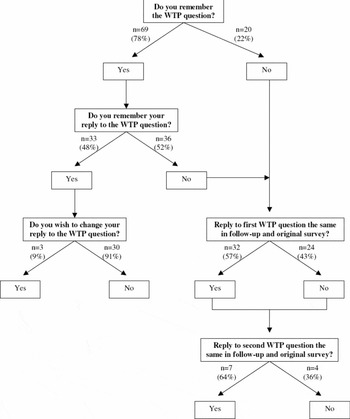
Forty respondents who said yes and 60 respondents who said no to the WTP question were randomly selected and contacted six months after they participated in the original survey. The response rate in the follow-up survey is 89 per cent. Thirty-six respondents who said yes and 53 respondents who said no were asked a series of follow-up questions about their original WTP replies. Seventy-eight per cent of the respondents remembered the WTP question in the survey (figure 2), half also remembered their WTP reply. Ninety-five per cent of these latter respondents also remembered the bid amount they were asked to pay.
Temporal stability stated WTP for flood protection in the follow-up survey

Ninety-one per cent of the respondents who remembered their WTP reply did not want to change their original WTP reply. Nine per cent changed their original reply. Two of these respondents said no to the presented bid amount in the original survey, but were willing to pay this money amount in the follow-up survey, because their financial situation had improved. One respondent who said yes to the WTP question in the original survey did not want to pay anymore in the follow-up survey due to financial problems.
Respondents who did not remember their WTP reply were asked the two WTP questions once again, but this time the second WTP question was an open-ended WTP question (asking respondents for their maximum WTP). Fifty-seven per cent of these respondents answered the first WTP question (WTP in principle) in the same way as they did in the original survey. Forty-three per cent gave a different answer. Six respondents said yes where they said no in the original survey and 18 respondents said no instead of yes, mainly because of insufficient financial resources (n = 14). Half of the latter respondents (n = 7) said that they are willing to pay in kind, for instance by providing labour or giving up land for the construction of the embankment.
Seven of the 11 respondents who agreed to pay a specific bid amount in the original survey and stated a maximum WTP for the second WTP question in the follow-up survey, gave a higher maximum WTP than the original bid amount. Four respondents stated a maximum WTP lower than the original bid amount, indicating that their WTP decreased over time between the original and follow-up survey. Nine respondents who said yes to the first WTP question and no to the second WTP question in the original survey stated, as expected, a lower maximum WTP in the follow-up survey than the bid amount in the original survey. Average WTP in the follow-up survey is US$ 2.02 (BDTK 12.7), which is lower than the estimated original WTP values. However, the number of observations for the WTP values in the follow-up survey is too low to be able to draw any meaningful conclusion.Footnote 7
Finally, respondents were asked in the follow-up survey how certain they were about the money amount they were willing to pay and how clear it was what they were being asked to pay for. All respondents who stated a maximum WTP in the follow-up survey were (very) clear and (very) certain about the stated WTP amount. Almost 70 per cent of those respondents who remembered their WTP reply were very clear what they were being asked to pay for during the first interview, 25 per cent were clear and only one respondent said it was not very clear to him.
5.4. Factors explaining floodplain resident willingness to pay for reduced flood risk exposure
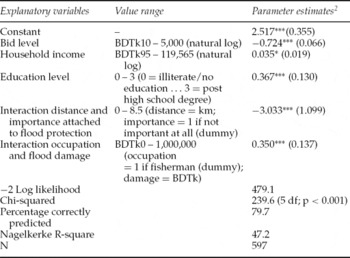
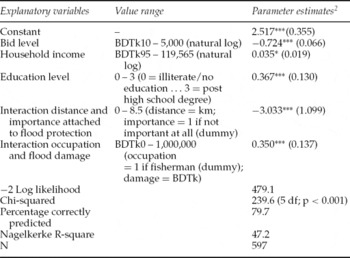
The theoretical model presented in section 3 is estimated empirically based on the same binary logistic regression model applied in section 5.2 to estimate average WTP extended with relevant co-variates, such as (i) the exogenous flood risk exposure indicator measured through the calculated distance respondents live from the river and self-reported inundation levels, (ii) disutility from flood risks measured through self-reported flood damage costs and the extent to which floodplain residents suffer from diarrhoea during the rainy season, (iii) risk aversion measured through self-protection measures and the importance attached to flood protection, and (iv) household income as an important economic constraint of WTP. Several models were estimated using statistical backward and forward elimination techniques, including a variety of combinations of exogenous and endogenous risk factors and socio-economic sample population characteristics. The statistically best-fit model, including variables significant at least at the 10 per cent level, is presented in table 2. Given the correlation results presented in section 4.2, all combinations of explanatory variables were checked for correlation to avoid multicolinearity and corresponding model misspecification. None of the variables presented in table 2 is correlated. The highest correlation is 0.12 (p < 0.01) between household income and respondent education level. The model explains 47 per cent of the observed variation in stated WTP, and the model's predictive power is 80 per cent.
Multivariate logistic regression results1
Notes: 1The response variable is the binary coded (0–1) reply to the DC WTP question.
2Standard errors in parentheses **p < 0.05; ***p < 0.001.
The parameter estimate for the bid amounts is statistically significant and has the expected negative sign: the higher the bid, the lower the probability that someone is willing to pay for flood protection and reduced flood risks in Homna, all other things being equal. As expected, household income has a significant positive influence on stated WTP: the higher the income level, the higher the probability that someone is willing to pay, again all other things being equal. Respondent education level is the only other socio-economic indicator that has a significant impact on WTP. Higher educated floodplain residents are more likely to state a positive WTP than lower educated floodplain residents. Other demographic and socio-economic characteristics appear to have no effect on stated WTP and include respondent age, gender, religion, household size, assets (including land and fish ponds), and physical house characteristics.
Initially, we only explored the main effects of the exogenous flood risk exposure indicators (distance or inundation depth), risk aversion (importance attached to flood protection), and disutility (health problems like diarrhoea or material damage costs) on stated WTP for a flood risk reduction. However, this resulted in model specification problems due to correlation between explanatory variables. There exists for instance a significant correlation between inundation depth and respondent attitude towards flood protection (r = 0.29; p < 0.01), making it hard if not impossible to include both subjective and objective risk measures in the statistical model (inundation level is in turn related to damage costs as a proxy for disutility). Hence, the statistically significant main-effects-only models include either inundation depth or importance attached to flood protection as additional explanatory factors besides bid level and household income.
In order to overcome this problem, interaction terms were tested for their significance, the results of which are presented in table 2. Two interaction terms were found to be highly significant at the 1 per cent level. First, respondent occupation in combination with the experienced damage costs during the 2004 disaster flood appear to have a significant impact on stated WTP. Fishermen who suffered more damage are more likely to state a positive WTP and say yes to the presented bid amount than any other occupational group. Secondly, a significant effect is also found for the interaction between the objective risk exposure variable ‘distance from the river’ and the subjective risk aversion variable ‘importance attached to flood protection’. Respondents who consider flood protection not important at all and live further away from the river (and are hence less at risk) are significantly less likely to state a positive WTP than other respondents.Footnote 8
6. Comparison of the economic value of flood risk exposure and flood risk reduction
The economic value of flood risk exposure was measured through the self-reported damage costs as a result of the 2004 disaster flood in Bangladesh, whereas the economic value of flood risk reduction was estimated through floodplain resident WTP for future risk protection. Contrary to expectations, the former constitute in our study a substantially larger share of average household income than the latter. Stated WTP is expected to reflect broader risk-related welfare considerations, such as stress and discomfort, than the expected material damage costs due to flooding only. Assuming for example a ten-year disaster return period and a constant value at risk (i.e. material damage cost) during that time period, the annual expected economic value of the disaster flood risk (US$ 19) is, on average, three to four times higher than stated annual WTP for flood protection. Using the lower median value for the damage costs, the expected value of the damage costs reduces to US$ 9.5, which is still one and a half times higher than the estimated median WTP. So, if we assume that stated WTP is the theoretically correct welfare measure based on the expected material damage costs, floodplain residents are not willing to pay a risk premium over and above their expected material damage costs to reduce flood risks. We have to keep in mind though that both the self-reported damage costs and stated WTP may be biased and either overestimated (self-reported damage costs) or underestimated (WTP) for strategic reasons. The self-reported damage costs furthermore refer to the disaster flood in 2004. The damage costs due to regular annual flooding were not elicited in this study and may be substantially lower. Most importantly, information about the perceived probability of flooding without and with the proposed flood protection scheme is missing from the survey and assumptions about return periods have to be made based around actually observed flood events.
Although not the main objective of the research reported here, this estimate of the economic value of flood risk reduction can be used to see if investments in flood risk reduction, in the form of an embankment surrounding the study area, can be justified from an economic point of view. Aggregated across the whole population of potential beneficiaries (about 65,000 households), a total economic value is found of US$ 280,000 to US$ 390,000 per year depending on the WTP value estimate used (Turnbull or log-logistic). Discounted over a time period of 50 years (the expected technical lifetime of the embankment) at a discount rate of 10 per cent, results in present value benefits of US$ 3.1 to 4.3 million. The costs of constructing an embankment can be estimated based on the costs of a similar embankment constructed in 1988 in the nearby Meghna Dhonogoda Irrigation Project. The total construction costs of this 65 kilometers long embankment were US$ 33 million, protecting almost 18 thousand hectares of land (ADB, 1990). Our case study area is about ten thousand hectares, resulting in a rough cost estimate of US$ 45 million using the inflation corrected price level in 2005. The benefits of such a flood risk reduction investment, measured using WTP, are therefore approximately only 10 per cent of the expected total construction costs. Using the avoided damage costs instead of the WTP results over this 50-year time period and assuming a disaster return period of ten years, the present value of the avoided damage costs at a 10 per cent discount rate are US$ 13.5 million or 30 per cent of the expected total construction costs. If we assume instead a five-year disaster return period, the present value of the expected damage costs avoided equals 60 per cent of the total construction costs. Given the outcome of this very rough cost−benefit comparison the construction of the flood protection scheme cannot be justified for this specific area based on either the stated WTP values or the avoided damage costs.
7. Conclusions and directions for future research
In this study, we tested the sensitivity of stated WTP for a flood protection scheme given different background flood risk exposure levels in a ‘natural experiment’ setting in one of the poorest regions in the world, where more than 50 per cent of the population lives under the poverty threshold. It is this combination of the empirical application of CV to the domain of flood risk exposure and flood risk reduction in a severely flood prone developing country that makes this an interesting case study from a methodological point of view. Generally, the application of the CV method for flood protection is limited to the economic valuation of the flood buffer capacity of riparian wetlands. Almost no studies exist in the developed and developing world where people are asked for their WTP for reduced flood risks due to the predicted insensitivity to scope as a result of the low probability nature of these kinds of natural hazards, while the predominance of severe income constraints in developing countries questions the applicability of CV under such circumstances.
The fact that regular flooding is an annually recurring event and disaster floods occurred every five to ten years in Bangladesh over the past two decades, the natural experiment set-up presented in this paper avoids many of the risk communication problems faced in typical low probability−high impact situations, especially in this case study where more than half of the population is illiterate. Given respondent experience with flooding in the past and the presence of a well-known embankment project nearby in the same district, the Meghna Dhonogoda Irrigation Project, we expected respondents to be well informed about the welfare implications of the proposed risk reduction scenario. Following best practice recommendations in the CV literature we also tested this in the design phase of the survey and found no problems with respondent understanding of the proposed level of future flood protection.
Accounting for expected relationships with explanatory variables such as price level and household income, floodplain resident attitude towards a risk reduction and the disutility associated with flooding, varying background or baseline flood risk exposure significantly affects, as expected, stated WTP for a common level of flood protection. The lower the level of exogenous risk exposure in combination with low preference for flood risk protection, the lower the probability that someone is willing to pay for a flood risk reduction. Floodplain fishermen who are more exposed to flood risks and face higher damage costs are more likely to pay than other occupational groups less at risk. Note that this is not considered a formal test of sensitivity to scope in CV research, but merely a test of how variations in the exogenous element of real flood risk affects stated WTP, in view of the fact that we are unable to fully control for the variety of possible endogenous influences on real flood risk levels. A majority of almost 85 per cent of the sample population takes no preventive measures to protect themselves against flooding for reasons of insufficient financial means or respondent belief that flooding is an unavoidable natural process. Risk-averting behaviour could therefore not be addressed properly in this case study.
The valuation results are fairly stable in time. In a follow-up survey six months after the original survey was carried out, almost 80 per cent of the respondents stayed with their original WTP reply. This corresponds with previous findings in developed countries (e.g. McConnell et al., Reference McConnell, Strand and Valdes1998). However, we find a large number of zero bids in this case study due to lack of money resources. This raises questions over the applicability of the CV method in a developing country like Bangladesh. Theoretically we expect income constraints to be significant in CV research as WTP is determined by ability to pay, but in our case as many as 47 per cent of the population sample are not willing to pay for this specific reason.
In the follow-up survey we find a number of reasons for this result. First, although there was no indication in the pre-test of limited experiences with the cash economy or preferences for in-kind payments, approximately half of the respondents who said that they had insufficient financial resources to pay were willing to contribute in kind, mainly by supplying household labour for the construction of the embankment. This indicates that WTP for these respondents is in fact positive and that the combined use of a monetary and non-monetary measure of WTP should have been considered. On the other hand, 20 per cent of the respondents in the follow-up survey believe that flooding is an unavoidable natural event. This suggests that flood events may be factored into floodplain residents’ mental frame and behaviour, and hence in their behavioural intention as measured through CV, resulting in a low WTP. The economic value of flood risk exposure also seems to have been capitalized already in property prices as we find a small, but significant negative relationship in this study between risk exposure and self-reported property prices.
Strategic behaviour may have played a role too in view of the fact that before answering the WTP question a majority of respondents indicated that they expected the central government to pay for flood protection with the help of foreign aid. However, no one protested against the proposed market and payment structure for this reason when answering the WTP question. In the follow-up survey, about 20 per cent of the respondents who claimed to have insufficient financial resources indicated that their WTP reply was influenced by their belief that the central government is responsible for flood protection. These respondents are usually categorized as protest bidders in CV research, undermining the validity of the CV application. Hence, despite thorough pre-testing of the CV questions and lengthy discussions about the questions between the ‘West-European’ and ‘South-East Asian’ experts, this latter result illustrates once again the necessity for careful interpretation of social survey results in a cross-cultural context.
The high number of zero bidders and the discrepancy between the expected value of future welfare losses and the economic value of risk aversion seriously limit the practical usefulness of the CV study reported here. The results indicate that more attention has to be paid in the risk valuation literature to the issue of risk communication. Although a ‘natural experiment’ has important advantages, especially in a developing country context with high illiteracy rates, such a set-up does not guarantee valid and reliable results per se. Information collection about the perceived expectations of future welfare losses under both the baseline and changed policy conditions remains of paramount importance. This inevitably involves the communication of changes in risks. Finally, monitoring of both regular and disaster flood damage costs is another key element if the collected information about subjective risk aversion is to be scrutinized for validity and reliability and hence usefulness in policy decision-making regarding flood risk management.