Introduction
Following a period of restricted dietary intake, young pigs exhibit compensatory growth that is characterized by an accelerated growth rate that usually includes more fat and less muscle than in pigs continuously fed ad libitum (Mersmann et al., Reference Mersmann, MacNeil, Seideman and Pond1987). Studies have shown that an animal’s ability to compensate for prior undernutrition is affected by severity and duration of the period of undernutrition, stage of development of the animal (effects on cellular proliferation relative to differentiation of each tissue), genotype and sex, level of feed intake during re-alimentation, period of re-feeding and composition of the diet during re-alimentation (Wilson and Osbourn, Reference Wilson and Osbourn1960). Compensatory growth appears to be mediated via the GH axis and is characterized by elevated levels of plasma GH, insulin, thyroxin and T3; however, the role of IGF-I remains unclear (Hornick et al., Reference Hornick, Van Eenaeme, Gérard, Dufrasne and Istasse2000).
Numerous studies have reported that fat and lean deposition in growing pigs can be influenced by feeding the β-adrenergic receptor agonist (βAR agonist), ractopamine (i.e. Mitchell et al., Reference Mitchell, Solomon and Steele1990; Carr et al., Reference Carr, Ivers, Anderson, Jones, Mowrey, England, Killefer, Rincker and McKeith2005). Ractopamine is a phenethanolamine βAR agonist that promotes muscle growth in swine (Moody et al., Reference Moody, Hancock and Anderson2000). Ractopamine appears to reduce fat deposition through a direct action on adipose tissue that causes an increase in the rate of lipolysis and a decrease in lipid synthesis (Peterla and Scanes, Reference Peterla and Scanes1990). The βAR agonists bind to receptors located on the plasma membrane of the adipocytes (Mills et al., Reference Mills, Spurlock and Smith2003). With βAR agonists and pST having different mechanisms of action, it is not surprising that their effects on growth and body composition in pigs might be additive. When either salbutamol (Hansen et al., Reference Hansen, Yen, Nelssen, Nienaber, Goodband and Wheeler1997) or ractopamine (Anderson et al., Reference Anderson, Paxton and Mowrey1989; Jones et al., Reference Jones, Anderson, Waitt, Waganer and Mowery1989) is fed in combination with pST treatment, the effects of the βAR agonist and pST appear to be additive for increasing lean deposition in pigs. Therefore, it is hypothesized that during compensatory gain, pigs will respond positively to ractopamine treatment resulting in an additional lean tissue growth.
Material and methods
Thirty-four pigs (barrows) were scanned by dual energy X-ray absorptiometry (DXA) for body composition analysis at a starting weight of 61.4 ± 0.3 kg and at a final weight of 100.5 ± 0.5 kg. Half the pigs were fed ad libitum (A) throughout – an 18% crude protein diet (13.79 MJ/kg ME), without (cont) or with ractopamine supplementation (Paylean®, Elanco Animal Health, a division of Eli Lilly and Co., Greenfield, IN, USA; 20 mg/kg of diet). The other half were fed at maintenance (M) for 8 weeks and then scanned again by DXA. Following the maintenance feeding, the pigs were fed ad libitum (9 cont and 8 rac) to the final weight.
DXA scanning and carcass analysis
Each pig was scanned by DXA for body composition analysis using a Lunar Prodigy instrument (GE-Lunar, Madison, WI, USA) as described by Mitchell et al. (Reference Mitchell, Conway and Scholz1996). Pigs were fasted overnight and then anaesthetized (500 mg ketamine, 80 mg tiletamine, 80 mg zolazepam and 333 mg xylazine per 100 kg body weight (BW), i.m.) to prevent movement during the scanning procedure. The DXA scans provided measurements of total body fat, lean and bone mineral content (BMC). In addition to total body analysis, specific regions (front legs, trunk and back legs) were analyzed as described previously (Mitchell et al., Reference Mitchell, Conway and Scholz1996). All pigs were slaughtered within 24 h following the final DXA scan at 100 kg BW. At slaughter, the head and viscera were removed, and the carcass was split at the midline. The hair and feet remained on the carcass. The right half of each carcass was chilled for 24 h, then scanned by DXA and analyzed for fat, lean and BMC in half-carcass, shoulder, loin, side and ham (Mitchell et al., Reference Mitchell, Scholz, Pursel and Evock-Clover1998). For each of the half-carcasses, area of the longissimus muscle (LM) was determined at the level of the 10th rib, and fat thickness (P2BF) over the LM was measured at 65 mm from the midline.
Protein and energy deposition
Total body protein was calculated from the DXA lean values using the following equation: protein (g) = −1.062 +[0.2×DXA lean] (Mitchell et al., Reference Mitchell, Conway and Scholz1996). Feed intake was measured for each pig individually. Total body fat and protein deposition were based on the differences between the 60-kg (second measurement for M-groups) and 100-kg DXA measurements of fat and lean. Energy deposition was calculated as the sum of fat deposition (39.6 MJ/kg) and protein deposition (23.7 MJ/kg). The efficiency of energy retention (k g) was calculated as the increase in total body energy content between 60 and 100 kg divided by energy intake. The efficiency of protein retention (PE) was calculated as the increase in total body protein content between 60 and 100 kg divided by protein intake.
Statistics
Differences in growth and body or carcass composition were analyzed by the GLM procedure (Number Cruncher Statistical System (NCSS), 2000) for a 2 × 2 factorial design with the main treatment effects being dietary intake and ractopamine. Two-way interactions were evaluated for each treatment combination. The experimental unit for all measures was the individual pig. Differences among treatment means were evaluated using the GLM procedure (Statgraphics® Plus 5.1, 2000) with Fisher’s LSD at 5%. In order to standardize body composition measurements, BWs were adjusted to 60 and 100 kg and carcass weights were adjusted to 37 kg.
Results
Body weights
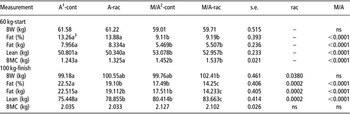
The starting and final BWs for pigs fed ad libitum (A) or restricted for 8 weeks and then fed ad libitum either the control diet or the same diet supplemented with ractopamine are shown in Table 1. There was no difference in BW among the groups of pigs at initial measurement (BW day 0 = 61.4 ± 0.3 kg). However, the restricted pigs lost a small amount of weight during the 8-week restriction period. Thus, the mean starting weight of the restricted pigs (M/A groups) on day 56 was slightly less than that of the continuously ad libitum-fed pigs (A groups) at day 0 (59.3 ± 0.9 v. 61.4 ± 0.4 kg, P = 0.057). At the final measurement, the mean BW was 100.5 ± 0.05 kg, but was slightly more for the ractopamine-supplemented pigs than for the control pigs (101.5 v. 99.5, P = 0.038).
Effects of maintenance feeding, compensatory growth and ractopamine (rac) on body composition of pigs as measured by DXA

DXA = dual energy X-ray absorptiometry; BMC = bone mineral content.
1A = fed ad libitum throughout.
2M/A = fed at maintenance for 8 weeks prior to start, followed by ad libitum intake.
3Means followed by different letters were significantly different (P < 0.05).
Total body composition
Results of the DXA measurements of body composition at the start (60 kg) and at the finish (100 kg) of the study are shown in Table 1. Initially (before maintenance feeding), there was no difference in the body composition among the groups (i.e. 13.56 ± 0.42% fat). Subsequently, a comparison of the measurements of body composition at 60 kg (A v. M/A) revealed that the 8-week period of feeding at a maintenance intake level resulted in a loss in body fat, accompanied by increases in lean mass and BMC. At 100 kg, the pigs that had been restricted and then fed ad libitum (M/A-cont) still had less fat and more lean compared with those continuously fed ad libitum (A-cont). Ad libitum-fed pigs that received ractopamine (A-rac) during the growth from 60 to 100 kg had less fat and more lean than those that did not receive ractopamine (A-cont). Also, the pigs that had been restricted and then fed ad libitum, a diet containing ractopamine (M/A-rac) during growth from 60 to 100 kg, had less fat and more lean compared with those that had also been restricted, but did not receive ractopamine during the ad libitum feeding (M/A-cont). At 100 kg, there was no difference in BMC among the four groups of pigs receiving the different dietary treatments, with no effect from either compensatory growth or ractopamine treatment.
Growth
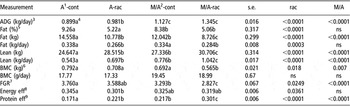
Table 2 shows the effects of compensatory growth and ractopamine treatment on the rate and composition of growth for pigs during growth from 60 to 100 kg BW. Following the 8-week period of maintenance feeding, the M/A-control pigs responded with a 25% increase in growth rate (average daily gain (ADG)) compared with the A-control group (compensatory growth). Addition of ractopamine to the diet resulted in a 13% increase in ADG. When ractopamine was fed to pigs during compensatory growth, the ADG increased by 50% (M/A-rac v. A-cont). For all of the measurements made in this study, the only ractopamine × compensatory growth interaction was for ADG (P = 0.048).
Effects of compensatory growth and ractopamine (rac) on the rate and composition of growth and the efficiency of energy and protein retention for pigs during growth from 60 to 100 kg BW

1A = fed ad libitum throughout.
2M/A = fed at maintenance for 8 weeks prior to start, followed by ad libitum intake.
3ADG = average daily gain.
4Means followed by different letters were significantly different (P < 0.05).
5Difference between total body fat percentage at 60 and 100 kg BWT.
6BMC = bone mineral content.
7FGR = feed : gain ratio (kg/kg).
8Efficiency of energy retention (k g).
9Efficiency of protein retention (PE).
Although compensatory growth resulted in a smaller increase in the percentage of total body fat and a lesser increase in the total amount of body fat (M/A v. A), there was no effect on the rate of fat deposition during growth from 60 to 100 kg. However, ractopamine treatment resulted in an 18% decrease in the rate of fat deposition. Compensatory growth resulted in more lean tissue deposition, including a 44% increase in the rate of lean tissue deposition. Likewise, ractopamine produced 29% increase in the rate of lean tissue deposition. When ractopamine was fed to pigs during compensatory growth, the rate of lean tissue deposition was increased by 92% (M/A-rac v. A-cont). Neither compensatory growth nor ractopamine had a significant effect on the rate of bone mineral deposition.
Efficiency
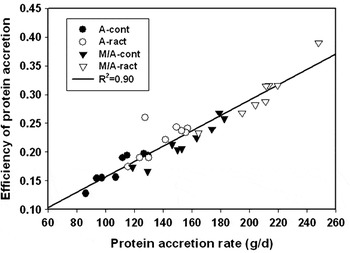
The effects of compensatory gain and ractopamine treatment on the efficiency of growth for pigs during the growth from 60 to 100 kg BW are shown in Table 2. The gross efficiency of feed utilization for growth (feed : gain ratio (FGR)) was improved 17% by compensatory growth (M/A v. A). Ractopamine treatment improved feed efficiency during compensatory growth by 14% (M/A-rac v. R/A-cont), while overall, ractopamine improved FGR by 9%. Compensatory growth had no effect on the efficiency of energy deposition (k g). Ractopamine resulted in an 8% reduction in k g, with the effect being primarily in the pigs that were continuously fed ad libitum. Compensatory growth was accompanied by a 30% increase in the efficiency of protein retention (PE). Also, ractopamine treatment increased PE by 32%. When ractopamine was fed to pigs during compensatory growth the PE increased by 76% (M/A-rac v. A-cont). The relationship between the rate of protein accretion and the efficiency of protein accretion for all dietary treatments is shown in Figure 1.
Relationship between protein accretion rate and the efficiency of protein accretion during ad libitum (A) feeding or maintenance intake followed by ad libitum feeding (M/A), without (cont) or with ractopamine (ract).

Composition of growth by body region
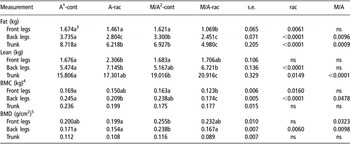
The effects of compensatory growth and ractopamine on composition of growth by the body region of pigs during growth from 60 to 100 kg BW are shown in Table 3. Ractopamine treatment resulted in a decrease in fat deposition in all three body regions: front legs, back legs and trunk. Compensatory growth resulted in a decrease in fat deposition in the back legs and trunk region. Ractopamine treatment increased in lean deposition in the back legs and trunk while compensatory growth increased lean deposition only in the trunk region. Compensatory growth had no effect on bone mineral deposition in front legs or trunk, but resulted in less bone mineral deposition in the back legs. However, ractopamine treatment resulted in less bone mineral deposition in both the front and back legs. With compensatory growth, there was an increase in bone mineral density in both the front and back legs compared with the continuously ad libitum-fed pigs. With ractopamine treatment, the increase in bone mineral density in the back legs was less than that observed in the pigs that did not receive ractopamine.
Effects of compensatory growth and ractopamine (rac) on composition of growth by body region of pigs during growth, based on differences in DXA measurements at 60 and 100 kg BW

DXA = dual energy X-ray absorptiometry.
1A = fed ad libitum throughout.
2M/A = fed at maintenance for 8 weeks prior to start, followed by ad libitum intake.
3Means followed by different letters were significantly different (P < 0.05).
4BMC = bone mineral content.
5BMD = bone mineral density.
Carcass composition
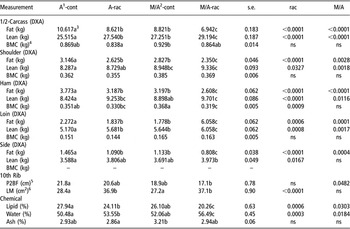
The measurements of carcass composition of the pigs slaughtered at 100 kg BW are shown in Table 4. DXA analysis of the half-carcass revealed that both compensatory growth and ractopamine treatment resulted in less total carcass fat including less fat in all four carcass regions. Compensatory growth produced more lean in the half-carcass, shoulder, ham and loin regions, but not in the side region. Ractopamine treatment resulted in more lean in the half-carcass and all four regions. Following compensatory growth, there was no difference in BMC in the half-carcass, ham, shoulder or loin regions. With ractopamine treatment, there was no difference in the BMC in the half-carcass, shoulder or loin region, but less BMC in the ham region. Measurements at the 10th rib showed that compensatory growth decreased P2 backfat, but had no effect on LM area; however, ractopamine treatment had no effect on the P2 backfat measurement, but increased the area of the LM. Chemical analysis of the half-carcass found that both compensatory growth and ractopamine treatment resulted in a lower percentage of lipid, a higher percentage of water, but no difference in the percentage of ash in the half-carcass.
Effects of compensatory gain and ractopamine (rac) on composition of the half-carcass and carcass regions.

DXA = dual energy X-ray absorptiometry.
1A = fed ad libitum throughout.
2M/A = fed at maintenance for 8 weeks prior to start, followed by ad libitum intake.
3Means followed by different letters were significantly different (P < 0.05).
4BMC = bone mineral content.
5P2BF = backfat thickness.
6LM = longissimus muscle area.
Discussion
Growth and body composition
When 60 kg pigs were fed at or near maintenance energy intake for 8 weeks, the loss of body fat accompanied by an increase in lean mass and bone mineral was similar to previous observations (Kolstad and Vangen, Reference Kolstad and Vangen1996; Mitchell et al., Reference Mitchell, Scholz and Pursel2003). Subsequent re-alimentation at ad libitum intake resulted in accelerated growth, typical to that associated with compensatory growth in pigs (Mersmann et al., Reference Mersmann, MacNeil, Seideman and Pond1987). During the compensatory growth, the pigs in this study deposited more lean and less fat and had an increased rate of lean deposition without a significant decrease in the rate of fat deposition. This resulted in total body and carcass compositions consisting of less fat and more lean when compared with pigs that had been continuously fed ad libitum to the final live BW of 100 kg. Although some studies have observed more fat and less lean deposition by pigs during compensatory growth (Mersmann et al., Reference Mersmann, MacNeil, Seideman and Pond1987; Heyer and Lebret, Reference Heyer and Lebret2007), the composition of growth during this period is influenced by severity and duration of the period of undernutrition, stage of development of the animal, genotype and sex, level of feed intake during re-alimentation, period of re-feeding and composition of the diet during re-alimentation (Wilson and Osbourn, Reference Wilson and Osbourn1960).
The addition of ractopamine to the diet during growth from 60 to 100 kg increased the growth rate (ADG), reduced the rate of fat deposition and increased the rate of lean deposition resulting in total body and carcass compositions consisting of less fat and more lean. These results are consistent with numerous studies regarding the effects of ractopamine on the growth and body composition of pigs (Dunshea et al., Reference Dunshea, King, Campbell, Sainz and Kim1993; Moody et al., Reference Moody, Hancock and Anderson2000; Mimbs et al., Reference Mimbs, Pringle, Azain, Meers and Armstrong2005).
When ractopamine was fed to pigs during compensatory growth, the ADG increased by an additional 19%. Likewise, the rate of lean tissue deposition was increased by an additional 34%. Previously, it was reported that when ractopamine was fed in combination with pST treatment (Anderson et al., Reference Anderson, Paxton and Mowrey1989; Jones et al., Reference Jones, Anderson, Waitt, Waganer and Mowery1989), the effects of ractopamine and pST were additive for increasing lean deposition in pigs and, thereby, consistent with different mechanisms of action. Since compensatory growth appears to be mediated via the GH axis (Hornick et al., Reference Hornick, Van Eenaeme, Gérard, Dufrasne and Istasse2000), the additive effects of ractopamine and compensatory growth observed in the present study are also in support of different mechanisms of action. The mechanism by which ractopamine and other βAR agonists alter growth and body composition has been the subject of a number of investigations. The receptors for βAR agonists are present in most tissues throughout the body. Bergen et al. (Reference Bergen, Johnson, Skjaerlund, Babiker, Ames, Merkel and Anderson1989) reported that in pigs, an increase in the fractional rate of protein synthesis resulting from ractopamine treatment could account for the observed increase in muscle hypertrophy and increased fractional accretion rates. Furthermore, ractopamine treatment was associated with a stimulation of myofibrillar protein synthesis in porcine skeletal muscle (Adeola et al., Reference Adeola, Ball and Young1992). The βAR agonists appear to reduce fat deposition through a direct action on adipose tissue that causes an increase in the rate of lipid degradation or lipolysis and a decrease in lipid synthesis (Spurlock et al., Reference Spurlock, Cusumano and Mills1993). The βAR agonists bind to receptors located on the plasma membrane of the adipocytes.
Efficiency or energy and protein deposition
The gross efficiency of FGR was improved during compensatory growth and was accompanied by an increase in the efficiency of PE. However, compensatory growth had no effect on the efficiency of energy deposition. A study by Lovatto et al. (Reference Lovatto, Sauvant, Noblet, Dubois and van Milgen2006) concluded that compensatory growth of pigs following a period of feed restriction does not appear to be related to a change in the metabolic utilization of energy for gain. Gädeken et al. (Reference Gädeken, Bohme and Oslage1983) also observed that pigs undergoing compensatory growth had increased protein deposition that was attributed to higher protein digestibility and higher efficiency of utilization; however, there was no difference in the efficiency of utilization of metabolizable energy when compared with control pigs. Measurements of protein turnover during compensatory growth suggest that muscle protein synthesis increases at a faster rate after the change to ad libitum feeding and reaches the same level as control pigs before muscle protein degradation (Therkildsen et al., Reference Therkildsen, Riis, Karlsson, Kristensen, Ertbjeerg, Rurslow, Dall Aaslyng and Oksbjerg2002).
Ractopamine has been shown to improve the efficiency of feed utilization (FGR) in pigs (Watkins et al., Reference Watkins, Jones, Mowrey, Anderson and Veenhuizen1990; He et al., Reference He, Aherne, Thompson, Schaefer and Merrill1993; Dunshea et al., Reference Dunshea, Eason, Campbell and King1998). In the present study, ractopamine treatment resulted in an improvement in both feed efficiency and the efficiency of PE. In both cases, the effect was more pronounced during compensatory growth. It appears that both compensatory growth and ractopamine improve the efficiency of protein deposition in part due to the increase in protein deposition – see Figure 1. The increase in the efficiency of protein deposition associated with an increase in the rate of protein accretion is in agreement with previous observations (Mitchell and Pursel, Reference Mitchell and Pursel2003). Ractopamine resulted in a reduction in the efficiency of energy deposition, with the effect being primarily in the pigs that were fed ad libitum throughout the study. It is unlikely that the reduction in the efficiency deposition associated with ractopamine treatment was the result of an increase in basal metabolic rate. Yen et al. (Reference Yen, Nienaber, Klindt and Crouse1991) reported that it had no effect on postprandial whole-animal heat production in pigs. Also, a study by Fernández et al. (Reference Fernández, Oksbjerg and Jørgensen1998) found that salbutamol did not alter energy metabolism in swine and concluded that the detected differences in energy retention were a consequence of the modified protein and fat deposition pattern.
Distribution of fat and lean growth
Although no studies have been reported regarding differences in regional growth patterns that might occur during compensatory growth, age-related differences in the growth of musculature in different areas of the pig (McMeekan, Reference McMeekan1940) would suggest that such differences might occur following an extended period of growth retardation in the young pig. Based on the live-animal measurements at 60 and 100 kg, compensatory growth resulted in a decrease in fat deposition in the back legs and trunk regions, but an increased lean deposition only in the trunk region. However, it should be noted that DXA measurements of the trunk region of the live animal includes all of the internal organs of both the thoracic and abdominal regions. Analysis of the half-carcass revealed that compensatory growth had resulted in less fat in all four carcass regions and that compensatory growth resulted in more lean in the shoulder, ham and loin regions, but not in the side region. Measurements at the 10th rib showed that compensatory growth decreased P2 backfat, but had no effect on LM area.
Previous studies have indicated that ractopamine may differentially affect growth in certain regions of the body. A study by Stites et al. (Reference Stites, McKeith, Singh, Bechtel, Mowrey and Jones1991) found that ractopamine, when fed to finishing swine, increased the yield of trimmed ham and loin, but not the belly or shoulder (boston butt and picnic shoulder). In contrast, Bark et al. (Reference Bark, Stahly, Cromwell and Miyat1992) reported that while ractopamine increased the amount of muscle in all the wholesale cuts, the distribution of the total muscle was altered by ractopamine such that the total muscle tended to be increased in the belly and decreased in the ham. Live-animal measurements in the study presented here revealed that ractopamine treatment resulted in a decrease in fat deposition in all three body regions: front legs, back legs and trunk and increased lean deposition in the back legs and trunk. Analysis of the half-carcass revealed that ractopamine treatment resulted in less total carcass fat including less fat in all four carcass regions and more lean in the half-carcass and all four regions. Ratopamine treatment had no effect on the P2 backfat measurement, but increased the area of the LM. These differences may be due to ractopamine targeting specific tissues within these regions. Adeola et al. (Reference Adeola, Darko, He and Young1990) observed that ractopamine appeared to stimulate the growth of some muscles (i.e. longissimus, psoas major, semitendinosus and biceps and quadriceps femoris), but not others (i.e. gastrocnemius, adductor, gluteus medius and sartorius) and suggested that the differential response of the various muscles to ractopamine correlated with the ratio of fiber types and β-2 receptor density. Furthermore, Gunawan et al. (Reference Gunawan, Richert, Schinckel, Grant and Gerrard2007) showed that myosin heavy-chain (MyHC) genes are differentially regulated by ractopamine and suggested that the βAR agonist-induced repartitioning effect is, in part, mediated by changing muscle fiber type-specific gene expression, perhaps through the β2-AR.
Bone growth
Studies of both compensatory growth and the effects of ractopamine on growth and body composition in swine have focused primarily on soft tissue growth, with lesser attention to bone growth. Stamataris et al. (Reference Stamataris, Kyriazakis and Emmans1991) reported that pigs that had been restricted during growth from 6 to 12 kg then fed ad libitum to 24 kg had higher rates of gain of not only protein, lipid and water, but also ash when compared with pig continuously fed ad libitum. However, pigs that had been restricted during growth from 30 to 70 kg then fed ad libitum to 110 kg tended to gain more fat than muscle and had no difference in the growth rate of ham bone when compared with pig continuously fed ad libitum. Thus, it is likely that those factors that influence the rate and composition of compensatory growth (Wilson and Osbourn, Reference Wilson and Osbourn1960) also influence bone growth. In the present study, as reported earlier (Mitchell et al., Reference Mitchell, Scholz and Pursel2003), bone growth continued, although at a reduced rate, during the 8-week period of maintenance feeding. Thus, at the beginning of the 60 to 100 kg growth phase, the restrictively fed pigs had more bone than their ad libitum-fed counterparts. Consequently, during compensatory growth, there was no difference in the rate of bone mineral growth, but there was less total bone mineral deposition and less bone mineral deposition in the back legs. Subsequent to compensatory growth, there was no difference in BMC in the total body, the half-carcass, or in the ham, shoulder or loin regions of the half-carcass compared with the pigs that had been continuously fed ad libitum.
Ractopamine treatment resulted in less bone mineral deposition in both the front and back legs. With ractopamine treatment, there was a smaller increase in bone mineral density in the back legs compared with the pigs that did not receive ractopamine. Also, with ractopamine treatment there was no difference in the BMC in the half-carcass, shoulder or loin region, but less BMC in the ham region. Other studies have shown that ractopamine may have an impact on bone growth in pigs. In the study by Bark et al. (Reference Bark, Stahly, Cromwell and Miyat1992), the bone content of the carcass was lowered by ractopmaine. Crome et al. (Reference Crome, McKeith, Carr, Jones, Mowrey and Cannon1996) reported that ham bone weight as a percentage of the trimmed ham decreased due to ractopamine. Likewise, pigs fed the βAR agonist cimaterol had shorter and lighter femurs compared with control pigs (Jones et al., Reference Jones, Easter, McKeith, Dalrymple, Maddock and Bechtel1985).
Conclusions
Under conditions of ad libitum intake, compensatory growth resulted in greater lean tissue deposition and improved efficiency of PE, but had no significant effect of fat deposition or efficiency of energy deposition. Addition of ractopamine to the diet resulted in enhanced growth, reduced fat deposition, increased lean deposition, with an improvement in the efficiency of protein deposition and a reduction in energy efficiency. The results of this study demonstrate that during compensatory growth, pigs will respond positively to ractopamine treatment, resulting in an additional increase in growth rate consisting of increased lean tissue growth and reduced fat deposition. The additive effects of compensatory growth and ractopamine are consistent with different mechanisms of action.