Introduction
Almost 800 000 deaths per year worldwide are attributable to suicide, with approximately one individual dying by suicide every 40 seconds (World Health Organisation, 2017). In Ireland, 399 [males=318 (79.7%)] individuals died by suicide in 2016 (Central Statistics Office, 2016). Approximately 40% of individuals who die by suicide have had some previous contact with mental health services (Luoma et al. Reference Luoma, Martin and Pearson2002; Kielty et al. Reference Kielty, van Laar, Davoren, Conlon, Hillick, McDonald and Hallahan2014) with 70% of these individuals having contact with mental health services in the 12-month period before their death (Appleby et al. Reference Appleby, Kapur, Shaw, Windfuhr, Williams, Hunt, While and Flynn2014; Kielty et al. Reference Kielty, van Laar, Davoren, Conlon, Hillick, McDonald and Hallahan2014). Rates of suicide in psychiatric inpatient units are significantly higher than in the community, accounting for approximately 3–5% of all suicides and often occur shortly after service user (SU) inpatient admission (Qin & Nordentoft, Reference Qin and Nordentoft2005; Qin et al. Reference Qin, Nordentoft, Hoyer, Agerbo, Laursen and Mortensen2006; Reutfors et al. Reference Reutfors, Brandt, Ekbom, Isacsson, Sparén and Ösby2010; Walsh et al. Reference Walsh, Sara, Ryan and Large2015; Madsen et al. Reference Madsen, Erlangsen and Nordentoft2017).
Many mental health professionals (MHPs) have treated SUs who subsequently have died by suicide, with previous data noting that 67–92% of consultant psychiatrists (Landers et al. Reference Landers, O’Brien and Phelan2010; Rothes et al. Reference Rothes, Scheerder, Van Audenhove and Henriques2013), 47–61% of psychiatry doctors in training (Dewar et al. Reference Dewar, Eagles, Klein, Gray and Alexander2000; Pilkinton & Etkin, Reference Pilkinton and Etkin2003), 55% of psychiatric nurses (Takahashi et al. Reference Takahashi, Chida, Nakamura, Akasaka, Yagi, Koeda, Takusari, Otsuka and Sakai2011) and 22–70% of allied health professionals including psychologists and social workers (Gulfi et al. Reference Gulfi, Castelli Dransart, Heeb and Gutjahr2010; Trimble et al. Reference Trimble, Jackson and Harvey2000; Sanders et al. Reference Sanders, Jacobson and Ting2005) have treated SUs who have subsequently died by suicide. The suicide of a SU has previously been demonstrated to adversely impact MHPs, with guilt, sadness, shock, preoccupation with suicide, anger, irritability and depression reported (Chemtob et al. Reference Chemtob, Hamada, Bauer, Torigoe and Kinney1988; Grad et al. Reference Grad, Zavasnik and Groleger1997; Alexander et al. Reference Alexander, Klein, Gray, Dewar and Eagles2000; Yousaf et al. Reference Yousaf, Hawthorne and Sedgwick2002; Sanders et al. Reference Sanders, Jacobson and Ting2005; Bohan & Doyle, Reference Bohan and Doyle2008; Castelli Dransart et al. Reference Castelli Dransart, Gutjahr, Gulfi, Kaufmann Didisheim and Séguin2014; Gulfi et al. Reference Gulfi, Castelli Dransart, Heeb and Gutjahr2016). A close therapeutic relationship or significant involvement in the care of the SU are factors associated with greater emotional sequelae and professional self-doubt for the MHP (Gaffney et al. Reference Gaffney, Russell, Collins, Bergin, Halligan, Carey and Coyle2009). Additionally, the experience of a SU suicide can potentially impact negatively on future clinical work practices. For example, some MHPs who have experienced a SU suicide have expressed self-doubt regarding their competence, describing a reluctance to work with SUs with suicidal ideation (Chemtob et al. Reference Chemtob, Hamada, Bauer, Torigoe and Kinney1988; Cryan et al. Reference Cryan, Kelly and McCaffrey1995; Linke et al. Reference Linke, Wojciak and Day2002; Gaffney et al. Reference Gaffney, Russell, Collins, Bergin, Halligan, Carey and Coyle2009; Gulfi et al. Reference Gulfi, Castelli Dransart, Heeb and Gutjahr2010; Rothes et al. Reference Rothes, Scheerder, Van Audenhove and Henriques2013; Wurst et al. Reference Wurst, Kunz, Skipper, Wolfersdorf, Beine, Vogel, Müller, Petitjean and Thon2013). Other adverse sequelae noted by MHPs following the suicide of a SU include concerns regarding adverse familial reactions and potential legal consequences (Bohan & Doyle, Reference Bohan and Doyle2008; Gaffney et al. Reference Gaffney, Russell, Collins, Bergin, Halligan, Carey and Coyle2009; Landers et al. Reference Landers, O’Brien and Phelan2010; Wurst et al. Reference Wurst, Müeller, Petitjean, Euler, Thon, Wiesbeck and Wolfersdorf2010).
However, professional development after experiencing a SU suicide has also been reported by MHPs including previous reports of an enhanced capacity to establish therapeutic relationships with SUs, more detailed record keeping, increased use of peer consultation, heightened awareness of risk, improved accuracy in risk assessment and the development of a greater balance between work and personal life (Cryan et al. Reference Cryan, Kelly and McCaffrey1995; Landers et al. Reference Landers, O’Brien and Phelan2010; Rothes et al. Reference Rothes, Scheerder, Van Audenhove and Henriques2013). In addition, the negative emotional and adverse professional impact of a SU suicide experienced by some MHPs have been shown to reduce in severity over time, resulting predominantly with a return to previous levels of occupational functioning (Landers et al. Reference Landers, O’Brien and Phelan2010; Wurst et al. Reference Wurst, Kunz, Skipper, Wolfersdorf, Beine, Vogel, Müller, Petitjean and Thon2013).
The most valued and most often utilised support by MHPs following the suicide of a SU has been reported as informal peer support (Pilkinton & Etkin, Reference Pilkinton and Etkin2003; Gaffney et al. Reference Gaffney, Russell, Collins, Bergin, Halligan, Carey and Coyle2009; Darden & Rutter, Reference Darden and Rutter2011); however formal supports including team meetings, debriefing, psychological autopsies and case reviews have also been reported to be beneficial in relation to reducing the personal and professional impact of a SU suicide (Cryan et al. Reference Cryan, Kelly and McCaffrey1995; Wurst et al. Reference Wurst, Müeller, Petitjean, Euler, Thon, Wiesbeck and Wolfersdorf2010; Rothes et al. Reference Rothes, Scheerder, Van Audenhove and Henriques2013).
In this study, we comprehensively examined the impact both personally (including emotions such as sadness, fear and shock) and professionally (including heightened awareness of risk, avoidance of high-risk SUs, fear of litigation, desire for time off work) of SU suicide in a large group of MHPs across multiple disciplines. Additionally, we wanted to ascertain if demographic or clinical factors relating to SUs or MHPs influenced the distress experienced by MHPs. Finally, we wanted to identify factors MHPs perceived as most helpful in reducing their distress following the suicide of a SU.
Methods
Study design
The questionnaire utilised in this study was based on the questionnaire utilised by Landers et al. (Reference Landers, O’Brien and Phelan2010) which investigated the effects of SU suicide on Irish consultant psychiatrists and was provided with permission by the authors on 05/06/2013. The content was modified by two researchers (P.T.M., A.v.L.) to enable use across a range of MHP groups. An additional critical analysis of the existing literature was subsequently conducted evaluating the impact of SU suicide on MHPs (Alexander et al. Reference Alexander, Klein, Gray, Dewar and Eagles2000; Landers et al. Reference Landers, O’Brien and Phelan2010; Wurst et al. Reference Wurst, Müeller, Petitjean, Euler, Thon, Wiesbeck and Wolfersdorf2010; Rothes et al. Reference Rothes, Scheerder, Van Audenhove and Henriques2013) by a multi-disciplinary focus group including psychologists, psychiatric nurses and psychiatrists with the aim of supplementing material to the modified questionnaire used by Landers et al. (Reference Landers, O’Brien and Phelan2010). Three researchers (P.T.M., A.v.L., R.o.R.) finalised the 132-item questionnaire utilised in this study and included items quantifiable by 4-point Likert scales with open questions aiming to generate enriched qualitative data. Questionnaire data acquired pertained to the demographic and clinical features of MHPs who had or had not experienced a SU suicide. For those MHPs who had experienced a SU suicide, demographic and clinical data pertaining to the SU, whose suicide was recalled as most distressing for the MHP was collected. The rationale for asking MHPs to consider the most distressing SU suicide was that details pertaining to this SU may potentially be best remembered, that MHPs were most likely to be aware of the distress they experienced and that MHPs may also have been aware of what supports they attained and found helpful or unhelpful following this SU suicide. MHPs were asked to provide a diagnosis for SUs utilising the International Classification of Diseases diagnostic classification with instructions not to provide a diagnosis where uncertainty was present (n=4). Additional data acquired included recalled levels of distress experienced after the SU suicide, the impact of the SU suicide on the personal life and professional functioning of the MHP, and changes in professional practices and supports that were attained or were deemed to be potentially beneficial after the SU suicide.
Participants
Questionnaires were distributed to all 508 MHPs (psychiatric nurses, psychologists, psychiatrists, occupational therapists, social workers and other mental health staff members) employed in a large catchment area in the West of Ireland (population of approximately 315 000) across different mental health disciplines (general adult psychiatry, child and adolescent mental health, psychiatry of later life, rehabilitation psychiatry and liaison psychiatry) between June and November 2015. Questionnaires were in paper format and sent by internal mail the researchers, with contact details provided for the first author (P.T.M.) if any queries were present. A total of 179 questionnaires were returned yielding a response rate of 35.2%. In total, 83 MHPs (46.4%) who responded had previously treated a SU who died by suicide with the median number of suicides reported as two. Not all questions were completed by all respondents, resulting in a marginally lower response rate for some items. In order to maintain confidentiality and optimise response rates, questionnaires were not coded or ordered in any fashion. Ethical approval was obtained from the Galway University Hospitals Research Ethics Committee.
Quantitative analysis
Statistical analysis was performed for quantitative data using the IBM Statistical Package for Social Sciences (SPSS) 24.0 for Windows. Independent t-tests were used to compare parametric data, while χ 2 tests were used to undertake analyses of categorical data. Given the low numbers in some MHP groups, MHPs were grouped into psychiatrists, psychiatric nurses and allied MHPs.
Qualitative analysis
For qualitative data, a thematic analysis (Braun & Clarke, Reference Braun and Clarke2006) was conducted by two of the researchers (L.C., P.T.M.). Analysts read all transcripts. One of the researchers (L.C.) extracted themes that assessed the lived experience and impact of the most distressing SU suicide experienced by MHPs. Initial codes were produced by following a line-by-line analysis of acquired free-text data, with repeated ideas or experiences noted. A second analysis by L.C. and P.T.M. was then conducted at the broader level of themes which were reviewed and analysed individually, facilitating the identification of underlying themes. Finally, discussions amongst the full research team were conducted and consensus was subsequently reached on all themes.
Results
Quantitative data: MHP demographics and supports for MHPs following SU suicide
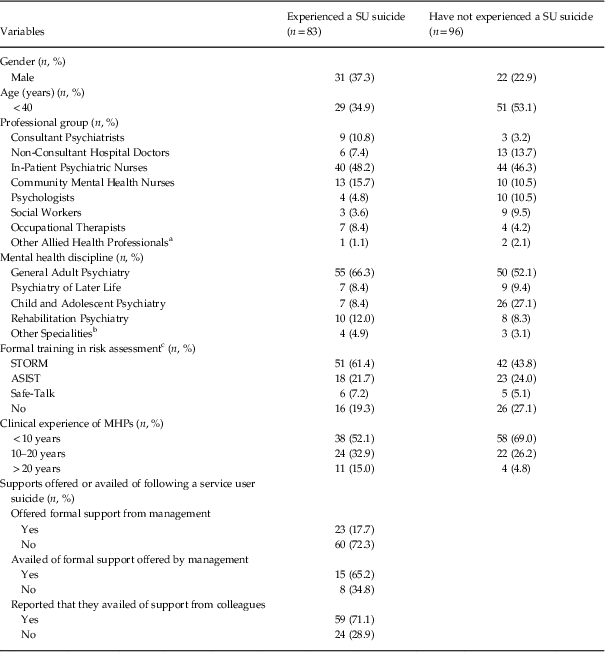
Demographic data pertaining to MHPs are detailed in Table 1. Most responses were attained from inpatient psychiatric nurses (n=84, 47.0%), the mean level of years of experience working in mental health was 12.60 (s.d.=8.81) years, and training in suicide risk assessment was completed (before SU suicide) by 137 (76.5%) participants. MHPs who had experienced a SU suicide were more likely to be male [χ 2(1, N=179)=4.45, p=0.035], over 40 years of age [χ 2(1, N=178)=5.64, p=0.018], and work in the discipline of general adult psychiatry [χ 2(1, N=179)=14.58, p=0.024]. No difference was noted in the rates of experiencing a SU suicide between the different MHP groups [χ 2(2, N=178)=1.74, p=0.419].
Demographic and clinical data of mental health professionals (MHPs)

SU, service user; ASIST, Applied Suicide Intervention Skills Training; STORM, Skills Training on Risk Management.
a Includes counsellors, and other therapists (data missing n=1 from ‘Have not experienced a SU suicide’).
b Includes liaison psychiatry, addiction psychiatry and intellectual disability psychiatry.
c Twenty-six individuals attained training with more than one assessment method.
Support following a SU suicide was offered by management to 23 (17.7%) MHPs and, when offered, was taken up by 15 (65.2%) of these MHPs. Informal support from colleagues was availed of by 71.1% of MHPs.
Quantitative data: method of SU suicide and mental health diagnosis of SU
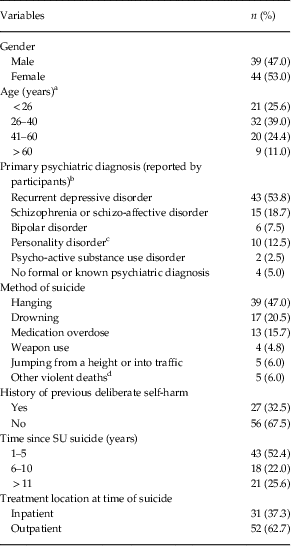
Demographic and clinical data pertaining to the SU whose suicide caused the greatest distress for the MHPs are detailed in Table 2. Hanging was the most commonly reported method reported by MHPs employed by SUs in their suicide (n=39, 47.0%). The most common mental health diagnosis was recurrent depressive disorder (n=43, 53.8%), and 27(32.5%) of SUs had a previously known history of self-harm.
Demographic data of service user (SU) detailed as dying by suicide

a Missing data (n=1).
b Missing data (n=3).
c Emotionally unstable personality disorder of borderline type was the diagnosis given for all but one case.
d Other violent deaths include self-laceration, asphyxiation and electrocution.
Quantitative data: impact of SU suicide on MHPs
Personal impact of SU suicide on MHPs
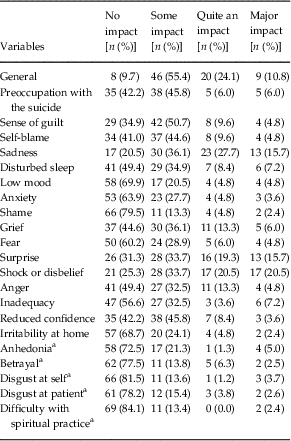
The three most common emotions reported by MHPs relating to the personal impact of a SU suicide were sadness (n=66, 79.5%), shock (n=62, 74.7%) and surprise (n=57, 68.7%). These emotions predominantly lasted less than 6 months (sadness=79.0%, shock=89.7%, surprise=94.3%); however, some individuals continued to experience these emotions for more than 12 months after the SU suicide (sadness=9.7%, shock=6.9%, surprise=3.8%).
Female MHPs reported greater levels of personal sadness as a result of SU suicide [χ 2(3, N=83)=8.27, p=0.041], with 23.1% (n=12) compared to 3.2% (n=1) of males reporting this having a major personal impact. Older MHPs were more likely to report a greater degree of sadness [χ 2(3, N=83)=10.6, p=0.014] and grief [χ 2(3, N=83)=9.34, p=0.025] than their younger colleagues (see Supplementary Data, Table 6, for further elaboration of these findings). Professional group affiliation, gender of SU, or site of SUs suicide were not associated with a statistically significant differential impact on the MHPs (Table 3).
Personal impact of service user suicide on mental health professionals (MHPs)

a Item not answered by all MHPs. Percentages are reported for those who answered.
Professional impact of SU suicide
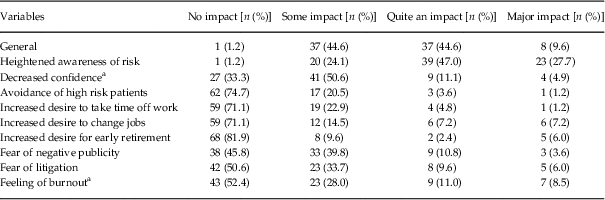
Heightened awareness of risk differed by MHP professional group affiliation [χ 2(6, N=83)=13.73, p=0.033], with nurses reporting higher awareness post-SU suicide than doctors or AHPs. Other factors commonly noted by MHPs following a SU suicide included reduced professional confidence (66.7%), fears of negative publicity (54.2%), litigation (49.4%) and burnout (47.6%) (see Table 4). Previous formal training in suicide risk assessment was associated with a reduced level of burnout (self-assessed) having a major impact on MHPs (25% v. 4.5%) [χ 2(3, N=82)=9.51, p=0.023] (see Supplementary Data, Table 6).
Professional impact of service user suicide on mental health professionals (MHPs)

a Item not answered by all MHPs. Percentages are reported for those who answered.
No other demographic or clinical factors including age, gender or professional group of MHP, age or gender of SU, site or method of SU suicide impacted statistically on any of these factors.
Qualitative results: thematic analysis
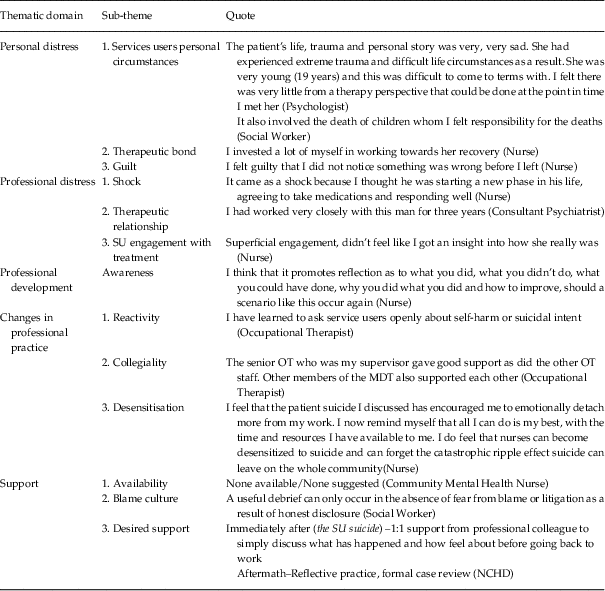
In total, 79 participants who had experienced a SU suicide provided qualitative free-text responses, with most responses from inpatient psychiatric nurses followed by community mental health nurses. Thematic analysis of enriched qualitative data yielded five major themes: (1) personal distress, (2) professional distress, (3) professional development, (4) changes in professional practice and (5) support (see Table 5).
Major thematic domains with sub-themes and examples of free-text analysis

OT, Occupational Therapist; MDT, multi-disciplinary team; SU, service user; NCHD, Non-Consultant Hospital Doctor; Nurse, In-patient psychiatric nurse.
Personal distress
Respondents described greater levels of distress dependent upon SUs personal circumstances, with distress being described as greater where the SU was either an adolescent or young adult or where they were a mother of young children. MHPs also described greater levels of distress when they reported that they had a close relationship with the SU or their family member(s). Some MHPs described feelings of guilt pertaining to the SU suicide believing they should have recognised that the SU was at risk of suicide.
Professional distress
Several MHPs described initially feeling shocked that the SU had died by suicide. On some occasions, this related to their opinion that the SU had improved from a therapeutic point of view prior to their suicide. Adverse professional sequelae described, included reduced self-confidence in managing other SUs with suicidal ideation. Distress was described as accentuated where there had been greater levels of personal investment (longevity or intensity of contact) by the MHP, with the SU and/or their family. Some MHPs stated they believed that some suicides were potentially preventable had the SU more actively engaged in treatment.
Professional development
After the SU suicide, many MHPs described a heightened awareness of the risk of SU suicide and described engaging more frequently in undertaking both formal risk assessments and informal risk assessments (i.e. verbally enquiring about suicidal ideation) on a more regular basis. MHPs also described deciding to attend further training in risk assessment as a consequence of the SU suicide.
Changes in professional practice
MHPs noted themselves to be both recipients and providers of greater support to colleagues after a SU suicide. Some described greater skills in supporting SUs and their family members where SUs experienced suicidal ideation. MHPs also described in some cases that either they or their colleagues were less distressed by subsequent SU suicides.
Support
Several MHPs described either a lack of awareness of how to attain or an unavailability or formal support following a SU suicide. MHPs expressed a preference for a range of supports including most frequently debriefing. Other supports suggested by MHPs included counselling sessions, informal support from a manager, the option of leave (time-off) from work after a SU suicide and further training. Training was most commonly desired in the areas of suicide risk assessment and in various aspects of litigation. Sources of additional stress following a SU suicide included subsequent investigations relating to the SU suicide and a perceived ‘blame culture’, from clinical and managerial staff both of which were stated to adversely impact on collegiality and increase levels of distress.
Discussion
This study evaluates and compares the personal and professional impact of SU suicide in a wide range of MHPs across different mental health specialities. Findings across different MHPs were largely consistent and were not significantly impacted by a range of demographic or clinical factors.
Clinical factors pertaining to the most distressing SUs suicide noted in this study are predominantly consistent with demographic and clinical data pertaining to data relating to all SU suicides, with, for example, the method of suicide most commonly employed being hanging (Lin et al. Reference Lin, Chang and Lu2010; Casey et al. Reference Casey, Gemmell, Hiroeh and Fulwood2012), and approximately half of SUs having a diagnosis of recurrent depressive disorder (Hirokawa et al. Reference Hirokawa, Matsumoto, Katsumata, Kitani, Akazawa, Takahashi, Kawakami, Watanabe, Hirayama, Kameyama and Takeshima2012; Kielty et al. Reference Kielty, van Laar, Davoren, Conlon, Hillick, McDonald and Hallahan2014). Female SUs (53%) were, however, over-represented in this study compared to existing suicide data, with an approximate 4:1 male to female ratio of SU suicides (who were attending mental health services) previously described in Ireland (Kielty et al. Reference Kielty, van Laar, Davoren, Conlon, Hillick, McDonald and Hallahan2014) and other (but not all) jurisdictions (Hepp et al. Reference Hepp, Ring, Frei, Rossler, Schnyder and Ajdacic-Gross2010; Hirokawa et al. Reference Hirokawa, Matsumoto, Katsumata, Kitani, Akazawa, Takahashi, Kawakami, Watanabe, Hirayama, Kameyama and Takeshima2012). This quantitative finding of greater distress associated with females who die by suicide is supported, at least to some extent, by qualitative data suggesting that a SU suicide where the SU was a parent (particularly where female) of young children was associated with greater levels of personal distress, a finding previously noted in studies examining the impact of the most distressing SU suicide for consultant psychiatrists (Landers et al. Reference Landers, O’Brien and Phelan2010), although gender of the parent was not specified in that study.
The most common factors causing distress after a SU suicide from quantitative data for MHPs across multiple disciplines were sadness, shock and surprise and these factors have also previously been noted (Yousaf et al. Reference Yousaf, Hawthorne and Sedgwick2002; Landers et al. Reference Landers, O’Brien and Phelan2010; Wurst et al. Reference Wurst, Kunz, Skipper, Wolfersdorf, Bein and Thon2011). In this study, sadness post-SU suicide was more prevalent in female and older MHPs. Previous research has demonstrated increased distress (but not sadness in particular) post-SU suicide in females relative to males (Grad et al. Reference Grad, Zavasnik and Groleger1997; Hendin et al. Reference Hendin, Haas, Maltsberger, Szanto and Rabinowicz2004; Gaffney et al. Reference Gaffney, Russell, Collins, Bergin, Halligan, Carey and Coyle2009); however, this is not a universal finding (Castelli Dransart et al. Reference Castelli Dransart, Gutjahr, Gulfi, Kaufmann Didisheim and Séguin2014). Data pertaining to age of MHPs and levels of distress experienced have previously yielded inconsistent results (Chemtob et al. Reference Chemtob, Hamada, Bauer, Torigoe and Kinney1988; Rothes et al. Reference Rothes, Scheerder, Van Audenhove and Henriques2013), with greater distress more frequently noted in younger MHPs (Chemtob et al. Reference Chemtob, Hamada, Bauer, Torigoe and Kinney1988). In this study, being >40 years of age was associated with greater distress, however, this needs to be interpreted cautiously, as MHPs were asked to consider retrospectively the SU suicide that was most distressing which in many cases was, several years earlier, and recall bias pertaining to the levels of distress experienced historically may also impact on the accuracy of this finding.
Qualitative data suggested that sadness, shock and surprise were accentuated where a close therapeutic bond had been formed with the SU. This finding is consistent with some previous data noting that the strength of the emotional attachment with the SU has a significant association with the level of distress experienced by MHPs (Gulfi et al. Reference Gulfi, Castelli Dransart, Heeb and Gutjahr2010; Castelli Dransart et al. Reference Castelli Dransart, Gutjahr, Gulfi, Kaufmann Didisheim and Séguin2014). Guilt and self-blame were other factors frequently present (evident from both quantitative and qualitative data), which is consistent not just with data pertaining to MHPs (Alexander et al. Reference Alexander, Klein, Gray, Dewar and Eagles2000; Yousaf et al. Reference Yousaf, Hawthorne and Sedgwick2002; Gulfi et al. Reference Gulfi, Castelli Dransart, Heeb and Gutjahr2010; Landers et al. Reference Landers, O’Brien and Phelan2010) but also data pertaining to health professionals working with SUs who have died by suicide outside mental health services including in hospice (Fairman et al. Reference Fairman, Thomas, Whitmore, Meier and Irwin2014) and general practice settings (Kendall & Wiles, Reference Kendall and Wiles2010). Qualitative data in this study noted that self-blame was associated with a preoccupation with the SU suicide. Such a preoccupation has previously been noted with non-consultant hospital doctors after the suicide of a SU (Dewar et al. Reference Dewar, Eagles, Klein, Gray and Alexander2000), with this study demonstrating that similar cognitions are present across different grades of doctors and other MHPs.
This study clearly demonstrated that SU suicide impacts MHPs professional practice, in both a positive and negative fashion. One of the most significant findings from this study from both the quantitative and qualitative results was a heightened awareness of the risk of suicide for other SUs, a finding consistent with some previous research (Bohan & Doyle, Reference Bohan and Doyle2008; Rothes et al. Reference Rothes, Scheerder, Van Audenhove and Henriques2013; Awenat et al. Reference Awenat, Peters, Shaw-Nunez, Gooding, Pratt and Haddock2017). This increased awareness was most evident in the psychiatric nurse group and may perhaps relate to the duration of time they spend with individual SUs who are actively unwell, compared to other MHPs. This increased awareness of risk following a SU suicide has additionally been associated with an improvement in risk assessment (Gulfi et al. Reference Gulfi, Castelli Dransart, Heeb and Gutjahr2016). All MHP groups in this study expressed an interest in either attaining training or attaining additional training in risk assessment suggesting that such training should potentially be included as a standard part of MHP educational programmes on an on-going basis. An additional potential reason to have ongoing risk assessment training for all MHPs relates to a previous study (Awenat et al. Reference Awenat, Peters, Shaw-Nunez, Gooding, Pratt and Haddock2017), which noted that a lack of risk assessment training was associated in part with MHPs having more defeatist attitudes when working with SUs expressing suicidal ideation. Some MHPs in this study described having greater skills in relating to both SUs expressing suicidal ideation and their family members after experiencing a SU suicide. Additionally, some MHPs noted that they were able after a SU suicide to support MHP colleagues when a SU they were treating died by suicide. Thus, professional development after a SU suicide was clearly demonstrated for some MHPs across a range of MHP disciplines in this study. Similarly, a qualitative study of social workers by Sanders et al. (Reference Sanders, Jacobson and Ting2005), report that in addition to distress following SU suicide, some social workers reported that they had learned to respond more sensitively to SUs who have suicidal ideation.
Deleterious professional effects of a SU suicide noted both from quantitative and qualitative data included reduced confidence when working with SUs expressing suicidal ideation, which is largely consistent with previous data (Cryan et al. Reference Cryan, Kelly and McCaffrey1995; Landers et al. Reference Landers, O’Brien and Phelan2010; Gulfi et al. Reference Gulfi, Castelli Dransart, Heeb and Gutjahr2016). In addition, feeling distressed when engaging with SUs expressing suicidal ideation was particularly evident from qualitative analysis. These emotions have been noted previously (Bohan & Doyle, Reference Bohan and Doyle2008; Awenat et al. Reference Awenat, Peters, Shaw-Nunez, Gooding, Pratt and Haddock2017) and the term ‘secondary trauma’ to reflect significant distress experienced has previously been utilised (Hubbart et al. Reference Hubbard, Beeber and Eves2017). Whilst not particularly evident in this study, ‘compassion fatigue’ (Figley, Reference Figley2002) related to MHPs becoming desensitised as a result of engaging with SUs experiencing trauma and subsequent ‘burnout’ have previously been noted and merit further investigation in future studies (Newell et al. Reference Newell and MacNeil2010; Sansbury et al. Reference Sansbury, Graves and Scott2015; Hubbart et al. Reference Hubbard, Beeber and Eves2017; Branson, Reference Branson2018).
Whilst nearly all MHPs availed of informal peer supports after SU suicide, a lack of formal supports from senior management was noted. A previous study in the same jurisdiction relating only to consultant psychiatrists noted that no formal supports were attained after a SU suicide (Landers et al. Reference Landers, O’Brien and Phelan2010), and thus this study demonstrated that formal supports were offered and attained by some MHPs. Some MHPs suggested that some formal supports might potentially reduce personal and professional distress including in particular debriefing and a period of leave from work if particularly distressed. Debriefing usually involves a short intervention (often, a single session), that is delivered shortly after individuals experience a significant trauma and is designed to alleviate acute distress and, thus, reduce the risk of the individual experiencing ongoing distress (Wessely & Deahl, Reference Wessely and Deahl2003; Mendes, Reference Mendes2015); however, limited supportive evidence is currently available for this intervention (Wessely & Deahl, Reference Wessely and Deahl2003; Tuckey, Reference Tuckey2007; Hawker et al. Reference Hawker, Durkin and Hawker2011; Tuckey & Scott, Reference Tuckey and Scott2014). Formal supports relating not just to risk assessment training, but also to managing potential legal complications (presenting in a court setting) were suggested by MHPs across different groups and disciplines and were deemed to be particularly relevant given the perception of a ‘blame culture’ and ‘fear of litigation’. Thus, this study suggests that in addition to informal support, formal supports should be offered to all MHPs who experience a SU suicide, with the MHP being able to discuss with management the type of support that may potentially alleviate the personal or professional distress they are experiencing. Indeed, vicarious resilience (working with trauma leading to greater personal and professional growth) has been noted, particularly where there is strong organisational support for staff and a culture of psychological self-care is part of the organisational milieu (Sansbury et al. Reference Sansbury, Graves and Scott2015; Killian et al. Reference Killian, Hernandez-Wolfe, Engstrom and Gangsei2017).
Strengths of the study include, the use of the same questionnaire across several MHP groups, and different psychiatric specialities, the use of both quantitative and qualitative analysis allowing elaboration and/or clarification of psychometric data a relatively large number of respondents. The number of respondents in this study is similar to or greater than a number of previous studies (Dewar et al. Reference Dewar, Eagles, Klein, Gray and Alexander2000, n=103; Halligan & Corcoran, Reference Halligan and Corcoran2001, n=103; Pilkinton & Etkins, Reference Pilkinton and Etkin2003, n=197; Landers et al. Reference Landers, O’Brien and Phelan2010, n=178), however some studies have previously included larger numbers of respondents (Alexander et al. Reference Alexander, Klein, Gray, Dewar and Eagles2000, n=247; Gaffney et al. Reference Gaffney, Russell, Collins, Bergin, Halligan, Carey and Coyle2009, n=447). There are a number of limitations with this study. First, the response rate was modest at 35.2%, but higher than a previous study examining the same topic (Gaffney et al. Reference Gaffney, Russell, Collins, Bergin, Halligan, Carey and Coyle2009) (21.2%) and is consistent with another recent study from the same region examining multiple MHPs opinions in relation to involuntary detention (Georgieva et al. Reference Georgieva, Bainbridge, McGuinness, Keys, Brosnan, Felzmann, Maguire, Murphy, Higgins, McDonald and Hallahan2017). Second, the study used a non-validated questionnaire, however, multidisciplinary input was utilised in the creation of the questionnaire which was based on previous data with both quantitative and qualitative analysis subsequently conducted. Third, the questionnaire was not piloted before use in this study and no reliability or validity studies have been conducted in relation to this questionnaire. Fourth, the retrospective nature of the study potentially leads to recall bias, particularly as MHPs were asked to quantify the duration of their distress following SU suicide. Consequently, we were particularly cautious not to focus extensively on the duration of time individuals’ experienced professional or personal distress in this study. Fifth, MHPs completed the questionnaire based on the SU suicide that was most distressing to them and thus adverse sequelae may be over-represented. Sixth, in some cases, formal diagnostic testing was not undertaken on SUs by the MHPs surveyed and it is probable that some of the retrospective diagnoses provided may be inaccurate. Finally, some quantitative data require caution with interpretation given the relatively low numbers of individuals in some categories examined, and consequently Supplementary Data, Table 6, has been added providing greater detail on reported study findings.
Conclusions
SU suicide in this study was associated with personal and professional distress for the majority of MHPs across a range of MHP groups and psychiatric disciplines with sadness, shock, guilt, reduced self-confidence and emotional blunting frequently noted. For most MHPs, these negative emotions and cognitions were relatively short in duration, although some MHPs continued to experience distress for greater than 12 months. Ongoing, professional training in risk assessment and interventions designed to reduce the risk of self-harm such as Dialectical Behaviour Therapy (Linehan, Reference Linehan2015) could enhance MHPs ability to support SUs with suicidal ideation and colleagues who experience a SU suicide. Our results demonstrate that formal supports were rarely offered to MHPs after SU suicide and this study suggests that a culture and clear pathway of formal support for MHPs to ascertain the most appropriate individualised support dependent on the distress they experience would be optimal. MHP induction and educational programmes that could potentially advise MHPs on these supports are recommended.
Acknowledgements
The authors thank all of the clinical staff who participated in this study. The authors would initially wish to acknowledge Dr Landers, Dr O’Brien and Dr Phelan who provided a copy of the questionnaire that was utilised in their study (Landers et al. Reference Landers, O’Brien and Phelan2010).
Authors’ contributions All authors participated in the design of the study, data attainment and critical review of the manuscript.
Financial Support
Formal financial support was not obtained for the study. The Health Service Executive (HSE) agreed for staff to participate in the study and provided materials used to complete the study.
Conflicts of interest
None.
Ethical standards
Ethical approval was obtained for the study from the HSE. The authors assert that all procedures contributing to this work comply with the ethical standards of the relevant national and institutional committee on human experimentation with the Helsinki Declaration of 1975, as revised in 2008.
Supplementary material
To view supplementary material for this article, please visit https://doi.org/10.1017/ipm.2019.4