Bioarchaeologists and archaeologists have long been aware that the constructed landscape of cemeteries contains cultural and historic expressions of past peoples (Dethlefsen and Deetz Reference Dethlefsen and Deetz1966). Whitehead (Reference Whitehead2010:1) describes the idea of a landscape as occupying both physical and cultural spheres in the human consciousness by characterizing landscape as an amalgam of geographic features, cultural experiences, and the shared memories and imaginations of those who interact with those features. Although dialogues regarding cemetery infringement have become more common in recent decades—body snatching from cemeteries for medical schools, development of anatomical study programs associated with universities, and the trafficking of human remains (Halling and Seidemann Reference Halling and Seidemann2016; Richardson Reference Richardson1988; Shultz Reference Shultz2005)—full-scale cemetery erasure and its effects has been far less explored. As the visible landscape changes when cemeteries are installed, so too does the landscape change when they are erased. This erasure of cemeteries can occur either tacitly, through the degradation of time and weather, or explicitly, through the intentional removal of the surface (and sometimes subsurface) evidence of a site.
Cemeteries are particularly poignant, as both the physical places where we store our dead and as the metaphysical and psychological storing places of the hopes, fears, and lore of a people. As described by Bowring (Reference Bowring2011:252), cemeteries are “memory-filled and melancholy places that provide a dark counterpoint to the relentlessly new world of capitalism and consumption.” Consequently, such locations make for an important focal point in which to study interactions of the persistence of the significance of such spaces and the treatment of those spaces by the establishment. While scholars such as Whitehead are interested in the visual representation of the manifestation of violence in the landscape (e.g., “the notorious gates of Dachau . . . [and the] aesthetic terror in the making of this monstrous landscape of death”; 2010:3), this article focuses on the violence wrought against the landscapes of memory themselves and the present collective memory of those violent events, rather than the violence against individuals that may have occurred in those spaces.
Cemeteries are constantly under threat of damage and destruction from multiple causes, including development, desecration, and anthropogenically enhanced land loss (Joiner and Seidemann Reference Joiner and Seidemann2019; Schexnayder and Manhein Reference Schexnayder and Manhein2017; Seidemann Reference Seidemann2013, Reference Seidemann2014, Reference Seidemann2018a, Reference Seidemann2018b). Each of these types of landscape alteration could be caused by some institutional (development and land loss) or personal (desecration) violence. Individual impacts, such as desecration of graves occur regularly, and they are often hurtful to the living family of those whose graves are impacted. One reason that these actions are hurtful is because, as Rugg (Reference Rugg2013:337) has noted, a long-standing Western compact has existed between cemetery landowners and families of the deceased that is an “implicit promise that the bodies would remain undisturbed.” Therefore, violations of this implicit compact are often felt to be particularly unscrupulous. However, beyond anecdotal evidence of single grave desecration events, there is little understanding of the dynamics of what causes and who authorizes destruction when an entire cemetery is erased from the landscape. In many cases, such complete erasure of cemeteries is an institutionally sanctioned occurrence (Gray Reference Gray2017). Occasionally, such erasures are not just institutionally sanctioned or a result of institutional ambivalence, but rather are overt efforts to attack memory and culture (Amanat Reference Amanat2012; Dasgupta Reference Dasgupta2015:194–195).
The notion that cemeteries are marginalized on the landscape is not new (Sheppard-Simms Reference Sheppard-Simms2016), as these spaces are often located out of view of the living. The interaction between these already marginalized spaces and expanding development creates the potential for violence. New Orleans presents a unique laboratory for analyzing cemetery destruction, as recent archaeological excavations in the city have revealed both sanctioned and unsanctioned examples of cemetery destruction. These actions are examined here through the lens of the concept of structural violence, a theory of differential treatment of human groups by governmental institutions or the social majority, in an effort to answer the question of whether institutional violence can be exerted toward a landscape such that it reinforces preexisting social prejudices.
Structural Violence
The Norwegian researcher Johan Galtung introduced the concept of structural violence in 1969 (Chopra Reference Chopra2014; Cocks Reference Cocks2012). In his seminal work on this topic, Galtung defined structural violence by juxtaposing it against standard violence as follows: “the type of violence where there is an actor that commits the violence [is] personal or direct, and [the] violence where there is no such actor [is] structural or indirect” (Reference Galtung1969:170). He further explained that “there may not be any person who directly harms another person in the structure. The violence is built into the structure and shows up as unequal power and, consequently, as unequal life chances” (Galtung Reference Galtung1969:170–171). In this way, evidence of structural violence is often only visible as indirect violence in the form of chronic long-term stressors (Stone Reference Stone2012). This concept, elaborated upon by Farmer (Reference Farmer2004:307), explained Galtung's concept of structural violence as “violence exerted systematically—that is, indirectly—by everyone who belongs to a certain social order.” Galtung clarified the concept of structural violence when he stated that “violence, then, is anything avoidable that impedes personal growth” (Reference Galtung1980:67).
What structural violence is, as currently discussed in the social sciences literature, is a concept of unequal treatment—often unintentionally and unwittingly—of minorities, the poor, and the otherwise disenfranchised by the established order (usually a government; Parsons Reference Parsons2007). Much of the literature stemming from Galtung's introduction of structural violence (Reference Galtung1969) has related to differential treatment of living peoples (Farmer Reference Farmer2004; Scheper-Hughes Reference Scheper-Hughes1992). Scholars do not uniformly accept the notion of postmortem violence. Rugg and Holland observe that “a number of commentators subscribe to this defence of posthumous harms, but there is no philosophical consensus on the matter and at least one of the present authors is unconvinced by it” (Reference Rugg and Holland2017:7). Positions rejecting postmortem violence, however, lack an anthropological lens and largely deny the potential messages communicated to surviving communities by postmortem violence. Surely, as Rugg and Holland (Reference Rugg and Holland2017) note, the dead do not “feel” the violence, but their descendants and the surviving communities receive the messages of exclusion communicated by these acts. As set forth below, the concept of structural violence has recently been applied to the postmortem treatment of human remains as an extension of the differential treatment of the disenfranchised beyond the grave (Littleton and Frolich Reference Littleton and Frolich2012).
Galtung's concept of structural violence was tailored for analyzing violence effected through the establishment against living people. In recent years, however, anthropologists and historians have begun to extend the notion of structural violence from actions impacting living minorities or less privileged individuals and continuing through to the treatment of these peoples’ remains after death (Klaus Reference Klaus, Martin, Harrod and Perez2012; Martin and Harrod Reference Martin and Harrod2012; Nystrom Reference Nystrom2014, Reference Hong2017). In these studies, the effects of structural violence are observed directly on skeletal remains as evidencing differential treatment of human remains among or between groups in a population. Such differential treatments include subjecting individuals to postmortem experimentation and the maiming or destruction of their mortal remains.
With few exceptions (e.g., LaRoche and Blakey Reference LaRoche and Blakey1997), to date, there has been little if any application of the idea of structural violence to the landscape, and even then, the actual structural violence theories are only implicitly invoked. Certainly, authors have discussed the psychological implications of significant and violent landscapes on living people (Roller Reference Roller2018; Whitehead Reference Whitehead2010), and even Galtung (Reference Galtung1969) postulated that violence could be effected on a landscape as object violence (rather than structural violence) or as psychological violence. Moreover, although the literature now is filled with examples of the differential treatment certain peoples experienced in life (Farmer Reference Farmer2004; Galtung Reference Galtung1969; Scheper-Hughes Reference Scheper-Hughes1992) and in death (Klaus Reference Klaus, Martin, Harrod and Perez2012; Martin and Harrod Reference Martin and Harrod2012; Nystrom Reference Nystrom2014, Reference Hong2017), we extend these applications of the structural violence concept to the postmortem landscape through selective violence directed at the final resting places of the disenfranchised. Scholars such as Blakey have indicated the importance of understanding this differential treatment among disenfranchised communities—in particular with regard to descendant communities—where, in the case of the African Burial Ground in New York City, descendants wanted “assurance that ‘we’ have human dignity in death” (Reference Blakey2010:61).
It is reasonably simple to discern structural violence when it is visited on the living (Farmer Reference Farmer2004). Even the historical record is full of evidence of such violence against the living, as Halling and Seidemann (Reference Halling, Seidemann and Nystrom2017) recounted from the histories of medical experimentation in New Orleans. In this regard, these authors document the fear in the nineteenth-century African-American and poor/immigrant communities that medical professionals were intentionally killing patients in order to use their bodies for experimentation. However, evidence of structural violence effected on the dead, in the absence of historical records of this violence (which are often nonexistent), is inferred from the skeletal record. As Richardson (Reference Richardson1988) and Shultz (Reference Shultz2005) have ably documented in the historical records of the United Kingdom and the United States (respectively), the bodies of the poor and minorities were used in postmortem medical training and research. Exemplified by Burke and Hare in Edinburgh and the skeletal remains excavated from the Medical College of Georgia basement (Blakely and Harrington Reference Blakely and Harrington1997; Richardson Reference Richardson1988), direct evidence definitively linking such violence to the postmortem violent treatment of human remains has been bolstered in the literature with recent sources dedicated to examining structural violence (Martin and Harrod Reference Martin and Harrod2012; Nystrom Reference Nystrom2017). Therefore, when researchers such as Douglas Owsley and colleagues began writing about postmortem evidence of medical experimentation on human remains from Charity Hospital in New Orleans in the 1990s (Owsley et al. Reference Owsley, Mann and Lanphear1990), they were treading new ground. Nonetheless, this relatively recent area of inquiry has produced a respectable body of literature, and researchers have succeeded in demonstrating that structural violence can, and does, extend beyond life through the violent and sometimes demeaning treatment of the remains of the disenfranchised after their deaths. Examinations of such violent acts on the landscape itself are not yet analyzed through the structural violence lens.
The complete disappearance of a cemetery from the landscape, although noticeable, is a common occurrence. Despite the seeming obviousness of the absence of a cemetery from the landscape, the cause of such disappearances is a bit more complex to interpret. For example, in New Orleans, the Jewish Gates of Mercy cemetery (established ca. 1828) disappeared from its original location in the twentieth century. Despite the fact that Jews are often disenfranchised and would constitute a suspect class of individuals for disparate treatment under the theory of structural violence, a review of the historical record indicates that not only was the disappearance of this cemetery intentional, but as discussed more fully below, it was also accomplished at the behest of its descendant community (Seidemann Reference Seidemann2018a). Such an event can easily be juxtaposed with innumerable examples of impacts to Native American burial grounds. The most notorious example of violence against the landscape in recent American history is the looting and damage that occurred at the Slack Farm site in Kentucky in the 1980s. This event, in which pothunters paid for the privilege of looting a Native American burial site, resulted in the desecration and obliteration of dozens of indigenous graves (although not the elimination of the entire site) (Lewis and Pollack Reference Lewis, Pollack and Lewis1996). The Slack Farm case in juxtaposition with the Gates of Mercy example is demonstrative of the broad spectrum of violence imposed on the landscape. With Slack Farm, the disenfranchised descendant community (Native Americans) gave no consent (and obviously never was consulted) to the obliteration of its cemetery. Such a situation is clearly structural violence against a landscape.
Historical sources examined thus far in the New Orleans area do not demonstrate any response or feelings (positive or negative) by the disenfranchised communities to their cemeteries’ removals. Modern responses to such acts, however, are legion, especially in the wake of the passage of the Native American Graves Protection and Repatriation Act (NAGPRA), which has provided more visibility to Native American cemetery impacts. Recent litigation has demonstrated that descendant communities often experience psychological (and sometimes physical) trauma by permitting decisions that authorize the relocation of cemeteries (Enos v. State Dep't of Land & Natural Res. 2010; Kaleikini v. Thielen 2010; Rosales v. United States 2009).
The African Burial Ground in New York City perhaps represents one of the more flagrant examples of institutional action threatening violence to a cemetery in recent history (Frohne Reference Frohne2015). In that case, a burying ground for enslaved Africans was identified on the proposed construction site of a U.S. General Services Administration building in Manhattan (LaRoche and Blakey Reference LaRoche and Blakey1997). Although the discovery of this site immediately postdated the passage of federal legislation to protect certain burial sites (NAGPRA), that law was inapplicable to this site (as it is protective only of Native American burial grounds) and, even today, New York has yet to pass meaningful state legislation to protect unmarked burial sites (Blakey Reference Blakey2010; Seidemann Reference Seidemann2010). Furthermore, although New York has laws protecting dedicated cemetery property, the use of such protections for unmarked cemeteries has been substantially underused (St. Agnes Cemetery v. State 1957). Ultimately, whether this disenfranchised people's burial site would be protected by a federal government agency when most laws did not mandate that protection became the subject of protests. As Blakey (Reference Blakey2010:62) observes, the only reason that this burial site was not simply unilaterally destroyed was the involvement of activists resulting from the “agency's bureaucratic arrogance [that] led it to violate both the legal requirements of public input and careful archaeological resource management.” The descendant community's response to development plans of the African Burial Ground site is emblematic of the real effects that such violence can have on the psyches of the living regarding the memories of the dead (see also Hong Reference Hong2017). The handling of this interaction of development with the dead is a prime example of violence meted out by an institution on a disenfranchised people through the structure of the institution. Consequently, the African Burial Ground debacle is structural violence on a landscape scale.
Examples of New Orleans cemetery disappearances are not exclusively positive, as seen with the Gates of Mercy in New Orleans. In fact, had the public been complacent or ambivalent, recent archaeological work in New Orleans that identified cemeteries erased from the landscape with seemingly no participation by or acquiescence of the descendant community (Gray Reference Gray2017) would have certainly constituted the same sort of violent act as seen in New York. Although erasures of certain cemeteries (Locust Grove Cemetery Nos. 1 and 2 and St. Peter's Street Cemetery) are generally prohibited by law (Seidemann Reference Seidemann2014, Reference Seidemann2018a, Reference Seidemann2018b), the disappearance of such sites often had the imprimatur of authorization or the tacit acquiescence of the government. In other words, the government sanctioned, permitted, or did not restrict the destruction of these cemeteries, thereby adding structure to the violent landscape change. In Louisiana, New Orleans is certainly not alone in this regard, as archaeological evidence suggests that even the patrician Highland Cemetery in Baton Rouge suffered damage due to governmental complacency and developers’ zeal (Seidemann and Kleinpeter Reference Seidemann and Kleinpeter2014). Examples of deliberate destruction or desecration of cemeteries across the United States are legion and are much more common than deliberate relocations of such sites. Consequently, structural violence occurs on a landscape scale through the erasure of memories by destruction of the final locales where there is a trace of certain people's existence and ultimate mortality.
Galtung may have hinted at such a notion as landscape violence when he spoke of “object violence”:
Is destruction of things violence? Again, it would not be violence according to the complete definition above, but possibly some “degenerate” form. But in at least two senses, it can be seen as psychological violence: the destruction of things as a foreboding or threat of possible destruction of persons, and the destruction of things as destruction of something very dear to persons referred to as consumers or owners [Reference Galtung1969:170].
Because cemetery site destruction is often carried out in full view (or with the tacit approval) of those with institutional authority to prevent such damage, this type of object violence appears to be much more related to structural violence when it is visited upon the minority and marginalized dead. There are countless additional instances where cemeteries are destroyed in rural areas or on private property, some impacting the marginalized dead (State v. Jetton 2010) and some not (Humphreys v. Bennett Oil Corp. 1940). Although less visible, these acts are no less violent than their visible counterparts and may be an extension of the institutional acts or ambivalence discussed here.
This leads necessarily to the question of whether violence can be effected on the landscape or whether such activity is merely a form of psychological violence. There is little doubt that a loved one's final resting place occupies a significant psychological place for people (Ellis Reference Ellis2003; Russell Reference Russell2003). Axiomatically, then, the loss of such a place can represent a violent psychological event. In fact, such a notion is a considerable underlying factor to the federal Native American Graves Protection and Repatriation Act (Seidemann Reference Seidemann2004:555–560). More recent examples can be regularly seen in the news when intentional or accidental acts disrupt grave spaces (Reever Reference Reever2018a). Although there is no doubt that psychological violence is a problem in the disparate treatment of minorities, for reasons discussed below, such a descriptor seems insufficient to capture both the psychological impacts of grave disturbances and the physical alteration of the landscape through cemetery destruction. In this regard, Galtung (Reference Galtung1969:169) distinguishes psychological violence, which he describes as “violence that works on the soul [which includes] lies, brainwashing, indoctrination of various kinds, threats, etc. that serve to decrease mental potentialities” from actual physical violence. Admittedly, Galtung's concept of physical violence is that directed at humans and not things, but the above description of psychological violence is insufficient to cover the physical activities inherent in landscape alteration that have a concomitant effect on people's psychological well-being. For this reason, landscape violence appears to be a separate type of physical violence that may have tangential psychological implications, both of which need to be understood to properly appreciate certain institutional decisions related to the spaces of death.
Disappearing New Orleans Cemeteries: Brief Descriptions of the Reviewed Sites
Although the New York African Burial Ground stands as the quintessential example of landscape structural violence, the nuances in the history of each cemetery must be independently evaluated. The cemeteries reviewed below have been impacted by development. The brief history of their disappearances is presented for the purposes of comparing and contrasting whether such events constitute violent acts perpetrated on the landscape.
The primary Louisiana laws violated by these cemetery erasures from the landscape are not the site and human remains protection laws of recent vintage enacted in the wake of federal legislation such as the Archaeological Resources Protection Act and NAGPRA (La. R.S. 8:671, et seq.) Rather, these are ancient laws prohibiting the reuse of cemetery land that exist in some form or another in most Western legal traditions: the cemetery dedication laws (La. R.S. 8:304–307). These laws generally stand for the proposition that, once land is put to use as a cemetery, it cannot be alternatively used without court authority and (occasionally) descendant community consultation (Seidemann Reference Seidemann2018a, Reference Seidemann2018b).
Gates of Mercy Cemetery
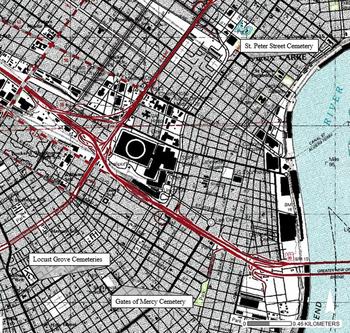
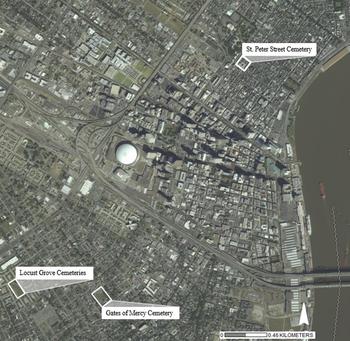
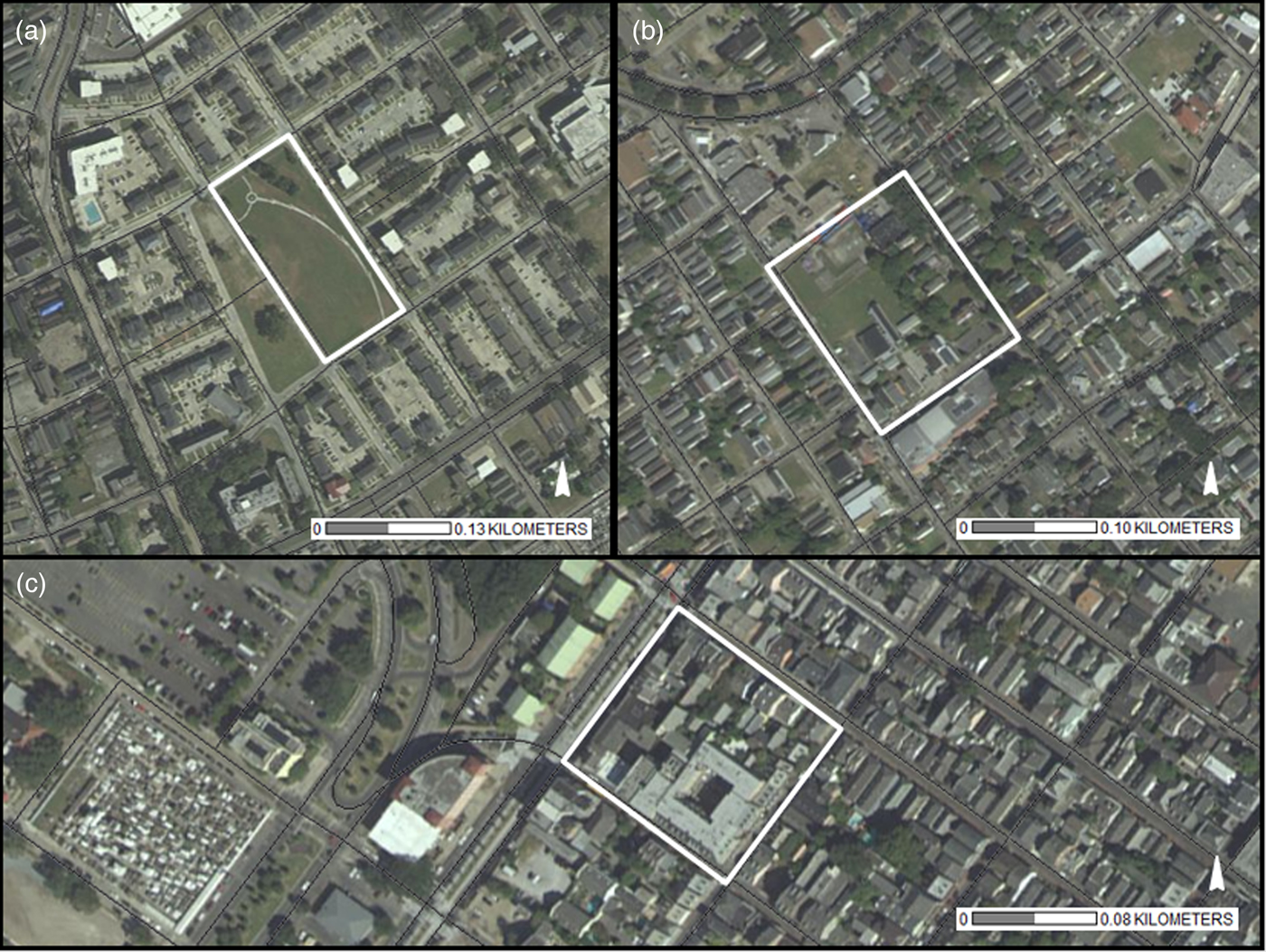
Located in the Central City area of New Orleans along Jackson Avenue, the Gates of Mercy cemetery was an in-ground burial site that was in use from 1828 until 1872 by the Touro Synagogue Jewish congregation (Dedek Reference Dedek2017; Figures 1, 2, and 3b). Following the congregation's establishment of a new cemetery location in the early twentieth century, the Gates of Mercy cemetery began to fall into disrepair. By the 1950s, it was characterized by the Louisiana Supreme Court in the matter of Touro Synagogue v. Goodwill Industries of New Orleans Assn, Inc. (1957:33), as having “fallen into ruin.” Because of the dilapidated state of the cemetery, the Touro Synagogue community decided to sell the property and move the remains of those interred on the site to a new location. This move became the subject of a court dispute between an attorney appointed to represent the interests of the dead in the cemetery, the synagogue, and the prospective purchaser, Goodwill Industries Inc. (Touro Synagogue 1957).
Locations (at their time of use) of the three cemeteries discussed: Gates of Mercy Cemetery, St. Peter's Street Cemetery, and Locust Grove Cemetery Nos. 1 and 2. (Image adapted from USGS quadrangle maps using the Louisiana Department of Natural Resources SONRIS system.) (Color online)

Locations (at their time of use) of the three cemeteries discussed overlaid on 2016 aerial imagery. (Image adapted from public sources created with the Louisiana Department of Natural Resources SONRIS system.) (Color online)

Current aerial view of each cemetery: (a) Locust Grove Cemetery Nos. 1 and 2, (b) Gates of Mercy Cemetery, (c) St. Peter's Street Cemetery. (Image adapted from public sources created with the Louisiana Department of Natural Resources SONRIS system.) (Color online)

Unlike the other cemeteries, the reuse of the Gates of Mercy property was an action that was contemplated and supported by the descendant community, which, rather than continue to maintain a full cemetery site, opted to consolidate the remains at a larger location and sell the old space. Following this community decision, the mortal remains of those interred in the cemetery grounds were relocated to Hebrew Rest Cemetery No. 1. This relocation was accomplished in accordance with the law and procedural mandates of the time before the cemetery space was put to an alternative use (Touro Synagogue 1957). Although it is questionable whether all human remains were actually properly recovered from the site, an attempt was made to move the burials (Caldwell and Seidemann Reference Caldwell and Seidemann2010a; Hahn et al. Reference Hahn, Carpenter, Hahn, Jungeblut, Anne Marie and Ryan2017). This cemetery was ultimately put to alternative uses following the court challenges (Figure 3b shows the current state of the property). Importantly, the court challenges centered on the merchantability of the property's title and not on any dispute over the moving of the remains. From the court record, it is clear that the congregation followed the law that was required at the time to move a cemetery: they petitioned a court for someone to represent the interests of the dead and then proved to the court that they had respectfully moved the remains.
St. Peter's Street Cemetery
The St. Peter's Street Cemetery is one of the earliest colonial cemeteries of New Orleans (see Figures 1, 2, and 3c). Roughly in operation from approximately 1725 through the 1790s, this in-ground burial site was located along the literal ramparts of early New Orleans (modern-day Rampart Street; Gray Reference Gray2017). This site was quickly filled, so it was officially closed as an active cemetery in 1789. Subsumed by the expanding city, the cemetery site became repurposed almost immediately. In fact, as Gray (Reference Gray2017:23) notes, “a [Spanish] Royal Decree . . . approved . . . the use of the old [cemetery] for the construction of residences.” Furthermore, Gray (Reference Gray2017:23) correctly observes that “this latter point is significant, as it makes clear that the old cemetery had been intended for re-use for non-burial purposes almost from the moment that it was closed”—a reality that contradicts with Spanish law at the time that prohibited such cemetery reuses (Seidemann Reference Seidemann2018a, Reference Seidemann2018b). There is no trace of the St. Peter's Street Cemetery's existence above ground, and it is now located beneath various structures along the south side of Rampart Street (Figure 3c). Archaeological excavations at this site have revealed an array of permanent inhabitants, from recently arrived Africans to colonial inhabitants of the city (Gray Reference Gray2017). The interments in St. Peter's Street Cemetery have effectively been sealed in place by overlying construction and have only been intermittently impacted by new construction activities over the centuries.
Locust Grove Cemetery Nos. 1 and 2
The Locust Grove Cemetery Nos. 1 and 2 are in-ground burial sites located in an area bounded by Magnolia Street, Sixth Street, Seventh Street, and Freret Street in Uptown New Orleans (see Figures 1, 2, and 3a). The Locust Grove Cemeteries were among the city's nineteenth-century potter's fields (Jumonville Reference Jumonville2016). Whereas Locust Grove No. 2 opened just before the yellow fever epidemic in 1878 (resulting in it being one of the primary repositories for the deceased), Locust Grove No. 1 served both the African American and Caucasian communities of the time (Hahn and McCarthy Reference Hahn and McCarthy2012). According to death records from 1867, 59% of interments were African American and 41% were Caucasian (Hahn and McCarthy Reference Hahn and McCarthy2012:3–23). Documentary evidence suggests that interments in these cemeteries ceased for Locust Grove Cemetery No. 1 in 1877, and just a year after opening, Locust Grove Cemetery No. 2 closed in 1879 (Branyon Reference Branyon1998; Hahn and McCarthy Reference Hahn and McCarthy2012). Finally, at the insistence of the mayor of New Orleans, with support from the Auxiliary Sanitary Association, both cemeteries were capped by sand and soil deposits by year-end of 1879 (Hahn and McCarthy Reference Hahn and McCarthy2012). Reportedly, the cemeteries were covered with 1–2.5 feet of sand, and Hahn and McCarthy (Reference Hahn and McCarthy2012) noted that the cemeteries sat as greenspace from 1879 to 1906, when the cemetery lots were approved to be used for Thomy Lafon School, a school for African American children.
After a city attorney opined that it was permissible to reuse cemetery space, an ordinance issued in 1905 by the City of New Orleans removed the dedication from Locust Grove Cemetery Nos. 1 and 2 and authorized the construction of the Thomy Lafon School on top of them (Hahn and McCarthy Reference Hahn and McCarthy2012). Although a concurrent ordinance directed the school contractor to “remove with due respect any remains found in Locust Grove Cemetery No. 1 to Locust Grove Cemetery No. 2,” (New Orleans City Ordinance No. 2945, March 15, 1905) later archaeological investigations suggest that most, if not all, of the interments were left in place underneath the school. In fact, the first indication that there was no enforcement of the 1905 removal ordinance came in the 1950s, when renovations to the school unearthed caskets and human remains (M. H. Landry to Attorney General James D. “Buddy” Caldwell, letter, December 29, 2009, in the Attorney General Opinion Collections of the Civil Division, Louisiana Department of Justice, Baton Rouge). However, this knowledge and whatever attention it received due to a newspaper report on the findings did not stop the use of the property as a school. In fact, in 1986, University of New Orleans archaeologists recovered additional human remains and cemetery artifacts when they were encountered during plumbing work in the schoolyard (Branyon Reference Branyon1998). This encounter also did not prompt any further investigation of the site or any dialogue regarding the proper memorialization of the former cemetery on the school property. In fact, it was not until Hurricane Katrina decimated the Thomy Lafon School and the Federal Emergency Management Agency began work with the Orleans Parish and Recovery School Districts for the possible rehabilitation of the overlying structures that officials recognized that the law had long mandated meaningful consideration of the property's original (and continuing) status as a cemetery (Caldwell and Seidemann Reference Caldwell and Seidemann2010b, Reference Caldwell and Seidemann2010c). In the wake of Hurricane Katrina, the burden of remediating a massive nineteenth-century cemetery on the school site led city, state, and federal officials to convert the Thomy Lafon School to a greenspace that commemorated not just the historic cemetery and those still interred at the site but also the significance of the Lafon schools as important locations in the burgeoning twentieth-century civil rights movement in New Orleans (Hahn and McCarthy Reference Hahn and McCarthy2012). Today, this site is a park (Figure 3a).
Discussion
As alluded to above, impacts to cemeteries that erase their existence from the landscape appear to fall under Galtung's (Reference Galtung1969) classification of violence. Although not a perfect fit for the types of violence that Galtung proposed, the reuse of cemeteries for non-cemetery purposes falls somewhere between structural violence and object/psychological violence, and the effect on the descendant community is a form of violence. Structural violence is recognized as actions by institutional or organizational entities that impede the personal growth of a minority or disenfranchised person or group. In order to fully understand whether impacts to a landscape—cemeteries in particular—can constitute some form of violence, it is crucial to understand whether their damage or destruction can cause problems that will impede a person's or group's growth.
Certainly, anecdotal evidence supports the idea that damage to someone's grave or to a cemetery has crippling psychological effects on people (e.g., Florido Reference Florido2018). Recent disruptions of a child's grave in a cemetery in Eunice, Louisiana, resulted in claims that the grief occasioned by that damage was the proximate cause of the mother's untimely death (Reever Reference Reever2018b). Additional anecdotal evidence from news reports around the world recount people's feelings of anger and grief when graves are damaged. The adverse impacts of grief to an individual's personal growth are also well documented in the academic literature. Stone (Reference Stone2012) addresses a similar aspect of such adverse impacts, in which an invisible or indirect form of violence causes disparity. In her study, she suggests an approach to interpret the “markers of health stressors as [a] means to see and interpret long-term cultural violence” (Stone Reference Stone2012:54). Whether or not the long-term threat or actual experience of the erasure of a loved one's final resting place is viewed as structural violence, it can certainly contribute to a long-term psychological stress event.
At least during the period that most of the cemeteries discussed here were in operation and decline (i.e., the nineteenth century), scholars have documented that the grieving process included regular visits to the cemetery as a place to commune with the dead (Walls Reference Walls2011). Debates regarding the continuance of specific grieving practices into the twentieth century exist (Walls Reference Walls2011), but although the sites of actual violence or death (as opposed to cemeteries) become more significant in the mourning process (Jacobs Reference Jacobs2004), there is little doubt that cemeteries continue to figure prominently in various individuals’ grieving (Woodthorpe Reference Woodthorpe2011).
Cemetery spaces are thus important from both mourning and historical perspectives, and removal of them from the landscape has significant impacts on both aspects of cemeteries’ common uses (Maples and East Reference Maples and East2013; Wyndham and Read Reference Wyndham and Read2011). As poignantly noted by Miller and Rivera (Reference Miller and Rivera2006:334), “whether the bodies of the deceased are placed in the ground, within elaborate tombs, or simply in the presence of ancient or contemporary monuments, their location holds symbolic meaning as well as practical historical meaning for the surrounding living community.” Accordingly, it is difficult to deny the unique nature of cemeteries (Sheppard-Simms Reference Sheppard-Simms2016) and, because of their connections to the grieving process and the historical nature of a particular place, it is clear that impacts to these spaces resulting in erasure from the landscape have an impact on the descendant community.
As a practical matter, the removal of a cemetery from a landscape may sever the ability of the descendant community the ability to continue the grieving process or to have a place within which to commune with a direct link to its history. In other words, in cases where a decision to remove a cemetery from the landscape is made not by the descendant community, but rather by or with the consent of the government, this action directly results in an erasure of the collective memory of those interred in the cemetery from the landscape. Such an action, whether intentional or not, represents the final act to eliminate the existence of a community from the landscape.
Although the disappearance of many cemeteries from the landscape can be classified as violent acts, not all landscape changes qualify as violent. The cemeteries reviewed here present examples of both violent and nonviolent landscape changes. As already alluded to, the Gates of Mercy Cemetery in New Orleans falls into a category of nonviolent conversion from burial place to other uses in which the historical record clearly demonstrates that there was no violence against a disenfranchised community. The descendant community, represented by their respective religious institutions and legal representatives, actively participated in the de-consecration of the cemetery and the movement of the interments to another final resting place. This erasure of a cemetery from the landscape was accomplished pursuant to law, in the full view and with the tacit (if not explicit) approval of the descendant community. Consequently, this cemetery destruction event cannot be said to represent violence in a Galtungian sense. Indeed, even though it now appears that a poor job was done of retrieving the interred remains from the Gates of Mercy Cemetery (Caldwell and Seidemann Reference Caldwell and Seidemann2010a), this potentially incomplete cemetery move cannot be said to undermine the consent or to have occurred without the knowledge of the descendant community when such consent was granted in the 1950s.
Although the St. Peter's Street Cemetery was erased from the landscape by later development on the site, in the same way that both the Gates of Mercy and Locust Grove cemeteries were, it is unclear whether a disenfranchised descendant community was impacted by this action. Therefore, the disappearance of this cemetery from the New Orleans landscape falls into a category of surface alteration violence, but not structural violence in the definition proposed here. As noted previously, the St. Peter's Street Cemetery contained the remains of both enslaved peoples and free New Orleanians, which represented a demographic difference from the impoverished Locust Grove Cemetery population. However, there is no historical evidence that the descendant community was consulted or participated at all in the decision to put the St. Peter's Street Cemetery to a non-cemetery use. In fact, according to Gray (Reference Gray2017), the decision to convert this cemetery was made by King Charles IV's royal edict from across the Atlantic. Although the decree was made, no public dispute in response to the obliteration of the cemetery from the landscape has emerged in the historical literature. (There was a public dispute associated with this cemetery between the church and the crown, but it merely related to ownership, not reuse; Gray Reference Gray2017; Morazán Reference Morazán1972.) In the absence of such consultation, it is easy to conclude that the decision to remove the surface evidence of this cemetery represented an act of violence against a group of people. If, however, future archaeological research on this site reveals a contradiction to the historical record regarding who was interred at this site; or if a particular group or class of individuals were removed prior to the cemetery's reuse for other purposes, then the conclusion that this reuse is likely not an example of structural violence may change.
Based on the available evidence, however, it seems that the reason that the St. Peter's Street Cemetery was converted from a place of burial to a location of commercial use was a matter of economic expediency. It was simply easier to remove surface evidence of a cemetery and reuse the property as something else than it was to go through the laborious process of removing the remains from the property. Eventually, as was the case here, people will simply forget that the cemetery exists, and it will only turn up on old maps as something to be considered in future reuses of the land. In this regard, the treatment of St. Peter's Street Cemetery is substantially similar to that of Highland Cemetery in Baton Rouge. As noted above, the latter cemetery contains the remains of Baton Rouge's elite, but it is clear that, over time, the surrounding neighborhood has constricted around the cemetery boundaries (Seidemann and Kleinpeter Reference Seidemann and Kleinpeter2014). In fact, old maps show burials in the place where single-family residences now stand at Highland. As with St. Peter's, it is not possible to say that such reuse of cemetery property constitutes a structurally violent act of the ruling class or the bureaucracy against a disenfranchised people. A Marxist perspective of cemetery impacts as violent acts by the elite against the proletariat—the perspective that Galtung (Reference Galtung1969) had proposed in his early writings on violence—simply does not fit all scenarios (Parsons Reference Parsons2007). Sometimes greed, expediency, or ignorance simply wins the day, and the disappearance of all or a portion of a cemetery from the landscape impacts no particularly oppressed people (Humphreys v. Bennett Oil Corp. 1940).
In the case of the Locust Grove Cemeteries, the historic record evidences no efforts made by the city or developers to make contact with the descendant community (which includes a cross-section of marginalized groups) prior to removing the surface evidence of the cemeteries’ existence and converting those spaces to alternative uses such as a school site. The decisions made by governmental officials (such as New Orleans Mayor Martin Behrman, city engineers, and school board members) caused erasure of these sites from the landscape, thereby erasing the remains of a powerless descendant community from collective memory. Not only did these acts constitute violence against the largely destitute New Orleans population of the nineteenth and early twentieth centuries, but the perpetrators, by failing to remove the existing burials to an alternative location prior to the new construction, also violated the law in carrying out these acts. In this regard, such acts violate the long-standing existence of restrictions against the disturbance (here, through obliteration) of the dead by failing to follow the law and move the remains.
Despite the knowledge that these violent acts occurred, it is impossible to directly understand the impacts of these landscape alterations on the descendant community. Although the historical record is silent, such violent acts represent a loss of identity of the dead and a stripping of agency from the descendant community. Based on current scholarship, however, it is possible to infer that, because such spaces are important to the grieving process and because disruption of that process can have significant adverse impacts on the living, such violence was wrought upon the descendant communities as a result of the destruction of these cemeteries (Maples and East Reference Maples and East2013). Therefore, the development activities that led to the disappearance of the Locust Grove Cemeteries meet the qualifications to represent violence carried out against the landscape with effects on the descendant communities.
Based on the above review of New Orleans cemetery repurposing, a picture of a unique form of violence emerges that is ascribable to cemetery destruction, although that violence does not exist each time a cemetery is destroyed or removed from the landscape. In order for such acts to constitute violence in a Galtungian sense, it is not enough that a disenfranchised people is on the receiving end of the act. There must also be a lack of consent from or participation by the descendant community in the decision to move the cemetery. While the latter component is missing from the Gates of Mercy Cemetery example, which represents landscape change as a nonviolent act, the violence inflicted on the impoverished New Orleanians in the case of the Locust Grove Cemeteries, and perhaps on the St. Peter's Street Cemetery descendant communities, does conform to the definition set forth here of landscape structural violence.
Conclusion
Currently, no scholarship directly addresses the issue of whether cemeteries are such unique places that destruction or repurposing of those spaces without consent constitutes a violent act in the tradition of Galtung. Cemeteries occupy a unique place in the consciousness—even the subconsciousness—of most cultures (when compared to other types of land), and violent acts directed at these spaces rise above the level of mere violence against an object. Often grouped with spaces in which great calamities or battles occurred (Walls Reference Walls2011), cemeteries are indeed unique (Maples and East Reference Maples and East2013). The effect of violence that erases these spaces from the landscape runs deeper than the demolition of a beloved structure. It functions to erase from the collective consciousness the final vestiges of the actual existence of people. When these people have been disenfranchised in life, their resting places in the cemetery are often all that is left of their memory. The demolition of such spaces with no consideration for the descendant community effectively erases whatever tenuous links such disenfranchised people had to immortality. Because the consequences of such violent acts are so consequential to the collective consciousness of a people, the violent demolition of cemeteries should be considered a form of structural violence and not, as Galtung (Reference Galtung1969:170) might argue, a “‘degenerate’ form” of violence.
We propose here an operational definition of landscape structural violence, as seen through cemetery erasure, as a reinforcement of preexisting social prejudices in death, where the existing entities (usually governments but also the social majority) intentionally or passively destroy, remove, or obscure a cemetery without consultation with the descendant community. Not all erasures of cemeteries will conform to the definition of landscape structural violence. Nonviolent situations that include the descendant communities certainly exist. Examples of violent landscape alterations, where alterations to the cemetery certainly exist through developmental encroachment, the population, and community feelings may dictate whether the situation is structural in nature. We argue here, however, that true landscape structural violence does exist in the decimation of cemeteries and that this violence impacts descendants in a physical and psychological manner.
Acknowledgments
The authors wish to extend their gratitude to the four reviewers who provided substantive commentary on the first version of this paper. We are grateful for their thoughtful responses and the opportunity to publish a more streamlined presentation of our thoughts. The authors are also grateful to Thurston Hahn and Christopher Lento for their assistance in tracking down the historic ordinances. This research did not receive any specific grant from funding agencies in the public, commercial, or not-for-profit sectors.
Data Availability Statement
No original data were presented in this article.