1. Introduction
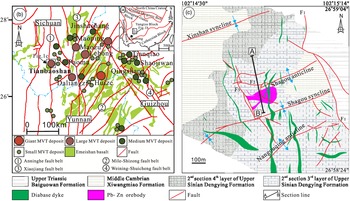
The Sichuan–Yunnan–Guizhou (SYG) triangle area belongs to the low-temperature metallogenic domain in South China (Tu, Reference Tu2002; Hu & Zhou, Reference Hu and Zhou2012). This region, geologically located in the western Yangtze Block (Fig. 1a), is bounded by the NW–SE-trending Weining–Shuicheng fault to the northeast, the N–S-trending Anninghe fault to the west, and the NE–SW-trending Mile–Shizong fault to the southeast (Fig. 1b). It hosts more than 400 Pb–Zn deposits with >20 Mt Pb + Zn metal resources (e.g. the world-class Huize deposit, the large Tianbaoshan and Daliangzi deposits; Fig. 1b), and constitutes a world-class Pb–Zn metallogenic province (Hu & Zhou, Reference Hu and Zhou2012; Zhang et al., Reference Zhang, Wu, Hou and Mao2015a). The ore-bearing strata of the Pb–Zn deposits in this region are located below the Permian Emeishan basalts and include Sinian to Permian carbonate strata, among which the Sinian–Cambrian stratum is the most important ore-bearing stratum in the area. Regional Pb–Zn deposits are characterized by epigenesis and are typical Mississippi Valley-type (MVT) in terms of mineral assemblage, mineralization type, lithology of ore-bearing strata and wall rock alteration (Han et al. Reference Han, Liu, Huang, Chen, Ma, Lei and Ma2007; Zhang, Reference Zhang2008; Wu, Reference Wu2013; Zhang et al. Reference Zhang, Qin, Zeng, Li, Zeng, Ruan, Song and Hu2015). However, most Pb–Zn deposits in this area are different from typical MVT deposits in terms of orebody shape, ore-controlling factors and ore grade. Their formation is controlled by faults. They are vein-like in morphology and have generally very high ore grades with more than 20 % Pb and Zn, such as the Huize (Han et al. Reference Han, Liu, Huang, Chen, Ma, Lei and Ma2007), Maoping (Wei et al. Reference Wei, Xue, Xiang, Li, Liao and Akhter2015) and Fule deposits (Zhu et al. Reference Zhu, Wen, Zhang, Fu, Fan and Cloquet2017; Li et al. Reference Li, Ye, Hu and Huang2018). Additionally, copper-bearing minerals are not generally common in MVT deposits (Symons et al. Reference Symons, Lewchuk, Kawasaki, Velasco and Leach2009; Abidi et al. Reference Abidi, Slim-Shimi, Somarin and Henchiri2010), and copper sulphides have only been discovered in a few MVT deposits (Pfaff et al. Reference Pfaff, Wagner and Markl2009; Muhling et al. Reference Muhling, Fletcher and Rasmussen2012). In contrast, such an association is common in many Pb–Zn deposits (e.g. Wushihe, Maozu and Chipu deposits) in the SYG area (Zhang et al. Reference Zhang, Mao, Wu, Li, Liu, Guo and Gao2005) and many copper ore occurrences have been discovered in the Permian basalt (Wang & Wang, Reference Wang and Wang2003; Li et al. Reference Li, Mao, Zhang, Xu and Chen2004; Wang et al. Reference Wang, Li, Cai and Yang2010; Zhang et al. Reference Zhang, Qin, Zeng, Li, Zeng, Ruan, Song and Hu2015). However, an understanding of the relationship between lead–zinc and copper mineralization still lacks geological and geochemical evidence (Tan et al. Reference Tan, Zhou, Zhou and Ye2019). Although the classification of these deposits has been changed from sedimentary type (Tu, Reference Tu1984; Chen, Reference Chen1986; Liu & Lin, Reference Liu and Lin1999) to MVT type (Zhou et al. Reference Zhou, Wei and Guo2001; Han et al. Reference Han, Liu, Huang, Chen, Ma, Lei and Ma2007; Hu & Zhou, Reference Hu and Zhou2012), their unique geological characteristics suggest that the lead–zinc mineralization has a complex origin (Zhou et al. Reference Zhou, Gao, Chen and Liu2013, Reference Zhou, Huang, Zhou, Zhu and Muchez2014, Reference Zhou, Xiang, Zhou, Feng, Luo, Huang and Wu2018; Li et al. Reference Li, Zhou, Huang, Yan, Bao and Sun2015; Wang et al. Reference Wang, Zhang, Zhong, Yang, Li and Zhu2018; Tan et al. Reference Tan, Zhou, Zhou and Ye2019) and needs to be further studied.
(a) Tectonic sketch of South China. (b) Schematic regional geological map of the Sichuan–Yunnan–Guizhou MVT triangle region showing the distribution of principal deposits modified from Zhang et al. (Reference Zhang, Qin, Zeng, Li, Zeng, Ruan, Song and Hu2015); small box shows location of (c). (c) Geological sketch map of the Tianbao ore segment within the Tianbaoshan deposit; the studied cross-section (line 30) of the orebody is also shown.

Here we present an example of the association of Cu and Pb–Zn in the Tianbaoshan ore deposit. This deposit comprises three separated vein orebodies, Tianbao I, Tianbao II and Xianshan, of which Tianbao II is the largest. Ore reserves total ∼26 Mt Zn and Pb (grading 7.76–10.09 % and 1.28–1.50 %, respectively; Ye et al. Reference Ye, Li, Hu, Huang, Zhou, Fang and Danyushevskiy2016). Recently, a Cu orebody was discovered below the Pb–Zn orebody, which has >0.1 Mt Cu ore reserves and a mean grade of 2.55 wt % Cu (Tan et al. Reference Tan, Zhou, Zhou and Ye2019). Previous studies have been carried out on the ore deposit’s geological features (Feng et al. Reference Feng, Li and Liu2009; Cheng, Reference Cheng2013), fluid inclusions and C–H–O–He–Ar isotopes (Wang, Reference Wang1992; XC Wang et al. Reference Wang, Zhang, Zheng and Xu2000; Yu et al. Reference Yu, Wei and Hu2015; J Wang et al. Reference Wang, Zhang, Zhong, Yang, Li and Zhu2018; Yang et al. Reference Yang, Zhang, Wang, Zhong and Liu2018), trace elements in sulphides (Wang, Reference Wang1992; Wang et al. Reference Wang, Zhang, Zheng and Xu2000; Ye et al. Reference Ye, Li, Hu, Huang, Zhou, Fang and Danyushevskiy2016; Hu et al. Reference Hu, Ye, Li, Huang and Zhang2018), and S–Pb–Cd isotopes of sulphides (Sun et al. Reference Sun, Zhou, Huang, Fan, Ye, Luo and Gao2016; Zhu et al., Reference Zhu, Wen, Zhang and Fan2016; Tan et al. Reference Tan, Zhou, Zhou and Ye2019). These workers suggested that the ore-forming process of the Tianbaoshan deposit is either non-magmatic mineralization (e.g. MVT type; Wang, Reference Wang1992; Wang et al. Reference Wang, Zhang, Zheng and Xu2000; Yu et al. Reference Yu, Wei and Hu2015; Ye et al. Reference Ye, Li, Hu, Huang, Zhou, Fang and Danyushevskiy2016; Hu et al. Reference Hu, Ye, Li, Huang and Zhang2018; Wang et al. Reference Wang, Zhang, Zhong, Yang, Li and Zhu2018; Yang et al. Reference Yang, Zhang, Wang, Zhong and Liu2018) or mineralization related to magmatism (SYG type; Zhu et al. 2016; Tan et al. Reference Tan, Zhou, Zhou and Ye2019). The precipitation mechanism of metals is still controversial and the relationship between Pb–Zn and Cu mineralization in the deposit remains unclear.
Geochemical signatures of sulphide minerals (e.g. pyrite, sphalerite and chalcopyrite) can reveal metallogenic information. For example, they allow us to distinguish between a single-stage event and multiple overprints (Yuan et al. Reference Yuan, Zhang, Yu, Yang, Zhao, Zhu, Ding, Zhou, Yang and Xu2018; Cave et al. Reference Cave, Lilly and Barovich2020), differentiating metallogenic types (e.g. VHMS-type, skarn-type, MVT-type; Ye et al. Reference Ye, Cook, Ciobanu, Liu, Zhang, Liu, Gao, Yang and Danyushevsky2011; Leng et al. Reference Leng, Wang, Ye and Zhang2018; Yuan et al. Reference Yuan, Zhang, Yu, Yang, Zhao, Zhu, Ding, Zhou, Yang and Xu2018; Niroomand et al. Reference Niroomand, Haghi, Rajabi, Shabani and Song2019; Xiao & Li, Reference Xiao and Li2019; Zhuang et al. Reference Zhuang, Song, Liu, Fard and Hou2019; Oyebamiji et al. Reference Oyebamiji, Hu, Zhao and Zafar2020), and constraining physicochemical conditions (e.g. T, pH, fO2) of the hydrothermal fluid (Hu et al. Reference Hu, Ye, Li, Huang and Zhang2018; Leng et al. Reference Leng, Wang, Ye and Zhang2018; Horn et al. Reference Horn, Dziggel, Kolb and Sindern2019; Maurer et al. Reference Maurer, Prelević, Mertz-Kraus, Pačevski, Kostić and Malbašić2019; Zhuang et al. Reference Zhuang, Song, Liu, Fard and Hou2019; Cave et al. Reference Cave, Lilly and Barovich2020; Knorsch et al. Reference Knorsch, Nadoll and Klemd2020).
The sulphur isotopic signatures of the sulphide minerals (e.g. pyrite, sphalerite and chalcopyrite) can constrain the mechanisms of metal precipitation, particularly regarding Pb–Zn mineralization hosted by carbonate rocks. It has been suggested that the main sulphur sources for carbonate-hosted Pb–Zn deposits generally include evaporite-derived sulphur (heavy δ34S values), previously deposited bacteriogenic sulphur (light δ34S values) and magma-derived sulphur (intermediate δ34S values) (Perona et al., Reference Perona, Canals and Cardellach2018; Elliott et al. Reference Elliott, Gernon, Roberts, Boyce and Hewson2019). Although a change in physicochemical conditions (e.g. T, pH and fO2) of a single hydrothermal fluid could cause sulphide precipitation, mostly sulphide mineralization is related to mixing of at least two fluids with contrasting components (e.g. sulphur-rich, metal-depleted brine and metal-rich, sulphur-poor hydrothermal fluid) (Ashton et al., Reference Ashton, Boyce, Fallick and Russell1998; Blakeman et al. Reference Blakeman, Ashton, Boyce, Fallick and Russell2002; Wilkinson et al. Reference Wilkinson, Eyre and Boyce2005; Bouabdellah et al. Reference Bouabdellah, Boudchiche, Ouahhabi and Naciri2008, Reference Bouabdellah, Sangster, Leach, Brown, Johnson and Emsbo2012; Barrie et al. Reference Barrie, Boyce, Boyle, Williams, Blake, Wilkinson, Lowther, McDermott and Prior2009; Gagnevin et al. Reference Gagnevin, Menuge, Kronz, Barrie and Boyce2014; Saintilan et al. Reference Saintilan, Stephens, Lundstam and Fontboté2015; Elliott et al. Reference Elliott, Gernon, Roberts, Boyce and Hewson2019). Compared to conventional bulk sulphur isotopic analysis, microscale variations in sulphur isotopes obtained by in situ analysis of sulphide minerals reveal more details of mineralizing processes (Deloule et al. Reference Deloule, Allegre and Doe1986; Layne et al. Reference Layne, Hart and Shimizu1991; McKibben & Eldridge, Reference McKibben and Eldridge1995; Peevler et al. Reference Peevler, Fayek, Misra and Riciputi2003; Ferrini et al. Reference Ferrini, Fayek, De Vito, Mignardi and Pignatti2010).
In this contribution, we present a detailed study of ore and mineral textures, coupled with in situ trace-element and sulphur isotopic analyses for sulphides from different-stage ores, to better address the mineralization mechanism of the sulphides and the link between Pb–Zn and Cu mineralization.
2. Geological setting
2.1. Regional geology
The SYG region is mainly composed of a pre-Sinian basement, Sinian to Palaeozoic marine sedimentary sequences and Mesozoic to Cenozoic terrestrial sedimentary sequences (Zhang et al., Reference Zhang, Fan, Xiao, Wen, Ye, Huang, Zhou and Guo2019a). The basement in this region includes the Kangding, Dahongshan and Kunyang groups that mainly consist of gneiss, migmatite, meta-clastics, clastic rocks and minor carbonates (Zhou et al. Reference Zhou, Wei and Guo2001; Wu et al., Reference Wu, Zhang, Mao, Ouyang and Sun2013). Sinian to Palaeozoic marine sedimentary sequences that cover the basement rocks consist of the lower Sinian acidic, intermediate-acidic igneous rock suite, the upper Sinian Dengying Formation dolostone and the Palaeozoic carbonates and clastic sediments, which are overlain by the voluminous Permian Emeishan flood basalts (Zhang et al. Reference Zhang, Qin, Zeng, Li, Zeng, Ruan, Song and Hu2015). The Mesozoic to Cenozoic terrestrial sedimentary sequences are mainly sandstones and conglomerates, which are characterized by an entirely continental origin (Zhou et al. Reference Zhou, Huang, Zhou, Zhu and Muchez2014; Zhang et al. Reference Zhang, Qin, Zeng, Li, Zeng, Ruan, Song and Hu2015). The upper Sinian Dengying Formation is the most important ore-hosting stratum in the SYG, accounting for over 75 % of the Zn + Pb reserves (Zhang et al., Reference Zhang, Xiao, Wen, Zhu, Ye, Huang, Zhou and Fan2019b). Carbonate-hosted Zn–Pb deposits, such as the Chipu, Maozu, Daliangzi, Tianbaoshan, Tianqiao Shaojiwan and Qingshan deposits, are distributed along the Anninghe, Weining–Shuicheng and Mile-Shizong regional faults and their secondary faults (Fig. 1b; Zhang et al. Reference Zhang, Qin, Zeng, Li, Zeng, Ruan, Song and Hu2015; Zhang et al., Reference Zhang, Fan, Xiao, Wen, Ye, Huang, Zhou and Guo2019a, Reference Zhang, Xiao, Wen, Zhu, Ye, Huang, Zhou and Fan2019b). These regional faults commonly control the migration of regional ore-forming fluids, and a series of thrust–fold systems are the primary ore-hosting structures in the SYG, where sulphide orebodies are generally present as strata-bound lenses in bedding-parallel fractures or as pipe-like orebodies (Zhang et al. Reference Zhang, Qin, Zeng, Li, Zeng, Ruan, Song and Hu2015; Xiong et al., Reference Xiong, Gong, Jiang, Zhang, Li and Zeng2018; Zhang et al., Reference Zhang, Fan, Xiao, Wen, Ye, Huang, Zhou and Guo2019a, Reference Zhang, Xiao, Wen, Zhu, Ye, Huang, Zhou and Fan2019b). These Zn–Pb deposits were formed at 245–225 Ma, co-temporally with the collision between the Indochina and South China cratons, and the Zn–Pb mineralization is genetically related to the regional-scale migration of basin-related fluids triggered by the late Indosinian orogeny (Hu & Zhou, Reference Hu and Zhou2012; Zhang et al. Reference Zhang, Qin, Zeng, Li, Zeng, Ruan, Song and Hu2015).
2.2. Local geology
The Tianbaoshan Pb–Zn deposit is hosted by dolostone of the upper Sinian Dengying Formation, which consists of the Tianbao and Xinshan ore segments (Wang et al. Reference Wang, Zhang, Zheng and Xu2000; Hu et al. Reference Hu, Ye, Li, Huang and Zhang2018; Tan et al., Reference Tan, Zhou, Zhou and Ye2019). This study focuses on the Tianbao ore segment. The major strata exposed in the Tianbao ore segment include the upper Sinian Dengying Formation, the Middle Cambrian Xiwangmiao Formation and the upper Triassic Baiguowan Formation (Fig. 1c; Zhou et al. Reference Zhou, Gao, Chen and Liu2013; Hu et al. Reference Hu, Ye, Li, Huang and Zhang2018). The Dengying Formation consists of four layers (Tan et al. Reference Tan, Zhou, Zhou and Ye2019): the first layer, up to 320 m thick, consists of dolostone; the second layer is composed of a 32–112 m thick dolomitic sandstone; the third layer comprises 240–470 m of siliceous dolostone, which is the host rock for Pb–Zn mineralization; and the fourth layer consists of siliceous dolostone with chert strips or nodules (30–110 m thick). The first and second layers are absent in the Tianbao ore segment, while the third and fourth layers are widely developed in this area (Fig. 1c). The overlying Xiwangmiao Formation consists of clastic rocks, dominated by black shale of <210 m thickness, while the Baiguowan Formation is composed of sandy shale (40–200 m thick) (Zhou et al. Reference Zhou, Gao, Chen and Liu2013; Tan et al. Reference Tan, Zhou, Zhou and Ye2019). Faults in this region mainly consist of N–S-, E–W- and NW-trending faults (Tan et al. Reference Tan, Zhou, Zhou and Ye2019). The N–S-trending fault (F1 in Fig. 1c) in the eastern part of the ore district is the main ore-controlling structure that acted as conduits for ore-forming fluids. The E–W-trending fault (F2 in Fig. 1c) is the main ore-bearing structure which controls the occurrence of the Tianbaoshan deposit. The NW-trending fault (F3 in Fig. 1c) cross-cuts the orebodies. The Tianbaoshan syncline is a wide, asymmetrical composite syncline with a steep north limb (Fig. 1c; Tan et al. Reference Tan, Zhou, Zhou and Ye2019). A series of secondary folds occurs in the two wings of the Tianbaoshan syncline, including the Xinshan syncline, the Shagou anticline and syncline and the Nangouqing anticline in the Tianbao ore section (Fig. 1c). Previous studies suggested that the Tianbaoshan area has undergone two episodes of regional compression in nearly NWW–SEE and SSW–NNE directions, which occurred in the late Indosinian and early Yanshanian, respectively (Zhang et al., Reference Zhang, Li, Tu, Xia and Wei2006; Tan et al. Reference Tan, Zhou, Zhou and Ye2019). The Pb–Zn mineralization in Tianbaoshan is considered to be linked to the late Indosinian regional compression (Zhang et al., Reference Zhang, Li, Tu, Xia and Wei2006). There is a lack of magmatic activity in the Tianbaoshan area, with only several diabase dykes occurring along N–S-trending and NW-trending faults (Fig. 1c). These mafic dykes with a thickness of 20–30 m usually cross-cut the orebodies (Fig. 1c) and were dated by Zhang (Reference Zhang2017) at 156–166 Ma. In the contact zone between diabase dyke and orebody, the Zn + Pb grade of the orebody increases and the dyke itself is a high-grade Zn–Pb orebody (Cai, Reference Cai2012; Zhang, Reference Zhang2017).
2.3. Ore deposit geology
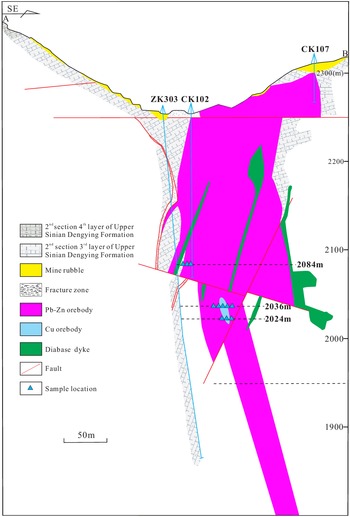
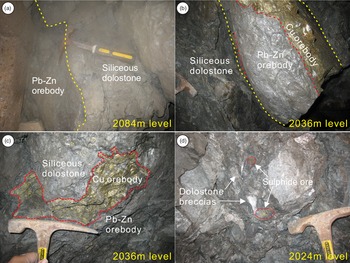
The Tianbaoshan deposit contains three orebodies including two Tianbao orebodies (Nos. I and II) and one Xinshan orebody (No. III) (Wang et al. Reference Wang, Zhang, Zheng and Xu2000; Feng et al. Reference Feng, Li and Liu2009; Tan et al. Reference Tan, Zhou, Zhou and Ye2019). The No. II orebody is the largest within the Tianbaoshan ore district, with average grades of 1.09 wt % Pb and 8.74 wt % Zn. This Pb–Zn orebody is more than 300 m thick, ∼285 m long and ∼70 m wide, and is cross-cut by the NW-trending fault which forms two ore segments (Yang et al. Reference Yang, Zhang, Wang, Zhong and Liu2018). They are structurally controlled by the E–W-striking faults and hosted in siliceous dolostone of the third layer of the Dengying Formation, which commonly occurs as steeply dipping, lens-shaped and in sharp contact with the siliceous dolostone host rock (Figs 2, 3a; Hu et al. Reference Hu, Ye, Li, Huang and Zhang2018; Tan et al. Reference Tan, Zhou, Zhou and Ye2019). Recently, Cu-dominant mineralization was discovered in the deep part of the Tianbaoshan deposit and forms a Cu orebody (Fig. 2). The Cu orebody has a lenticular form in the Tianbao orebodies, is found at an elevation of 2036 m (Fig. 3b–c) and thins out at 2024 m (Fig. 3d). It dips south, has a length of up to 50 m and is ∼10 m thick (Hu et al. Reference Hu, Ye, Li, Huang and Zhang2018; Tan et al. Reference Tan, Zhou, Zhou and Ye2019). This orebody contains over 100 000 tons of Cu ores at an average grade of 2.55 % Cu (Tan et al. Reference Tan, Zhou, Zhou and Ye2019). The sulphide ores are relatively simple and predominantly consist of sphalerite with minor galena, pyrite and chalcopyrite. The gangue minerals are dominated by dolomite, calcite and quartz (Wang et al. Reference Wang, Zhang, Zheng and Xu2000; Feng et al. Reference Feng, Li and Liu2009; Sun et al. Reference Sun, Zhou, Huang, Fan, Ye, Luo and Gao2016; Ye et al. Reference Ye, Li, Hu, Huang, Zhou, Fang and Danyushevskiy2016).
Geological cross-section along the No. 30 exploration line.

Photographs of Pb–Zn and Cu mineralization occurrences from 2084 m, 2036 m and 2024 m a.s.l. in the Tianbao No. II orebody. (a) The 2084 m level shows sharp contact between Pb–Zn orebody and siliceous dolostone host rocks. (b–c) The 2036 m level shows a minor Cu orebody occurring as lenticular form in the massive Pb–Zn orebody. (d) The 2024 m level shows brecciation of dolostone host rock with minor sulphide infillings, and that the Cu orebody tends to thin out at this level.

3. Sulphide minerals petrography
Detailed mineralogical and textural investigations of samples from the Tianbaoshan orebody allow the splitting of the processes that formed the deposit into early pyrite, early chalcopyrite, the main sphalerite, and carbonate stages (Fig. 4).
Paragenetic sequence of sulphide and associated alteration mineral formation in the Tianbaoshan deposit.

3.1. Early pyrite stage (Stage 1)
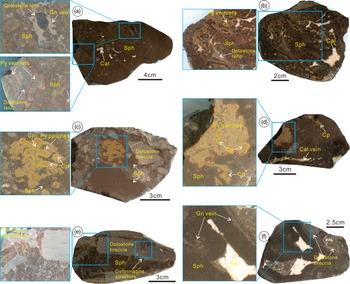
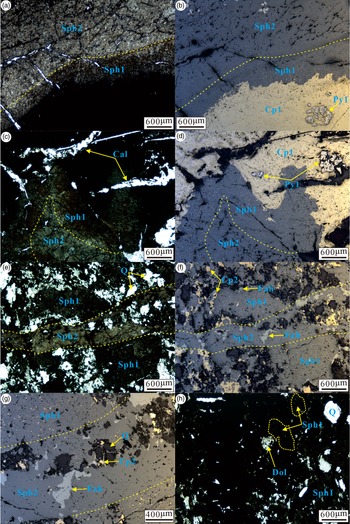
In this stage, pyrite patches were developed in the brecciated ore (Fig. 5c) or massive sulphide ore (Fig. 5d). These pyrite patches (Py1) occur in small quantities relative to other sulphides during whole stage, and are only observed in rare ore specimens. In thin-sections, the crystals of Py1 are highly fractured and appear as anhedral to subhedral 80–800 μm relic crystals (Figs 6b, d, 7a). They have a porous or cracked surface with infillings of carbonate or sulphide minerals (Figs 6b, d, 7a). This type of pyrite was intensively replaced by chalcopyrite (Fig. 6b, d) or sphalerite (Fig. 7a) along its rims or internal fractures. Therefore, pyrite in this stage is the earliest sulphide mineral, predating subsequent sulphides.
Photographs of typical ore texture and mineral assemblage in the Tianbaoshan deposit. (a) Sphalerite–galena massive ore, which shows that galena and pyrite veinlets cross-cut massive ore, and rare dolostone relics are suspended in massive ore with some calcite infillings. (b) Dolostone relic-bearing massive sphalerite ore with pyrite and calcite veinlets filling along fractures. (c) Breccia-shaped sphalerite ore with sphalerite cementing dolostone breccias, which shows that pyrite patches overprint sphalerite and spot-like chalcopyrite replaces the pyrite patches. (d) Spot-like chalcopyrite either replaces pyrite patches or is enclosed by massive sphalerite with calcite vein filling along fracture. (e) Sphalerites cement the dolostone breccias with irregularly dissolved boundaries and deformation structure in the dolostone breccias. (f) Sphalerites occur as open space-filling texture among the dolostone breccias with calcite filling in the dissolution cavity of former sphalerite. Abbreviations: Py = pyrite; Sph = sphalerite; Cp = chalcopyrite; Gn = galena; Cal = calcite.

Photomicrographs of sulphide mineral associations of early pyrite stage (Py1), early chalcopyrite stage (Cp1) and main sphalerite stage (Sph1 and Sph2) in the Tianbaoshan deposit. (a) Transmitted light microphoto shows that dark sphalerite (Sph1) is surrounded by light sphalerite (Sph2) with obvious boundary. (b) Reflected light microphoto from (a) shows Py1 relics occur in the chalcopyrite (Cp1) matrix, which was replaced by Sph1 with widespread chalcopyrite disease and Sph2 with rare chalcopyrite disease. (c–d) Both transmitted and reflected light microphotos show that two generation sphalerites (Sph1 and Sph2) replaced the early Cp1 grain enclosing relicts of Py1 and formed a curved boundary between them. (e–f) The light Sph2 occurs as a veinlet cross-cutting composite aggregate of dark Sph1 with widespread chalcopyrite blebs, and anhedral fine-grained Cp2 and Fah crystals occur between massive Sph1 grains. (g) Details from (f), showing coexisting assemblage of fine-grained Q, Cp2 and Fah crystals, which replaced Sph2. (h) Transmitted light microphoto showing sulphide-bearing dolostone host rock has undergone silicification. Abbreviations: Py = pyrite; Cp = chalcopyrite; Sph = sphalerite; Fah = fahlore; Dol = dolomite; Q = quartz.

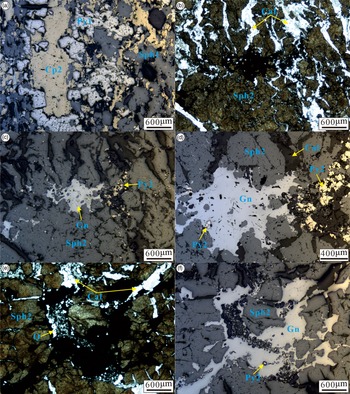
Transmitted light photomicrographs and corresponding reflected light photomicrographs mainly showing sulphide mineral associations observed in the main sphalerite stage (Sph2) and carbonate stage from the Tianbaoshan deposit. (a) Reflected light microphoto from (h) in Figure 6 shows that the fractured Py1 grains are intensively replaced by massive Sph1 with siliceous dolostone relic, which is replaced by Cp2. (b–c) Coarse-grained sphalerite (Sph2) with no chalcopyrite disease is cut by pyrite (Py2) and calcite (Cal) veinlets. (d) Details from (c), auhedral fine-grained galena intergrown with pyrite and calcite, cross-cutting massive Sph2. (e–f) Fine-grained pyrites (Py2) disseminate in a galena (Gn) vein, together with calcite (Cal) and quartz (Q) veinlets, which cross-cut coarse-grained sphalerite (Sph2). Abbreviations: Py = pyrite; Sph = sphalerite; Gn = galena; Cal = galcite; Q = quartz.

3.2. Early chalcopyrite stage (Stage 2)
The second stage of the mineral phase is dominated by chalcopyrite mineralization occurring as disseminated grains (Fig. 5c–d). It commonly replaced early Py1 patches or is surrounded by massive sphalerite grains (Fig. 5c–d). It also occurs as coarse-grained, elliptical crystals (Cp1) (Fig. 6b, d) and encloses the early Py1. The Cp1 is surrounded by dark sphalerite (Sph1) that exhibits irregular boundaries, suggesting that Cp1 formed earlier than the Sph1 (Fig. 6b, d).
3.3. The main sphalerite stage (Stage 3)
Abundant sulphide mineralization took place in this stage and the sulphide mineralogy is simple sphalerite. It occurs as massive (Fig. 5a–b, d) and brecciated textures (Fig. 5c, e–f), which intensively replaced the dolomite host rock or filled between wall rock breccia. Two types of sphalerite are identified based on microscopic textural characteristics as follows: (a) early dark fine-grained sphalerite (Sph1) and (b) late light coarse-grained sphalerite (Sph2). The Sph1 around elliptical Cp1 is present as dark-coloured, anhedral fine-grained crystals (Figs 6, 7a), and is typified by a large quantity of dusty chalcopyrite disease condensing into larger particles (Fig. 6b, d, f, g). It is noted that these chalcopyrite blebs are only observed within Sph1. Sph1 is also widely distributed throughout the host rock, accompanied by significant silicification (Fig. 6e–h). In contrast, the Sph2 around Sph1 appears as light-coloured, coarse-grained crystals, and lacks chalcopyrite disease (Figs 6b, d, 7b–f). In some cases, the Sph2 cross-cuts the Sph1 as veinlets (Fig. 6e–g). Sph2 formation occurs in large quantities relative to Sph1 during the main mineralization stage.
3.4. Carbonate stage (Stage 4)
The late stage of the hydrothermal phase is characterized by calcite and quartz, with rare sulphide mineralization, including galena, pyrite and chalcopyrite as caverns and fracture-filling veins in massive ores (Fig. 5a–b, d, f). In thin-sections, the pyrite (Py2), chalcopyrite (Cp2) and galena of Stage 4 are closely associated with veins of calcite and quartz, and occur as veinlets or fine-grained crystals that cut or replaced previous sulphide phases. Chalcopyrite (Cp2) exhibits anhedral, fine-grained forms filling between Sph1 (Fig. 6f) or Py1 (Fig. 7a) grains. Py2 shows veinlets cross-cutting coarse-grained Sph2 (Fig. 7b–f). Noticeably, some veinlets of fahlore have intergrowth textures with Cp2, which cross-cut both Sph1 and Sph2 (Fig. 6f–g). The galena coexists with Py2, quartz and calcite, which cross-cuts Sph2 as veinlets (Figs 6d, 7f).
4. Sampling and methods
Sulphide ore samples were collected from three different levels (2024 m, 2036 m and 2084 m) in the Tianbao No. 2 orebody. Double-polished petrographic thin-sections were first studied using both transmitted and reflected light to distinguish the four paragenetic stages (1–4) of sulphides. After a detailed preliminary petrographic study, locations suitable for laser ablation – inductively coupled plasma – mass spectrometry (LA-ICP-MS) analysis were selected with surfaces free from scratches, no visible inclusions and no microfractures visible on the surface. Six polished thin=sections of representative sulphide minerals (pyrite, chalcopyrite and sphalerite) from each of the four paragenetic stages were then used to analyse major and trace elements and subsequent sulphur isotopes using LA-ICP-MS. The areas selected for sulphur isotope analysis were approximated to the major and trace element analysis points.
4.1. LA-ICP-MS analysis for trace elements
In situ trace elements were analysed using a Photon Machines Excite Excimer laser ablation system coupled to an Agilent 7700x quadrupole ICP-MS at the Nanjing FocuMS Technology Co. Ltd. An energy density of 6.06 J cm−2 and a repetition rate of 6 Hz were used with laser spots 40 μm in diameter for sample analysis. Helium carrier gas was used to transport the aerosol, and was mixed with argon via a T-connector before entering the ICP-MS. The total 55 s analysis time included a 15 s background measurement before ablation. The 8:3 standard sample bracketing approach (three standard samples analysed twice every eight unknowns) was used to correct for mass bias and instrument drift. An in-house standard pure pyrite was used for calibration of the concentrations of S and Fe. The integrated count data of concentrations for other elements were calibrated by US Geological Survey (USGS) synthetic basaltic glass GSE-1G. The USGS sulphide reference material MASS-1 was analysed as an unknown sample to check the analytical accuracy. The preferred values of element concentrations for the USGS reference glasses were from the GeoReM database (http://georem.mpch-mainz.gwdg.de/). Raw data reduction was performed offline by ICPMSDataCal software using 100 %-normalization strategy without applying an internal standard (Liu et al. Reference Liu, Hu, Gao, Günther, Xu, Gao and Chen2008). The precision of each analysis is better than 15 % for most elements (>1 ppm).
4.2. LA-MC-ICP-MS analysis for sulphur isotopes
In situ sulphur isotope analyses of sulphides were carried out using a 193 nm ArF excimer laser-ablation system coupled to a Nu Plasma II multi-collector MC-ICP-MS in the Nanjing FocuMS Technology Co. Ltd. An energy density of 2.5 J cm−2 and a repetition rate of 5 Hz were used with spot diameters of 33 μm, 40 μm and 50 μm for pyrite, sphalerite and chalcopyrite, respectively. Each analysis comprised 40 s of ablation for signal collection and 30 s for background measurement. Helium (800 mL min−1) was applied as the carrier gas to efficiently transport the aerosol out of the ablation cell, and was mixed with argon (∼0.8 L min−1) via T-connector before entering the ICP torch. Natural pyrite Wenshan (δ34S = +1.1 ‰ V-CDT) was used as an external bracketing standard every fourth analysis, which is used to correct for instrument drift and mass bias. Pressed powder pellets of pyrite GBW07267 and chalcopyrite GBW07268 (δ34S = +3.6 ‰ and –0.3 ‰, respectively, from National Research Center for Geoanalysis, China) and fine-grained sphalerite SRM 123 (δ34S = +17.5 ‰, from National Institute of Standards and Technology, USA) were treated as quality-control samples. The long-term reproducibility of δ34S is better than 0.6 ‰ (1 standard deviation).
5. Results
5.1. Mineral chemistry
The chemical compositions of various generations of pyrite, chalcopyrite and sphalerite from the Tianbaoshan deposit are determined by LA-ICP-MS. The summaries of the results of the pyrite (Py1 and Py2), chalcopyrite (Cp1 and Cp2) and sphalerite (Sph1 and Sph2) analyses are presented in Tables 1–3 and Figures 8–10, while the complete data are shown in Appendix 1 (in the Supplementary Material available online at https://doi.org/10.1017/S0016756822001054).
Elemental compositions (in ppm) of different types of pyrites from the Tianbaoshan deposit

Elemental compositions (in ppm) of different types of chalcopyrites from the Tianbaoshan deposit

Elemental compositions (in ppm) of different types of sphalerites from the Tianbaoshan deposit

Notes: T cal means temperature was calculated using the formula suggested by Frenzel et al. (Reference Frenzel, Hirsch and Gutzmer2016) (GGIMFis). LA-ICP-MS data of Ga, Ge, Mn, In and Fe were used during the calculation in this study.
Boxplots of LA-ICP-MS results for trace element data of Py1 (a) and Py2 (b).

Boxplots of LA-ICP-MS results for trace element data of Cp1 (a) and Cp2 (b).

Boxplots of LA-ICP-MS results for trace and minor element data of Sph1 (a) and Sph2 (b).

5.1.1. Trace element characteristics of pyrites
Among the analysed elements, both Py1 and Py2 possess moderate concentrations of V, Cr, Co, Ga, Ge, As, Se, Ag, In, Sb, Te, Tl and Bi, with concentrations in the same order of magnitude (Table 1). The concentrations of Cu (mean = 1595 ppm), Zn (mean = 14 033 ppm) and Pb (mean = 19 302 ppm) are significantly higher in Py2 relative to Py1 (Table 1; Fig. 8).
5.1.2. Trace element characteristics of chalcopyrites
Cp1 displays significantly high concentrations of Co (mean = 1199 ppm), Ni (mean = 577 ppm), As (mean = 4461 ppm), Mo (mean = 2734 ppm), Ag (mean = 1035 ppm) and Sb (mean = 1318 ppm) relative to Cp2 (Table 2). On the other hand, V, Mn, Ga, Ge, Se, Cd, In, Sn, Tl and Bi have low concentrations in both Cp1 and Cp2 (Table 2; Fig. 9). The contents of Cr (mean = 196 ppm) and Zn (mean = 8420 ppm) are significantly higher in Cp2 relative to Cp1 (Table 2).
5.1.3. Trace element characteristics of sphalerites
Almost all elements show a similar range of concentrations in the two sphalerite types (Table 3). V, Co, Ni, Mn, Se, Sb and Tl show a similar order of magnitude in the two sphalerite types (Table 3; Fig. 10). Notably, the contents of Cu (mean = 1852 ppm), As (mean = 101 ppm), Ag (mean = 212 ppm) and Pb (mean = 2185 ppm) in Sph1 are much higher than those of Sph2 (Table 3).
5.2. Sulphur isotope systematics
Sulphur isotope compositions of different types of pyrite, chalcopyrite and sphalerite are presented in Appendix 2 (in the Supplementary Material available online at https://doi.org/10.1017/S0016756822001054) and Figure 11. All sulphide minerals from the various mineralization stages define similar and positive isotopic signatures with δ34S values of c. 6.0 ‰, with a narrow range of 5.1 to 7.9 ‰ (average 6.2 ‰) for Py1, 4.4 to 9.3 ‰ (average 6.5 ‰) for Py2, 5.1 to 7.2 ‰ (average 6.0 ‰) for Cp1, 5.0 to 6.8 ‰ (average 5.8 ‰) for Cp2, 4.7 to 7.4 ‰ (average 5.8 ‰) for Sph1 and 3.9 to 8.7 ‰ (average 6.0 ‰) for Sph2 (Fig. 11).
Sulphur isotopes of different types of pyrites (Py1 and Py2), chalcopyrites (Cp1 and Cp2) and sphalerites (Sph1 and Sph2) by LA-MC-ICP-MS in comparison with typical δ34S values for gypsum in Dengying and Xixiangchi Formations (Zhu et al. Reference Zhu, Zhang, Liang and Li2006) and Cambrian and Sinian seawater sulphate (Canfield & Farquhar, Reference Canfield and Farquhar2009).

6. Discussion
6.1. Link between Pb–Zn and Cu mineralization
The relationship between Pb–Zn and Cu mineralization has not been well constrained by previous studies.
The Py1 of Tianbaoshan is relatively rare compared with the other sulphide minerals and has been intensively overprinted by continuous hydrothermal sulphide deposition. It is only found as scarce relicts overprinted by Sph1 (Fig. 6b) or Cp1 (Fig. 6e). The Py1 grains occur between detrital grains (e.g. quartz) in the sandstone (Fig. 6b), and the rims of these grains including Py1 and quartz exhibit overgrowth of Sph1 (Fig. 6b), suggesting that the Py1 might represent the earliest expression of a hydrothermal ore fluid and offer nucleation sites for subsequent Cp1 and Sph1 growth. The relationship between Cp1 and Sph1 also exhibits similar characteristics. The minor Cu orebody is enclosed in the abundant Pb–Zn orebody without any cross-cutting relationship (Fig. 3b–c). Spot-like Cp1 grains surrounded by later dense sphalerite are observed in the massive sulphide ores (Fig. 5d) and they make up typical core–rim texture, with the core of elliptical chalcopyrite and the dark rim comprising fine-grained Sph1 (Fig. 6f–g), as previously reported by Hu et al. (Reference Hu, Ye, Li, Huang and Zhang2018) and Tan et al. (Reference Tan, Zhou, Zhou and Ye2019). Similarly, the light-coloured, coarse-grained Sph2 type overgrows surrounding Sph1 (Fig. 6f–g). The main sulphide minerals including Py1, Cp1, Sph1 and Sph2 demonstrate the sign of growth relationship from core to rim, suggesting that they were generated within a continuous hydrothermal system. This is confirmed by the homogeneous sulphur isotope signatures (5.5–8.3 ‰; Fig. 11) in ore minerals (pyrite, chalcopyrite and sphalerite) with similar sulphur source affinity. Therefore, we suggest that the Cu and Pb–Zn ores should have formed in order from the same hydrothermal system.
6.2. Implications for genetic type of ore deposit
The genesis of the Tianbaoshan deposit has been equivocal and debated. It has been described as a magmatic hydrothermal deposit (e.g. a unique SYG-type: Zhou et al. Reference Zhou, Gao, Chen and Liu2013, Reference Zhou, Xiang, Zhou, Feng, Luo, Huang and Wu2018; Tan et al. Reference Tan, Zhou, Zhou and Ye2019; a distal magmatic hydrothermal type: Xu et al. Reference Xu, Huang, Zhu and Luo2014) or as non-magmatic hydrothermal type (e.g. MVT: Wang Reference Wang1992; Wang et al. Reference Wang, Zhang, Zheng and Xu2000; Feng et al. Reference Feng, Li and Liu2009; Yu et al. Reference Yu, Wei and Hu2015; Ye et al. Reference Ye, Li, Hu, Huang, Zhou, Fang and Danyushevskiy2016; Hu et al. Reference Hu, Ye, Li, Huang and Zhang2018; Wang et al. Reference Wang, Zhang, Zhong, Yang, Li and Zhu2018; Yang et al. Reference Yang, Zhang, Wang, Zhong and Liu2018). However, the geological and mineralogical evidences of this study show that the carbonate-hosted Tianbaoshan Zn–Pb–Cu mineralization has many characteristics that are typical of MVT deposits (Sverjensky, Reference Sverjensky1986; Sangster, Reference Sangster1990; Leach et al. Reference Leach, Sangster, Kelley, Large, Garven, Allen, Gutzmer and Walters2005, Reference Leach, Taylor, Fey, Diehl and Saltus2010).
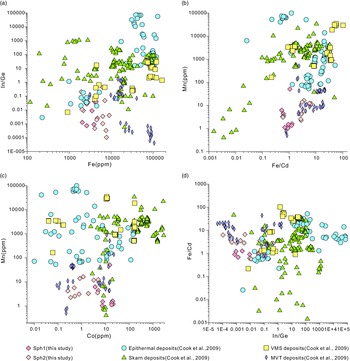
The GGIMFis geothermometer of sphalerite (78–198 °C; Table 3) indicates that the ore-forming fluids responsible for Pb–Zn–Cu mineralization have an intermediate to low temperature. This signature is consistent with the temperature range of 75 to 200 °C typical of MVT deposits (Kesler et al. Reference Kesler, Appold, Martini, Walter, Huston and Kyle1995; Leach et al. Reference Leach, Sangster, Kelley, Large, Garven, Allen, Gutzmer and Walters2005, Reference Leach, Taylor, Fey, Diehl and Saltus2010; Fazli et al. Reference Fazli, Taghipour, Moore and Lentz2019). Additionally, the trace element signature of sphalerite and pyrite in sediment-hosted Pb–Zn deposits can be used to effectively distinguish whether magmatic fluid has been added to a hydrothermal system. Previous studies (Cook et al. Reference Cook, Ciobanu, Pring, Skinner, Shimizu, Danyushevsky, Saini-Eidukat and Melcher2009; Ye et al. Reference Ye, Cook, Ciobanu, Liu, Zhang, Liu, Gao, Yang and Danyushevsky2011) show that sphalerite from magmatic hydrothermal deposits (e.g. epithermal, skarn and VMS deposits) is typically characterized by elevated In, Sn, Mn, Co and Ga and low Ge and Cd contents, whereas that from non-magmatic or sedimentary deposits (e.g. MVT deposits) is typically enriched in Ge and Cd, with low Mn, In, Co and Sn contents. In the discrimination diagrams of Fe–In/Ge, Fe/Cd–Mn, Co–Mn and In/Ge–Fe/Cd (Fig. 12), both stages of sphalerite from the Tianbaoshan deposit display similar elemental compositions to MVT-related sphalerite, but are distinct from sphalerite from high-temperature deposits (e.g. epithermal, skarn and VMS deposits) directly associated with magmatism and/or volcanism (Fig. 12). This suggests that the Tianbaoshan deposit is likely a MVT deposit which is not directly associated with magmatism and/or volcanism. Notably, the low-temperature hydrothermal fluid resembles basinal brines responsible for MVT deposits, as shown in the As–Co–Ni ternary diagram (Fig. 13).
Binary plots of Fe vs In/Ge (a), Fe/Cd vs Mn (b), Co vs Mn (c) and In/Ge vs Fe/Cd (d) for sphalerite at Tianbaoshan compared with epithermal, VMS, skarn and MVT-type Pb–Zn deposits. Data from Cook et al. (Reference Cook, Ciobanu, Pring, Skinner, Shimizu, Danyushevsky, Saini-Eidukat and Melcher2009).

Plot showing Co–Ni–As content variation of pyrite in Tianbaoshan deposit (modified from Gong & Ma, Reference Gong and Ma2011).

Throughout the main Tianbaoshan orebodies, the predominant ore-controlling factors are the dolostone host rocks and the NNW-trending faults, which yield in wedge-shaped bodies with sharp boundaries with the host rocks (Fig. 3a–b). Due to the ore-controlling factors, the ores have textures that reflect replacement of the carbonate host rock and open space filling (Fig. 5) with a simple alteration style (silicification and carbonation), and contain a simple mineral assemblage, comprising sphalerite and minor chalcopyrite, pyrite and galena (Fig. 5). Moreover, there is a lack of igneous rocks in the Tianbaoshan area, except for few diabase dykes cross-cutting the sulphide orebodies (Figs 1d, 2). These features are typical of those observed in MVT deposits (Leach et al. Reference Leach, Sangster, Kelley, Large, Garven, Allen, Gutzmer and Walters2005). Therefore, we suggest that the Tianbaoshan deposit is an MVT deposit and has no genetic relationship with magmatism.
6.3. Fluid mixing as the main ore-forming process
A mixing model involving two different component fluids, a metal-rich solution and a H2S-rich solution, has frequently been proposed to explain MVT ore deposition, which provides an important means of generating the large volumes of carbonate dissolution and sulphide precipitation in sedimentary carbonate rocks (Anderson & Garven, Reference Anderson and Garven1987; Ghazban et al. Reference Ghazban, Schwarcz and Ford1990; Mazzullo & Harris, Reference Mazzullo and Harris1992; Qing & Mountjoy, Reference Qing and Mountjoy1994; Corbella et al. Reference Corbella, Ayora and Cardellach2004). Previous studies (Samson & Russell, Reference Samson and Russell1987; Maul, Reference Maul1991; Banks & Russell, Reference Banks and Russell1992; Eyre, Reference Eyre1998; Everett et al. Reference Everett, Wilkinson, Rye, McCaffrey, Lonergan and Wilkinson1999) suggest that the metal-rich fluid is characterized by low temperatures (70–120 °C) and high salinities (17–28 wt % NaCl equiv.) and that the H2S-rich fluid is characterized by middle-low temperatures (170–230 °C) and middle salinities (8–12 wt % NaCl equiv.). The former was considered to be a typical basinal brine (Leach, Reference Leach1979; Coveney et al. Reference Coveney, Goebel and Ragan1987; Shelton et al., Reference Shelton, Bauer and Gregg1992; Basuki & Spooner, Reference Basuki and Spooner2002), and the latter was interpreted as magmatic water (Samson & Russell, Reference Samson and Russell1987), metamorphic water (Russell, Reference Russell, Tarling and Runcorn1973; Phillips, Reference Phillips1983) and/or deep circulating seawater (Russell, Reference Russell1978; Samson & Russell, Reference Samson and Russell1987). Based on fluid inclusion and H–O isotope studies (Yang et al. Reference Yang, Zhang, Wang, Zhong and Liu2018; Wang et al., Reference Wang, Zhu, Wang, Jia, Shi, Chen and Xu2021, the ore-forming fluids of the Tianbaoshan deposit are characterized by a large range in temperature (87–273 °C) and salinity (3–22 wt % NaCl equiv.), which was mainly sourced from basinal brine with the addition of metamorphic water.
The mechanism of sulphide mineral precipitation could be constrained by the origin of H2S in the mixing model. The reduced sulphur is derived from thermochemical sulphate reduction (TSR) and/or from bacterial sulphate reduction (BSR) (Ghazban et al. Reference Ghazban, Schwarcz and Ford1990). The available temperature range for BSR is 30 to 45 °C (Orr, Reference Orr1974), and the upper limit is 84 °C (Trudinger et al. Reference Trudinger, Chambers and Smith1985). There is no doubt that the conditions for BSR are not suitable at elevated temperatures (78–198 °C) for sulphide deposition at Tianbaoshan. In terms of identifying the sulphur source (e.g. seawater sulphate or gypsum), the range in sulphur isotope fractionation caused by BSR is larger than the isotope fractionation of 15–25 ‰ obtained by TSR (Ohmoto & Goldhaber, Reference Ohmoto, Goldhaber and Barnes1997). At Tianbaoshan, the δ34S values of all sulphide minerals (3.9 to 9.3 ‰) fall within the range of δ34S values produced by TSR (Fig. 11). Therefore, it is most likely that the mixing model involving thermochemical sulphate reduction is the main mechanism for Tianbaoshan ore formation.
Support for this mechanism comes from the tube-like shape of the main orebody (Figs 2, 3a–b) which is compatible with the deposit filling a void that was produced by dissolution of the host dolomite. In addition, a large number of dissolved structures are observed in the Tianbaoshan deposit, e.g. caverns and breccias (Fig. 5). The host rock remnants are suspended within the massive ore (Fig. 5a–b), and many sulphides grow around host rock breccias in brecciated ore (Fig. 5c, e–f) where the host rock fragments exhibit deformation structures. These physical features indicate that replacement of the host dolostones by ore fluids is volumetrically significant and the ore was formed simultaneously with the cavity which it fills. Moreover, some cavities are also present in the massive sulphide ore and are filled with calcite (Fig. 5a–b, d, f), indicating that calcite formation postdates sulphide mineralization. The processes in this model can be expressed as three reactions:
 $${{{\rm{H}}_2}{\rm{S\ production}}\,{\rm{reaction}}:{\rm{SO}}_4^2 + {\rm{C}}{{\rm{H}}_4} = {{\rm{H}}_2}{\rm{S}} + {\rm{CO}}_3^2 + {{\rm{H}}_2}{\rm{O}}}$$
 $${{\rm{Sulphide \ precipitation \ reaction:}}\,{{\rm{H}}_2}{\rm{S}} + {\rm{Z}}{{\rm{n}}^{2 + }} = {\rm{ZnS}} + 2{{\rm{H}}^ + }}$$
 $$\matrix{{{\rm{Mg}- \rm{rich}}\;{\rm{carbonate}}\;{\rm{dissolution}}\;{\rm{reaction}}:{\mkern 1mu} {\rm{CaMg}}{{\left( {{\rm{C}}{{\rm{O}}_3}} \right)}_2} + 4{{\rm{H}}^ + }} \hfill \cr {\quad = {\rm{C}}{{\rm{a}}^{2 + }} + {\rm{M}}{{\rm{g}}^{2 + }} + 2{\rm{C}}{{\rm{O}}_2} + 2{{\rm{H}}_2}{\rm{O}}} \hfill \cr } $$
Based on this model, H2S from Eq. 1 can generate acid by precipitating sulphide (Eq. 2). This, in turn, may cause dissolution and brecciation of adjacent carbonate rocks (Eq. 3). Thus, dissolution and brecciation could occur at the same time as mineralization. Although carbonate and sulphide cannot precipitate together, the association of sulphide minerals (e.g. pyrite, sphalerite and galena) and quartz (Figs 6a–d, 7e–f) indicates that silicification occurred in the host rock during sulphide mineralization (Anderson & Garven, Reference Anderson and Garven1987).
There are two mechanisms of sulphate reduction in the mixing model. One is that sulphate-bearing fluid encountered hydrocarbon within the flow path and produced H2S-bearing fluid that was carried to a mixing site with the introduction of metal-bearing fluid (Ghazban et al. Reference Ghazban, Schwarcz and Ford1990; Plumlee et al. Reference Plumlee, Leach, Hofstra, Landis, Rowan and Viets1994). Alternatively, both the sulphate-bearing fluid and metal-bearing fluid arrived at the mixing site which already contained the reducing agent (e.g. hydrocarbon) (Crocetti & Holland, Reference Crocetti and Holland1989; Leventhal, Reference Leventhal1990; Anderson, Reference Anderson1991). However, the eventual reaction is interaction between a H2S-bearing fluid and a metal-bearing fluid at the deposition site (e.g. carbonate host rock). These processes can be constrained by studying the components of the ore-forming fluids. Most data from fluid inclusions in sphalerite (Yu et al. Reference Yu, Wei and Hu2015; Wang et al., Reference Wang, Zhu, Wang, Jia, Shi, Chen and Xu2021; Yang et al. Reference Yang, Zhang, Wang, Zhong and Liu2018) indicate that the vapour phase was mainly composed of H2O and CO2, with only minor reduced species (e.g. CH4). In addition, reducing materials (e.g. bitumen) are not observed in the hand specimens (Fig. 5). Therefore, it is most likely that sulphate reduction took place before ore precipitation rather than during ore precipitation. Evaporite (e.g. gypsum) from the Sinian Dengying Formation and Cambrian Xixiangchi Formation (Zhu et al. Reference Zhu, Zhang, Liang and Li2006) provides an important source for generating reduced sulphur. Based on the characteristics discussed above, we suggest that regional groundwater flowed through evaporate-rich strata and encountered sulphate reduction to form H2S-rich fluid, mixed with metal-rich fluid ascending through the fault at the deposition site, and eventually caused massive sulphide mineralization together with significant carbonate dissolution.
These data and interpretations are important for Pb–Zn–Cu exploration in the Tianbaoshan ore district. An exploration model should focus on: (1) the combining studies of specific structures and alteration in the host rock, especially extensive dissolved structures (caverns and breccias) and prominent silicification assemblages; and (2) developing a quantitative index of the sulphides, namely a uniform sulphur isotope signature and an intermediate- to low-temperature feature of characteristic trace elements (e.g. Mn, In, Ge and Cd), which can be used for providing geochemical tools or index systems to identify and exploit deposits.
7. Conclusions
(1) Sulphides from the Tianbaoshan deposit, consisting of pyrite, chalcopyrite, sphalerite and galena, are typically contained within space-filling structures (massive and brecciated) and textures (relic texture, poikilitic texture, caverns and fracture-filling veins). These textural relationships reveal that the sulphide minerals underwent four paragenetic stages: early stage (Py1) of pyrite relics (Stage 1); early stage (Cp1) of coarse-grained, elliptical crystal chalcopyrite (Stage 2); main stage of dark-coloured, fine-grained sphalerite (Sph1) and light-coloured, coarse-grained sphalerite (Sph2) (Stage 3); and late stage (Py2, Cp2 and Gn) of sulphide veinlets (Stage 4).
(2) Textures in the main sulphides including Py1, Cp1, Sph1 and Sph2 demonstrate mutual inclusion relationships from core to rim and they have nearly uniform sulphur isotope signatures (5.5–8.3 ‰), which is the result of different stages of mineralization throughout a continuous hydrothermal system.
(3) The Tianbaoshan deposit resembles a typical MVT-type deposit, with dolostone host rock, open space filling and a weak alteration style. Sphalerite and chalcopyrite geothermometer studies indicate that the ore-forming fluid was an intermediate- to low-temperature (< 200 °C) hydrothermal system. The low contents of Mn and In, low In/Ge ratios and high Fe/Cd ratios in sphalerites, and high S/Fe mole ratios, low Se contents and high S/Se ratios in pyrites are consistent with those of MVT deposits but are different than those of magmatism-related deposits (i.e. epithermal, skarn and VMS deposits).
(4) The Tianbaoshan deposit developed extensive dissolved structures (caverns and breccias) with massive sulphide infillings and deformed host rock remnants, suggesting that replacement of the host dolostones by ore fluids was volumetrically significant and the ore formed simultaneously with the cavity formation. Both carbonate dissolution and sulphide formation can be attributed to mixing between a H2S-rich fluid and a metal-rich fluid with thermochemical sulphate reduction occurring before ore precipitation rather than during ore precipitation.
Supplementary material
To view supplementary material for this article, please visit https://doi.org/10.1017/S0016756822001054
Acknowledgements
We are greatly indebted to Senior Engineer Shun-Ping Qin (Sichuan Huili Zinc & Plumbum Company Limited) for the assistance during fieldwork. This research was supported by the opening funding of State Key Laboratory of Ore Deposit Geochemistry, Institute of Geochemistry, Chinese Academy of Sciences (Grant No. 202008), the Science and Technology Project of Sichuan Province (No. 2022YFS0451), and the Science and technology Project of Tibet Autonomous Region (No. XZ202102YD0024C, XZ201801-GB-01).