I begin not with Vernon Lee, née Violet Paget (1856–1935), but with Walter Pater, the pivotal mentor and literary model for Lee, and Laurel Brake's 1994 analysis of Pater's books of essays: “[T]he bound volume is the form in which the essays, extracted from their periodical context, are known today, if they are known at all.”Footnote 1 The fountain spring of his works was periodical publication, yet “the production process whereby writing is translated from the ephemeral of the periodical essay into the permanence of the book engineers the obscuring of the ephemeral characteristics and, most important, origins, even to the original readers of the book.” By omitting from the prestige book any essay that elicited adverse reaction or silence, moreover, Pater could reshape as he also constructed himself as author.Footnote 2 Brake remains one of the few periodicals scholars today to address the serialized book of essays.Footnote 3 As she explains in a 2017 article,
From the 1840s, authors of non-fiction such as critics and historians used the opportunity periodicals afforded to publish longer works in fragments, and to make books of disparate pieces. Thomas Babington Macaulay and Francis Jeffrey were among the earliest journalists to gather their journalism into books of collected essays, but Algernon Swinburne's Essays and Reviews in 1866, Walter Pater's Appreciations in 1889, and Oscar Wilde's Intentions in 1891 were books comprised of similar material. Matthew Arnold's Essays in Criticism (1865) and Walter Pater's Studies in the History of the Renaissance (1873) indicate a different relation to the press. These were volumes of criticism that used the press to develop ideas for manuscripts. Arnold and Pater placed pieces, later to appear as chapters, in periodicals first, envisaging the later opportunity to select from them and revise them for book publication. This plan allowed them to gain income at two points, as they wrote and on publication of the first edition.Footnote 4
Lee was clearly of their company, a journalist who followed Pater's periodical-into-book process while likewise constructing herself as an aesthetic critic. The point can easily be extracted from the 1983 bibliography of Lee's books and periodical writings compiled by Phyllis Mannocchi, and Ana Vadillo opens her entry on Lee in the Dictionary of Nineteenth-Century Journalism by straightforwardly terming her a “journalist and critic.”Footnote 5 Yet Lee scholars rarely write about Lee's journalistic practice. Vineta Colby notes Lee's frequent contributions to periodicals but does not call it journalism, applying that term only to opinion pieces on current social and international affairs in weekly papers after 1900.Footnote 6 Christa Zorn cites Lee as a “regular contributor to some of the foremost critical journals” with over fifty entries in the Wellesley Index to Victorian Periodicals.Footnote 7 But this datum appears only in Zorn's preface; nor is there an entry on “journalism” in Zorn's index. To redress this scholarly lacuna, and to expand understanding of imbricated journalism and high aestheticism beyond Henry James, Pater, and Oscar Wilde, to name the most prominent examples, I examine Lee's journalism in periodicals that she carefully targeted in the 1870s and 1880s, with an emphasis on the longer pieces that constituted her slow serialization of successive books.Footnote 8 I also analyze the deliberation with which Lee retroactively re-presented her gathered articles as books, then conclude by considering how slow essay serials might be conceptualized.
According to Colby, “Launching her ambitious project to write a history of eighteenth-century Italian opera, Violet Paget became Vernon Lee.” Colby acknowledges that Studies of the Eighteenth Century in Italy (1880) originated in Fraser's Magazine (see the appended table of Lee's serialization-into-book record) but asserts that the essays “written as separate pieces and published first as articles” produced a book with “remarkable unity of effect.”Footnote 9 Those “separate pieces,” however, underwent very minor changes in becoming book chapters. The major change was a new introduction that explicitly and painstakingly positioned the “separate pieces” as a book:
This book is at first sight heterogeneous and anomalous: heterogeneous, because it treats two subjects which are rarely treated by one individual, and never treated under one binding, literature and music. . . . The book is seemingly most incoherent in subject, and most incomplete and digressive in treatment. But the apparent incoherence of subject is in reality unity of treatment: and the apparent incompleteness and irrelevance is in reality completeness and restriction of the subject.Footnote 10
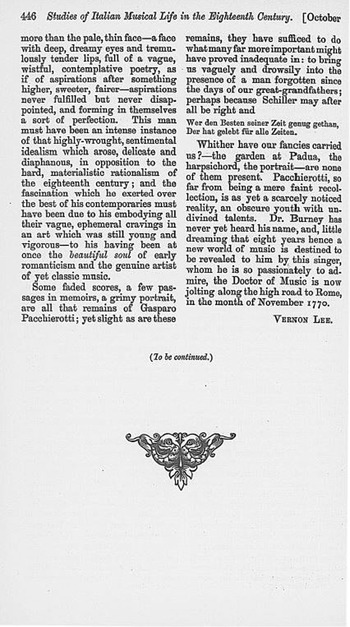
Rather than taking Lee at her word, I find it more useful to see what is unstated and unincluded—any acknowledgment of prior periodical publication, for one.Footnote 11 Unlike her practice starting with Belcaro (1881) of listing periodicals from which disparate chapters had been gathered, Lee excluded acknowledgment of prior periodical publication in 1880, or the fact of serialization. Yet the book's chapters, published in the same sequence they followed in book form, were at times published in two parts (“The Arcadian Academy”) or three (“The Musical Life,” “Metastasio and the Opera”), each part ending, “To be continued” accompanied by a designated ornament (see figure 1).
Studies in the Eighteenth Century installment in Fraser's Magazine (October 1878)

Lee's paratexts preclude any explanation of why her serial, which made her name and her identity as an aesthete and critic, appeared in Fraser's specifically, rather than in another journal. I suggest that it was likely Fraser's own publishing fortunes that made it possible for her to be featured so continuously in 1878 and 1879. In his introduction to Fraser's in the Wellesley Index, Walter Houghton comments on the magazine's editorship:
[James Anthony] Froude tried to resign in 1871, but not being able to find a successor, carried on until the death of his wife in 1874. William Allingham, who had been sub-editor since 1870, took over. Though a minor poet of some distinction, he had neither Froude's force nor his literary connections. Francis Newman and A. K. H. Boyd continued to write, and Allingham's friend Carlyle sent him a few papers, as did Froude, but on the whole the contributors were undistinguished, and worst of all from a commercial point of view, there was not a single novel coming out serially at a time when that was essential for the success of a magazine. By 1879 a crisis was reached.Footnote 12
Given Houghton's focus (shared by most scholars of his era) on canonical writers, it is unsurprising that Houghton makes no mention of Lee, who was certainly noncanonical in 1968, and a quirky woman writer to boot. Even so, there was some truth in classing this literary newcomer as “undistinguished” when she began serializing her book. Lee had as yet made no mark.Footnote 13 That very circumstance would have made it easier for her to gain access to Fraser's pages, and Allingham may well have been grateful to have a serial, albeit a nonfiction serial, filling his monthly pages.
Immediately preceding and contemporaneously with her Fraser's serialization, Lee was unquestionably operating as a journalist, completing unsigned omnibus essay-reviews, the format begun in quarterlies early in the century, in the conservative Quarterly Review, founded in 1809, and in the British Quarterly Review, a cosmopolitan Nonconformist outlet.Footnote 14 Additionally, during this period, she contributed a signed article to the New Quarterly Magazine, Oswald Crawfurd's short-lived hybrid of magazine and quarterly, and a light travel essay to Fraser's, which the literary newcomer took care to sign “V. Paget” rather than Vernon Lee. These were on congenial subjects—musical expression in the eighteenth century, contemporary Italian poets, Taine's aesthetic philosophy of literature and music, Tuscan peasant plays—but they too overtly betrayed their journalistic roots and Lee never republished them, a task made easier by her unsigned work.Footnote 15 That these pieces represented journalism is clear from her May 6, 1878, letter to Linda Villari:
I have been recorrecting the proofs of my article on Taine, which I am thankful will really appear in July. As to writing I am absolutely checkmated, both by refusals & acceptances, & don't know whither to turn; Fraser still delays the publication of the Arcadi, and there is an immense heap of Burney waiting to be sent to him; the Cornhill is blocked by my accepted paper on the Bas Relief & by another similar one, written last year, which I thought was irrecoverably lost in Crawfurd's chaos; the British Quarterly has two articles accepted; the Westminster is still reading, or rather not reading, that unlucky Mozart, the Quarterly has broken with me, the Edinburgh has quarreled with me; . . . so you see I am entirely prevented from writing from want of outlets, from the accumulation of the produce of two years scribbling; for I don't think I can ever hit the taste of Grove, and as to the smaller fry, why . . .Footnote 16
Eager to publish and with a lively sense of differential orientations among periodicals, Lee was testing a gamut of journals. Of the articles her letter mentioned, the Arcadi and Burney became installments of the 1880 Studies, the Mozart a one-off in Blackwood's in 1882, the Orpheus an installment of Belcaro (1881), and the British Quarterly “Art of Singing” another one-off.
By the end of her last installment of Studies in Fraser's, Lee had established her presence in London journalism, as indicated by the prominence Allingham accorded her in successive issues. Her first Arcadi essay came last in the June 1878 issue, a usual berth for travel essays, foreign reporting, poetry, and “Ivy-Leaves,” Allingham's faux prose diary from an “Eastern Hermit” in Epping Forest to “Mr. Yorke,” which gave Allingham latitude to comment on anything he wished, from seasonal changes in nature to recent or long-known books.Footnote 17 But after the first installment Lee's work steadily moved upward, appearing in the middle or even near the beginning of monthly issues, an editorial signal of audience appeal.
Newly visible in London journalism and letters with her Fraser's serial and the success of Studies in book form, Lee could choose from a more eclectic range of journals for subsequent articles and avoid being blocked in one journal because some of her work was already in hand (see appendix). In contrast to the straightforward, regularly issued serialization of Studies, Belcaro was her first slow serial, emerging from articles in the Cornhill, Fraser's, and Contemporary Review. Assessing where she placed her articles demonstrates how shrewdly she targeted the work. “Orpheus and Eurydice: The Lesson of a Bas-Relief,” her first contribution to Cornhill under the editorship of Leslie Stephen, author of Hours in a Library (1874–79) and future editor of the Dictionary of National Biography, ultimately argued that visual art must be appreciated through its beauties of form, not through the imposition of verbal narratives or description. But the article itself was decidedly literary, since she began by comparing the Iliad and Nibelungen, Achilles and Siegfried, before moving on to Greek myth. This literary peroration precisely suited the Cornhill, which still featured serial novels and criticism. Few today would pair Vernon Lee with Margaret Oliphant as a contemporary, yet an Oliphant serial, which Vineta and Robert Colby term a “particularly bleak and unpleasant novel” about a jilted young woman's loveless marriage to a curate,Footnote 18 fronted the August 1878 issue, and Lee's “Orpheus” was wedged between an article on Lessing and Stephens's own prose serial, “Hours in a Library.” Two other Belcaro chapters first published in Cornhill were likewise literary, “Faustus and Helena,” Lee's theorization of writing supernatural imaginative works, and “Cherubino,” which traces Mozart's character to its origins in Beaumarchais's Le Mariage de Figaro (1784), with sidelights on Goethe's Mignon as a cross-gendered possible source.Footnote 19
“A Dialogue on Poetic Morality,” Lee's first “Dialogue,” appeared in Contemporary Review in May 1881 and became chapter 9 of Belcaro (1881). This was also important for introducing Baldwin, a character who extended across her periodical and book titles over time, like some of Trollope's or Oliphant's serial characters, except that Baldwin is a philosopher representing aspects of mind, especially Lee's mind, until she killed him off as Trollope did Mrs. Proudie in the 1894 introduction to Althea: “this shadowy personage, about whose real existence and identity I once seemed so certain, has ceased to exist. . . . Baldwin has died because, like certain insects, he was organized to live only a few days. He belonged, like many of our dead selves, of the youthful predecessors of our identity.”Footnote 20 Having left behind her former youthful ideas articulated by Baldwin, she explains, she has therefore introduced Althea, who begins as Baldwin's student but who, over the course of the dialogues, matures and becomes a newly authorized intellectual avatar of Lee.Footnote 21 All essays in the 1894 volume thus revolve around the new female figure.
Baldwin, however, still “living,” figured importantly in Lee's periodical articles and books from 1881 to November 1892 before he was exiled—and criticized as boring—in Althea's final installment in May 1893, then killed off in 1894.Footnote 22 The Contemporary, which excluded serial fiction, was just the right placement for a Baldwin essay or other philosophical papers. James Knowles, who succeeded Henry Alford, dean of Canterbury, as editor in 1870, had established a firm base for Metaphysical Society authors in this Christian liberal periodical, which ran on an “open platform” policy. When he departed in 1877 to found Nineteenth Century, the policy remained in place as proprietor Alexander Strahan and E. H. Plumptre took over. With the arrival of Percy Bunting as editor in 1882, the journal pursued a more activist agenda and greater attention to international issues.Footnote 23 Lee came increasingly to function as a Contemporary house author, as the serial patterns of Baldwin, Althea, and Renaissance Fancies (1895) indicate (see appendix). As Lee boasted in negotiating an article placement in a June 7, 1883, letter to T. H. S. Escott, the 1882 successor to John Morley at the Fortnightly Review, “the Contemporary accepts my papers previous to my writing them; and if you turn to its May number, you will see what sort of stuff to expect”—a reference to a Baldwin dialogue.Footnote 24
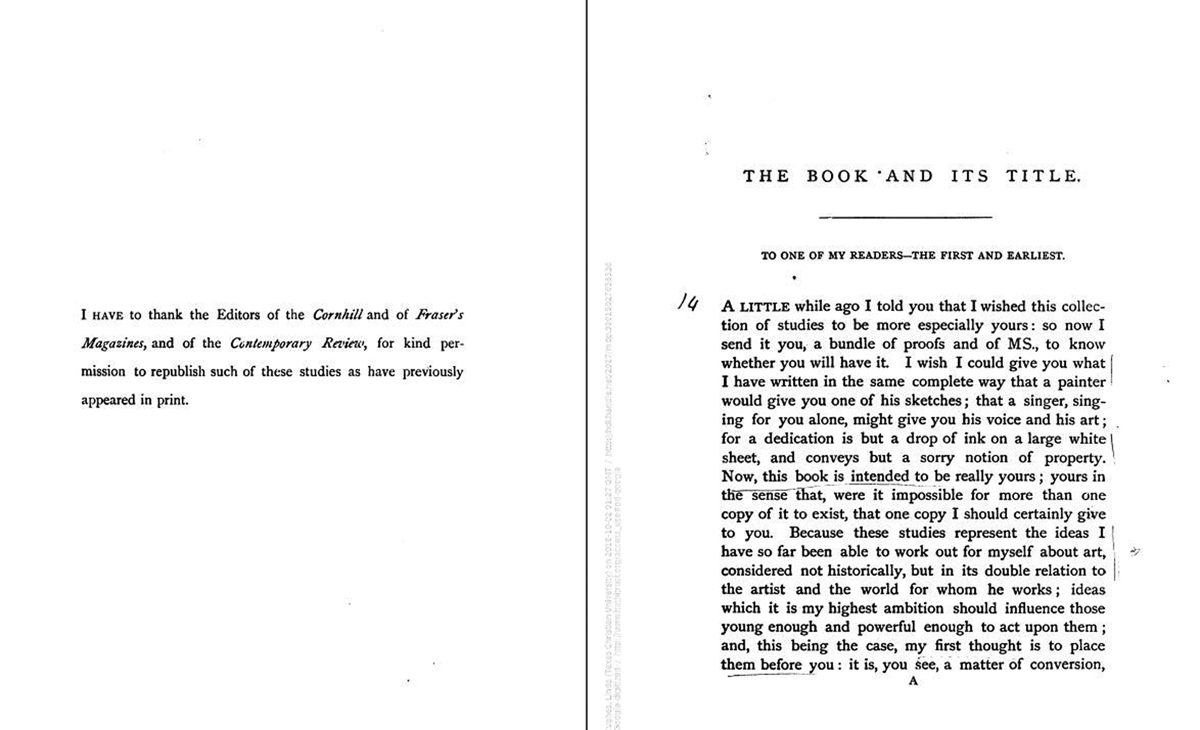
In contrast to Studies in the Eighteenth Century, Lee included across from her introduction to Belcaro an acknowledgment of prior publication in journals, which also functioned as a tacit demonstration to other periodical editors of demand for her work (see figure 2). She never hid the truth of this book's print origins. Yet the acknowledgment makes for evident friction with the introduction to her 1881 volume, which, for those who know about the volume's serial origins, captures Lee in the act of “book”-making. Belcaro, which added two previously unpublished chapters, the introduction, and a postscript to Lee's serial articles, marks not only (in Colby's eyes) Lee's transformation from “historical scholar to aesthetic critic” but also her public declaration of herself as lesbian lover through her dedication to poet A. Mary F. Robinson and her introduction addressed solely and wholly to Robinson.Footnote 25 For Lee transformed piecemeal publication into bookish wholeness through an act of romantic love: “Now, this book is intended to be really yours; yours in the sense that, were it impossible for more than one copy of it to exist, that one copy I should certainly give to you.”Footnote 26 The introduction does more than merely transmit the volume to Robinson, however, because Lee asserts that the entire meaning of this volume is bound up with and in Robinson, whom Lee met in Florence in September 1880 after having already published three of the book's chapters in periodicals: “a meaning the name [‘Belcaro’] has: a meaning of association. For . . . during the time of making up this volume, I have been haunted by the remembrance of that winter afternoon, when last we were together, on the battlements of Belcaro” (Belcaro, 2).Footnote 27 Lee then fictionalized an alternative source for the book, not in the 60 percent of chapters first published in periodicals (see appendix), but in “helter-skelter notes” in her personal commonplace books: “Such a collection of notes this volume most unmetaphorically is: it is literally a selection of such pages out of my commonplace books as seemed alone and solely afforded by art itself” (Belcaro, 5–6).Footnote 28 Later still in the introduction she indicates an oral and bodily origin for these very notes: “though in their written shape merely copied out from a confusion of quite heterogeneous notes, [individual thoughts] have nearly all . . . , while they were living, . . . come mainly in the presence of works of art, or in discussions with friends.” But from these conversations “in the fire-lit winter afternoons, with the crackle of wood and the crackling of sparks” or other settings, “In order to endure, they had, these ideas, to be removed out of all this living frame-work; to be written down, . . . to be made quite lifeless and inorganic” (Belcaro, 6–7). Ultimately, in Lee's representation of them, these sociable conversational origins of her book are as elusive and apparitional as the ghosts in her model of supernatural writing that she theorized in “Faustus and Helena,” the article first published in Cornhill Magazine (August 1880) before becoming chapter 4 of Belcaro (see appendix).
Acknowledgment of prior periodical publication in Belcaro

Lee's bookmaking with its newly created center of gravity also inheres in what she “forgets” in writing the introduction. In declaring that at the end of writing Studies the historical scholar had become extinct and a new “myself” had arisen as a student of aesthetics in the 1881 book (Belcaro, 4), Lee apparently forgot that the earliest published piece of Belcaro, “Orpheus and Eurydice,” had appeared in the very middle of the ongoing serialization of Studies in Fraser's. Additionally, Lee's Belcaro introduction asserts the organic growth of her mind after she encountered the thought of Herbert Spencer, which enabled her to correct fallacies in “Chapelmeister Kreisler” “in the adjoining essay called Cherubino” (Belcaro, 13), “forgetting” that “Cherubino” was the last serial part, published in August 1881, nearly three years after the Kreisler article. I am not suggesting that Lee dissembles about Belcaro's publishing history, given her opening acknowledgment of periodical publication. But to give Belcaro its book-ness, Lee romances the origins of her second book by adding a new creation, a creative story unified by love.
For the sake of brevity, I examine only one more serialized book here, Euphorion: Being Studies of the Antique and the Mediæval in the Renaissance, which resulted from six periodical articles in four different periodicals—many concurrently appearing along with Studies, Baldwin, and Juvenilia installments—before the volume was issued by T. Fisher Unwin on May 24, 1884.Footnote 29 In addition to the Contemporary and Cornhill, Lee returned to the pages of the British Quarterly Review, in which she had earlier published “Taine's Philosophy of Art” (July 1878). Both it and the 1882 contribution, “The Influence of the Italian Renaissance on the Elizabethan Stage,” were omnibus reviews with a list of books at the top rather than the article title (given as a running header on successive pages). But by 1882 Lee had learned to handle this print subgenre with greater finesse, ignoring the volumes before her (as she had not done in her Taine piece) and beginning with an essay-like sentence that could directly be transferred to her 1884 book. She had begun the Taine review, “If the five little volumes before us are less well known in this country than the ‘Notes sur l'Angleterre,’ the ‘Histoire de la Littérature Anglaise,’ and the recently published ‘Ancien Régime’ and ‘Révolution’ . . .” and so on for another four and a half print lines in a clumsily long sentence.Footnote 30 But some four years later she knew how to get directly to her real topic in a more concise opening sentence: “The chroniclers of the last years of the fifteenth century have recorded how the soldiery of Charles VIII. of France amused the tedious leisure of their sullen and suspicious occupation of Rome, by erecting in the camp a stage of planks, and performing thereon a rude mystery-play.”Footnote 31 That is to say, she had become a more sophisticated professional journalist.
By November 1882, Fraser's was defunct and succeeded by Longman's.Footnote 32 It is unsurprising that she therefore turned to Alfred Austin's National Review, a designedly conservative outlet.Footnote 33 It was due not to political differences but to Lee's concurrent journalism that “The Transformations of Chivalric Poetry,” the source from which all but the first section of the Euphorion chapter “The School of Boiardo” was carved, appeared under the signature “V. Paget.” In May 1883 Lee had published a second Baldwin dialogue in Contemporary Review, “The Responsibilities of Unbelief” (reprinted in Baldwin, 1886).Footnote 34 It caused an uproar. As Lee reported to her mother on August 3, Austin “says (private) that he wishes to use my paper, but that my signature cannot appear, as it is connected with ideas which, although they do not at all scandalize him, are scandalizing to the readers of the Nat. Review.”Footnote 35
Concurrence was a notable feature of Lee's journalism. During the irregular appearance of pieces that became Euphorion essays, Lee published articles on Renaissance painting that found a place in Juvenilia (1887), some music articles never reprinted, short travel narratives—two illustrated by Joseph Pennell—and book reviews for the Academy.Footnote 36 Concurrence likewise marked her slow seriality, so that, even while Belcaro articles were appearing, her early journalism later repurposed as Euphorion chapters came out in Contemporary Review. The temporalities of her serial books after Studies were thus decidedly irregular and overlapping. Indeed, the sequenced chapters Lee ordered for her 1884 volume were first published in periodicals, respectively, in March 1879, April 1882, January 1884, September 1879, May 1883, and November 1883 (see appendix).
In what had become (and would remain) standard practice for her, Lee again veiled her prior serialization when she published her resulting book. Nowhere in the periodical articles did the name Euphorion ever appear. Yet the title was essential to the book's cohesion, an act of naming that retroactively drew into unity chapters that had been accreting for the prior five years. She did not fashion a new bookmaking story in her introduction, though her dedication of the volume to Walter Pater was another act of love—as well as a declaration of her ambitions, inviting as it did her alignment with her mentor and model serialist.Footnote 37 Her epigraph from John Addington Symonds's Renaissance in Italy (1877) effected a referential triumvirate of same-sex lovers at the outset (Pater, Symonds, herself) while also signaling the source of consanguinity among her chapters. For the Symonds epigraph alluded to the encounter of medieval tradition with classical tradition that gave birth to the Renaissance: “Faustus is therefore a parable of the impotent yearnings of the Middle Ages. . . . The indestructible beauty of Greek art, whereof Helen was an emblem, became, through the discovery of classic poetry and sculpture, the possession of the modern world. Mediævalism took this Helen to wife, and their offspring, the Euphorion of Goethe's drama, is the spirit of the modern world.”Footnote 38
On November 11, 1882, Lee wrote that she was “in the thick of finishing a volume of mine on the middle ages & Renaissance”; yet, as noted above, Euphorion was not published until May 24, 1884.Footnote 39 As she noted in her newly written epilogue to the volume,
More than a year has elapsed since the moment when, fancying that this series of studies must be well-nigh complete, I attempted to explain in an introductory chapter what the nature of this book of mine is, or would fain be. I had hoped that each of these studies would complete its companions; and that, without need for explicit explanation, my whole idea would have become more plain to others than it was at that time even to myself. But instead, it has become obvious that the more carefully I had sought to reduce each question to unity, the more that question subdivided and connected itself with other questions.Footnote 40
If she imparts a developmental temporality to the book's composition, she also represents the process as a topography:
In those introductory pages written some fifteen months ago, I tried to bring home to the reader a sense which has haunted me throughout the writing of this volume; namely, that instead of having deliberately made up my mind to study the Renaissance . . . I have, on the contrary, quite accidentally and unconsciously, found myself wandering about in the spirit among the monuments of this particular historic region, even as I might wander about in the streets of Siena where I wrote last year, of Florence whence I write at present.Footnote 41
“Book”-ness here becomes a solid land within the space of which time passes according to its own peculiar temporality. Yet as would a series novelist, she also hints at a sequel to come: “Each of these studies of mine brings its own lesson. . . . But besides these I seem to perceive another deduction, an historical fact with a practical application . . . of the subtler sides of Mediæval and Renaissance life and art which at present occupy my mind and may some day add another series of essays to this.”Footnote 42 And indeed, when Renaissance Fancies and Studies appeared in 1895, it was subtitled A Sequel to Euphorion.
Lee's serialization of her books through and alongside her journalism, then, was a pervasive practice throughout her career until 1910, when the literary market shifted and she came more and more to write books without prior serialization. Her practice of transforming journalism into books traced in the three works discussed above should indicate one reason why Lee the journalist so rarely figures in approaches to her body of work: she expertly covered her tracks, a means by which she could create and circulate her authorial identity. She fashioned herself to herself as an autonomous philosophical aesthetic critic free to write exactly as wished, a point she made to others as well. When Mary Ward suggested in 1893 that Lee write regular reviews to establish a public for herself, Lee responded, “The advice is excellent. . . . But I find that I should have to write on actualities, new books, new editions, at the choice of an Editor. . . . I cannot sacrifice all intellectual private life to reading up for articles. . . . So I am determined [I] will not read a book unless it conduces to my education as a human being or to my pleasure, which comes to the same.”Footnote 43
The dynamics of the fin de siècle field of cultural production, to use Pierre Bourdieu's term, would also have inclined her to avoid aligning herself with journalism—all too easily aligned with commodification and writing to order rather than autonomous philosophical commentary in books about art and aesthetics. Other high-prestige writers could also exert pressure on her, as her letter to A. Mary F. Robinson on April 25, 1884, indicates. J. A. Symonds had written appreciatively about her review of his book on Shakespeare but questioned Lee's dedication to higher literary criticism because she had spent time writing a review. Privately, Lee discloses that the money she earned motivated some of her work:
I cannot but smile at the notion of my being insufficiently serious & scrimmaging for literary nonsense. Scrimmaging for a hundred a year were more like it. I will read his answer to mine. I have looked into my conscience, & see that I have twice written for money, i.e. Raphael & Ctss Albany; but not once, not once from a desire to make myself conspicuous. I am too conceited for that; and the pleasure in literary success is mainly the pleasure in anticipating money or social advantages.Footnote 44
Certainly the review to which Symonds responded was not her only review in 1883–84, for she produced a spate of them.Footnote 45
Lee also recorded her awareness that what she could and did publish in a periodical mediated and partly shaped what eventually appeared in a book, as her letter to Percy Bunting at the Contemporary on December 30, 1884, indicates: “Shall I send you a paper on the ‘Ethics of the Novel’ upon which I am at work? It will be the companion piece of the ‘Dialogue on Poetic Morality’ which appeared in the Contemporary for May ’81, & was reprinted in my book Belcaro.” After outlining the proposed dialogue she added, “I shall write this dialogue at any rate, for the sake of a future book of ‘Opinions of Baldwin’; but the fact of publishing it first in the Contemporary will naturally greatly affect the structure; so I must beg you to be so very kind as to let me have an immediate answer.”Footnote 46 The “paper” duly appeared as “A Dialogue on Novels” in September 1885 and took its place as the chapter “On Novels” in Baldwin the next year (see appendix). In November 1886 she also offered to shorten her article on “The Imaginative Art of the Renaissance” for Bunting should it prove overlong; this contribution appeared in the Contemporary in April 1887.Footnote 47
Over the course of the 1880s, as noted above, Lee became something of a house author at the Contemporary, and she acknowledged her desire to maintain her position before readers of the Contemporary in 1890, when Lee was unable to complete a new article on the timeline she had agreed to. She was still suffering from ill health and depression after Mary Robinson had left her own close companionship to marry Frenchman James Darmesteter. Her “‘Imaginary Portrait’ of a Renaissance Painter” on which she had begun work had proven to be a complex process, and for the time being she did not feel up to the task. As she wrote to Bunting on February 25, 1890: “I should like to keep before yr readers, however. So I want to know whether I should copy out some old notes of mine on various Catholic churches. . . . I should unite them with numbers under the title – ‘In Church: heretical impressions.’”Footnote 48 Despite this illness, however, she remained an adept and cagey negotiator regarding pay, as can be seen in her adroit interweaving of assertiveness and a show of deference in her May 23, 1890, letter to Bunting:
I want to tell you, what is rather difficult to say; namely, that I want you, if you can, to raise my pay. The New Review has given me, without demurring, £40 for twenty pages (or about) and it doesn't seem fair to make them pay more than other people. Besides, I not only find that my writing can command more, but also that I require more. This I submit to you, adding however that if you cannot, I would rather stay on the Contemporary with less pay than go elsewhere with more. Let me have a postcard.Footnote 49
Presumably her ploy worked, for after editor Harry Quilter pleaded for a submission to his Universal Review, Lee wrote to her mother on August 10, 1890:
Harry Quilter, a cad who edits the Universal Review wrote to ask whether he might call & ask for some work. When he was told that owing to my engagements with the Fortnightly & Contemporary I could at present give him only fiction, he said he could take fiction only from well known writers; then I had the satisfaction of telling him that his terms were only half of what I got elsewhere, so we parted.Footnote 50
Lee, then, could maneuver quite well in the periodicals market as a journalist. At the same time, Quilter's comment about whose fiction he did and did not recruit was not entirely unjust. The novel on which Lee expected to found her subsequent career, Miss Brown (1884), failed to find favor with the critics and the public. On the other hand, the volume of “fantastic” tales she published in the same year that Quilter snubbed her, Hauntings, today forms perhaps her most important—and certainly most widely read—literary legacy. But for the time being she remained known to editors as what she had called herself in the preface to her earliest sustained fiction, Ottilie (1883): an “essayist,” just as her publishing history lends support to her terming essays a “trade” in that work.Footnote 51 Here “essays” could plausibly refer to books, to serials, or to one-off ephemera in periodicals.
The temporalities of Lee's essay serials, certainly, were decidedly irregular and overlapping as well as slow. How should these serials be conceptualized? All serials are marked by continuity as well as temporal gaps and disruptions, as James Mussell asserts of periodicals and as Sean O'Sullivan remarks of contemporary television series.Footnote 52 If an essay serial lacks the “momentum” of a story coming out regularly that fascinates its readers, as did Wilkie Collins's The Woman in White (1859–60), O'Sullivan points out that some TV serials also resist momentum, as with the “end-stopped” episodes of Mad Men, each “sealing itself off from its predecessor and successor.”Footnote 53 Akin to fictional series books, an author's invention of essay personae for articulating ideas could even generate serial characters who “lived” beyond individual articles and underwent character development, as with Allingham's “Eastern Hermit” in his essay serial Ivy-Leaves (first published in Fraser's) or Lee's Baldwin dialogues.Footnote 54 An essay serial, moreover, like an ongoing TV series, enabled its creators to discern what met with cordial reception or hostility.Footnote 55 Lee, despite the hostility elicited by her Baldwin dialogue “The Responsibilities of Unbelief,” defiantly included it as the opening chapter of Baldwin (1886), but the knowledge of earlier audience repulsion enabled her to mediate its unconventionality and relation to her own authorial persona in her volume edition. She argued on the opening page that Baldwin resided in “a borderland between fact and fancy” where he quite comfortably occupied “a very actual habitation”; and she further distanced herself as author from the character she birthed by refusing to deny or entirely assert her identity with him: “I am the pupil of Baldwin, the thing made by him, or he is my master, yet made by me; choose and understand, for I cannot. I agree in all his ideas; yet I can place myself at the point of view of some of his opponents. . . . I agree with Baldwin, and, agreeing, I sometimes dislike him.”Footnote 56 In both embracing and denying her protagonist, Lee refuses to submit to public censure for his unbelief yet concedes grounds for disliking him, and ultimately displaces the matter onto the process of creating a fictional character. If in the preface to Belcaro she romanced her book's origins, here she mystifies the process of authorial creation.
As Brake observes, essay serials were a shrewd means adopted by author-journalists to generate material for their books and also be paid twice, an arrangement likewise congenial to serial fictionists. Still, the temporalities and materialities of essay versus story serials differ in fundamental ways. Above all Lee's essay-serials (Studies of the Eighteenth Century in Italy excepted) were so irregular and unpredictable in appearance, with gaps between parts as long as two years and more, that they generated a queer kind of seriality. And the invocation of that term may be applicable insofar as Lee's periodical serialization and her sexuality both involved a degree of cloaking: neither her serial processes nor her lesbianism were manifest in materialities immediately visible to observers.Footnote 57
The fiction chronicle (especially Walter Scott's) recently theorized by Maia McAleavey is another partial model for Lee's essay serials, since both forms feature “the episodic over the finite” and an ability “to move from piecemeal assemblages to a linear stretch of time,” resulting in a “narrative outside of teleology.”Footnote 58 Fiction chronicles, too, like a serial, must display both continuity and disruptions. Continuity did define the gathered essays that Lee reinvented as books through her titles and introductory essays. But no such means united Lee's serial parts as they issued forth. One self-evident source of continuity and unity in Lee's slow serials, of course, derived from Lee's mind, thought, and authorial personality—the Vernon Lee brand, so to speak, or more simply Lee the author. To the degree that an essayist's regular readers constructed a fiction of “their” author, the slow-serialist could become an antimimetic serial character, a fictional character created by readers whose author-character pointed to but fell far short of the complex bio-psychological being who produced serially issued essays.
One additional model or metaphor drawn from Victorian science is helpful in conceptualizing Lee's essay serials. Addressing the pervasive publishing and reception of Victorian fiction and poetry serials, Michael Lund and I point to the nascent temporalities of deep time and evolution as one of several contributing factors in naturalizing serial form for Victorian readers.Footnote 59 For Lee's and Pater's slow essay serials, an alternative model drawn from Victorian science is helpful, the nebular hypothesis of the origins of the solar system advanced by Pierre Simon de Leplace and extended by William Herschel. This theory, like Charles Lyell's geology and pre-Darwinian evolutionary theory, infiltrated Victorian literature, so that the opening of canto 4 of Alfred Tennyson's The Princess (1847) and section 118 of his In Memoriam (1850) allude to the nebular hypothesis. A late-century explication of the nebular hypothesis indicates continuing interest in the concept. In the 1885 Our Corner, the free-thought magazine edited by Annie Besant and contributed to by Thomas Huxley, William Morris, and E. Nesbit, among others, Laurence Small contributed a highly accessible explanation of “The Nebular Theory.”Footnote 60 Beginning with “an impalpable haze spread through a spherical space, the diameter of which was many times greater than that of the present diameter” of the solar system and marked by at least “slight” rotation, the “haze began to lose heat, . . . and as it lost heat the force of gravitation caused the mass to become smaller by driving the particles closer together. . . .” Ultimately, as “embryo planets” precipitated out with their own rotations, the nebula “pass[ed] from the gaseous through the liquid into the solid state.”Footnote 61 The nebular hypothesis suggests a useful analogue for the slow-essay serial as a form spread over space (viz., different periodicals) and reliant on unfolding time before becoming subject more and more to a gravitational center that, as the serial precipitates out from its periodical publication into book form, pulls the various components into a newly visible form of definite shape and unity hitherto undetected. I am not suggesting that the hypothesis was consciously wielded by Lee in shaping her slow serials. But this scientific concept of slow, irregular development is a period-specific conceptual model that was familiar to educated readers and can be a useful theoretical framework today.
As periodical and literary markets changed in the new century, Lee's opportunities to publish her essay serials faded, as is indicated by the increasing paucity of reprintings evident in Mannocchi's bibliography of Lee's periodical articles from 1870 to 1933. Lee accordingly turned to other vehicles as a writer, especially travel writing and occasional stories, as well as the opinion pieces that Colby identifies as journalism in weekly papers after 1900. Clearly, however, Lee engaged in journalism from the beginning to the end of her career and proved adept at negotiating with editors as well as targeting alternative periodicals for specific articles. But the essay serial was essential in launching Lee's writing career and (given the failure of Miss Brown) was her most successful means of establishing and sustaining her reputation as a writer of note—one who, in adopting the essay serial, also shored up her financial independence. Mapping and recovering Lee's journalism and slow seriality create a fuller picture of Lee's creativity, publishing strategies, and fashioning of her authorship for herself, her literary circles, and her publics as well as illuminate a serial process enacted by other writers. Seen in greater detail, Lee's emergence as a slow serialist is itself a fascinating long-form story over a three-decade period, a story now self-evident, now veiled, of her writing practices and success.
Appendix: Essay Serial Installments by Periodical Title, Date, Article Title, and Book Chapter Title
Studies of the Eighteenth Century in Italy (seci)—1880