


Conventional models of political decision-making implicitly assume that citizens form opinions about politics through conscious thought. Even if political attitudes ultimately derive from deep emotional attachments to group loyalties developed early in life (Campbell et al. Reference Campbell, Converse, Miller and Stokes1960), people nonetheless consciously survey the considerations that are at the “top of their heads” at the moment of making a decision (Zaller Reference Zaller1992). The past two decades of research in the neurosciences challenges this simple and intuitive assumption. Much of human decision-making takes place outside of conscious awareness (Bargh and Chartrand Reference Bargh and Chartrand1999). The brain nonconsciously processes information, automatically imbuing it with emotional content, allowing only a fraction to reach conscious awareness. Even though people are unaware of “seeing” subliminally presented images, for instance, the emotional states that they cause influence unrelated decisions (Brooks et al., Reference Brooks, Savov, Allzén, Benedict, Fredriksson and Schiöth2012).
These insights have just begun making inroads into political science. Extraneous stimuli, such as music embedded in advertising or images presented outside of conscious awareness, can induce emotional reactions that influence political attitudes and evaluations (e.g., Albertson and Gadarian Reference Albertson and Gadarian2015; Banks and Valentino Reference Banks and Valentino2012; Brader Reference Brader2006; Lodge and Taber Reference Lodge and Taber2013). From the perspective of conventional models of political decision-making, these findings seem like parlor game tricks that fail to capture how people actually form political attitudes. Perhaps in a laboratory, the argument could go, people act in strange ways, but automatic processes should have less influence in real world settings where people have the time and space to engage in conscious reflection.
However, once we consider that the automatic processes in the human mind evolved well before conscious cognition, it makes sense that the brain should be quite capable of making complex and important life-and-death decisions without needing input from the conscious mind. Indeed, from this perspective, the automatic processes’ speed and ability to continually scan the environment are crucial (e.g., Gray Reference Gray1987). Over the course of human evolution, the mind was endowed with many specialized mechanisms designed to deal with recurring threats faced by our ancestors (Barkow, Cosmides, and Tooby Reference Barkow, Cosmides and Tooby1992; Cesario et al. Reference Cesario, Plaks, Hagiwara, Navarrete and Higgins2010; Petersen Reference Petersen2015). Because different threats often require unique responses, these mechanisms use different emotional states—anxiety, disgust, jealousy, etc.—to motivate different behaviors (Cottrell and Neuberg Reference Cottrell and Neuberg2005). In modern democratic societies, a key function of government is to enact policies that provide security and safety from external threats. Thus, there is reason to expect that the deep-seated evolved mechanisms that helped our ancestors defend against threats also influence current-day policy preferences (Petersen Reference Petersen2015).
In this article, we demonstrate the effects of an important specialized set of mechanisms designed to protect humans from threats caused by pathogens: the behavioral immune system (e.g., Schaller Reference Schaller2006). The behavioral component of the immune system works outside conscious awareness (Tybur et al. Reference Tybur, Lieberman, Kurzban and DeScioli2013) and uses feelings of disgust to motivate avoidance of potentially infected objects and people (e.g., Schaller and Neuberg Reference Schaller and Neuberg2012). Because pathogens can be lethal but extremely hard to detect, the behavioral immune system evolved to be hypervigilant against unfamiliar stimuli, including unfamiliar individuals. In the evolved mind, we argue, differences in appearance (such as the color of one's skin) are intuitively misinterpreted as cues of infectious diseases, rather than harmless differences in levels of melanin. As the history of institutionalized racial segregation and current day opposition to immigration show, public discourse readily associates contamination risk with outgroups, seeking to separate supposedly unclean outgroups from the clean (or “pure”) ingroup.
We investigate the political implications of the behavioral immune system's hypervigilance by studying its effect on opposition to immigration. We focus on immigration, because it is one of the most divisive issues in Western democracies today (e.g., Brader, Valentino, and Suhay Reference Brader, Valentino and Suhay2008; Citrin et al. Reference Citrin, Green, Muste and Wong1997; Malhotra et al. Reference Malhotra, Margalit and Mo2013; Sniderman et al. Reference Sniderman, Hagendoorn and Prior2004). Indeed, the rise of anti-immigration candidates and parties is fundamentally reshaping the political landscapes in both the United States and Europe. In particular, we argue that individuals with sensitive behavioral immune systems (i.e., those who are prone to experience disgust) unconsciously tag immigrants as bearers of pathogens and experience strong motivations to avoid them. In building this theoretical claim, we incorporate disgust and the behavioral immune system into the standard political science models of emotional processing. These models have emphasized anxiety as the key emotion motivating vigilance against perceived threats (e.g., Albertson and Gadarian Reference Albertson and Gadarian2015; Brader, Valentino, and Suhay Reference Brader, Valentino and Suhay2008; Markus, Neuman, and MacKuen Reference Marcus, Neuman and MacKuen2000). Yet, an emerging line of research suggests that disgust may be distinct from anxiety and give rise to unique behavioral responses (Banks and Valentino Reference Banks and Valentino2012). At the same time, however, there is no clear consensus about the exact nature of these responses. Originally, researchers proposed that disgust underlies motivations to adopt conservative ideologies as a way to avoid negative outcomes (Hibbing, Smith, and Alford Reference Hibbing, Smith and Alford2014; Terrizzi, Shook, and McDaniel Reference Terrizzi, Shook and McDaniel2013), but recent findings suggest that disgust shapes support for “protective” policies, be they liberal or conservative (Kam and Estes Reference Kam and Estes2016). Such disparate findings call for a more refined perspective on the politics of disgust (cf. Banks and Valentino Reference Banks and Valentino2012).
To meet this call, this article utilizes an evolutionary perspective on disgust to reach four specific goals. First, using evolutionary principles, we refine and extend extant theoretical models of emotional processing in political science. Second, we critically evaluate empirical studies in the biological and psychological sciences that advance the claim that the behavioral immune system shapes immigration attitudes (e.g., Faulkner et al. Reference Faulkner, Schaller, Park and Duncan2004, Green et al. Reference Green, Krings, Staerklé, Bangerter, Clémence, Wagner-Egger and Bornand2010, Navarrete and Fessler Reference Navarrete and Fessler2006) through a meta-analysis, uncovering a number of empirical and theoretical gaps. Third, we address these gaps through a suite of observational and experimental studies drawn from nationally representative samples in the United States and Denmark. We find consistent evidence that the behavioral immune system shapes immigration attitudes over and beyond standard explanations in extant political science models: education, ideology, and economic interests. Finally, we consider the broader implications of the notion that unconscious pathogen-avoidance motivations lead some people to adopt particular political attitudes. Specifically, we demonstrate, for the first time, how individual differences in the propensity to feel disgust frustrate standard social science approaches to facilitating acceptance of ethnic differences. We conclude by discussing how the behavioral immune system may generate ideological belief systems that cut across the constraints generated by dominant elite discourse.
THE BEHAVIORAL IMMUNE SYSTEM AND DISGUST
Disease constitutes a fundamental threat to human fitness, and the immune system is our most complex physiological system dedicated to the challenge of defending against pathogens. What may perhaps be less appreciated is that over the course of evolution, humans also developed a behavioral immune system at the psychological level that continuously scans for potential pathogen threats (e.g., infected food, objects, or people) outside of cognitive awareness and, upon detection, motivates individuals to take precautions that help avoid coming into contact with pathogens in the first place (Oaten, Stevenson, and Case Reference Oaten, Stevenson and Case2009; Schaller and Duncan Reference Schaller, Duncan, Forgas, Haselton and von Hippel2007; Schaller and Neuberg Reference Schaller and Neuberg2012; Tybur et al. Reference Tybur, Lieberman, Kurzban and DeScioli2013).
The behavioral immune system operates through a cluster of psychological mechanisms that activate both affective and cognitive responses designed to counter perceived pathogen threats. Pathogens are invisible to the naked eye and, at the dawn of humankind, completely outside of human knowledge (Tybur and Lieberman Reference Tybur and Lieberman2016). To avoid pathogens, however, our ancestors did not need to know of their existence, just to behave as if they did. This is the evolved function of the automatically operating behavioral immune system. Specifically, the behavioral immune system is designed to defend against pathogens by treating specific cues “as information regarding the statistical likelihood that pathogens are present” (Tybur and Lieberman Reference Tybur and Lieberman2016, 7). These cues reflect the “superficial sensory signals” that over the course of evolution correlated with pathogen presence, such as wounds or bodily fluids (Schaller and Duncan Reference Schaller, Duncan, Forgas, Haselton and von Hippel2007, 296). Importantly, the system is not perfectly calibrated to detect the presence of actual pathogens. Instead “given the asymmetry in costs of false alarm versus misses” (Tybur and Lieberman Reference Tybur and Lieberman2016, 7), it is hypervigilant and errs on the side of treating any cue of disease as a potential threat.
Once the behavioral immune system identifies a potential pathogen threat, it activates its consciously accessible output: feelings of disgust that motivate individuals to retreat from potentially infected objects (Tybur, Lieberman, and Griskevicius Reference Tybur, Lieberman and Griskevicius2009). As a basic human emotion (along with, e.g., anger, anxiety, and sadness), disgust exists across cultures (Tomkins and McCarter Reference Tomkins and McCarter1964) and exhibits common physiological features, such as universally recognized facial expressions and nausea (Rozin, Haidt, and McCauley Reference Rozin, Haidt, McCauley, Lewis and Haviland-Jones2000).
Given the crucial role that disgust plays within the behavioral immune system, we find it useful to place it in the context of the affective intelligence theory (Markus, Neuman, and MacKuen Reference Marcus, Neuman and MacKuen2000), which is the standard model for how emotions shape political attitudes and behavior. Drawing on Gray's (Reference Gray1987) work, the affective intelligence model contends that specific emotions arise from two neural systems that operate continuously and automatically to sort information we encounter, identify dangers and threats, and provide feedback about how to attain our goals (e.g., survival). The disposition system evaluates whether our goals are being met. When they are, we experience enthusiasm, providing positive feedback, and when they are not, we experience sadness as a form of negative feedback. The surveillance system scans the environment for threats and draws our attention when a perceived threat is present. The affective intelligence model concentrates on the role that anxiety plays in focusing our attention toward dealing with the threat, and perhaps as a result, the lion's share of work on how perceived threats (e.g., from economic instability or terrorism) affect political attitudes and behavior focuses on anxiety (e.g., Albertson and Gadarian Reference Albertson and Gadarian2015; Arceneaux Reference Arceneaux2012; Brader Reference Brader2006; Brader, Valentino, and Suhay Reference Brader, Valentino and Suhay2008).
Yet different types of threats require different behavioral responses (Kenrick et al. Reference Kenrick, Griskevicius, Neuberg and Schaller2010). Pathogen threats are distinct from other evolutionarily recurrent threats, such as violence or predators, in that one cannot see pathogens nor confront them effectively through brute force. If one accidentally consumes tainted food, for instance, the best strategy is to expel the contents of one's stomach quickly. Disgust achieves this particular behavioral response through nausea and vomiting. It also motivates people to avoid sources of potential contamination and engage in precautionary behaviors, such as washing.
As a system for threat management, we place the behavioral immune system within the surveillance system of the affective intelligence model.Footnote 1 Its purpose is to scan for pathogen threats and trigger disgust when detecting cues that the behavioral immune system associates with the presence of pathogens. Although the behavioral immune system focuses on the specific motivational output and effects of disgust, we are not asserting that anxiety plays no role. Just as anxiety and anger work in tandem to confront controllable threats (Valentino et al. Reference Valentino, Brader, Groenendyk, Gregorowicz and Hutchings2011), it is quite possible that anxiety helps activate the behavioral immune system. The important point is that disgust plays an independent role in motivating people to retreat and take protective behaviors in the face of pathogen threats, and this has distinct implications for people's political attitudes.
BEHAVIORAL IMMUNE SENSITIVITY AND POLITICAL ATTITUDES
The behavioral immune system can influence political attitudes by predisposing people to prefer specific policies, particularly ones that reduce the likelihood of coming into contact with pathogens (real or imagined). Given the automatic operations of the behavioral immune system (Tybur et al. Reference Tybur, Lieberman, Kurzban and DeScioli2013), individuals may not be conscious that their attitudes are shaped by psychological mechanisms designed to protect from pathogens.
Although all humans possess a behavioral immune system, the sensitivity of this system varies across individuals (e.g., Schaller and Duncan Reference Schaller, Duncan, Forgas, Haselton and von Hippel2007, 299). Some people are more easily disgusted, worry more about contamination, and avoid sources of pathogens more actively than others. Just as it would have been disastrous for our ancestors to indiscriminately approach all objects and people in the environment, it would have been equally disastrous to forgo establishing new potentially beneficial relationships by avoiding all contact. Therefore, individuals must trade off the cost and probability of becoming infected with the cost and probability of foregoing cooperation and exchanges (Aarøe, Osmundsen, and Petersen, Reference Aarøe, Osmundsen and Petersen2016; Tybur and Lieberman Reference Tybur and Lieberman2016). These costs and probabilities vary across individuals and contexts (see Al-Shawaf and Lewis Reference Al-Shawaf and Lewis2013; Fessler, Eng, and Navarrete Reference Fessler, Eng and Navarrete2005; Fessler and Navarrete Reference Fessler and Navarrete2003). Accordingly, the behavioral immune system is “functionally flexible,” calibrating its response to the threat posed by the environment (Curtis, de Barra, and Aunger Reference Curtis, de Barra and Aunger2011) and the individual's ability to cope with it (Schaller and Duncan Reference Schaller, Duncan, Forgas, Haselton and von Hippel2007).
For our purposes, variation in disgust sensitivity provides a window into how the behavioral immune system shapes political attitudes. People who become disgusted easily should be more apt to support policies that reduce (or seem to reduce) their probability of coming into contact with pathogens. We demonstrate the political implications of the behavioral immune system by investigating its effects on opposition to immigration, which has emerged as a consequential and polarizing fault line in Western democracies over the past decades. Extant research in political science points to two broad factors that contribute to opposition to immigration: (1) the desire to preserve socially accepted cultural norms and values, particularly among individuals with less education and a less cosmopolitan worldview (e.g., Coenders and Scheepers Reference Coenders and Scheepers2003; Hainmueller and Hiscox Reference Hainmueller and Hiscox2007; Sniderman, Hagendoorn, and Prior Reference Sniderman, Hagendoorn and Prior2004; Wright, Citrin, and Wand Reference Wright, Citrin and Wand2012), and (2) concerns over economic competition and job insecurity, with low-income low-skilled individuals being more opposed (e.g., Brader, Valentino, and Suhay Reference Brader, Valentino and Suhay2008; Hainmueller and Hiscox Reference Hainmueller and Hiscox2010; Key Reference Key1949).
An emerging line of research, largely in the psychological and biological sciences, contends that opposition to immigration also arises from deeper psychological predispositions shaped by the behavioral immune system. This research proposes that immigrants can trigger the behavioral immune system and disgust reactions which motivate anti-immigration sentiments (e.g., Faulkner et al. Reference Faulkner, Schaller, Park and Duncan2004; Hodson et al. Reference Hodson, Choma, Boisvert, Hafer, MacInnis and Costello2013; Huang et al. Reference Huang, Sedlovskaya, Ackerman and Bargh2011, Navarrete and Fessler Reference Navarrete and Fessler2006). There are two possibilities for why the behavioral immune system perceives different others as potential pathogen threats. The first is that humans developed an adaptive predisposition against unfamiliar outgroups, because individuals from other groups and regions potentially carried different pathogens during our evolutionary history (e.g., Faulkner et al. Reference Faulkner, Schaller, Park and Duncan2004; Fincher and Thornhill Reference Fincher and Thornhill2012). The second possibility is that the proclivity to perceive different others as pathogen threats is a byproduct, rather than adaptive predisposition, of a tendency to be hypervigilant against anything and everyone that appears unfamiliar (Aarøe, Osmundsen, and Petersen Reference Aarøe, Osmundsen and Petersen2016). For instance, individuals tend to treat many physical deviations from the statistically normal phenotype within their ingroup as a sign of potential pathogen risk, especially deviations that are similar to actual disease symptoms such as rashes, swelling, and discoloration.Footnote 2 Hypervigilance may even extend beyond signs of physical abnormality to unfamiliar behavioral practices that may connote pathogen risk (e.g., poor hygiene or unfamiliar food habits) (Fessler and Navarrete Reference Fessler and Navarrete2003).
The superficial differences to which the behavioral immune system is attuned—whether as an adaptation or as a byproduct—are the hallmark of modern-day ethnic differences and routinely animate concerns about immigration. Consequently, physical as well as cultural differences may be mentally tagged by the behavioral immune system as signs of pathogen risk, eliciting disgust, and causing people to avoid contact with ethnically different individuals and prefer restrictive immigration policies. As we explain above, we should not observe this outcome for everyone. Rather, individuals with higher behavioral immune sensitivity are more likely to react negatively to perceived sources of pathogens, including immigrants (e.g., Faulkner et al. Reference Faulkner, Schaller, Park and Duncan2004).
Given the novelty of this theoretical framework to political science, we undertook a systematic meta-analysis of the 16 articles published between 2004 and 2014 that investigate the link between measures of behavioral immune sensitivity and opposition to immigration. A complete description can be found in Online Appendix A1–2. From the 16 articles, we coded 66 empirical tests of the relationship between behavioral immune system sensitivity and immigration attitudes.Footnote 3
The majority of the tests (66%) corroborate the basic prediction that disgust sensitivity is associated with opposition to immigration. Although our meta-analytical review offers sufficient evidence to take the notion seriously that behavioral immune sensitivity correlates with opposition to immigration, it also reveals a number of gaps in this body of scholarship. All of the studies draw on convenience samples (mostly students) in a single country (mostly Canada). They tend to be underpowered and report bivariate correlations between behavioral immune sensitivity and immigration attitudes. Of the observational tests that do include controls, almost all of them fail to account for some of the most central factors identified in political science research as correlates of immigration attitudes: education and income (e.g., Citrin et al. Reference Citrin, Green, Muste and Wong1997; Coenders and Scheepers Reference Coenders and Scheepers2003; Espenshade and Calhoun Reference Espenshade and Calhoun1993; Hainmueller and Hiscox Reference Hainmueller and Hiscox2007; McLaren Reference McLaren2001). Only two studies use an experimental manipulation of disgust to establish the general causal effect of behavioral immune sensitivity on immigration attitudes. At the same time, however, it should be noted that some experimental studies have moved beyond a main effect of behavioral immune sensitivity and investigated potential conditional effects (see Online Appendix A2.1). A central focus in these studies is whether cues related to disease threat moderate the effect of behavioral immune sensitivity on opposition to immigration (e.g., Huang et al. Reference Huang, Sedlovskaya, Ackerman and Bargh2011; Reid et al. Reference Reid, Zhang, Anderson, Gasiorek, Bonilla and Peinado2012; see Online Appendix A2.1 for a review). However, the existing studies testing this central claim (Huang et al. Reference Huang, Sedlovskaya, Ackerman and Bargh2011; Reid et al. Reference Reid, Zhang, Anderson, Gasiorek, Bonilla and Peinado2012) draw on small samples (n = 58–146), increasing the risk of both false negatives and false positives. In sum, the meta-analysis indicates that the extant literature is characterized by limitations related to external and internal validity and is limited in its integration and comparison with key political science explanations.
INTEGRATING POLITICAL SCIENCE AND RESEARCH ON THE BEHAVIORAL IMMUNE SYSTEM: OVERVIEW OF AIMS AND SAMPLES
The findings from the meta-analytical review call for more systematic assessment of the relationship between behavioral immune system sensitivity and immigration attitudes. We believe it is of vital importance to do so for two reasons.
First, this potential relationship offers a crucial test case for whether deep-seated behavioral predispositions, largely working outside of conscious awareness and rooted in a computational architecture shaped by evolution, can influence public opinion on specific, pressing political issues. If so, it implies that political scientists cannot simply reduce individual disagreements over public policy to economic and sociological explanations, underscoring the breadth of insight gained from including biology in our theoretical models of political behavior (e.g., Fowler and Schreiber Reference Fowler and Schreiber2008; McDermott Reference McDermott2009; Petersen Reference Petersen2012; Smith et al. Reference Smith, Oxley, Hibbing, Alford and Hibbing2011).
Second, to the extent that opposition to immigrants is even partially motivated by pathogen avoidance, it has far-reaching, novel, and testable implications for understanding how obstacles to achieving ethnic social integration may be more deep-seated and more difficult to eradicate than extant research implies. We directly theorize and test how the effects of the behavioral immune system on anti-immigration attitudes compare to and interact with the factors that political scientists consider fundamental to the politics of immigration and ethnic tolerance. We demonstrate how the behavioral immune system frustrates the effects of the two dominant pathways to peaceful ethnic co-existence according to classical political science research: (1) motivations to fit in and contribute to society and (2) intergroup contact (e.g., Allport Reference Allport1954; Brader, Valentino, and Suhay Reference Brader, Valentino and Suhay2008; Pettigrew et al. Reference Pettigrew, Tropp, Wagner and Christ2011; Pettigrew and Tropp Reference Pettigrew and Tropp2006; Sniderman and Hagendoorn Reference Sniderman and Hagendoorn2007).
Achieving these goals, however, requires rigorous empirical tests of the link between behavioral immune sensitivity and immigration attitudes that account for alternative explanations. To this end, we employ a cross-national research design comprising a number of cross-sectional surveys as well as survey and laboratory experiments collected in the United States and Denmark. The United States and Denmark are both Western democracies, yet in this context they provide a comparison akin to a Most Different Systems Design. The United States was largely populated through immigration from all over the world, whereas Denmark is ethnically homogenous and has historically had low levels of immigration. In addition, the United States and Denmark face different challenges from current waves of immigration, with generous Danish welfare programs making immigration particularly costly (Sniderman et al. Reference Sniderman, Petersen, Slothuus and Stubager2014). Our research design thus allows us to test whether our theoretical argument applies across these historical and current contingencies.
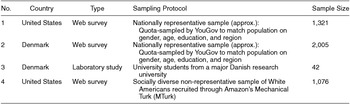
All together, we rely on four samples, summarized in Table 1 (see Online Appendix A3 for sample characteristics and sampling procedures). Crucially, these studies allow us to (1) increase internal validity by utilizing both experimental designs and observational designs with extensive statistical control for potential confounding variables related to sociodemographics, personality, and political ideology (Samples 1–2 and 4); (2) increase measurement validity by the demonstration of convergent effects from an array of self-reported measures of behavioral immune sensitivity drawn from previous studies (see Online Appendix A4.1) and an unobtrusive physiological measure of disgust sensitivity (Sample 3); and (3) increase external validity through nationally representative samples of Americans and Danes (Samples 1–2).
The Four Samples

TEST 1: ARE INDIVIDUALS HIGH IN BEHAVIORAL IMMUNE SENSITIVITY MORE OPPOSED TO IMMIGRATION?
The purpose of the first test is to investigate the effect of behavioral immune sensitivity on anti-immigration attitudes, using representative cross-national survey data as well as physiological measures. It provides a basic test of whether general individual differences in attention and reactivity to pathogenic material translate into attitudinal differences on the issue of immigration. Furthermore, it allows us to compare the effects of behavioral immune sensitivity with traditional measures related to opposition to immigration—in particular, income (e.g., Espenshade and Hempstead Reference Espenshade and Hempstead1996) and education (e.g., Citrin et al. Reference Citrin, Green, Muste and Wong1997; Espenshade and Hempstead Reference Espenshade and Hempstead1996).
Materials and Methods
In all four studies, opposition to immigration was measured using a scale including six items, such as “Immigrants improve American [Danish] society by bringing in new ideas and cultures” (see Online Appendix A4.2). Answers were measured on seven-point scales ranging from “Strongly disagree” to “Strongly agree” (αUS Sample 1 = 0.84, αDK Sample 2 = 0.84, αDK Sample 3 = 0.76; αUS Sample 4 = 0.84). The scale was recoded to range from 0 to 1, with higher values indicating higher opposition to immigration.
To measure individual differences in behavioral immune sensitivity, our research strategy was to include several measures, including three of the most established scales in the literature as well as self-reported and physiological measures. This increases measurement validity and allows us to assess replicability and robustness of the findings (see Online Appendix A4.1.1). In the U.S. and Danish nationally representative surveys (Samples 1–2), we utilize the original five-item contamination disgust subscale from the DS-R (Haidt, McCauley, and Rozin Reference Haidt, McCauley and Rozin1994; modified by Olatunji et al. Reference Olatunji, Williams, Tolin, Sawchuk, Abramowitz, Lohr and Elwood2007). The contamination disgust subscale taps “disgust reactions based on the perceived threat of transmission of contagion” (Olatunji et al. Reference Olatunji, Williams, Tolin, Sawchuk, Abramowitz, Lohr and Elwood2007, 285) and is based on items from “the most widely used instrument for assessing disgust propensity” (van Overveld et al. Reference van Overveld, de Jong, Peters and Schouten2011, 325). Answers to all five items (e.g., “I never let any part of my body touch the toilet seat in public restrooms”) were measured on five point scales (αUS Sample 1 = 0.67, αDK Sample 2 = 0.61; αUS Sample 4 = 0.67, see Online Appendix A4.1.2 for item wordings). The five-item contamination disgust scale was recoded to range from 0 to 1, with higher values indicating higher sensitivity.Footnote 4
In Sample 3, we replicate the results from Samples 1–2 with a physiological measure of sensitivity to disgusting stimuli. As pathogen avoidance motivations can operate outside consciousness awareness, they can be difficult to fully capture in self-reports (Smith et al. Reference Smith, Oxley, Hibbing, Alford and Hibbing2011). Hence, an advantage of a physiological measure is that it can gauge “nonconscious and nonreportable” responses (Balzer and Jacobs Reference Balzer and Jacobs2011, 1302; Cacioppo, Tassimary and Bernston Reference Cacioppo, Tassinary, Bernston, Cacioppo, Tassinary and Bernston2007, 2). In the Danish laboratory study, individual differences in behavioral immune sensitivity were measured using the participants’ skin conductance response (SCR) while viewing six images related to infection risk and disease on a computer screen. The participants’ SCR provide a behavioral measure of individual differences in physiological arousal in response to the stimuli (Oxley et al. Reference Oxley, Smith, Alford, Hibbing and Miller2008; Smith et al. Reference Smith, Oxley, Hibbing, Alford and Hibbing2011; see Online Appendix A4.1.3 for details). Skin conductance responses to the six images were summed into a single scale ranging from 0 to 1, with higher values indicating strong physiological response to the images of infection risk and disease.
In Sample 4, we probe the robustness of the results from Samples 1–2 by also including the more recent and well-validated seven-item pathogen disgust scale from the Three Domain Model of Disgust (Tybur, Lieberman, and Griskevicius Reference Tybur, Lieberman and Griskevicius2009) and eight-item germ aversion factor from the Perceived Vulnerability to Disease scale (Duncan, Schaller, and Park Reference Duncan, Schaller and Park2009). The pathogen disgust scale measures individual differences in sensitivity to disgust within the pathogen domain that “functions to motivate avoidance of infectious microorganisms” (Tybur, Lieberman, and Griskevicius Reference Tybur, Lieberman and Griskevicius2009, 117). Germ aversion measures “aversive affective responses to situations that connote a relatively high likelihood of pathogen transmission” (Duncan, Schaller, and Park Reference Duncan, Schaller and Park2009, 542). Hence, contamination disgust, pathogen disgust, and germ aversion all measure individual differences in behavioral immune sensitivity. Accordingly, past studies show strong correlations between contamination disgust and pathogen disgust (r = 0.66, Tybur, Lieberman, and Griskevicius Reference Tybur, Lieberman and Griskevicius2009, 116) and the germ aversion factor (r = 0.58, Duncan, Schaller, and Park Reference Duncan, Schaller and Park2009, 544) (see Online Appendix A4.1.1–A4.1.2 for all measurement details). Both the pathogen disgust scale and the germ aversion factor possess strong internal consistency (Duncan, Schaller, and Park Reference Duncan, Schaller and Park2009, 542; Tybur, Lieberman, and Griskevicius Reference Tybur, Lieberman and Griskevicius2009, 116) and generate reliable scales in Sample 4 (αPathogen = 0.83, αGerm = 0.76). Finally, in Sample 4 we also included the contamination disgust scale measured as in Samples 1–2 (αContamination = 0.67). All three scales range from 0 to 1, with higher values indicating higher behavioral immune sensitivity. The wording of all items in the three self-reported measures of behavioral immune sensitivity, supplementary measurement details for the physiological measure, descriptive statistics, and description of the survey flow are reported in Online Appendix A4.1. and A4.3.
We control for gender, age, education, income, ideology, and race (U.S. Sample 1) in the representative Danish and U.S. Samples 1–2; for gender, age, and ideology in the Danish laboratory sample of students (Sample 3); and for gender, age, education, income, ideology, and personality as indexed by the Big Five (Mondak et al. Reference Mondak, Hibbing, Canache, Seligson and Anderson2010, 29) in the U.S. MTurk Sample 4 (but not race because all respondents are White). See Online Appendix A4.2 for measurement details for all control variables.
RESULTS
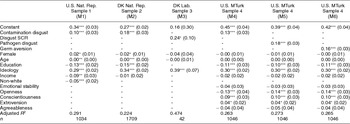
Are individuals with high behavioral immune sensitivity more opposed to immigration? Table 2 reports the effects of behavioral immune sensitivity on opposition to immigration in all four samples. As our expectations are directional, all tests of statistical significance are one-tailed.
The Effects of Behavioral Immune Sensitivity on Opposition to Immigration in the United States and Denmark

Note: Entries are unstandardized OLS regression coefficients. Standard errors in parentheses. All variables range between 0 and 1, except for age, which is measured in years. *p < 0.05, **p < 0.01, ***p < 0.001, one-sided tests.
The findings in Table 2, Models 1–2, show that across representative samples drawn from highly different national contexts, contamination disgust correlates with opposition to immigration (b US Sample 1 = 0.10, p < 0.001, b DK Sample 2 = 0.18, p < 0.001). This relationship exists over and beyond the effects of standard demographic correlates of prejudice and anti-immigration attitudes: income and education. The findings in Models 1–2 indicate that the effect of contamination disgust on opposition to immigration is comparable to the effect of education, a central predictor of opposition to immigration in prior political science research (e.g., Citrin et al. Reference Citrin, Green, Muste and Wong1997; Coenders and Scheepers Reference Coenders and Scheepers2003; Espenshade and Calhoun Reference Espenshade and Calhoun1993; Hainmueller and Hiscox Reference Hainmueller and Hiscox2007; McLaren Reference McLaren2001). Also, the effects of contamination disgust are generally larger and more robust than the effects of income. Finally, it is noteworthy that the effects of contamination disgust remain even when we control for political ideology. Previous research has established a link between ideology and prejudice (see Jost et al. Reference Jost, Glaser, Kruglanski and Sulloway2003) and ideology and disgust sensitivity (Inbar et al. Reference Inbar, Pizarro and Bloom2009; Smith et al. Reference Smith, Oxley, Hibbing, Alford and Hibbing2011). The findings in Table 2 show that disgust sensitivity is not simply a proxy for political ideology.
The results reported in Models 3–6 replicate the findings from the nationally representative surveys across Samples 3–4, i.e., the Danish lab sample and the U.S. MTurk sample. Employing a physiological measure of behavioral immune sensitivity, Model 3 demonstrates that unobtrusive biological responses to disgusting images correlate with opposition to immigration (b Model 3 = 0.24, p = 0.011).Footnote 5 (See Online Appendix A5.3 for robustness checks.) The effect of the physiological measure alleviates concerns with regards to potential low measurement validity of self-reported measures and, in line with the proposed role of immune response, provides crucial evidence that disgust-related opposition to immigration indeed emerges from visceral, physiological processes rather than cold cognition (see also Smith et al. Reference Smith, Oxley, Hibbing, Alford and Hibbing2011).
Finally, using three different measures, Models 4–6 show that the relationship between behavioral immune sensitivity and anti-immigration attitudes is robust across different operationalizations and in the face of indicators of demographics, income, education, and personality traits (b contamination disgust = 0.13, p < 0.001; b pathogen disgust = 0.18, p < 0.001; b germ aversion = 0.16, p < 0.001). It appears, therefore, that we are not simply observing a spurious relationship that is accounted for by domain-general predispositions, like ideology and personality (see Online Appendix A5.1–3 for robustness checks).
We also explored interactions between ideology and behavioral immune sensitivity in affecting anti-immigrant attitudes. In Samples 1–2 and 4, we find significant or marginally significant interaction effects so that the effect of behavioral immune sensitivity on opposition to immigration is intensified among more liberal respondents (see Online Appendix A5.4 for regression tables and discussion).Footnote 6 Consistent with their ideology, conservatives may oppose immigration for many reasons beyond pathogen avoidance. Among liberals, in contrast, a high behavioral immune sensitivity motivates people to support policy views that are at odds with their ideological outlook, creating the ideological inconsistency we observe here. We return to the broad implications of these findings in the conclusion.
In sum, across (1) well-powered representative and convenience samples from the United States and Denmark, (2) using physiological and self-reported measures of behavioral immune sensitivity, (3) and a rich set of control variables, the findings support that concern about pathogens increase opposition to immigration.
TEST 2: DISEASE PROTECTION DEACTIVATES THE LINK BETWEEN ANTI-IMMIGRATION ATTITUDES AND THE BEHAVIORAL IMMUNE SYSTEM
The purpose of Test 2 is to further test the contention that behavioral immune sensitivity is the causal agent for the effects established in Test 1. Specifically, Test 2 maximizes internal validity by employing a well-powered randomized experiment to evaluate the link between disease exposure and anti-immigration attitudes. In doing so, we test a hypothesis central to the existing literature (see the meta-analytical review): whether the degree of disease threat moderates the effect of individual differences in behavioral immune sensitivity on anti-immigration attitudes (see also Huang et al. Reference Huang, Sedlovskaya, Ackerman and Bargh2011; Reid et al. Reference Reid, Zhang, Anderson, Gasiorek, Bonilla and Peinado2012; and Online Appendix A2.1).
The behavioral immune system is a flexible system designed to take contextual and individual circumstances into account (Al-Shawaf and Lewis Reference Al-Shawaf and Lewis2013). An overly sensitive system motivates avoidance of people and increases the probability of foregoing new, potentially beneficial relationships (Aarøe, Osmundsen, and Petersen Reference Aarøe, Osmundsen and Petersen2016). Too little sensitivity, in contrast, leads to infection. One factor that the behavioral immune system could use to manage this trade-off is the level of exposure—perceived and real—to pathogens in the local environment. High exposure should strengthen pathogen avoidance motivations and, hence, the link between behavioral immune sensitivity and opposition to immigration (Curtis, de Barra, and Aunger Reference Curtis, de Barra and Aunger2011, 391; Fessler and Navarrete Reference Fessler and Navarrete2003). Exposure to disease protection should, in contrast, decrease the effect of behavioral immune sensitivity on opposition to immigration.
In Test 2, we consider the possibility that something as basic as hand washing may obviate the need for the behavioral immune system to activate social avoidance motivations (see also Huang et al. Reference Huang, Sedlovskaya, Ackerman and Bargh2011). Across cultures, people routinely engage in practices and behaviors aimed at reducing pathogen threat, with hand washing at the center of personal hygiene practices for centuries (Jumaa Reference Jumaa2005, 4). Indeed, the simple act of washing one's hands is the most effective strategy against the spread of infectious pathogens (Bhojani, D'Costa, and Gupta Reference Bhojani, D'Costa and Gupta2008, 15).
Measures
To test this prediction, we implemented the disease protection experiment in Sample 4. The experiment had two conditions. In both conditions, respondents read a detailed story about a hospital orderly who cleans up vomit. Respondents in the disease threat condition stopped here, while respondents in the disease protection condition read on to learn how the orderly carefully washed his hands in the freshly cleaned wash area afterwards (see Online Appendix A6–7 for full wording and manipulation checks). We code the experimental treatment as a dummy variable (1 = disease protection and 0 = disease threat). The treatment has a marginally significant direct effect on opposition to immigration (b = −0.02, p = 0.065, one-sided, n = 1037), indicating that it has relatively limited impact on anti-immigration attitudes independent of individual differences in behavioral immune sensitivity.
We measure opposition to immigration and individual differences in behavioral immune sensitivity using the same scales from Sample 4 as in Test 1. Importantly, to form the most encompassing and robust measure of behavioral immune sensitivity, we combine the three measures into a single highly reliable index ranging from 0 to 1 (α = 0.77). In Online Appendix A8.1 we offer replication analyses using the individual scales.
Results
Do cues of disease protection mitigate the effect behavioral immune sensitivity on opposition to immigration?
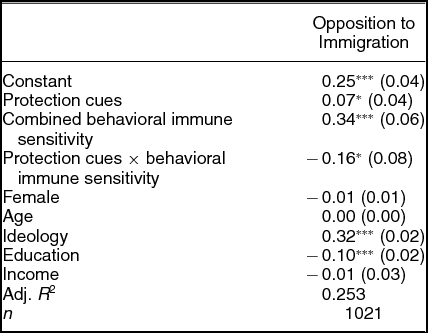
Table 3 shows the mitigating effect of infection protection cues on the relationship between behavioral immune sensitivity and opposition to immigration. The findings indicate that providing disease protection cues decreases the influence of behavioral immune sensitivity on anti-immigration attitudes (b = −0.16, p = 0.025) by 47% when compared to cues activating pathogen threat.Footnote 7 Testifying to the distinctness of the effects and psychological motivations of the behavioral immune system, no moderating effect of the treatment is observed on the effect of education and income (see Online Appendix A8.3). In addition, we measured respondents' level of anxiety after the treatment and, consistent with past research, we find that anxiety is positively correlated with opposition to immigration (Brader, Valentino, and Suhay Reference Brader, Valentino and Suhay2008). Moreover, consistent with our theoretical argument, the disease protection cue does not diminish the effect of anxiety while it continues to diminish the effects of behavioral immune sensitivity after controling for anxiety (see Online Appendix A8.4).
The Mitigating Effect of Infection Protection Cues on the Impact of Behavioral Immune Sensitivity on Opposition to Immigration

Note: Entries are unstandardized coefficients from a fixed effects model with state as group variable. Robust standard errors in parentheses. *p < 0.05, **p < 0.01, ***p < 0.001, one-sided tests.
In sum, we observe that simply eliminating the psychological experience of disease threat substantially attenuates the effect of the behavioral immune system on opposition to immigration. These experimental results effectively rule out concerns that the effects of pathogen avoidance are spurious. It plays a causal role in the formation of immigration attitudes and because hand washing is not logically connected with immigration attitudes, it ostensibly does so outside of one's conscious awareness.
TEST 3: THE BEHAVIORAL IMMUNE SYSTEM AND CUES IN IMMIGRATION DEBATES
We now investigate the broader implications of the effects of the behavioral immune system. In doing so, we push beyond previous studies by demonstrating how the behavioral immune system can undermine established pathways to ethnic tolerance in political science research.
Previous research suggests that tolerance toward immigrants increases when immigrants signal a motivation to fit in and contribute to society (e.g., Brader, Valentino, and Suhay Reference Brader, Valentino and Suhay2008; Hainmueller and Hiscox Reference Hainmueller and Hiscox2010; Sniderman, Hagendoorn, and Prior Reference Sniderman, Hagendoorn and Prior2004). Yet while credible signals of benign motivations in others decrease their threat level in a variety of contexts (cf. Fiske, Cuddy, and Glick Reference Fiske, Cuddy and Glick2007; Weiner Reference Weiner1995), the motivations of an individual and the threat posed by him or her as a potential pathogen host are fully uncorrelated. The pathogens are, in a very real sense, autonomous agents and the effects of the behavioral immune system should be unresponsive to cues about the goodwill of their perceived hosts.
In the context of immigration debates, the behavioral immune system should primarily respond to cues about differences in appearance and cultural lifestyles between immigrants and native populations and psychologically represent such differences as signs of infection risk. Consequently, the effects of the behavioral immune system on anti-immigration attitudes are first and foremost predicted to wax and wane with the familiarity of the immigrant group (e.g., Faulkner et al., Reference Faulkner, Schaller, Park and Duncan2004). As with disease protection cues (cf. Test 2), the link between behavioral immune sensitivity and anti-immigration attitudes should be weakened in the context of debates about immigrants who appear and act familiarly. In contrast, prosocial cues about immigrants’ benign intentions that otherwise promote tolerance (Sniderman, Hagendoorn, and Prior Reference Sniderman, Hagendoorn and Prior2004) should offer no comfort to those sensitive to pathogen threats.
Research design and measures
To test this prediction, we rely on the U.S. nationally representative Sample 1. The measure of behavioral immune sensitivity, contamination disgust, remains as described under Test 1. To test how cues about immigrant familiarity (as a disease protection cue) shape the effects of behavioral immune sensitivity and immigrant intention (as cues unrelated to disease protection), we implemented a 2 × 3 experiment.
Following Sniderman, Hagendoorn, and Prior (Reference Sniderman, Hagendoorn and Prior2004), all respondents read a description of an immigrant. In the description, we experimentally varied the cues about the familiarity of the immigrant. In half of the conditions he was presented as Middle Eastern and in the other half as Eastern European. The comparison of a Middle Eastern to an Eastern European immigrant entails comparing an immigrant who is different from the American majority in terms of physical and cultural appearance with an immigrant who is much more similar. At the same time, choosing an Eastern European immigrant instead of a Western European immigrant means that other factors are held more constant, including socioeconomic background, a legacy of nondemocratic regimes, and lower levels of English proficiency. We also manipulated the presence of cues about the immigrant's willingness to make an effort to fit in. In one set of conditions respondents were told that the immigrant “. . .is not motivated to learn English and is skeptical of American ideals such as democracy and equal rights” (bad intentions condition). In another set of conditions, respondents were told the exact opposite: “He is very motivated to learn English and is committed to American ideals such as democracy and equal rights” (good intentions condition). Finally, in a third set of conditions, no cues were provided about his willingness to make an effort and fit in (control condition) (see Online Appendix A9 for full wordings). The dependent variable is a combined scale of three items about subjects’ opposition to “have immigrants like him” enter the country (α = 0.87; see Online Appendix A9 for details). We include the same individual level control variables as in the previous analyses of Sample 1 in Test 1 (see Online Appendix A9 for measurement details).
RESULTS
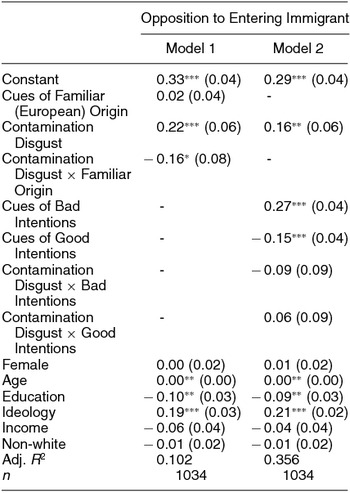
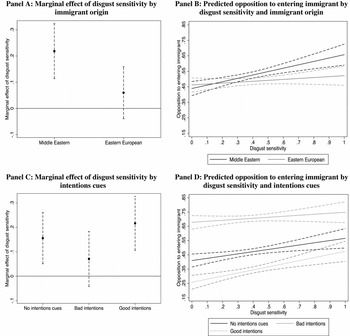
Does the effect of behavioral immune sensitivity on anti-immigration attitudes endure in the face of clear cues about immigrants’ willingness to make an effort and fit in? In Online Appendix A10.1, we validate that all treatments have a significant main effect on opposition to the entering immigrant (b good intention cues = −0.13, b bad intention cues = 0.24, b European= −0.05, all p values < 0.001, one-sided). These findings support that our manipulations were effective and replicate prior findings in the political science literature (e.g., Sniderman, Hagendoorn, and Prior Reference Sniderman, Hagendoorn and Prior2004). Moving beyond these prior findings, Table 4, Model 1 shows that the effect of contamination disgust on opposition to the entering immigrant is significantly reduced when the immigrant is of familiar European origin instead of Middle Eastern origin (b = −0.16, p = 0.030).
The Effect of Contamination Disgust Sensitivity on Opposition to Entering Immigrant

Note: Entries are unstandardized OLS regression coefficients, robust standard errors in parentheses. All variables range between 0 and 1, except for age (measured in years). *p < 0.05, **p < 0.01, ***p < 0.001, one-sided tests.
As illustrated in Figure 1, panel A, the marginal effect of contamination disgust drops from b = 0.22 (p < 0.001) when the immigrant is of Middle Eastern origin, to statistically insignificant (b = 0.06, p = 0.16) when the immigrant is of European origin. As illustrated in panel B this pattern is caused by people high in behavioral immune sensitivity expressing significantly less opposition to the entering European immigrant than the Middle Eastern immigrant. This finding offers a political instantiation of the disease protection experiment: Just as hand washing alleviates unease about sources of pathogens, cultural familiarity deactivates disgust responses to prospective immigrants.
By Cues of Ethnic Origin and Intentions, Marginal Effect of Disgust Sensitivity (panels A and C) and Predicted Levels of Opposition to Entering Immigrant by Disgust Sensitivity (panels B and D)

In contrast, as shown in Table 4, Model 2, the effect of contamination disgust sensitivity on anti-immigration attitudes is not moderated by clear cues about the immigrant's willingness to make an effort to fit in (b contamination disgust × good intentions = 0.06, p = 0.248; b contamination disgust × bad intentions = −0.09, p = 0.176, one-sided).Footnote 8 As seen in Figure 1, panel C, the marginal effect of contamination disgust on anti-immigration attitudes is 0.16. (p = 0.008) in the control group and remain 0.22 (p < 0.001) when clear cues of good intentions are provided. As revealed in panel D, this pattern reflects that individuals high in disgust sensitivity continue to oppose the immigrant even when he signals a motivation to adopt American values and customs. Only individuals low in disgust sensitivity lower their opposition to the well-meaning immigrant.
Finally, as shown in Figure 1, panel C, and Table 4, the marginal effect of contamination disgust is 0.07 (p = 0.152) when cues of bad intentions are provided. Importantly, this effect is not significantly different from the marginal effect of 0.16 in the control condition (b contamination disgust × bad intentions = −0.09, p = 0.176). As panel D illustrates, bad intention cues descriptively reduce the attitudinal differences between individuals high and low in disgust sensitivity, because these cues trigger opposition among individuals with low disgust sensitivity, while people high in disgust sensitivity are not markedly moved by these cues (potentially due to their already high opposition, i.e., a ceiling effect).
Consistent with past research, Table 4 and panel D in Figure 1 show a clear effect of intention cues on opposition to the entering immigrant, but this effect works relatively independently of behavioral immune sensitivity. In sum, the findings in Table 4 and Figure 1 consistently support that behavioral immune sensitivity reduces people's responsiveness to those prosocial cues that according to extant research establish a key route to inclusive coexistence and ethnic tolerance (Fiske, Cuddy, and Glick Reference Fiske, Cuddy and Glick2007; Hainmueller and Hiscox Reference Hainmueller and Hiscox2010; Sniderman, Hagendoorn, and Prior Reference Sniderman, Hagendoorn and Prior2004).
TEST 4: THE BEHAVIORAL IMMUNE SYSTEM AND THE AVOIDANCE OF INTERGROUP CONTACT
High behavioral immune sensitivity motivates people to oppose immigration from unfamiliar ethnic groups even if these groups are motivated to contribute to their new country. Yet immigrants nonetheless enter many societies. According to the broad literature on prejudice, one of the most important factors for facilitating intergroup tolerance between groups in society is cross-group contact (Allport Reference Allport1954; Welch et al. Reference Welch, Sigelman, Bledsoe and Combs2001; Williams Reference Williams1964). As emphasized by Pettigrew et al. (Reference Pettigrew, Tropp, Wagner and Christ2011, 278) “it is clear that cross-group contact is an essential [. . .] component for lasting remedies” in the context of intergroup intolerance. In essence, intergroup contact reduces intergroup prejudice (e.g., Pettigrew et al. Reference Pettigrew, Tropp, Wagner and Christ2011; Pettigrew and Tropp Reference Pettigrew and Tropp2006).
In light of our findings, we argue that activity in the behavioral immune system can create obstacles to the emergence of tolerance. If the threat from immigrants is mentally represented as a function of pathogens, strict avoidance is the only sure way to head off this perceived threat (Schaller and Neuberg Reference Schaller and Neuberg2012). Consequently, people with high behavioral immune sensitivity should actively avoid contact with those who are different—precisely the kind of contact that previous research identifies as tolerance enhancing. Individuals with high behavioral immune sensitivity should be more likely to dislike situations that increase the probability of contact with immigrants and to support policies that decrease the chances of contact.
Research Design and Measures
To test this prediction, we rely on the Danish nationally representative Sample 2. We presented eight items measuring approval of situations related to contact with immigrants, such as “To have an immigrant family as neighbors,” and “That immigrants stopped shopping in your local grocery store and instead only shopped in shops owned by other immigrants,” and “That immigrants moved away from the city's other neighborhoods and gathered themselves in their own community (see Online Appendix A11 for question wording). In particular, the last two items in the three examples above are critical. They were devised to measure approval of behavior among immigrants that would make them less exposed to the national culture (a traditional concern of those skeptical about immigration, cf. Sniderman and Hagendoorn Reference Sniderman and Hagendoorn2007), while at the same time minimizing the possibility of coming into contact with immigrants in their daily lives (a predicted concern for those with high behavioral immune sensitivity). The items were carefully constructed so as not to give an impression that these developments involved imposing costs on immigrants and, in fact, were directly framed to suggest that these developments happen on the immigrants’ own initiative. In this way, these items allow us to dissociate preferences for decreasing the likelihood of contact from the kind of punitive preferences often associated with prejudice (Sniderman et al. Reference Sniderman, Petersen, Slothuus and Stubager2014).
Our measure of behavioral immune sensitivity, contamination disgust, and our standard set of control variables are described under Test 1. Because we are interested in reactions to immigrants who already live in the respondents’ own country, we also control for opposition to allowing immigrants to enter the country using our general anti-immigration scale.
Results
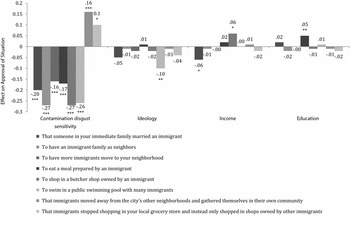
Do individuals with high behavioral immune sensitivity disapprove of situations implying close contact with immigrants and support actions that would reduce the probability of coming into contact with immigrants? To discern between the effects of behavioral immune sensitivity and the factors emphasized in extant research on anti-immigration sentiments, we compare the effects of contamination disgust with the effects of socioeconomic and political factors (income, education, and ideology). Figure 2 shows the effects of these variables on the diverse range of items relating to the approval of situations involving close contact with immigrants (the first six items) and approval of social avoidance behavior among immigrants (the last two items). Consistent with our predictions, individuals with high contamination disgust sensitivity express significantly stronger disapproval of all types of close contact with immigrants (b = −0.16 to −0.27, p < .001 on all indicators) and significantly stronger support for behaviors whereby immigrants freely choose to avoid contact with the majority population (b = 0.10 to 0.16, p = 0.015 or lower). This last finding is particularly instructive, as it suggests—consistent with the behavioral immune perspective—that people with high contamination disgust sensitivity are motivated by avoidance per se, rather than a desire to impose costs on immigrants.
Effects of Contamination Disgust Sensitivity, Ideology, Income, and Education on Approval of Situations Involving Increased or Decreased Contact with Immigrants

The effects of contamination disgust are present even when controlling for the standard explanatory factors related to prejudice—ideology, income, and education—bolstering our contention that there is an independent link between behavioral immune sensitivity and the preference for avoiding social contact with immigrants. Moreover, once we account for disgust sensitivity, the standard explanatory factors are uncorrelated with the approval of social avoidance. Hence, while previous research has shown that prejudice impels people to avoid those who are the object of their prejudice (see Allport Reference Allport1954), our findings cast doubt on exclusively sociocultural explanations for this effect. It should be noted that Test 4 was conducted using the sample from Denmark, a relatively homogenous country. Future research should investigate the generalizability to highly diverse, nonsegregated societies where avoidance is not possible. It is plausible that the increased familiarity following substantial and continuous personal contact leads individuals to stop categorizing immigrants as pathogen threats (see Online Appendix A12 for further discussion). In this way, ethnic tolerance may turn out to be an “acquired taste.”
DISCUSSION AND CONCLUSION
The brain is the most sophisticated part of the human organism, sculpted over millennia by natural selection to help our ancestors deal with a variety of evolutionarily recurrent threats. As neuroscience has advanced, it has become increasingly clear that consciousness is indeed just “the tip of the iceberg” (cf. Freud Reference Freud1915) of human emotional processing (e.g., Kahneman Reference Kahneman2011; Stanovich and West Reference Stanovich and West2000). Outside conscious considerations about self-interest, values, and norms, a wide range of evolved mechanisms are in constant operation to help remove threats. While political psychologists have begun incorporating insights from neuroscience into models of decision-making and paid more attention to the effects of emotions (e.g., Hibbing, Smith, and Alford Reference Hibbing, Smith and Alford2014; Lodge and Taber Reference Lodge and Taber2013; McDermott Reference McDermott2009), the canonical model of emotions within political science, affective intelligence theory (Marcus, Neuman, and MacKuen Reference Marcus, Neuman and MacKuen2000), is primarily oriented towards understanding how brain mechanisms identify threats through anxiety. Yet to survive and reproduce our brains needed to not just identify threats but to effectively remove them. Hence, in the face of threat cues other emotions, designed to effectively deal with imminent threats, should be coactivated with the emotion of anxiety. As argued by Brader and Marcus (Reference Brader, Marcus, Huddy, Sears and Levy2013, 186), “there is considerable potential for theoretical integration” between different approaches and especially the antecedents of emotions should be considered from a more integrated perspective (Brader and Marcus, Reference Brader, Marcus, Huddy, Sears and Levy2013: 185). Our findings demonstrate how our understanding of the foundations and implications of fundamental emotions in politics is advanced by considering the specific evolved functions that define them and the deep psychological mechanisms they arise from (Tooby and Cosmides Reference Tooby, Cosmides, Lewis, Haviland-Jones and Barrett2008).
We focused on how the human brain contains dedicated, emotional mechanisms for dealing with one of the most enduring and dire threats to human fitness, lethal infections (see Jensen and Petersen Reference Jensen and Petersen2017), and how the behavioral strategies elicited by these mechanisms map directly on to modern policy debates in the domain of immigration, one of the most pressing and polarizing issues in contemporary politics in both United States and Western Europe (see, e.g., Givens and Luedtke Reference Givens and Luedtke2004, 145; Green Reference Green2016). Following developments within the psychological sciences, we have referred to this set of mechanisms as the behavioral immune system (e.g., Schaller Reference Schaller2006) and demonstrated how it operates through the emotion of disgust. In doing so, we employed a consilient (cf. Wilson Reference Wilson1999) body of knowledge from psychology, anthropology, and biology to make a priori evaluations of the validity of existing claims about disgust. Although psychological research documents an association between disgust and leeriness of outsiders, our meta-analysis found that these empirical studies tend to be underpowered, underspecified products of unrepresentative samples that show signs of publication bias—calling into question the veracity of these findings (Open Science Collaboration 2015). Despite these issues, a consilient, evolutionary perspective provides a strong a priori rationale for the contention that the behavioral immune system tags unfamiliar strangers as infection risks and generates opposition to immigration. On these grounds, we marshaled the most complete test to date of the relationship between anti-immigration attitudes and individual differences in behavioral immune sensitivity.
Employing a cross-national research design and using a wide-ranging set of studies with high degrees of statistical power, internal validity, and external validity, we demonstrated that self-reported and physiological markers of behavioral immune sensitivity are robust predictors of anti-immigration attitudes. Testifying to its generalizability, this result replicates across the United States and Denmark—two highly different contexts with regard to immigration history, welfare regimes, and ethnic composition. Furthermore, we demonstrated that the association between behavioral immune sensitivity and anti-immigration attitudes is substantially attenuated when people are primed to feel clean. These findings establish that the unconscious motivation to avoid pathogens drives the connection between behavioral immune sensitivity and immigration attitudes, ruling out concerns that behavioral immune sensitivity simply proxies other political predispositions (e.g., prejudice). This conclusion, we believe, sheds light on why people who espouse racist and xenophobic ideologies compare members of outgroups to vectors of disease, such as vermin, cockroaches, and plagues (see Banks and Valentino Reference Banks and Valentino2012), and why immigrants are often described as being unclean, filthy, or dirty. We have developed and tested a coherent theoretical framework that makes it apparent why such analogies come to mind for certain people and why such analogies are powerful tools for persuasion.
Importantly, the recognition of disgust as an evolved tool for avoiding infections furthermore allowed us to move beyond the simple claim that individual differences in behavioral immune sensitivity shape anti-immigration sentiments. In the face of novel theoretical arguments, political scientists rightly ask: “So what? . . . what will work of this sort really add to our understanding of politics?” (Bartels Reference Bartels2013). In response, we note that the evolved features of the behavioral immune system fundamentally change the politics of ethnic inclusivity and frustrate the integrationist route to tolerance as multiculturalism increases in the Western world (Sniderman et al. Reference Sniderman, Petersen, Slothuus and Stubager2014; Sniderman and Hagendoorn Reference Sniderman and Hagendoorn2007). Our findings show that, to the extent that anti-immigration attitudes emerge from pathogen avoidance motivations, extant social science proposals to increase acceptance of unfamiliar ethnic groups face significant challenges. First, pathogen avoidance motivations reduce people's sensitivity to those prosocial signals that facilitate peaceful coexistence in other areas of life (Fiske, Cuddy, and Glick Reference Fiske, Cuddy and Glick2007). It is the presence of physically and culturally distinct immigrants that poses a threat to individuals concerned about pathogens, not the intentions of the immigrants. Second, individuals motivated by pathogen avoidance are especially motivated to avoid contact with immigrants, potentially preventing the sorts of experiences that may engender tolerance. Taken together, these findings demonstrate that the behavioral immune system emerges as a potent—and distinct—obstacle to inclusive attitudes and tolerance. With rising rates of migration across the Western world and the polarizing increase in concerns about immigration in the mass electorate, this is an important finding.
We have compared the effects of behavioral immune sensitivity to traditional explanatory factors within political science and found its effects to rival those of standard variables such as income and education. Also, it is of particular importance that the effects of behavioral immune sensitivity operate over and beyond ideology as a range of previous studies has suggested an association between endorsements of conservative ideologies and individual differences in the propensity to experience disgust (Inbar et al. Reference Inbar, Pizarro, Iyer and Haidt2012, see Terrizzi et al. Reference Terrizzi, Shook and McDaniel2013 for a review). Our results suggest that people high in disgust sensitivity are not opposed to immigration because they are conservative. More likely, these people tend to be conservative because their behavioral immune system propels them to oppose immigrants and related policies.
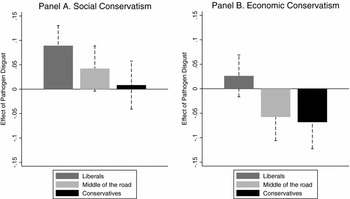
In Test 1, we provided novel evidence about this relationship between ideology and behavioral immune sensitivity. We observed that the effect of disgust sensitivity on anti-immigration attitudes tended to be stronger among liberals than among conservatives. Hence, conservatives—by nature of their ideology—will tend to oppose immigration no matter what; their opposition is, in a sense, overdetermined. A liberal, in contrast, would on average tend to be sympathetic to immigration but a liberal high in disgust sensitivity has a strong pull toward opposing it, creating a set of ideologically inconsistent policy preferences. As a deeper demonstration of these opinion dynamics, we present analyses of a representative sample of Americans (Sample 5) in which we collected measures of overall liberal-conservative ideology as well as the two key attitudinal dimensions in the American electorate: economic conservatism and social conservatism (see Treier and Hillygus Reference Treier and Hillygus2009). In addition, we collected measures of individual differences in pathogen disgust (Tybur, Lieberman, and Griskevicius Reference Tybur, Lieberman and Griskevicius2009) and the control variables used in the previous analyses (see Online Appendix A13–14 for full descriptions of the sample, measures and statistical models). Figure 3 shows how individual differences in pathogen disgust sensitivity affect economic and social conservatism for people that self-identify as “liberals,” “middle of the road” and “conservatives,” respectively.
Marginal Effect of Pathogen Disgust Sensitivity on Social and Economic Conservatism by Ideological Self-identification

Consistent with the previous analyses, we observe that support for conservative social policies—e.g., policies that keep strangers out, restrict the life ways of people, and uphold traditional norms of conduct—are influenced by disgust sensitivity but only among liberals. People who identify as conservatives have plenty of ideological reasons to support socially conservative policies but for liberals being high in disgust sensitivity, pathogen avoidance motivations prompt them to support such policies despite the ideological incoherence it generates. With respect to conservative economic policies, we see the exact same opinion dynamics but this time driven by people who self-identify as conservatives. Individuals concerned about pathogens are prompted to support liberal policies in the economic domain to satisfy their need for cleanliness—e.g., policies that create decent living standards and urban renewal. Again, liberals already support these policies by nature of their ideological identification, but conservatives high in disgust sensitivity are prompted to take up an ideological inconsistent position.
Having carefully dissected the automatic operations of a distinct threat management system in the human brain, the behavioral immune system, we arrive at an important counternarrative to the traditional view on the relationship between deep-seated individual differences and political orientations. Most previous studies on the relationship between deep-seated individual differences and political orientations have focused on how these individual differences give rise to ideological consistency (Hibbing, Smith, and Alford Reference Hibbing, Smith and Alford2014; Inbar et al., Reference Inbar, Pizarro, Iyer and Haidt2012). Indeed, as summed up by Malka et al. (Reference Malka, Soto, Inzlicht and Lelkes2014, 1047–8), it is often assumed “that a broad-based conservative versus liberal ideology is rooted in particular dispositional, neurobiological, and genetic characteristics.” In contrast, our findings suggest that these differences might just as well prompt individuals to develop ideologically inconsistent views. It is an increasingly recognized fact that electorates cannot be neatly lined up on a single ideological dimension from liberal to conservative (Feldman and Johnson Reference Feldman and Johnston2014; Treier and Hillygus Reference Treier and Hillygus2009). In our view, this is an inevitable consequence of the independent operations of automatic mechanisms for dealing with distinct threats, such as the behavioral immune system. While the adherence to modern, elite-created and symbolic systems of thought, such as ideologies, are shaped by these mechanisms (i.e., through their regulation of policy support on specific issues), there are likely multiple other independent causes of ideological consistency, including parental socialization and educational experiences. If these other causes move people with high disgust sensitivity to the liberal side of the political spectrum, ideological inconsistencies and cross pressures will spontaneously occur. Not because of “empty-headedness,” “political ignorance,” or other standard explanations (Converse Reference Converse1964; Zaller Reference Zaller1992), but because of the evolved, sophisticated threat management systems in the human brain and the motivations they generate.
SUPPLEMENTARY MATERIALS
To view supplementary material for this article, please visit https://doi.org/10.1017/S0003055416000770
Replication data and command files are available at Dataverse Network, http://dx.doi.org/10.7910/DVN/C56WMI




Comments
No Comments have been published for this article.