INTRODUCTION
There has been a worldwide shift in the burden of disease as the impact of infectious diseases declines, child and maternal health improves, and the population ages (Menken et al., Reference Menken, Munsat and Toole2000). The burden of neuropsychiatric disorders has been previously under-recognized (Murray & Lopez, Reference Murray and Lopez1997) and is now emerging as a worldwide priority for healthcare. Neurological conditions were calculated to be the primary cause in 1.4% of all deaths worldwide (Menken et al., Reference Menken, Munsat and Toole2000) and 2.8% of deaths in England (Department of Health, 2006). However, they account for 28% of all years of life lived with a disability (Menken et al., Reference Menken, Munsat and Toole2000), with >1,000,000 people in the United Kingdom disabled by a neurological condition (The Neurological Alliance, 2003). Hence mortality statistics alone may belie the true prevalence and impact of neurological conditions (Spinney, Reference Spinney2010).
This article focuses on research with key United Kingdom service providers who provide care to people with progressive long-term neurological conditions (PLTNC) such as multiple sclerosis (MS), Parkinson's disease (PD), motor neuron disease (MND) and, in particular, Huntington's Disease (HD). These conditions give rise to physical, cognitive, and psychiatric impairments that have extensive impacts on the lives of all those affected, who require complex and responsive care (Dawson et al., Reference Dawson, Kristjanson and Toye2004; Pratt, Reference Pratt2006; Weightman, Reference Weightman2006). Taking a palliative care approach (Kristjanson et al., Reference Kristjanson, Toye and Dawson2003) to the organization, delivery, and conceptualisation of care is necessary in order to respond to the wide ranging and complex needs of patients and their families, which often extend over many years (Moskowitz & Marder, Reference Moskowitz and & Marder2001; Kristjanson et al., Reference Kristjanson, Toye and Dawson2003; Dawson et al., Reference Dawson, Kristjanson and Toye2004; Travers et al., Reference Travers, Jones and Nicol2007; Klager et al., Reference Klager, Duckett and Sandler2008; Giles & Miyasaki, Reference Giles and Miyasaki2009).
MS, PD, MND, and HD each falls into the category of a serious and complex illness (Lynn & Forlini, Reference Lynn and Forlini2001). For those with MS, PD, and HD, activity is slowly restricted until, toward the end of life, repeated bouts of exacerbation and hospitalization occur. For those with MND, the process is much more rapid. Lynn and Forlini (Reference Lynn and Forlini2001) note that there is often no distinct ‘terminal’ phase to mark the period just prior to death, but that some acute incident, such as an infection or heart attack, will finally overwhelm already diminished reserves (p. 316). This lack of a distinctive dying phase makes communication and ongoing flexible planning essential to good end-of-life care. A particular challenge is the loss of communication abilities in many patients; this is particularly the case among patients with MND and HD.
There is limited evidence identifying the palliative and end-of-life care needs of people with PLTNC (Byrne et al., Reference Byrne, McNamara and Seymour2009) or highlighting the rewards and challenges faced by those providing care to this group of people. A few studies have touched on the experiences of bereaved carers and highlighted some of the issues they consider to be important when a relative/loved one dies (Edmonds & Rogers, Reference Edmonds and Rogers2003; Heyland et al., Reference Heyland, Dodek and Rocker2006; Munn & Zimmerman, Reference Munn and Zimmerman2006; Young et al., Reference Young, Rogers and Dent2009). However, the perspectives of health and social care professionals delivering palliative and end-of-life care are largely under-investigated. A few studies have gathered staff views alongside a primary focus on those of patients and families (Steinhauser et al., Reference Steinhauser, Christakis and Clipp2000; Forbes-Thompson & Gessert, Reference Forbes-Thompson and Gessert2005; Fitzsimons et al., Reference Fitzsimons, Mullan and Wilson2007; Munn et al., Reference Munn, Dobbs and Meier2008); however, the emphasis is often on the educational needs of staff rather than their experiences (Ersek et al., Reference Ersek, Kraybill and Hansberry2000).
This article focuses on the delivery of end-of-life care for people with PLTNC from the perspectives of healthcare staff. It draws on a study that used a mixed method approach to explore palliative and end-of-life care delivery and outcomes among people with PLTNC. Full explanation of methods and findings from the study are complied in a final report, available from the authors on request (Wilson et al., Reference Wilson, Seymour and Aubeeluck2008). Following is an explanation of the methods used to generate discussions about palliative and end-of-life care provision with healthcare staff.
METHODS
This article draws attention to one aspect of a larger study that took place between October 2006 and September 2008. The study aimed to explore the palliative and end-of-life care needs of patients with PLTNC. The study used a multi-method design and in total included 180 individuals or their records. The study took place across three sites providing different types of services to people with PLTNC:
1. Long-term residential care services within six neurological care centers run by a United Kingdom charity.
2. Inpatient and day care services at an urban hospice in the United Kingdom.
3. A multi-disciplinary outpatient Huntington's disease service based at a large United Kingdom hospital.
This article concentrates on the focus groups/interviews conducted with a range healthcare staff from all three of the services. The six neurological care centers at site 1 are the largest provider of respite and long-term residential care for people with PLTNC in the United Kingdom. Therefore, the majority of participating staff were recruited from the six centers at this site, located across England. A breakdown of the number of participants from each site is displayed in Table 1.
Healthcare staff participation by site

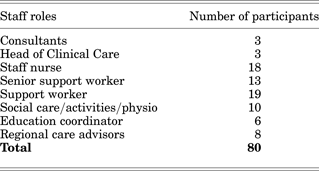
Health and social care staff working with patients with PLTNC from each site were invited to participate in a focus group or one-to-one interview. A range of staff were involved including senior physicians, nurses, support workers,Footnote 1 a physiotherapist, and Regional Care Advisors (RCA) for the United Kingdom charity, the Huntington's Disease Association (HDA). These RCAs work throughout the United Kingdom providing advice and support to those affected by HD. A breakdown of the types of healthcare staff who took part in the focus groups is presented in Table 2.
Participants by role across all sites

Because of pressures on their time, not all staff were available to take part in a focus group, and in these cases individual interviews were undertaken. Two interviews took place over the telephone at a prearranged time, and one was arranged as an individual face-to-face interview.
RESULTS
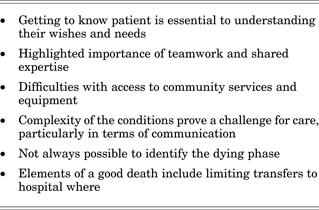
A summary of the findings presented in this section can be found in Table 3.
Summary of findings

Relationship Building
All staff talked about how they considered knowing their patients to be a key aspect of “good” care. Learning about patients’ wishes and preferences for care, and their likes, dislikes, and body language was seen by staff as vital to developing an understanding of their patients. All staff said they encouraged some form of advance care planning and felt this should begin at an early stage, facilitated by community-based staff. It is not possible to know exactly in what form this was undertaken by the staff participating in our study; however, recent literature recommended that advance care planning take place as a discussion with patients and/or their family carers, in particular to establish patients’ concerns, values, and wishes for care should they no longer be able to make these decision for themselves (Wilson et al., Reference Wilson, Seymour and Perkins2010). One participant from the outpatient HD service explains how she felt it was part of her role to initiate discussion about end-of-life care, preferably prior to the need for residential care.
… whenever they get a new resident (at the care centre), they try and go through with that person's loved one if they can't go through it with the person themselves. But I just think it makes things easier for that person if they've thought about those things beforehand. And about the sorts of choices that they normally make. Even if it's down to clothing and the music they listen to. Because how frustrating to be stuck in a room full of people playing bingo or watching (television) if they are the sorts of things that you absolutely loathe, and then of course you are going to get frustrated and angry and agitated. So I think it's really important to talk about those things but only if people want to, and people do bring that up quite a lot with me. (Outpatient HD service participant)
Staff reported that they often tried to establish any wishes patients may have about their care and said that they did this in several ways. They described gleaning information from relatives and key people who had known the patient outside of the residential care environment, but explained that they fundamentally relied on “knowing” the person, often over a number of years.
And somebody said to me, oh this patient, isn't it a shame, she can't talk, and I thought, oh she can't talk, but I communicated with her so well, I'd forgotten, literally forgotten that she couldn't talk, because she just grunts at me, and I know exactly what she says. (Neurological care center participant)
When a patient was introduced to staff during the latter or final stages of their disease, staff reported that they did not have the time to establish these important levels of rapport. Staff felt this hampered the care they were able to provide to both patients and their families.
But it's difficult as well to build any sort of rapport with the patient, … if they're not referred until late, then they are so far, they're so near death, that you might not be able to build up any sort of rapport with the patient, and certainly not with the relatives, or the friends or the carers, … it leaves you feeling as if you've somehow missed out on something, as if you could have done it better. (Hospice participant)
Staff talked about how relationship building was also seen as key within the care teams at each site, often drawing on each others’ expertise and experience.
There's always somebody you can ask, … if you're not quite sure, you can say, have you come across this before? (Neurological care center participant)
… we can always approach the rest of the team, and deal with it, and we work in partnership, and hopefully we do manage to cope with most of the things. (Hospice participant)
Community Services Support
Input and strong links from community services were considered by staff to be important aspects of good care, particularly for the outpatient HD service and inpatient hospice where patients were admitted for short periods only, requiring continued links with community.
The patients who come in for respite quite often, it's the community team who have picked up problems at home, and arranged for them to come in for a period either to for symptoms to be dealt with or to give the carer a break. So again they get seen at home. (Hospice participant)
(the specialist nurse) really looks after the palliative care side. But because we're a specialist service and we don't have emergency facilities, I'm very keen to liaise with local services, work with local palliative care consultants. (Outpatient HD service participant)
Within the neurological care centers,Footnote 2 these links, although improving, were still not as strong as staff would like. The long-term residential care provided at the neurological care centers is a nurse-led service supported by local GPs. At this site, some staff perceived GPs, especially those provided by the out-of-hours services, to be unfamiliar with the residents and the center staff, making them less confident about allowing patients to die there.
I guess the difficulty is the out of hours service, isn't it, I think our own GP would recognise the (statement of wishes), but you get on-call doctors coming in, they don't know the client, they tend to err on the cautious side. (Neurological care center participant)
Community services differed depending upon location across the country. Each of the sites involved in this research covered very large and disparate geographical areas and therefore dealt with differing community service configurations in different locations for funding and service provision for individual patients. This phenomenon affected the inpatient, residential and community based sites. In the United Kingdom it is a common problem for the care of people with neurological conditions to straddle both mental and physical health services, often fitting into neither.
I think one of the most frustrating things is trying to access specialists, certainly in terms of challenging behaviour, trying to get a psychologist on board is near[ly] impossible. It gets very political as well, do they have a mental health problem?, is it [psychological]? and at the end of the day, we just want to help somebody, so I find that frustrating. (Neurological care center participant)
One predominant challenge experienced by all staff irrespective of location, employer, or role was dealing with bureaucracy associated with organizations such as the United Kingdom's National Health Service, social services, local councils, and charities, which led to delays in access to equipment or services.
…look how long it took (patient) to get a wheelchair, and her family had to fight because (the Primary Care Trust) didn't want to pay for it, … and so for me personally the fighting for the funding and mobility [is difficult]. (Neurological care center participant)
Processes for assessments were also a source of frustration for some staff, particularly when this slowed access to essential supporting services. Staff perceived that slow referral processes had a negative impact on patient well-being:
There are always time delays with (communication aids) because it's a regional service, so if you do have someone who has a very rapidly progressing condition, you don't necessarily have the time, but there's quite a long process of assessment … which itself is frustrating. (Hospice participant)
The RCAs for the HDA are not National Health Service employees and therefore are less limited by organizational barriers. The RCAs saw part of their role as educating staff within services about the individual and diverse nature of HD.
…invariably Social Services are looking at putting somebody in a nice category, in a nice box, but we can go there, and we can make them think outside of that box, and look at services that might available to support both the client and any partners or relatives that are involved. (Outpatient HD service)
The RCAs took an active role in the outpatient HD service, attending the clinics and maintaining contact with patients between appointments. Clinic staff saw this as an essential role, liaising between primary and secondary care and advocating for patients:
… they would talk about whether people are getting the right social support and advise them on where to get that and look at housing needs and be that advocate in the community for sorting things out. … I think that they are key to providing the link between secondary care and the community as they go out and they see people at home and they flag problems up, and when patients are admitted to other hospitals, they often go in and make sure that they are being actively managed … (Outpatient HD service participant)
Staff at the residential neurological care centers identified the level of nursing care they can provide as a particular issue. For example, being unable to use intravenous methods for fluids or antibiotics often resulted in residents needing to be admitted to hospital for these interventions. Staff saw this as a limitation of the care provided at the centers and felt that this could restrict their ability to fulfil patients’ wishes for care at end of life if they preferred to remain at the center.
Recognizing Dying
Recognizing the dying phase was noted by all the staff as a particular challenge in their care of people with long-term neurological conditions. Staff commented on the unpredictability of the disease trajectories associated with the conditions, noting that these varied across the different neurological diagnoses and also among individuals with the same disease. Patients often had acute episodes of deterioration or illness requiring a high level of clinical input; staff reported that it was difficult to predict whether a person would respond and recover from such an incident. This also made the use of end-of-life care pathways, such as the Liverpool Care Pathway,Footnote 3 complex.
… a lot of hospital admissions are a response to maybe what we consider an acute period of sudden illness, a chest infection,.. and I think it's very difficult for the staff here to maybe recognise that occasionally it's going to be that last admission. I don't think you seeing it coming. I think it's a kind of shock for us that the person has then died, because we've seen them in that condition so many times, you think they're going to bounce back yet again. (Neurological care center participant)
It was clear that although all staff recognized the fluctuations in trajectory for patients with PLTNC, almost all were able to describe how they recognized when a person had moved into the dying phase. For example, staff reported how they noted several physical changes and changes in behaviour as key signals.
…there are certain things that you know maybe to signify that someone is nearer the end of their life, certain kind of physiological things that you might look for. Often when people's temperature control isn't so great, and things like cachexia sets in, so not eating or losing vast amounts of weight, but then of course that can happen much earlier on. So it is quite a difficult, whilst you can say yes, someone's got advanced disease it's very difficult to kind of pinpoint. (Outpatient HD service participant)
Staff also described how they drew upon a tacit knowledge or sense that they could not really describe. They referred to this as a “general feeling,” “gut feeling,” or “just knowing.” One group described how this intangible sense of knowing sometimes affected them all:
… a peace comes over the unit, … you're almost as one, you work in harmony, and I don't know if anybody else has felt it, but that's what I've felt here.
-And the other residents seem to know something's going on.
-Yes, they know.
- …you're right. It does come without any words being spoken doesn't it really? (Neurological care center participants)
Staff noted that deaths from these conditions were still relatively rare in their experience (~5 deaths a year at the neurological care centers), many citing that they had never actually been on shift when a death had occurred despite working at the center for a number of years. Staff working at the inpatient hospice talked about having to “re-learn skills” as neurological patients made up such a small proportion of their client group (~10%). Hence sharing expertise was highlighted as being so important.
The “Good Death”
Planning for all aspects of care for the end of a patients’ life was identified by staff across all the sites as an important issue. Staff explained how they tried to incorporate the patients’ wishes for care at the end of life into discussions about more general care planning where appropriate. Generally staff felt that the earlier these wishes or preferences for care or medical treatment were raised with patients and their families, the more likely that they could be explored and implemented.
…people more and more are wanting to talk about [end of life] and are wanting to ask about it even quite early on in their condition. And it's things that we would perhaps mention at certain appropriate times, if people wanted to talk about it then they are able to … I think it's down to us as clinicians to try and gauge it right. And people will pretty soon tell you if they don't want to discuss it. (Outpatient HD service participant).
Staff perceived that as patients’ disease progressed and their communication abilities became impaired, broaching and engaging in these discussions became more challenging. They recognized that “getting to know” the person and establishing their wishes and needs for care was a vital aspect of relationship building, which should take place as early as possible and continue throughout the care relationship.
When asked to identify elements of a “good death,” staff highlighted key aspects as: being pain free, calm and peaceful, as well as being in a place known to the person and being surrounded by people (including staff) who cared about them. Staff working in the neurological care centers perceived that ensuring that patients’ deaths could take place at their care centers was a key component of the “good death,” since they considered the center to be a patient's “home.” However this seemed to be an aspect of death that was hardest to control and caused the most distress to staff when it was not achieved. Staff were particularly concerned that the communication needs of patients were unlikely to be appropriately met in a hospital environment because of the lack of familiarity, and they were worried about the fear and loneliness that patients might endure as a result.
-Somebody else wouldn't know what those grunts were, but we do. That must be horrible, you know, you're stuck in a hospital ward, and nobody understands you, it must be awful. …
-I think it's more distressing for the relatives as well (Neurological care center participants)
Staff working in the outpatient HD service reported that they were often called on by GPs, hospitals, care homes, and sometimes palliative care teams for advice about the end-of-life care of people with HD. They reported how they were able to provide telephone support and advice to both clinical teams and to patients’ families. Staff at all the sites worked to generate a holistic approach to care generally, as well at the end of life. Good end-of-life care was seen as an extension of an approach to care, involving the family and support of one's colleagues, which was pursued across the course of a person's illness. Although this was often not labelled as “palliative care” by the staff, the key elements of a palliative care approach were well understood.
-I think it's making life as comfortable as possible … give them the quality as best to our ability … be there to support them, family, anything for them in general.
-We support our colleagues as well, yes.
-We are very family orientated, we look after the whole family here, and we try and treat all the patients holistically, and treat the whole person, the whole family. (Neurological care center participants)
DISCUSSION
From the interviews and focus groups with healthcare staff, we have gained insight into some of the challenges involved in caring for people with PLTNC toward the end of life. Across the three sites there were many shared experiences and views about the delivery of palliative and end-of-life care. All staff noted the importance of teamwork and shared expertise as well as getting to know the patients in order to provide care in accordance with their wishes and needs. Although in different locations and working in different settings, staff also shared common thoughts about the challenges for providing good palliative and end-of-life care. Staff identified the importance of building relationships in order to communicate with patients as well as to manage and plan care to meet complex needs. The continuity of staffing was particularly seen as a positive factor which supported this model of care. In contrast, staff at the hospice site, who rarely encountered patients with neurological conditions, found that they needed to “re-learn” how to care for such individuals on the occasions they were admitted. They talked about the challenges of accessing community services and equipment required in order to meet a variety of patient needs. Also highlighted by all participating staff was the challenge of recognizing the dying phase when people with PLTNC often fluctuate between stable stages and acute health crises.
A lack of wider support for the staff, or ready access to resources to support their “in house” efforts, was perceived as constraining the quality of care that could be provided. Forbes-Thompson and Gessert (Reference Forbes-Thompson and Gessert2005) illustrate the impact of these kinds of “structural” issues on care outcomes in their study of end-of-life care in nursing homes. Their case studies of two care homes highlighted how differing institutional philosophies were reflected in staffing and environmental structures and processes of care. These distinct structures and processes then resulted in different outcomes in terms of patient satisfaction and quality of life.
In the study reported here, community services were perceived to be the bedrock of support required for patients, whether living at home or in a care center. Although general improvements were noted by staff, they identified many remaining challenges in terms of access to out-of-hours support by GPs, social services input, and the provision of equipment and other services. This is in line with Fitzsimons et al.'s 2007 study exploring the palliative care needs of people with a non-cancer diagnosis. This latter study incorporated multi-professional clinical staff providing care to people in the final stages of a chronic illness. The clinical team participating in a focus group in Fitzsimons et al.'s 2007 study reported limited resources available to support patients and families, with those working in outpatient clinics concerned about the limited provision of services for this group of people in the community. Support from community-based services, particularly social services, was also highlighted as important in long-term care by two United States studies exploring end-of-life experiences (Munn et al., Reference Munn, Dobbs and Meier2008) and the meaning of a “good death” (Munn & Zimmerman, Reference Munn and Zimmerman2006) for residents in long-term care facilities. In our study, frustration for staff arose from the challenges of working across a number of health and social care authorities. This had implications for: equity of equipment provision, funding for care, and availability and access to supporting health or social professionals.
Staff identified elements of what they considered to be a “good death.” These resonate with not only the experiences of staff in a study by Munn et al. (Reference Munn, Dobbs and Meier2008) of end-of-life care in a long-term care facility, but a number of others (Smith, Reference Smith2000; Steinhauser et al., Reference Steinhauser, Christakis and Clipp2000; Walsh & Kowanko, Reference Walsh and Kowanko2002; Edmonds & Rogers, Reference Edmonds and Rogers2003; Pleschberger, Reference Pleschberger2007). Hence a good death was considered to be pain free, peaceful, calm, and with people around who care for the dying person. This should also be in the place of the person's choosing (Edmonds & Rogers, Reference Edmonds and Rogers2003; Munn & Zimmerman, Reference Munn and Zimmerman2006; Munn et al. Reference Munn, Dobbs and Meier2008).
However, staff in our study recounted that the unpredictability of the disease trajectory in many neurological conditions meant that they often found it difficult to accurately identify the dying phase. A similar finding was identified in a study exploring the barriers to quality end-of-life care for people with dementia (Sachs et al., Reference Sachs, Shega and Cox–Hayley2004). In the study reported here, staff in the residential care centers described how limited medical provision sometimes meant that hospital admission was required. Staff felt that hospital was unlikely to be the preferred place of care for most, and were concerned about the distress caused for patients and their relatives. However, hospital intervention was accepted by staff as a necessary intervention order for families to know they had done everything they could for their relative, particularly when it was not clear if the patient was in the dying phase.
Staff gave accounts of several experiences in which they thought the patient was in the dying phase, but then the patient later recovered. Assumptions by family members about the ability of staff to predict impending death can threaten trust, as observed by Munn et al. (Reference Munn, Dobbs and Meier2008) in a long-term care facility. In the same study, staff also expressed recognition of their own grief because of the “family-like” (p. 489) relationships between staff and patients. This resonates with the experiences reported by staff in our study, in which many talked about “debriefing” with other staff, attending the funeral, or having a memorial service as some of the ways they chose to manage grief after a death had occurred.
CONCLUSION
A major challenge to the provision of palliative and end-of-life care in the future now involves identifying and meeting the complex needs associated with diseases other than cancer. Long-term neurological conditions exemplify how these diseases are often associated with prognostic uncertainty and a longer and variable trajectory, in some cases characterized by unpredictable relapse and remission. The findings of this study have demonstrated that good knowledge and understanding of the individual patient's wishes and care needs are perceived by staff to be of particular importance in the delivery of good quality palliative and end-of-life care. Staff highlighted teamwork and support from community-based resources as necessary in order to effectively provide care for patients with PLTNC. However, staff noted that the challenge of identifying the dying phase can prevent all wishes for care being met, particularly if a transfer to hospital is made. This study adds to the small body of literature that seeks staff views and opinions about the provision of palliative and end-of-life care. Of interest is the concordance between the views of the range of participating staff from across the three different types of services for people with PLTNC. Although some aspects of these findings provide focus primarily for neurological conditions, it is clear that many aspects have wider implications for palliative care and across all conditions.